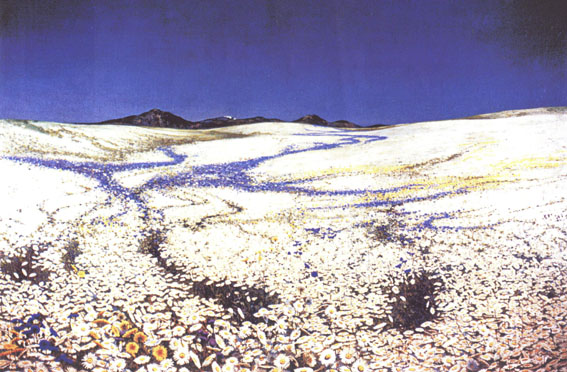
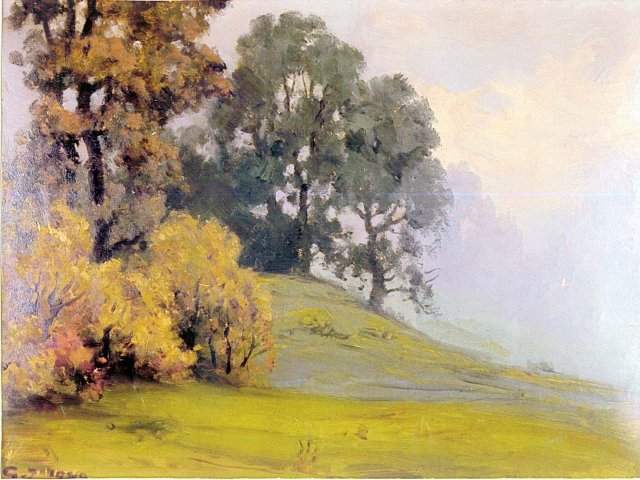
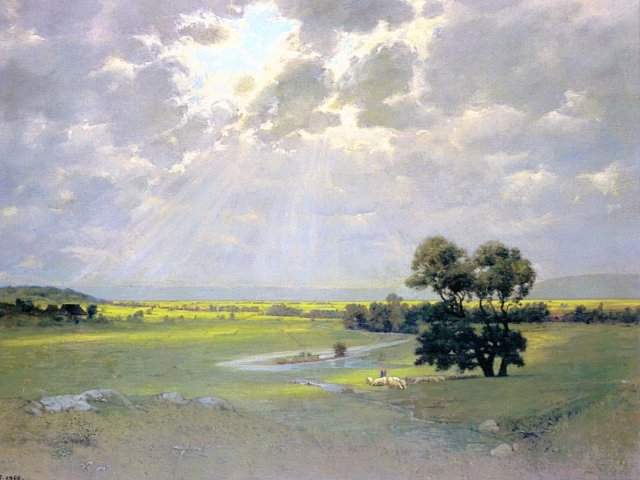
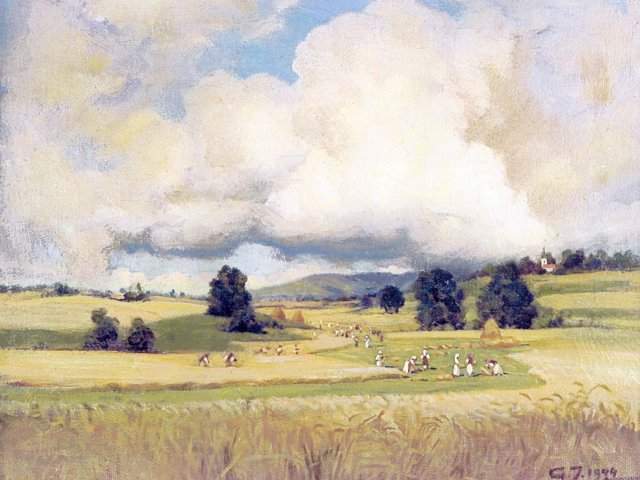
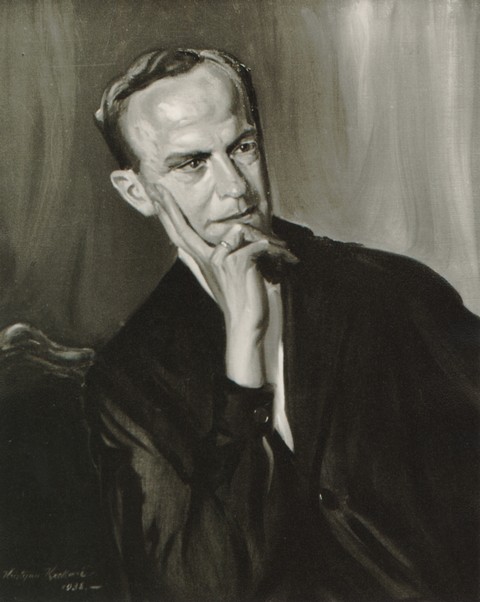
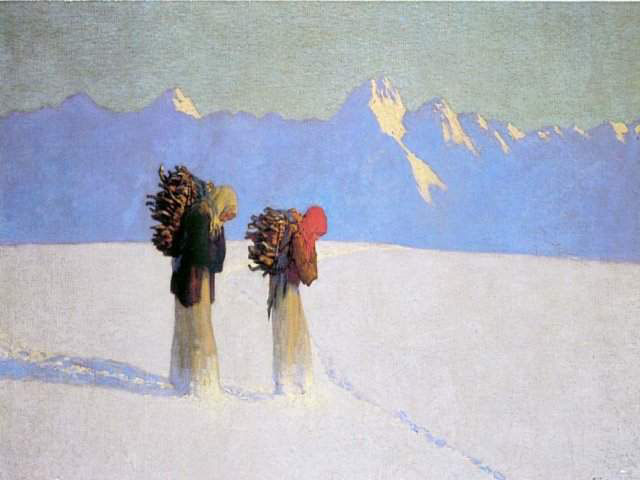
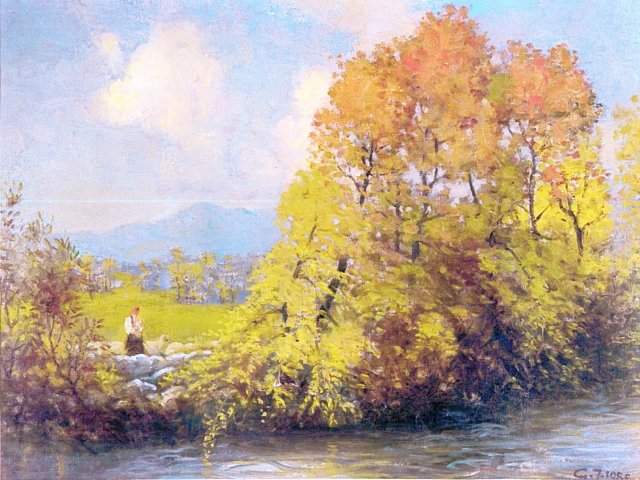
Bosniak name and its derivativesGabrijel Jurkić: Flower plateau in Kupres in Central BiH (BiH = Bosnia and Herzegovina)
The
aim of this article is to indicate deep connections between the Croats
and Muslim Bosniaks (= Bošnjaci - Muslimani). In order to avoid
misunderstanding, we shall rather use their descriptional name - Muslim
Slavs. The reason is that the Croats in Bosnia are also Bosniaks.
Indeed, many of them bear Bošnjak as their second name. The meaning of
Bosniak is simply - a Bosnian.
In the Zagreb telephone book only (1994/95),
you can find a long list of as many as 210 surnames of Bošnjak,
with just one Muslim forename, and also more than 30 Bošnjaković's,
with just 3 Muslim
forenames.
There is village Bošnjaci
in Croatia
(4,500 inhabitants prior to 1991, near the city of Županja). I did not find any
village of a similar name on maps of Bosnia and Herzegovina. Also in Hrvatsko Zagorje,
near Zagreb, there is a
a small
village of Bosna,
then
Bosanci
near Bosiljevo and Bjelovar,
Bosnići
near Drežnica and Kijevo,
Bosanka
(that is, Bosnian Woman!) near the famous
city of Dubrovnik,
and two small regions
of Bosna
near Vrbovac and D.
Stupnik.
There
is also a village of Mala
Bosna
(that is, Small Bosnia) near the city of Subotica.
One can find Croatian families bearing the
Turkish second name of Ulama
even in the NW of Croatia
(Hrvatsko Zagorje), as well as Turčić, Turčin,
Turčinović, Turčinov, Turk, Poturica, all of them obviously derived
from the Turkish name.
The name of sthe town of Tuhelj
in Hrvatsko Zagorje was given by
those Croats
who had to escape from the region of the village of Tuhelj in Bosnia,
between
Kreševo and Konjic, see [Gizdelin,
pp 44, 53].
Near Varaždin Breg there is a village of Turčin
(=
The Turk). Croatian glagolitic priest fra Matija Bošnjak
had to escape from Bosnia in
front of the Turks with numerous compatriots. He died in the town of
Rab, where on his grave the year of his death, 1525, was chiselled in
Croatian Glagolitic characters.
The following surnames that can be found in Croatia are indicative: Turčić, Turčin, Turčinović, Turčinov, Turk, Poturica. As well as the second names of Bosanac (meaning just - Bosnian), Bosnić, etc.
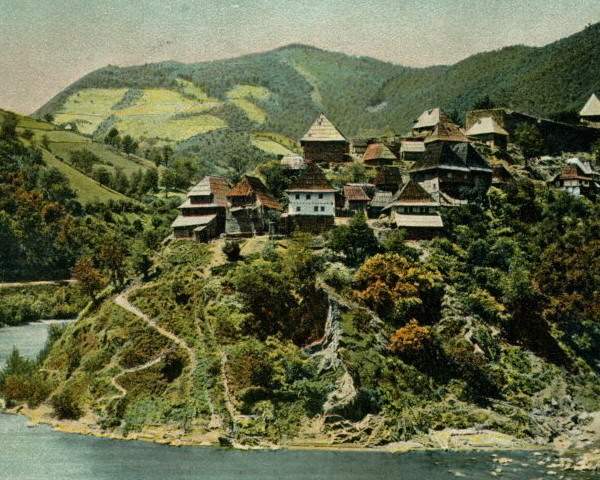
The name of Hrvat (Croat) in BiHVillage of Vranduk in 1910.
Let
us start by describing many traces left
by the Turkish Ottoman Empire. This civilization, that was present on
Croatian soil from the 15th to the 19th century (in eastern parts of
former Yugoslavia until the beginning of the 20th century), left a deep
imprint. Many Croats converted to Islam. The Muslim Slavs are in great
majority of Croatian descent, and constitute now a nation, recognized
according to their own wish in 1968 (Muslimani
has been the
usual name since the beginning of the 20th century). Except in Croatia
they live today mostly in Bosnia-Herzegovina and Sandzak (a province in
the south of Serbia, between Montenegro, Kosovo and Bosnia).
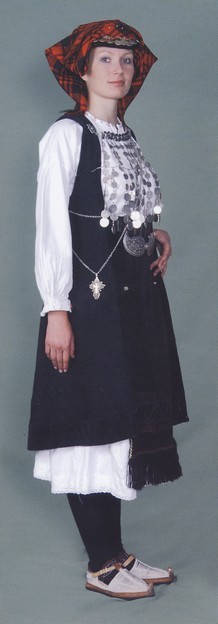
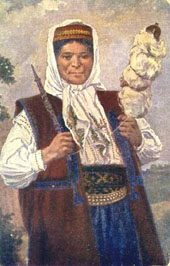
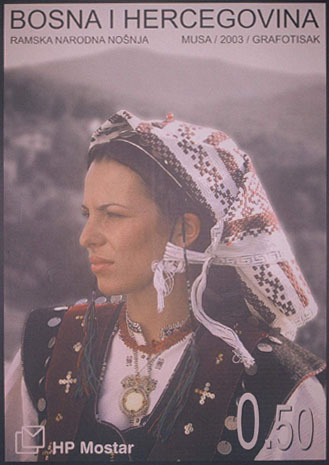
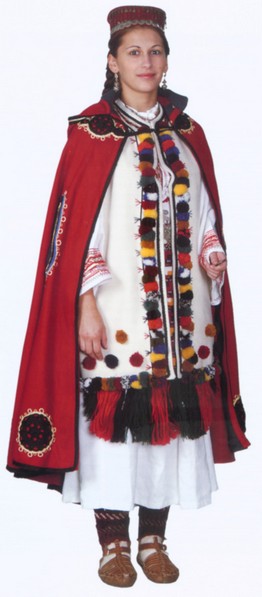
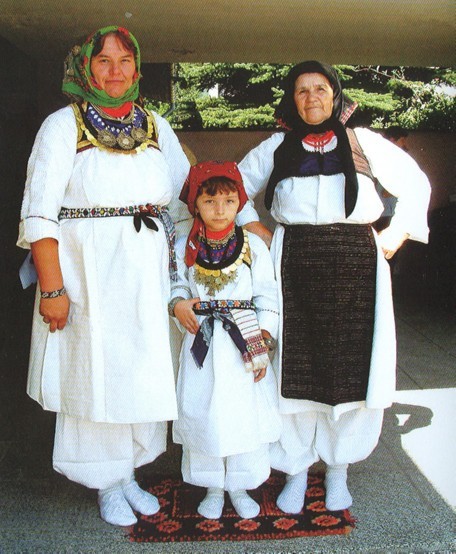
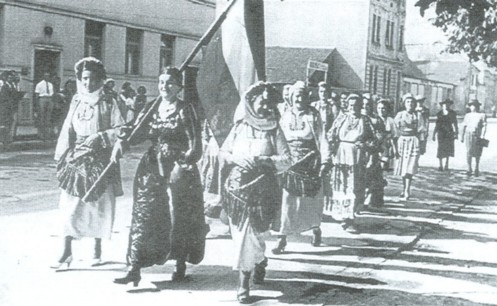
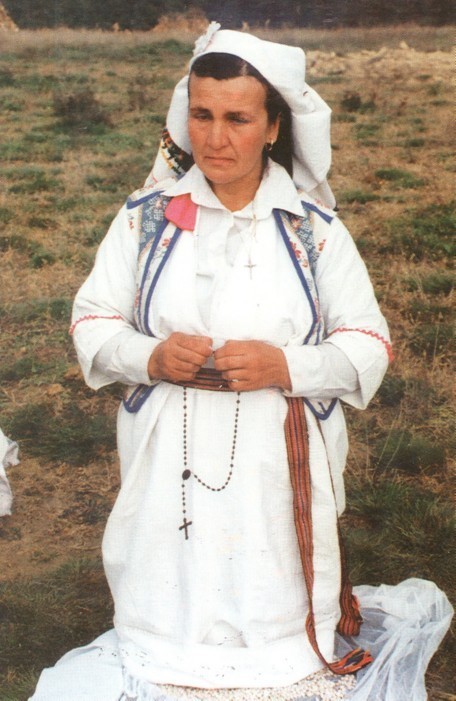
Croatian national costume near Tomislavgrad in BiH (photo by Stojan Puretić)
There
were many
disputes even about the name of "Muslimani", which was defined to have
only the national content (i.e. one could have been Musliman without
being religious at all, as was the case for example with Raif
Dizdarević, former president of ex-Yugoslavia; of course, his
predecessors were Muslims). On the other hand the term "musliman" (with
small m) had the meaning of Muslim exclusively in the religious sense.
The way out was to choose an old geographical name Bosniak,
which traditionally denoted any citizen of Bosnia - either Croat (as we
said, many of them have Bosniak as a surname), or Muslim, or Serb. It
is strange that this usurpation of the name of Bosniak has been
accepted even in the official Croatia. From this easily follows a
complete usurpation of the Bosnian name (usurpation of Bosnian
literature, language and of the entire history of Bosnia). Of course,
we do not deny the right of Muslim - Bosniaks to call themselves
Bosniaks. We would like to indicate that the name of Bosniaks does not
refer exclusively to Bosnian Muslims, but to Bosnian Croats too.
I recommend the interested reader to
consult
BEHAR, the journal of the Cultural society of Bosniaks (more precisely:
Bosniaks - Muslims) in Zagreb called Preporod, for their views on these
very sensitive questions, especially an article by Esad Cimic in
No 22-23, p.12-15, 1996. The society unites outstanding Muslim
intellectuals in Croatia. ``Behar'' was founded in 1900 - its first
editor in chief had been Safvet-beg Basagic.
It was forbidden during the 70 years' ex-Yugoslav period.
Even
the historical names of many
officials in the Ottoman Empire at Porta reveal their origin (Hirwat =
Hrvat or
Horvat, which is a Croatian name for Croat):
Mahmut-paša Hirwat
(= Hrvat)
Rusten-paša Hrvat
Pijali-paša Hrvat
(or Piyale pasha)
Sijavuš-paša Hrvat,
etc.
In the 16th century a
traveler and writer Marco A. Pigaffetta
wrote that almost everybody on the Turkish court in Constantinople
knows the Croatian language, and especially soldiers. Marco Pigafetta
in his "Itinerario'' published in London in 1585 states: "In Istanbul
it is customary to speak Croatian, a language which is understood by
almost all official Turks, especially military men."
More information, with the corresponding documents:
Croatian woman on the North of BiH (Bosanska Posavina)
This
can also be confirmed by the
1553 visit of Antun
Vrančić, Roman
cardinal, and Franjo Zay, a diplomat, to Istanbul as envoys of the
Croat - Hungarian king to discuss a peace treaty with the Turks. During
the initial ceremonial greetings they had with Rustem - pasha Hrvat (=
Croat) the conversation led in Turkish with an official interpreter was
suddenly interrupted. Rustem - pasha Hrvat asked in Croatian if Zay and
Vrancic spoke Croatian language. The interpreter was then dismissed and
they proceeded in the Croatian language during the entire process of
negotiations. Igitur
quum inter loquendum Verancius loqueretur
ad interpretem, quod passae responderi debebat, conversus passa ad Zay:
Tu, inquit, scisne Croatice? Scieo, respondit. Eti is collega tuus?
Respondit: Ipse quoque... Sed et Verancius itidem, quum eum Croatice ob
quaedam severius dicta lenire vellet, dixit.. (Verancius, 66-67). See [Eterovich],
p. 18. Hrvat Rustem pasha
originates from the region of Makarska, and his original Croatian
second name was Opuković.
Piyale
Pasha (c.
1515-1578), was a Croatian Ottoman admiral and an Ottoman Vizier. He
was also known as Piale Pasha in the West or Pialí
Bajá
in Spain; in Turkish: Piyale Paša.
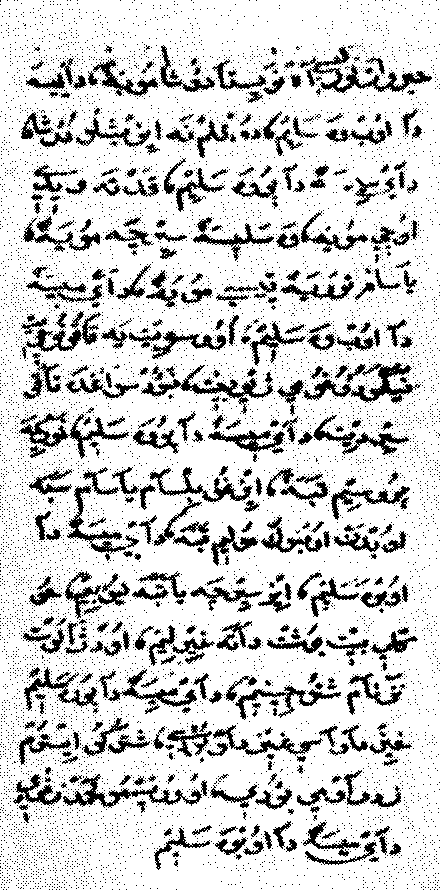
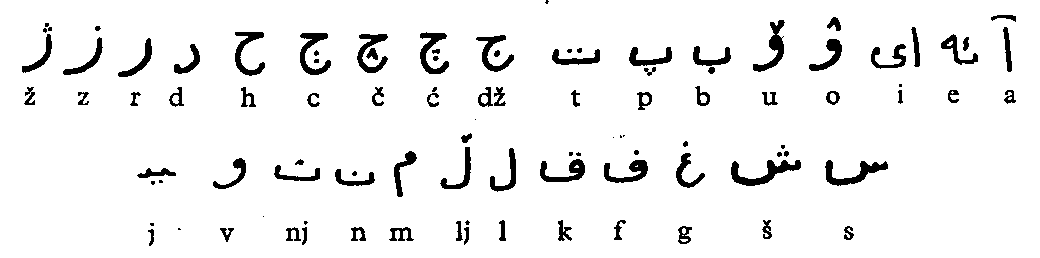
Arabica and Muslim Croats in BiHCroatian song written in Arabica Script (source: ex-Yugoslav Encyclopedia I, 1st edition of 1955, p. 145; removed from subsequent editions)Arabica alphabet
One
of the oldest texts written in Arabica
(i.e. Arabitza script, which is in fact Arabic script for the Croatian
language) is a love
song called "Chirvat-türkisi"
(= Croatian song) from 1588,
written by a certain Mehmed
in Bosnia. This manuscript is held
in the National Library in Vienna. Except for literature Arabica was
also used in religious schools and administration. Of course, it was in
much lesser use than other scripts. The last book in Arabica scriopt
was
printed in 1941.
Some additional names of Muslim Croats who wrote verses using
Arabica script can be found in the chapter "Doprinos muslimana
zajedničkoj i jedinstvenoj hrvatskoj kulturi" (Contributions of Muslims
to the common and unique Croatian culture), on pp. 75-81 of the book [Bakšić]:
Hadži Jusuf Livnjak
(17th ct.)
Mehmed Hevaji Uskufi
(lexicographer, creator of Hrvatsko-turskog
rječnika u stihu,
i.e., Croatian-Turkish Dictionary in Verses, written 1631)
Hasan Kaimija Zrinović,
derviš, poznat po po jednoj pjesmi
u kojoj govori o Hrvatima pod mletačkom vlašću kao dijelu vlastitog
naroda
Umihana Čuvidina,
prove poznata pjesnikinja muslimanka,
jedna od prvih pjesnikinja na hrvatskom jeziku (19. st., rođena oko
1795. u Sarajevu)
Mula Mustafa Bušaski
(ili Ševki - Svjetli), 18. st.
Mustafa Firaki
(1775.-1809.), sin predhodnog, rođen i umro
u Sarajevu
Hasan Travničan, Jusuf-beg Čengić, Abdulkerim Tefterdarija,
Omer Humo pisao o
aljamiado književnosti.
Many
of the Muslim Slavs in
Bosnia-Herzegovina had a strong awareness of their Croatian descent,
and even called themselves Muslim
Croats, to distinguish from
the Catholic Croats. Some of the most outstanding Croatian writers and
intellectuals of the Muslim faith in Bosnia and Herzegovina are:
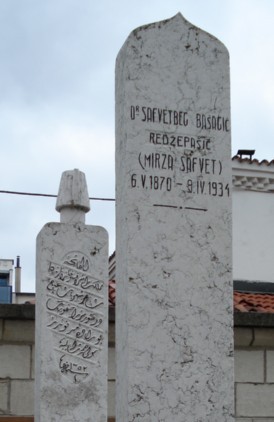
Grave of Dr. Safvetbeg Bašagić Redžepagić (1870-1934) in Sarajevo
Edhem
Mulabdić
(1862-1954),
Adenaga
Mešić (1868-1945),
Ivan
Aziz Miličević (1868-1950),
Safvet-beg Bašagić
(1870-1934), PhD, was a member of JAZU (Yugoslav Academy of Sciences
and Arts, in Zagreb) since 1939. In 1945, his membership was revoked by
the advent of the new communist Yugoslav rule. The NGO "Dr. Safvet-beg
Bašagić" was founded in 2004 in Zagreb, with Mirsad Bakšić as its
president. See [Bakšić].
Osman
Nuri Hadžić (1869-1937),
Hasan
Fehim Nametak (1871-1953),
Fehim
Spaho (1877-1942),
Musa Čazim Čatić (1878-1915),
Džafer-beg
Kulenović (1891-1956),
Ahmed
Muradbegović (1898-1972),
Hasan
Kikić (1905-1942),
Hamdija
Kreševljaković (1898-1959)
Alija
Nametak (1906-1987), distinguished Muslim-Croatian writer, was
imprisoned by ex-communist Yugoslav police in the period of
1945-1955. He was a member of Croatian Writers' Association since 1955.
See [Bakšić].
Nahir
Kulenović (1929-1969), another Muslim Croat, was assassinated by
the ex-Yugoslav communist agents in Germany. See [Bakšić].
Anybody wishing to
study the history of Islamic culture
in Bosnia-Herzegovina seriously should consult numerous works of Hamdija
Kreševljaković (1888-1959), an
outstanding Muslim Croat, member of
the Croatian Academy of Sciences and Arts in Zagreb, author of an
important monograph
about history of Croatian
literature in Bosnia and Herzegovina. Biographies of important Muslim
Croats can be found in his Kratak
pregled hrvatske knjige u Herceg -
Bosni (A short survey of Croatian literature in Herzeg - Bosnia)
printed in Sarajevo in 1912. For more information see [Karihman].
We also mention Safvet beg Bašagić (Mirza Safvet), who wrote
the monograph, Znameniti Hrvati
Bošnjaci i Hercegovci u Turskoj Carevini (Distinguished Croatian
Bosniaks and Herzegovinians in the Turkish Empire), published by Matica
hrvatska (Matrix croatica) in Zagreb in 1931.
It should be noted that the
literary and scientific activity of such intellectuals has been
severely suppressed during the 70 years' ex-Yugoslav period, resulting
that today a very small percentage of the entire Muslim Slav population
in BiH and Croatia has the awareness of its Croatian roots.
Croatian Muslim centers existed in Munich (Germany), Chicago (USA),
Toronto (Canada), Melbourne (Australia). Mirsad Bakšić especially
pointed out Croatian Muslim Center in Melbourne, which now gathers
numerous Croats of Muslim faith.
Distinguished Croatian-American scientist (international expert in radiology) and Croatian-Muslim poet Asaf Durakovic
(1940-2020) wrote several booklets dealing with his origins:
Asaf Duraković: Od Bleiburga do muslimanske nacije, Vedrina, Toronto 1971.
Asaf Duraković: Mjesto muslimana u hrvatskoj narodnoj zajednici, Vedrina, Toronto 1974.
Asaf Duraković: Zapisi o zemlji Hrvatskoj.
According to [Bakšić],
about 30,000 Muslim Croats participated in the Homeland War 1990-1995. A distinguished figure is
Croatian general Nijaz Baflak, better known under the pseudonim Mate Šarlija - Daidža (who was the
first brigadier of Croatian Army).
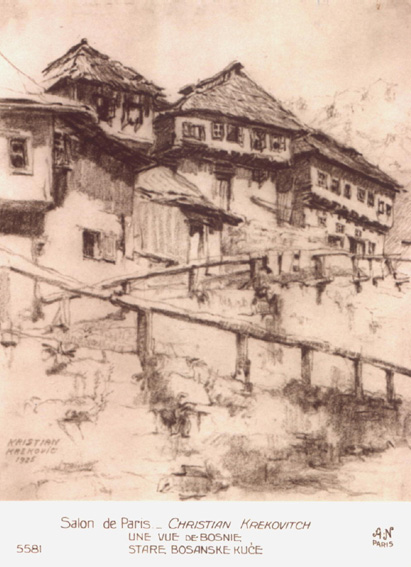
Salon de Paris - Kristian Krekovic, 1925 Une vue de Bosnie: Stare bosanske kuće, 1925 (a Paris postcard!)
We
can document the
equivalence of the name of Bosniak and Hrvat during many centuries,
until the Yugoslav period (see below). It seems that the final and
almost complete national individualization of Muslim Slavs took place
only during the tragedy they experienced during the Serbian large-scale
aggression on Bosnia and Herzegovina in the period of 1992-95 (the
aggression against BiH started already in October 1991 by the slaughter
of the Croats in the Herzegovinian village of Ravno).
This aggression found Muslim
officials totally unprepared. Moreover, when Vukovar and the whole of
Croatia were bleeding, being systematically destroyed in the second
half of 1991, president Izetbegovic declared "This is not our war'',
believing naively that the Yugoslav Army and armed extremists would not
dare to do the same in Bosnia - Hercegovina. Of course, the national
individualization was strengthened also during the tragic conflict with
the Croats in 1993, which was one of the well prepared results of the
Serbian aggression.
The equivalence of the
name of Bosniak and Croat in the early
period of the Ottoman occupation of Bosnia is documented by the famous
Turkish historian Aali (1542-1599) in his work Knhulahbar, also known
as Tarihi Aali. He gave the following description of the properties of
Croatian tribe (as he calls it) in Bosnia:
As
regards the tribe of the Croats, which is assigned
to the river Bosna, their character is reflected in their cheerful
mood; throughout Bosnia they are also known according to that river...
[i.e. Croats = Bosniaks i.e. Bosnians].
Then follows an
interesting passage describing virtues of the
Croats in Bosnia.
Let us cite it in Croatian, in Basagic's translation (the original text
in the Arabic script and its translation can be seen in [Karihman],
p. 78, with the Croatin translation
being taken from Safvet-beg Basagic: Bošnjaci
i Hercegovci u
Islamskoj književnosti):
Što se tiče plemena Hrvata, koje se
pripisuje rijeci Bosni, njihov se značaj odrazuje u veseloj naravi;
oni su po Bosni poznati i po tekućoj rijeci prozvati [dakle
Bošnjaci]. Duša im je čista, a lice svijetlo; većinom su stasiti i
prostodušni - njihovi likovi kao značajevi naginju pravednosti.
Golobradi mladići i lijepi momci poznati su (na daleko) po pokrajinama
radi naočitosti i ponositosti, a daroviti spisatelji kao umni i
misaoni ljudi. Uzrok je ovo, što je Bog - koji se uzvisuje i uzdiže -
u osmanlijskoj državi podigao vrijednost tome hvaljenom narodu
dostojanstvom i čast njegove sreće uzvisio kao visoki uzrast i
poletnu dušu, jer se meddu njima nasilnika malo nalazi. Većina onih,
koji su dossli do visokih položaja (u Turskoj državi) odlikuju se
veledušjem to jest: čašću i ponosom; malo ih je koji su
tjeskogrudni, zavidni i pohlepni. Neustrašivi su u boju i na mejdanu,
a u društvu, gdje se uživa i pije, prostodušni. Obično su prijazni,
dobroćudni i ljubazni. Osobito se odlikuje ovo pleme vanrednom
ljepotom i iznimnim uzrastom... Bez sumnje Bošnjaci, koji se
pribrajaju hrvatskom narodu, odlikuju se kao prosti vojnici dobrotom i
pobožnosti, kao age i zapovjednici obrazovanošću i vrlinom; ako
dođu do časti velikih vezira, u upravi su dobroćudni, ponosni i
pravedni, da ih velikaši hvale i odlični umnici slave.''
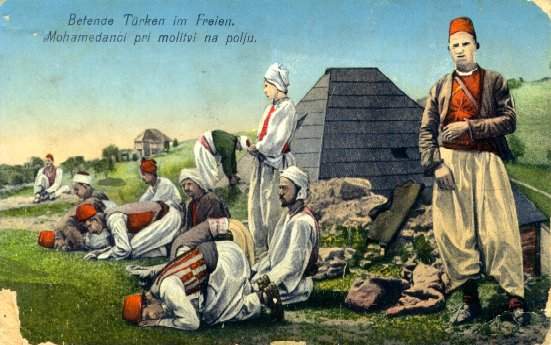
Bosnian Muslims praying in the open, 1914.
According
the documents from the
15th and 16th centuries, Bosnian Muslims in central Bosnia and in
Herzegovina called their language Croatian language and called
themselves the Croats. Even today there are Bosnian Muslims with the
second name Hrvat
(= Croat). Islam left valuable written and
architectural monuments, like in Spain for instance. Let us mention
that Croatia's capital Zagreb has one of the biggest and most beautiful
newly built mosques in Europe, although in Turkish time it had none
(Zagreb was never occupied by the Turks). For instance in Belgrade, the
capital of Serbia, there had been several hundred mosques from the
Turkish time, out of which only one survived.
Probably
the most interesting writings
about the life in Ottoman Empire in the 16th century are numerous works
published by Bartol
Gyurgieuvits
(1506-1566), who spent there 13 years as a slave.
Croats displaced to Hungary, Italy, Austria, Slovakia, Czechia
In
the province of Molise
in central
Italy there is a small Croatian enclave (about 4,500 people), living
today in several villages, inhabited in 15 villages in the 16th century
by the Croats fleeing before the Turks. They preserved their ethnic
identity and language even today.
Croatian woman in Bosnia
Since the 16th century a
similar enclave has existed near
Bratislava in Slovakia. The largest Croatian community of exiles dating
from that period is in the area of Gradišće
(Burgenland) in
Austria and Hungary. One of the results of this forced migrations is
that the most widespread surname in today's Hungary is Horvath,
whose meaning is simply Croat. Also the family name Horvat
is
one of the most widespread in today's Slovenia. The surname Charvat
(= Croat) in the present-day Czechia is a remaining of the presence of White Croats
on this area since the Early
Middle Ages. The family name Horwath
and its variations is also
very common in Austria (see the telephone book in Vienna). The most
famous descendant of Gradišće Croats is without any doubt Joseph Haydn.
It is interesting that King
Ferdinand I (1515-1564) granted the Burgenland Croats in Austria the
right to use Glagolitic Mass, see here.
In Slovenian part of Istria, near Italian
border east of Trieste, there is the village of Hrvatini
(literally - Croats). Also in Croatian part of Istria, north-east of
Zminj, there is the village of Hrvatin.
Several Istrian
villages have names that are obviously related to those Croats who had
to escape before the Turks from the region Lika
and Krbava.
Additional information
about centuries old Croatian
emigration in Czechia and Slovakia can be obtained here:
Today there are several tens of thousands
of
Croats living in about fifty settlements in the region of Gradišće,
i.e. Eisenstadt (about two thirds) and in Vienna (one third). There are
14 Croatian settlements left in Hungary and only four in Slovakia,
among them Hrvatski Grob (Croatian Grave) near Bratislava. Specialists
estimate that the overall number of Croatian settlements in these
regions in the 16th century was as many as 200 to 300! In the 16th
century in the area around Bratislava in Slovakia there were about
sixty Croatian settlements. See Sanja Vulić, Bernardina Petrović: Govor
Hrvatskoga Groba u Slovačkoj,
Sekcija DHK i Hrvatkog PEN-a za
proučavanje književnosti u hrvatskom iseljeništvu, Zagreb 1999.
In 1722 the Croats in
the Hungarian city of Pecuh exiled from
Bosnia made 47% of population, in suburbs of Budim (a part of today's
Budapest) 80%, and in Siget (Szeged) 53%.
Among descendants of the
Croats in Italy we should mention Pope Sixto V
(he was the Pope from 1585 to
1590), who spoke Croatian at home.
It is estimated that
until the 18th century there were about two
million Croats who had been
either exiled or taken as slaves to
Turkey. Among the Bosnian Catholics there was a large number of
Cryptocatholics, i.e. those who were secretly Catholics at home, and
"Muslims'' out of it. Children were circumcised, but secretly baptized
as well.
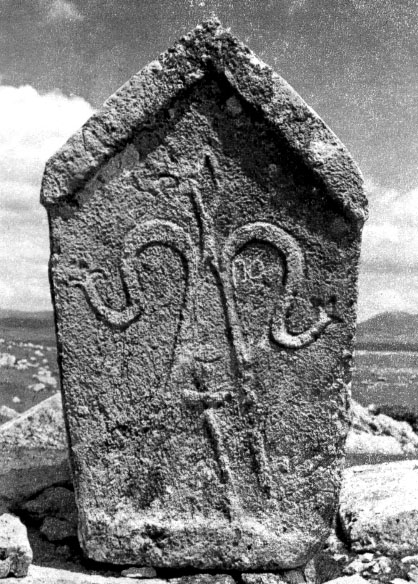
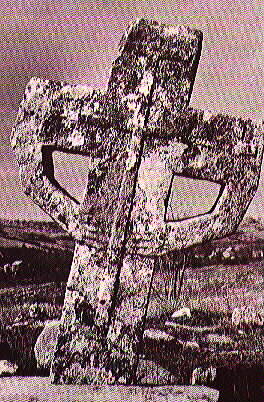
Stećak tombstones
Bosnia
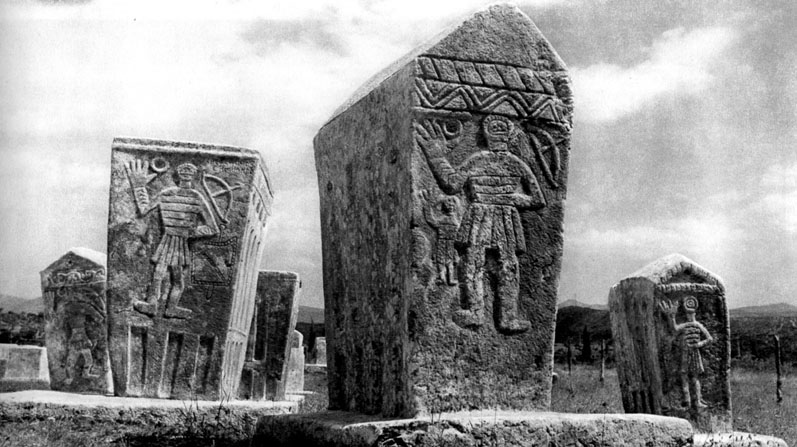
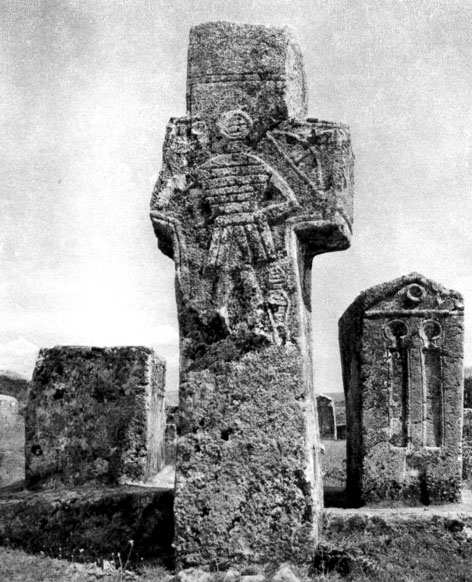
and Herzegovina is full of very
interesting, mysterious tombstone monuments called stećak (stechak).
The older names are
bilig
= sign,
mramor
= marble,
priklopnik
or priklopnica =
folding.
The most famous collection can be seen in
Radimlja in Herzegovina:
Radimlja
Radimlja
Here are a few stećak
monuments in the vicinity of Srebrenica
in eastern Bosnia:
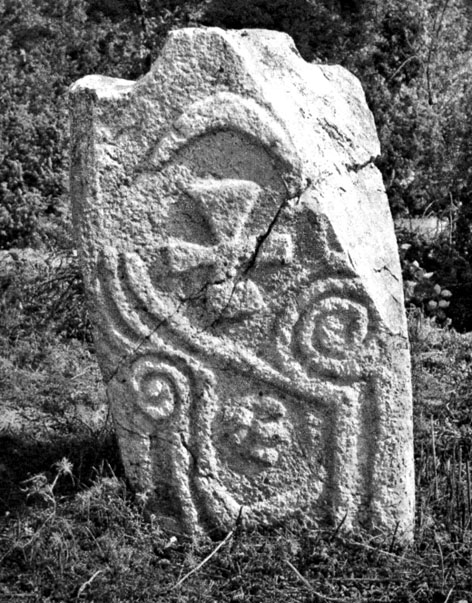
In the middle stechak one
can see a lily,
which is a
very old symbol of Bosnia. In Croatia, there are also numerous stechak
monuments. Some of them are even near the towns of Knin, Karlovac (Generalski
stol), and in Slavonia, near the
towns of Požega and Pakrac.
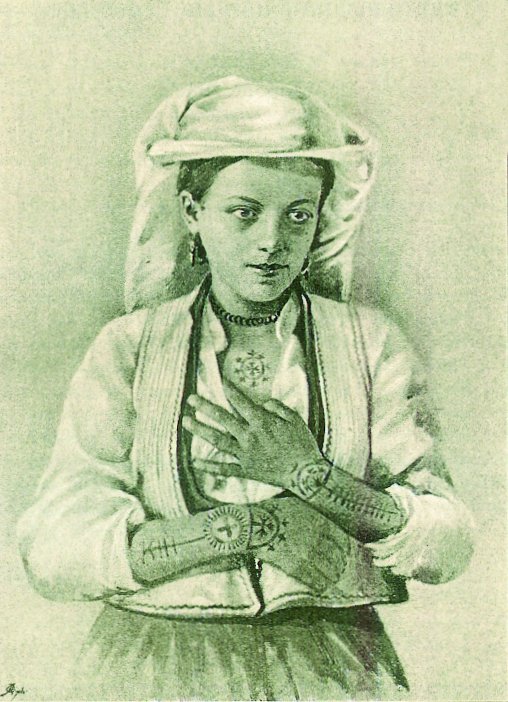
Tatooing of Croatian women in BosniaTatooing of Croatian women in Bosnia
Even
today Croatian women in some parts of
Bosnia tattoo their hands with Christian symbols and stechak
(stećak) ornaments. This very old custom,
used exclusively among Catholic Christians, had a special meaning in
the period of the Ottoman occupation. In this way, by wearing indelible
signs of their Christian religion, the forced conversion to Islam has
been prevented. However, the custom itself is much older. For example,
a Greek historian Strabo (1st century BC) mentions tattooing among
inhabitants of this area. For more information see an article by Ćiro Truhelka: Die Tätowirung
bei den
Katholiken Bosniens und der Hercegovina
(published in Wissenschaftliche
Mittheilungen Aus Bosnien und der Hercegovina,
herausgegeben vom
Bosnisch-Hercegovinischen Landesmuseum in Sarajevo, redigiert von Dr.
Moriz Hoernes, Vierter Band, Wien 1896).
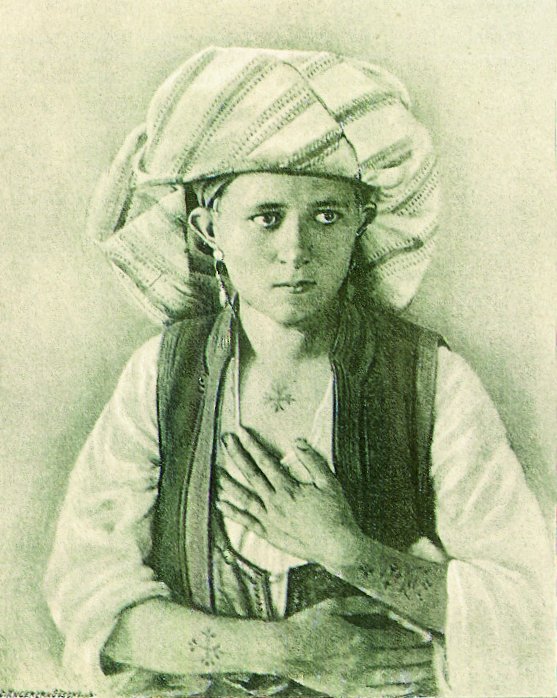
Tatooing of Croatian women in Bosnia
Bosnian Catholic Croats tattoo their hands
and other visible parts of body with Christian symbols (usually with a
small cross), like brow, cheeks, wrist, or below neck. This can be seen
even today, not only in middle Bosnia, but also among exiled Bosnian
women living in Zagreb. For more information, see the mnograph [Haluga].
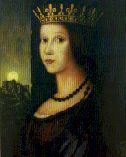
Katarina Vukčić-Kosača
(1424-1478),
the last Queen of Bosnia, ardent Catholic, wife of the Bosnian King Stjepan
Tomasevic (1461-1463), is still
one of the most beloved
personalities among the Croats living in Bosnia. When Bosnia fell under
the Ottoman rule in 1463, her two children (a boy and a girl) had been
taken to slavery and educated in the spirit of Islam, her husband
decapitated. She managed to escape to Dubrovnik,
and then to Rome, where she had been deeply involved in the
humanitarian activity of the Franciscan community (Aracoeli) becoming
Franciscan Tertiary herself, to help Bosnian Croats under the Turkish
rule.
The above portrait of Katarina Kosaca,
Bosnian
Queen, was made by Giovanni Bellini, held in the Capitol Gallery of
paintings in Rome.
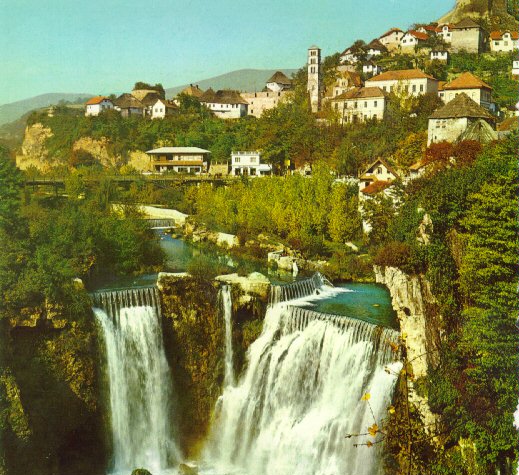
The city of Jajce in Bosnia
She
built a church of St. Katarina in a picturesque Bosnian city of Jajce
(totally destroyed by the Serbs in 1993). Despite her very difficult
position, she had always been treated as a Queen of Bosnia in official
circles. Tormented by the tragedy of her homeland, lawful
Queen
Katarina bequested her Bosnian Kingdom to pope Sixto IV and Holly See
in 1478 ("...in
case that my islamised children are not freed
and returned to Catholic faith").
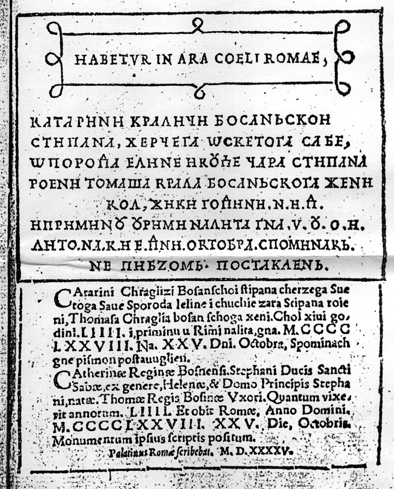
Her grave in the Aracoeli church
in Rome had a Croatian
Cyrillic inscription
until 1590 (with the coat of arms of the old Bosnian Kingdom and of the
Kosaca family), when it had been replaced by translation into Latin.
Even today, after more than five centuries, Croatian women wear black
costumes in some parts of Bosnia in remembrance to her tragic life and
kindness towards poor people. Beatified.
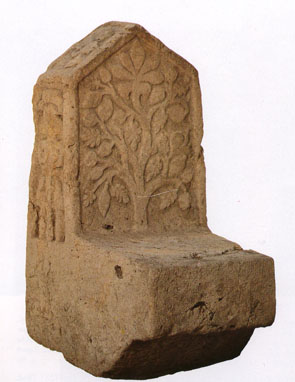
Libro Nouvo, G.B. Palatino, 1545, Rome: Tombstone inscription of Bosnian Queen KatarinaStone throne of Bosnian kings, Bobovac
The
seat of Bosnian kings in 14th and
15th centuries was Bobovac,
about 50 km north of Sarajevo. Its
walls were about 1100 meters long. Many documents are preserved
mentioning Bobovac. It fell under the Turks in 1463, which meant the
fall of mediaeval Bosnian state.
After the catastrophic
defeat of the Serbs in the Kosovo
field in 1389, on whose side both Croatian forces from Bosnia and
Albanian troops had also participated, Serbia became a vassal state to
the Turkish Ottoman Empire.
Battle on the Krbava Field in 1493
Among
the most tragic events in
the history of the Croats were the Turkish occupation of Bosnia in
1463, and the catastrophic defeat of Croatian defenders in the battle
with the Turks on the Krbavsko
polje (Krbava field in present-day Lika)
in 1493. The slaughter of the Croatian
nobility greatly reduced the economic power of the Croatian lands for
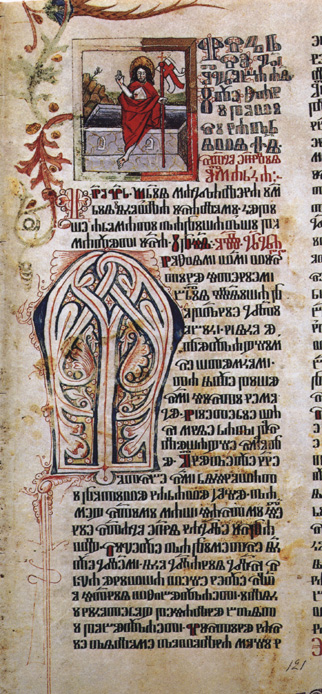
the centuries to come. It was described in the "Second Novi Glagolitic
breviary" by rev.
Martinac in 1494 (see a column
from this breviary on the photo). Marko Marulic
wrote his famous Prayer
against the Turks. An extensive
collection of dozens of speeches
"against the Turks" (Orationes contra Turcas) from the middle of the
15th century to the end of the 16th century can be seen in [Gligo],
on 650 pp. Several of these speeches have
been delivered by Croatian noblemen, writers and clergy in front of
Popes, as well as in front of high dignitaries of various European
states.
These
speeches are important and indelible historical
fact. They do
not have to have any influence on good contemporary relations between
Croatian and Turkey. D.Ž.
In the 16th century the
Turks started settling down Serbian
population in the emptied regions previously inhabited by the Croatian
Catholics. The representatives of the Serbian Orthodox Church had the
privilege to collect taxes from the Croatian Catholics. In this way the
Serbs wanted to include the Catholics into the Orthodox Church, which
was under the control of the Turks (the residence of the Serbian
Patriarch was in Constantinople in present-day Turkey).
Let us mention by the
way that the animosity of the Orthodox
Christians against Catholics was strengthened first in Greece and then
in Serbia after the Crusaders had occupied Constantinople and formed
the Latin Empire (1204-1261).
Turkish Croatia (Turska Hrvatska)Gabrijel Jurkić: Ljubljenje križa u Bosni (Kissing the Cross in Bosnia)
Before
the Turkish penetration in the 15th century there were 151 Catholic
churches in Bosnia, about 20 Catholic monasteries, and not a single
Serbian Orthodox church. Several Catholic orders were present in
Bosnia: Benedictines, Paulines, and above all Franciscans. Immediately
after the arrival of the Turks a large number of Serbian Orthodox
churches was built up, many of them on the ruins of Catholic churches.
Under the pressure of the Serbian Clergy many Croatian Catholics had to
convert to the Serbian Orthodox Christian faith. And the religion was
one of the decisive factors in the national affiliation of the people
in Bosnia.
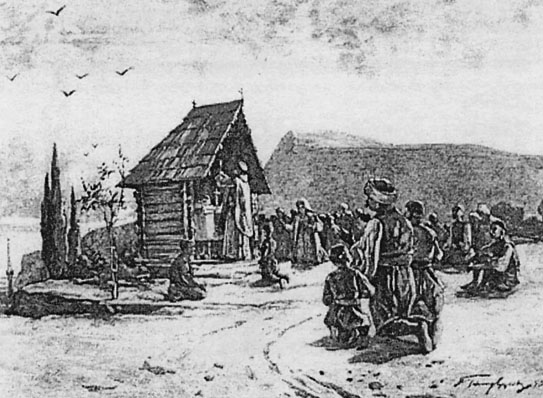
Catholic mass in Bosnia in the open, 1898
The
border between Middle Age Bosnia and Croatia was on the river Vrbas,
not on Una. The lovely town of Jajce (on river Vrbas) was in Croatia,
as well the town of Bihac. The territories enclosed by three rivers -
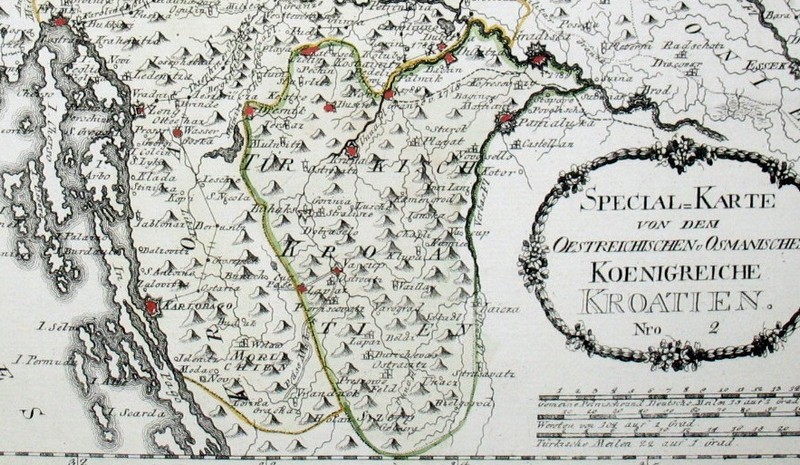
Sava, Una and Vrbas - bore the name of the Turkish
Croatia in
the European literature of 18th and 19th century. The name was given by
the Turks, and it was accepted by Austrian, Italian, German and Dutch
cartographers. It was only in 1860 that upon insistance of the Valachian
part of the population the name of Turkish Croatia was abolished in
favor of the new name - Bosanska
Krajina
(Bosnian Frontier). This name appears on maps for the first time in
1869.
TURKSICH
KROATIEN, depicted with light
green border in the middle of the
map
from 1799.
Source of the map Turska
Hrvatska.
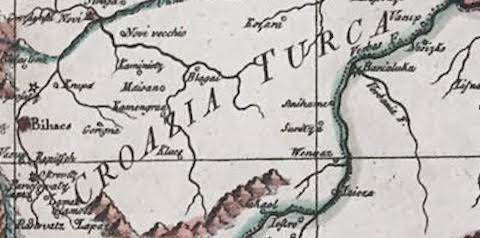
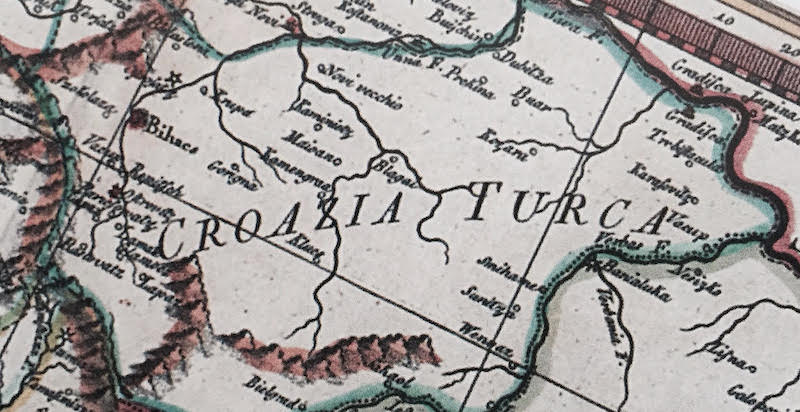
CROAZIA TURCA,
depicted on a map published in Rome in 1790.
Below is the same map with more details, slightly rotated
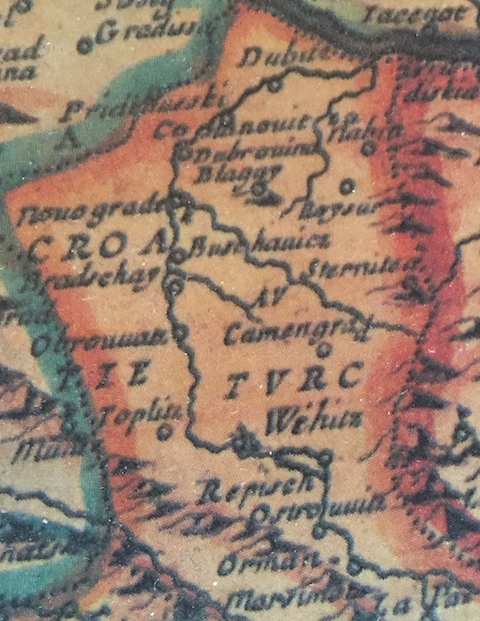
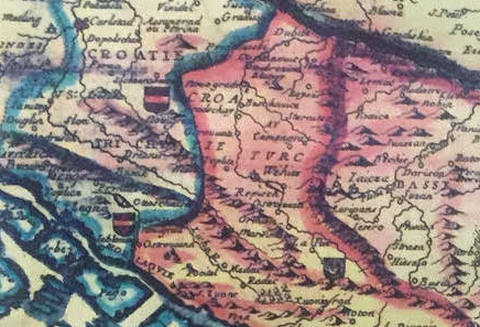
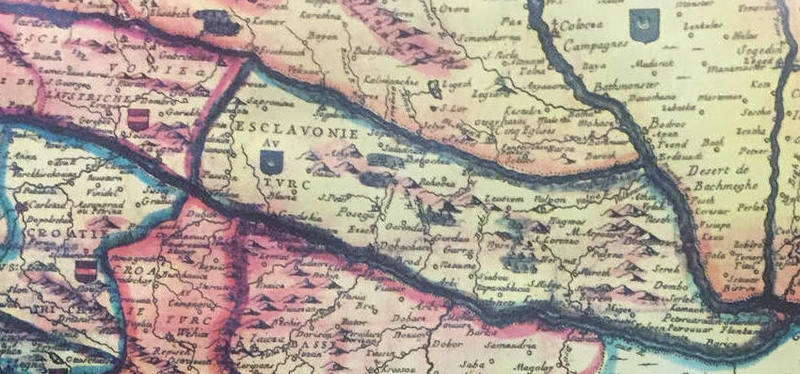
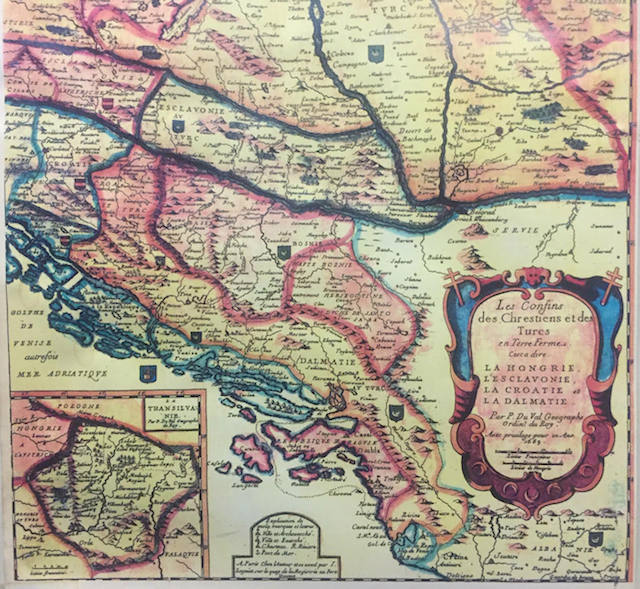
Croatie Turc (in French), part of a map by P. Du Val from 1663:
Les confins des Chrestiens et des Trucs en Terre Ferme, C'est a dire
LA HONGRIE, L'ESCLAVONIE, LA CROATIE et LA DALMATIE.
The whole map also shows Slavonie Turc and Dalmatie Turc, occupied by
the Turks.
CROATIE TURC
ESCLAVONIE TURC
DALMATIE TURC
Franjo Glavinić and Croatian language
Franjo
Glavinić
(1585 -
1652), Croatian Franciscan born in Istria,
whose parents were noblemen
exiled from Bosnian Kingdom (Glamoc), wrote several important books,
among which we cite
L'origine
della Provincia di Bosna
Croatia
(The Origine of the Province
of Bosnia Croatia), two
editions,
Udine 1648 and 1691; the Province of Bosnian Croatia has been separated
from the Province of Bosnia Argentum in 1514 by a decision which took
place in the convent of Cetin in Upper Croatia;
Szvitlost
duse verne (Light of Faithful
Soul; in
Croatian, first edition printed in Venice, second in Padova, and third
again in Venice), in which he speaks about the
human need for
virtues here... and to please brothers and faithful, in particular the
Croatian people (ugoditi... navlastito Hervackomu
jeziku) and
my Istrians...
Czvit
szvetih (The Flower of the
Sacred People;
three editions in Venice), and Chetiri
poszlidnya chlovika (The
Last Four Men; Venice), both written in Croatian in the monastery of
Sv. Leonard near Okic in the vicinity of Samobor.
He
has discovered very old and
important muniment from 1288
which mentions Stipan
from old Dubrovnik,
Bishop of Modrus, written in the Glagolitic Script.
Here Old Dubrovnik is a town which existed in Middle Bosnia, north of
Sarajevo, founded by merchants from the famous Dubrovnik.
Old (Stari ) Dubrovnik had existed also after the fall of Bosnia under
the Turks in 1463 (nahija Stari Dubrovnik).
See
also Pavao Ađjelić: Stara bosanska
župa Vidogošća ili Vogošća [PDF],
Glasnik
Zemaljskog muzeja BiH u Sarajevu, Arheologija, XXVI, 337-346.
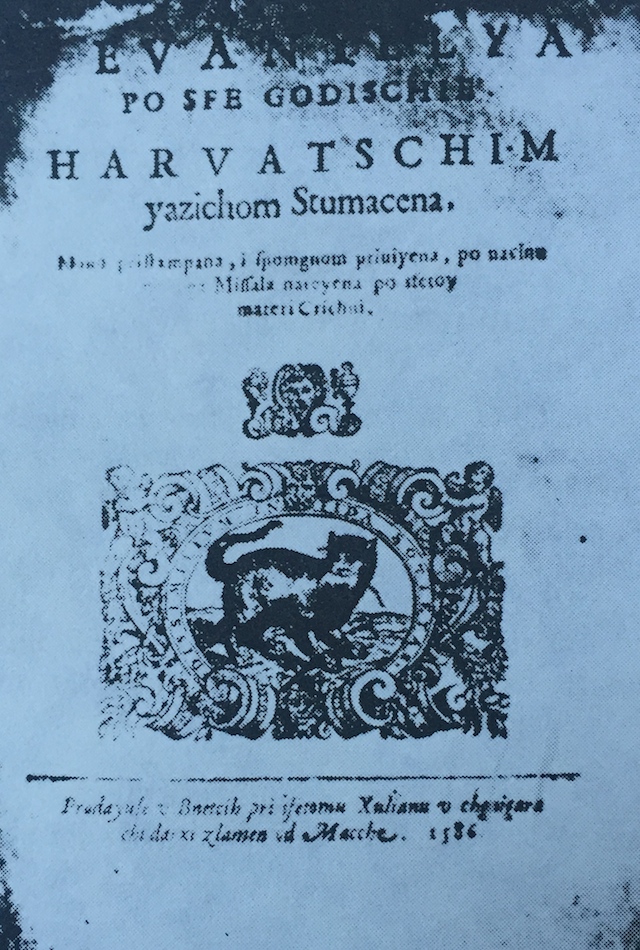
The Evangel from the Franciscan Monastary of Olovo, published in
Venice in 1586,
written in Croatian (HARVATSCHIM yazichom Stumacena = in Croatian
language described).
Photo from Bernardin Matić: Gospa Olovska, drugo preuređeno
izdanje, Svjetlo riječi, Sarajevo 1991.
Valachies (Vlachs) and Krajina
The territory between
Una and Vrbas (former Turkish
Croatia)
has been ceded to the Serbian entity by the Dayton
agreement in 1995. Truly a great success of Milosevic and his
apprentices Karadzich and Mladich. The area itself, as well as the
fertile region of Bosanska Posavina along the right bank of the Sava
river (now also within the Serbian entity), had a large Muslim and
Croatian majority in 1991. The region has been almost completely
cleansed from the Croats and Muslims that lived there for centuries. A
part of cleansing was the so-called "humanitarian exchange of
population'' under the auspices of the international community that was
not willing to put pressure on Karadzic and Mladic. The European
officials describe this as a "compensation'' for the disappearance of
the Serbian para-state in Croatia during the Flash and Storm
operations.
The
Serbs living in Bosnia came with the
Turks mostly as assisting Turkish troops. It should be emphasized that
these Bosnian Serbs were originally Valachies
(Vlachs) from
Montenegro and northern Albania. In fact they were non-slavic nomads -
Protoromans and romanized Balkan Celts and Illyrians, who accepted the
Serbian Orthodox faith (there were also Catholic Valachies in Croatia,
croatized after 16th century). Later, under the influence of the
Serbian Orthodox Church in Bosnia, they became Serbs. They had been
fighting on the Turkish side until the decline of the Turkish Empire
started. Their enclaves in present day Croatia follow roughly the
border of the Turkish Empire in the medieval Croatia.
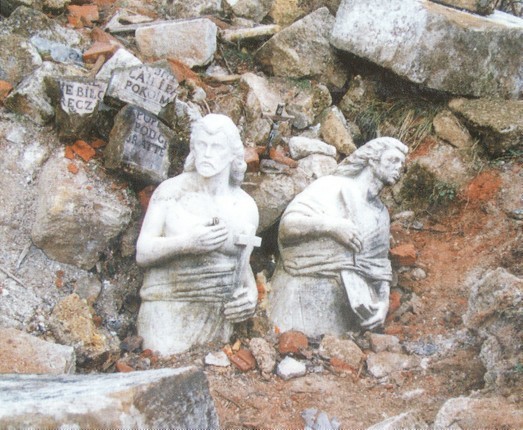
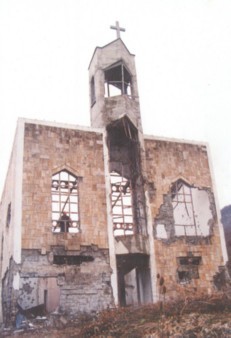
Completely destroyed sanctuary
of Podmilačje (on the left) and a damaged church near Jajce, after
Greater Serbian aggression on BiH (photos by [Čakić-Did])
These migrations led to
further complications. Counting on
these Serbian settlers as a military aid, the Austrian kings supplied
them with privileges. This meant that parts of the Croatian territory
were not completely under the Croatian jurisdiction and the Croats felt
them as intruders within their state. This was the beginning of the
so-called Krajina
(`Military Frontier'; "Bosnian Krajina"
appeared much later), whose complete and systematic ethnical cleansing
from Croats and from everything reminding on their existence was
finished during the Serbian aggression 1991-1995. Here we see the
beginning of the drama
in Croatia
and Bosnia-Herzegovina.
The Krajina region in Croatia has
been liberated during the Flash and Storm operations
in the summer 1995.
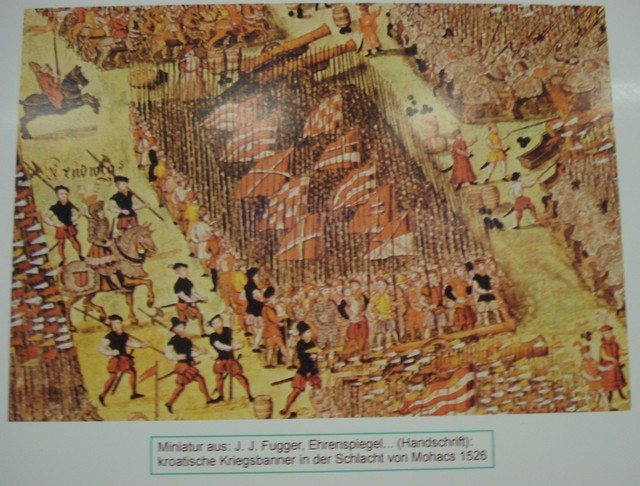
Two
clearly visible Croatian Coats of Arms of
Croatian troups at the 1526 battle at the Mohač field (Hungary) against
the Turks, can be seen in the following two photos. (By the courtesy of Josip Seršić and Mijo Jurić, Vienna,
2009.)
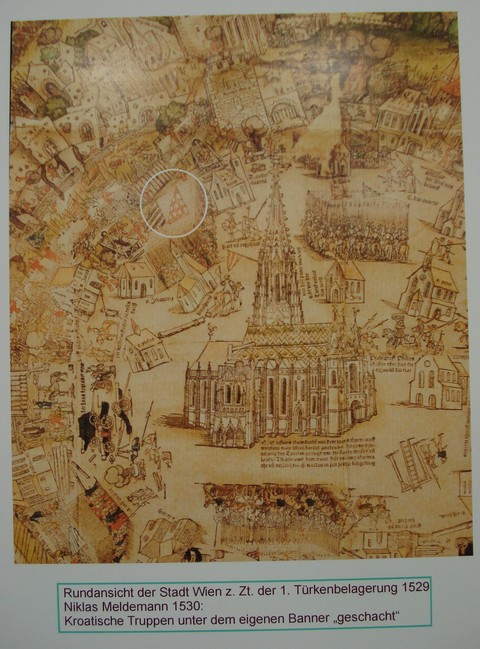
The above photo is a detail from the following picture:
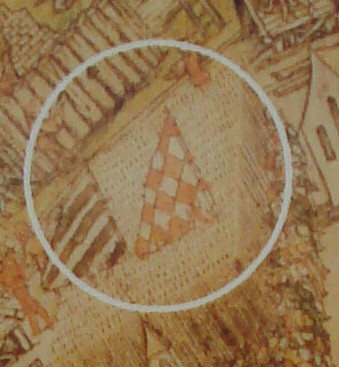
The
city of Vienna, capital of Austria, has been
attacked by the Turks already in 1529. Among defensive forces Croatian
troups participated under their flag. See encircled below, left of the
Stephanusdome, the famous Vienna Cathedral.
Croatian defensive forces
under their Croatian flag in Vienna in 1529, during the first Turkish
siege of the city.
I express my deep gratitude to Josip Seršić (1948-2020) and Mijo
Jurić, Vienna, for this information.
During the second Turkish
siege of Vienna in 1683, a Croatian
village called Krowotendörfel,
placed
immediately near the city walls, has been destroyed, and since then it
does not exist any more. The meaning of its name is precisely Croatian
Village! Its position corresponded to contemporary Spittelberg near the
Hofburg Palace.
For more details, see [400 Jahre
Kroaten in Wien].
There are other names of Krowotendörfel
that can also be encountered in the literature:
Crabathen Derffel
Crabatendörfel
Croathndörfel
Krowotendörfel
Crabatendoerfel
Krawattendörfel
Croatendörfel
Kroatendörfel...
Among defenders of Vienna
in 1683 was a renowned Croatian
theologist and ecumenist panslavist Juraj
Križanić, who was assasinated
during the Turkish seige.
Battle at Mohač Field, Nikola Zrinski and Siget, Sisak
In
1526, the disastrous defeat of
Hungarian and Croatian army took place in the Mohač
field in
southern Hungary. Let us mention by the way that since 1991 this area
has offered refuge to 45,000 exiles, mostly Croats from Serbia and
occupied parts of Croatia.
The
territory of western Bosnia, that was
occupied by the Turks only after the battle on the Mohač field, was
called Croatian Bosnia
or Turkish
Croatia
(Bosna hrvatska or Turska Hrvatska), until the Berlin Congress in 1878.
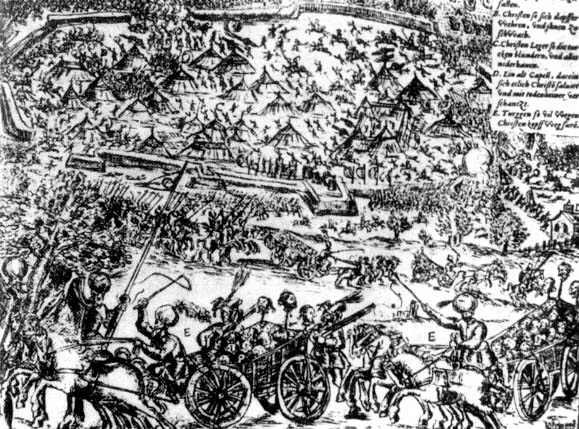
Here is a document
depicting cut off heads of Croats killed
after the battle at Petrinja near Zagreb in 1592:
Petrinja near Zagreb, 1592
The 1592 defeat of
Croatian-Habsburg army near Brest was
celebrated in Constantinople by showing 29 charriots with 172 captured
dignitaries, 600 cut off heads, and 23 captured flags.
A
legendary Croatian military
commander Nikola Jurišić
(born in the town of Senj, 1490- c 1545)
managed to stop sultan Sulejman the Magnificent (or Great) in 1532 near
the town of Köszeg (Güns) at Austrian and Hungarian
border.
Nikola Jurišić had about 700 Croatian soldiers, the Turks about 32,000
people. The Turkish onsloughts lasted for three weeks. The aim of
sultan Sulejman was to occupy Vienna. It is interesting that two years
earlier Nikola Jurisic visited sultan Sulejman in Constantinople as a
deputy of King Ferdinand.
Marko Stančić Horvat,
Croatian military commander (Gradec, circa 1520 – Siget, 1561),
successfully defended Sziget in 1556 with his infantry consisting of
1000 men, against the attacs of Ali-pasha. The Turcs had about 10,000
victims. Marko Stančić Horvat wrote the book Historia obsidionis et oppugnationis arcis
Zigeth in Ungaria, published in 1557.
Nikola
Zrinski Junior
(1620-1664), a Croatian statesman and writer, described in his epic
The siege of Siget the heroic death of his grandfather Nikola Šubić Zrinski
in 1566, which
entered all the historical annals of the 16th century. With his 2500
brave soldiers, mostly Croats, Nikola Šubić Zrinski was defending the
fortress of Sziget
in southern Hungary against 90,000 Turks.
Nikola Šubić Zrinski, Siget 1566
The
Turkish troops were
under the sultan Suleyman the Great
and supplied by 300 cannons. It took them a month to defeat the
Croatian soldiers, who all died a terrible death in the final battle.
Despite his promise, the King Maximillian Habsburg did not help Nikola
Šubic Zrinski. Historians say that the Turks had almost 30,000 dead.
Siget defended by Nikola Šubić Zrinski, 1566
Cardinal Richelieu,
famous French minister at the court of
King Lui XIII, wrote the following: A
miracle was necessary for the
Habsburg Empire to survive. And the miracle happened in Sziget.
The
above mentioned epic was written in the Hungarian language. Though
written by the Croat, it is regarded to be one of the greatest
achievements of the early Hungarian literature. See also here
(in Croatian).
Ivan Zajc
has composed the opera
Nikola Šubić Zrinski, which is very popular in Japan, especially its
tune "U
boj, u boj!" (on this web page
you can
listen to Japanese choirs singing this song in Croatian!).
It is worth noting
that Dominko
Zlatarić'', a famous 16th century
Croatian writer in Dubrovnik,
dedicated some of his translations from Greek classics to Juraj
Zrinski, a son of the above mentioned Sziget hero Nikola Subic Zrinski.
Zlatarić stated that he translated Greek verses into
Croatian
("u hrvatski izložene").
In 1660, a Dutch
scientist Jakov Tollins payed a visit to
Nikola Zrinski Junior in Čakovec, and was impressed by his huge library
(now a part of the National and University Library in Zagreb). Besides his native
Croatian, Nikola Zrinski Jr read Hungarian, German, Latin, Italian and
Turkish perfectly, and he was not stranger to French and Spanish.
See also the monograph published in London in 1664:
dealing with Croatian ban
(governer ) and poet Nikola Zrinski Jr. At its very beginning, we can
read the following dedication:
To
All the Admirers of Count Nicholas Serini, The Great Champion of
Christendom.
Among
innumerably many Croatian captives in
Turkish slavery, there were at least two that deserve special
attention:
Bartol Gyurieuvits
(Bartol
Jurjevic, Gjurgjevic), 16th century, who left us extremely interesting
testimonies about the Ottoman (Turkish) Empire, that can be found in
various libraries of almost all larger European cities;
Juraj Hus (Husti),
16th
century, who became Turkish military trumpeter.
It
is not widely known that in the 16th
century the town of Bihac
was Croatian capital. Hasan-paša
Predojević, an islamized Croat,
occupied Bihać in 1592. About 2000
people were killed and 800 Croatian children taken to slavery and
educated in the spirit of Islam.
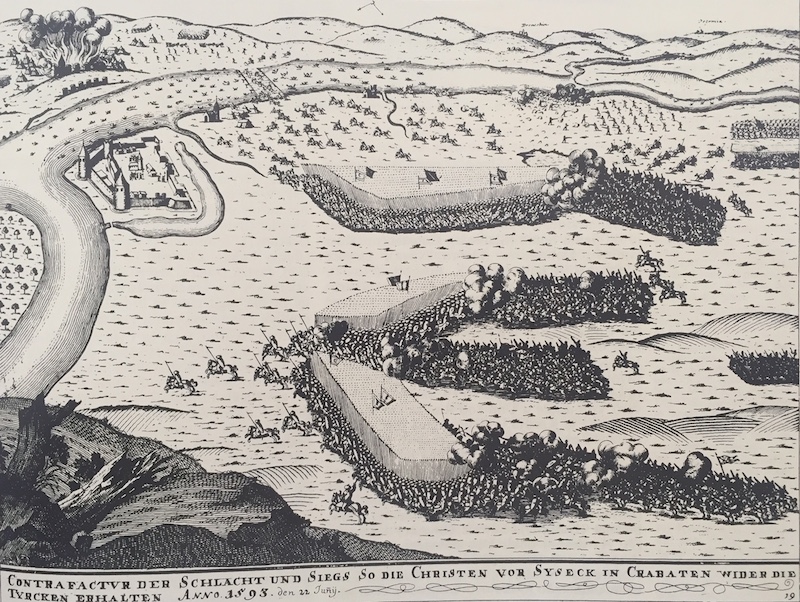
Illustration of the victory of the
Christian army in Croatia (Crabaten) over the Turks in the town Sisak
(Syseck) in 1593 (from Oertler's
Chronology, 1602). Source of the photo [Marković].
A real turning point which meant the
beginning of the fall of the Ottoman expansion to Croatian historical
lands (and to Europe) was a defeat of Hasan-paša Predojević in a battle
at Sisak
near Zagreb in 1593, which echoed in the
whole of Europe.
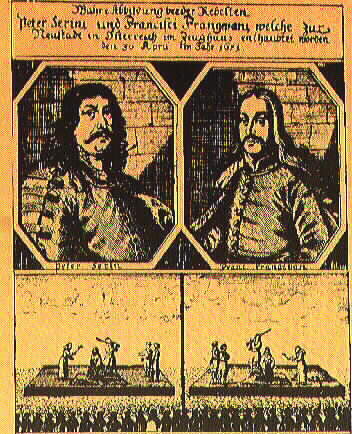
Petar Zrinski and Fran Krsto FrankapanDecapitation of Zrinski and Frankapan in Wiener Neustadt, 1671
Ban
(Viceroy) Petar Zrinski
(1621-1671) and Fran Krsto
Frankapan
(1643-1671), both outstanding as statesmen and writers, are among the
most beloved figures in the history of Croatia. They had a great
successes in liberating the areas occupied by the Turks. However, the
Viennese Military council, instead of supporting them to free the rest
of the Hungarian and Croatian lands, signed a shameful peace treaty
with Turkey, by which the liberated territories had to be handed back
to the Turks. The result of the rebellion against Vienna was a cruel
public decapitation of Zrinski and Frankapan in Wiener Neustadt near
Vienna in 1671. The remains of these two Croatian martyrs were buried
in the Cathedral of Zagreb in 1919.
It is interesting that,
while in prison from 18th April 1670
to 30th April 1671, Fran Krsto Frankapan translated Molier's "George
Dandin" into Croatian, written in Paris in 1669, ie. only two years
earlier. This was was its first European translation. Frankopan is the
author of very famous Croatian verses Navik on
živi ki zgine posteno (Forever
he lives who dies honorably).
Petar Zrinski was also
very educated, being a statesman,
poet, composer, polyglot. He presented his legendary
sword to the town of Perast in Boka
kotorska during his sojourn
there in 1654.
The letter
sent by
Petar Zrinski to his wife Katarina
(in Croatian) just a day before
his death is one of the most deeply moving texts ever written in the
Croatian language. It was very soon translated and published in
His wife Katarina,
also an outstanding poetess, was
imprisoned by general Spankau in a monastery in Graz, where she went
insane and died in extreme poverty. Even the son of Peter and Katarina
- Ivan Antun, the last of the Zrinski's, was imprisoned in Graz, solely
because he belonged to this outstanding noble family. He died after 20
years of prison in Schlossberg in Graz out of pneumonia. For more
details see [Bartolić].
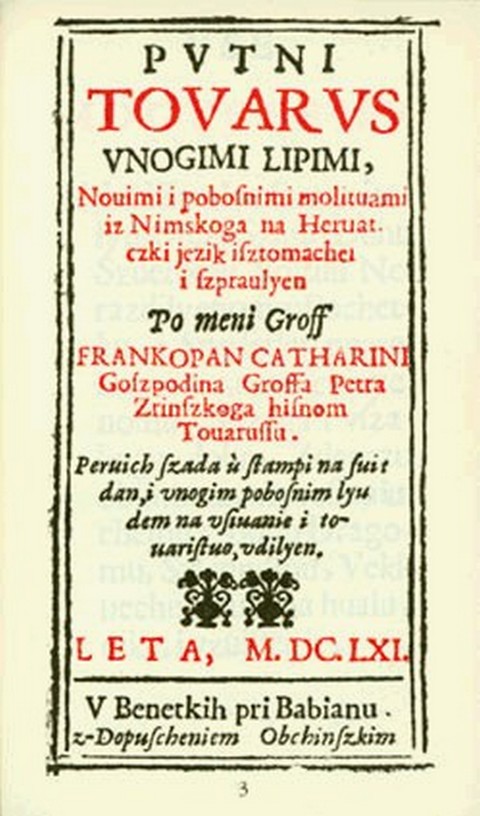
Ana Katarina Frakapan
translated a prayer book (Putni tovaruš)
from German into Croatian language (Heruatczki
jezik) and published in
Venice in 1661:
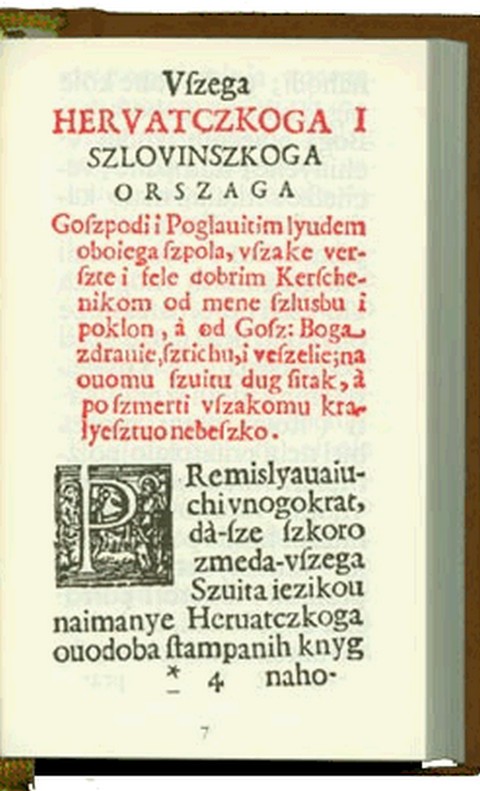
Vsega
Hervatczkoga i Szlovinskoga
orszaga... - Of the entire Croatian and Slavonian state...
These six centuries old
noble Croatian families died out and
their property was robbed. It should be stressed that both Petar
Zrinski and Fran Krsto Frankapan went to Vienna voluntarily, where they
have been arrested. During the trial they defended themselves claiming
that only Croatian Parliament (Hrvatski Sabor) can try them. In their
burgs they had a considerable collection of books and works of art,
which after confiscation are held in Austria (many of them in Austrian
National Library). A period of the influence of the absolutistic
Viennese politics had started.
Marc Forstall (Marcus Forestal, +1685), an
Irish monk of Augustinian order, was a chancellor of Nikola nad Petar
Zrinski. In 1664 he wrote a genealogical treatise about the family of
Zrinski, kept in the National and University Library in Zagreb.
Even today some descendants of the Zrinski
family (Sdrin, Sdrinias) live in Greece. See an interesting article by Dionisis pl. Sdrinias (Greece).
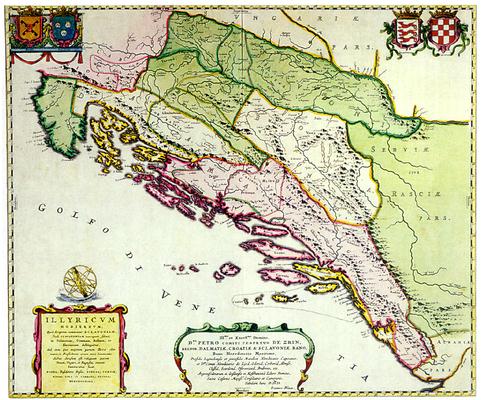
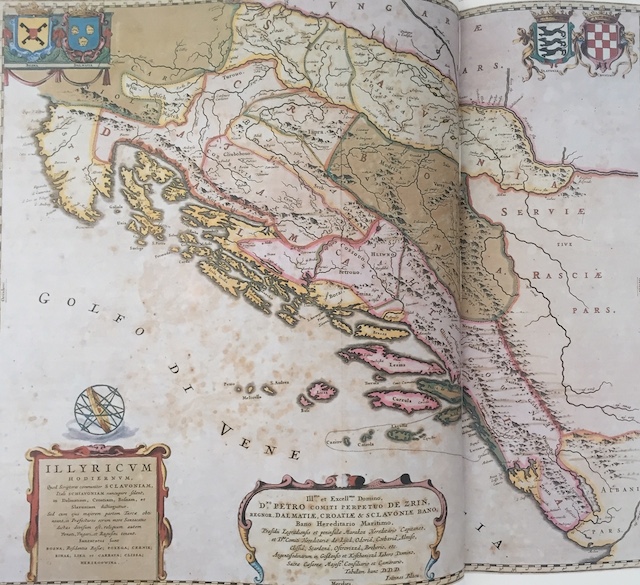
Map dedicated to Petar Zrinski,
ban of
Croatia. The map was created at the workshop of Joannes Blaeu in
Amsterdam as an addition to the work by Ivan
Lučić, De Regno Dalmatiae et
Croatiae libri sex, Amsterdam, 1666.
Blaeu had inserted the map in Atlas Maior in 1667, and dedicated it to
the Croatian ban Petar Zrinski (bottom of the map, in the middle):
To
the most illustrious and noble lord, Prince
Peter of Zrin, the ban of the Kingdom of Dalmatia, Croatia and
Slavonia, hereditary ban of the Littoral, hereditary captain of the
Legrad fortress and Medimurje peninsula, master and hereditary prince
of Lika,
Odorje, Krbava, Omis, Klis, Skradin,
Ostrovica, Bribir etc.., Master of Kostajnica and the sliver mine at Gvozdansko,
councillor and
chamberlain to his anointed imperial
majesty, master Ioannes Blaeu dedicates this map.
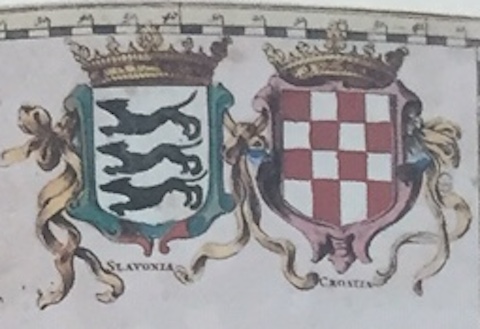
Ivan Lučić, the first Croatian historiographer: Map of Illyricum (i.e., of Slavonia,
Croatia, Bosnia, Dalmatia),
from the atlas by Dutch cartographer Joan
(or Johannes) Blaeu, 1669. Source of the photo [Markovic].
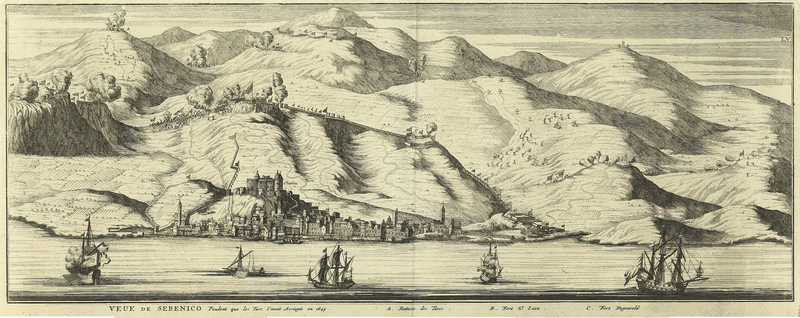
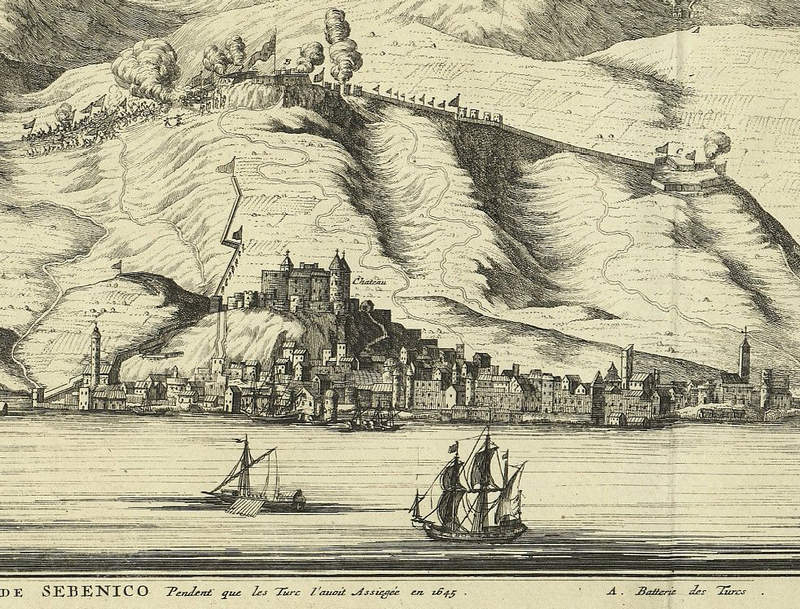
Joan
(or Johannes) Blaeu: VUE DE SEBENICO Pendant que les Turcs l'avait
Assiégée en 1645.
(Joan Blaeu: A view to Sibenik, during the Turkish occupation in 1645)
This was one of the most dramatic events in the history of this
important Croatian city.Joan Bleau: Vue de Sebenico, Kandijski rat
The Gvozdansko fortress in Croatia, between the villages of Dvor (at
that time called Novigrad, on Una river)
and Glina. Drawing from the
17th century.
On Jaunary
13th 1578, after three months
of continuous attacks of several thousand soldiers, led by Ferhad
pasha,
the Turks managed to enter the fortress of Gvozdansko.
To
their surprise, this time they entered the fortress without any
resistence from Croatian side. And upon entering, they saw an amazing
scenery: all Croatian defenders (50 soldiers, and 250 peasants and
miners with wives and children) were lying dead, frozen in the snow.
The soldiers were with arms in their hands. Ferhad pasha was so shocked
by
what he saw, that he asked a Catholic priest to be found, so that
currageous defenders could be burried according to their tradition. The
Croatian crew refused several previous Turkish offers to leave the
fortess for unoccuopied part of Croatia. They had to struggle not only
aginst the Turks, but also against famine and extreme coldness. This is
one of the most celebrated events in the military history of Croatia.
We
know the names of four captains that led the defense of Gvozdansko:
By the 1699 peace treaty in Srijemski Karlovci, the region between the
rivers Una and Vrbas was named Turkish
Croatia (Turska Hrvatska,
Croazia Turca). According to the
decisions of the Berlin Congress in 1878 (by which the Habsburg
Monarchy obtained a mandate to occupy Bosnia and Herzegovina), for the
first time was a settlement on the right side of the river Una
called Bosnian
Dubica
(Bosanska
Dubica), and
the name of Bosnia was extended to the region between the rivers Una
and Vrbas.
Gabrijel Jurkić: Kuda? (Where to go?)
By
the end of the
17th century some of the occupied parts of Croatia and Hungary were
liberated from the Turks. The Serbs joined Austrian forces (composed
mostly of Croats), hoping to get a full freedom. However, the Austrian
forces were defeated near Skopje in Macedonia. The Turks managed to
regain most of the lost territories, and then a very difficult period
for Serbian people started. Fearing the revenge of the Turks, in 1690
Kosovian Serbs (37,000 families) left for present day Vojvodina, a very
fertile region, the part of which between the rivers Sava and Danube
was a Croatian territory and Hungarian to the north of the Danube.
Actually, the exodus of Serbs included even Budapest. Most of the
Catholic monasteries in Vojvodina became the `property' of the Orthodox
Church, whose aggressiveness made interconfessional relations very
tense. The emptied territories of Kosovo were then populated by the
islamized Albanians. Today the official Serbia quite unjustly claims an
equal right to both Kosovo and Vojvodina.
The
penetration of the Ottoman
Empire to Europe was stopped on Croatian soil, which could be in this
sense regarded as a historical gate of European civilization. Since
1519 Croatia has been known as Antemurale
Christianitatis in
Western Europe. The name was given by Pope Leo X.
Gabrijel Jurkić: Saviors and protectors of our fathers
The
Croats endured
the greatest burden of this four century long war against the Turks.
The most tragic fact in this war was that many islamized Croats had to
fight against the Catholic Croats. It is interesting to note that the
city of Zagreb and nearby Sisak despite many attempts were never
occupied by the Turks, though they came as far as Vienna in 1683.
Budapest for instance was in the hands of the Turks for 160 years.
It
is in the 17th century that the
following very condensed description of the Croatian tragedy was given
by Pavao Vitezovic (1652-1713), a writer: ``Reliquiae reliquiarum olim
inclyti Regni Croatiae'',
i.e. ``Remains of remains of ancient
glorious Croatian Kingdom''. Indeed, throughout its long and difficult
history its territory has been reduced to the shape of a flying bird.
Gabrijel Jurkić: Prayer
Present day Croatia is profoundly related to Bosnia-Herzegovina, which
is ethnically certainly the most complex state in Europe. It has three
major ethnic groups: the Muslims, Serbs and Croats, very intermixed.
Let us mention by the way the world-famed Medjugorje,
which is in the area inhabited by Croats. During the last ten years it
was visited by millions of pilgrims.
Bombed
by Greater Serbian aggressors in 1992.Gabrijel Jurkić: MadonaBosnian Church - Krstyans
The earliest mention of
a Catholic diocese in Bosnia dates
from 1089 (i.e. from the 11th century). It was called Bosnian
Diocese, and its center was in Vrhbosna
(present-day
Sarajevo).
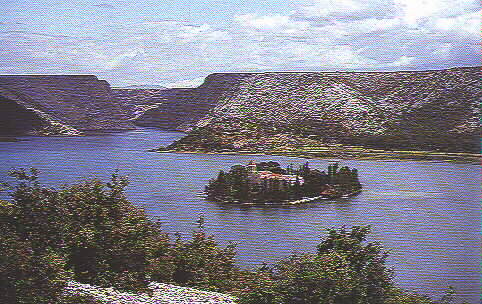
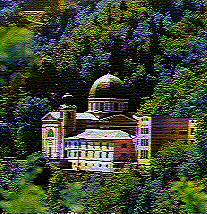
Visovac monastery (in Croatia, on Krka river), and Fojnica monastery (in central Bosnia)
Deep
traces were left by the Bosnian
Franciscans, present on Bosnian
soil since 1291 (only 80 years
after the foundation of the Franciscan order). They were beloved by
people, for being educated and humble, for keeping the national and
religious identity of the Croats. In 1376 they had 35 Catholic
monasteries and about 400 missionaries (the Fojnica
(Hvojnica) monastery is on the
photo on
the left; on the right is the famous Visovac
monastery on the
Krka river, founded in 1445 by Bosnian Franciscans from Kresevo,
middle Bosnia;
shelled by the Serbs in 1991). In Turkish time, by a special Charter (Ahdnama,
1463) from the Sultan, the Bosnian
Franciscans and their Croatian Catholics had a guaranty to live in
peace and freedom in his Empire. However, in reality it was rather
different. Three Franciscan bishops in Bosnia had been killed by the
Turks despite ostensible protection: in 1545, 1564, 1701, not to
mention priests and ordinary people. From 1516 to 1853 a decree was
issued by the Turks that Catholics are not allowed to build new
churches, but only to repair those built before 1463.
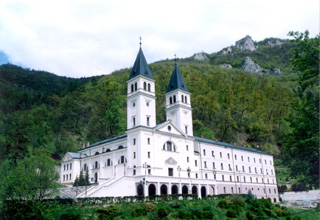
Kraljeva
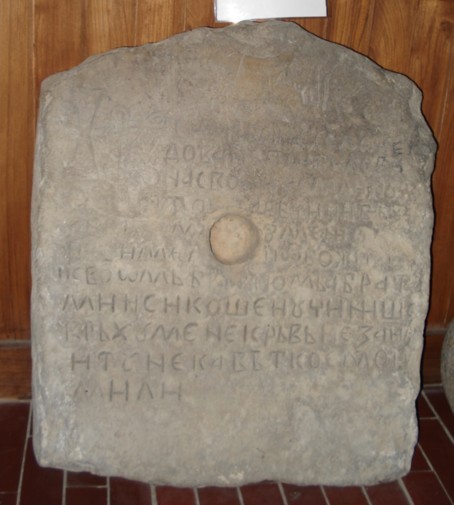
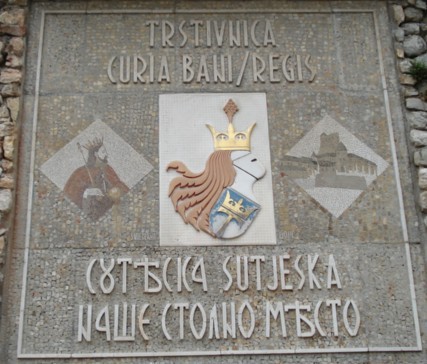
Sutiska (or Kraljeva Sutjeska = Royal Gorge), photo from www.turizam-zdk.net An
old and contemporary inscriptions, carved in Croatian
Cyrillic
in Kraljeva sutiska
(on the left: + V ime Božje,
se leži Radovan Pribilović, na svojoj
zemlji plemenitoj, na Ričici; bih s bratom se razmenio, i ubi me Milko
Božinić, sa svojom bratijom; a brata mi isikoše i učiniše vrhu mene krv
nezaimitnu vrhu; Nek (zna) tko je moj mili.).
Even some of Catholic
churches built before 1463 were
transformed into Muslim mosques (for example in Foča, Bihać, Jajce,
Srebrenica, etc.). So in 18th century only three monastic Catholic
churches were left (in Fojnica, Kraljeva Sutiska, and in Kresevo), and
two small churches (in Podmilačje and Vareš), see [Gavran,
IV, p. 103. About
Ahdnama and the question of its
authenticity see two articles by Saša Sjeverski in Stećak, Sarajevo,
56/1998, pp 28-29, and 57/1998, pp 14-15.
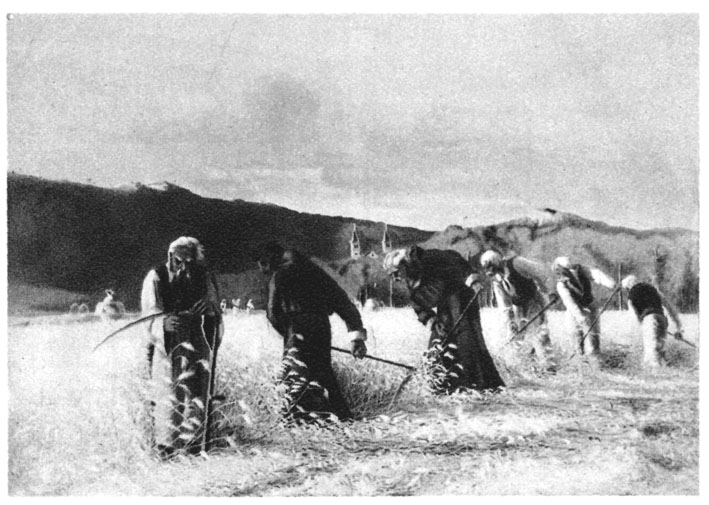
Gabrijel Jurkić: Kreševo monastery (left); Reapers (with two Franciscans...)
An outstanding European
intellectual of his time was Georgius Benignus
(Juraj Dragišić, ?1454 -
1520), a Croat born in Bosnia, in the town of Srebrenica.
The richest contemporary
library in Bosnia-Herzegovina is placed in the
Franciscan monastery of Mostar (bombed by the Serbs in 1992). The most
famous Croatian Franciscan is St.
Nikola Tavelić (born in
Šibenik about 1340-1391), a missionary in Bosnia and Yerusalem, a
martyr whom Pope Paul VI proclaimed a Saint in 1970. We should also
mention another Franciscan-capuchin, St.
Leopold Mandić (1866-1942), who
was a forerunner of today's Ecumenism.
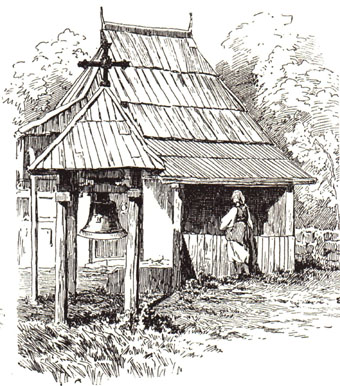
Wooden chapel of Bosnian Catholics
The
Franciscan province in Bosnia was
called
Bosna Srebrena (Bosnia
Argentum)
i.e.,
Silver Bosnia.
Since the 19th century its site is in Sarajevo. This very old name was
derived from the name of the city of SREBRENICA
which in pre
Turkish times (before the end of the 15th century) had been known as an
important Catholic center in north-eastern Bosnia (in Croatian, srebro =
silver). Due to the existence of the famous Franciscan monastery in
Srebrenica, the whole Franciscan province in Bosnia obtained its name
from it. Srebrenica was also an important mining center, known from the
Roman times. It had been settled also by the Dubrovnik merchants and
Saxonian miners from Germany. Even today there is a small village near
Srebrenica called Sase, whose name has been derived from the name of
Saxons.
We know that in the
region of north-eastern Bosnia, to which
also the city of Srebrenica belongs, there existed a large number of
Catholic churches and six Franciscan monasteries. This witnesses about
deeply rooted Catholic tradition in this area before the Turkish
occupation in the second half of the 15th century.
Gabrijel Jurkić: Uskrsna igra u Bosni (Easter play in Bosnia)
The
names of many toponyms in this area,
as well as elsewhere, reveal its Croatian origin:
HRVATSKE
njive (HRVAT = CROAT) on the river
Drina near Zvornik,
the nearby village HRVAČIĆI,
the village of HRVATI
near Tuzla,
HRVATI
near Brčko,
HRVATSKO
brdo near Repnik,
HRVATOVCI
near Gradačac,
the village BIŠKUPIĆI
(Biškup = bishop; and not
"Episkopići'') etc.
A district in Sarajevo was called HRVATIN
in the past.
It would be in vain to search for typical Serbian Orthodox church names
like eparchy (eparhija), episcopacy (episkopija), hrišćan anywhere in
Bosnia before the 15th century.
Gabrijel Jurkić: Franciscan church of sv. Ante, Sarajevo
Now
we would like to provide an
impressive list of
FRANCISCAN
MONASTERIES
IN
BOSNIA - HERZEGOVINA BEFORE 1463
i.e. monasteries that we
know to have existed before the
Turkish occupation of Bosnia in 1463.
Just for comparison, immediately before
the
Serbian aggression that started in 1991/92 Bosnian Franciscans had
altogether 25 monasteries (three of them outside of Bosnia -
Herzegovina: two in Belgrade and one in the Kosovo region).
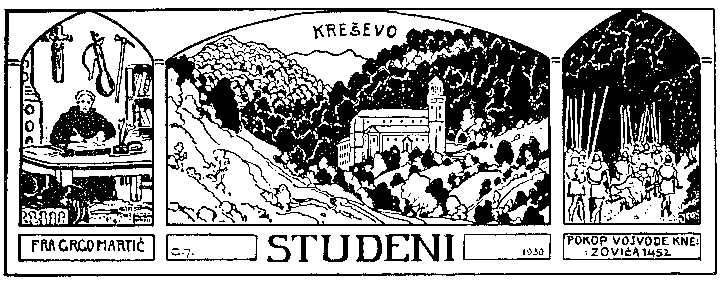
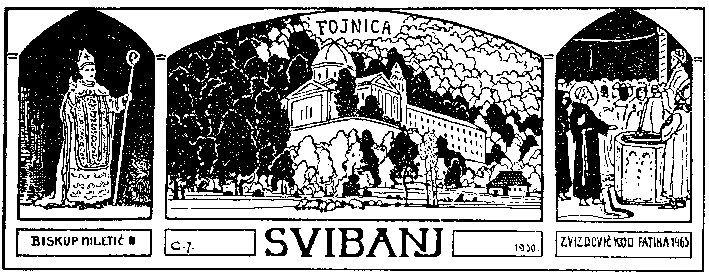
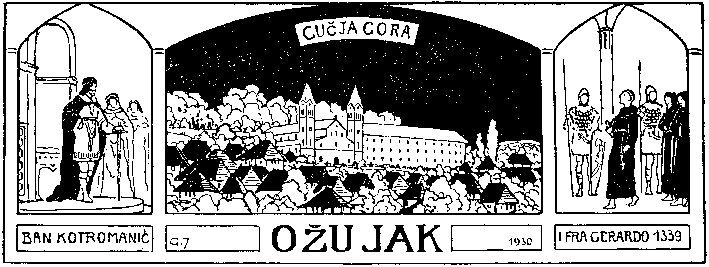
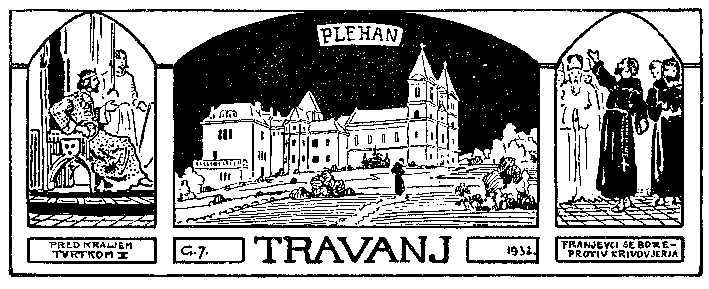
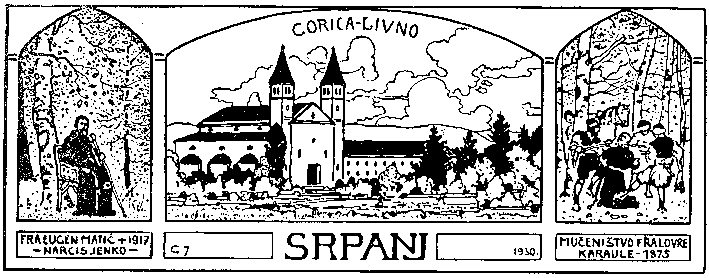
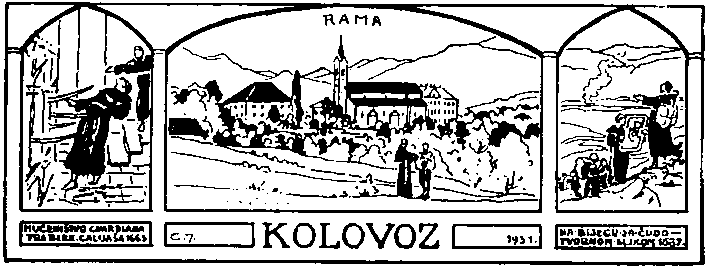
We provide nice drowing by Gabrijel Jurkić of some of the most important monasteries in BiH: in Kreševo, Fojnica, Jajce, Guča Gora, Plehan, Livno, Rama, Visoko:
This list is
for sure
not complete, but it tells us already
enough. It is clear that Catholic churches in Bosnia were much more
numerous than Franciscan monasteries. According to the Turkish census
of population in Bosnia from 1570 even the city of Foca on the river
Drina had Catholic majority at that time. The ethnic and religious
picture of Bosnia - Herzegovina has changed especially drastically in
the 17th and 18th centuries in favor of Muslims and Orthodox
Christians.
In
1658 a Franciscan Ivan
from Foča sent a
request to
the Pope in the Vatican for permission to use Croatian language, "as
was allowed to all priests in the province of Dalmatia" (...come pure
concesta a tuti gli sacerdoti della provincia di Dalmazia), meaning of
course the Croatian
Glagolitic liturgy. See [Strgačić],
p. 388. Here Foča
is a small town on the north of Bosnia (in
Bosanska Posavina, between the towns of Derventa and Doboj), and
not Foca on the river Drina. Many thanks to Mr. Ilija Ika Ilic for this
information.
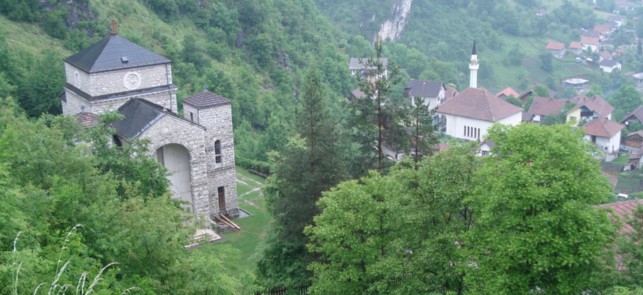
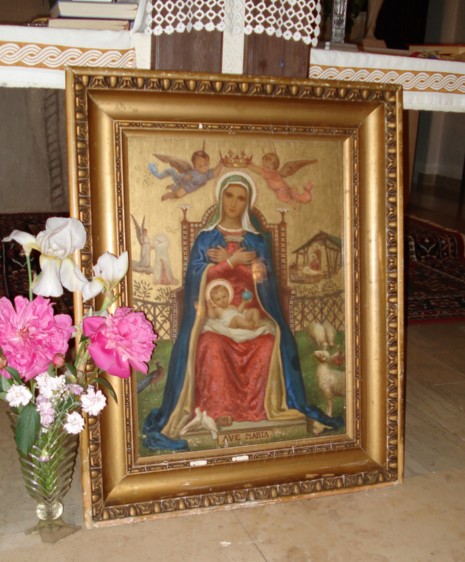
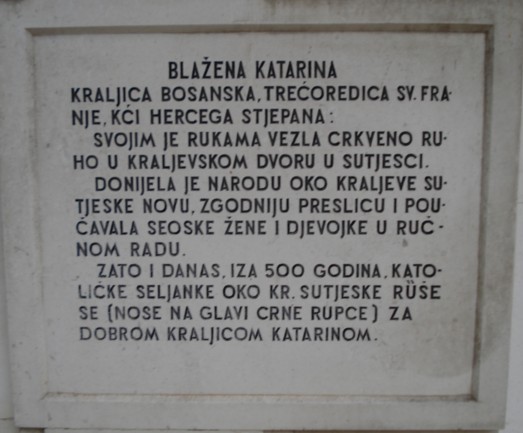
The Olovo Sanctuary. A nice mosque is on its right. Photos by DŽ.The Olovo SanctuaryGospa od Olova (Lady of Olovo)Comtemporary inscription dedicated to Bosnian Queen Katarina
Very important
franciscan monastery of Plehan
with the accompanying
church have been completely destroyed in 1992., using two tons of
explosive, during Greater Serbian aggression on Bosnia - Herzegovina
(1991-1995), see [Baltić,
p. 6
of dr. fra Andrija Zirdum's introduction].
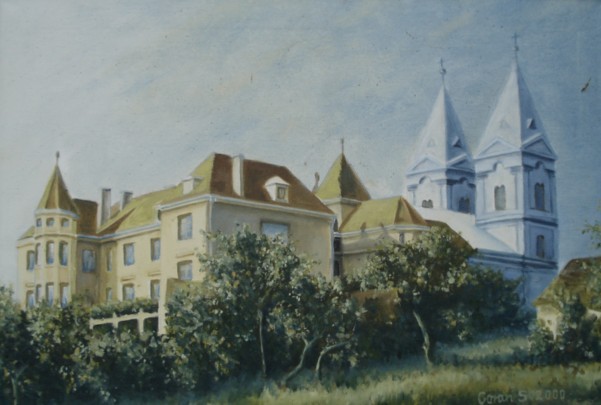
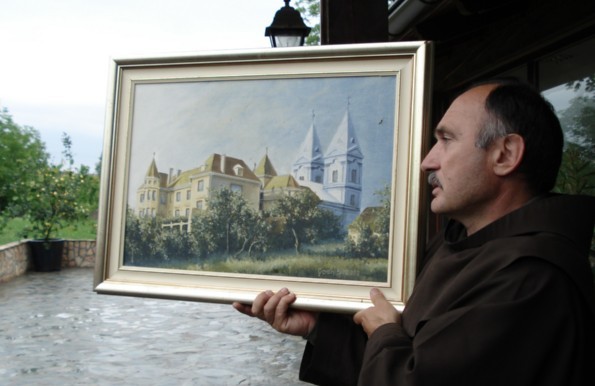
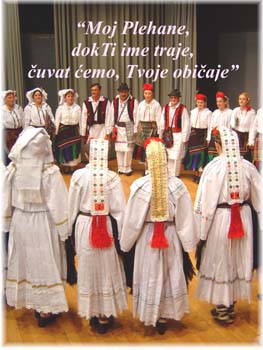
Plehan franciscan monastery (completely destroyed in 1992)Fr. Mirko Filipovic showing a drawing of Plehan Monastery, as it was until its destruction in 1992Croatian costumes from the Plehan area, BiH. Photo from www.plehan.ch
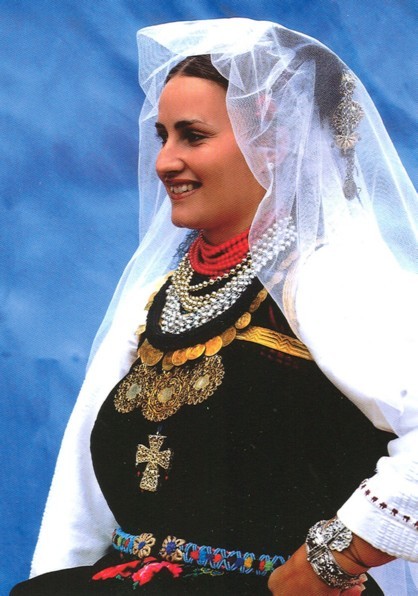
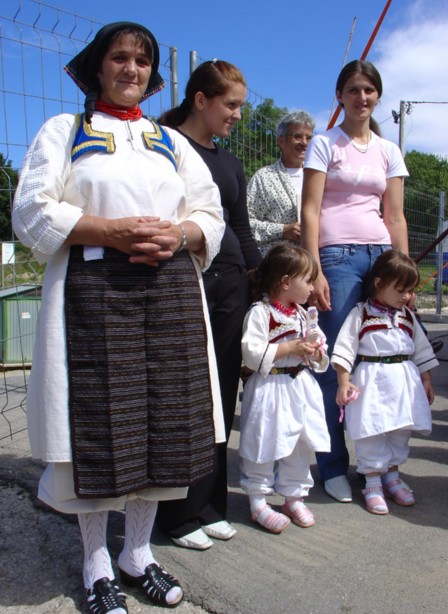
Girl from Rama (part of BiH) in Croatian national costume
A well known fact from
the history of Bosnia (as well as
recent) is that successes in the defense of the Croatian territories
from Turkish onslaughts were followed by savage reprisals over the
remaining Croatian Catholics in occupied areas (in today's Bosnia -
Herzegovina and parts of Croatia). In this way many Catholic churches
and monasteries disappeared and large ares in Bosnia had been emptied
from the Croats. Especially infamous was gazi Husref - Beg, army leader
of sultan Suleiman the Magnificent (16th century).
In this way the emptied
areas had been populated by Muslim
and Valachian settlers. Catholic churches were transformed into mosques
like in Srebrenica, nearby Zvornik on the river of Drina, and in many
other places.
Bosnian Church - Krstyans
An
important and interesting phenomenon
of Bosnian history are Krstyans,
members of the mysterious Bosnian
Church - a Christian religious
sect. Krstyans are also known under
the name of Good Christians (Dobri Krstyani). According to studies of fra Leon Petrović,
reports of Hungarian clergy to the
Pope in 13th century about the "heresy" of Bosnian Krstyans were
unfounded. The "heresy" of Bosnian Krstyans was invented by church
authorities in Budim in order to subjugate Bosnia to Hungary first in
ecclesiastic, and then in political sense. This policy succeeded to
separate Bosnia from the Dubrovnik
Archdiocese (which was also accused for "heresy"!), and to attach it
to the Hungarian Archdiocese in Kalocsa in 1247. Several crusades
against Bosnian "heretics" had been undertaken in the 13th century.
According to recent investigations, their overall number in the 15th
century was already small compared to the Catholic population in Bosnia
(Turkish sources recorded only 700 Krstyans in 1468/69, see [Gavran,
IV, p. 101). They all disappeared with the
fall of Bosnia under Turks in 1463.
According
to Franjo Sanjek, claims about massive
passage of Bosnian and Herzegovinian Krstyans to Islam are historically
unfounded. See his article "Dobri
Muz'je" Crkve bosanskih i humskih
krstjana in Stecak 58/1998,
Sarajevo. See also [Sanjek].
The history of Krstyans of Bosnian
Church is studied in an illuminating monograph [fra
Leon Petrović].
It is interesting that
they had institutions of their own
that they called hizha
(house), while the bishop of the Bosnian
Church was did
(= grandfather), both typically Croatian names,
in dialectal use even today. They were never called ``hristjans'' or
``hrischans'', as would be the case if they were of the Serbian
provenance. The institution of "did" existed also in old Croatian
Kingdom, until its union with Hungary in 1102.
Another important and
well documented fact regarding Krstyans
in Bosnia is that liturgical books of the Bosnian Church had been
transliterated from the Croatian
Glagolitic
sources into Croatian
Cyrillic (Bosancica).
Thus Krstyans are very closely related to the Croatian Glagolitic
tradition.
inscription of prince
Miroslav from Omis, 12th century
(Croatian Cyrillic and Glagolitic),
short Glagolitic
inscription from Posusje (Grac),
containing only two letters (T or V), according to Branko Fucic 12/13th
centuries, see [Damjanović,
Glagoljica na
tlu današnje BiH]
a leaf of Glagolitic
parchment, known as the Split
fragment
(12/13th centuries), held in the treasury of the Split
Cathedral, probably from Bosnia,
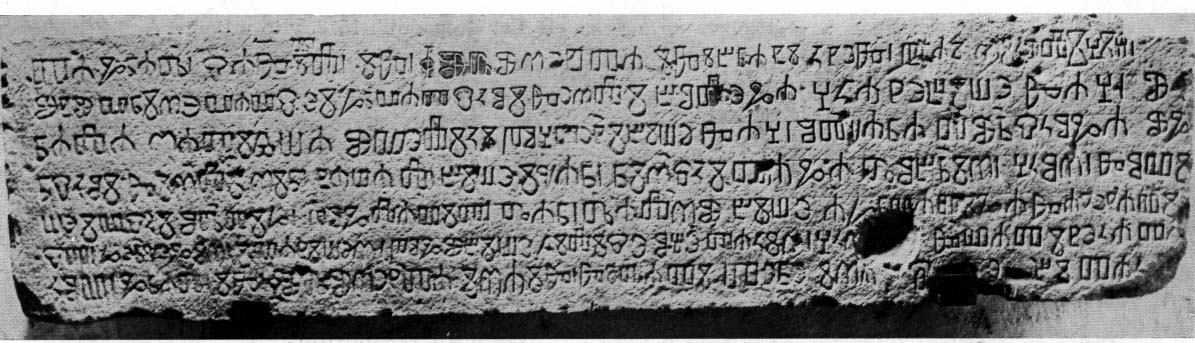
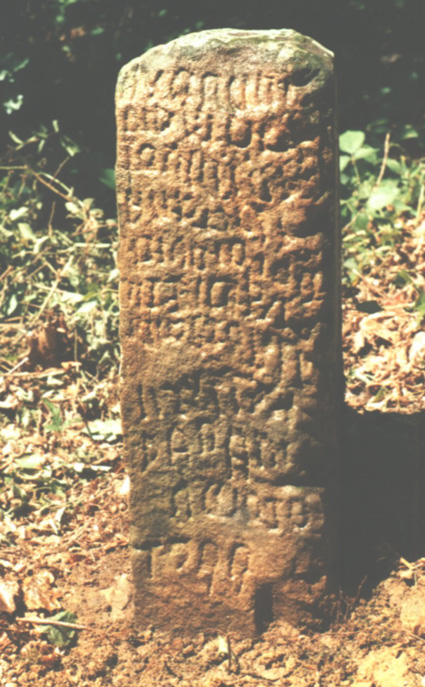
Glagolitic
inscription in Livno, (content:
A SE PI /
SA LU / KA DI / AK / 13 / 6 / 8) 1368, (and three more fragments,
groblje sv. Ive)
[1]
[2]
[3]
[4]
Many
thanks to dr. fra Bono Vrdoljak, Livno,
for this information.
Sokolska
isprava, Glagolitic
quickscript document from 1380,
from western Bosnia (at that time
part of Croatia, in Turkish time called Turkish Croatia),
Kolunići
inscription, 14/15th centuries,
found near
Bosanski Petrovac, with OSTOJA inscribed twice (the first one is
mirror, in reverse order), see [Fučić]
Inscription from
Dragelja, south of Bosanska Gradiska, lost
(there is no photo or drawing)
Čajniče
Evangelistary, 14/15th
centuries, contains a
part written in the Glagolitic script (St John, 17-20), and a
Glagolitic alphabet (incomplete and rather deformed),
Glagolitic inscription
from Bihać (kept in Fojnica), is
still studied,
two glagolitic
fragments on parchment from 14th century are
today in the Franciscan Monastery Livno (Gorica)
Glagolitic document
from Ostrozac near Bihac in BiH, 1403,
vellum with seal on purple silk ribbon, (kept in the archives of
prices' of Auersperg in Ljubljana in 1890's, today probably in National
Library of Ljubljana, [Lopašić,
p. 294]),
Hrvoje Glagolitic Missal,
1404
(held in Constantinople, Library of Turkish sultans Topkapi Saray),
Venice collection
(Mletacki zbornik), written in the
Cyrillic, was transcribed from glagolitic original (Josip Hamm)
Glagolitic
inscription from Golubici
near Bihac in western Bosnia (ie. Turkish Croatia),
carved in 1440 and in 1442, mentioning knez Tomas (ie. Prince Toma
Kurjaković) from Krbava;
it is
held in the famous Franciscan monastery in Fojnica in central Bosnia;
this is the largest glagolitic inscription found on present-day Bosnia and
Herzegovina, see [Fučić,
Glagoljski
natpisi, p. 164];
A detail from the above Croatian Glagolitic monument from Golubići
Glagolitic page
from the
Manuscript of Krstyanin Radosav,
1443 -
1461 (kept in the Library of De Propaganda Fide in Rome), transcribed
into standard Croatian Glagolitic in 18th century by
Matija Sović; the book contains also two Croatian Glagolitic
abecedariums, see one of them;
according to Josip Hamm the whole cyrillic book of Radosav was
transcribed from glagolitic original; Radosav wrote the Nikoljsko
evanđelje, which was also transcribed from glagolitic original;
Glagolitic muniments
from Ostrožac, Ripač, Rmanj, Blagaj, Čovac, Bihać, and Peć (mentioned
by [Kreševljaković]),
Glagolitic inscription
above the main entrance of Fetjija
mosque in
the town of Bihać in western Bosnia, designating the year 1527 in
glagolitic characters (Č, Fi, I, Ž).
The mosque used to be the dominican church before the arrival of
Turks. See [Fučić,
Glagoljski natpisi, p.
96].
Some glagolitic books
are held in the Franciscan convent
Gorica in
Livno. [1]
[2]
Glthe Manuscript
of Krstyanin Radosav,
15th century (which contains
three Glagolitic
notes), held in the Library of De Propaganda Fide in Rome, etc.
Glagolitic
inscription with very
cultivated letters, from Bužim near Bihac in western Bosnia (ie. Turkish Croatia),
mentioning Prince Juraj
Mikuličić,
who built the fortress of Buzim against the Turks; mentions among
others that "U nu vrime va vsei
hrvatskoj zemlji boljega covika ne
bise..." (ie. "At that time
there was not a better man in the whole
Croatian land...", see the second line on the inscription below); it
dates from the end of 15th century, and is held in the Museum of the
City of Zagreb, see [Fučić,
Glagoljski
natpisi, p. 112].
Glagolitic inscription from Bužim near Bihać, end of the 15th century
Bihać, 1543, cursive
glagolitic document (Archives of
Croatian Academy of Sciences and Arts in Zagreb, Acta Croatica), see [Lopašić, Bihać
i bihaćka krajina,
p. 301].
Bihać 1558. - secret message to Gvozdansko, Kostajnica and Udbina about the danger of Turkish onslaughts
Bihać, 1573, message
written in the Glagolitic script about
Turkish preparations to attack the town; with seven seals, see [Lopašić, Bihać
i bihaćka krajina, p. 305].
Turski glasi
(Turkish voices; i.e., secret messages written in Croatian Glagolitic quickscript,
reporting about Turkish troup movements in the then Ottoman Empire,
near the Croatian border). In one of these documents, also the name of Dubrovnik appears written in the
Glagolitic Script.
See [Jolić,
Duvanjski popovi
glagoljasi, pp 297-301], and [Damjanović, Jezik hrvatskih glagoljasa]
There is no doubt that
the oldest phase of the Bosnian and
Herzegovinean literature was Glagolitic. Numerous Cyrillic manuscripts
were translated from older Glagolitic books. This can be seen for
instance in the Mostar
Evangelistary from the 14th
century,
written by Mihajlo Grk, held in the Archive of the Serbian Academy in
Belgrade. The last three glagolites in Bosnia died in 1834.
The last known glagolitic
priest in Bosnia was Jakov Čotić
(1727-1807), nicknamed Jako Čota, who lived in Kupres (Rastično). See
Glas koncila, 6. June 2010.
Here is an interesting monument from central Bosnia with inscription
for which it is difficult to decide is it Croatian
glagolitic, cyrillic,
or something else:
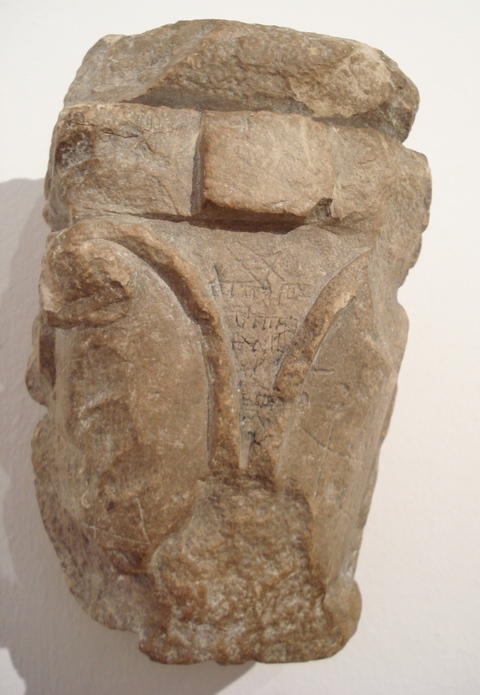
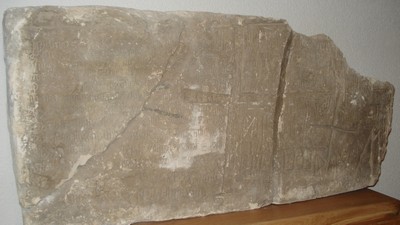
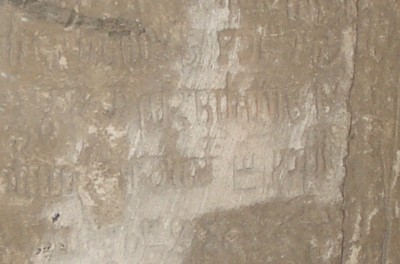
Epigraphic monument in Bosnia with unknown script
It
is interesting that in 1390, Jadwiga,
the Polish Queen and her husband Wladyslaw
Jagiello (Vladislaus
Jagiello), founded a Glagolitic monastery under the invocation of The
Saint Cross. It was established in Kleparz,
the quarter of
Krakow. Glagolitic liturgy existed there for about 100 years. Queen
Jadwiga's mother was the princess Elzbieta
Bosniaczka, that is, Elizabeth of Bosnia.
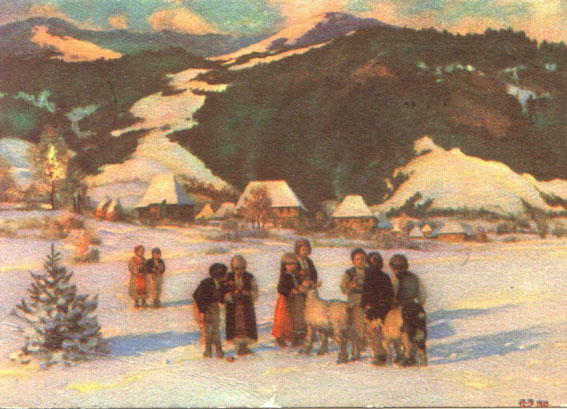
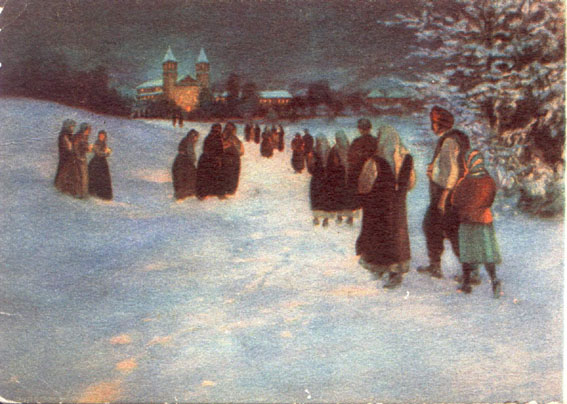
Croatian ikavian dialect Gabrijel Jurkić: Božićna večer u Bosni (Christmas evening in Bosnia)
One
of undoubtedly Croatian linguistic characteristics in Bosnia is a very
widespread use of the ikavian
dialect (an amazing literature
has been written in the ikavian version of the Croatian language, since
the time of Marko
Marulic in the 15th
century, and also earlier by Glagolitic scribes). Even today many
Croats in Istria, Dalmatia, Gorski Kotar, Slavonia, Baranja use it, as
well as the Croats in Austria (Gradišće area), Hungary and
Srijem, Bačka. Many traces of its use can be heard also in Bosnia,
both among the Croats and Muslims, despite intensive serbization of the
language in the period of 1918-1991.
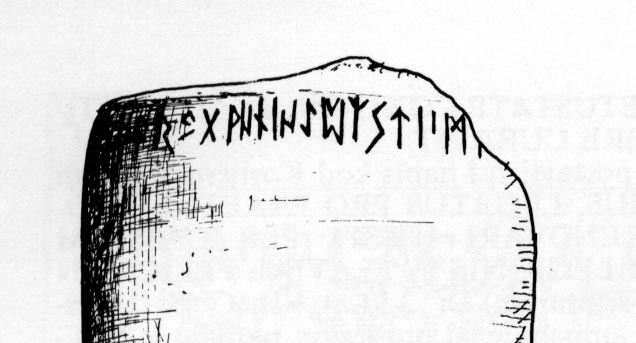
Runic inscription from Breza, 5/6th centuries
The
reader may be surprised to
know that there are even traces of runic script on the territory of
BiH, like the one from the village of Breza in central Bosnia, dating
from 5-6th centuries.
Much more information
regarding ethnic and religious history
of the Croats in Bosnia, Slavonia and Srijem, and their migrations
until the 17th century, can be found in an important monograph [Živković].
Besides the ikavian
dialect, the Croats also use two more dialects:
ikavian,
ijekavian,
ekavian.
To
make out the difference, see how `milk' is
written in these three dialects: MLIKO,
MLIJEKO,
MLEKO,
or `grandfather': DID,
DJED,
DED.
Another classification of dialects can be made
according to how ``what'' is written (= ča, kaj, što):
čakavian,
kajkavian,
štokavian.
The
Croats use all these three dialects. Cakavian exists only among the
Croats and is spoken mostly along the Croatian coast and on the
islands. Today kajakvian is used to a much lesser extent. Stokavian is
the official dialect which is the most widespread. Serbian, Bulgarian
and Russian languages are also stokavian. In Croatia one can encounter
each of nine possible combinations of speeches: ikavian-cakavian,
ikavian-stokavian, ikavian-kajkavian, ijekavian-cakavian,
ijekavian-stokavian (being the most widespread), ijekavian-kajkavian
etc. Ekavian-stokavian dialect is typical for the Serbs.
The ikavian dialect is spoken also in
Slovakia, Ukraine and Bielorussia, which is a consequence of the common
history and very probably of the common roots with the Croats in the
early Middle Ages. Croats are ethnically also very close to the Czech
and Polish people.
Croatian epic persons
Important
representatives of the
Croatian resistance against the Turkish penetration, that entered our
national epic literature, are
What Jeanne d'Arc is
for France, Mila
Gojsalić is for Croatia. In 1543
she saved the Poljica
Principality from the furious
attack of 6,000 Turks. She managed to break into the Turkish camp,
found the ammunition magazine next to Pasha's tent, and sacrificing her
life - blew up the entire encampment.
Petar
Kružić (16th century), the
famous defender of
the Klis fortress near Split. After the fall of Klis in 1537 Kruzic was
decapitated by the Turks. His sister Jelena had to pay 100 gold coins
for his head, which was buried in the Franciscan Monastery of Trsat,
Rijeka. We know these details from a manuscript preserved from that
time, written in the Glagolitic script. See [Fučić,
Terra Incognita].
Mijat
Tomić (17th century), legendary
Herzegovinean
from Duvno,
Vuk
Mandušić (17th century), the
famous defender of
the Šibenik hinterland. His sabre is held in the Visovac Monastery.
Ilija
Smiljanić (17th century),
defender of the
Zadar hinterland (Ravni Kotari).
All of them have been killed by the Turks.
In the vicinity of Zadar (in Ravni Kotari)
there are two neighbouring villages bearing surprising names, unique in
the world, which witness about extremely complex history of Croatia:
Islam
Latinski (that is, Latin
Islam!), and
Islam
Grcki (that is, Greek Islam!).
According
to the investigations of
academician Veselko Karaman there are more than 300 names in the
history of the Croatian literature in Bosnia - Herzegovina. The
earliest known Bosnian writer in general is Matija
Divković
(1563-1631), a Bosnian Franciscan, educated in Italy. He published his
books in the Croatian
Cyrillic (Bosančica).
Archaeology and africanistics in BiH
The
earliest cultural institutions in
Bosnia - Herzegovina were organized by the Croats, including the most
important one: the
Archeological Museum (Zemaljski Muzej) in
Sarajevo (opened in 1888; bombed
during the Serbian aggression in
1992-95). Especially important contributions to our knowledge of the
early history of Bosnia had Ćiro
Truhelka (1865-1942), since
1906 a director of the Archeological Museum. He was collaborator of Croatian Encyclopaedia.
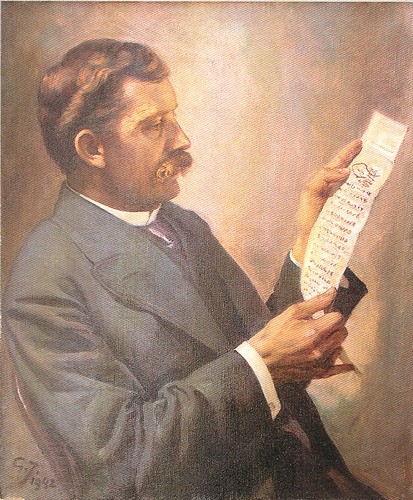
Ćiro Truhelka (portrait by Gabriel Jurkić)
The first literary
periodical Bosanski prijatelj (Bosnian
Friend) in Bosnia and Herzegovina appeared in the middle of the 19th
century. It was edited by Ivan Franjo Jukić in Zagreb.
Two Bosnian missionaries
are among the most important
representatives of Croatian Africanistics:
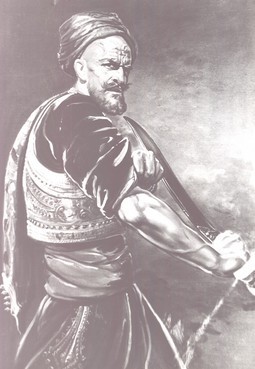
Arts, national costumes, and NapredakZmaj od Bosne - Huseinbeg Gradaščević (1802-1834)
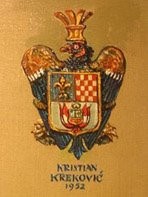
painting by Kristian Kreković, from his series of Croatian historical personsPersonal Coat of Arms of Kristian Krekovic, composed of centuries old Coat of Arms of Bosnia (a lily), also centuries old Croatian Coat of Arms, and of Coat of Arms of Peru, drawn in 1952 during his stay there; see Amigos del Museo Krekovic, Palma de Mallorca, SpainKristian Kreković: Sad Bosnia (Tužna Bosna 1943), study of a head of a Bosnian peasant, published in Hrvatska revija (Croatian Review)
Among important persons
from Bosnia and Herzegovina, let us
mention also
Kristian
Krekovic (1901-1995),
outstanding Croatian born Peruvian artist,
known as Poeta de la pintura,
with his famous Museum in
Palma del Mallorca (Museu
Krekovic) opened by the Spanish Queen
Sophia in 1982. Krekovic portrayed Mahatma
Gandhi in 1936 in his atelier in Paris.
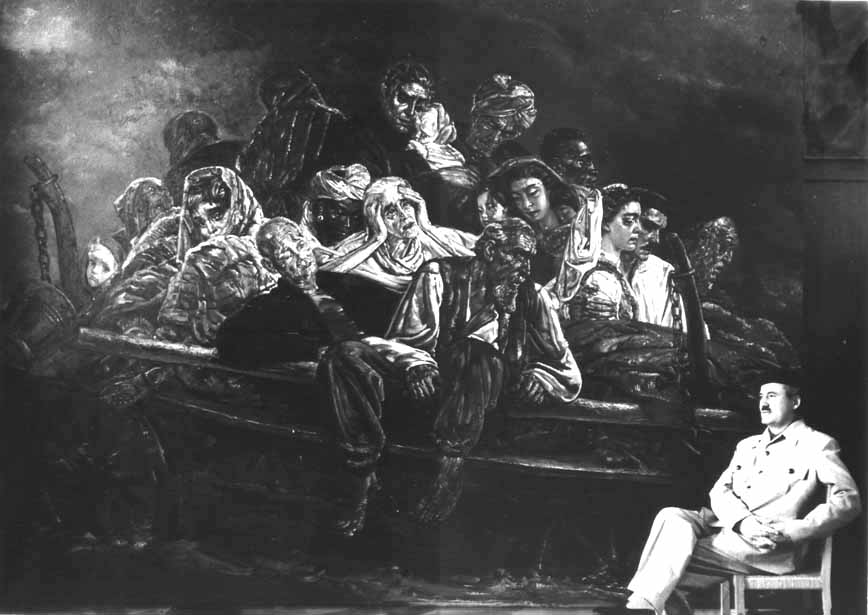
Here is his Exodus
of the 20th century,
with
his autoportrait
with his wife Sina (of a Jewish origin in France)
on the far right (both of them in Croatian national costumes from Lika),
and with all races
represented:
Kristian Kreković: Exodus of the 20th century (kept in Museu Krekovic, Palma de Mallorca, Spain)
Borislav
Arapović, honorary director of
the Biblical Institute in Stockholm,
Sweden, member of the Russian Academy of Sciences. He discovered A Remarkable Address of a Croatian
Minister,
published among others in the Hague (Gravenhage) in 1778.
Saving
the famous Sarajevo
Haggadah (Jewish Bible) in 1941.
The Sarajevo Haggadah surpasses
all the known Haggadas in the world, and is considered to be the most
valuable Hebrew illuminated manuscript in the world.
This Croatian national costume from
Ivanjska, BiH, has been proclaimed the most beautiful at the
international competition in China, 2004, where 60 countries have
participated (photo by Josip Puretić, Svjetlo Riječi; published in [Marić, Orlović])
About
50,000 books have been stolen
from the library of the Sarajevo Theological Faculty during the Greater
Serbain aggression on BiH. About a half of the books of lesser
importance have been returned to the Faculty by the Serbs. For example,
the important Bosniensia
Collection is still not
returned.
Stolen books from various Croatian and BiH libraries can be seen in
various second hand bookshops in Belgrade. Many of these plundered
books have been sold to individuals from western European countries.
Very
important cultural society of
Croats in BiH is Napredak
(meaning "progress"; not to be confused
with Progress,
which is the name of the cultural society of
Serbs in BiH). Napredak
was founded in 1902 and existed
continuously until 1949, when the communist Yugoslav rule dissolved the
society and its numerous offices and branches, and confiscated the
entire movable and immovable property (buildings, libraries, books,
cars, schools, bookshops, stationer's, bookbinderies, etc). The
official 1949 document mentions even confiscation of "eventual
organizations of Napredak
not mentioned in the document". And Napredak
was also the proprietor of cultural and historical collections, choirs,
brass orchestras, student dormitories, etc.
Croatian national costume from Kraljeva Sutjeska, from the monograph by Ljiljana Beljkašić-Hadžidedić
The following list of
offices and branches that have been
dissolved by communist ex-Yugoslavia in 1949 shows clearly the power of
Napredak,
see [Maric,
Pregled..., pp
357-359]:
central head office in
Sarajevo,
county offices in BiH:
Bosanski Samac, Gradačac, Ljubuško,
Posušje, Sanski Most, Široki Brijeg, Teslić, Tuzla, Vareš, Zenica,
Žpeče, Bosanski Brod,
Croatian national costumes in Kraljeva Sutjeska, photos rom a monograph by Ljiljana Beljkašić-HadžidedićThe above photos are from [Beljkašić-Hadžidedić].Croatian woman with
grand-daughters exiled from Kraljeva Sutjeska, living in Udbina, Lika. Photo by DŽ.
We mention in passing that in 1936,
Napredak had as many as 151 branches
with over 20,000 members. Among distinguished members and collaborators
of Napredak
were:
Josip Andrić, Ivo
Andrić (Nobel Prize for Literature),
Vladimir Bazala (philosopher), Enver Čolakovic (poet and writer), Drago
Ćepulić (professor), Mak Dizdar (poet), Dragutin
Domjanić (poet), Krunoslav
Draganović (historian), Milovan Gavazzi
(famous ethnologist), Petar Grgec (writer and leader of the prestigeous
literary society of St. Jerome in Zagreb), Stjepan Gunjača (historian),
Muhamed Hadžijahić (writer), Rudolf Horvat (historian), Štefa Jurkić
(writer), Mile Budak (writer), Kristian Kreković
(painter, stipendist of Napredak during the secondory school), Gabrijel Jurkić
(painter, stipendist of
Napredak), Aleksandar (Aleksa) Kokić (writer from Backa),
Sida Košutić (writer), S.S. Kranjčević (poet and writer), Hamdija Kreševljaković
(outstanding Muslim-Croatian
intellectual), Husein Muradbegović (poet), Alija Nametak (writer),
Vinko Nikolić (poet and writer), Stijepo Obad (historian), Marko
Perojević (historian), Leon
Petrović (historian),
Josip Poljak (medicine specialist and mountaineer), Vladimir Prelog (Nobel Prize for Chemistry),
Tin Ujevic (poet), Nikola Žic
(historian), and many others.
Amongthe greatest
Croatian kajkavian
poets is Dragutin
Domjanić, whose roots are,
according to the family tradition, from Bosnia. The poem below has been
published in 1928 on the occasion of the assassination of Stjepan Radić,
Croatian politician, in the
ex-Yugoslav parliament in Belgrade.
Herceg-Bosni
Dragutin
Domjanić
Povrh
hridi orao tvoj kruži
Guste šume spuštaju se k ravni,
Staze hite niz tvoj cilim travni
K tihom domu, sevdahu i ruži.
Tvrda
ruka tvrdu zemlju pluži,
Al tvoj kamen čuva spomen davni
Sv'jetlih ljeta i junaštva slavnih
Roda, koji i ginuć, ne tuži.
K
tebi lete naših želja jata,
Naša radost tvojoj se veseli, Naša tuga tvojoj pomoć
zeli.
Herceg-Bosno,
- kol'jevko Hrvata,
Bog te čuvo, ponosni nas kraju,
Ti starinom - i moj zavičaju!
Tradicije je u obitelji Domjanic, da
starinom potjecu iz Bosne.
According [Bakšić, p. 159], the immediate reason
for the assasination of Stjepan
Radić in the Belgrade Parliament in 1928 (organized by the Royal
court in Belgrade) was his negative opinion about the demands of the
Serbs concerning "solving the Muslim and Albanian question in the
course of 24 hours" (i.e., by ethnic cleansing).
According to [Bakšić, pp. 51, 182, 211],
during the 1920 elections, out of 24 Muslim MPs of the Constitutional
Council (Ustavotvorna skupština) of the Parliament, 23 of them declared
to be Croats of Muslim faith.
Prof. Hakija Hadžić (1883.-1953.), born in BiH, died in Damask in
Siria. He wrote about three attempts to assasinate Stjepan Radić in BiH
in the period of 1926-1927, in Tuzla, Stolac and Ilidža (see [Bakšić, p. 182]):
Da bi se omela ta politička
suradnja Hrvata islamske i katoličke vjere i da bise tim olakšalo
slobodno vršljanje po Bosni i Hercegovini, osobit se je nastojali
omesti dolazak hrvatskih političkih struja i ljudi iz sjevero-zapadno
hrvatskih krajeva, a napose iz Zagreba. To je išlo tako daleko, da je
sam kralj Aleksandar (preko Pavla Radića, bezuspješno) tražio, neka
Stjepan Radić (1926.-1927.) ne ide u Bosnu i Hercegovinu jer da bi
mogao poginuti (pripremljena mu je bila, ali osujećena pogibija u Tuzli, gdje je pala mrtva glava u
Brezi, gdje su iz zasjede pucali Srbi činovnici, koji su u rudarskim
uredskim prostorijama dulje vremena prije toga vježbali u strijeljanju,
u Stocu (Stolac), gdje je zla
namjera poznatih atentatora osujećena krajnjom odlučnošću hrvatskih
seljaka, te napokon kasnije u Ilidži
kod Sarajeva, kada je na mjesto Stjepana Radića bio došao Pavle Radić i
gdje je ometena četnička zasjeda hrvatskom zaštitom. Što nije uspjelo
izvesti u Bosni, to je 20. lipnja 1928. izvedeno u begoradskoj
Skupštini.
Hrvatskom borcu za slobodu (To Croatian fighter for freedom)
H.S.S. Konjic (Croatian Peasant Society, Konjic)
kotarska organizacija (regional organization)
Source [Stjepan Radić].Stjepan Radić (1871-1928)The building of Napredak in
Sarajevo; notice Croatian
Coat of Arms appearing above on the left; photo
taken in 2008. Dr. fra Leon
Petrović, assasinated by
Yugoslav communist partisans in 1945
without trial.Croatian national costumes in central Bosnia, photo by Anto Čakić - Did
The
anthem of Napredak
was
written by Croatian lexicographer Bratoljub
Klaić, and
composed by a famous Croatian cellist Rudolf
Matz:
Napretkova himna
Silni,
slavni, snazni bili su Hrvati,
kad Tomislav i Tvrdko rasprsise tmine.
Njive
pune cvijeca plodova i vlati,
zlatilo je sunce s nebeske visine.
U
to ropstvo tesko stegnu lance krute,
Narod pade nas u gorka iskusenja.
Al
Napredak dobro javi nove pute i
nadvi nad Bosnom baklju prosvjetljenja.
Planu
nova zora snagom dosad skritom.
Sunce stade opet starim zarom sjati.
Sarajevo,
Zagreb, Mostar s Bijelim Splitom,
viju jedno kolo slozno svi Hrvati.
Among 6,300 stipendists
of Napredak
were two young
BiH Croats:
Ivo Andrić,
Nobel prize
laureate for Literature in 1961,
Vladimir Prelog,
Nobel prize
laureate for Chemistry in 1975.
Another stipendist of Napredak
was academician Ivo
Padovan, president of Croatian
Academy of Sciences and Arts,
Zagreb. It is important to mention that the Napredak
schools
(and not only schools) were open also to Muslims, Serbs and Jews. Napredak
was revived in 1990 with the advent of democratic changes in
ex-Yugoslavia.
The
society Hrvatska Zena
- Croatian
Woman (dealing with
education, humanitarian and social aid);
both photos are from the town of Banja Luka, the second one is from
1938, when a branch of this society was opened (see [Marić,
Orlović]). Hunger among Bosnian children,
1918 (see [Marić,
Orlović])Playing harmonica in Banja Luka, 1920s or 30s, (see [Marić, Orlović])
Gabrijel Jurkić: Magla u Bosni
Gabrije Jurkić: Sunce u Bosni
Gabrijel Jurkić: Vedrina u Bosni
Gabrijel Jurkić: Žetva u Bosni
Gabrijel Jurkić
(1868-1974) was
distinguished Croatian painter in Bosnia and Herzegovina. See his biography
(in Croatian).
Tamburitza
orchestra in the Croatian reading
room in 1908 in Bugojno, Bosnia and Herzegovina. Source [Antun Lucić ed.] Tamburitza orchestra in
Bugojno, Bosnia and Herzegovina, in the first half of 20th century,
directed by a nun. Note that there are many girls. Source
[Antun
Lucić ed.]Mixed tamburitza orchestra, 1908, Kreševo, BiH (photo by DŽ. from the Kreševo Franciscan monastery)Mixed tamburitza orchestra from Kreševo, BiH (photo from the Kreševo Franciscan monastery)
Dolac kraj Travnika, BiH, cc 1900. Photo by the courtesy of Franjo MarićBosnian Croats, with unaviodable "uncles" - Bosnian Franciscans.Tamburaški zbor travničkih
vanjskih đaka, Travnik, BiH 1907. Photo by the courtesy of Franjo Marić.
Hrvatsko pjevačko i tamburaško društvo ZVEČAJ u Zenici (Croatian
singing and tamburitza society Zvečaj in Zenica).
Zenica, BiH 1905. Photo by the courtesy of Franjo Marić.
Croatian women in Bosnia and Herzegovina play tamburtiza instruments as
well.Engineering, two Nobel Prize winners, etc.
Here you can see a lovely
example of Bosnian genius in civil
engineering:
Engineering in BiH...
I am not joking. As I
have said, Bosnia and Herzegovina has
two Croats as Nobel prize winners:
Fra Augustin
Augustinović (1917-1998), born in a village near the town
Prijedor in Bosnia and Herzegovina, served during many years (for
nearly half a century) as a missionary in Venezuela. A result of his
Cursillios was a two volume book entitled Historia de Jesu, published in 1981
in Spanish. It was translated by the author into Croatian (Povijest Isusova I, II)
in 1984 and published in Sarajevo, capital of Bosnia and Herzegovina.
Difficult historical
conditions, relations with very different
civilizations, left deep traces on Croatia and Bosnia - Herzegovina.
One of the consequences is the unusual geographical shape of present
day Croatia. Note that its mainland is not connected (there is a narrow
passage along the Neretva river, where the territory of Bosnia -
Herzegovina enters the Adriatic sea, thus cutting the Croatian soil in
two - an interesting remain of the former Turkish Ottoman rule). It is
little known that until 1949 Bosnia - Herzegovina had another entrance
to the Adriatic sea in the region of Sutorine (between Prevlaka
peninsula and Herceg Novi), which is today in Montenegro. Today quite
unjustly the New Yugoslav state claims the right to Croatian Prevlaka.
Here
we provide a list of Croatian
Latinists who wrote about (or were in other way related to) the Turkish
Ottoman Empire:
Pope
John Paul II visited Bosnia and
Herzegovina twice (1997,
2003), and three times Croatia (1994, 1998, 2003). During his
apostolic visit to Banja Luka
in 2003 he beatified Ivan
Merz
(1896-1928),
Bosnian Croat born in that town.
Exiled Croatian women from Dobretić, praying at the
founding stone of the Nova
Bila Hospital,
Central Bosnia,
(8 members of her family killed), photo by photo from [ČakićS-Did] The trapist monastary of Marija Zvijezda (Mary
the Star) was founded Franz Pfanner, an Austrian trapist. It used to be
the largest trapist community in the world. During a certain period it
had as many as 200 monks.
Bosnia and Herzegovina
(BiH) is full of natural beauties. But
be careful: the country is polluted with mines.
The
largest cave in BiH is Vjetrenica
(wind cave; vjetar = wind), placed near
the village of Ravno, not far from Dubrovnik. It appears under this
name for the first time in 1461 in the minutes of the Dubrovnik
Senat. However, this famous cave was
known already to Plinius the Elder (1st century AD), who mentioned it
in his Natural History (Gaius Plinius Secundus: Naturalis Historiae, in
2, 115). The cave, as well as the nearby village of Ravno,
deserve to be seen (25 km NW from
Dubrovnik).
Also a famous Dubrovnik
15th century scholar Benedikt Kotruljić
mentions this cave near
Popovo not far from Dubrovnik, with miraculous wind: at the entrance
the air is colder in the summer than in Italy in the winter.
The cave is mentioned in his book De Navigatione, 1446 (in Chapter
XXXXVIII, ie. Ch XLVIII), which is the first manual on navigation in
the history of Europe.
Ivan Meštrović,
the most famous Croatian sculptor, agreed for three minarets (45 m of
height) to be built by the Meštrović Pavilion in Zagreb (see [Bakšić, p. 48]). After 1945, with the advent of
communist Yugoslavia, they have been destroyed (in 1948). But even
today in Zagreb
we say Džamija (i.e., Mosque)
instead of the Meštrović Pavilion.
Bono, singer from
U2, recites the famous Gundulic's
verses O lijepa, o
draga, o slatka slobodo from the
17th century in Croatian language
(= Oh
beautiful, oh dear, oh sweet liberty)
in the song entitled Miss
Sarajevo, sang by Pavarotti and
Bono
on the background of this web page (here with kind permission of Nenad
Bach).
Basic
references
related to the history of Croats in Bosnia and Herzegovina
Vjekoslav
Klaić: Poviest
Bosne do propasti
kraljevstva, Zagreb, 1882,
translated also into German (Geschite
Bosniens von den ältesten Zeiten bis zum Verfalle des
Koenigreiches,
Leipzig, 1885) and Hungarian (Bosznia
tertenete a legregibb kortol a
kiralysag bukasaig, Veliki
Beckerek, 1890), reprinted in Sarajevo
in 1990,
Poviest
hrvatskih zemalja Bosne i
Hercegovine (od najstarijih
vremena do 1463), Vol 1 (and the only
one), Hrvatsko kulturno drustvo Napredak, Sarajevo 1942
Reprinted
by Napredak, Sarajevo, in 1991,
under the title Povijest
hrvatskih zemalja Bosne i Hercegovine.
Third edition appeared in 1998. Written by some of the best Croatian
scientists: Ljubo Karaman, Ferdo Sisic, Mate Tentor (his History of
Scripts has been cited by the British palaeographer David Diringer), Ciro Truhelka,
Vladimir Vrana, Marko Perojevic, and
other.
Dominik
Mandić (his exhaustive
monographs are
available at the Library of Congress, Washington):
Državna
i vjerska pripadnost sredovjecne Bosne i
Hercegovine, ZIRAL (Zajednica
Izdanja Ranjeni Labud), Chicago-Rim,
1978 (The National and Religious Affiliation of Bosnia - Herzegovina)
Bogumilska
crkva Bosanskih Krstjana, ZIRAL,
Chicago-Roma-Zürich-Toronto, 1979 (The Bogumil Church of
Bosnian
Krstyans)
Etnička
povijest Bosne i Hercegovine,
Chicago-Roma-Zürich-Toronto, 1982 (Ethnic History of Bosnia -
Herzegovina)
Radoslav
Lopašić:Bihać
i
Bihaćka krajina, mjestopisne i
poviestne crtice, Matica hrvatska,
Zagreb 1890.
Krunoslav
Draganović, o. Dominik Mandić:Herceg-Bosna
i Hrvatska, LAUS, Split, 1991
fra
Ignacije Gavran: Putovi i
putokazi, I-IV, Svjetlo Rijeci, Sarajevo, (1988, 1998, 1998, 2003)
fra
Ignacije Gavran: Suputnici
bosanske povijesti, Svjetlo
rijeci, Sarajevo - Zagreb, 2007., ISBN
978-953-7091-40-8
Pavo Živković:Etnička
i vjerska povijest Bosne,
Slavonije i Srijema do konca XVII. stoljeca,
HKD Napredak, Sarajevo
- Mostar, 1996 (Ethnic and
religious history of Bosnia, Slavonia and
Srijem until the end of the XVIIth century,
Arrival, development
and disappearing of Croatian Catholics in these areas).
Ivan
Zovko:Hrvatsko
ime u narodnoj predaji i
običajima Bosne i Hercegovine,
HKD sv. Cirila i Metoda (sv.
Jeronima) Zagreb, 1990.,
Augustin
Kristić:Kreševo,
Matica hrvatska,
Zagreb, 1941.
Ferid
Karihman:Hrvatsko
- Bošnjačke teme,
Hrvatska sveucilisna naklada, Zagreb 1996.
Franjo Glavinić:
Historia Tersattana,
Reprinted in 1989, Rijeka,
Italian original and Croatian translation, with illuminating afterword
by Academician Eduard Hercigonja,
Dr.
fra Leon Petrović: Kršćani
Bosanske crkve, drugo izdanje,
Svjetlo riječi - Sarajevo, ZIRAL -
Mostar, 1999.
Andrija
Zirdum:
Povijest krscanstva u Bosni i Hercegovini, Slovoznak, Plehan, 2007.
Juko
Baltić: Godišnjak
od
dogadaja promine vrimena u Bosni 1754-1882,
Synopsis, Sarajevo -
Zagreb, 2003 (with introduction of dr fra Andrija Zirdum)
Franjo Šanjek: Bosansko
- humski Krstjani u
povijesnim vrelima (13. - 15. st.),
Barbat, Zagreb, 2003.
"Testimonium
Bilabium" by Filip Lastrić, Bosnian
Franciscan and Latinist from 18th century,
has been studied in
detail by a young Italian scholar Ruggero
Cattàneo, see
a short summary of his extensive work
Hamdija
Kreševljaković: Kratak
pregled hrvatske knjige u Herceg - Bosni, od najstarijih vremena do
danas, vlastita naklada,
Sarajevo 1912.
Fra
Mijo. V. Batinić:
Franjevački samostan u Fojnici od stoljeca 14. do 20.,
Zagreb
1913, reprinted in 1998 by Franjevački samostan Fojnica
dr.
fra Karlo Jurišić: Katolicka
crkva na Biokovsko-neretvanskom području u doba turske vladavine,
Kršćanska sadašnjost, Zagreb, 1972
Pisana
riječ u Bosni i Hercegovini
(The written word in Bosnia and Herzegovina from the earliest times up
to 1918), Sarajevo, 1982.
Ljiljana
Grbelja, Franjo Marić (ed): Žepča
i
njegova okolica, putna crtica od Staparica - Nikole Tordinca iz 1882.,
Ekoloski glasnik, Zagreb 1998., ISBN 953-97331-0-3
Franjo
Marić:
Hrvati
- Katolici u Bosni i Hercegovini između 1463.
i 1995., Katehetski salezijanski
centar, Zagreb 1998., ISBN
953-6055-42-2
Kronologija Žepačkog kraja 1458-1998, Zagreb
Zepce 1999., Ekoloski glasnik, Zagreb 1999.
Pregled
pučanstva Bosne i Hercegovina izmedu 1879. i
1995. godine, Katehetski
salezijanski centar, Zagreb 1996., ISBN
953-6055-18-X
Ljetopis
katoličke zupe Žepče, Hrvatski
klub - Žepče, Zagreb, 2000, ISBN 953-97946-0-9
Pregled
Napretkovih hrvatskih narodnih kalendara
1907.-2002. HKD Napredak, glavna
podruznica Zagreb i sredisnjica
Sarajevo, 2002., ISBN: 953-6383-13-6
Gabrijel Jurkić
u
hrvatskim kalendarima 1926.-1945.,
Donja Lomnica: Ekoloski glasnik,
2003., ISBN 953-98192-6-1
Vrhbosanska
nadbiskupija početkom III. tisućljeća,
Nadbiskupski ordinarijat vrhbosanski, vikarijat za prognanike i
izbjeglice (adresa Kaptol 7, 71000 Sarajevo, BiH), Sarajevo - Zagreb,
2004., ISBN 953-99591-0-1
(with Anto
Orlović)
Banjolučka
biskupija u riječi i slici od 1881. do 2006.,
Biskupski
ordinarijat Banje Luke 2006. (printed in Croatia)
Petar
Oreč: Pisma
i
natpisi iz Zapadne Hercegovine,
Most, br 43-44, Mostar, 1982,
Mirko
Marković: Descriptio
Bosnae &
Hercegovinae, AGM, Zagreb 1998
(in Croatian, BiH on old maps), ISBN
953-174-091-7
Ive
Mažuran: Hrvati
i Osmansko carstvo,
Golden Marketing, Zagreb, 1998.
Géza
Pálffy, Miljenko Pandžić, Felix Toblar: Ausgewählte
Dokumente zur Migration der
Burgendländischen Kroaten im 16. Jahrhundert / Odabrani
dokumenti
o seobi Gradiscanskih Hrvata u 16. stoljecu,
Herausgegeber/Izdavac
Kroatisches Kultur- unde Dokumentazionszentrum Eisenstadt, Hrvatski
kulturni i dokumentarni centar, Željezno, Austria, 1999, ISBN
3-85374-321-8
Die
Gekreuzigte Kirche in Bosnien - Herzegovwina, Die
Zerstörung von Katolischen Sakralbauten in Bosnien -
Herzegowina,
Banju Luka - Mostar - Sarajevo - Zagreb, Kroatisches
Informationszentrum, 1997, ISBN 953-6058-22-7
Roy
Gutman (Pulitzer Prize):Bosnia:
witness of
genocide, Macmillan publishers,
New York, 1993 (French translation Bosnie:
témoin du génocide,
Desclée de Brouwer, Paris
1994; translated into many other languages),
Norman
Cigar:Genocide
in Bosna - The policy of
Ethnic Cleansing, Texas
University Press, 1995,
Komarica: In
Defence of the Rightless,
A collection of documents of the Bishop of Banja Luka and the Bishop's
Ordainary written during the war years of 1991 to 1995, Croatian
Heritage Foundation, Zagreb, 1997
fra
Bazilije S. Pandžić: Hercegovački
franjevci, sedam stoljeća s narodom,
ZIRAL, Mostar - Zagreb, 2001,
ISBN 9958-37-018-2
Vjenceslav
Topalović: Srednja
Bosna - ne
zaboravimo hrvatske žrtve 1941-50./1991-95.,
HIC, Zagreb, 2000
Zdravko
Dizdar, Mihajlo Sobolevski: Četnicki
zločini na području Hrvatske i Bosne i
Hercegovine 1941-1945, Dom i
svijet, Hrvatski institut za povijest,
Zagreb 1999.
Charles
R. Shrader: A
Muslim - Croat Civil War
in Central Bosnia: A Military History 1992 - 1994,
Eastern European
Studies, Texas University Press, 2003
Anto
Cakić - Did: Križni
put Hrvata Srednje Bosne 1992.-1994.,
Busovaca 1996.
[warning - the book contains shocking photos]
Raguz,
Vitomir Miles: Who
saved
Bosnia: and other essays,
Zagreb, Naklada Stih, 2005 . - 363 str.
(in Croatian and English) ISBN 953-6959-28-3
Miroslav
Tuđman: Istina
o Bosni i Hercegovini - Dokumenti 1991.-1995.,
Slovo M, Zagreb,
2005.
Josip
Jurčević: Odnos Republike
Hrvatske
prema Bosni i Hercegovini 1990.-1995., ??
Ivica
Puljić, Stanislav Vukorep, Ðuro Bender
(eds.): Stradanje Hrvata
tijekom Drugog svjetskog rata i poraca u
istocnoj Hercegovini, Zajednica
Hrvata istocne Hercegovine (etc.),
Humski zbornik -V.,
ISBN 953-98747-0-x
Zdravko
Kuzman (ed.) : Stolac
mjesto
spora umjesto razgovora, Stolac
2002., UDK 908(497.6 Stolac)"16"
Ivica
Puljić, Stanislav
Vukorep (eds.): Dubljani,
Humski zbornik X., Ravno
2006., UDK 908(497.6 Dubljani)
Robert
Jolic: Duvno
kroz stoljeća, Nasa
ognjista, Tomislavgrad - Zagreb,
2002., ISBN 953-168-403-0
Vedran
Gligo (ed.): Govori
protiv Turaka/ Orationes contra
Turcas, (summaries: [PDF,
Raukar], [PDF,
Mijatović], [PDF,
Nazor), Logos, Split
1983., 650 pp., with facsimiles
Martin
Gjurgjević: Memoari sa
Balkana
1858.-1878., Stolac, 2000. (reprinted from the 1910 edition, Sarajevo),
UDK 821.163.42(497.6)-94
Marko
Dragić: Od
Kozigrada
do Zvonigrada, Hrvatske predaje
i legende iz Bosne i Hercegovine
(II.), Mala nakladnu kuća sv. Jure, ZIRAL - Zajednica izdanja Ranjeni
labud, Baska voda, 2001, ISBN 953-96497-6-5
Marko Dragić: Deset kamenih mačeva / Hrvatske
legende i predaje iz BiH (I.), 1999., Mala naklada Sveti Jure, Baška
Voda. 250 str.
Hamdija
Hajderhodžić: Bosna,
Hrvatska, Hercegovina;
zemljovidi, vedute, crteži i zabiljeske
grofa L.F. Marisglija krajem XVII stoljeca, AGM, Zagreb 1996., ISBN
953-174-030-5
400
Jahre Kroaten in Wien / 400 ljet Hrvati u Becu,
Kroatisches Zentrum, Wien, 2009, ed. Petar Tyran, Josip Seršić and Mijo
Jurić, catalogue of exhibition Vienna.
Stolačko
kulturno proljeće,
Godišnjak za
povijest i kulturu, godiste VII, 2009
Ismet
Huseinović, Džemaludin Bahić: Svjetlost
Europe u Bosni i Hercegovini,
(collection of old photographs),
printed by "Čakovec i Zrinski", Buybook, Sarajevo 2004, ISBN
9958-630-39-7
Ljiljana
Beljkašić-Hadžidedić: Hrvatska
tradicijska nošnja iz Kraljeve Sutjeske,
Kraljeva Sutjeska 2005., ISBN 9958- 9256-0-5
Zvonko
Martić (ur.): Tradicijska
odjeća i nakit Hrvata Bosne i Hercegovine
(Traditional Attire and
Jewelry of the Croatian People of Bosnia-Herzegovina) , KIZ - Hrvatska
karmelska provincija sv. oca Josipa, Zagreb 2006, ISBN 953-6621-18-5
Zijad Duraković: Asaf Duraković, hrvatski književnik, hrvatski, kanadski i američki liječnik, Nova Istra br. 3-4, Pula 2022., str. 58-68.
Turski glasi
(Turkish voices; i.e., secret messages written in Croatian Glagolitic quickscript),
reporting about Turkish troup movements in the then Ottoman Empire,
near the Croatian border. In one of these documents, also the name of Dubrovnik appears written in the
Glagolitic Script.
Bihać 1558. - secret message to Gvozdansko, Kostajnica and Udbina about the danger of Turkish onslaughts