Croatia - historical and cultural overview
© by Darko Zubrinic, Zagreb (1995)Local index:
Although Croatia developed under the impact of many different cultures - Greek, Roman, Celtic, Illyrian, Austrian, Hungarian, Byzantine, Islamic - it gave its own and unique imprint to the history of European civilization.
See Prehistoric Archaeology in Croatia.
Let us first give a very rough sketch of the main historical periods of the Croatia's past:
- the arrival of the Croats to the Balkan peninsula at the beginning of the 7th century,
- the period of Croatian Princes and Kings of native birth (until 1102),
- Croatia sharing with Hungary a new state under common Hungarian and Croatian Kings (1102-1526),
- Croatia ruled by the Habsburgs, as a member of the Habsburg Crown (1527-1918, Austrian-Hungarian Empire from 1867 to 1918), parts of Croatia under Venice, Turkish Ottoman Empire and France,
- Croatia in the first Yugoslavia (1918-1941),
- The Independent State of Croatia (1941-1945),
- Croatia as a republic in Tito's (or second) Yugoslavia (1945-1991),
- internationally recognized Republic of Croatia (January 1992).
Croatia is a point of contact of very different cultures and civilizations. Across its territory or along its boundary
- the border between Western and Eastern Roman Empire had been laid by the Roman Emperor Theodosius in 395,
- the border between Francs and Byzantium (9th century),
- between Western and Eastern Christianity (11th century),
- and between Islam and Christianity (15-19th century).
Aucune
frontière en Europe n'est
plus lourde d'histoire que celle qui sépare Rome de
Byzance, l'Occident de l'Orient.
[Gregory
Peroche], p. 250.
The origins
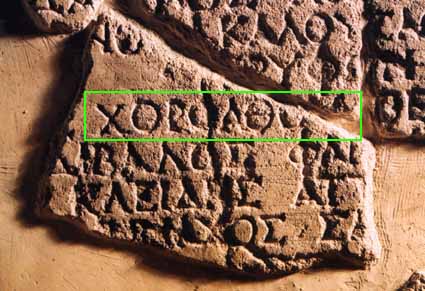
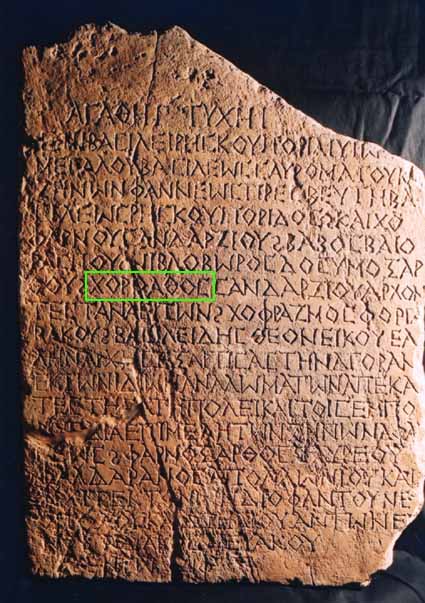 The
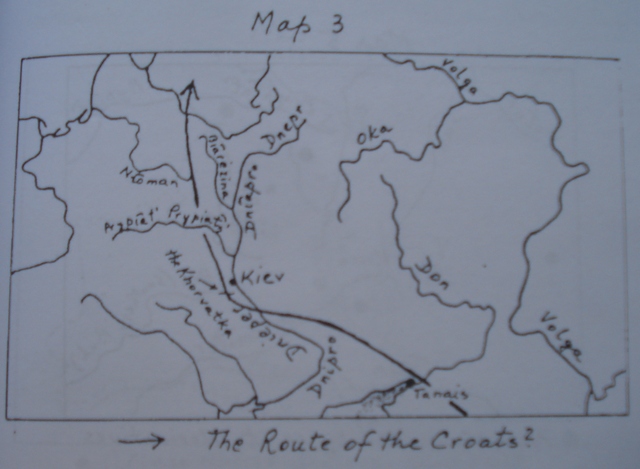
origins of the Croatian name are Iranian. The earliest mention of the
Croatian name as Horovathos
can be traced on two stone
inscriptions in Greek language and script, dating from around the year
200, found by the Black Sea (more precisely in the seaport Tanais on
the Azov sea, Krim). Both tablets are held in the Archeological museum
in St Petersburg, Russia.
The
origins of the Croatian name are Iranian. The earliest mention of the
Croatian name as Horovathos
can be traced on two stone
inscriptions in Greek language and script, dating from around the year
200, found by the Black Sea (more precisely in the seaport Tanais on
the Azov sea, Krim). Both tablets are held in the Archeological museum
in St Petersburg, Russia.
One of the confluents to Don river near the region of Azov is called Horvatos (see [Pascenko], p. 87). The Croatian name can be traced to different sites in Ukraine, also around Krakow in Poland, in Bohemia, and Austria, thus showing migrations of the Croatian tribes to their future homeland.
In the ``Bavarian geographon'' (written in 666-890) there is a description of various tribes in the north of Karpatian and and Sudetian mountains, where the Croats are also mentioned.
In the region of northern Steiermark, Austria, (between Judenburg and Leoben) there is a place called Kraubat. The name appears many times in various charters of the 11th and 12th centuries, and is written as Chrowat (= Croat).
In the region of Kärnten (old Karantia in the south of Austria) there is a place called Kraut, also derived from the Middle Age name Chrowat, mentioned in many charters of the 11th and 12th centuries.
In Kärnten
(Karantia) there existed a Croatian parish
already in the 10th century. Old manuscripts call it pagus
Crouuati,
which is obviously derived from the Croatian name (= Croatian parish).
The name appears even in Royal charters. According to investigations of
Felicetti this parish of `pagus Crouuati' spread precisely along the
Gosposvetsko polje, where the earliest Slavic Princes of Karantia had a
seat. It included also the region of today's Klagenfurt (Celovec),
capital of Karantia, together with the famous Church of Gospa Sveta
(Maria Saal, Maria in Solio, Maria ad Karanten), probably the oldest
Christian church in the region.
The
above information regarding the Croats in
Austria are taken from Ferdo Sisic, one of the greatest Croatian
historians.
White Croats
Constantine Porphyrogenitus (905-959), a Byzantine emperor and writer, mentions the state bearing the name of White Croatia. His description shows that it occupied a wide region around its capital Krakow, in parts of Bohemia, Slovakia, and Poland. The state disappeared in 999. St. Adalbert (Vojtech, 10th century) was a descendant of the White Croats, son of the White-Croatian prince Slavnik. He was spreading Christianity, education and culture, and to this end founded the benedictine monastery in Brevnov in 993. Also St. Ivan Hrvat, who died in Tetin in Bohemia in 910, was a son of White-Croatian King Gostumil. It is interesting to add that according to some American documents from the beginning of the 20th century there were about 100,000 immigrants to the USA born around Krakow (Poland) who declared themselves to be Bielo-Chorvats, i.e. White Croats by nationality. See US Senate-Reports on the Immigration commission, Dictionary of races or peoples, Washington DC, 1911, p. 40, 43, 105.White and Red Croatia in the new homeland, described in in one of the earliest known Croatian historical and literary texts - Ljetopis popa Dukljanina.
Even today the descendants of the White Croats live in Bohemia. The surname Charvat is still rather widespread there. For example a director of the National Theatre Opera in Prague in 1990's was Mr Premysl Charvat. An outstanding person in part of Prague called Nove Mesto was Jan Charvat (+1424). In the same quarter of Prague there is a street called Charvatska street even today. Villages in Bohemia like Harvaci, Harvatska gorica reveal its early Croatian inhabitants.
According to the Prague
Telephone Book
1999/2000 there are as
many as 516 individuals having names of possible Croatian root:
CONCLUSION: Since the capital of Bohemia today (in 2000) has about 1,250,000 inhabitants, than assuming that each telephone subscriber has at least three closest relatives in the mean, we obtain that in a random set of 800 Prague citizens there will be at least one with Croatian name. Many thanks to my dear friend Mr. Vlatko Bilic for painstaking counting :)
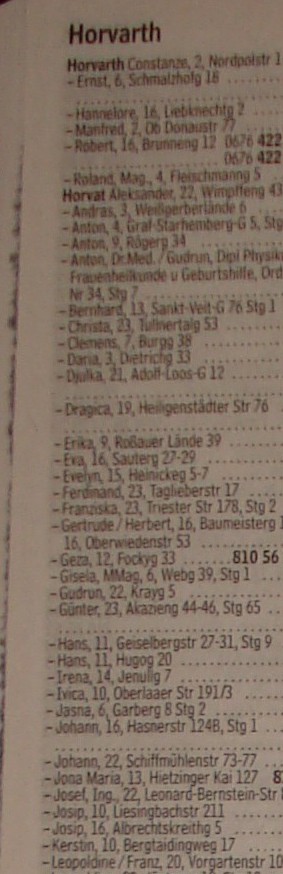
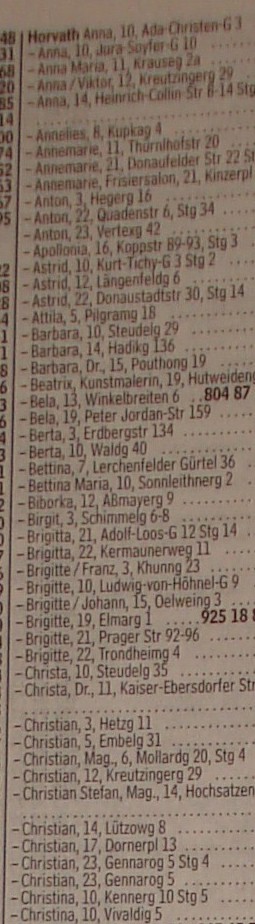
Croatian national name Horvat
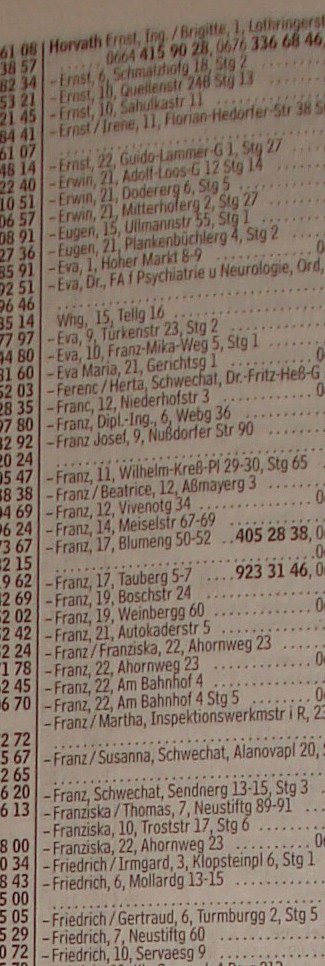
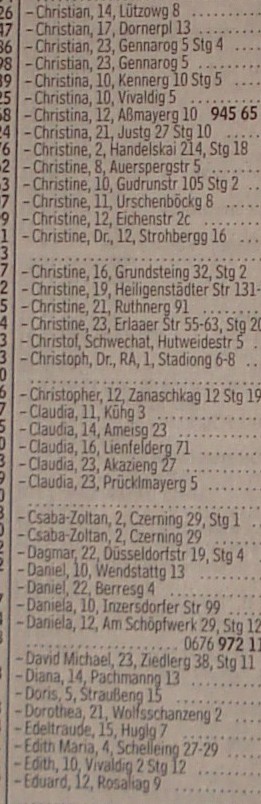
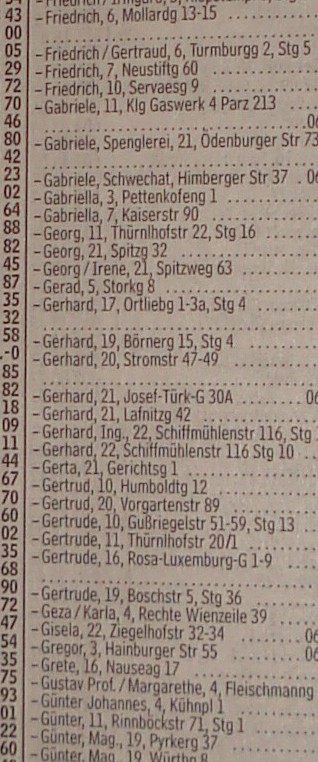
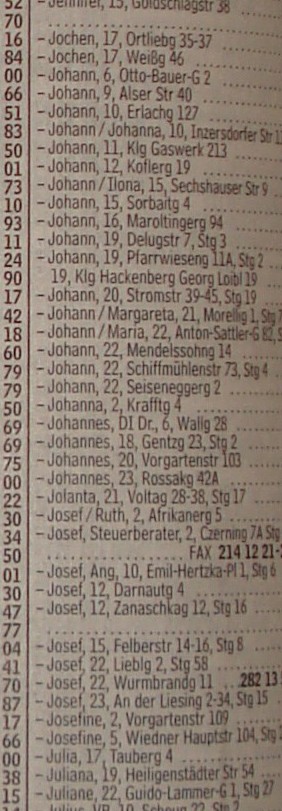
in the Vienna Telephone Book, Austria
 |
 |
 |
 |
 |
 |
 |
 |
 |
 |
 |
 |
|
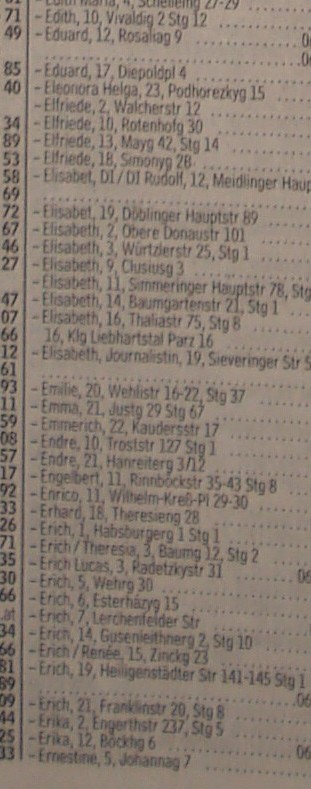
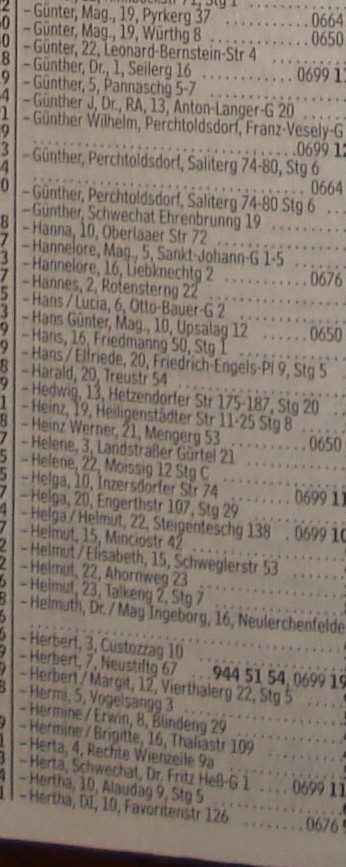
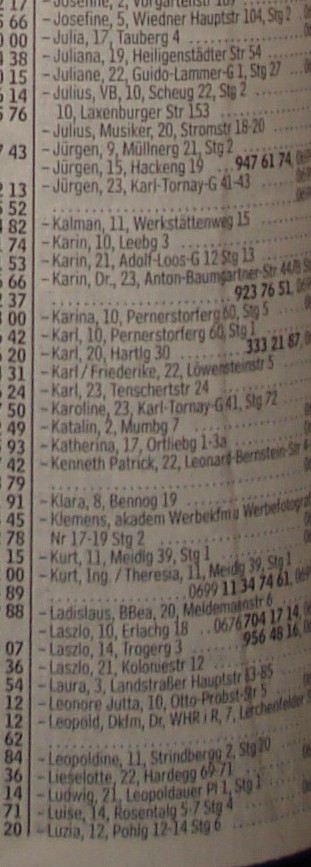
The above table represents only one page from The Vienna Telephone Book (2007). Its four columns contain the following second names: Horvarth, Horvat, Horvath All of them are variations of the standard Croatian name that we use today: Hrvat (HR), the English version of which is Croat or Croatian. Please, note that we do not claim that all these persons from the book are Croats by nationality. But it is without any doubt that the source of their second names is Croatian. The next page in the Vienna Telephone Book is almost entirely, throughout more than three columns, filled with other versions of Croatian name: Horwath, Horwarth, etc. We have counted more than 100 such names per column, which makes altogether about 700 explicit Croatian second names in the book! But many names in the telephone book correspond to a family. If we take two or three members per family in avarage, then we see that in Vienna only there are probably between 1400 and 2000 persons (if not even more), bearing the Croatian second name. For the entire Austria the corresponding number is, of course, much larger. Similar is the situation in Prague (Czechia), Budapest (Hungary), Bratislava (Slovakia), and in Ljubljana (Slovenia). Why is the Croatian name so frequent in the mentioned countries? A part of the story is related to White Croats, and another part is here. For comparison, in The Zagreb Telephone Book (Zagreb is the capital of Croatia) the second name of Horvat and its various derivatives Horvacic, Horvat, Horvatec, Horvatek, Horvath, Horvaticek, Horvatic, Horvatin, Horvatincic, Horvatinec, Horvatinovic, Horvatovic, Horvatus, Hrvacanin, Hrvat, Hrvatic, Krobat, Krobot appear more than 2,800 times! See the flag of Croatian defensive forces in 1526 during the tragic battle with the Turks on the Mohac Field, and another Croatian flag from 1529 during the first Turkish seige of Austria's capital Vienna. During the second Turkish siege of Vienna in 1683, a Croatian village called Krowotendörfel, placed immediately near the city walls, has been destroyed, and since then it does not exist any more. The meaning of its name is precisely Croatian Village! Its position corresponded to contemporary Spittelberg near the Hofburg palace. For more details see [400 Jahre Kroaten in Wien]. Other names of Krowotendörfel can also be encountered in the literature:
Among defenders of Vienna in 1683 was a renowned Croatian theologist and ecumenist panslavist Juraj Krizanic, who was assasinated during the Turkish seige. |
The Slavnik family had its coins with inscription Mulin Civitas, issued by Prince Sobjeslav (?-1004), the oldest son of Slavnik. This confirms that the fortress of Mulin near Kutna Hora (west of Prague in Bohemia) was a part of their territory. It is assumed that the Slavnik's were the leading tribe of the Croats in the 10th century in that region. Their main seat was in the town of Libica, west of Prague (near Kutna Hora). Thus we had two parallel Croatian states in that period: White Croatia in Central Europe and Dalmatian-Panonian Croatia near the Adriatic sea.
In 995, when White
Croatian troops led by Sobjeslav were
defending their Princedom from pagan tribes, White Croatia was
suddenly attacked by the Czech prince Premysl, destroying
their capital Libice and killing most of the Croatian
population. There
are some conjectures that several noble families in Poland
(like Paluk's) are descendants of White Croats, as well as
the family of Rozomberk (which seems to be related to the town of
Ruzomberok
in Slovakia). Sobjeslav was killed in 1004 on a bridge over
Vltava river in Prague, when Polish troops tried to occupy
the city.
See Ivica Sumic: U potrazi za "Hrvatskom Atlantidom" (In the
quest of "Croatian Atlantida"), Stecak, Sarajevo, No 64,
1999.
The following map of Chrobatia (around Krakow, 10th century) is from the Atlas To Freeman's Historical Geography, Edited by J.B. Bury, Longmans Green and Co. (Third Edition 1903):
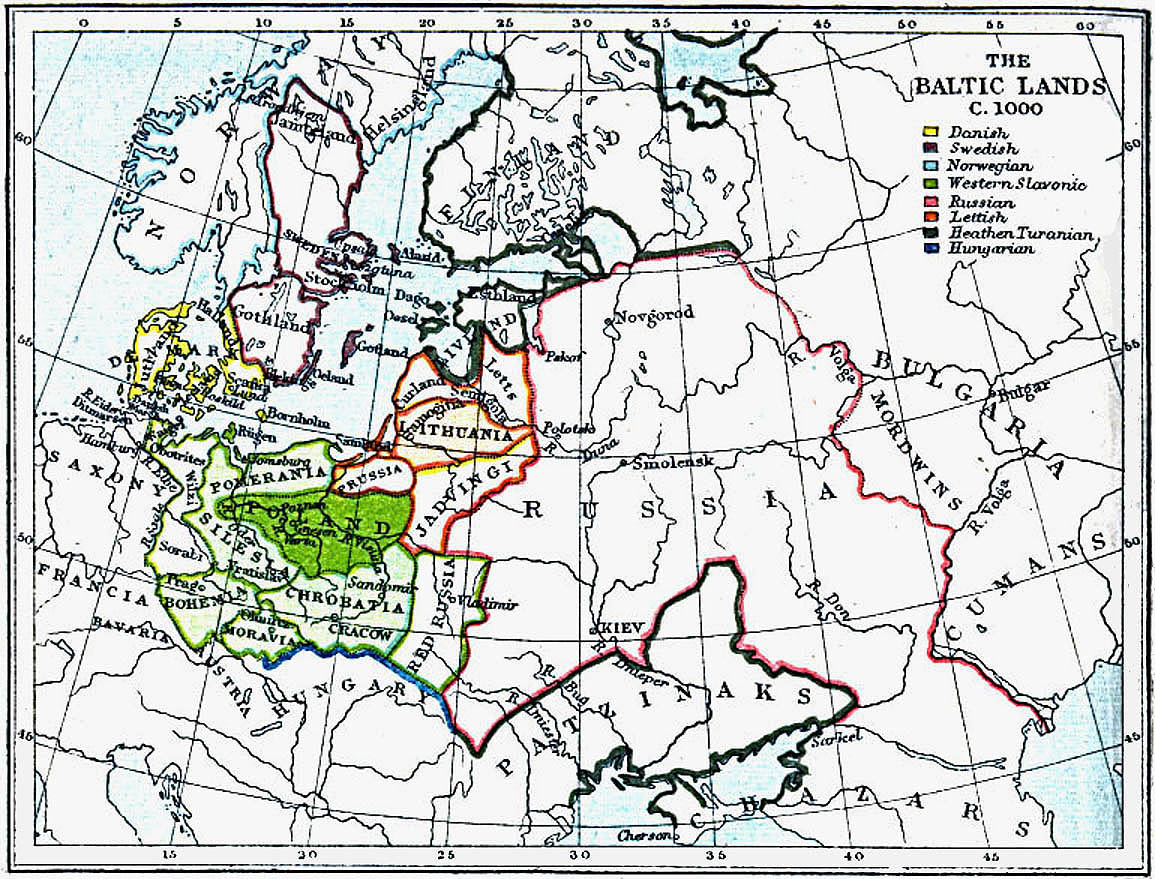
Source file at Sun Site - Central Europe.
The name of the Croats is met in many places throughout Ukrainian soil. It is contained in Ukrainian written documents since the 2nd century until the end of the 10th century. The famous Ukrainian chronicler Nestor from Kyiv (in his "Povest vremennyh let", 1113) mentioned also the White Croats inhabiting early-medieval Old-Ukrainian empire, known as the Kyiv Rus'. According to a very old legend, one of the three brothers who founded the Ukrainian capital Kyiv was Horiv, whose name might be at least hypothetically related to the Croatian name: Horvat. See [Hrvatska/Ukrajina], p. 9, and [Pascenko], p. 105. Even today some of the Ukrainian citizens say for themselves to be the White Croats. There are many proofs that the Croats once lived in common with Ukrainian and Slovak people: their language (very widespread ikavian dialects in Croatia and Slovakia, ikavian language in Ukraine), legends, customs, many common toponyms etc.
In central part of Kyiv there are three hills: Starokyivska gora, gora Shchekovitza and gora Horevitza, and even a street Horev (ulica Horeva). The very beginning of Nestor's "Povest Vremennyh let" mentions the above legend: I bysha tri brata: Kij, Shchek i Horev, i sestra ih Lybed'. I sotvorisha grad vo imya brata svoego, i narekoshe ego Kyiv.
Ukrainian archaeologist
Dr. Orest Korcinski has undertaken an
extensive study of White Croatian site from 8th-11th centuries near the
town of Stiljsko, not far from Lviv in Ukraine. He estimates that in
the 9th century the Stiljsko archaeological site
with environinig
settlements had nearly 40,000 inhabitants, more than Kiev at that time!
See
Stilskyi Grad (in Ukrainian), Volume 1, Lviv 2017, ISBN 978-617-655-173-7, in particular se the following article by Orest Korchynskyi: Archological sites of historical-cultural reserve "Stilske Gorodysche", pp 125-154 (in Ukrainian), Summary (p. 154): ... It has been established that the sites of Early Middle Ages of the VIII-X centuries, such as Stilske and Iliv hill-forts, cult centers and earth dam in Dubrova village, and cave temples on the outskirts of Mykolaiv, belong to the Eastern Slaves - Carpathian Croats, mentioned in the "Tale of the Past Years", Arabian-Persian and Byzantine sources of VIII-XI centuries.
The region of historical Pagania around the Neretva river has many common toponyms and hydronyms with Western Ukraine, like Neretva, Mosor, Ostrozac, Gat. Also Sinj, Kosinj, Kostrena, Knin, Roc, Modrus, and many other throughout Croatia and Western Bosnia. Too many to be just an incidence.
There are numerous names of villages, hills and rivers in Slovakia, Czechia (especially in Moravia), Poland and Ukraine, which have their obvious equivalents in Croatia and Bosnia - Herzegovina. Many of them are indeed surprising:
The once prosperous and rich Ukrainian village of Horvatka near Kyiv (note well: Horvat = Croat) disappeared overnight in 1937, together with all of its inhabitants, during Stalin's infamous collectivization, sharing the tragic destiny of millions of Ukrainians. The only witness is an innocent brook, called Horvatka, today Hrobatka (Hrovatka), about 70 km south of Kyiv. See "Marulic", 1998/2, p. 263, and also [Pascenko], p. 293. On the brook of Hrovatka (~30 kms long right confluent of Dnipro) there is a village bearing the same name Hrovatka, personal information (2010) by mr. Djuro Vidmarovic, former Croatian ambassador to Ukraine In the 1990s in Kyiv, Ukraine, a youth organization of scouts was founded, and named - White Croat (Bili Horvat; reported by Croatian ambassador Gjuro Vidmarovic in 2000)!
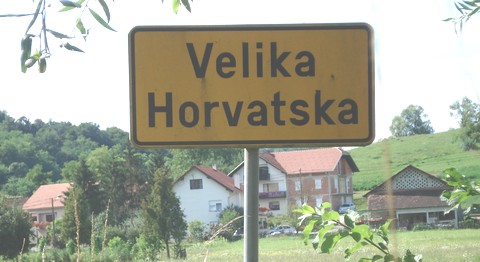
On the north of Croatia's captial there is a very small village called Velika Horvatska (Great Croatia!), and a small brook bearing the name Horvatska. It reminds us about existence of White Croatia. We find it pertinent to mention that we know of several cases during former Yugoslavia in which young Croatian soldiers were not allowed by Serbian officers to declare that they were born in the village called Velika Horvatska, but were pressed to declare a nearby village Zbilj.
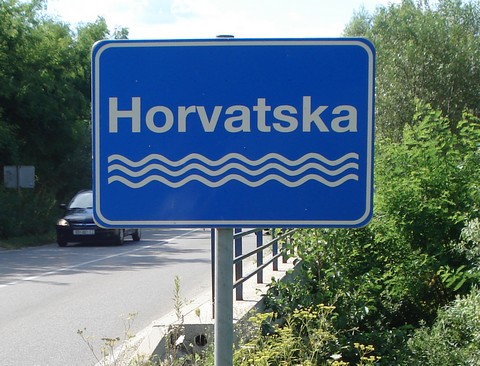
The brook of Horvatska near the village of Velika Horvatska. Another village of Horvatska exists near Klenovik, SW of the city of Varazdin north of Zagreb (many thanks to mr. Nenad Hancic, Duesseldorf, Germany, for this information).
According to actacroatica.com/hr/surname/Horvat/, the name of Horvat with its numerous variants (Horvath, Horwath, Thorvat, Horváth, Horwat, Horvát, Thorwat, Horvatt i Horvaht) can be found in as many as 88 countries worldwide. As of 2018, the second name of "Horvath" have as many as 100,000 persons in Hungary, 40,000 in the USA, and 20,000 in Germany. The second name of "Horwath" is born by 3,000 persons in the USA, 500 in Austria, and 400 in Germany.Old Norwegian - Viking travel writers Sigurd, Ohtere, and Wulfstan from the 8th century mention the Kingdom of Krowataland on the territory of today's Ukraine. It has been investigated by a Czech historian and writer Karel Krocha.
The Byzantine Emperor Heraclius (610-641) asked the Croats from White Croatia for help in protecting his Empire from the penetration of the Avars. As written by Byzantine Emperor Constantin Porphyrogenetus from the middle of the 10th century, a part of the White Croats, led by
and five brothers Kluk, Lobel, Muhlo, Kosjenc, Horvat,
moved to the territories of present-day Croatia. This happened in the 7th century. There they came in touch with the Romans and romanized descendants of Illyrians, Celts and others.
Soon after their arrival in the 7th century Croatians were baptised and so accepted Christianity. The Croats were the first among the Slavs who converted to Christianity.
According to Byzantine ruler Constantin Porphyrogenetus, the Croats made an agreement with the Pope Agaton as early as in 679, in which they obliged themselves not to undertake any offensive wars against neighbouring Christian states. This was the first international diplomatic agreement of the Croats with the Holy See. The importance of this event has been pointed out by the Pope John Paul II in his speech held in the Croatian language during his apostolic visit to Croatia in Zagreb in September 1994. The Pope also stressed the importance of more than 13 centuries of Christianity among the Croats.
Pope John Paul II had his second apostolic visit to Croatia in 1998, on the occasion of beatification of Cardinal Alojzije Stepinac.
An Italian cartographer Allodi in 1730 draw two Croatian Kingdoms: the one is Regno de Croazia on the Adriatic, and another is Belocroati (White Croats) situated between Moravians and Romanians north of the Carpathian Mountains. See Mile Vidovic, Povijest crkve u Hrvata, Crkva u svijetu, Split 1996., p. 29, or [Jolic, p. 117] relying to the same reference, and see also Vicko Rendic.
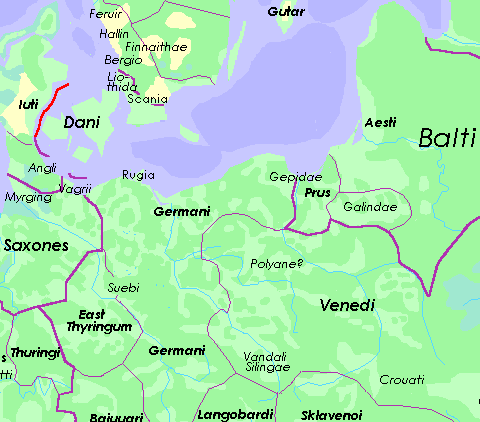
The Croats, indicated as Crouati, see on the above map (below right). The map is from AD 500, source Irlande, Bretagne, Scandinavie et Germanie Septentrionale.
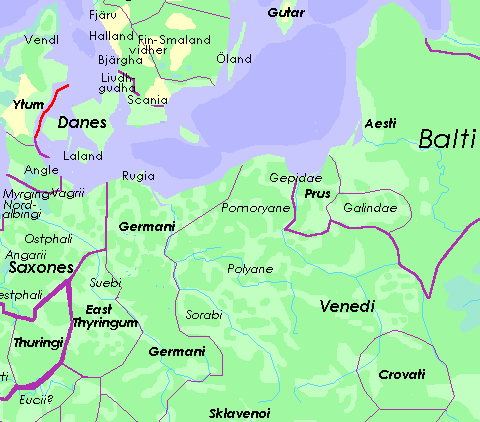
The Croats, indicated as Crouati, see on the above map (below right). The map is from AD 540, source Irlande, Bretagne, Scandinavie et Germanie Septentrionale. Many thanks to Mr. Stipe Botica from the Faculty of Arts and Letters, University of Zagreb, for his information about this source.
See also [Klaić: Hrvati i Hrvatska...] and [Grčević, Ime "Hrvat" u etnogenezi Ju¾nih Slavena].
Mario Grčević: Ime "Hrvat" u etnogenezi ju¾nih Slavena, Zagreb - Dubrovnik 2019. (for Boka kotorska, see pp. 18-20, 55-57, 67, 68, 80, 117, 219-221, 223; Crna Gora: 15-19, 22, 27, 33, 35, 36, 57, 62, 65-69, 75, 77, 93, 95, 99, 136, 154-158, 160, 161)
The Roman Empire was divided in 395. Later the Croats entered the Western Roman Empire. The historical border between the Eastern and Western Roman Empire was the river Drina. It flows between present Serbia and Bosnia, and in the past it divided in political and cultural sense, two very different civilizations, which had been separated until the penetration of the Turks in the 16th century. Later in 1054 this division also defined the border of the two Churches, one under Byzantium (Constantinople) and the other under Rome. Let us mention that Montenegro and Albania belonged to the Western Church. In 1184 the Serbian Orthodox Church penetrated by military expansion to Montenegro. Until that time the territory of Montenegro was a part of Red Croatia. Serbia, and later Montenegro, developed on the heritage of the Eastern Roman Empire (or Byzantine Empire).
Today the name of Montenegro is Crna Gora (Black Mountain). However, historical evidence shows that the old name of Crna Gora was Crmna Gora, that is Red Mountain, derived from the name of Red Croatia. This is confirmed by the existing mountain of Crmnica in contemporary Cr(m)na Gora. See a very interesting article by one of greatest Croatian historians [Vjekoslav Klaic, Crvena hrvatska... PDF].
According to Bulgarian scientist Gantscho Tsenoff (1875-1952), professor at the university of Berlin, the founder of Bulgarian state in the first half of the 7th century was KROVAT (or KURVAT). Tsenoff points out that this reveals very early and interesting connections between Bulgarians and Croats. The third son of Krovat was Asparuh, a well known name in Bulgarian history. See Ganco Cenov: "Krovatova B'lgaria i pokr'stvaneto na B'lgarite", Plovdiv 1998, in particular pages 59 and 183 (the first 1937 edition was forbidden during the communist period).
The earliest Croatian Princes and Kings
The earliest known Croatian prince was Borna, who ruled from around 812 to 821. 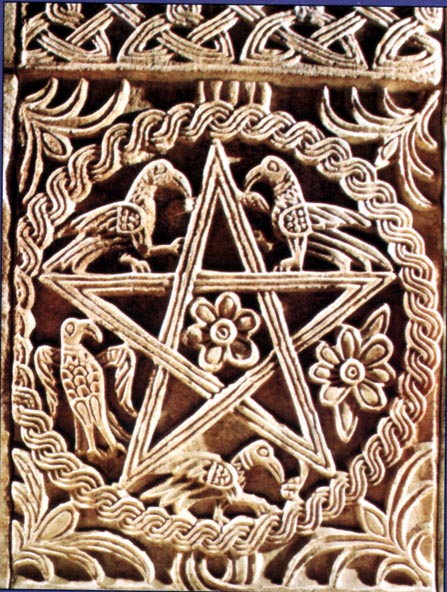 Prince
Trpimir ruled from 845 to 864.
In 852 he issued the oldest
known governmental document in the Latin script, where the Croatian
name was mentioned (dux Chroatorum). The fact that his name is recorded
in the Cedad Gospels (from today's Italian city Cividale) shows the
cultural level of his state. The most famous Benedictine monk
Gottschalk found refuge at the Croatian court from 846 to 848. Trpimir
invited the Benedictines,
known as great promoters of education
and economy. One of the earliest Benedictine monasteries was built in
852 near Split.
In
the 11th century Croatian Benedictines had more than 40 monasteries,
mostly along the Adriatic coast. They contributed a great deal to the
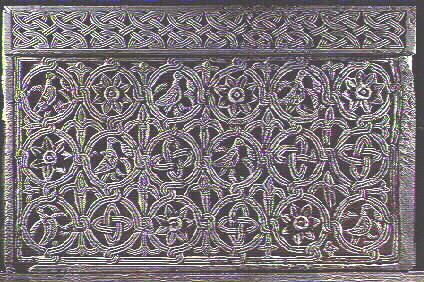
cultural and material development of the Croats. On the photo you can
see a choir screen panel from Split, containing pentagram and nice
interlace patterns, 11th century.
Prince
Trpimir ruled from 845 to 864.
In 852 he issued the oldest
known governmental document in the Latin script, where the Croatian
name was mentioned (dux Chroatorum). The fact that his name is recorded
in the Cedad Gospels (from today's Italian city Cividale) shows the
cultural level of his state. The most famous Benedictine monk
Gottschalk found refuge at the Croatian court from 846 to 848. Trpimir
invited the Benedictines,
known as great promoters of education
and economy. One of the earliest Benedictine monasteries was built in
852 near Split.
In
the 11th century Croatian Benedictines had more than 40 monasteries,
mostly along the Adriatic coast. They contributed a great deal to the
cultural and material development of the Croats. On the photo you can
see a choir screen panel from Split, containing pentagram and nice
interlace patterns, 11th century.
Besides the name of Trpimir also the names of some other Croatian princes can be seen in Cedad Gospels: Branimir, Braslav, their wifes, and escort.
In 871 the King of Italy Ludovic II and Byzantine Emperor Basil I defeated the Arabs in the city of Bari (Italy). Croatian soldiers also participated in the battle, arriving to Bari on Dubrovnik ships.
Some of the earliest Benedictine monasteries in Croatia were founded in
- Karin, 850,
- Bisevo, islet near the island of Vis, 850,
- Rizinice (near Split), 852,
- Zadar, St Krsevan, 908,
- Nin, St Ambrosius, 941,
- Nin, St Maria, 948,
- Ugljan (on the island
of Ugljan near Zadar), 988,
It is interesting that both names Uljan and Uglian(o) can be seen on old maps of the island.
Today there are altogether eight benedictine communities for nuns in Croatia: on the islands of Cres, Hvar, Krk, Pag, Rab, and in the towns of Sibenik, Trogir and Zadar. The only benedictine monastary for monks that remained to these days is Cokovac on the island of Pasman near Sibenik, not far from Zadar. See redovnice (nuns) and redovnici (monks).
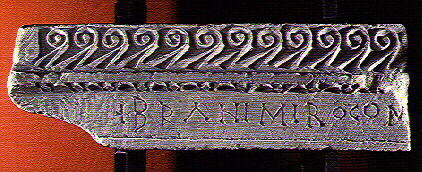 The
Croatian Prince Branimir made
further
steps in strengthening the relations with Rome. During the solemn
divine service in St. Peter's church in Rome in 879, Pope John VIII
gave his blessing to the prince and the whole Croatian people, about
which he informed Branimir in his letters. In his letter dated from 881
the Pope addressed Branimir as the `glorious prince'. This was the
first time that the Croatian state was officially recognized (at that
time the international legitimacy was given by the Pope). In Branimir's
time Venetians had to pay taxes to the Croatian state for their ships
traveling along the Croatian coast.
The
Croatian Prince Branimir made
further
steps in strengthening the relations with Rome. During the solemn
divine service in St. Peter's church in Rome in 879, Pope John VIII
gave his blessing to the prince and the whole Croatian people, about
which he informed Branimir in his letters. In his letter dated from 881
the Pope addressed Branimir as the `glorious prince'. This was the
first time that the Croatian state was officially recognized (at that
time the international legitimacy was given by the Pope). In Branimir's
time Venetians had to pay taxes to the Croatian state for their ships
traveling along the Croatian coast.
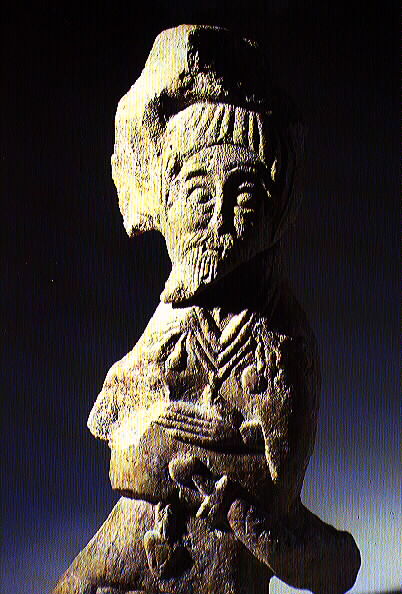 The
earliest Princes and Kings we
know of
lived in the 9th and the 10th century (see a figure of an unknown
Croatian Dignitary). The strongest among them was King
Tomislav,
who ruled from from 910 to 928. The previously mentioned Constantine
Porphyrogenitus, a Byzantine emperor, referred to him as the Croatian
King. In his time Croatia was
one of the most powerful states in
Europe. It had an enormous (for that time) army of 100,000
foot-soldiers and 60,000 horsemen, 80 larger and 100 smaller ships.
When Bulgaria occupied Serbia in 924, King Tomislav accepted and
protected many Serbs who had escaped and sought refuge in the Croatian
state. The Bulgarian tsar Simeon soon tried to spread his reign to
Croatia, but Tomislav defeated him in 927. The Serbs organized their
earliest internationally recognized Kingdom in 1217.
The
earliest Princes and Kings we
know of
lived in the 9th and the 10th century (see a figure of an unknown
Croatian Dignitary). The strongest among them was King
Tomislav,
who ruled from from 910 to 928. The previously mentioned Constantine
Porphyrogenitus, a Byzantine emperor, referred to him as the Croatian
King. In his time Croatia was
one of the most powerful states in
Europe. It had an enormous (for that time) army of 100,000
foot-soldiers and 60,000 horsemen, 80 larger and 100 smaller ships.
When Bulgaria occupied Serbia in 924, King Tomislav accepted and
protected many Serbs who had escaped and sought refuge in the Croatian
state. The Bulgarian tsar Simeon soon tried to spread his reign to
Croatia, but Tomislav defeated him in 927. The Serbs organized their
earliest internationally recognized Kingdom in 1217.
The Arabs began to attack the Croatian coast in the 9th century. So a Croat from Dalmatia, known under the Islamic name Djawhar ben Abd Allah (911-992), was taken as a slave to the court of caliph Al-Khaim in Tunisia. Later he made a great career becoming the supreme general. He conquered the land of pharaohs, thus extending the Empire of Fatimids from the shores of the Atlantic to the river Nile. He founded the new Egyptian capital Al-Qahira (Cairo), the future second largest Islamic city after Baghdad. In 970 he built up the mosque named Al-Azhar (the Brightest).
Lit. Marjan Bošnjak: Jawhar Dalmata, utemeljitelj Kaira - činjenice i pretpostavke, Hrvatska revija, 2023 br 1, Zagreb, str. 37-51A very old mention of the name of HORITS, the ancient name of the Croats (Horvat), can be found in the Latin work ``Historia adversus'' Pagano by Paulus Orosius (9th century). Its translation into Old English has been made by King Alfred (871-901). See [Mardesic], p. 130.
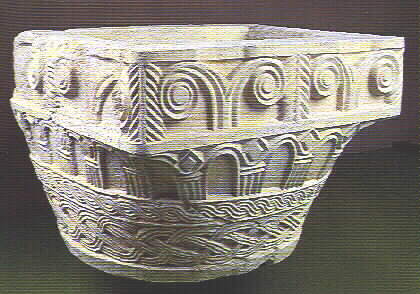 As
is well known, many important monuments of pre-Romanesque
Croatian art have been found in the region of Knin
which used
to be the residence of Croatian Kings (11th century). Here are two
examples, both from the 9th century.
As
is well known, many important monuments of pre-Romanesque
Croatian art have been found in the region of Knin
which used
to be the residence of Croatian Kings (11th century). Here are two
examples, both from the 9th century.
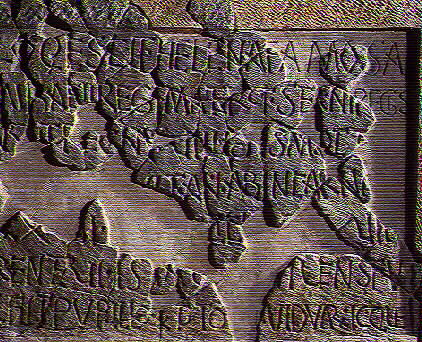 One
of the most important
discoveries of
Don Frano Bulic (1846-1936), an outstanding archeologist, is an
inscription in the Latin language from the sarcophagus of Croatian Queen
Jelena (10th century). Though it
was broken, Don Bulic put it
painstakingly together from 90 fragments. The advanced level of Latin
literacy, simply rhymed, is quite different from the stereotyped
``memento mori'', designed to fill the passer with the fear of death.
Here is the English translation of one of the most important Croatian
monuments, carved in 976:
One
of the most important
discoveries of
Don Frano Bulic (1846-1936), an outstanding archeologist, is an
inscription in the Latin language from the sarcophagus of Croatian Queen
Jelena (10th century). Though it
was broken, Don Bulic put it
painstakingly together from 90 fragments. The advanced level of Latin
literacy, simply rhymed, is quite different from the stereotyped
``memento mori'', designed to fill the passer with the fear of death.
Here is the English translation of one of the most important Croatian
monuments, carved in 976:
| In this grave rests famous Jelena, wife of King Michael (Kresimir), mother of King Stephen (Drzislav). She brought peace to the Kingdom. On the eighth day of October 976 from the incarnation of Our Lord she was buried here in the 4th indiction, 5th lunar cycle, 17th epacta, 5th solar cycle. While she lived she was mother of the Kingdom and she became mother of the poor and protectress of widows. You who look here say: God have mercy upon her soul. |
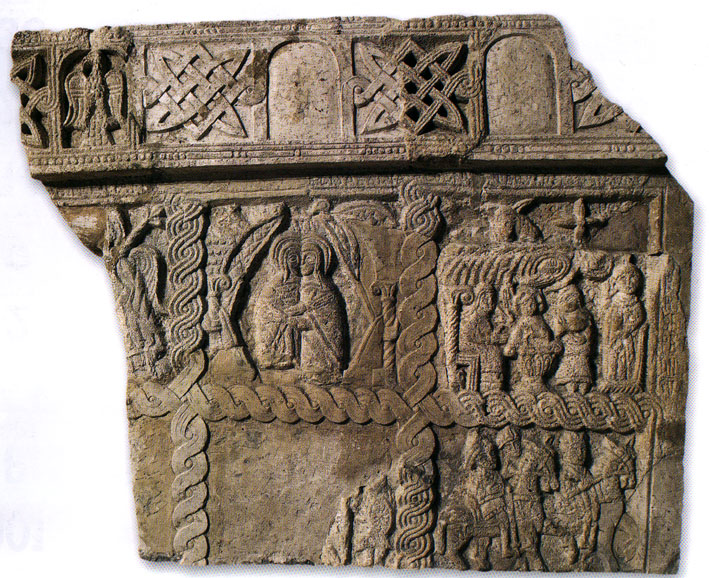
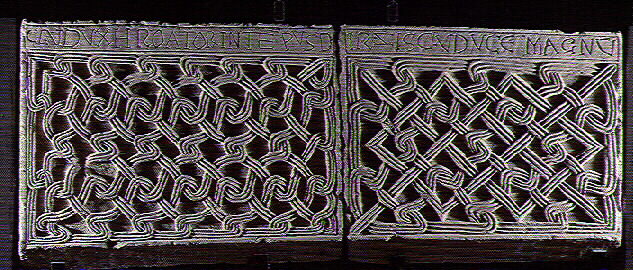 An
important monument is a stone
panel
from the 10th century mentioning the name of DUX CHROATORUM Drzislav,
a son of Queen Jelena. It contains nicely interlaced interlace
patterns.
An
important monument is a stone
panel
from the 10th century mentioning the name of DUX CHROATORUM Drzislav,
a son of Queen Jelena. It contains nicely interlaced interlace
patterns.
An important Croatian Pre-Romanesque church is Sv. Spas
near Cetina river, built in the 9th century. It also has remains of
some
wattle
patterns.
 |
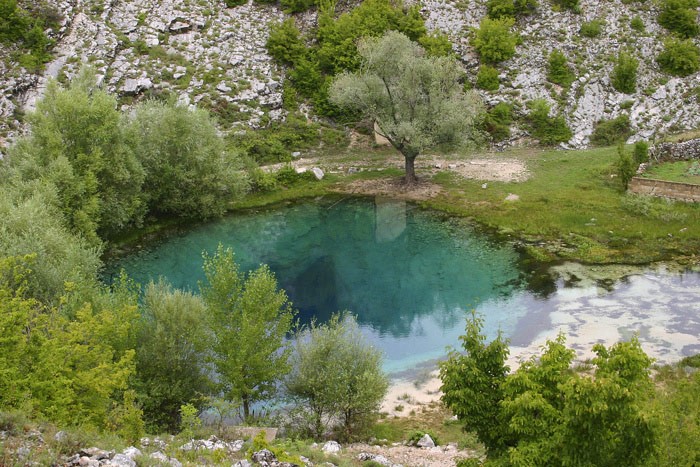
Photos of Sv. Spas and the spring of Cetina river below by Julija Vojkovic
 |
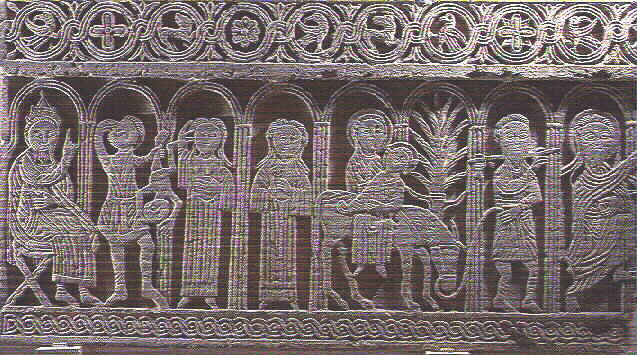 Probably
the greatest achievement of
Croatian Pre-Romanesque sculpture is choir screen panel from the Church
of St. Domenica (Sv. Nediljica) in Zadar, with scenes of the Massacre
of the Innocents and the Flight to Egypt, created in the 11th century
(André Malraux included it into his "Musée
imaginaire").
The Croats were deeply devoted to the Western Church. When Pope
Alexander III visited Zadar
in 1177, one of the most beautiful European cities, he was solemnly
greeted by people singing very old songs in their Croatian language (as
noted by Italian chronicler Baronius):
Probably
the greatest achievement of
Croatian Pre-Romanesque sculpture is choir screen panel from the Church
of St. Domenica (Sv. Nediljica) in Zadar, with scenes of the Massacre
of the Innocents and the Flight to Egypt, created in the 11th century
(André Malraux included it into his "Musée
imaginaire").
The Croats were deeply devoted to the Western Church. When Pope
Alexander III visited Zadar
in 1177, one of the most beautiful European cities, he was solemnly
greeted by people singing very old songs in their Croatian language (as
noted by Italian chronicler Baronius):
 There
is no doubt that this was Croatian glagolitic
singing
(see an article
by dr. Marija s. Agnezija Pantelic in [Badurina,
p. 106]). During the shameful aggression of Venetians and Crusaders in
1202, the Christian city of Zadar, a dangerous rival of Venice at the
time, was robbed and terribly destroyed. Geffroy de Villehardouin, a
French chronicler who described the siege and destruction of Zadar for
the good of Venice during the Crusade, wrote that Zadar
in
Sclavonia (a synonym of Croatia at that time) is one of the best
fortified cities, surrounded with strong walls,
and that it is difficult
to find a more beautiful, better fortified and richer city.
There
is no doubt that this was Croatian glagolitic
singing
(see an article
by dr. Marija s. Agnezija Pantelic in [Badurina,
p. 106]). During the shameful aggression of Venetians and Crusaders in
1202, the Christian city of Zadar, a dangerous rival of Venice at the
time, was robbed and terribly destroyed. Geffroy de Villehardouin, a
French chronicler who described the siege and destruction of Zadar for
the good of Venice during the Crusade, wrote that Zadar
in
Sclavonia (a synonym of Croatia at that time) is one of the best
fortified cities, surrounded with strong walls,
and that it is difficult
to find a more beautiful, better fortified and richer city.
The
City was again destroyed
Pope John Paul II visited Bosnia and Herzegovina twice (1997, 2003), and three times Croatia (1994, 1998, 2003). His apostolic visit to the city of Zadar in 2003 will always be remembered, like the one by Pope Alexandar III in 1177.
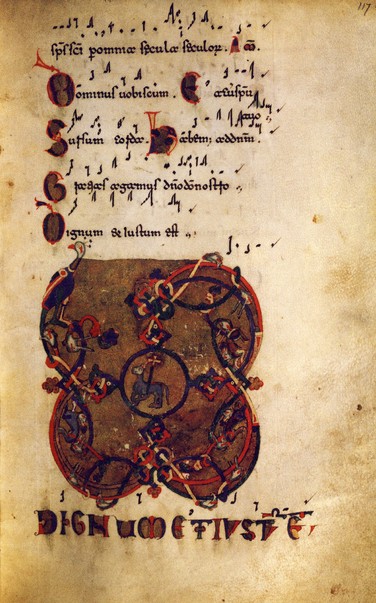
Vekenega Evangelistary (with musical notation), Zadar, 11th century
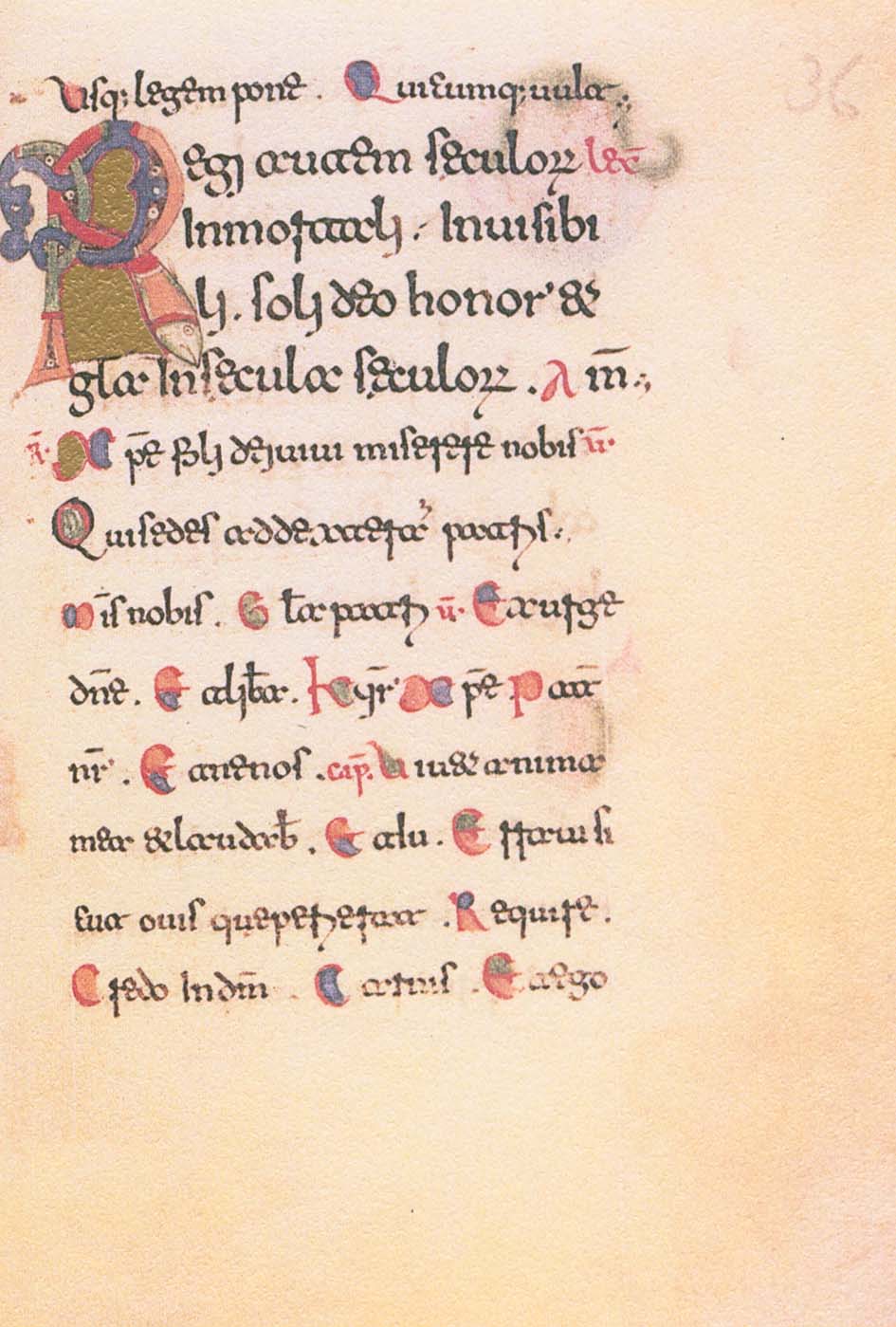 Zadar
was an important European cultural center at that time due to its Benedictine
monastery of St Krsevan (founded
in 986, shelled by the Serbs in
1991), in whose scriptorium the famous Vekenega
Evangelistary.
This richly illuminated Latin text from the 11th century is held today
in the Bodleian Library in Oxford (which also possesses other important
Croatian documents written in the Latin, Glagolitic
and Croatian
Cyrillic Script). Even older is
the the Cika Breviary
from the 11th century, written in the
Latin script in the same scriptorium in Zadar. This jewel of Croatian
culture (see on the right) represents the oldest known breviary in
Europe, and is kept in the Library of the Hungarian Academy of Sciences
in Budapest. It also contains musical notation. Another important book
written in 1081/82 in Zadar scriptorium of St Krsevan is Osor
Evangelistary (Osor is a town on the island of Cres), known as
Evangeliarium Absarense, held in the Vatican Library (Vat.Bibl. Ms
Bergianum Lat. 339). Zadar is also the oldest university center of
Croatia (1396). For additional information about Croatian art in Zadar see here.
Zadar
was an important European cultural center at that time due to its Benedictine
monastery of St Krsevan (founded
in 986, shelled by the Serbs in
1991), in whose scriptorium the famous Vekenega
Evangelistary.
This richly illuminated Latin text from the 11th century is held today
in the Bodleian Library in Oxford (which also possesses other important
Croatian documents written in the Latin, Glagolitic
and Croatian
Cyrillic Script). Even older is
the the Cika Breviary
from the 11th century, written in the
Latin script in the same scriptorium in Zadar. This jewel of Croatian
culture (see on the right) represents the oldest known breviary in
Europe, and is kept in the Library of the Hungarian Academy of Sciences
in Budapest. It also contains musical notation. Another important book
written in 1081/82 in Zadar scriptorium of St Krsevan is Osor
Evangelistary (Osor is a town on the island of Cres), known as
Evangeliarium Absarense, held in the Vatican Library (Vat.Bibl. Ms
Bergianum Lat. 339). Zadar is also the oldest university center of
Croatia (1396). For additional information about Croatian art in Zadar see here.
Dalmatian
rounded beneventana that was in use in
the Zadar scriptorium of St Krsevan shows original characteristics
different from the south-Italian round beneventana.
The church of St. Simun in Zadar possessed an old codex written in Latin script, containing well known lauds from12th century. Zadar had a famous scriptorium at that time. The book disappeared by the end of 19th century, and since 1893 is held in Staatsbibliothek in Berlin, see [Strgacic, p. 374]. Numerous Croatian valuables are held throughout Europe. See a list of Glagolitic books and manuscripts only, held outside of Croatia. Pre-Romanesque architecture in Croatia is described in detail in works of [Delonga].
See a few of numerous Croatian stone monuments with interlace patterns found in the region of the city of Dubrovnik.
It is interesting that King Richard the Lion-Hearted (1157-1199) sojourned in Zadar (and not in Dubrovnik as it has been believed). Also Henry of Lancaster, the future King Henry IV, visited Zadar and Dubrovnik during his pilgrimage to the Holy Land in 1392 and 1393. See [Mardesic], p. 134-135.
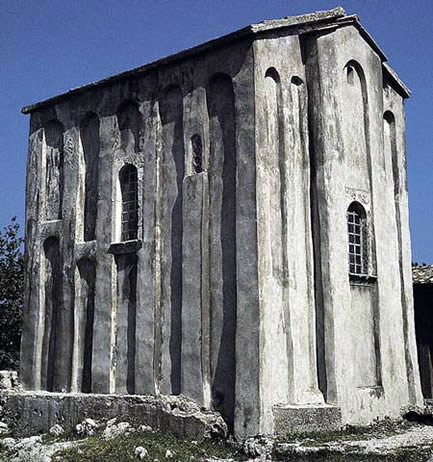
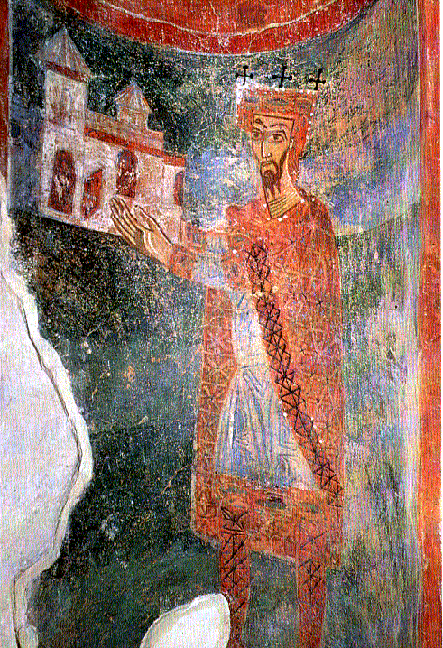
Among important Croatian Preromanesque jewels from 11th century we mention the church of Sv. Mihajlo in the town of Ston (on the Peljesac peninsula, west of Dubrovnik). It has interesting frescos representing various saints, and a Croatian dignitary (probably Mihajlo Viskovic):
 |
 |
In the 12th century the famous Arabian geographer al-Edrisi (Idrisi) was working at the court of the the Norman King Roger II in Palermo. After 15 years of study he prepared a huge map of Europe (3.4x1.5 m) where one can find
where bilad = land, country, and garuasia = Croatia.

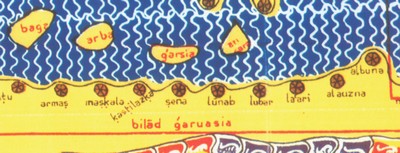
The map appeared in 1154, when many contemporary countries still do not exist in Europe. Especially important is a description of GARUASIA in the accompanying book of commentaries, where he states that Croatia starts with Istrian cities of Umag, Novigrad, Porec, Rovinj, Pula, Medulin, Labin, Plomin. Then al-Edrisi describes the cities from Bakar to Dubrovnik. It is known that he visited Senj, Knin, Biograd and some other Croatian cities. The original map is kept in the Bodleian Library in Oxford, while partial copies can be found in Paris, St Petersburg, Constantinople and Cairo.
Very important historical source for early Croatian history is Libellus Gothorum, a chronicle from 12th century known in Croatia as Ljetopis popa Dukljanina and Croatian Chronicle. It was written by Archbishop Grgur of Bar (a city in Boka kotorska, a region annexed to Montenegro in 1945), born in Zadar. The chronicle represents the oldest historiographic work of Croatian Middle Ages. There exist two versions, Croatian and Latin. Especially important is Grgur's presentation of assembly (SABOR) on the Duvno field ("in planicie Dalme"), and above all his terms for Croatian territories:
The source Sclavorum Regnum, known as Ljetopis popa Dukljanina and Croatian Chronicle, is also the earliest known literal text written in Croatian language. Marko Marulic translated this chronicle from Croatian into Latin in 1510, and the manuscript is held in Belgrade. The title is
VNA CVM SALONARVM DESOLITIONE
Another version is written in Croatian, and in Latin script, due to Jerolim Kaletic from 1546, held in the Vatican. It is a copy of Dmine Papalic's copy of Croatian Chronicle. There are clear indications that the original was written in the Glagolitic script (the opinion goes back to Franjo Racki, and is further supported by Muhamed Hadzijahic from Sarajevo and by Ivan Muzic from Split). For more details see a monograph [Hrvatska kronika 547.-1089.] and the references therein.
It is interesting that Shakespeare's The Tempest has its source in Ljetopis popa Dukljanina, see here..
Toma Arcidiakon (Thomas arhidiaconus Spalatensis, 1200-1268), an important chronicler from the city of Split, wrote in his Historia Salonitana that (a part of) Croatian tribes arrived to their present day homeland not as pagans, but as Aryan Christians (though very rude):
Quamvis pravi essent et feroces, tamen christiani erant sed valde rudes, Ariana etiam erant tabe respersi.
That is why in Croatian history we do not know of any single and precise date of christianisation, as in the case of other European nations, like Ukrainians, Czechs, Bulgarians etc. It seems that we can speak only about conversion of parts of newly arrived Croatian Aryan Christians to Catholicism in their new homeland. Indeed, Toma Arcidiakon writes the following:
Posteaquam per praedicationem praedicti Johannis et aliorum presulum salonitanorum duces Gothorum et Chroatorum ab Ariane heroseos fuerant contagione purgati.
Henry S. Hart in his book "Venetian Adventurer Marco Polo" (Oklahoma, 1967) states that Marco Polo was a "descendant of an old Dalmatian family which had come from Sibenik, Dalmatia, and settled in Venice in the 11th century". Hart also claims that "crews of the Venetian ships were freemen, so many of them Slavonians (Croatians) from the Dalmatian coast that the long quay by St. Mark's was and is known as the Riva degli Schiavoni (or Riva od Hrvatov in Croatian sources). It is said that Marco Polo had a home on the island of Korcula in Dalmatia. His coat of Arms includes four chickens. And in Italian, Polo (pollo) means chicken or fowl, while in Croatian Pilich means chicks or chickens, which was probably his original name. See [Eterovich], p. 13. Eterovich cites about 20 references (mostly Italian, and also English and German, the oldest one being from 1522), claiming the Dalmatian roots of Marco Polo, either from the city of Sibenik or from Korcula, at that time under Venice. See also Marko Polo = Marko Pilich? on this web-site.
The grave of Prince Mladin III Subic Bribirski, 14th century, which can be seen in the famous Trogir Cathedral, contains an extensive poem carved in the Latin Script, describing him as
Croatorum clipeus fortis
that is, "a firm shield of Croatians."
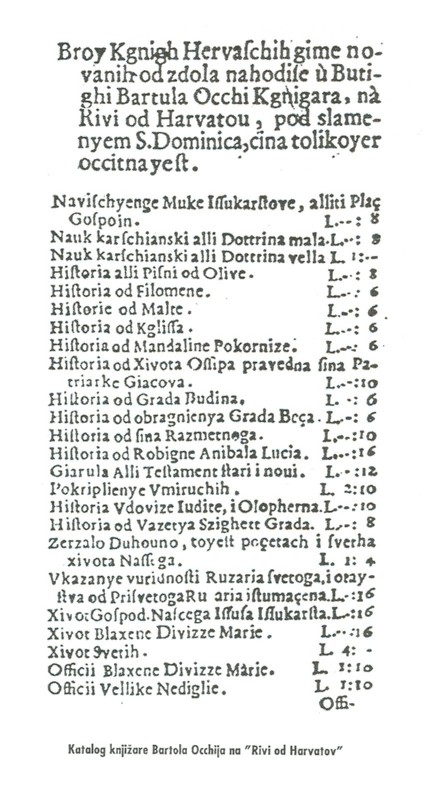
Riva
od Harvatou, mentioned in
the 17th century list of books in Venice
(source
Lovorka Coralic, Hrvatski
tragovi u
Mletcima, Zagreb, 2002, ISSN
1330-4941)
Venice was very important place for publishing books of numerous Croatian writers, philosophers and scientists. It is no surprise that in 17th century a Venetian master Bartol Occhi published a catalogue of Croatian books, in which the central Venetian pier (Riva degli Schiavoni) was called Riva od Harvatou, and the catalogue was sold in his workshop in this very street. Precisely in front of the grand hotel Danieli Excelsior in this pier, there is an inscription (hardly legible) showing that this part of Venetian harbour had been reserved for ships from islands of Hvar and Brac: FINE DI STAZIO DEI ABITANTI DELLA BRAZZA E DI LESINA (Lovorka Coralic).
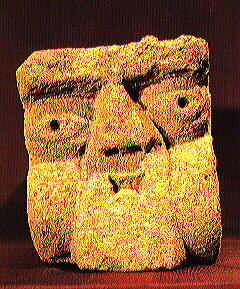 Another
important Benedictine monastery, unfortunately almost
totally ruined, built probably in the 11th century, is the one in Rudine
(Western Slavonia, near Pozega). A sensational discovery were the
exotic human-like figures (like on the photo, see also here)
and some glagolitic inscriptions.
Professor Andjela Horvat, historian, discovered stone inscription with BRAT
IAN, from 12th or 13th
centuries. This is the oldest
known
Latin inscription in the Croatian language.
Another
important Benedictine monastery, unfortunately almost
totally ruined, built probably in the 11th century, is the one in Rudine
(Western Slavonia, near Pozega). A sensational discovery were the
exotic human-like figures (like on the photo, see also here)
and some glagolitic inscriptions.
Professor Andjela Horvat, historian, discovered stone inscription with BRAT
IAN, from 12th or 13th
centuries. This is the oldest
known
Latin inscription in the Croatian language.
From 1102 the Croats had shared together
with Hungarians a newly built state under common Hungarian and Croatian
Kings. The Kings were crowned twice: with the Hungarian and the
Croatian crown.
From that time
on, the Croats were dreaming about having their own independent state,
and it was revived after almost nine centuries in 1991.
During this very long period parts of Croatian soil were dominated by Venetians, Italy (in the first half of the 20th century), the Ottoman Empire and the Habsburgs. Among all the nations reigned by the Habsburgs (Czechs, Poles, Slovenians and others) the Croats are together with Austrians and Hungarians the only ones who have preserved an uninterrupted continuity of their state since the Early Middle Ages. Furthermore, as stated by one of best Croatian historians Vjekoslav Klaic, the Croatian Kingdom was the oldest one in the Habsburg Monarchy, older than Austrian, Hungarian, or Czech Kingdom.
During many centuries the Croats had their bans (viceroys) and their assembly called Sabor (Deit). The oldest known Sabor was held in Split in 925 and in 928 (devoted more to religious than to secular questions), and in 1076 when Dmitar Zvonimir was elected the Croatian King by the "unanimous choice of the clergy and the people". The Croats preserved these important state institutions of ban and Sabor also when they decided to enter the Habsburg state (1527-1918). Today the Sabor has the meaning of the Croatian Parliament.
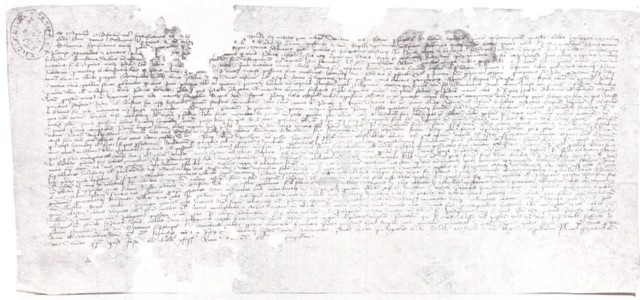
The oldest known minutes of Croatian Deit (Hrvatski sabor), dating from 1273 (Conclusions of the Deit of the Kingdom of Slavonia, held in Zagreb)
See the list of heads of the Croatian state during 13 century, and the list of bans in Croatian Kingdom
It is interesting that Dante Alighieri (13/14th centuries) mentions the Croatian pilgrims to Italy in his Divine Comedy (Paradiso XXXI, 103-108):
| Qual
è colui che
forse di Croazia viene a veder la Veronica nostra che per l'antica fame non sen sazia, ma dice nel penser, fin che si mostra "Segnor mio, Gesù Cristo, Dio verace, or fu sì fatta la sembienza vostra?" |
It seems that Dante traveled through Croatia with Croatian Bishop Augustin Kazotic.
It
would be difficult even to trace interesting historical
personalities that connect the Croats with other nations.
So Ivan VI Frankapan
was a master of the Royal Palace
Stäkebórg, and also led the entire estate of the
Royal
Court in Sweden.
He lived there from 1427(?) until 1433, and was a close
friend to Eric
VII of Pomerania, the second
common King of
Denmark, Sweden and Norway. How did Ivan VI get there?
Well, when King Eric VII travelled to the Holly Land in
1424, he also passed through parts of Croatia. His travel
back to his homeland also led him through Croatian lands. It
is known that he visited Dubrovnik,
Omis
and Senj.
It was
probably in Senj that King Eric VII met Ivan VI, and made
friends with him. Ivan VI Frankapan became known in Sweden
as Johann Valle
or Jany Franchi.
During an uprising of
Swedes
against the Danish authorities, led by Engelbreksston, Ivan
VI was at the Royal Palace. Upon his return to Croatia he
became the Ban (viceroy) of Croatia.
I owe
this information to dr Petar Strcic,
director of the Archives of HAZU (Croatian Academy of
Sciences and Arts). For more information see
- Dr. Mladen Ibler: Count Ivan Anz Frankopan, the Royal steward of the estate in Sweden 1426-1434, [PDF, 14 pp] (many thanks to Nenad Bach for sending me the article). Mr. Ibler was ambassador of the Republic of Croatia in Sweden.
- Mladen Ibler: Ivan VI. An¾ Frankopan – U slu¾bi nordijskoga kralja, Meridijani, Zagreb, 2014.
- Berislav Klobucar: Hrvati su Svedskoj
- The name of Prince Ivan is mentioned in a Croatian Glagolitic manuscript kept in Norway , then in Croatian Glagolitic breivary Illirico 5 kept in the Vatican Library.
Very important personality in Croatian history is Ban Josip Jelacic (1801, Petrovaradin - 1859, Zagreb). We offer you quite interesting presentation of the Jelacic family (in French), written by a descendent of this noble family in France, Monsieur Michel Iellatchitch.
From 1918 to 1929 Croatia was one of the states in the Kingdom of Serbs, Croats and Slovenians. In 1929 it was renamed Yugoslavia and existed as such until 1941 and as a communist state from 1945 to 1991. The Croats are despite all the difficulties the only ones among all the nations of former Yugoslavia whose state has had uninterrupted continuity since the ninth century.
The territory of former Yugoslavia (named so in 1929) was a point of contact of three very different worlds in its past:
- the Catholic West,
- the Orthodox East,
- and Islam.
Only Slovenia, situated to the west of Croatia, was relatively safe from the threat of Orthodox Christians and Islam. This is why the Republic of Slovenia was nationally the most compact and economically the most developed region in former Yugoslavia. Please, note the difference between Slovenia, Slovakia and Slavonia, which is a part of Croatia. The origin of all these names is the same - derived from the name of SLOVO (= word), from which then the names of Slovinje, Slovinci, Sloveni, Slovenci, Slovani, Slaveni were coined.
It is lovely and amusing to see how in Slovak language one says "Slovenian - Slovakian dictionary": Slovinsko - Slovenski slovnik. And in Slovenian language, the same would be Slovensko - Slovaski slovar!
In Slovenian part of Istria, near Italian border (south of Trieste) there is a small town of Hrvatini (= the Croats). It is indicative that the most widespread second name in Slovenia is Horvat (= Croat). The Croats living for centuries in present-day Slovenia do not have the status and rights of national minority (3% of entire population of Slovenia), contrary to much smaller national minority of Slovenians in Croatia (0,47% of population in Croatia; see Hrvatske knjige izvan Hrvatske, Hrvatska matica isljenika, Zagreb 2009, p13).
Najstariji zapisi imena "Hrvat" u stranim izvorima - The oldest written traces of the name of "Hrvat" (Croat) in foreign sources. (with respect to present-day Croatia). See also Dalmatinska povijest - Veritas Vincit!Srb is a small village near the spring of the river Una (north of Knin). Serbian linguists see this name as a trace of the Serbian name (Serb -> Srb?). However, according to academician Petar Simunovic the name of Srb originates from an old Croatian verb serbati, srebati = to sip, from which the noun "srb" has been derived (see his interview in Fokus, 30.09.2005). Thus "srb" denotes the spring of river Una, where the village lies. In fact, there are as many as fifty water springs. Compare with the villages of Srbani (near Pula), and Srbinjak, both in Istria, which clearly have nothing to do with the Serbian name. The Istarski razvod from 13th century mentions the name of srbar, meaning a water spring. In Sokol & Sokol, p. 29, it is emphasised that the name of the town of Srb is not an ethnonym, but hydronym: "Već je N. Klaić dobro napisala da Ljudevit iz Siska nije pobjegao nikakvim Srbima nego u S/a/rb u Lici, koji je još i danas ondje, a u srednjem vijeku bio znani grad i plemićka općina, odnosno ¾upanija. On meðutim nije etnonim, nego hidronim, te svojom sličnošću pučkim etimolozima stvara nerješive probleme, pa tako i kod Einharda". Dr. Vladimir Sokol was the first to indicate that the name of Croatian town of Srb is in fact a hydronim, and not an ethnonym.
Povezan s time je i naziv za meko (vodenasto) kuhana jaja u Dalmaciji: "jaja u sorbulu" ili "jaja u šorbuli".
U bilje¾ničkim zapisima 1353.-1354. od zadarskog notara Andrije pok. Petra iz Cantua objavljen je jedan ugovor od 17.11.1354. u kojem piše ...Iursa condam Pervoslavi de Serbo, districtus Corbavie... (Jurša pok. Prvoslava iz Srba, iz Krbavskog distrikta). Izvor je ova knjiga: Andreas condam Petri de Canturio. Quaterni imbreviaturarum 1353-1355./Andrija pok. Petra iz Cantua. Bilje¾nički zapisi 1353-1355. Prepisao latinski tekst te izradio hrvatske sa¾etke i kazala Robert Leljak. S izvornikom sravnio, izvršio redakciju teksta i kazala te izradio kritički aparat i bilješke Josip Kolanović, sv. 1, Notarilia Iadertina/Spisi Zadarskih bilje¾nika 4, Zadar, Dr¾avni arhiv u Zadru, 2001., 783 str. Prikaz Damira Karbića o toj knjizi: [PDF].In Istria there is the village of Sorbar, north of Gro¾njan, which has 7 glagolitic graffittos in the churhc of Sv. Petar See [Fučić, Glagoljski natpisi], under Sorbar.
In the town of Vrbnik there is an expression "palenta se serbje", that is, "paletna se srka", that is, "polenta is being sipped" (according to personal investigation of dr. Sanja Vulić in Vrbnik). There is the town of Srbljani in Istria (peninsula in Croatia), 5 km south of the town of Pazin. The meaning of srbati is "upijati vodu", that is, to "absorb water". Information in this paragraph by the courtesy of dr. Sanja Vulić, 2014.
In [Eleršek, Žic Mikulin, p. 92, in the last sentence of item 41.], posrbali has the meaning of popili (have drank, derived from drinking). On p. 158 of the same book (in item 276.) there is the notion of srbat - popiti (to drink).Additional information
Vladimir Sokol: Hrvatska srednjovjekovna arheološka baština, Zagreb 2019.
Leonard Eleršek i Rado Žic Mikulin (Croatian sagas in 12 books):
- Putom Sunca - Crveni
bojovnici iz Horezma / nacionalna saga o dolasku Hrvata, Zadar,
2019.; about the book
- Seobe Hrvata / plemenite boduslke predaje o doseljenju Hrvata u Iliriki na otok Krk,
- Stari bozi nas Hrvata / plemenite bodulske predaje o starim bogovima,
- Čančarije i babarije / bapske i druge priče s otoka Krka, Zagreb 2024.
- Zvanimirove crkve / plemenite boduulske predaje o drevnim hrvatskim crkvama s pobo¾nim pjesmama,
- L. S. A. N. E., plemenite bodulske predaje o hrvatskoj pomorskoj sili s himnom starohrvatske ratne mornarice i rekonstrukcijom brodovlja,
- Kosiz / plemenite bodulske predaje o drevnoj hrvatskoj vojsci od iona do provale Osmanlija s epskim pjesmama o prvom krčkom knezu,
- Zauzeće Sigeta grada / plemenite bodulske predaje o drevnoj hrvatskoj vojsci u osmansko-hrvatskim ratovima s epskom pjesmom o Sigetskom boju,
- Rankunjeri, plemenite bodulske vojničke predaje novijeg doba s epskom pjesmom o Boju kod Kanajta,
- Puntarska predaja, dio I., bodulske predaje iz pismohrane Rada Žic Mikulina,
- Puntarska predaja, dio II., bodulske predaje iz pismohrane Rada Žic Mikulina,
- Besjedarij ju¾noga kraja otoka Krka / čakavski besidnik Muraja, Lakmartina, Kornića, Vrha, Punta, Stare Baške, Drage Bašćanske i Veje s 850 bodulski poslovica i uzrečica,