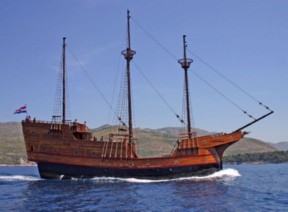
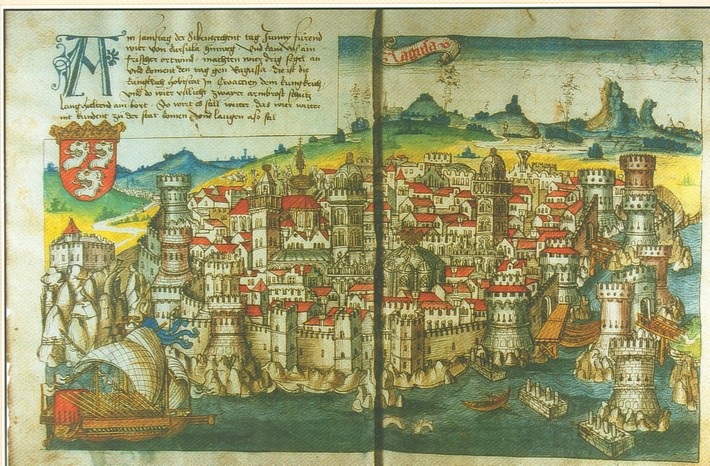
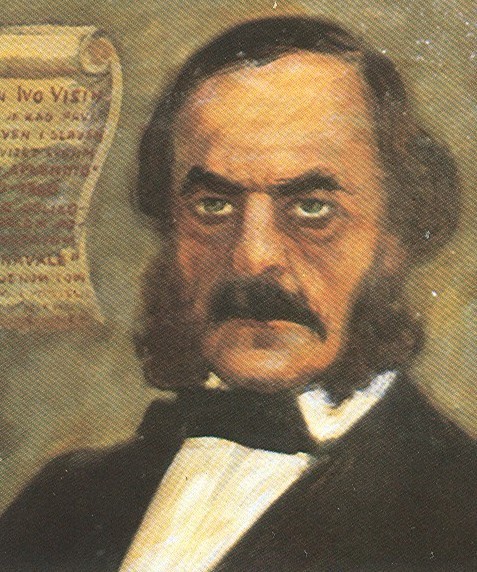
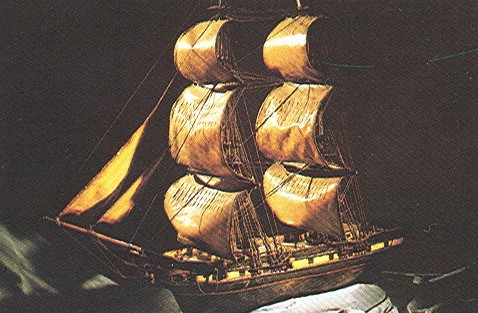
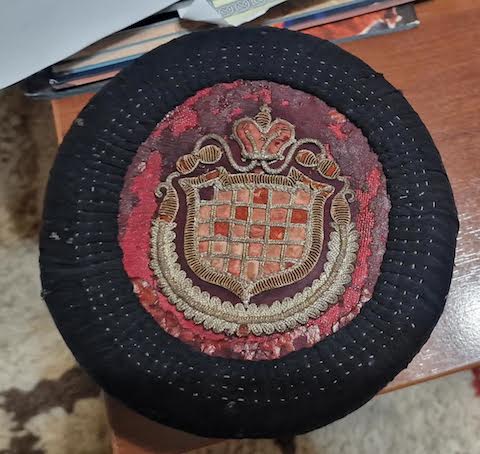
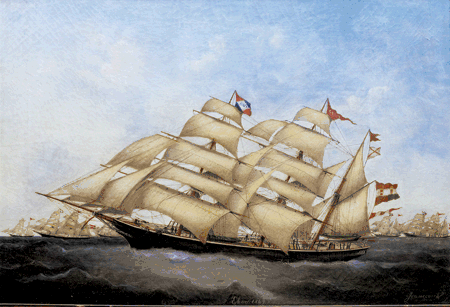
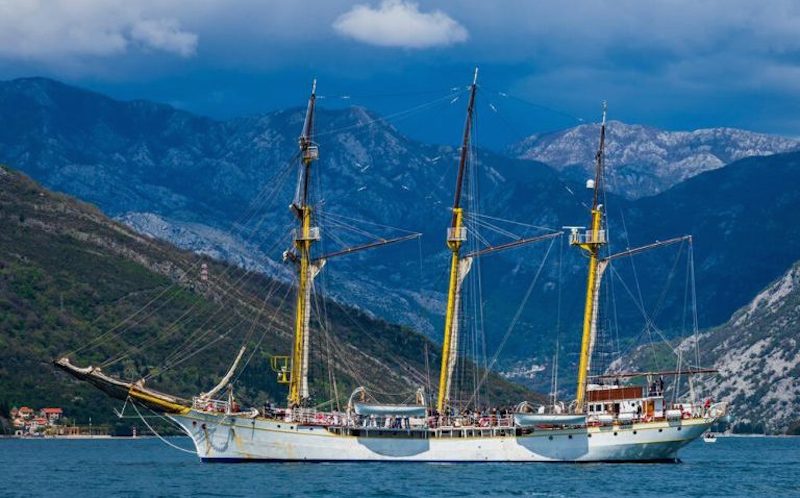
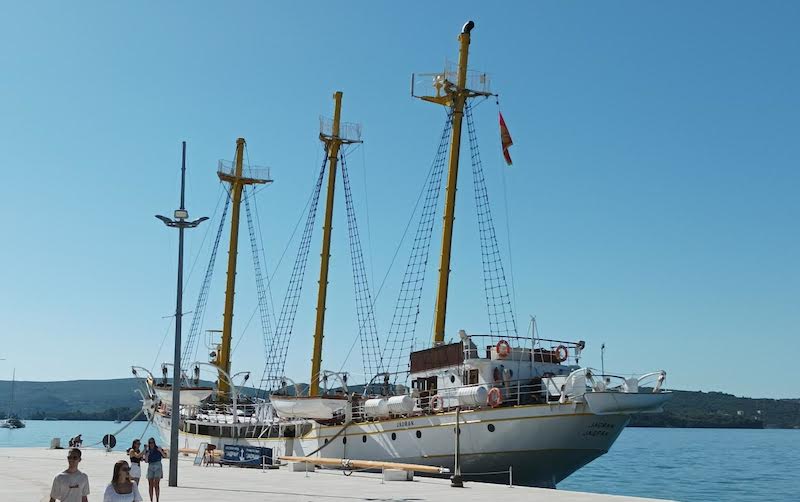
Argosy ship; Sv. Vlaho (St. Blais) - patron of the City
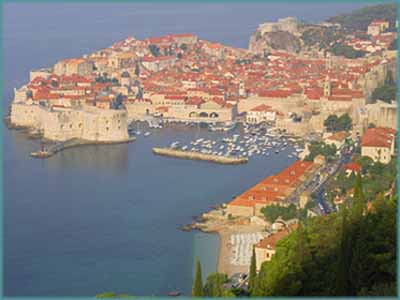
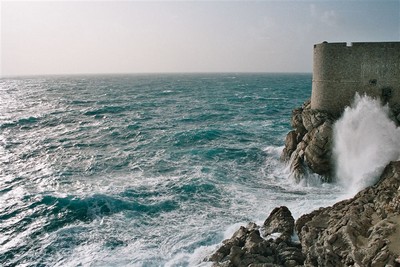
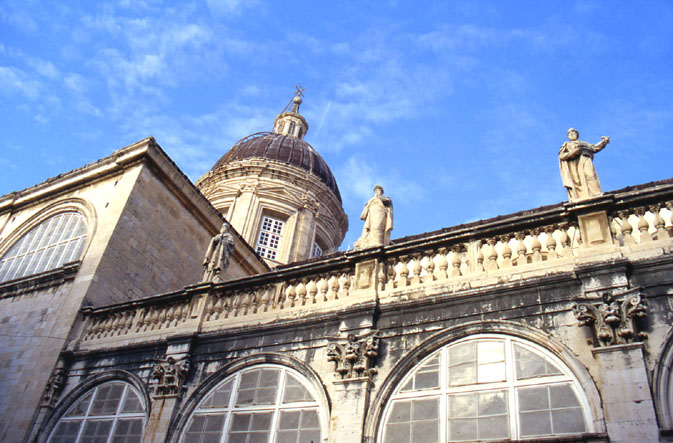
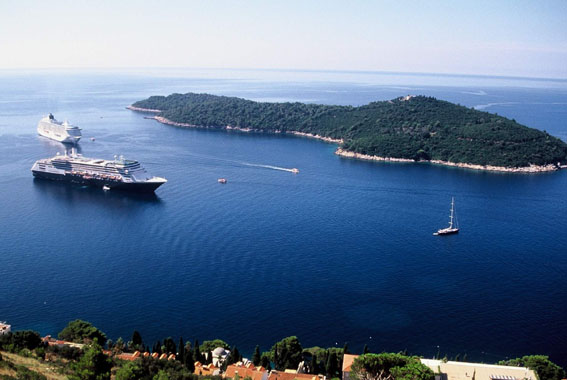
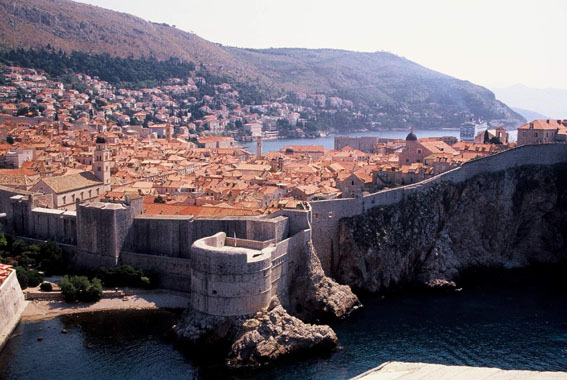
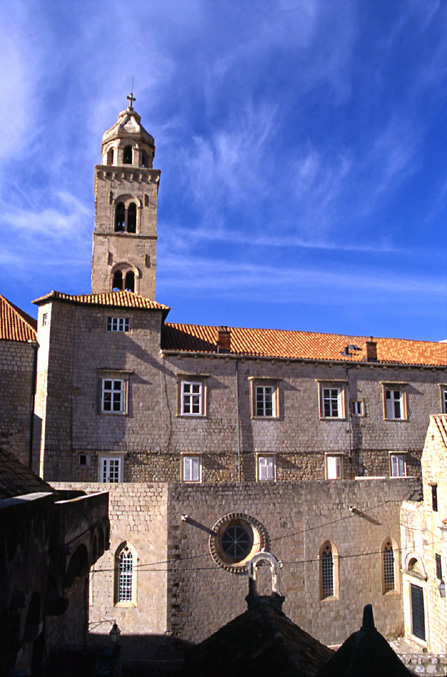
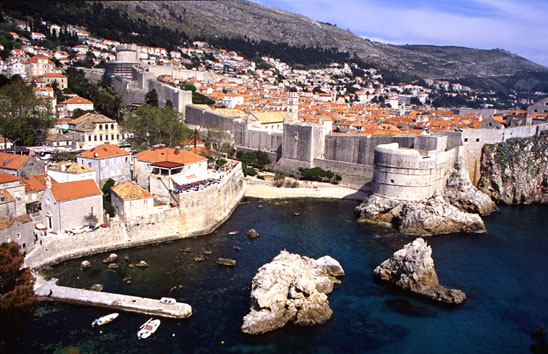
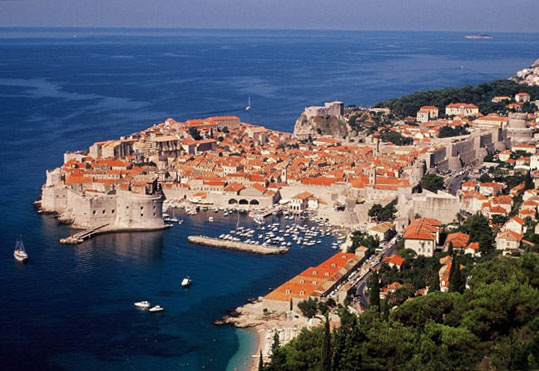
View to Dubrovnik (photo by G. Prakash)
The
territory of the famous Republic
of Dubrovnik
(Ragusa), though somehow
disconnected from the
main part of Croatia, was able to keep balance with great forces, which
always had respect for its economic well being and culture, and it
remained free due to its numerous diplomatic and economic relations.
This earliest Croatian city-state had as many as 85 consulates in
various seaports throughout the Mediterranean, and diplomatic
representatives in Barcelona, Madrid, Rome, Vienna, Paris and London.
Dubrovnik was especially flourishing from the 15th to the 18th century,
and was the chief rival to Venice. In the 16th century Dubrovnik
had a
fleet of 200 larger ships, which grew to 300 in the 18th century.
Around 1780 the ships from Dubrovnik sailed to New York, Baltimore
etc.
The English word ARGOSY
(= Ragusin ship; Ragusa = Dubrovnik) soon after the first Dubrovnik
ships arrived in England in 1510, became synonymous with a large, rich
cargo ship (Karaka of Dubrovnik).
ARGOSY (reconstruction)It is
strange that "The World Book Dictionary",
an important American dictionary of the English language, claims for
"argosy" to be an "Italian (!) Ragusea (ship) of Ragusa, an Italian
port (!) which traded extensively with England in the 1500's". See its
1995 edition, Vol. I, p. 110.
On the island of Sicily,
Italy, there is a town called Ragusa.
This town, known from ancient times, was rebuilt by Dalmatian settlers
in the VIIth century, who gave it the name of their native place
(information from "Art and History of Sicily", Casa Editriche Bonechi,
Firenze, Italy, p. 110). A well known veduta by Matthäus Merian from 1638 (with
numerous
subsequent printings), does not represent Dubrovnik, but Sicilian
Ragusa.
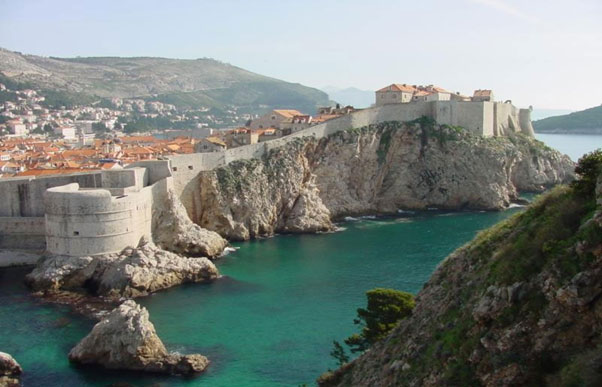
Dubrovnik walls
An Italian naval
historian Bartolomeo Crescentio, author of
"La Nautica Mediterranea", 1602, Rome, states that the Ragusans were
the best builders of galleons in the Mediterranean and that the Argosy
was a galleon of Ragusa.
The Dubrovnik galleon
Argosy is mentioned in two Shakespeare's
plays: "Merchant of Venice" and "Taming the Shrew".
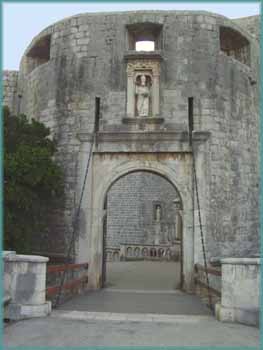
Main entrance to Dubrovnik. | Sv. Vlaho (St. Blais, patron of the City). Photos by G. Prakash.LIBERTAS
The white flag of
Dubrovnik contains a figure of Sv.
Vlaho
(St. Blais, St. Blasius, Armenian
martyr from 3/4 centuries), patron of
the City. Also other flags were in use on Dubrovnik ships, like the one
with significant inscription LIBERTAS,
or
LIBER
TAS
The earliest Dubrovnik flag is mentioned in the 1272 Statue of
the city, as vexillum sancti Blasii
(see [Macan, p. 271]).
The famous Columbus crew
in 1492 had at least two Ragusan
mariners: Martin de Araguis, Pedro de Arague. The Ragusan name can be
found in numerous places of the New World. Why? See Croatian mariners in the New World.
The earliest history of
Dubrovnik goes back to Ancient times,
at least to the 6th-5th centuries BC. In other words, the Grad (the
City) is at least thousand years older than it was believed until
recently, see [Nicetic].
This is confirmed by
excavations carried out in the 1980s and 1990s.
Photo by Najka Mirković,
Dubrovnik
According
to Antónia Pusich (1805-1883), Portuguese writer
having Croatian roots and living in Cabo Verde (her father Antonio
Pušić, governor of Cabo Verde and a member of the Portuguese Royal
Academy, was born in Dubrovnik),
the history of Dubrovnik goes back to 14th century BC. Legend has it
that Kadmo (Kadmos) and Hermiona, escaping from Thebai (Thebes),
brought with them the
elements of Phoenician civilization to the region of present-day
Dubrovnik,
including their script. For more details, see [Talan,
pp. 158-160].
In the 12th century the
famous Arab geographer al-Edrisi (Idrisi)
made a map of Europe
containing Bilad Garuasia,
that is, Croatia. In the
accompanying text al-Edrisi mentions various cities in Croatia
(Garuasia), among them Dubrovnik (Ragusa).
In 1506, an English nobleman Richard Guildford wrote that the city of Dubrovnik is placed in the Kingdom of Croatia.
Early Dubrovnik
Dubrovnik in 13-14th centuries
In
1272 Dubrovnik had its first statute
(in eight books) and urban planning.
The seventh book of
the Statute contains exclusively
regulations concerning Maritime
Law, which is the oldest such
document in the world. Among other things, the statute says If
a
slave is embarked on a Dubrovnik ship - he must be considered as a free
man.
In 1296 Dubrovnik had
a sewerage system.
In 1377 Dubrovnik had
the first quarantine in Europe.
The first
European pharmacy that has been
working continuously
till these days was opened there in 1317. Among the oldest ones (from
1355) is also the pharmacy of Zagreb, in which a great-grandson of Dante
(Nicolo Alighieri) was a pharmacist in
1399. According to some documents the pharmacy in the city of Trogir
goes back as early as 1271.
Dubrovnik's 1395 Insurance
Law is the oldest in
Europe. It had all aspects of contemporary maritime insurance. This law
is three centuries older than Lloyd's insurance, London, which dates
from the end of the 17th century.
Dubrovnik in the 15th century
An organized production
of soap started in 1417.
The first hospital
(Domus Christi) in Dubrovnik was
opened in 1347. The Dubrovnik Senat recognized it as the hospital in
1540. It was shelled and seriously damaged during the Greater Serbian
aggression in 1991-1995.
Slave
trade in the Republic of
Dubrovnik was
forbidden in 1416 (in the British Empire in 1833).
The first canon
foundry in Dubrovnik was
started in 1410, that is, 62 years before Vienna and 64 years before
Russia. The most famous canon and bell founder in Dubrovnik was Ivan
Rabljanin (1470-1540),
employed by the City on a full-time
basis. Source
Welcome to Dubrovnik, 2009, no
18, p 27.
The first
orphanage was founded in 1432.
Dubrovnik had the oldest
arboretum in Europe -
Trsteno, founded in 1498, with many rare plants. It was seriously
damaged during the Greater Serbian aggression in 1991-1995. Also
precious forests around Dubrovnik were burnt down during the
aggression, for example a large part of the imposing hill of Srdj above
the City.
Ivan Stojković de Corvatia
Tractatus
de Ecclesia, written by Ivan
Stojković de Corvatia (or
Iohannes de Carvatia, also known as Jean
de Raguse, 1390/95-1443), a professor at the University of Paris, was
the first systematic tractate about the Church in the history of
Catholic theology. Ivan Stojković also headed the delegation of the
Council of Basel to Constantinople, aiming to negotiate the Ecumenical
questions of the Eastern and Western Church. He wrote that he was from Dubrovnik,
which was a Croatian city (de Ragusio
quae civitas est in Charvatia).
Benedikt Kotruljević wrote the first manual on book-keeping and double-entry
The
first known manual about
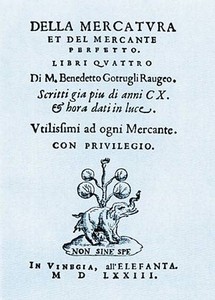
book-keeping was Della
mercatura
e del mercante perfetto, (On
merchantry and the perfect merchant)
written
in
1458 by Benko Kotrulji''
or Benedikt Kotruljevi''
(Benedictus
de Cotrullis, born in Dubrovnik,
1416-1469).
It is also
the oldest known manuscript on double-entry.
As such it
precedes Luca
Pacioli's description of double-entry for no less than 36 years, so
that Kotruljic's
priority is indisputable.
Kotruljic's famous 1464
manuscript on book-keeping,
was printed in 1573 in Venice; editor and publisher was
another outstanding Croatian scholar - Franjo Petris
The French translation
of Kotruljic's book appeared under the
title "Parfait négociant" in Lyon in 1613.
In the book he states the following: "I
declare that a merchant must not only be a good writer,accountant and
book-keeper, but he also has to be a man of letters and rhetorician."
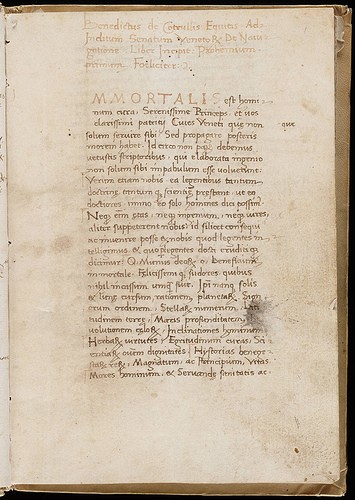
His other important
manuscript is Benedictus de Cotrullis:
"De Navigatione", 1464, written also in Italian. It is the
first
known manual on navigation in
the history of Europe. Note that it
appeared almost 30 years before the discovery of America.
The original manuscript
is kept at the University of Yale (in
the Beinecke Rare Book and Manuscript Library, MS 557), and has 132 pp.
See
Benedikt
Kotruljević: De navigatione, in Dubrovčanin
Benedikt Kotruljević : hrvatski i svjetski ekonomist XV. stoljeća.
- Zagreb, Hrvatska akademija znanosti i umjetnosti : Hrvatski
računovođa, 1996. - ISBN 953-96998-0-0. - pp. 19-32.
Benedikt Kotruljević: De
navigatione / O plovidbi, Zagreb
2005., ISBN 953-6310-37-6
(parallel Italian-Croatian edition)
In this book Kotruljević
mentions places like Bocari (Bakar),
Braca (Brač), Dalmatia, Fiume (Rijeka), Illirico (Croatia), Mare
Adriatico, and many others, throughout Europe, Africa, and Asia. In
Chapter XXXXVIII (ie. Ch XLVIII), he also mentions that in Popovo near
Dubrovnik [near the village of Ravno
in
Eastern Herzegovina] there is a huge cave [Vjetrenica] with miraculous
wind: at the entrance the air is colder in the summer than in Italy in
the winter.
The name of the cave of Vjetrenica
(wind cave; vjetar = wind) appears under this name for the first time
in 1461 in the minutes of the Dubrovnik Senat. However, this famous
cave was known already to Plinius the Elder (1st century AD), who
mentioned it in his Natural History (Gaius Plinius Secundus: Naturalis
Historiae, in 2, 115). This largest cave in Bosnia
and Herzegovina, as well as the
nearby village of Ravno,
deserve to be seen (25 km NW of
Dubrovnik).
Renaissance writers
Marin Držić
Literature
written in Croatian flourished
in Dubrovnik. In the first place we should mention Marin Držić
(1508-1567), who is one of the most
outstanding names of European Renaissance literature, a predecessor
to Moliére's comedy and Shakespeare's drama
(Moliére
1622-1673, Shakespeare 1564-1616). It was observed long ago that Marin
Držić handled themes and motifs that appeared 50 years later in the
works of Shakespeare.
A few of Drzic's books
printed in Venice in Croatian language
have been discovered in Milano (MI0185 Biblioteca nazionale Braidense -
Milano):
Tirena comedia Marina
Darxichia prikasana u Dubrouniku
godiscta 1548. ukoioi ulasi Boi na nacin od morescke; i tanaz Na nacin
pastirschi. In Vinegia (Venice): al segno del Pozzo 1547. [Andrea
Arrivabene], 1551.
Also
Shakespeare's The Tempest
has its source in the old Croatian chronicle from the 12th century,
known as the Chronicle
of Father Dukljanin.
Its Italian translation was published in 1601, a decade before The
Tempest was composed (see [Mardesic],
p.
151).
The importance of Držić
as a playwright for Croatians is
analogous to that of Shakespeare for the English, Moliére
for
the French, and Goldoni for the Italians. Note that Shakespeare was
three years old when Drzic died. Drzic's plays were translated into
Chinese, Czech, Dutch, English, Esperanto, Finish, French, Italian,
Japanese, German, Hungarian, Polish, Russian, Slovakian, Swahili,
Swedish, Ukrainian, and some other languages.
Ivan Gundulić
Ivan Gundulić (1589-1638). Note
his cravat
around his neck. This is the
earliest known usage of cravat in history (1622). Louis XIV was born in
the year when Gundulić died.
One of the greatest
Croatian poets was Ivan
Gundulić
(1589-1638), who wrote the well
known and endeared patriotic verses in Croatian language:
Oh
beautiful, oh dear, oh sweet liberty,
the gift that Almighty God gave us,
the cause of truth and all our glory,
the only adornment of Dubrava;
neither all the silver and gold,
nor the human lives
can match your pure beauty!
O
lijepa, o draga, o slatka slobodo,
dar u kom sva blaga višnji nam Bog je dô,
uzroče istini od naše sve slave,
uresu jedini od ove Dubrave;
sva srebra, sva zlata,
svi ljudski životi
ne mogu bit plata tvôj čistoj ljepoti!
The word LIBERTAS is
written on the flag of the famous city
of Dubrovnik and its freedom loving people.
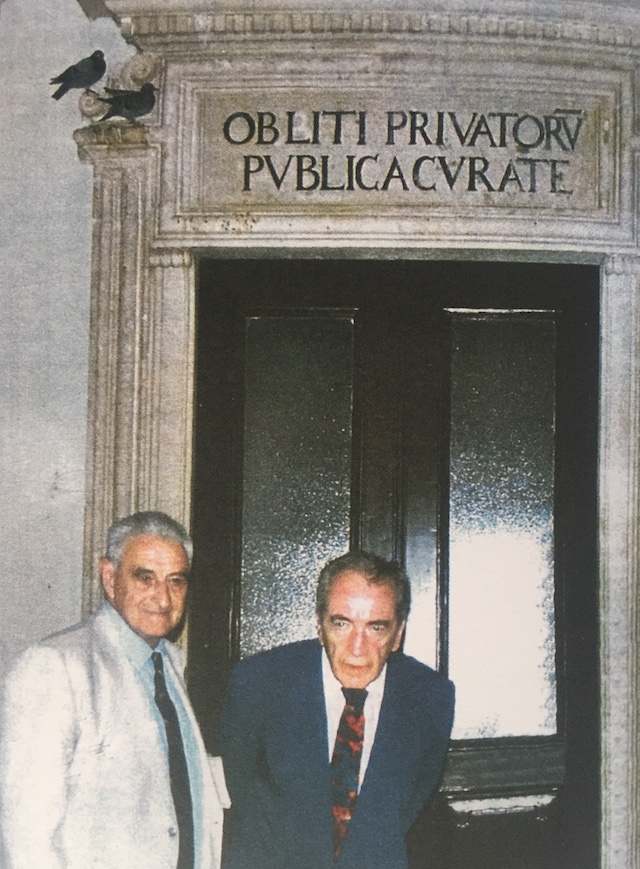
The following inscription adorns the entrance to Rector's Palace in
Dubrovnik:
Obliti
Privatorum, Publica Curate
(Forget private affairs, take care
of the public ones) On the photo below:
Dr. Hrvoje Kačić and Dr. Alois Mock, distinguished Austrian politician,
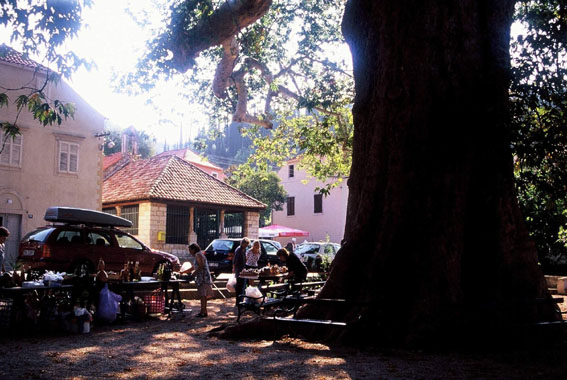
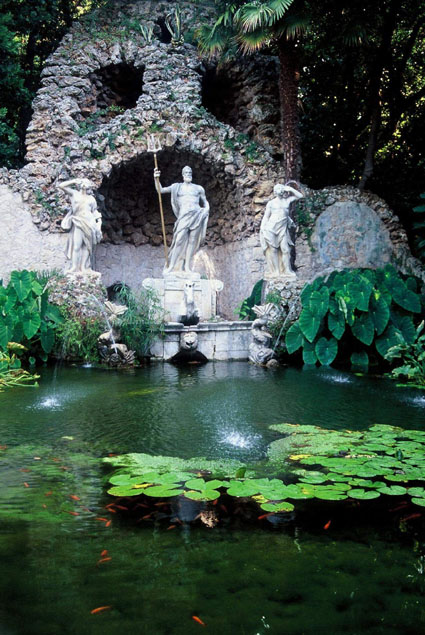
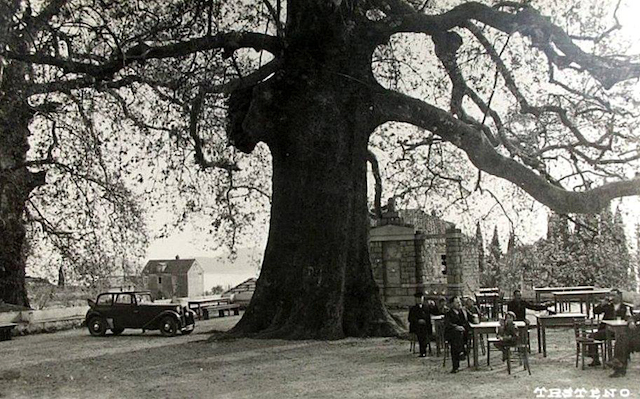
in 2004 in front of Rector's Palace in Dubrovnik. Photo from [Kačić, U službi domovine]Lucioano Pavarotti, Bono (from U2), and Nenad BachTrsteno near Dubrovnik, the biggest plane-tree (plantus) in Europe.Trsteno near Dubrovnik, the oldest arboretum in Europe (photos by Mladen Žubrinić). Luciano
Pavarotti & Friends:
Together for the
Children of Bosnia
(Modena, Italy, 1995), with
participation of Croatian singer Nenad Bach,
New York, with his tune Can We
Go Higher?. Bono, singer from
U2, recites the famous Gundulić's verses O
lijepa, o draga, o
slatka slobodo from the 17th
century in Croatian language (= Oh beautiful, oh dear,
oh sweet liberty)
in the song
entitled Miss Sarajevo,
sang by Pavarotti and Bono.
A famous plane-tree (platanus) in Trsteno near Dubrovnik, photo from 1930. The tree
still
exists today,
and it is the largest platanus in Europe. Many thanks to Najka Mirković
for the photo.
Pilgrims, writers, musicians, and physicians
Pilgrims to DubrovnikKonrad von Grünemberg: Dubrovnik - the most important city in Croatian Kingdom, 1486
In a book by a
German pilgrim Bernard von
Breydenbach, published in 1485,
one can read that Ragusa
is in Sclavonia, which is a province
of Croatian Kingdom
(...civitate que Ragusiu vocatur in
Schlavonia provincia regni Croacie).
The first public library
in Croatia was founded in Dubrovnik in
1463,
just 20 years after the
first public library was founded in Europe (in Florence, 1443). It was
the
third public library in Europe. It was intended not only for the
citizens of Ragusa, but also for foreigners, independently of their
social status. See the monograph [Krasić].
In 1486 a German
pilgrim Konrad von
Grünemberg
wrote that Dubrovnik is the
most important city in Croatian
Kingdom (...die kunglich
hobstat in Croattien), and that "it
is surrounded with incredible strongholds which have no rival in the
world". Furthermore, the
City is an Archdiocese, and its
jurisdiction encompasses the whole Croatian Kingdom.
"...It
recognizes the sovereignty of the Hungarian king, but he is not able to
defend it, since a mighty
Turk occupied large portions of
Croatia."
In 1497, a German
pilgrim Arnold von Harff
wrote in
his travel book a short list of 56 Croatian words, as he heard them
when talking to citizens of Dubrovnik, with explanation in German. He
also wrote that this city
is situated in the Kingdom of Croatia
(...item dese stat lijcht in dem koenynchrijch van Croattia).
In 1506 an English Sir Richard Guylforde
wrote that
"Dubrovnik is in Sclavonia or Dalmatia, which is a
province in
Kingdom of Croatia." See [Raukar],
pp. 360-362, and especially
Edo Pivcevic: Grünemberg
o hrvatskim gradovima,
Hrvatska revija, Zagreb, No 2, 2005, pp. 14-22. (see also his
description related to Zadar)
Writers, musician, physicians
In his 1564 epistle Ivan
Vidal from the island of Korčula
praises Ragusan playwright Nikola Nalješković (1510-1587) as follows
(see Franolić):
Oh,
Nicholas, you are the honour we praise, You are the glory and fame of the Croatian language, An excellent poet full of virtue.
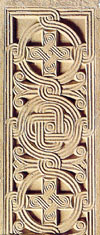
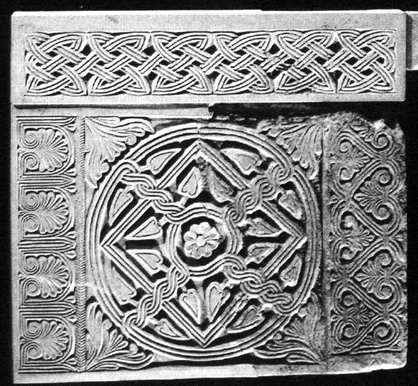
The
beauty of remains of numerous
Croatian stone monuments with interlace ornaments found in Dubrovnik
and its environs is truly amazing. For example, only in the church of
St. Peter the Great (crkva sv. Petra Velikog), the remains of which are
hidden under the floor of The Luka Sorkocevic
Art
School in Dubrovnik, about two hundred fragments with interlaced
patterns were found! See [Early Medieval
Sculpture in Dubrovnik].
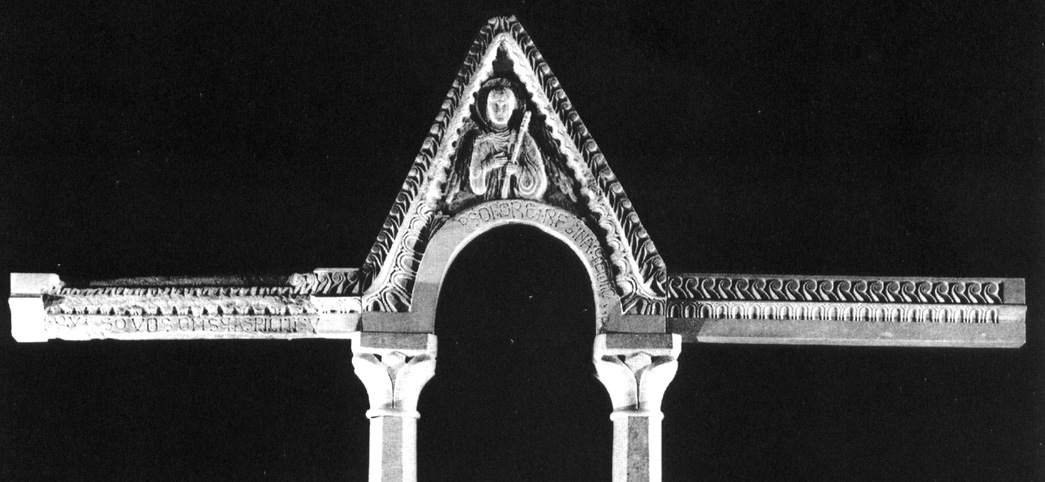
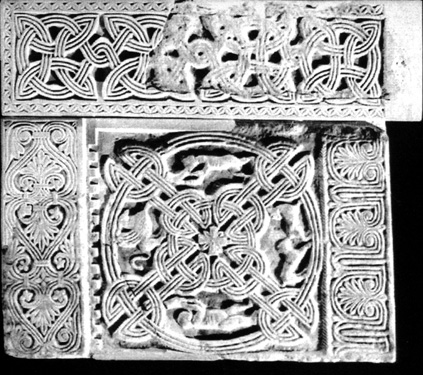
Fragment of gable from Sv. Srđ, island of Koločep, west of Dubrovnik.Altar closure, St. Michael's, island of KoločepAltar closure, St. Michael's, island of Koločep
Some other Croatian
monuments with interlace ornaments can be
seen here,
and also in Boka
kotorska.
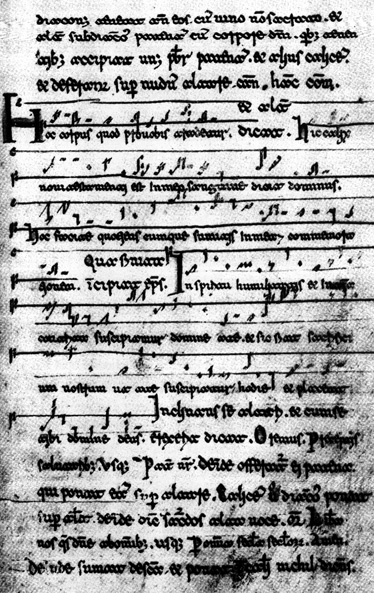
Very old and valuable is
the Dubrovnik Missal
from
the 12th century, now kept in the Bodleian Library in Oxford. Written
in
Latin, in Beneventan script, it contains prayers and some chants unique
in Europe. See [Menalo,
pp. 34-35].
The Dubrovnik Missal, 12th century, with musical notation (kept in Bodleian Library in Oxford)
The Missal, written for
the Dubrovnik Cathedral , is full of
old Gregorian chants, containing more than 200 monodic melodies. For a
long time it was believed to have been written in North Italy, until
E.A. Lowe discovered that it was written in Dubrovnik. Miho
Demoviæ proved that the Missal was written for the Dubrovnik
Cathedral, [Demović,
Rasprave i
prilozi, p 171-183]. It is interesting that as many as 430 monodic
melodies are preserved in the Dubrovnik region from that time: 220 are
kept in Dubrovnik missals, out of 720 known monodic melodies preserved
in the whole of Croatia. Out of these 220 monodic melodies, 50 of them
represent the Dubrovnik music particularities. In this way Dubrovnik
became an important European center for monodic music. Some of them
according to Demović represent the highest achievements of
world
heritage with respect to melodic beaty [Demović,
Rasprave i prilozi, p 177].
A pioneer of Dubrovnik tourism is Gabriel de Armino, a
musician from Rimini in Italy. Since 1458 he lived in the City of
Dubrovnik as trumpeter. In 1461 he obtained permission from Veliko
Vijece (City Council) to keep a
hotel with five beds. The council stressed that such an institution is
very important since many foreigners visit the City. See [Demović,
Rasprave i prilozi, p 317].
The earliest known
French-Flemish musician living in Dubrovnik
was Gallus Piffarus. He was in the City since 1425. See [Demović,
Rasprave i prilozi, p 314].
Svuda ga jes puna slava,
svud on slove hrvatskih ter kruna gradov se svih zove.
Because it is known and praised everywhere it is called the crown of
all Croatian cities.
- Ivan Vidali, 1564, Zbornik stihova
XV and XVI stoljeća (Anthology of
poetry of the fifteenth and sixteenth centuries)
The
first known opera in Croatia
was
performed in Dubrovnik in 1629, composed by Lambert Courtoys junior.
His grandfather was a naturalized citizen of Dubrovnik, Lambert
Courtoys senior from France. The opera was composed on the text Junije
Palmotiæ's (1606-1657) text Atalanta
written in
Croatian, which bore the subtitle Musica. Unfortunately, the scores are
not preserved, but a document preserved in the Dubrovnik archives from
that time proves that it was indeed an opera performed by 17 musicians.
See [Demović,
Rasprave i prilozi, p
387].
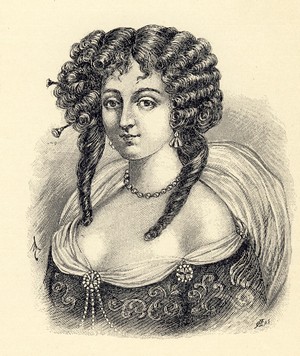
Cvijeta Zuzorić
(1552-1648), wrote her verses and
epigrams in Croatian and Italian. Known for her exceptional beauty,
both physical and spiritual, verses were devoted to her by some of the
best Ragusan and Italian poets, for example by Dinko Zlataric and
Torquato Tasso. Torquato Tasso compared her verses to "rare pearls of
unparalleled beauty". Unfortunately, not a single one has survived.
The
first mention of playing chess in Croatia
dates from the 14th century,
more precisely, from 1385
in the city of Zadar.
Thomas Hyde, an English orientalist from 17th century, travelled
through Croatia, and mentioned that the correspondence
chess
had been played between Croatian and Venetian merchants in 1650,
more precisely, between the
Dubrovnik and Venetian merchants. It is the
oldest mention of correspondence chess in history.
This fact can be found in his book "De ludis orientalibus" (On Eastern
Games), published in Latin in 1694. Information by the courtesy of dr.
Zvonko Krečak, Croatian physicist and president of the Croatian
Correspondence Chess Association.
Luka
Sorkočević (1734-1789),
whose beautiful
symphonies
are performed throughout the world, lived in Dubrovnik (you are just
listening to his Andante). His two sisters were the first
women-composers in Croatia.
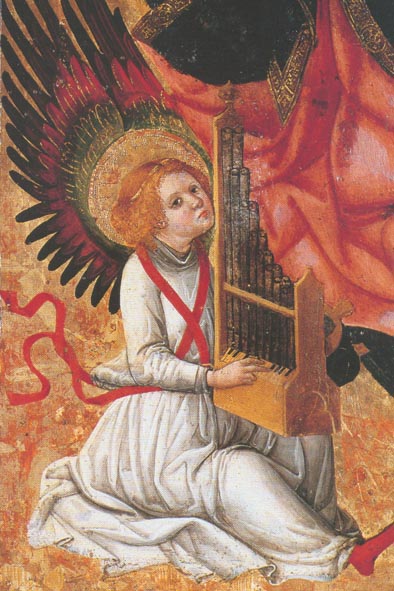
Here is a detail from
the Dubrovnik polyptych by Lovro
Dobričević from 1466,
representing an angel playing portative, a small portable organ.
Ivan
Mane Jarnović (1740-1804)
was an outstanding Croatian violinist and composer of the 18th century,
probably from Dubrovnik. He had a true European career - playing,
composing and conducting in France (Paris), Austria, Germany,
Switzerland, Poland, Scandinavian countries, England. Also played the
first violin in the orchestra of the Russian empress Katarina II.
Jarnović composed about 50 chamber instrumental pieces, 22 violin
concerts (17 preserved), and is known for having introduced the romanza
as a slow movement into the structure of the violin concert. His life
is described in a novel Jarnowick
by G. Desnoisterres - Le
Brisoys, Paris 1844, and in a collection Scènes
de la vie
d'artiste by P. Smith (Une
leçon de Jarnovic, Paris, 1844).
Jelena Pucić-Sorkočević (1786-1865), who was born
and died in Dubrovnik,
was the first known Croatian women composer. Her compositions belong to
the early and middle Romantic era. Many thanks to Dr. Miho Demović for
this
information.
Jelena Pucić Sorkočević (1786-1865), the first Croatian woman composer.
Photo from www.geni.com.
More details about Jelena Pucić Sorkočević can be found in his
monograph Miho Demović: Glazba i
glazbenici na području bivše Dubrovačke Republike za vrijeme austrijske
uprave 1814.-1918., Zagreb-Dubrovnik 2016.
Let
us mention the name of Dobrić Dobričević
(Boninus de Boninis de
Ragusia), Ragusan born on the island of Lastovo, 1454-1528, who worked
as a typographer in Venice, Verona, Brescia. His last years he spent as
the dean of the Cathedral church in Treviso. His bilingual (Latin -
Italian) editions of "Aesopus moralisatus", Dante's "Cantica", and
"Commedia del Divino" were printed first in Brescia in 1487, and then
also in Lyon, France. We know of about 50 of his editions, the greatest
number belonging to the period of 1483-1491 that he spent in Brescia -
about 40. Croatia is in possession of 19 of his editions in 30 copies.
The greatest number of his editions is in possession of the British
Museum, London (22).
The
first printed Croatian Cyrillic book
was The Book of Hours (or the
Dubrovnik breviary, or Oficje) published in Venice in 1512, prepared by
Franjo Ratkovic
from Dubrovnik. One copy is held in Paris
in Bibliothèque Nationale. There is also another copy in the
Codrington Library at All Souls College, Oxford (q.14.9); it was
probably part of the founding bequest of Christopher Codrington in
1710. It is, admittedly, slightly less complete than the Paris copy,
lacking 19 leaves. Many thanks to prof. Ralph Cleminson (University of
Portsmouth, UK) for information about the Oxford copy.
Old Croatian pre-Romanesque church of sv. Ivan on the island of Lopud (photo by Najka Mirković)
Bonifacije
Drkolica (known also as
Darcoliza, Drakolica, Drkoličić,
Ragusinus, Stjepović etc.), born on the island of Lopud near Dubrovnik
in the beginning of 16th century, started his career as a Franciscan
and continued his study of philosophy in Paris. In Rome he met many
famous persons, including the future pope Sixto V,
whose roots are Croatian on his father's side. In 1550 he was
appointed the apostolic guardian in Jerusalem, and apostolic vicar of
the Holy Land, which meant that he was responsible for all Catholics in
the Near East. With his diplomatic skills, having visited several
times Constantinople and once Persia, he managed to renew all
the sanctuaries in Palestine. He renewed the basilica of St. Grave, and
was
the first after St. Helena, mother of tsar Constantine, to enter and
examine the St. Grave, about which he made a written report. Since
1561. he is apostolic visitator in Hungary, Poland and Russia. In 1564,
he was appointed the Ston bishop (Ston
is a
lovely town near
Dubrovnik). He was also in the mission of Pope Pio IV in Russia under
Tsar
Ivan Grozny, and in Spain under King Phillip II. His book Liber
de
perenni cultu Terrae Sanctae
(Venice 1573, 2nd edition in 1875)
dedicated to pilgrims, is important for the study of the situation in
Palestine in his time. He also published his speech held at the Trident
council, in the booklet Liber
de ortu clerricorum in ecclesia
(Venice, 1573). For more details see [Zorić].
Nikola
Sorgoević, a sea captain
from Dubrovnik (born on the island of Sipan), wrote several books on
navigation,
shipbuilding,
and
tides,
and
three
of them
have been preserved. Two
of them were published in 1574 in Venice, soon after his death in
1573..
Didak
Izaija Cohen, known under
pseudonyms Dydacus
Pyrrhus Lusitanus and Iacobus
Flavius Eborensis, was a
renowned Portuguese physician and poet of the Jewish origin. He lived
in Dubrovnik from 1558 until his death in 1599, i.e. for more than 40
years. He devoted some of his verses to the beauty of Dubrovnik.
Another famous Jew exiled from Portugal who found refuge in Dubrovnik
(1556-1558) was Amatus
Lusitanus (Juan Rodriguez), a
leading
European physician of the 16th century.
When Dominko Zlatarić,
a 16th
century Croatian writer in Dubrovnik, translated Electra from the Greek
original to Croatian (not via the Italian translation), he approximated
the Hellenic spirit by Christianizing it, according to the measure and
spirit of his own time. As he wrote himself, he made
his Electra
Croatian. He dedicated some of
his translations into Croatian
("u hrvatski izložene") to Juraj Zrinski, son of the Sziget hero Nikola Šubić Zrinski.
Zlataric's teacher
and later a close friend was the above-mentioned Dydacus Pyrrhus.
Cathedral of Mary's Assumption, Dubrovnik (photo by Najka Mirković
André
Vaillant, a famous French
specialist for
Slavic languages, defended his thesis entitled La
langue de Dominko
Zlataric, poéte ragusain de la fin du XVIe siècle,
in
1926. That same year he published Les
Piesni razlike de Zlataric.
Vice
Bune (1559-1612), a
Dubrovnik merchant born on the island of Lopud, diplomat and high state
official of Spanish kings, for some time occupied the position of
viceroy in Mexico. He had important diplomatic missions for the
Dubrovnik Republic on the courts of Naples, Milano and Madrid.
The
first coffee-house in England
was opened in London in the 17th century by a native of Dubrovnik, a
certain Pasque Rosee
(probably distorted form of Raguseo). In
1983 at North Stoneham, England (a few
kilometers from Southampton), a stone slab was uncovered under a
boarded floor near the choir stall in the Church of North Stoneham (6
feet 8 inches by 3 feet 8 inches). It contains emblems of St Mathew, St
Luke, St Mark and St John. Carved around the edge of the stone is the
inscription: "The Guild of the Slavonians (Croats) in the year 1491."
It is very probable that the stone was initially in Southampton in a
chapel that belonged to the Guild of Croatian mariners there. One of
the earliest Croatian mariners in Southampton is Blasius de Jar' from
Zadar, mentioned already in 1396, while in the 15th century there are
many other Croatians in Venetian galleys: from Dubrovnik, Zadar, Split,
Zagreb, Kotor, Budva, Bar. Moreover, according to collected data from
that period we know that a great part of the staff in Venetian galleys
was composed of Croats. See [Eterovich],
p. 21, and Lovorka Čoralić: Hrvatska bratovština u južnoj Engleskoj
(XV.-XVI.st.), Marulić, 1998, No 1, p.53-59.
Island of Lokrum near Dubrovnik (photo by Mladen Žubrinć)
Island of Lokrum
near Dubrovnik
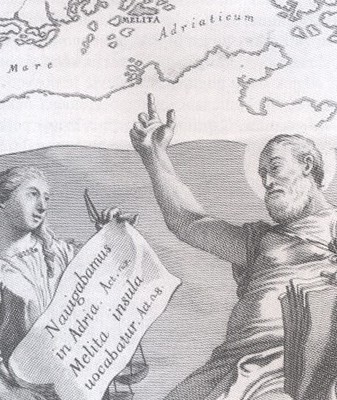
St. Paul's shipwreck on the island of Mljet
Ancient islands of Melita (Mljet in the Adriatic and Malta)
From
the description of St. Luke in the Acts
of Apostles, chapters 27 and 28, we know that during St.
Paul's
journey from Caesarea to Rome there was a shipwreck on the island of
Melita, in Adria (Adriatic Sea). At that time there were two islands on
the Mediterranean bearing the name of Melita:
today's
Malta, and the island of Mljet
not far from
Dubrovnik.There are many arguments that the shipwreck occurred on this
island of Mljet, and not on Malta, see [Ničetić]
(professor at the University of Dubrovnik, and experienced mariner).
The journey from Crete to Malta would be impossible due to unfavorable
winds and unfavorable sea currents.
Archeological excavations
on Mljet have pointed to the existence
of an Early Christian basilica which according to local tradition
belonged
to the Church of St. Paul. There are also other archeological findings
on Mljet bearing Christian symbols of Syrian and Palestinian origin,
dating from 5th to 6th centuries.
Ignjat Đurđević (Ignatio Georgio)Ignjat Đurđević (1675-1737), Croatian writer, poet, historian, and
benedictine monk at the Veliko jezero (Great Lake) abbey on the island of Mljet.
Ignjat
Đurđević (Ignatio
Georgio,
1675-1737), a Dubrovnik baroque writer, poet, and historian, issued a
book D. Paulus Apostolus in
mari, quod nunc Venetus sinus dicitur,
naufragus, et Melitae Dalmatensis insulae post naufragium hospes,
Venice, 1730, kept in the Metropolitan Museum in New York, containing a
map indicating that St. Paul had the shipwreck in the Adriatic (Mare
Adriaticum) on the island of Mljet (Melita).
A detail of gravure from Ignjat
Đurđević's book from 1730, indicating that St. Paul had a shipwreck in
Mare Adriaticum (Adriatic Sea) near the island of Mljet.A detail from the title page of
Ignjat Djurdjevic indicating Melitae
Dalmatensis Insulae
(i.e. Dalmatian island of Mljet) as the place of St. Paul's shipwreck,
and not Malta which is in the Libyan Sea.A sketch of St. Paul's
shipwreck near the island of Melita (Mljet) in the Adriatic Sea, not
near Malta. Published by Ignjat Đurđevic in 1730. Source of the
photos is [Đurđević].
Also a well known Greek
statesman and historian Konstantin
Porphyrogenitus, 10th century, in his well known book On
Administering the Empire,
mentioned that it was the island of
Mljet that St. Paul visited. See See [Demović,
Glazba u staroj hrvatskoj državi, pp 109].
Miho Demović:
Sveti Pavao bio na Mljetu i osnovao Pracrkvu? Glas koncila, br. 16, 20.
travnja 2008., p. 25.
Ignjat Đurđević:
Sveti
Pavao apostol brodolomac, with
foreword by
Miho Demović, Dubrovačka biskupija, Dubrovačke knjižnice, Općina Mljet,
Zagreb 2008. ISBN 978-953-97952-3-0 (see IKA)
Miho Demović (ed.): Brodolom sv. Pavla
u vodama hrvatskog otoka Mljeta,
Zbornik radova, Dubrovačka
biskupija i Matica hrvatska Dubrovnik, Zagreb 2009
Croatian Glagolitic Script in the Dubrovnik area
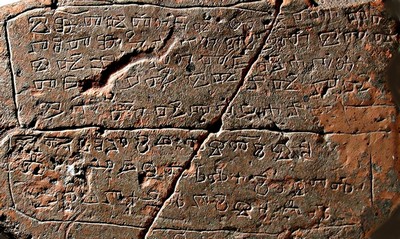
Župa dubrovačka fragment from 10th or 11th century
The Župa
Dubrovačka fragment (from 10th or
11th century),
carved in Croatian
Glagolitic Script, was discovered by Mrs. Marta Perkić near of the town of Župa dubrovačka, east of the city of
Dubrovnik, in 2006, during excavations directed by Dr. Zdenko Žeravica, distinguished Croatian archaeologist. See [Žeravica].
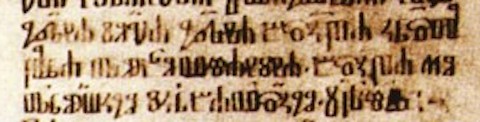
The text of rev. Martinac appearing
in the IInd Novi Breviary
(completed in 1495), describing the Krbava battle in 1493, contains a
rare occasion of the name of Dubrovnik written in the Croatian
Glagolitic Script. There, we can see the name of Kristopor Dubrovčanin
(Christopher from
Dubrovnik), bishop of Modruš,
Krbava etc:
...gospodina biskupa Krsto-
pora Dubrovčanina, biskupa mo-
druškogo i krbavskogo i pročaja
Dubrovčanina (containing glagolitic ligature BR)
There are secret documents written in Croatian Glagolitic quickscript, reporting about
Turkish troup movements in the then Ottoman Empire, near the Croatian
border. In one of these documents (see Turski glasi, i.e., secret information from the lands occupied by the
Turkish), also the name of Dubrovnik appears written in the
Glagolitic Script.
Dubrovnik in 16th and 17th centuries
Dubrovnikers in Kosovo
Even today there is a
town in the Kosovo region near Priština,
called Janjevo,
whose citizens are old descendants of Dubrovnik
merchants. They have an uninterrupted, documented history of seven
centuries. According to the 1991 census there were still about 4,000
Croatian Catholics there, while after the Greater Serbian policy of
ethnic cleansing only 320 of them were left in very difficult
conditions.
It is little known that
there was the Society of
Dalmatians in England already in
1590. Personal
information by Adam S. Eterovich.
Dubrovnikers in India
It is interesting that
the Dubrovnik merchants had their
settlement in the city of Gvendolin in India in the 16th century, where
they built the Church of St. Blase in 1653, which exists even today. In
Goa in India there existed a strong Dubrovnik colony around the Church
of St. Blase. In 1540, St. Francis
Xaver arrived on his mission to India,
and later to Japan.
Miho Pracat
What is the reason why the Dubrovnik Senate reached a decision in 1638 to place a bust of a plebeian...
Miho Pracat, a Dubrovnik benefactor (+1607); his bust is in the Rector's Palace since 1638
between two columns at the eastern wing of the Rectors Palace atrium? The only plebeian whose statue was erected during the thousand-year life of the Dubrovnik Republic.
Miho Pracat was a rich seaman from the Island of Lopud, who left his wealth to the Republic. This powerful ship-owner and accomplished merchant was shown the way to success by a little tenacious lizard. Watching its two attempts to climb the wall of his fathers house, two downfalls and eventually the third successful climbing to the top, Pracat realised the importance of persistence. This encouraged him to make a new start after his business repeatedly collapsed and his ships and their cargo ended up at the bottom of the sea.
During one of his voyages Pracat broke the pirate siege and brought the ships loaded with corn to the hungry people of Charles the Fifth. The king granted Pracat an audience during his morning shaving! In addition to numerous compliments and astute glances, he offered Pracat honours and gold. The shrewd man of Lopud responded in kind: he refused all gifts and requested the kings serviette, which is now displayed at the museum situated on Pracats native island.
One
of the most outstanding Dubrovnik
mathematicians, physicists and astronomers of the 17th century was Stjepan Gradić
(1613-1683), who was a
Director of the Vatican Library. Some of his experimental results are
cited by Jacob Bernoulli, and his tractate about navigation incited
Gottfried Wilhelm Leibniz to discuss the problem of steering ships
using helms. Gradic's book Disserationes
physisco-mathematicae
quatour was published in
Amsterdam in 1680. He died in Rome, where
according to his last wish he was buried in the Croatian church of St.
Jerome.
Gjuro Baglivi
Gjuro
Baglivi (born in
Dubrovnik, of Armenian origin,
1668-1707) was a professor of
anatomy
and theoretical
medicine in Rome (Sapienza) already at the age of 28, and the Pope's
physician. He developed a theory that living fibre was the anatomical
and physiological element of all pathological processes (fibral
pathology). He also had some essential discoveries in the fine
structure of muscles. His collected works written in the Latin language
had more than 20 editions, translated into Italian, French, German and
English. Académie
Française in Paris accepted him as
"membre
d'honneur". Baglivi was also a member of the Royal Society in London
and of the Accademia
dell'Arcadia.
Anselmo Banduri, Gjuro de Ragusa, Vladislav Menčetić
His Ragusan colleague Anselmo
Banduri
(1675-1743) became a famous antique numismatist
in Paris, and entered Académie des
Inscriptions et Médailles. Anselmo (or Anselme, Anselmus) Banduri was a
Ragusan benedictin monk who served at the Benedctine Abbey on the island of Melita (Mljet) in
Croatia. Born in Dubrovnik, he died in Paris. He is the author of
several important
monographs:
Imperioum
oriental, sive Antiquitates Constaninopolitanae, Vols I and II
(Vol II contains also De
Administrando Imperio by Constanin
Porphyrogenetus, as well as two
tables of Croatian Glagolitic Script on
p. 329), Paris 1711.
Numismata
imperatorum Romanorum a Traiano Decio ad Palaeologos Augustos,
Paris 1718 (2nd corrected edition published in 1719 by Fabricius in
Hamburg).
Gjuro Dubrovčanin (Gjuro de Ragusa)
published
his Epistolae
Mathematicae in Paris in 1680.
The
Rugusan poet Vladislav
Menčetić (1600 - 1666),
dedicating his verses Trublja
slovinska
(Ancona 1665) to the Croatian ban (governer) Petar
Zrinskii, expresses feeling full
of patriotic sentiment:
Your
people are crowned with fame,
A teeming Croatian multitude -
Under captivity's wave long since
Would Italy have sunk
Had the Ottoman sea not broken
Upon Croatia's beaches. (94)
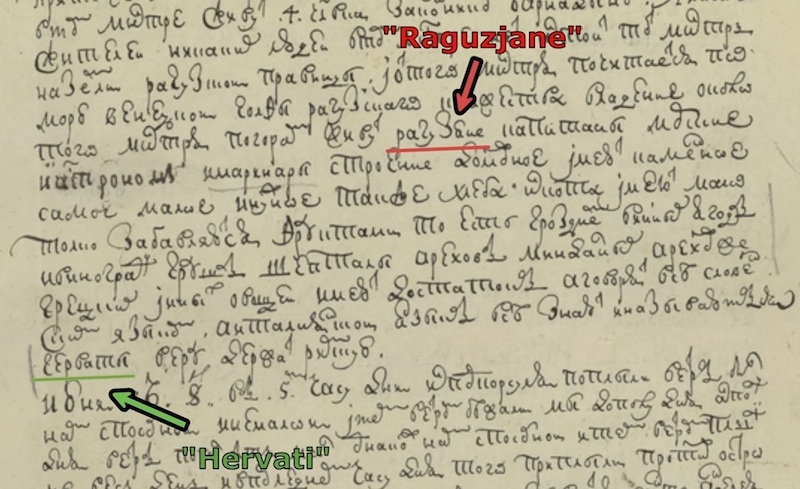
Petar Andrejevič Tolstoj in Boka in 1698The original Russian text handwritten by Petar
Andrejevič Tolstoj in 1698.
describing the citizens of Dubrovnik as the
Croats (Hervati, Gervati).
Provided by Hrvati
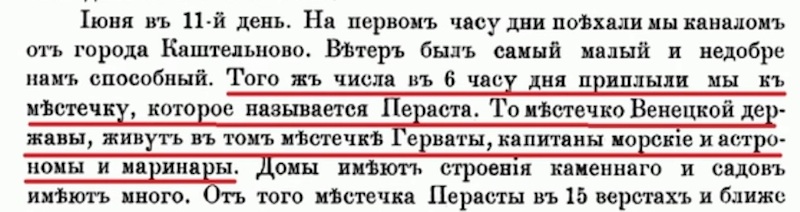
u putopisu P. A. Tolstoja, 1698, starting at 3:00.The original Russian text by P. A.
Tolstoj from 1698. describing the citizens of Perast in Boka kotorska
as the Croats.
Provided by Hrvati u putopisu P. A. Tolstoja, 1698, at 4:40.
For numerous other examples, follow the above link.
p>
Dubrovnik in the 18th century
Bernardin Pavlović, Derivaux-Bruerovic, Luka Sorkočević
The Franciscan Bernardin
Pavlovic from Dubrovnik, born in Ston,
had two
works printed in Venice in
1747 "in the Croatian
language." The title of the second work runs as follows: Salves
for the dying...new and revised edition printed in Croatian for the
benefit of the Croatian nation,
Venice, 1747. (95)
In Dubrovnik the Jesuit
Peric, the Franciscan J. Gjurinic and
the Croatized Frenchman Derivaux-Bruerovic call their language
Croatian. The latter at the outset of the XIX century complains that
some of the people of Dubrovnik forsake their "Croatian heritage" and
are ashamed "to speak only Slavic" (slovinski). (96)
This
paragraph is taken from Mr Vicko
Rendic
web page, where
you can find more information.
In the 16th century, Dubrovnik had very strong maritime activities,
due to which, during a certain period, the City had a network of as
many as 50 consulates
throughout the Mediterranean, especially in Italy (36). See [Mitic
1973, p. 220]. For example, on the island of Sicily only, there were 8
consulates of the Dubrovnik Republic: Messina, Palermo, Siracusa,
Terranuova (since 1927 renamed to Gela), Catania, Agrigento, Trapani,
Millazo, and even on the nearby island of Lipari; see a map of the
Dubrovnik consulates in [Mitic, just
after p. 200].
In that period of the 16th century, Dubrovnik had 180 ships and 5000 mariners.
By the end of the 18th century, Dubrovnik had 280 long-range ships
(including long-range coastal ships);
see [Mitic, pp. 15 and 19].
Arround 16th century, the Dubrovnik navy had about 200 (two hundred) sailing ships.
Only England and the Netherlands had more sailing ships. Some of the
Dubrovnik ships were sailing under foreign flags (Spanish, for
instance).
Dubrovnik had a maritime
and trade contract with the port of
Messina on the island of Sicily already in 1283. Also, Dubrovnik had
the consulate in Messine for more than 400 years, from 1397 till 1808.
In1588 Dubrovnik had greater traffic with Messina than France and
Venice (measured in weight-tons of ships), in fact, almost as much as
France
and Venice taken together. Messina was the most important trade partner
for Dubrovnik on the entire Mediterranean.
See Ilija
Mitić: Pomorsko -
trgovačke veze Dubrovnika sa lukom Messinom od kraja XIII do početka
XIX stoljeća, Pomorski Zbornik,
22/1984, 549-556.
Dubrovnik had consulates
from Lisbon to Odessa on the Black
Sea. In the 18th century Dubrovnik had as many as 80 consulates,
which is more than
Austria at that time (35), or France (40).
From an interview
with dr. Ilija Mitić published in Sonja
Seferović: Znanstveni rad koji je urodio dugogodišnjom suradnjom s
njemačkim sveučilištima, Dubrovački
vijesnik, 24. veljače
2007.,
p. 51.
It seems that Dubrovnik was in possession of Archimedes' telescope,
about which a testimony exists written in 1672 by Antun Sorgo
(Sorkočević, son of distinguished Dubrovnik composer Luka
Sorkocevic),
in his book "Origine et chute de l'ancienne République de
Raguse". Antun Sorgo was the last ambassador of the Dubrovnik Republic
to
France, where he spent
35 years. The Archimedes' telescope seems to have been lost during the
disastrous Dubrovnik earthquake in 1667. The basic idea of
Archimedes' reflecting telescope (3rd ct. BC) seems to coincide with
that of Newton's reflecting telescope (Isaac Newton,
1642–1727).
The earliest known symphonic orchestra in Croatia was founded in
Dubrovnik 1755. The first organ with two manuals for the Korčula
Cathedral was built by Vicenzo Klišević in the 1790s, who was organ
builder in Dubrovnik. Information by the courtesy of Miho Demović
(March 2017).
Ruđer Bošković, philosopher and scientist
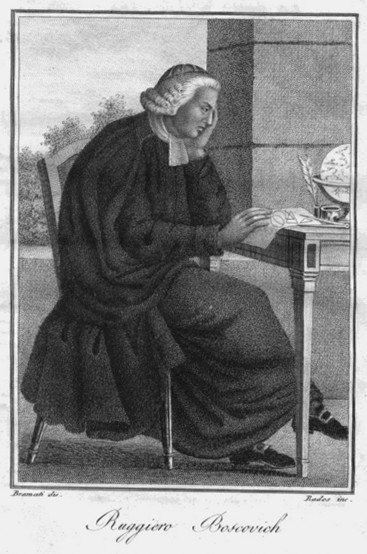
The
greatest and most famous Croatian
philosopher and scientist Ruđer Bošković
(Boscovich, 1711-1787), was born in Dubrovnik, where he was educated in
the Jesuit Collegium. He was a member of
the Royal Society of London,
of St. Petersburg Academy,
"membre correspondant" of the French
Academie Royale des Sciences,
a professor at
many European universities. Very
delicate work on repairing the cupola of St. Peter's church in the
Vatican (diameter: 42m) was entrusted to R. Bošković, a proof that he
was a leading European authority for static computations and civil
engineering of that time. Upon the request of Austrian Empress Maria
Theresia, Bošković was solving the problem of stability of the Royal
Library (now Austrian National Library) in Vienna.
Portrait of Ruđer Bošković by the
English painter Edge Pine
(London, 1760).
He was also the founder
of the astronomical observatory in
Brera near Milan. In 1773 a charter granted by Louis XV made him a
French subject. Soon he was appointed by Louis XV to a very prestigious
position and became the Director of Naval Optics of the French Navy in
Paris (Optique Militaire de la Marine Royale de France). He left to his
adoptive country an achromatic telescope and micrometer. Boskovic spent
nine years in France, and became a good friend to many outstanding
scientists, like the mathematician Clairaut, Lalande, Buffon. When
D'Alembert took him for Italian, he hastened to correct him.
Boskovic stayed 7 months
in England and met many famous
scientists there: James Bradley (famous astronomer), George Parker
(president of the Royal Academy), Samuel Johnson (Lexicographer),
Edmund Burke (philosopher and political writer), Joshua Reynolds (the
first president of the Royal Academy of Arts), and others. It is
interesting that in England he designed a telescope filled with water
in all its components, which was implemented at the Greenwich
observatory in 1871, that is, 84 years after his death. He also met
Benjamin Franklin, who showed him some of his electrical experiments,
see an article
by Branko Franolic.
A
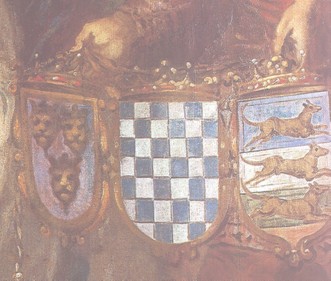
detail from the Jesuit Collegium in Dubrovnik, where Ruđer
Bošković was educated,
17th century, representing coat of arms
of
the Kingdom of Croatia,
Slavonia and Dalmatia.
Boskovic was also a
brilliant Croatian
Latinist poet. He wrote an
extensive scientific epic De
solis
et lunae defectibus (On Solar
and Lunar Eclipse) published in
London in 1760. It contains 5570 Latin verses, and was dedicated to the
Royal Society of England whose member he was. In the title one can read
"Father r. Boskovic, of the Jesuit Order", although at that time it was
forbidden for Jesuits to live and work in England. The epic was written
in the manner of Roman classics, in dactilus (dactylic) hexameter.
When Charles Burney, a
well known English musicologist, met
Boskovic in Milan, he wrote: ...if
all Jesuits were like this
father, who uses the higher science and the work of mind to advance
science for the happiness of mankind, then it were to be wished that
this society were as durable as is this world.
Bošković was buried
in the church of S. Maria Podone in Milano.
Ruđer Bošković
French astronomer Joseph-Jerome de Lalande wrote the following lines in
his book Voyage en Italie:
Le
plus grand mathématicien que l'aie
connu à Rome est M. Boscovich, alors jésuite: il
est
né à Raguse en 1711, mais il vint à
Rome
étant encore fort jeune, et après avoir longtemps
professé les mathématiques au collège
romain il
fut fait professeur à Milan et ensuite à Pavie;
mais l'on
voyait avec peine des talents supérieurs comme les siens,
concentrés dans cette dernière ville; non
seulement il
n'y a personne en Italie dont les ouvrages soient aussi
célèbres dans toute l'Europe que les siens, mais
je ne
connais pas de géomètre plus spirituel et plus
profond
que lui. Sa mesure de la terre, son beau traité sur la loi
de la
pesanteur, ses découvertes sur la lumière et sur
diverses
parties de la physique, de l'astronomie, de la
géométrie, son poème
sur les
éclipses,
imprimé à Londres, à Venise et
à Paris,
peuvent donner une idée du nombre et de l'étendue
de ses
talents; mais il faut l'avoir connu particulièrement, pour
savoir
combien il a de génie, combien son caractère est
aimable,
sa conversation intéressante, et ses idées
sublimes dans
tout les genres. En 1773, il a été
appelé en
France et naturalisé Français. Il est
actuellement [1784]
à Bassano, occupé à faire imprimer ses
nouveaux
ouvrages, en cinq volumes.
William Thompson-Kelvin, the English
physicist (19/20 centuries), once expressed his opinion that his atomic
theory is a pure "Boskovicianism." Still earlier, Sir Humphry Davy,
professor of physics and chemistry at the Royal Institution in London
from 1802 till 1827, mentioned the name of Boskovic on several
occasions in his Diary (Commonplace Book), accepting his atomistic
theory. The diary is kept in the archives of the Royal Institution in
London. Also a famous Irish mathematician and physicist R.W.
Hamilton wrote extensively about
Boskovic's theory of forces.
With his theory of
forces R. Bošković was a forerunner of
modern physics for almost two centuries. It was described in his most
important book Theoria
Philosophiae naturalis (Vienna
1758,
Venice 1763, London 1922, American edition in 1966).
Werner Heisenberg (Nobel
prize for physics in 1932) wrote the
following:
Among
scientists from the 18th century Bošković
occupies an outstanding place as a theologian, philosopher,
mathematician,
and astronomer. His "Theoria philosophiae naturalis" announced
hypotheses which were confirmed only in the course of the last fifty
years.
Indeed, see his graph of regions of attractive and repelling forces
between material points (elementary particles), the closest region (CPD)
being repelling, tending to infinity (nuclear force!; see
here; published in his Dissertationes
de lumine pars secunda,
1748), and the farthest region (MNRSZ) is attracting, corresponding to
gravitational force:
Ruđer Bošković's unified theory of forces (nuclear - CPD, gravitational - MNRSZ,...).
This graph was since 1763 called the Bošković
curve (curva
Boscovichiana).
Ruđer Bošković was the discoverer of the principle of determinism, 56 years
earlier than P. S. Laplace. Moreover, Boscovich's approach is more
precise, complete and comprehensive than Laplace's. See Boris Kržljak.
Robert Marsh, the author
of Physics and Poets, credits
Bošković with the idea of FIELD.
Faraday and others took the
idea from him, see
here. He was the first to apply
probability to the theory of
errors. Laplace and Gauss acknowledged their indebtedness to his work
which led to the Legendre principle of least squares in statistics
(stating that the best fitting line is the one with the smallest sum of
squared residuals).
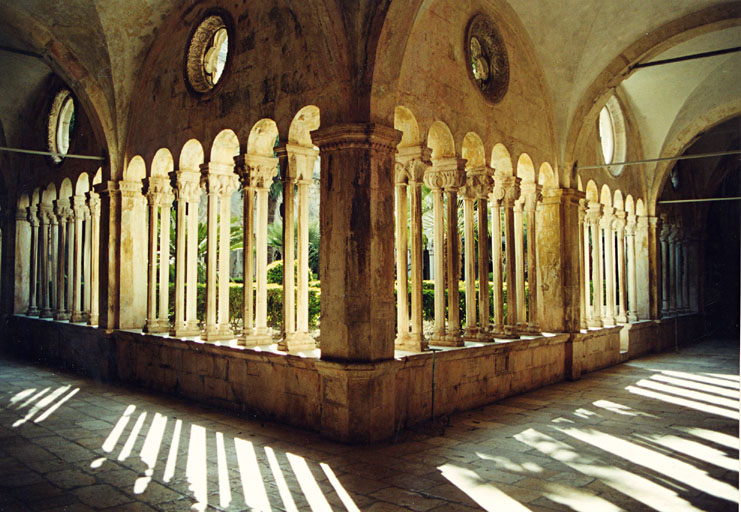
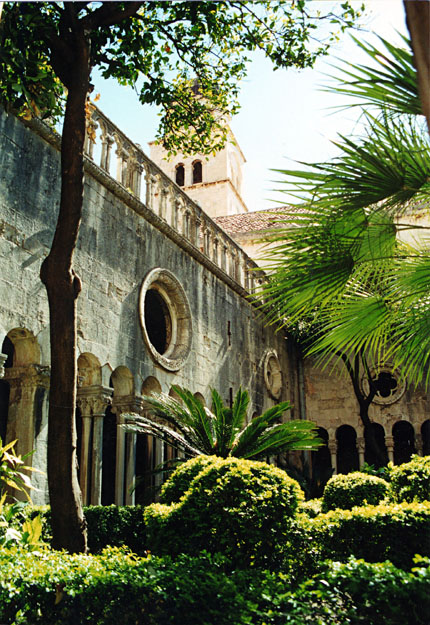
Interior of Franciscan monastery in Dubrovnik (photo by Najka Mirković)
He was also very active in astronomy and diplomacy. A great many
letters sent to his sister and two brothers written in Croatian testify
that
he did not neglect his mother tongue. So in one of his letters he wrote
that in one of European cities he saw soldiers - "our Croats" (naše
Hrvate).
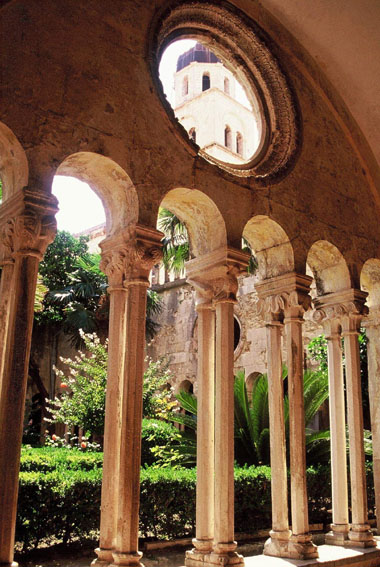
Interior of Franciscan monastery in Dubrovnik (photo by Mladen Žubrinić)
He also wrote poetry. Most of his manuscripts are kept in the special Bošković
Archives in the Rare Books
library in Berkeley, University of
California, USA:
altogether 180 items
and including 66 scientific treatises,
plus
rich correspondence
comprising over 2,000 letters, among
others with D'Alambert, Lagrange, Laplace, Jacobi and
Bernoulli;
he had intense correspondence with his friend Voltaire.
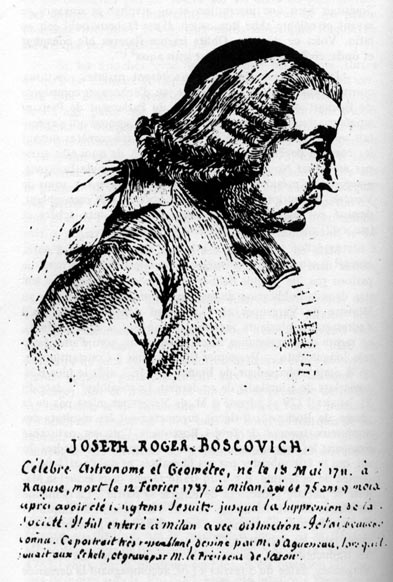
A portrait of Ruđer Bošković,
published in Milano in 1818 in a collection of
famous people living between the 18th century and the beginning of the 19th.
(many thanks to Dr Luca Leoni, Italy, for the photo)
Signature of Ruge Boscovich
from one of his letters written in Croatian,
sent to his sister Anica. Source Roger
Boscovich, the eighteenth-century polymath,
lecture by Ivica Martinović at the Royal Society in London, 2013.
Some of his books,
articles and letters, together with other
documents, are kept in the famous Franciscan
monastery
(Samostan Male Brace) in Dubrovnik. Its library possesses 30,000
volumes, 22 incunabula, 1,500 valuable handwritten documents. It was
severely damaged in the aggression in 1991/92 (shelled
by the Serbian Army
- 37 direct hits).
Franciscan monastery in Dubrovnik (photo by Najka Mirković)
The names of Rudjer Boskovic
and Marin
Getaldic (Ghetaldus) appear on
an extensive list of the Chronology of Mathematics,
where you can find
additional biographical sources related to Boskovic held in the USA and
UK.
One of the greatest
English 20th century novelists, Aldous
Huxley, in Antic Hay (1923) mentions Bošković, Leonardo, Michelangelo,
Händel.
Cornelia Wright
(1757-1837), an English writer, in her
"Autobiography'' left us important information about Raymund Kunić
(Croatian latinist and
grecist), whom she met in Rome. She also met Ruđer Bošković in Paris,
whom she admired as a "mathematician and astronomer and as a good Latin
poet who like many of his countrymen had the gift of composing Latin
verse with facility''. It is very likely due to her acquaintance with
Kunić that the first translation of a Croatian poem into English arose
(a poem by Ignjat Gjurgjevic, translated into English from its Latin
translation).
Nikola Tesla
(1956-1943) was in possession of Ruđer Bošković's monograph Theoria
Philosophiae naturalis.
Croatian writer Vojmil
Rabadan wrote a poem Carmen
Boscovichianum iliti Spomen mali velikom nam Rudi
(on the
occasion of 200 years since the death of Ruđer
Josip Bošković, SJ), Zagreb 1987. Inspired by this text,
maestro Boris
Papandopulo
composed a cantata. Source Valentin
Pozaić.
Lit.
Grant
Konstantinovič Cverava: Rudžer
Iosip Boškovič ([PDF],
in the Russian), Nauka, Sankt Peterburg 1997
(published three years after the death of the author). Description of
the book makes it clear the the book is dedicated to distinguished
Croatian scientist-Jesuit of the 18 century:
Книга посвящена жизни и
деятельности выдающегося хорватского учёного-иезуита ХVІІІ в. Р.И.
Бошковича, успешно работавшего в области физики, астрономии, геодезии,
оптики, математики. геологии, археологии, архитектуры и даже дипломатии.
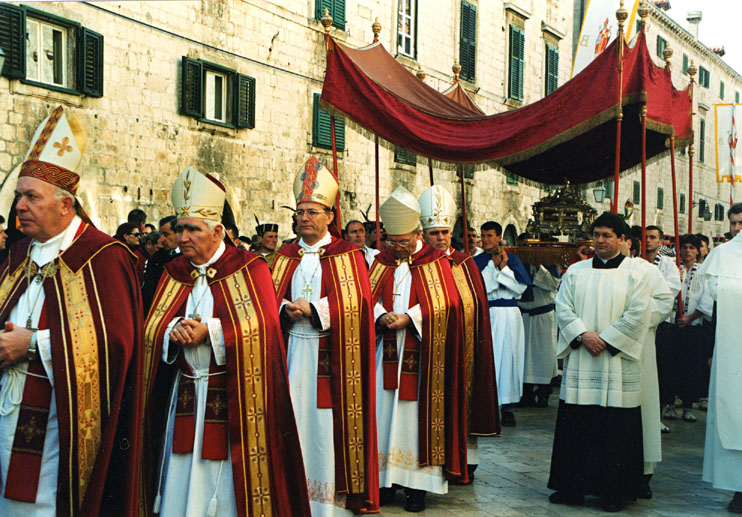
Marko Bruerović, Antun SorkočevićProcession during the feast of Sv. Vlaho (photo by Najka Mirković)
During
the French occupation in 1808
the Republic of Dubrovnik was abolished, although the Senat refused
such a decision with indignation. On the other hand, it is interesting
to mention René
Bruère Desrivaux
(1736-1817), a
French consul in Dubrovnik about 30 years earlier, who declared: j'aime
les Ragusins comme les Francais.
His son, born probably in Tours or
Lyon, has been completely "ragusinated," and became a ragusin poet - Marko
Bruerović (~1765-1823). In 1793
he was engaged for 4 years in
diplomatic work in Bosnia
(Travnik) as
commercial attaché. He also helped Jewish merchants in
Sarajevo.
His wife was Katarina Hodic, a Bosnian Croat who gave him two children.
See [Dolbeau],
p 38. The
name of Katarina is very frequent among the
Croats in central Bosnia. This is related to the last Bosnian Queen Katarina.
Antun
Sorkočević (Compte de
Sorgo, 1775-1841), a good friend of Marko Bruerović, was the last
ambassador of his native Republic of Ragusa in France, where he spent
35 years. Author of numerous publications, he became member of
Académie Celtique (1806), Société des
Antiquaries
(1828). Among other books he published "Mémoire sur la
langue et
les moeurs des peuples slaves", "Fragments sur l'histoire et la
littérature de la République de Raguse et sur la
langue
slave", translated Ivan Gundulić's Osman (poéme
illyrien
en vingt chants) in 1838.
Antonia
Gertruda Pušić
(1805-1883), outstanding Portuguese poetess and writer, is the daughter
of Antun Pušić
(Pushich) (1760-1838), the Croat from Dubrovnik,
doctor of literature and science, officer of the Dubrovnik navy.
Arthur
Evans, a well known English
archaeologist, lived in the City of Dubrovnik from
1875 to 1882. He brought a valuable gift to the City, the incunabula by
Croatian Latinist Juraj
Dragišić, De
natura angelica, Dubrovnik,
1498. This valuable book, kept in the
Scientific Library, bears the following dedication:
This
book is
presented as a historic relic of the City of Ragusa, and its civil
library by Sir Arthur Evans, who here, like its author, first arriving
through Bosnia, found a hospital retreat. On the ocasion of his
revisiting Dubrovnik - after an interval of fifty years - June 18th,
1932.
Dubrovnik
The city of Dubrovnik
endured a great many attacks in its
history. Only during the Serbian Nemanjic dynasty (1168-1371) the Serbs
performed 15 unsuccessful attempts to occupy Dubrovnik: in 1172, 1196,
1215, 1228, 1252, 1253, 1254, 1265-1268, 1275, 1301, 1302, 1317, 1318,
1325, 1328. The greatest tragedies in the history of Dubrovnik were the
earthquake and the fire in 1667, and the well known Greater Serbian
aggression in 1991/92. The population of the Dubrovnik region was 82.4%
Croatian before the aggression, with only 6.7% Serbs.
Dominican Monastery in Dubrovnik (photo by Najka Mirković)
The Dominican
Monastery from 14th century is one
of the
most beautiful architectural masterpieces of the city. Very famous are
paintings by Nikola Božidarević
(15/16th centuries), especially the
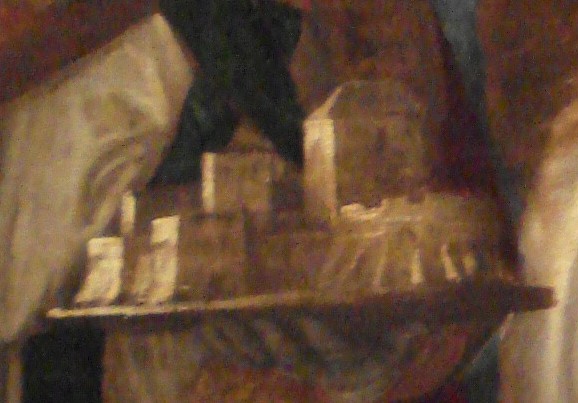
one in which Sv. Vlaho holds the model of the city in his hands. Sv.
Vlaho (= St. Blais, St. Blasius) on the left, protector of the City, by Croatian Renaissance
painter Nikola Božidarević (~1460
– 1517).
On the right St.
Paul the Apostle, another
protector of the City of Dubrovnik. The painting is kept
in the Dominican Monastery
of the City.
Photo by Ivo
Pervan.
During
the French occupation of the City in the
beginning of 19th century, the monastery served as a stable for horses!
The Dominican Monastery is
in possession of a very nice work by
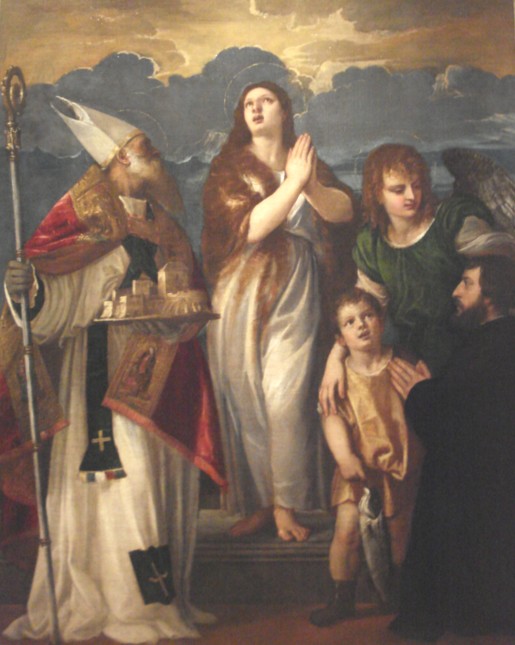
Tizian (1489-1576), a famous Italian painter, representing St.
Mary Magdalen and St. Vlaho
(Blasius), patron of the City (with a
model of the City in his hands).
The
philosophical and medical works of
Ibn-Sina (Avicenna, 980-1037) are a part of the rich collection of our
oldest libraries. The Dominican
Library, founded in 13th
century in Dubrovnik, possesses one of the oldest Latin translations of
Avicenna's works on metaphysics and logic and a tractate of St. Thomas
Aquinus - Concordantie super Physiceu (14th century). It was one of the
biggest European libraries in the period between the 15th and the 17th
century. Now it possesses 16,000 volumes, 240 incunabula and important
archives (shelled by the Serbian army in 1991/92 - 25 direct hits).
When Laurence Olivier visited Dubrovnik in 1970s, he performed William
Shakespeare's Hamlet
in the main role, in the ambience of the Fortress of Lovrijenac. After
the performance, he said: "I never have seen such setting like St.
Laurence council". (Information by the courtesy of Mrs Franica Krampus,
Dubrovnik.)
Benjamin Britten (1913-1976), distinguished English composer, conductor
and pianist, visited Dubrovnik for four consecutive years, since 1969.
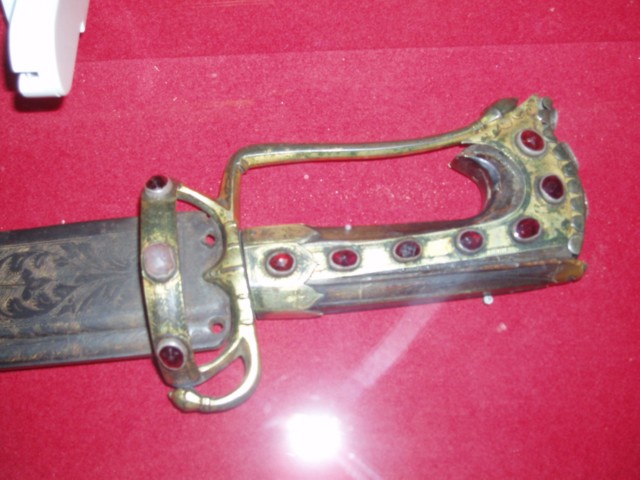
Old sword, Nikola Primorac
According
to Croatian historian dr. Vinicije B. Lupis,
a very old sword of a Dubrovnik
prince, as a symbol of the Dubrovnik statehood, is kept today in
Kunsthistorisches Museum (Museum of Art History) in Vienna, since the
1814 occupation of Dubrovnik. This and other relevant Dubrovnik
insignia, kept in that museum and elsewhere, should be returned to the
City. An initiative has been undertaken by Društvo
prijatelja
dubrovačke starine (Society of the Friends of the Dubrovnik Antiquity).
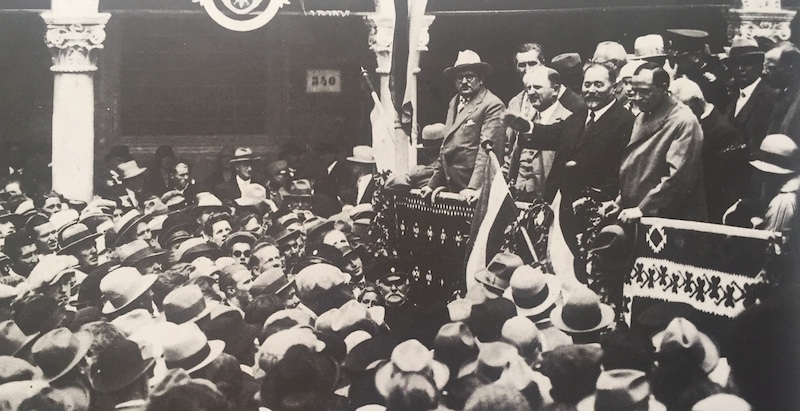
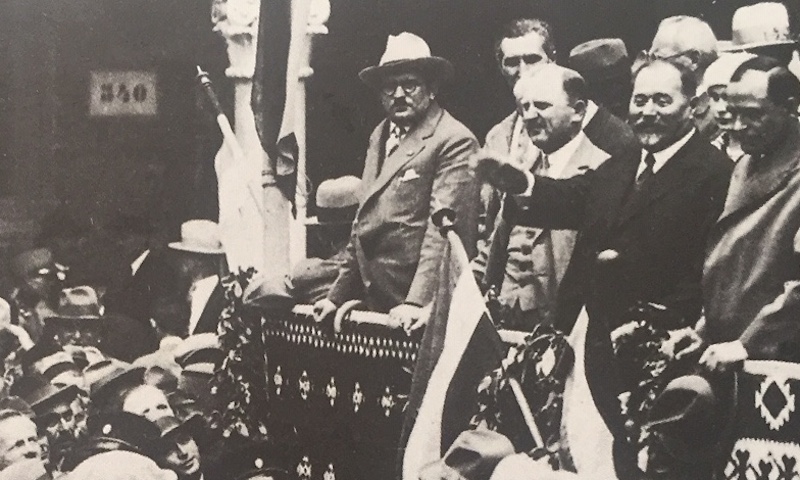
Stjepan Radić, Alojzije Stepinac, Petar PericaStjepan Radić (1871-1928) in Dubrovnik in 1928;
a few months later the same year, he was assasinated in the Parliament
of the Kingdom of Yugoslavia in Belgrade.
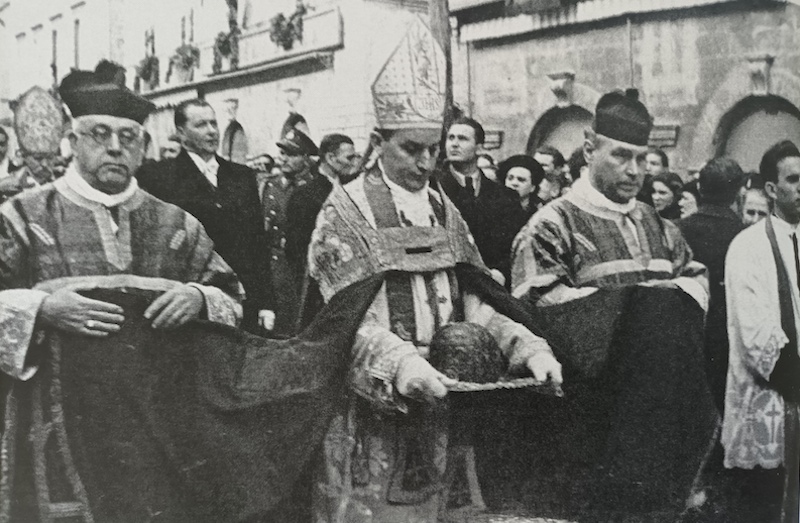
Cardinal Alojzije Stepinac in
Dubrovnik in 1941, during the St. Blaise Festivity (Fešta sv. Vlaha).
The Festivity of St. Blaise was inscribed in 2009 on the UNESCO Representative list
of Nontangible Cultural Heritage of Humanity. The Festivity is being
organized continuously since the 10th century (more precisely, since
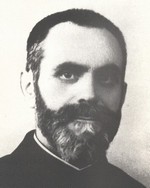
972 AD).Petar
Perica
(1881-1944) wrote verses for two
sacral songs still extremely popular among the Croats: Do
nebesa
nek se ori (in 1900, at the age
of 19) and Rajska Djevo
(in 1904, at the age of 23). In 1901 he entered the Society of Jesus.
Assassinated by Yugoslav communist partisans in 1944 on the islet of Daksa near
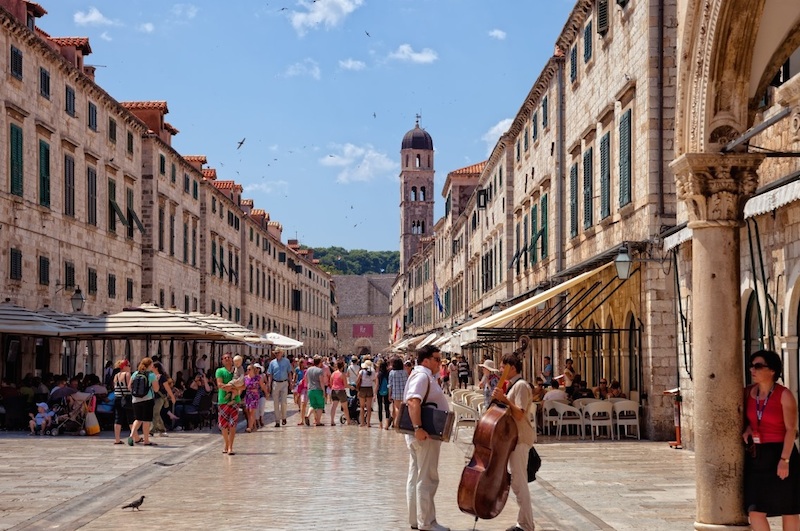
Dubrovnik.Stradun - the central street of the city of Dubrovnik
Stradun, central street in the city of Dubrovnik, in 2015. Source.
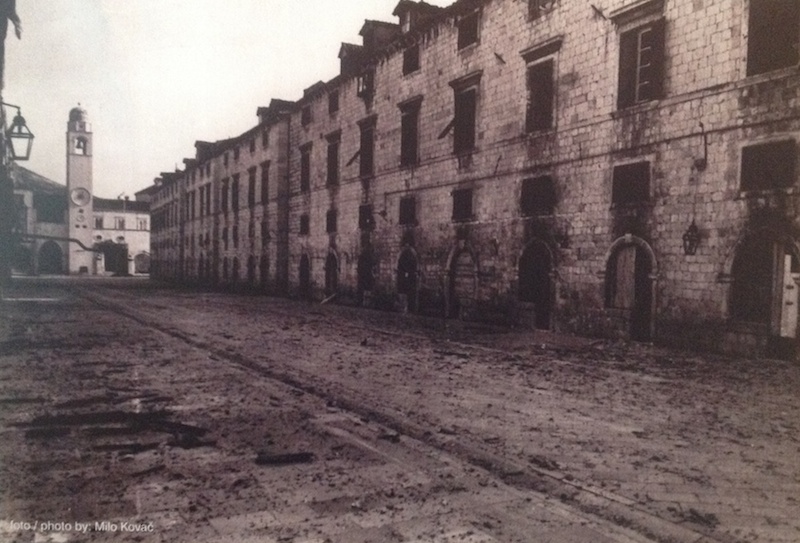
The Stradun street in 1991, during the Serbian and Montenegrin
aggression on Croatia. Photo by Milo Kovač (1955-2005).
The destruction of Dubrovnik and of the corresponding area was directed
by Serbian vice-admiral Miodrag
Jokić.Barbarian rhapsody in DubrovnikBarbarian
rhapsody (from
the presentation by professor Enver
Šehović,
University of
Zagreb)The map of 1991 bombing raids on DubrovnikBarbarian rhapsodyDestruction of the Inter-University Center in Dubrovnik
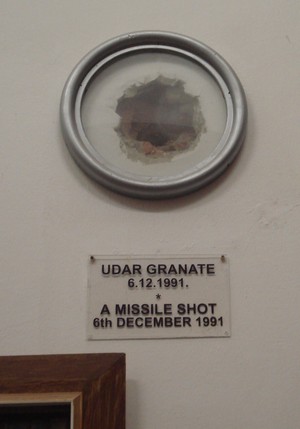
A missile shot in December 6, 1991 to the
monastery of Minor Brothers in Dubrovnik. This monastery only was hit with
50 (fifty) direct granade hits during the Serbain agression, causing a
lots of damage on this top monument of Croatian culture. The hall hit
by the granade is precisely the place where the oldest European
pharmacy working continuously to these days was founded in 1317.
A result of Serbian and Montenegrin 1991-1995 aggression on Croatia:
a wounded church in the City of Dubrovnik. Subsequently renovated.
During the Serbian-Montenegerin siege of Dubrovnik, Mrs. Franica Krampus Vidović founded the children's choir Lastavice (Swallows), so that children could endure the hardships of war. See [Orešković].
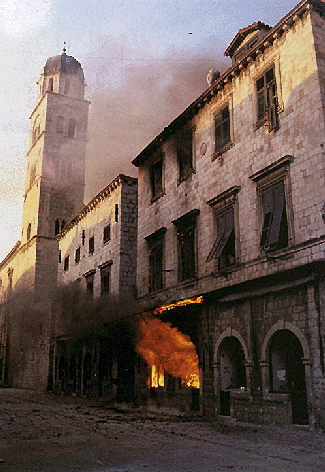
The most violent assault on Dubrovnik occurred on 6th December 1991, when more than 600 projectiles hit the Old City. Nine buildings hit by incendiary missiles were burned to the ground, whereas severeal hundred residential buildings were damaged. Damage was also inflicted on important cultural sites such as the Franciscan and Dominican monasteries and churches, the Jesuit school Collegium Ragusinum, Convent of St. Clare, the Church of St. Blaise and the Dubrovnik Cathedral, the Church of St. Joseph, the Sigurata Convent, the Synagogue, the Orthodox Church, the Sponza Palace, the Rector's Palace, the City Walls, the Great Onofrio Fountain, the bridge on the Pile Gate, as well as Stradun, the central street.
Besides palaces that burned down, the most serious damage was suffered by the Franciscan Monastery (37 direct hits), Stradun (45 direct hits), the Dominican Monastery (23 direct hits), the Sponza Palace (7 direct hits) and the City Walls (76 direct hits).
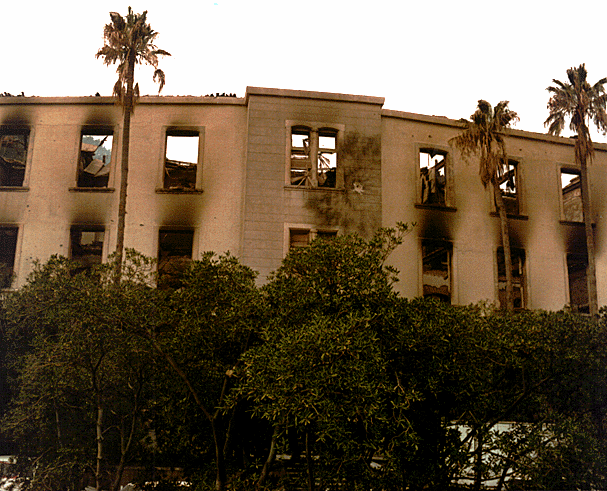
In the immediate vicinity of the Old City numerous houses were damaged, including 57 cultural monuments. The Inter-University Center, which had a valuable library containing 20 thousand titles, was burned to the ground. (Source: Grad Dubrovnik)
The city state of
Dubrovnik unanimously decreed that the Jews
should have a permanent living quarter in the city. The Ghetto was
formed in 1546. In the city there is a street called Žudioska
ulica
(Jewish street).
It is not widely known
that Dubrovnik has the second
oldest Jewish synagogue in Europe
(shelled by the Serbian army in
1991/92). Here we would like to stress that only half a dozen of the
2000 Jews in Croatia have chosen to emigrate to Israel since the
Greater-Serbian aggression began.
To be more precise, the Dubrovnik synagogue
represents
the oldest Sephardic
synagogue in Europe, and
the second oldest
among Ashkenazi and Sephardic synagogues
in Europe.
The oldest Jewish cemetery on the territory
of Croatia (and of the ex-Yugoslavia) was in the town of Cernik,
near Nova
Gradiška in Slavonia. The cemetery has been totally destroyed during
the Greater-Serbian aggression in 1991.
When German Gestapo
entered Dubrovnik in 1941, the annals
("Pinkes") of the Jewish Sephardic community were confiscated. This
represents irreparable loss for the Jewish and Croatian culture. The
annals described the history of the community and the city itself over
a very long period, starting with 1600.
Panorama of Dubrovnik from the Lovrijenac fortress (photo by Najka Mirković)
The
Inter-University Center in
Dubrovnik hosted
thousands of scholars from all over the world since its foundation in
1970. In 1991 it was completely destroyed during Greater Serbian
aggression:
Destruction of Inter-University Center, Dubrovnik, in 1991
In a fire caused by
missiles fired at the building
disappeared the valuable library with collection of 25,000 volumes of
books and 205 periodicals. See [Wounded
Libraries in Croatia, p. 48].
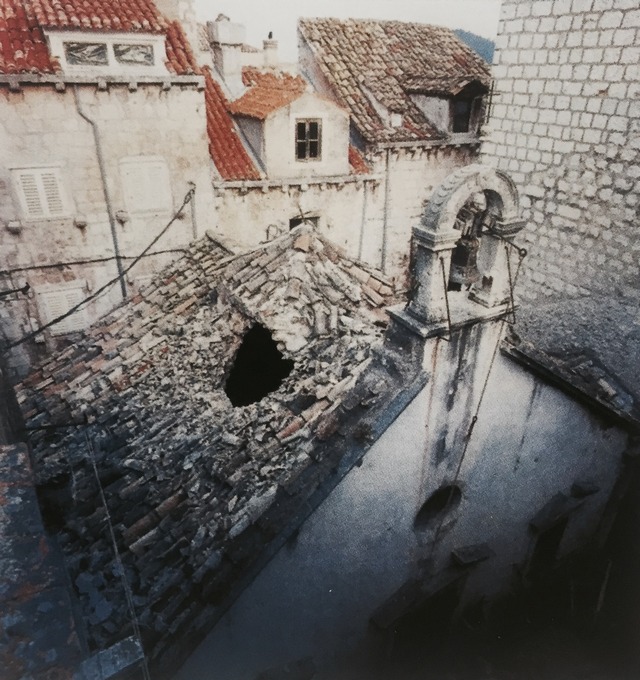
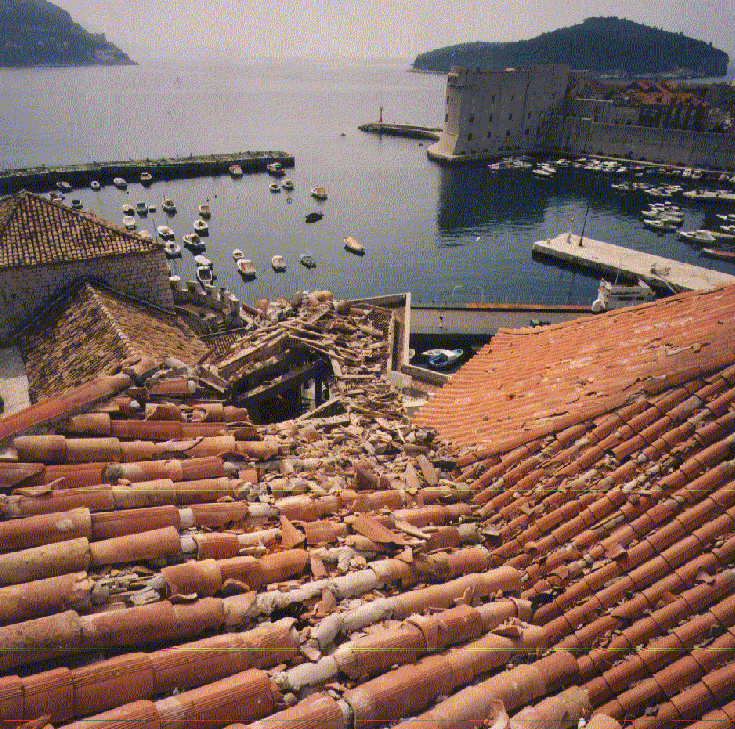
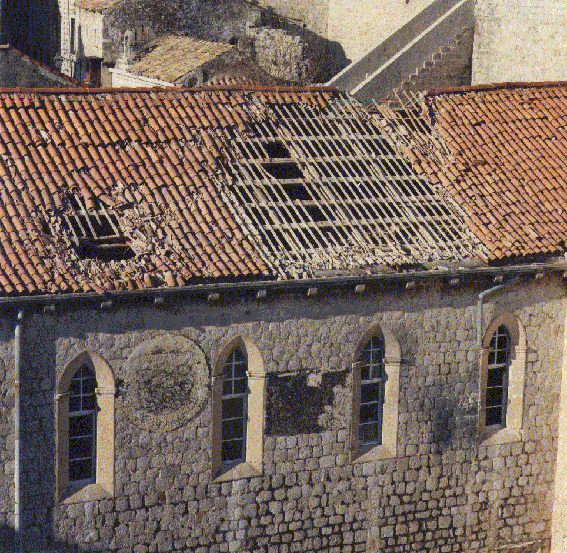
See destroyed Dubrovnik roofs:
Severely damaged roof of the Dominican Monastery, Stradun street, Dubrovnik
Klapa Linđo
Photo of the Dubrovnik walls by maestro Frano Kakarigi, distinguished Croatian classical
double bassist,
employed in Granada (Spain), born in the city of Dubrovnik.
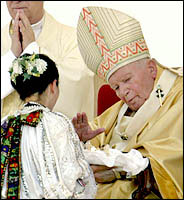
Pope
John Paul II visited Croatia three times (in 1994, 1998, 2003) and
Bosnia and Herzegovina twice (in 1997 and
2003). During his apostolic visit to the city of Dubrovnik in 2003 he
beatified Marija of the Jesus Crucified Petković
(1892-1966), born on the island of Korčula,
founder of Daughters of Mercy.
For more information see marijapropetog.hr.
As
a swarm of snow flakes
Swirling in the wind,
A bevy of girls
In uniforms white
Spin about the aisles
And bustle about in wards
A bunch of busy bees
Bearing no sting
Sucking no nectar
These fair daughters
Of mercy are rent
With work and fatigue
In giving smiling hope
To broken bodies
And failing hearts.
The city of Dubrovnik
has been under the protection of UNESCO since 1979. Photo by Mladen ŽubrinićHrvoje Kačić
Stjepan
Ćosić, Nenad
Vekarić: Dubrovačka
vlastela između roda i države, Salamankezi i sorbonezi (Ragusan
patriciate between kinship and state: the Salamankanists and
Sorbonnists), HAZU, Zagreb -
Dubrovnik, 2005., ISBN 953-154-660-6
Stjepan
Ćosić, Niko Kapetanić, Pero Ljubić, Nenad
Vekarić: Hrvatska
granica na Kleku,
Dubrovnik: Županija Dubrovačko-Neretvanska, 1999, 110 str.
Bruno
Šišić: Vrtni
prostori
povijesnog predgrada Dubrovnika od Pila do Boninova
(Gardens of
the historical suburbs of Dubrovnik from Pile to Boninovo), HAZU,
Zagreb - Dubrovnik, 2005., ISBN 953-154-565-0
Bruno Šišić: Dubrovnik Renaissance Garde s / Genesis
and Design Characteristics, HAZU, Zagreb - Dubrovnik 2008
Robin
Harris: Dubrovnik:
A History, Saqi
Books, 2003 (550 pp.); translated into Crotian: Povijest Dubrovnikom, 2022
Antun
Ničetić: Nove
spoznaje o postanku Dubrovnika, o njegovu brodarstvu i plovidbi Svetoga
Pavla, Sveučilište u Dubrovniku, Dubrovnik, 2005., ISBN
953-7153-02-9
Anica
Kisić - Vinicije B. Lupis: Miho
Pracat, o 400. obljetnici smrti.
Matica hrvatska, Dubrovnik, 2007.
Vinicije B. Lupis: Dubrovačke srednjovjekovne zlatarske teme, Zagreb - Dubrovnik 2015
Vinicije B. Lupis: Dubrovnik
i Poljska : o kulturnim i
političkim vezama hrvatskog juga i Poljske
/ Polska
i Dubrownik O kulturalnych i
politycznych zwiazkach poludniowej Chorwacij z Polska
(Dubrovnik
and Poland : about cultural and political relationships between
Croatian south and Poland), Veleposlanstvo Republike Poljske, Zagreb
2005 (in Croatian and Polish)
Seraphinus
Maria Cerva: Prolegomena in
Sacram Metropolim Ragusinam, Editio Princeps, ed. Relja
Seferović, Zagreb - Dubrovnik 2008.
Dubrovačka
diplomacija u Istambulu, Dubrovnik-Zagreb, HAZU Zavod za
povijesne znanosti, 2003.
The
Jewish Ghetto in the Dubrovnik Republic (1546-1808),
Dubrovnik-Zagreb, HAZU Zavod za povijesne znanosti, 2005.
Wisdom
at the Crossroads: True Stories From the Time of the Republic of
Dubrovnik and the Ottoman Empire, Dubrovnik: Udruga za
promicanje multiklturalnih vrijedosti “Kartolina”, 2011.
Židovski rodovi u
Dubrovniku (1546-1940), HAZU, Zagreb - Dubrovnik 2017.
Zdenka Janeković-Römer: Okvir slobode. Dubrovačka vlastela između
srednjovjekovlja i humanizma, Zagreb-Dubrovnik: Zavod za
povijesne znanosti HAZU u Dubrovniku, 1999.
Some photos are taken
from the web page Dubrovnik,
été 2003
with permission
(photos by Gwendolyn Prakash - Notre conclusion sur cette
ville :
Si d'aventure un
week-end vous ne savez quoi faire, prenez un aller/retour par
avion et visitez la sans hésitaion, vous ne serez pas
déçus !).
Leksikon Ruđera
Boškovića, Leksikografski zavod, Zagreb, 2011., ISBN
978-953-268-020-1
Trpimir Macan: Dubrovački barabanti u XVI stoljeću, Anali Zavoda za povijesne znanosti Hrvatske akademije znanosti i umjetnosti u Dubrovniku, No. 8-9, 1962., str. 301-323.
Konavle - from the city of Cavtat to the Cape of Oštra
Cape of Oštra (Prevlaka)Konavle women [Kapetanić, Vekarić, Stanovništvo Konavala 1, p. 182]Konvale family [Kapetanić, Vekarić, Stanovništvo Konavala 1, p. 318]
To the east of Dubrovnik
is placed the region of Konavle, interspersed with numerous pine trees and nice villages.
Its
east-most part is the Cape of
Oštra (rt Oštra, also
imprecisely
called "Prevlaka"),
which is an interesting stretch about
2,5 km long, and several hundred meters wide. This area was in
possession of the Republic of Dubrovnik since the first half of 15th
century, when it was bought from Bosnian dignitaries in 1419 and 1426.
As such, it is a part of Croatia (also during the ex-Yugoslav communist
period).
Croatian Glagolitic heritage in Konavle
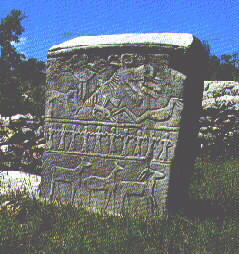
Glagolitic inscription from Dunave from 1066Konavle glagolitic inscription / Konavoski glagoljski natpis, 11th century
It is important to note
that in the Konavle region a very old
remain of Croatian
glagolitic inscription on
the marble plate was discovered in 1990's (Konvale Glagolitic
fragment), dating probably from the year 1060 or later, that is, from
11th century (see [Fucic]
and [Kapetanić,
Žagar]). Also some stećak tombstones
bearing Croatian
cyrillic inscriptions, have a
few
glagolitic letters. See [Kapetanić,
Konavoski
epigraficki spomenici].
Dunave in Konavle with fortress against the Turks (photo by Mladen Žubrinić)Dunave in Konavle where the above glagolitic inscription from 1060 has been found (photo by Darko Žubrinić)Stechak tombstone in Konavle near DubrovnikKiev and Sinai folia in 11th century, 1460
As shown by dr. Agnezija
Pantelić, well known Kiev and Sinai
folia, written in the Glagolitic script, were used in the Dubrovnik
Diocese by the end of 11th century (see [O
Kijevskim i Sinajskim...]. It is
of interest to stress that
Glagolitic monuments carved in stone exist only among the Croats (in
present-day Croatia and parts of BiH), nowhere else. For more information
see Croatian
Glagolitic heritage in the
region of Dubrovnik.
The village of Kuna in Konavle with a view to the sea (photo by Mladen Žubrinić)A view from the mountain of Snježnica in Konavle to Dubrovnik, Cavtat, low Konavle, and the sea (photo by Darko Žubrinić)Mavar's breviary in Konavle around 1460
Glagolitic breviary
(Mavrov brevijar) from 1460 contains a marginal note written by
Catholic priest Mavar from the town of Vrbnik (island of Krk) about his
sojourn in Konvale with this book around 1475.
To pisa pop Mavar z'Vr-
bnika kada stojaše
v Konavli poli Du- brovnika...
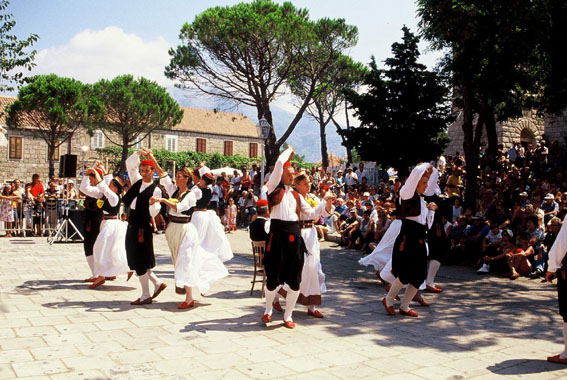
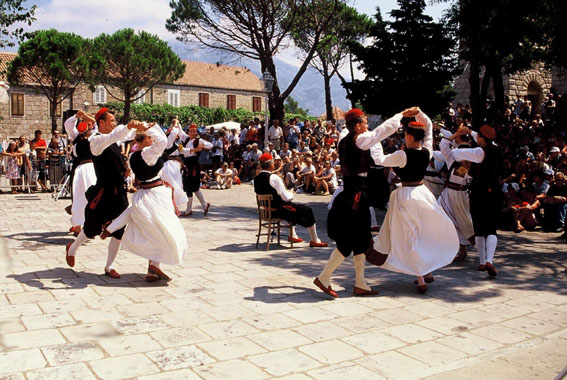
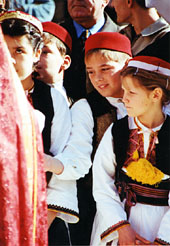
Traditional dances and costumes in Konavle Traditional dance lindjo in Ćilipi (photos by Mladen Žubrinić)Konavle children on the feast of sv. Vlaho, protector of Dubrovnik (photo by Najka Mirković)
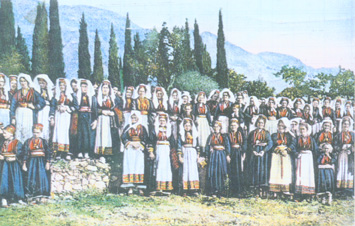
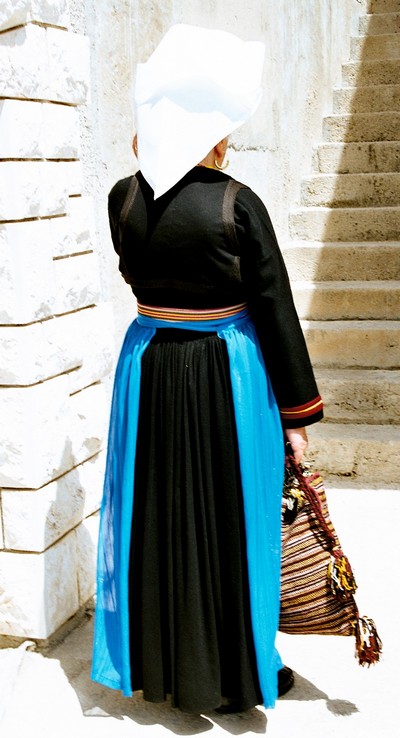
Konavle are known among
others for beautiful national costumes.
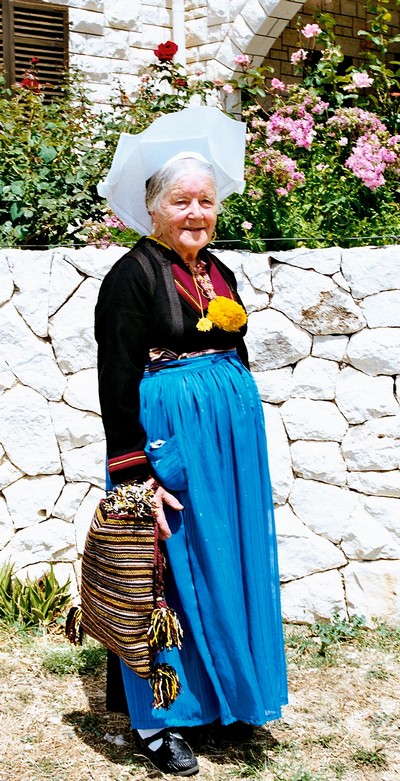
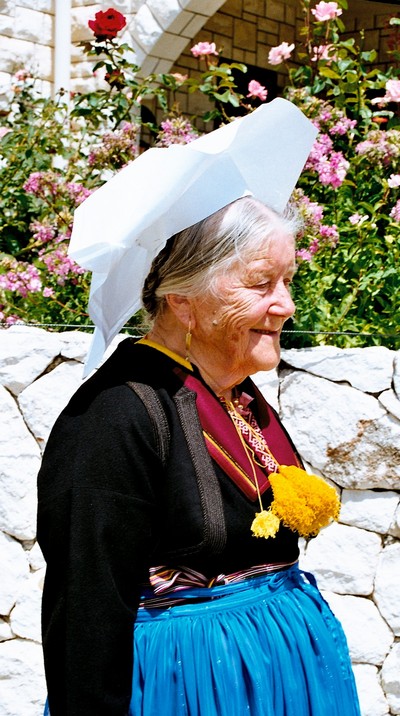
Mrs. Ane Marnić
Mrs
Ane Marnić from the village of Dubravka in
Konavle, south of Dubrovnik.
Photo
from 2006, many thanks to Dr. Zdenko
Žeravica, distinguished Croatian archaeologist,
Dubrovnik.
The region of Konavle,
occupied by the Yugoslav (Serbian and
Montenegrin) army in 1991/92, served as a basis for ferocious attacks
on the city of Dubrovnik. The lovely town of Cilipi near the Dubrovnik
airport was devastated to the point that no house was left with a roof,
and the Cilipi church was destroyed.
By aggressive and primitive intrigues (claiming that borders of states
in ex-Yugoslav federation were only administrative) and pseudo history,
the Yugoslav and Montenegrin official institutions and diplomacy are
trying in vain to question Croatian jurisdiction over this territory.
For more details see [Macan].
Arts in Konavle
Vlaho Bukovac
Distinguished Croatian painter Vlaho Bukovac was born in Konavle, in the town
of Cavtat.
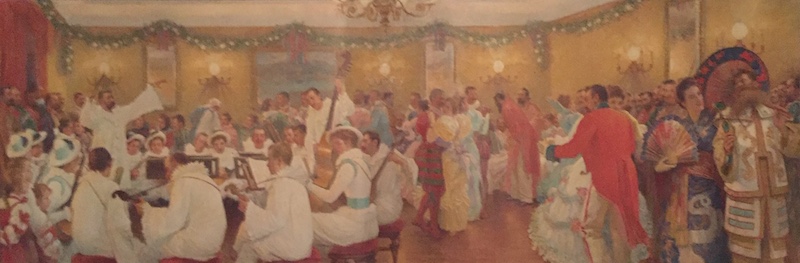
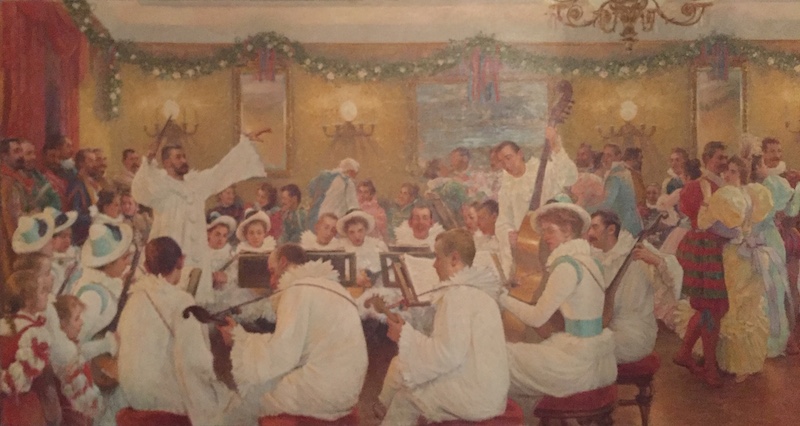
Vlaho Bukovac: Cavtat tamburitza orchestra (Cavtat is a small, very
nice Croatian town near Dubrovnik). Around 1900.
All the persons appearing in the photo are known. This painting (of
large dimensions)
is kept in the Baltazar
Bogišić Museum in Cavtat.
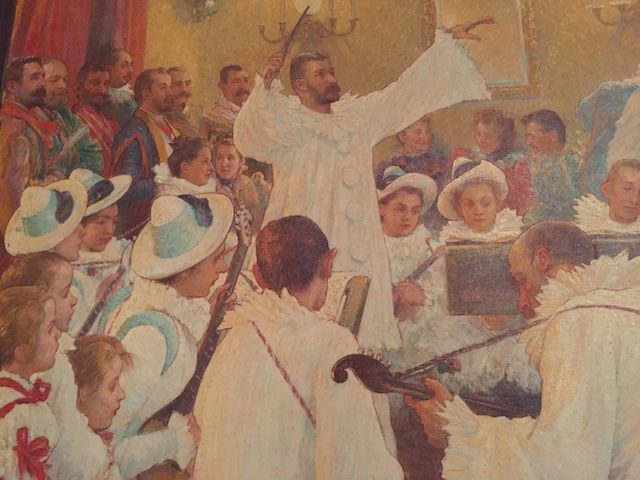
A detail from the above photo,
the left part.
Vlaho Bukovac (self-portrait) is sitting on the right, playing
tamburitza. On the left are his three children,
and just in front of his forehead is his wife, also playing tamburitza.Miho Šiša Konavljanin
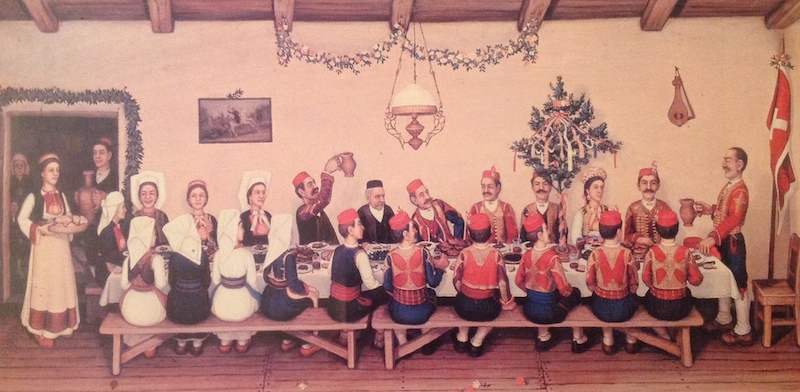
This work of art of monumental dimensions by Miho Šiša Konavljanin,
represents local customs of the Konavle region
near Dubrovnik. Plundered during the Serbian-Montenegrin aggression on
Croatia, it is still not returned to its proprietor,
the Konavoski dvori Croatian national restaurant.
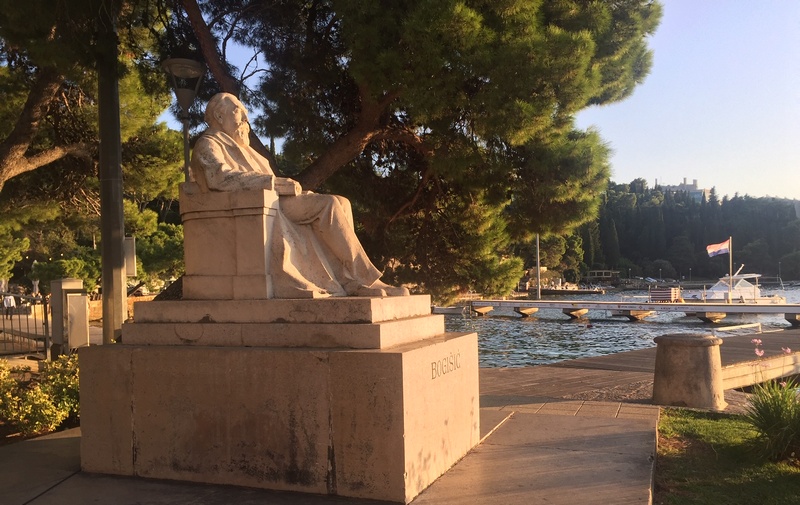
Baltazar
(Baldo) Bogišić
(Cavtat, 1834 - Rijeka, 1908) is a notable
Croatian intellectual, who grew up under the spiritual influences of
Josip Juraj Strossmayer, archbishop of Đakovo, and of Josip Marčelić
(1847-1928), bishop of the city of Dubrovnik, responsible for his
education (Bogišić was receiving a stipend from the Dubrovnik bishop).
He attended the Gymnasium in Dubrovnik, was a librarian in
the Royal Library (now the National Library) in Vienna, lectured at the
University of Odessa, where he changed his name to Valtazar, which he
used afterwards. The then Kingdom of Montenegro offered him to prepare
the first Constitution of this country.
Monument to Baltazar Bogišić (1834-1908), distinguished Croatian
jurist, historian and ethnographer, born in Cavtat.
Created by Ivan Rendić (1849-1932), a famous Croatian
sculptor.
He was a very good singer, so
that (according to personal information due to dr. Miho Demović) Franz von
Suppè, distinguished composer, born in the city of Split, offered him a
position in an opera, but he did not accept it. He founded
the "Primorska dramska družina za Dalmaciju" ("Primorje Drama
Confraternity"), which extended its activities also in Istria. When he
died, the Dubrovnik Theatre prepared his commemoration. He was a full
member of JAZU (now Croatian Academy of Sciences and Arts) in Zagreb,
since its
foundation in 1867, as well as a member of many other Academies and
Scientific societies, and a holder of several European decorations.
Related to his name is the village of Bogišić near Tivat in
Boka kotorska, as well as a Hungarian bishop whose name was Bogišić.
Dr. Miho Demović: Brodolom sv. Pavla apostola na otoku Mljetu, YouTube
Barbarian rhapsody in Konavle
Three thosand six hundred
(3600) houses have been pillaged and burned to ground in the
1990s,
during the Serbian and Montenegrin occupation of the region of Konavle,
south-east of Dubrovnik. All of them have been renovated with a lot of
effort. Information by Mr. Luka Korda.
The
aim of this section is to indicate deep connections between the Croats
and Boka kotorska Croats.
The region of Boka kotorska
is situated on the south-east of
Dubrovnik and Konavle, along the Adriatic coast from Herceg Novi to
very near the town of Bar. It was named after the town of Kotor, which
is placed in a fascinating fjord.
Croatian
benedictins in Boka kotorska
had their abbeys since at least the year 1066. There were at least
seven of such abbeys:
Sv. Juraj near Perast,
Sv. Marija de
Resson,
Sv. Luka in rtoli,
Sv.
Mihovil in Prevlaka,
Sv. Nikola from
Petranac,
Sv. Petar from Gradac,
and
Sv. Marko de Pinita.
The benedictines in Boka kotorska appear in the 9the or the beginning
of the 10th century. A Bull of pope Clement III from 1089, and to a
Bull of pope Calisto II from 1124, confirm that on the territory of
Duklja (Doclea) there were abbeys that were designated as latinorum,
graecorum et sclavorum (Glagolitic benedictine abbeys), under the
auspices of Duklja-Bar archbishops. The source of this information is [Ivan Ostojić].
Boka kotorska was
annexed to Montenegro in 1945. At that time
it was populated mostly by Croatian Catholics (Bokelji). Now the ethnic
situation in this region is entirely different, especially after 1991.
Bokelj Marine 809 (Bokeljska mornarica 809)
The
Bokelj Marine 809 (Bokeljska
mornarica 809) is a
confraternity whose aim is to preserve more than a thousand year's
Croatian maritime tradition. In 809 the remains of St Tripun were
brought by Croatian mariners from Asia Minor to Kotor. The Cathedral of
St Tripun in Kotor is the
oldest Croatian cathedral in this area
built by Croats in 1166.
The Croatian Coat of Arms
was a part of a solemn uniform of the Boka Marine (Bokeljska mornarica).
The suit, kept in the Croatian History Museum in Zagreb, is dating from
the
second half of the 19th century. It is worth mentioning that New Yugoslavia
participated at the international maritime exhibition EXPO'98
in Lisbon, Portugal, with Croatian cultural and maritime heritage of
Boka kotorska. This very old and rich heritage was presented as
Yugoslav without even mentioning that it belongs to the Croats in Boka
kotorska. One can say that the Croats had in fact two pavilions in
Lisbon: one belonging to the Republic of Croatia (generally considered
as
one of the most original pavilions on the exhibition), and the other
hidden under the name of Yugoslavia.
Ex-Yugoslav press (and even some Croatian!)
used to attach an innocent number 1 to 809, to obtain 1809, thus reducing
the rich history of Croatian mariners in Boka kotorska for no less than
1000 years!
Grgur of Bar (pop Dukljanin)
Boka kotorska region is
under the protection of UNESCO, due to
its very rich Croatian cultural heritage. The region around the town of
Kotor is situated in probably the most beautiful fjord in Europe. In
1979 there was an earthquake that destroyed or seriously damaged
numerous cultural monuments.
Very important
historical source for early Croatian history
is Libellus Gothorum,
a chronicle from the 12th century known in
Croatia as Ljetopis
popa Dukljanina. It
was written by Archbishop Grgur
of Bar, born in Zadar, and Bar
is a coastal town near Boka kotorska. The chronicle represents the
oldest historiographic work of Croatian Middle Ages.
It
is interesting that Tripun
Kotoran,
a Kotor goldsmith, worked on the court of Ivan Grozny in Moscow in
1476. One of the earliest Croatian typographers was Andrija
Paltašić
(~1450-1500), born in the town of Kotor. He was one of the best
Venetian typographers around 1480, who printed more than 40 incunabula,
among them the Bible in Italian language. We also mention by the way
that a very old missal from the 12th century - the Kotor
missal, is
held in St. Petersburg, Russia.
Croatian Glagolitic heritage related to Boka
Nikola Modruški
(Lat. name
Nicolaus Machinensis, Italian name Nicolo di Cattaro, ~1427-1480), born
in Boka kotorska, was bishop of Modruš in Lika,
Pope's representative at the court of Stjepan Tomašević in Bosnia,
and on the court of the Hungarian king
Matijas Corvin in Budim, his huge library was left to the newly founded
Vatican library (founded by Pope Sixto IV). In 1478/79 he wrote a
treatise in defense of the Glagolitic Script
which he sent from Rome to the Modrus Diocese. It is regarded to be the
first polemic treatise in the
history of Croatian literature, and
it was written in the Glagolitic Script. Buried in the church of Sta
Maria del popolo in Rome.
In
the village of Bogdašić
near Tivat,
in the church of Sv. Petar, a Croatian Glagolitic
inscription has been found.
Also the Glagolitic mass (i.e. Catholic mass served in Croatian Church
Slavonic language instead of Latin language) has been in use in the
church. The same for the village of Kostanjica
near the town of Perast. These two parishes were glagolitic in the
19th century as well. See [Pederin,
p 247]. Many
thanks to dr. Vanda Babić for information about the Bogdasic Glagolitic
inscription.
Fragments of a 15th century Croatian glagolitic breviary kept in the
city of Kotor.
Photo by the courtesy of Mons. dr. Slavko Kovačić, Split.
Boka kotorska in the 17th and 18th centuries
Archbishop Vicko Zmajević
Archbishop
Vicko Zmajević (1670.-1745.),
born in Perast, brought the Bar Catholics (from the environs of the
city of Bar, descendants of Red Croatians), endangered by the Turks, to
the environs of Zadar
where they live also
today. He built a school "Collegium Illiricum" or "Seminarium
Zmajoillyricum" in Zadar for educating Glagolitic
priests (today archbishops school "Zmajević").
His nephew Matija (Matej)
Zmajević was a famous admiral of the Russian tsar Peter the Great, see
below.
In
Perast the first nautical school was founded by the end of the 17th
century. It is considered to have been founded by Marko Martinović
(1663-1716), a famous Boka mariner. In 1698 the Russian Emperor Peter
the Great sent 16 young Russian noblemen to Boka to attend maritime
studies in Perast, in order to be able to organize the future
Russian Navy. See Croatian
Encyclopaedia (Boka kotorska in
Volume III).
The
Bokeljs had a very strong fleet,
which counted as many as 300 ships in the 18th century. Boka was a
rival to Dubrovnik and Venice. It is worth mentioning that one of the
Bokeljs - Matija Zmajević (1680-1735) - was
the admiral of the Baltic navy and the ship-builder of the famous
Russian
tsar Peter I the Great, and for whom he built a fleet in
Voronež.
Matija
Zmajević had great successes in maritime battles against Sweden, and
for this reason he was decorated with the Order of Aleksandar Nevski by
Empress Katarina. Peter I the Great took off his personal sword and
donated it to Matija Zmajević in recognition of his military successes.
Matija Zmajević had the honour to carry the crown of Romanov's during
the funeral of Peter the Great in 1725. Zmajević was buried with
greatest military honours in the Catholic
church in Moscow. Peter the Great sent some of his young officers
(bolyars) to the town of Perast in Boka in order to study maritime
sciences there. For more information see [Miloš
Milošević,
pp 244-251].
Marko
Vojnović from Hercegnovi
organized the Russian marines on the Black Sea, and achieved the status
of admiral. Matija
Melada
of Perast, a well known engineer of his time, arranged many Russian
ports. See Croatian
Encyclopaedia (Boka kotorska in
Volume III).
Krsto Čorko, Kristofor Ivanović, Karlo Mrazović, Petar Zelalić
Sea-captain Krsto Čorko,
born in
Perast, was Spanish Marquis and Governor of Balearic Islands in the
second half of the 17th century.
Kristofor
Ivanović, a Canon of the
town of Budva in Boka kotorska, published his Memorie
teatrali
in Venice in 1681. It was the first history of Venetian opera, covering
the period of 1637 - 1681. Its 2nd edition appeared in 1687.
The
first balloonist in Croatia was Karlo
Mrazović, who performed
two balloon flights in Zagreb with his own balloons in 1789 and
1790. He was born in Boka kotorska.
See [Croatia
- Europe, III, Barok i
prosvjetiteljstvo, p. 426, the article by Vladimir Muljević].
Captain Petar Zelalić
(Zhelalich), 18th century, born in Boka kotorska, was a member of the Order
of Maltese Knights. He became
famous after his ship defeated a huge
Turkish ship called "The Ottoman Crown."
Josip Marinović
Josip
Marinovic (1741 - 1801),
was a Jesuit born in Perast - Kotor (in Boka
kotorska, annexed to Montenegro
in 1945), professor of theology in
Venice. His friendship with an Armenian banker Serpos resulted in his
interest in the history of Armenians. His assiduous research resulted
in the book "Compendio
storico...della nazione armena",
published in Venice in 1783. The book was a great success. Though it
was signed by Serpos, its true author was Marinovic. It represents the first
history of Armenians published in Europe.
It is interesting that
the book had been extended and republished by Ivan Dominik Stratico
(1732-1799), bishop on the Croatian island of Hvar. This book incited
European interest for Armenian people and their culture. In particular,
upon the initiative of the Vatican, supported by Austria and Russia, in
1830 the Turkish sultan admitted the very old Armenian Christian Church
and
allowed the Armenian Archdiocese to be founded in Constantinople. See [Gregory Peroche],
p. 119, and [V. B. Lupis, O armensko-hrvatskim kontaktima].
In
1782 Krsto Mazarević
from
the city of Kotor (in today's Montenegro) performed a flight in two
balloons.
Boka kotorska in the 19th century
Ivan Visin
Another
outstanding Croat is captain Ivan
Visin born in Prcanj in Boka.
His travel around the world started
in Antwerpen in 1852 (his ship "Splendido", built in Rijeka, was 30m
long, 311 metric tons of cargo) and ended successfully in Trieste in
1859, having sailed 101,000 nautical miles (the circumference of the
Earth is 21,600 n.m.; the ship sailed in westward direction around the
Earth, which is more difficult than in the opposite direction). Visin
was only the sixth after Magellan to do a similar exploit.
Ivo Visin (photo from Brodovi na Jadranu by Veljić - Govedić)
For his brave
undertaking, which was of historical
importance, he had been decorated by a flag of honour Merito
navali
by the Austrian Emperor (in fact, Visin was the only one who ever
obtained such an honour). The trophy is held in Prcanj. Visin also
became the honorary citizen of Trieste.
The ship Splendido of Ivo Visin (photo from Brodovi na Jadranu by Veljić - Govedić)Ivo
Visin in Trieste in 1860, photo from [I Croati
di Trieste] Route of Ivo Visin (photo from Brodovi na Jadranu by Veljić - Govedić)Anton Luković
Anton
Luković (1815-1880), born in Prčanj, was among the
principal engineers who participated in building the Suez Canal (193.3
km), completed in 1869. He worked there as an Austrian architect and
civil engineer. He was proprietor of a monumental palace Dario in Canal
Grande in Venice, where he died in 1880. The palace appears on the work
of art by Claude Monet, distinguished French painter, which is kept in
the Museum of Art in Chicago. He also had a merchant house in Cardiff.
An important fortress at the entrance of the port in Alexandria was
built according to his project. During this work, he discovered three
old-Egyptian columns from 16-14
century BC carved with hieroglyphics, which were subsequently solemnly
donated to Austrian Emperor Franz Joseph I on the occasion of the
official opening of the Suez Canal. The columns are now kept in Vienna,
in the Egyptian Hall of the Museum of Fine Arts.
For his merits, Luković earned hereditary nobility from the Austrian
Emperor, and the title of Lukovic de Ascrivio. For more details see an
article by Siniša Luković appearing in [Vidmarović,
Hrvati Boke kotorske kroz
povijest, pp. 375-379].
For the reader who thinks that these claims
are not sufficiently well grounded, I can offer a personal experience
from the city of Zagreb, Croatia's capital. In 1971 a census of
population was held in the whole ex-Yugoslavia. At that time I was a 15
years old secondary school pupil. My math teacher "suggested" to
everybody, in front of the whole class, to fill in the form as follows:
"If I were in your place, I would fill in Yugoslav
in the
nationality section, and underline it three times." She was a daughter
of a Serbian colonel in Zagreb. It was only many years later that I
realized the meaning of this "suggestion."
Anton
Luković (1815-1880), descendant of an
old Croatian family from Boka kotorska, was a chief engineer in the
project of building the Suez Canal (1859-1869).
Anton Luković (1815-1880), one of the principal engineers
in the project of building the Suez Canal
Born in Prčanj, Luković was among the
principal engineers who participated in building the Suez Canal (193.3
km), completed in 1869. He worked there as an Austrian architect and
civil engineer.
Luković's Dario Palace in Canal Grande in Venice
He was proprietor of a monumental palace Dario in Canal
Grande in Venice, where he died in 1880. The palace appears on the work
of art by Claude Monet, distinguished French painter, which is kept in
the Museum of Art in Chicago. He also had a merchant house in Cardiff.
An important fortress at the entrance of the port in Alexandria was
built according to his project. During this work, he discovered three
old-Egyptian columns from 16-14
century BC carved with hieroglyphics, which were subsequently solemnly
donated to Austrian Emperor Franz Joseph I on the occasion of the
official opening of the Suez Canal. The columns are now kept in Vienna,
in the Egyptian Antiquities Room of the Museum of Art History
(Kunsthistorisches Museum).
Egyptian pillars discovered by Anton Luković, placed in
Kunsthistorisches Museum in Vienna.
Photo by Tianlan Xie.
For his merits, Luković earned hereditary nobility from the
Austrian
Emperor, and the title of Lukovic de Ascrivio. For more details, see an
article by Siniša Luković appearing in [Vidmarović,
Hrvati Boke kotorske kroz
povijest, pp. 375-379].
Boka kotorska since the 20th century
Stjepan Radić and Boka kotorska Seal of H.S.S. (Hrvatska seljačka stranka, i.e., Croatian Peasant Party)
in the town of Tivat in Boka kotorska, 1928. The founder and leader of
H.S.S. was Stjepan Radić.
Note its Croatian Coat of Arms.
Photo from [Vidmarović, Prilog
povijesti Hrvata Gornje i Donje Lastve].
Boka kotorska cap from the second half of the 19th century, from the
settelment of Spič (near the city of Bar),
containing the Croatian Coat of
Arms.
Photo by the courtesy of Zvonimir Deković, Donja Lastva.
Plemenito Tielo Bokeljske
mornarice (Noble Body of the Bokelj Marine = Admirality)
in Praška ulica (the Prague street) in Croatia's capital Zagreb, during
the funeral of Stjepan
Radić on 12th August 1928.
Photo by the courtesy of Zvonimir
Deković, Donja Lastva (near the town of Tivat).
A delegation of the
Bokelj mariners from Boka kotorska
participated with their traditional uniforms at the funeral of Stjepan Radić
in Zagreb, after his
assassination in the Yugoslav Parliament in Belgrade in 1928.
B. Ivanković (1815-1898): A
Kotor sailing ship, 19th century, source Matrix
CroaticaBoka kotorska - Bay of Croatian saints
Boka
kotorska is also known as the Bay
of Croatian saints. Out of
eleven Croatian saints and blessed (St.
Leopold Mandić, St. Nikola Tavelić, St. Marko of Križevci, Bl. Augustin
Kažotić, Bl. Ozana of Kotor, Bl. Jakov Zadranin, Bl. Gracija from Mulo, Bl.
Julijan of Bale, Bl. Alojzije
Stepinac, Bl. Ivan
Merz, Bl. Marija
Petković),
three of them are from Boka kotorska:
St. Leopold Bogdan
Mandić (1866-1942),
blessed Ozana Kotorka
(Kata Kosić, 1493-1565),
blessed Gracija from
Mulo (1438-1508).
St. Leopold Bogdan MandićLeopold Bogdan Mandić
St Leopold
Bogdan Mandić (1866-1942,
memorial day 30th
July) was born in Herceg Novi in Boka kotorska, and died in Padova,
Italy. Physically malformed and delicate, having height only 1m 35cm,
with clumsy walk and stuttering, he developed tremendous spiritual
strength. Although he wanted to be a missionary in Eastern Europe, he
spent almost all of his adult life in Italy, and lived in Padova from
1906 until the end of his life. He also spent one year in an Italian
prison during WWI, since he did not want to renounce his Croatian
nationality, see here.
He dreamed unceasingly about going to
the Orient, but one day he gave Communion to a very good person. And,
as he
described:
After
finishing her thanksgiving, she came to me with
this message: "Father, Jesus ordered me to say this to you: Your Orient
is each of the souls you assist by hearing confessions." (see here).
He became known as
Apostle of Confession and Apostle of Unity.
Here is a famous prayer in honour of this forerunner of today's
Ecumenism:
O
God, source of life and love, you gave Saint Leopold a
tremendous compassion for sinners and a desire for church unity.
Through his prayers, grant that we may acknowledge our need of
forgiveness, show love to others, and strive to bring about a living
unity among Christians. Through Our Lord Jesus Christ, who lives and
reigns for ever and ever. Amen.
St. Leopold Bogdan Mandić (1866-1942), Croatian saint,
Also the famous Pope Sixto V
has
Croatian roots from Boka kotorska on his father's side.
Gospa od Škrpjela (Lady of Škrpjela)Gospa od Škrpjela
Out
of 38 churches existing in the Kotor
region (annexed to Montenegro in 1945) 36 are Catholic and only 2 are
Orthodox (one of them was a gift of the Croats in Boka kotorska). On
the photo you can see two beautiful churches on islets in the Boka bay,
belonging to the Croatian Catholic community in Montenegro, built in
the first half of the 17th century (Sveti Juraj and Gospa od Škrpjela
near the town of Perast). It is interesting that the Church of Gospa od
Škrpjela (in the photo) is built on an artificial island! Each year a
procession of Croatian Catholics encircles in numerous fishing boats
the island of Gospa od Škrpjela and pilgrims throw pebbles around it.
Cathedral of St. Tripun, Kotor
An
important
monument, showing uninterrupted presence of the Croats in Boka kotorska
during many centuries, is the cathedral of St Tripun in the town of
Kotor, built as early as 1166. As we have said, it represents the
oldest known Croatian cathedral. Its ciborium is decorated with a
beautiful interlace pattern which is even older than the church itself,
and of the same type as numerous exotic interlace patterns found in
many pre-Romanesque
churches along the Croatian
littoral. The town of Kotor has a surrounding wall which is about 5km
long.
The benedictine order has been
present in the region of Boka
kotorska since the 9th century. Today this region has about a hundred
Catholic churches and chapels.
Sabre of Petar Zrinski presented to the town of Perast
The
town of Perast had extremely difficult
moments in 1654 when the attacks of the Turks were especially
dangerous. Their brave and successful defense of Boka was the reason of
the arrival of Petar
Zrinski, a famous
Croatian statesman, who also had numerous dramatic battles with the
Turks. During his three day sojourn in Perast he presented his
legendary sword to the town, as the sign of his recognition to their
efforts to defend their homeland, and to stop the approach of the Ottoman Empire
to Middle Europe.
1928 inscription in Perast dedicated to Petar Zrinski.
Many thanks to Smiljana Šunde
and Vesna Svaguša for the photos.
NA VJEČNU USPOMENU
KAD PETAR KNEZ
ZRINJSKI, VOJVODA HRVATSKI,
POTOM BAN
IZA SLAVNE POBJEDE JUNAKA PERAŠTANA NAD TURCIMA
ODVJETOVANJEM GOSPE OD ŠKRPJELA 15.V.1654. DOJEDRI
SVOJIM BRODOM 23-24.V.1654. U PERAST DA ČESTITA
KAKO REČE : SLAVNOM SRETNOM I PLEMENITOM PERASTU
DAROVAVŠI IM JUNAČKU SABLJU
P.
GRAD PERAST - 15.V.1928.
FOR ETERNAL REMEMBRANCE
WHEN PETAR PRINCE
ZRINSKI, CROATIAN DUKE AND
BAN
AFTER A FAMOUS VICTORY OF PERAST HEROS OVER THE TURKS
WITH HELP OF GOSPA OD ŠKRPJELA 15.V.1654. SAILED
WITH HIS BOAT 23-24 V 1654 TO PERAST TO CONGRATULATE
AS HE SAID : TO THE FAMOUS, HAPPY AND NOBLE PERAST
PRESENTING IT WITH HIS BOLD SABRE
P.
GRAD PERAST - 15.V.1928.
An article dealing with the Zrinski sword in
Perast has been written by Dr Pavao Butorac (1888-1966), bishop of Kotor since
1938 and of Dubrovnik since 1950.
In 1944, bishop Pavao Butorac
had to escape from Kotor to Dubrovnik in front of partisans,
saving his life. Since then, the Kotor Diocese was without any bishop
until the 1970s. Information by academician Josip Pečarić.
Tripo Kokolja, Andrija Kačić Miošić
Many Croatian artists
(like Tripo
Kokolja)
have described the struggle of Bokeljs against the Turks. The verses of
"Kotor Knights" written by Andrija Kačić Miošić(1704-1760)
in his famous book
"Razgovori ugodni naroda slovinskoga"
(published in
Venice, 1756, 1759) start as follows:
Ej
Kotore, gnizdo sokolova,
na visokoj grani
savijeno,
di se legu zmaji i
sokoli,
koji caru puno
dodijaše!
Svijeno je na jeli
zelenoj
ter pokriva Buku
od Kotora,
kojano je dika od
Hrvata
i viteško srce od
junaka.
As we see, the verses
describe Kotor as the nest of
falcons, and as the pride
of Croats. Kačić Miošić's book was
enormously popular in Croatia. It was translated into Italian by Alberto Fortis, and some
of the verses appear in German in Herder's "Volkslieder". Some of the verses were
translated also into French, and even into Latin.
In Croatia, the book had about eighty editions!
One of Croatian churches, given as a gift
to
Serbian Pravoslav Church in Kotor already in 1657 (during Venetian
rule), was the church of St
Luka in Kotor. The church itself
is
much older, and dates from 1195. Above the main entrance to the Church
we can now read the following inscription "Serbian Pravoslav Church -
1195." This falsification that appeared in 1990's aims to "prove" that
the Serbs built this church already in 1195. In 1995 the Serbs in
Montenegro even "celebrated" 800th anniversary of this church which was
Catholic until 1657, when it was given as a gift to Serbian Pravoslavs.Catholic churches Gospa od Škrpjela and Sv. Juraj
One
of the greatest Croatian Baroque
painters is Tripo Kokolja
(1661-1713), born in the town of
Perast in Boka kotorska, whose works of art are held in the Church of Gospa
od Skrpjela, and also in the
Dominican church in Bol on the island
of Brač, in the town of Hvar on the island of Hvar, in the town of
Korčula on the island of
Korčula (where he died), and in the city of Dubrovnik.
Kotor bay with catholic churches Gospa od Škrpjela and Sv. Juraj
When a Russian travel-writer P. A.
Tolstoy payed a visit to Boka in 1698, he noted that the local hills are
also inhabited
by the Croats.
Jozo Kljaković - painter, Ivan Brkanović - composer
Jozo Kljaković
(1889-1969) is
a distinguished
Croatian painter and illustrator. His paintings and murals are
mainly of religious content. Kljaković is best known for his frescoes
that he painted in the church of St. Mark in Zagreb, in the parish
churches of Vranjic (near the city of Split), in Dobrota in
Boka
kotorska,
and in the memorial church
in Biskupija near the town of Knin, as well as for his
mosaics in
the Pontifical
Croatian St. Jerome Institute in
Rome. He left Croatia in 1943, and spent the following 25 years in
Rome and Buenos Aires.
A
distinguished Croatian
composer Ivan Brkanović
(1906-1987) was born near the town
of Kotor in Boka kotorska. He studied at the Music Academy in Zagreb.
Among others, he was a director of The Zagreb Philharmonic and
professor
at the University of Sarajevo. He composed Bokeljsko kolo, Konavosko
pirovanje, opera Zlato Zadra (Gold of Zadar), etc.
Viktor Vida
In the Boka kotorska
churches there are important works of art
of many outstanding Croatian artists, like Ivan
Meštrović, Antun Augustinčić,
Celestin
Medović, and others.
Important
Croatian poet born in the town of
Kotor is Viktor
Vida
(1913-1960), since 1945 living in Buenos Aires in Argentina. Here are
some of his verses:
"Freedom,
I like you as bread
Freedom,
I like you as a star and bird
Freedom,
I like you as a beloved dream.
(Freedom)
SPIRITUAL CROATIA
All
the earthly experiences undergone by Croatia reflect
on her own significance. Her true national character corresponds more
to the formations, which gleam at us from the depths of eternity, as
stalagmites in bluish caves, the deposits of geological millennia, than
to the political expediences of empirical reality...
...I
imagine the land of Croatia as a white fortress
high on a glacier beneath which mists roll and fiery dragons hiss. The
mire bubbles in the ravines and furrows, yet will never defile the holy
threshold of the fatherland.
Here,
then, is Croatia several miles above the earth in
elevated spheres. It reigns above the clouds with a hoary smile and
white roses all around, as a beautiful woman in the apotheosis and
quintessence of light and sound.
In
her hands a sceptre; her locks of hair the silvery
moon. Deep down below her the iron raven crows late in the centuries.
According to official
Montenegrin sources, 40% of
real
monumental property and 66% of movable monumental property
of this
republic is in the Boka kotorska region. This means that at least 50%
of the entire monumental cultural heritage of Montenegro belongs to the
Catholic church in Boka, i.e. to the Croats. And now Montenegro has
less than 1% of Catholics.
Croatian
Bokelj Music in 1910 in Kotor, Boka
kotorska
(source: Miloš Milošević, Tripo
Schubert: Tri hrvatska glazbenika i skladatelja,
Hrvatska revija, 2,
Zagreb 2007, pp. 49-58). Note Croatian
Coat of Arms.
A result of the
assimilation and systematic persecutions from
the Serbs and Montenegrins in the Boka kotorska region was that the
population of the Croats began to diminish rapidly since Yugoslavia was
created in 1918, and especially after the aggression against Croatia in
1991. Let us illustrate only the "silent" ethnical cleansing in the
ex-Yugoslav period (1918-1991). Namely, while in the period from 1910
(when the last Austro-Hungarian census was held) to 1991 (the last
ex-YU census) the overall population in Boka kotorska doubled, on the
other hand the number of Croats dropped in the same area three times.
The towns of Kotor,
Perast, Tivat, Dobrota, Prcanj, Herceg
Novi and Budva had a Croatian majority in 1910. A large Catholic
majority in 1910 had peninsula Vrmac and southern part of Spič (from
Sutomore to the border between Boka kotorska and Montenegro near the
town of Bar). For example,
the number of Croats
in Kotor dropped from 69% in 1910 to
7% in 1991;
in Herceg Novi from
70% to 2%;
in Tivat from 95% to
23%.
In 1991 there were only
8% of Croats in Boka kotorska region,
and today (after 1991-1995 Serbian and Montenegrin aggression on
Croatia and Bosnia-Herzegovina) even less. For example, 350 Croatian
families had to leave their native town of Tivat in the period of
1991-1998.
Croats in Boka kotorska
Visiting card of Ilija Petković,
zidarski
poslovodja (masonry foreman), president of the Tivat
municipality in Boka kotorska. Živial Hrvatska! (Long
Live Croatia). Živila stranka prava!
(Long Live the Party of the Right) with Croatian Coat of Arms. Bog i Hrvati! (God and
the Croats). Probably from arround 1935.
Photo by the courtesy of Zvonimir Deković, Donja Lastva (near the city
of Tivat) in Boka kotorska.
Croatian sports and cultural associations in Boka kotorskaCroatian Falcon - Budva
1914 (with beautiful Croatian Coat
of Arms). Source www.hrvatiizvanrh.hr"Croatian Falcon" sports club in the city of Budva, 1914
Release certificate for Marko Milović born in 1895 in Kotor in the Kingdom of Dalmatia,
issued in 1909 by
primary school in Tivat.
The Chucrch of sv. Nikola in Kotoru was founded in the 15th
century as a Catholic church by the Dubrovnik dominicans.
Since the beginning of the 19th century, during the French rule it
became the pravoslav orthodox church.
On the right one can see the church of sv. Luka, also a pravoslav
church. These are the the only pravoslav churches in the city of Kotor.
Both of them used to be catholic churches.
Photo from the monograph by don Niko Luković: Blažena Ozana kotorska / jubilarno izdanje
povodom 400. godišnjice smrti (1565-1965.), Kotor 1965. (You Tube, in Croatian).
According to personal information provided by Zvonimir Deković, the church of
sv. Nikola was deliberatly set to fire in 1896 (destroying the valuable
library of the former Dominican Monastery, containing thirty thousand
of books),
and a new church was built on its ruins; the city of Kotor had as many
of 32 Roman Catholic churches.
Building of the Croatian culutral society of "Croatian House" (HRVATSKI
DOM) in Herceg-Novi;
photo from
the beginning of the 20th century; by the courtesy of Zvonimir Deković,
Donja Lastva.
The inscription today, with individual letters vandalically removed.
Reconstructed text from the beginning of the 20th century:
PRVOM HRVATSKOM KRALJU (To the first Croatian King)
TOMISLAVU (Tomislav)
925-1925
"HRVATSKI DOM" U H. NOVOME. (Croatian House in Herceg-Novi)
PRIGODOM SVOJE 25 GODIŠNJICE 1928. GOD. (On the occasion of its 25th
birthday.)
This indicates that the Croatian
cultural society of "Hrvatski dom" (Croatian House) in Herceg-Novi was
founded in 1903.
Boka Croats! ...
Public Electoral Assembly of the Croatian Peasant Party in Tivat and in
Kotor in 1938,
with Anđelo Marković, Šime Škanata, dr. Sekula Drljević (from Zemun)
as candidates.
Hrvatska Seljačka Stranka u Tivtu, iskaznica za Šime Skanata, 1939. Pečat sadrži hrvatski grb.
Lijevo dr. Vladko Maček.
Šime Skanat, Tivat, pomoracLocal organization of HSS (= Croatian Peasant Party), Tivat. The seal contains Croatian Coat of Arms.
The above photos by the courtesy of Mr. Zvonimir Deković, Donja Lastva
near Tivat in Boka kotorska.
In
June 1996 msgr. Ivo Gugić,
bishop of Kotor, was cruelly killed (strangled by a wire).
The name of the town of Dobrota
in Kotor bay has an
interesting meaning: Goodness. In fact, the French bonté
is even closer to the meaning of Croatian dobrota.
And there is
a family name - Dobrota, that can be found also among the Croats in
Konavle region south of Dubrovnik.
Croatian Working Society Progress (Hrvatsko Radničko Društvo
Napredak), Kotor 1901.
From the front cover page of Stolačko
kulturno proljeće,
Godišnjak za
povijest i kulturu, god. VII., 2009.
Note Croatian
Coat of Arms
on the tricolor flag. Croatian tamburitza
players in Kotor in 1901 Croatian tamburitza
choir "Napredak" (Advancement), Gornja
Lastva, 1919 Exhibition
of music instruments in Gornja
Lastva
Hrv(atsko) tamb(uraško) dr(uštvo) NAPEDAK, Lastva Gornja
Croatian Tamburitza Society NAPREDAK (Advancement), Lastva Gornja
Hrvatsko tamburaško društvo "Napredak"(Croatian Tamburitza Society
"Advancement") in Gornja Lastva
Tamburitza choir of Croatian Savings Bank, Donja Lastva, 1915Croatian
tamburitza choir "Napredak", Gornja
Lastva, 1939 (founded in 1919)
Tamburitza choir "Sloga" (Harmony), Mrčevac
Seal of the Mrčevac tamburitza choir "Sloga"
Tamburitza choir of Croatian Savings Bank, Donja Lastva, 1912.
Above the window on the right: Hrvatska čitaonica Lastve (Croatian
Reading Room of Lastva).
Tamburitza orchestra "Zora" (Dawn), Dobrota, 1896
Croatian tamburitza choir
"Sloga" (Harmony),
Prčanj, cc 1903, Boka kotorska
According to information provided by Zvonimir Deković (Donja Lastva),
there were two more Croatian societies and tumburitza orchestras:
"Zvonimir" (named after Croatian king from the beginning of
the 10th century) in the village of Muo
"Sastanak" (Reunion) in the village of Škaljari.
Both Muo and Škaljari are not far from the city of Kotor.
Vjenceslav Čižek
Vjenceslav
Čižek (Gjenovici, Boka
kotorska, 1928-2000) died in Dortmund, Germany. He was born in a
peasant-working class family, educated in Kumbor and Herceg-Novi, and
studied philosophy in Sarajevo. For his political beliefs he was
sentenced twice to a total of 17 years imprisonment, and due to savage
prison tortures he became blind. After his release he lived in
Germany.
He became internationally
known as the "captive of
conscience."
Vjenceslav Čižek was an exceptional lyricist and satirist of
dictatorship. Unfortunately, his literary activity was interrupted by
prison. Due to his blindness, he memorised poems while he was in prison
using a special mnemonic technique. In his poems he writes about places
of his youth - Boka and Konavle.
While in prison in ex Yu (in the town of Tuzla), the
collection of his texts entitled
Vjenceslav Čižek — borac i mučenik was published, subsequently
translated into German, English, French, and even into Russian (Kontinent, 1982, p. 34; edited by
Aleksandar Solženjicin). Source Hrvatski biografski leksikon
(Croatian Biographical Lexicon)
SIN I MATI
Domovino moja trnova krunidbo, sveto slovo glagoljskog Misala, oku mome Ti bi svjetlost dala da i Tvoju zlotvor nije tmicom
izbo.
EPITAF (na grobu u Sinju)
Bijah
samo jedno zrno U Božjoj žitnici, Tek jedan kamičak U Katedrali hrvatske slobode.
Malkica Dugeč i Josip Pečarić: Vjenceslav Čižek, Hrvatski svjetski kongres, 2019.
Budva, Sutorine,
In 1998 a new mosaic was exhibited in a
Catholic chapel in the town of Budva in Boka kotorska, on the
initiative of the Pravoslav Church in the city. This was done without
knowledge of the Catholic Church. On the other hand, it is known that
the Votive Icon of Our Lady
existed in the same place from 1333
to 1949, when local yugoslav communists threw it out into the sea.
Fortunately, the old Catholic icon was saved (though damaged), but it
was not allowed to be placed where it had been for centuries.
It is little known that
until 1949 Bosnia - Herzegovina had
another entrance to the Adriatic sea in the region of Sutorine (between
Prevlaka peninsula and Herceg Novi), which is today in Montenegro.
Today quite unjustly the New Yugoslav state claims the right to
Croatian Prevlaka. See [Macan].
Hrvatsko kulturno društvo Napredak (Croatian Cultural Society
Advancement) from the village of Gornja Lastva
in Boka kotorska, 1919
As confirmed by all
partisan documents related to Boka
kotorska and Montenegro during WW2, both regions are mentioned with
clear distinction: Boka
kotorska (which is defined as a
coastal
region from Herceg Novi to very near the town of Bar) and Montenegro.
Since 1945 the name of Boka kotorska was simply erased. The name of
Montenegrins (or Yugoslavs) was imposed on the Croats. Even today many
Croats in Boka kotorska are hidden under the name of Yugoslavs (of
Catholic faith).
Andrija Maurović
(1901-1981), distinguished
Croatian cartoonist and painter, was born in the coastal village of Muo
near the city of Kotor.
Luka Brajnović
An outstanding Croatian
intellectual born in 1919 in Boka
kotorska was Luka
Brajnović, professor of
Ethics of the University of Navarra, a former director of the Institute
of Artes Liberales, a well known Spanish intellectual. Premio
Brajnovic a la communication is
a prestigious Spanish award
(500,000 pesetas) established in his honor during his lifetime upon the
initiative of newspapermen and lecturers from the University of
Pamplona.
Sveto
Deković
is a distinguished Croatian sportsman (karate, judo, jiu jitsu) of
international reputation (European Kyokushin karate champion 2001),
living in Tivat in Boka kotorska, Montenegro.
Croatian school ship Jadran (Adria)Jadran (i.e., Adria), Croatian school ship, conceived in Split in 1926,
the project was made by Josip Škarica from Rijeka.
The ship was built
in Hamburg, Germany, in 1933, length 64 m, 737 tons.
Trpimir
Macan: Rt Oštra u
povijesti
i politici, Matica hrvatska,
Zagreb 1998, ISBN 953-150-168-8
Miloš
Milošević: Iz prošlosti Boke kotorske,
Matica
hrvatska, Zagreb 2008.
Stijepo Obad, Serđo Dokoza, Suzana
Martinovic: Južne granice Dalmacije
od 15. stoljeća do danas, Državni arhiv u Zadru, Zadar 2013.,
ISBN 978-953-7434-11-3
Dominik Mandić: Crvena
Hrvatska, ZIRAL (Zajednica
Izdanja Ranjeni Labud), Chicago-Rim, 1973 (see other Mandic's references
related to
history of Bosnia and Herzegovina)
Pavao Butorac: Boka
kotorska u 17. i 18. stoljeću - politički pregled (2000.), Kotor za samovlade (1355.-1420.)
(1999.), Kulturna povijest grada
Perasta (1999.) i Razvoj i
ustroj peraške općine (1998.).
Pavao Butorac: Pisma ruskog admirala
Matije Zmajevića / Četiri pisma nadbiskupa Vicka Zmajevića, Zagreb 1948.
Barani
u Mlecima:
povijest jedne hrvatske
iseljeničke zajednice, Dom i
svijet d.o.o., Zagreb 2006, ISBN
953-238-015-9
Iz
prošlosti Boke
- odabrane teme,
Meridijani, ISBN 978-953-239-070-4
Boka
kotorska - jedno od
izvorišta hrvatske pasionske baštine,
Tivat, 3.-7. svibnja 2006.,
V. Medjunarodni simpozij, Udruga Pasionska
bastina, ISSN 1334-8264
Anita Mažibradić:
Prčanj - biser u riznici Boke, Hrvatska
revija, 2, Zagreb 2007, 38-43
Anita Mažibradić:
Tivat kroz vjekove, Hrvatska revija, 2,
Zagreb 2007, 44-48
Miloš
Milošević, Tripo
Schubert: Tri hrvatska glazbenika i
skladatelja, Hrvatska revija, 2, Zagreb 2007, 49-58
Hrvatska bokeljska
glazba 1910. u Kotoru, Hrvatska revija,
2, Zagreb 2007,
Vladimir Maruvčić:
Hrvati u Baru - "Ostaci ostataka",
Hrvatska revija, 2, Zagreb 2007, 59-66
Stijepo Obad: Hrvatska
društva u Boki kotorskoj do Drugoga
svjetskog rata, in Stolačko
kulturno proljeće,
Godišnjak za
povijest i kulturu, godište VII, 2009., str. 23-36
Ivan Bongo Bolica: Opis
zaljeva i grada Kotora,
Matica hrvatska Dubrovnik, Dubrovnik
2010.
Milenko Pasinović: Hrvati
u Crnoj Gori s posebnim osvrtom na Boku kotorsku i drugu polovicu XX.
st., Adamić, Kotor - Rijeka,
2005.
Alemko Gluhak: Porijeklo imena Hrvat, Zagreb 1990 (Ime Hrvat u Crnoj Gori, str. 186-192, Ime Hrvat u Srbiji, str. 192-198.)
Grga Novak: Dalmacija na raskršću 1848. god., reprint, Hrvatsko nacionalno vijeće Crne gore, 2025. (printed in 1948, during the communist ex-Yugoslav period, and the whole edition had been immediately destroyed, while the author managed to save one copy only; the reason of its destiny was undeniable fact that, until 1945, Boka kotorska had never been a part of Crna Gora, i.e., of Montenegro); Foreword by Viktoria Franić Tomić and Slobodan Prosperov Novak, Afterword by Domagoj Vidović