Croatian Cyrillic Script
Darko Žubrinić, Zagreb (1995)
The tradition of the
Croatian Cyrillic Script goes back to
the 12th century and lasted continuously until the 18th century, with
sporadic uses even in the 20th century. Of course, there are
incomparably more Croatian
Glagolitic monuments
than Cyrillic, not to speak about tremendous Croatian literature in the
Latin Script
since the 15th century. However, it is the fact that the Croatian
Cyrillic represents an important cultural heritage. This Script was in
use among the Croats in Dalmatia (especially in the Split and Makarska
hinterland), in the Dubrovnik region and in Bosnia-Herzegovina. It is
interesting that some of the Croatian Catholics, who visited the
Vatican in the 17th and 18th century, left their signatures written in
the Croatian Cyrillic, which they call expressly the Croatian script.
Thus, the Croatian Cyrillic includes the following three major regions:
- Bosnia and Herzegovina, (especially widespread among Bosnian Franciscans),
- the Poljica Principality (near Split) and Makarska hinterland, as well as isladnds of the middle Dalmatia (e.g. Brac),
- the region of Dubrovnik, including Konavle.
The name of `Bosančica' (or `bosanica') is of a relatively recent provenance - it has been created by a Croat Ciro Truhelka in 1889, at that time a very young, 24 years old scientist. Its rather misleading name suggests that it has been related exclusively to the territory of Bosnia, which is not true, since it was used in Herzegovina, Dalmatia and on some Croatian islands as well. It is interesting that Croatian Cyrillic, i.e. `Bosancica', can be seen in Croatian texts written in Istria, see below. The name of `western Cyrillic', which also appears in the literature, is even more imprecise (`western' with respect to what?). It seems to be appropriate to call this version of the Cyrillic script by the national name of those who used it most and who left the greatest number of written documents, as in the case of other national versions (Bulgarian Cyrillic, Macedonian, Montenegrin, Serbian, Ukrainian, Byelorussian, Russian). There are also important palaeographic reasons, see [Benedikta Zelic-Bucan]. Thus the notions of Croatian Cyrillic and "Bosancica" are equivalent.
The name of the Croatian Cyrillic (or Bosancica) had the following genesis:
- Marko Marulić (1450-1525): harvatsko pismo (Croatian script),
- Paltasic of Split (16th century): harvatsko pismo,
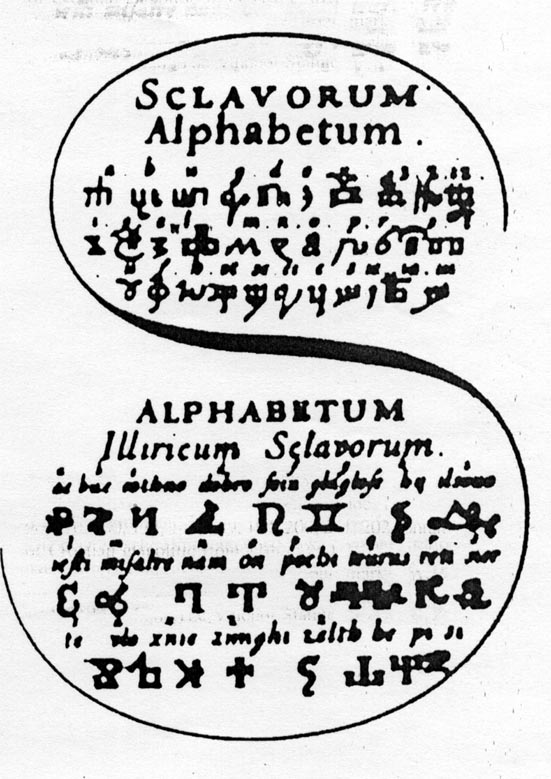
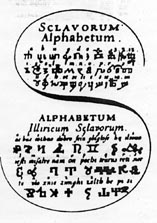 Richard Daniel
(in his book "Daniels
Copy-Book: or a Compendium of the most usual hands..., London 1664"):
Alphabetum Illiricum Sclavorum (Illirucum = Croatian, for example
Vat.Illir. documents of the Vatican library all refer exclusively to
Croatian documents), thus Croatian alphabet, see p. 50 of Daniels'
book.
On the same page you can see Alphabetum
croaticum for the Glagolitic of
the 17th century (see Branko
Franolic: "Croatian Glagolitic printed texts recorded in the British
Library General Catalogue," Croatian information centre, London, 1994
ISBN 953-6058-04-9)
Richard Daniel
(in his book "Daniels
Copy-Book: or a Compendium of the most usual hands..., London 1664"):
Alphabetum Illiricum Sclavorum (Illirucum = Croatian, for example
Vat.Illir. documents of the Vatican library all refer exclusively to
Croatian documents), thus Croatian alphabet, see p. 50 of Daniels'
book.
On the same page you can see Alphabetum
croaticum for the Glagolitic of
the 17th century (see Branko
Franolic: "Croatian Glagolitic printed texts recorded in the British
Library General Catalogue," Croatian information centre, London, 1994
ISBN 953-6058-04-9) 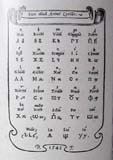 Still
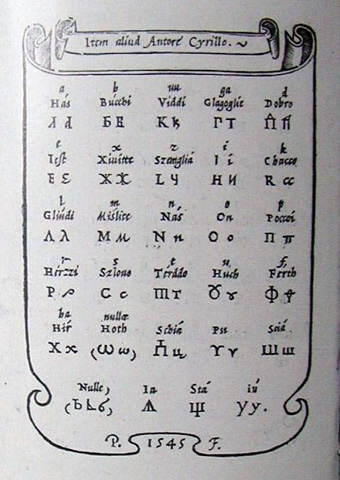
earlier, in
1545 in Rome, an Italian encyclopaedist Giovanni
Batista Palatino presented the
Glagolitic (see [the photo])
and Cyrillic
Script (see on the right) in the second edition of his book Libro
Nouvo (Libro nel qual s'insegna a scrivere ogni sorte lettera, antica
et moderna...), among 29 scripts
that he designed for printing. He
claims the Glagolitic (which he calls Buchuizza
- bukvica) to be created by St. Jerome, and to be "different from all
other existing Scripts". The Cyrillic is ascribed to St. Cyril.
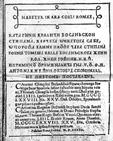
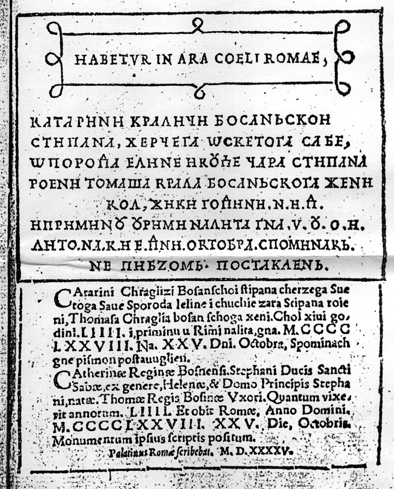
Palatino also provided a page with tombstone inscription of the Bosnian Queen Katarina
(15th century; buried
in Aracoeli, Rome), written in Croatian Cyrillic, in Latin script
(Croatian language) and in Latin Script (Latin language). The last
sentence is SPOMINAK NJE PISMOM POSTAVLJEN (Monumentum ipsius scriptis
positum - Monument written in her script):
Still
earlier, in
1545 in Rome, an Italian encyclopaedist Giovanni
Batista Palatino presented the
Glagolitic (see [the photo])
and Cyrillic
Script (see on the right) in the second edition of his book Libro
Nouvo (Libro nel qual s'insegna a scrivere ogni sorte lettera, antica
et moderna...), among 29 scripts
that he designed for printing. He
claims the Glagolitic (which he calls Buchuizza
- bukvica) to be created by St. Jerome, and to be "different from all
other existing Scripts". The Cyrillic is ascribed to St. Cyril.
Palatino also provided a page with tombstone inscription of the Bosnian Queen Katarina
(15th century; buried
in Aracoeli, Rome), written in Croatian Cyrillic, in Latin script
(Croatian language) and in Latin Script (Latin language). The last
sentence is SPOMINAK NJE PISMOM POSTAVLJEN (Monumentum ipsius scriptis
positum - Monument written in her script):
- A short note about Croatian Glagolitic and Cyrillic can be found in Viaggio in Dalmazia by Alberto Fortis, Venice 1774. The book is also known to have brought the famous poem of Asanaginica to European public.
- Bosnian Franciscans (all of them are the Croats): Bosanska chirilica, bosanska azbukvica,
- Ivan Kukuljević Sakcinski (outstanding Croatian intellectual, 19th century): Croato - Bosnian Cyrillic (hrvatsko - bosanska ćirilica),
- Ćiro Truhelka, a Croatian scientist: Bosančica, 1889,
- Vatroslav Jagić (19th century, Tomislav Raukar (mid 20th century, Zagreb): "Western Cyrillic" (western with respect to what??). Jagić also used the name of "Bosnian - Dalmatian Cyrillic."
- Josip Vrana (in the sixties of the 20th century): hrvatska ćirilica (Croatian Cyrillic),
- Benedikta Zelić-Bučan (a leading expert for the Croatian Cyrillic - Bosancica): since the seventies insisting on the name of the Croatian Cyrillic (she wrote an important booklet entitled "Bosancica in Middle Dalmatia" (in 1960, of course, in the Croatian language),
- An important and highly readable book treating the three-script history of Croatian Middle Ages (including Croatian Cyrillic) is [Hercigonja], written by outstanding specialist in 1994. It should be consulted by anybody wishing to study in more detail extremely complex history of writing among the Croats.
Here is the text of Asanaginica from the above mentioned Fortis' book (transliterated into Latin Script with ikavian reflex of yat):
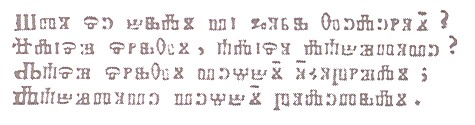
Što
se bili u gori zelenoj?
Al su snizi al so labutove?
Da su snizi već bi okopnuli;
Labutove već bi poletili.
Here is the same text in Croatian Cyrillic:
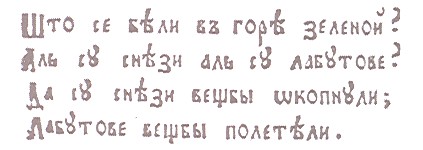
Što
se bili u gori zelenoj?
Al su snizi al su labutove?
Da su snizi već bi okopnuli;
Labutovi već bi poletili.
and in Croatian Cyrillic quickscript (with slight differences) :
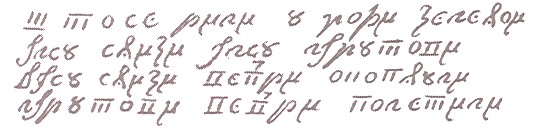
{to
se bili u gori zelenoi
Al su snizi al su labutovi
Da su snizi već bi okopnuli
Labutovi već bi poletili
Some of the oldest and most important Croatian Cyrillic monuments are as follows (here we follow [Benedikta Zelic-Bucan] and [Hercigonja]):
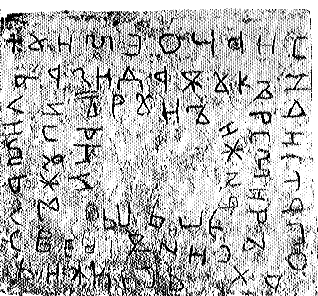
- the tablet
of Humac (Herzegovina),
comprising also
several Glagolitic letters (early 11th century according to Hercigonja;
10/11th century according to Vinko Grubišić),
- the Croatian Cyrillic inscription of the Povlja lintel (1184) from the Benedictine monastery in the village of Povlja on the island of Brac near Split;
- the Povlja charter
from Povlja on the island of Brac
(1184, copy from 1250), extensive Croatian Cyrillic text having 53
lines, mentioning 250 old Croatian names (the information contained on
the above to web pages is based on the work of Dr. Ivan Ostojić),
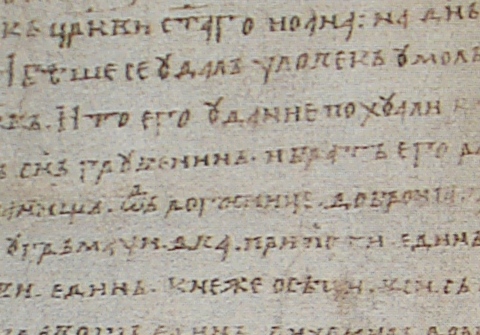
- the charter document of the Bosnian ban (governor) Kulin (1198), see below
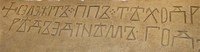
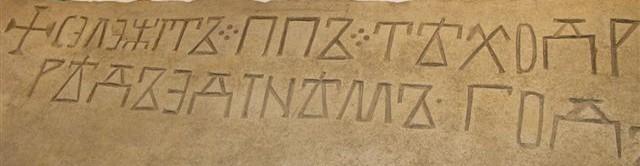
- The
inscription of pop Tjehodrag,
12th
century, Livno, Bosnia and Herzegovina, discovered in 2003, described
in [Marić,
Šimić, Škegro].
Photo below by
the
courtesy of Slavko Kirin.
- The Evangel
of Prince Miroslav of Zahumlje
(dating
from the end of the 12th century), created by Croatian Benedictins,
most probably in the city of Ston on the Peljesac peninsula. It has
been noticed already in the middle of the twentieth century that
miniatures of this evangelistary do not belong to the Byzantine style,
but to the Roman (western) style (Ivan Ostojic in his voluminous
three-volume "History of Benedictins in Croatia").
The language analysis performed by Benedikta Zelić-Bučan, based on the previous investigations of a Croatian palaeographer Josip Vrana, shows that it has been written in the Croatian recension of the Church Slavonic language. This important monument is held in Belgrade (Narodni muzej), except of one page which is in St. Petersburg.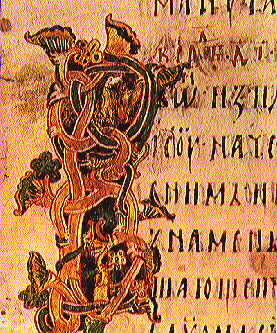
- the Blagaj inscription from the Bosnian city of Blagaj (second half of the 12th century),
- the Trebinje inscription of the župan Grdo from Trebinje in Herzegovina (second half of the 12th century). "Zupan" (country prefect). This very old title is in use in Croatia even today.
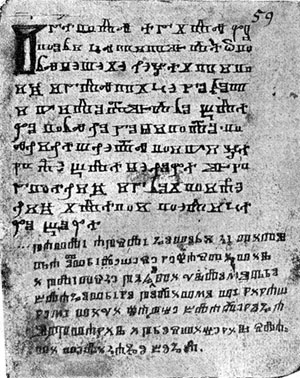
- the Croatian Chronicle (12th-14th centuries); the famous Croatian humanist Marko Marulić translated it from Croatian Cyrillic into Latin in 1510. The chronicle was written by Archbishop Grgur of Bar (pop Dukljanin).
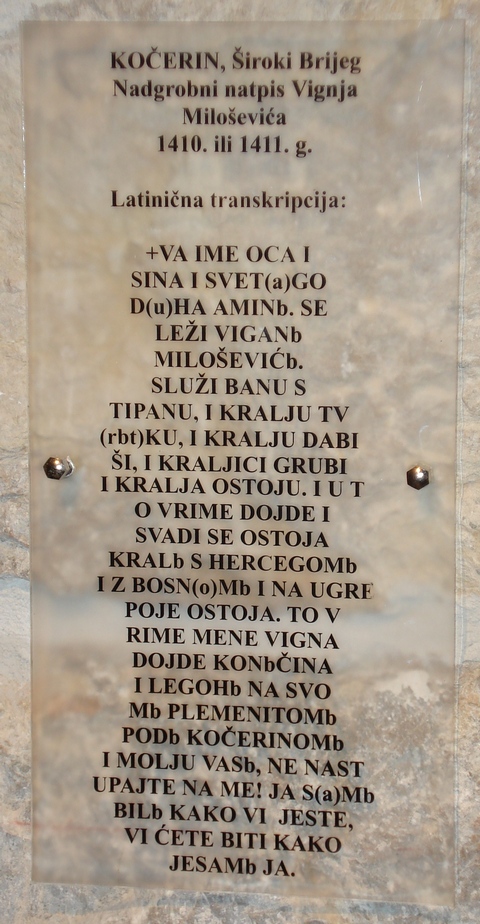
- Kočerin tablet
from 1410 or 1411 (carved in stone in
Kočerin near Siroki Brijeg), with about 300 Croatian cyrillic letters
(this the largest known text in Croatian Cyrillic appearing on
stecak's); the text is written in ikavian dialect, and starts with
invocation of Holy Trinity:
Va ime Oca i Sina i svetoga Duha, Amin, se leži Viganj Milošević..., and the concluding message is indicative:
I molju vas ne nastupite na me! Ja sam bil kako vi jeste, vi ćete biti kako jesam ja ("And I ask you not to step on me, I was like you, and you will be like me") 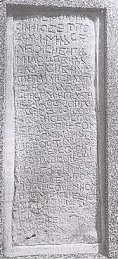
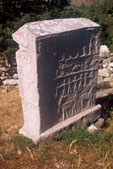
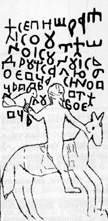
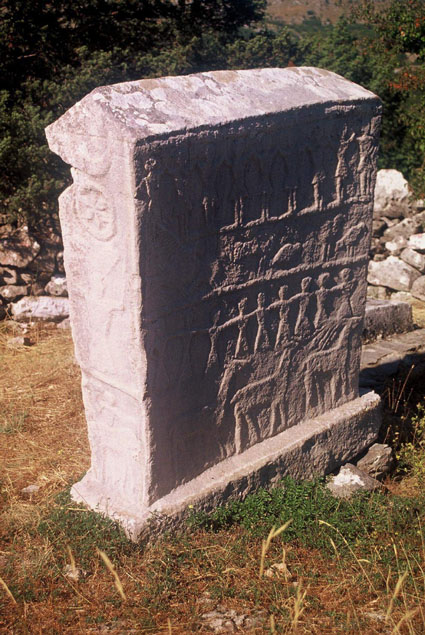
- the cyrillic
inscription on the stecak
in Brotnice in Konavle
south of Dubrovnik
probably from 15th century (note also
the glagolitic A appearing at the end of the first line), see [Kapetanic, Vekaric,
Stanovnistvo Konavala 1,
p. 24]:

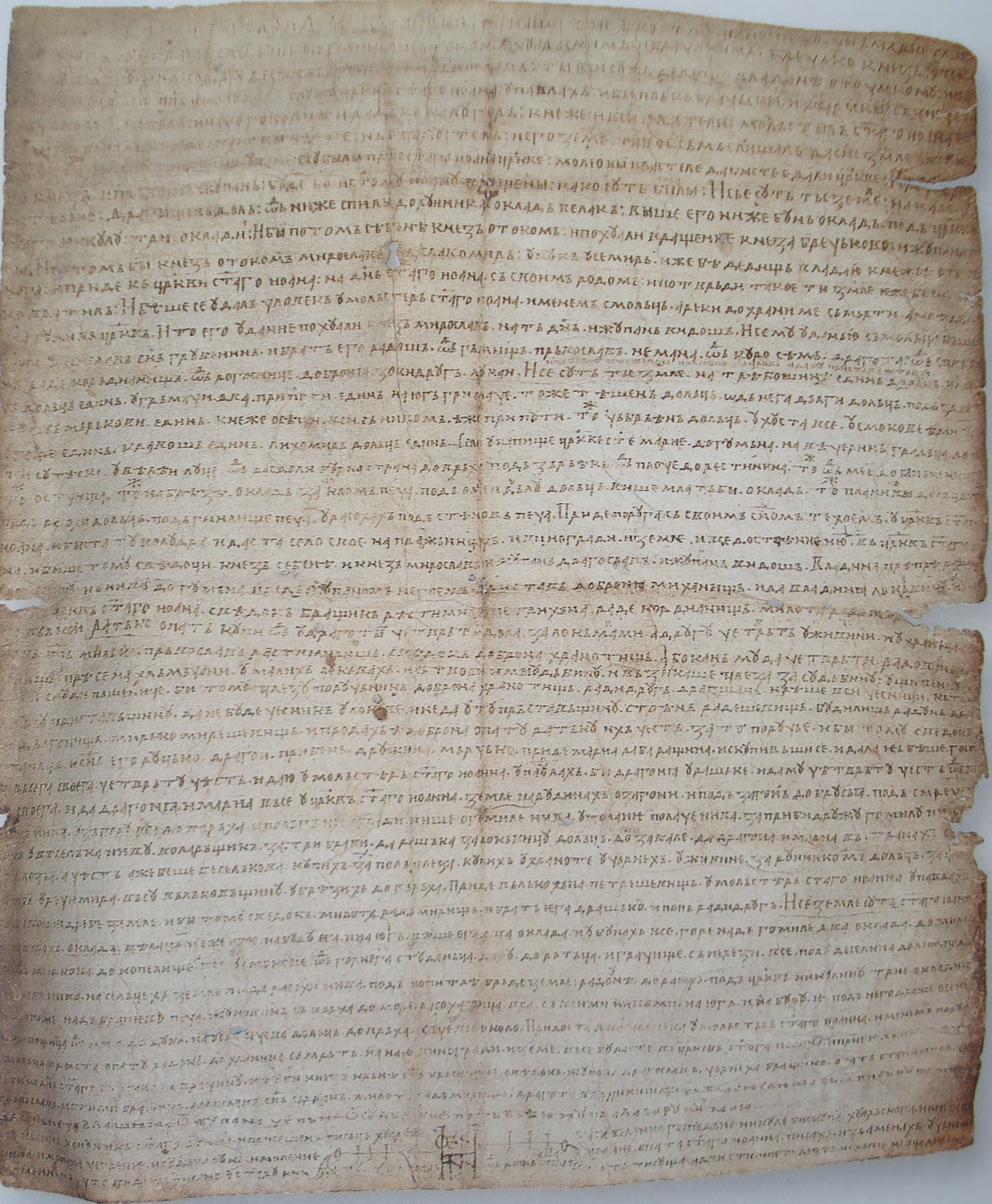
Here we provide a translitartion of the Charter of Ban Kulin, August 28, 1189, from Croatian Cyrillic to Latin script, with English translationn provided by Mr. Marko Puljic, USA. Note the solemn Christian invocation "In the name of Father and of the Son and of the Holy Spirit" (and other), a proof that Bosnia at that time was a Christain land.
U ime oca i s(i)na i s(ve)toga d(u)ha. Ja ban' bos'n'ski Kulin' prisezaju tebЪ kneže Kr'vašu i v'sЪm' građam' Dubrov'čam' pravi prijatelj'biti vam'od'selЪ i do vЪka i pravi goj dr'žati s'vami pravu vЪeu dokolЪ s'm' živ. V'si Dubrov'čane kire hode po mojemu vladanju tr'gujuće, gdЪ si kto hoće krЪvati godЪ si kto mine pravov' vЪrov' i pravim' sr'(d')cem' dr'žati je bez'v'sakoje z'ledi raz'v'Ъ što mi k'to da svojov' voljov' poklon'. I da im'ne bude od'moih'čest'nikov sile I do kolЪ u mene budu dati im's'vЪt'i pomoć' jajire i sebЪ kolikore moge bez' v'sega z'loga i primis'la. Tako mi b(og') pomagaj i sie s(ve)t(o) evan'đelie. Ja Radoje dijak ban pisah'siju knjigu poveljov' banov' od' roždstva H(risto)va hiljada i s'to i os'm'deset i devet' IЪt', mЪseca av'gusta u d'vedesete i deveti d'n', usЪčenie glave Jovana Kr'stitelja. |
In the name of the Father and of the Son and of the Holy Spirit. I, Kulin, ban of Bosnia, swear to be a true friend to you, o prince Kr'vash, and to all Dubrovnik citizens from now on and forever, and to keep true peace with you, and true faith, as long as I am alive. All Dubrovnik people who go through my domain trading, wherever anyone wants to move or wherever anyone passes, I will in true faith and with a true heart keep without any damage, unless someone of his own will gives me a gift, and let there be no violence against them by my officers, and as long as they are in my lands I will give them advice and help as I would to myself, as much as I am able, without any evil intention. So help me God and this holy Gospel. I Radoje the ban's clerk wrote this document by the command of the ban, one thousand and one hundred and eighty and nine years from the birth of Christ, the month of August, the twenty-ninth day, [the day of] the beheading of John the Baptist. |
It is interesting that in 2012 a monument dedicated to Ban Kulin was errected in the city of Tuzla in Bosnia and Herzegovina, containing this text, but with indicated boldface parts deleted, obviously aiming to deny the Christian roots of Ban Kulin. For more information see here.
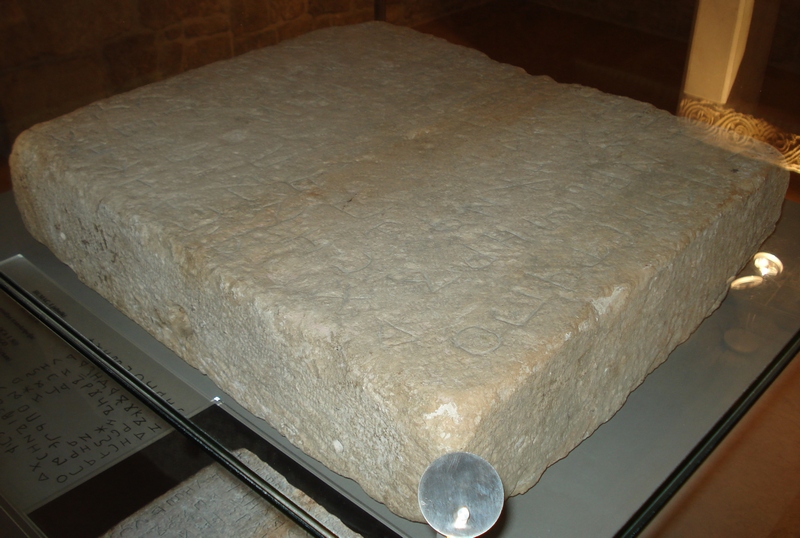
Humac Tablet (Humačka ploča), kept in the Franciscan Museum in
Ljubuški, BiH.
According to academician Eduard Hercigonja, it dates from 11th century.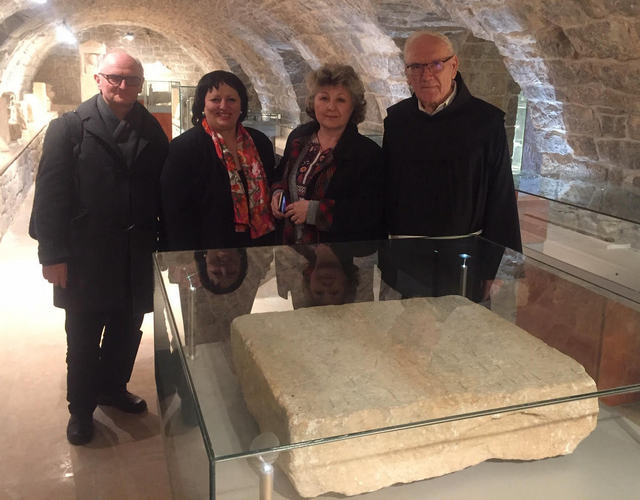
D.Ž., Vanja Gabrić, Mirna Lipovac and fra Andrija Nikić by the Humac
Tablet.
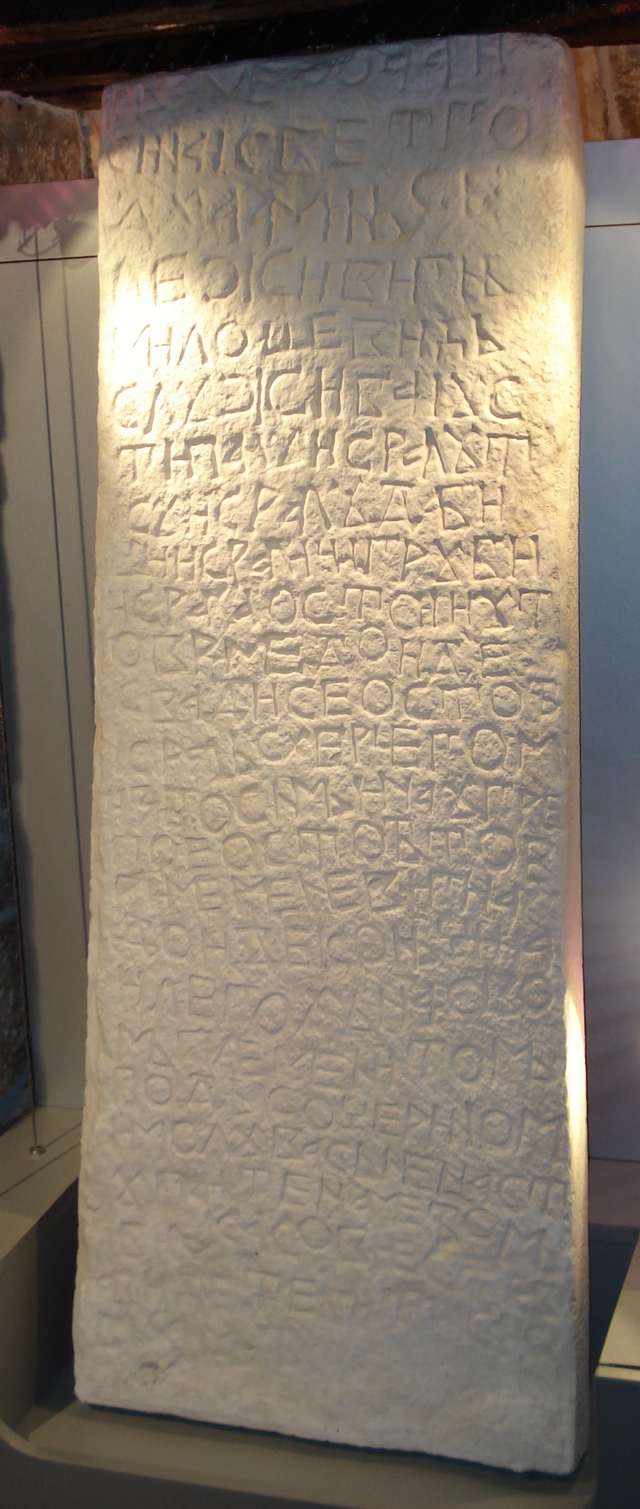
Kočerin tablet from 1410 or 1411, kept in the Franciscan Museum in
Ljubuški, Bosnia and Herzegovina
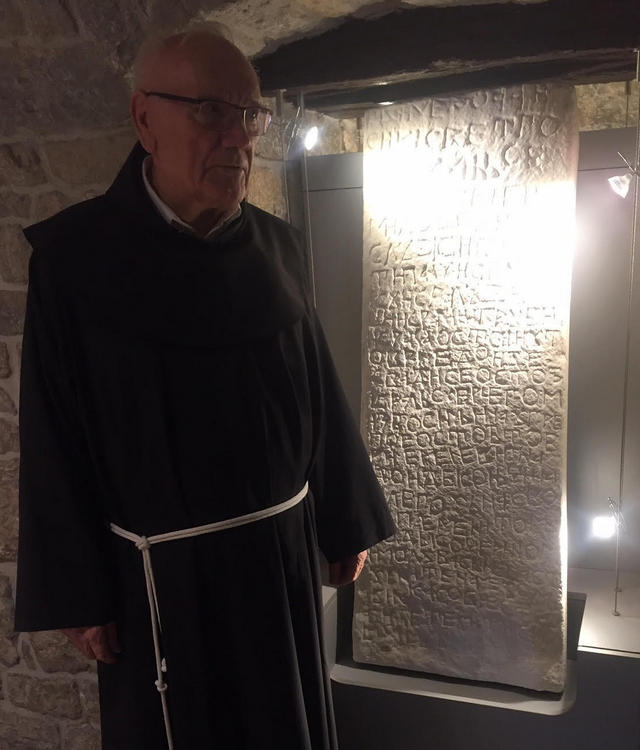
Professor fra Andrija Nikić, Humac, by the Kočerin tablet, Franciscan
Museum in
Ljubiški, BiH.
There exists a significant number of Croatian Cyrillic codices, chronicles, healers' pharmacopoeias, registers of births, testaments, personal correspondence etc. Especially important is the Poljice Statute of the small Principality in the neighbourhood of Split (1440).
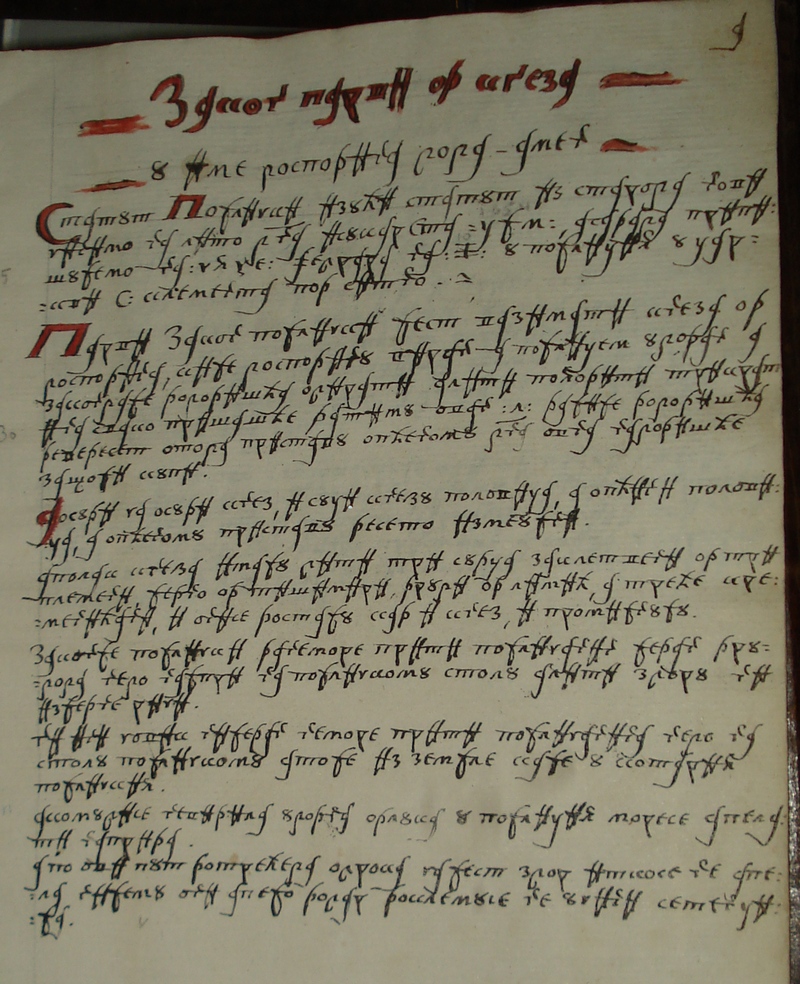
Zakon
parvi od kneza
u ime Gospodina Boga - amen.
The Poljica statute, a famous Croatian Cyrillic legal document. This is
a version from 1665, kept in the National and University Library in
Zagreb. The oldest preserved version is from 1440., and it is known to
have been based on even older manuscripts.
The Poljica Statute was translated
from Croatian into Czech, German, Russian, Spanish and English.
According to the German scholar E. Donnert (who translated the statute
into German), "the statute ... belongs to the most interesting and the
most abundant legal monuments of the Middle Age Europe." B.D. Grekov, a
Russian scholar, claims that "there is no other Middle Age law, either
Slavic or non-Slavic, providing so many opportunities to study inner
social relations of village communities as the Poljica statute". See [Poljički statut, pp. 13-14].
It seems that the Poljica statute
served as an inspiration for the English humanist Thomas More in
writing his Utopia; see [Poljički statut, pp. 23].
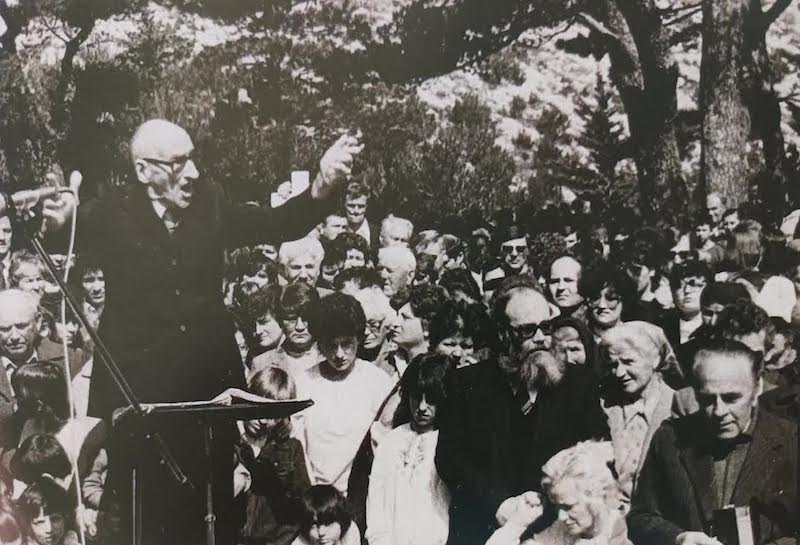
Boris Papandopulo u Poljicima (Gradac kod Gata) 1983., dirigira svoju Poljičku pučku misu. Fotografija iz monografije
Nedjeljko Mihanović & Hrvojka Mihanović-Salopek: Povijest društva Poljičana, Zagreb - Podstrana 2021.
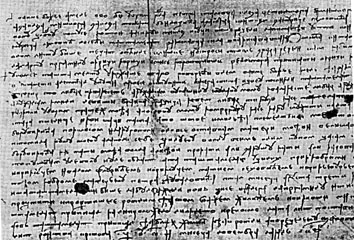
Here is a Croatian
Cyrillic testament of R. Vladisic written
in
the famous fortress of Klis near Split in
1436 (transcription from 1448).
 |
One of the most famous Franciscan monasteries is the one in Kraljeva Sutiska (or Kraljeva Sutjeska = Royal Gorge):
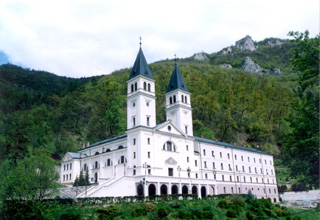
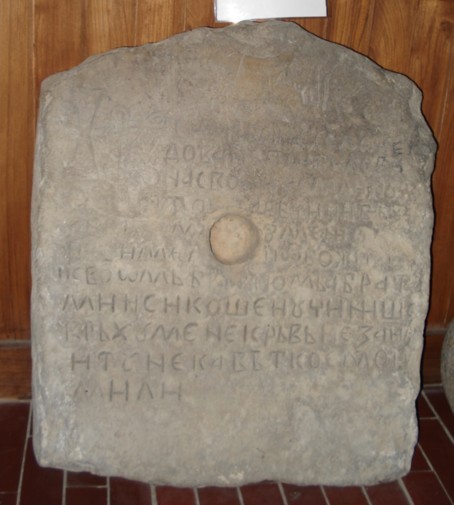
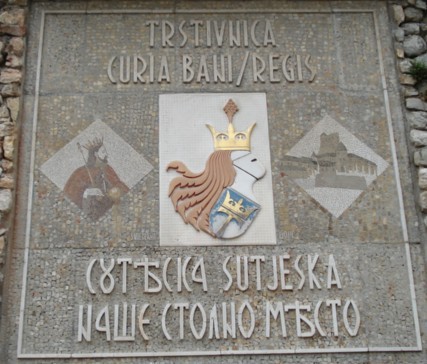
An
old and contemporary inscriptions in
Croatian Cyrillic
in Kraljeva Sutiska
(on the left: + V ime Bozje,
se lezi Radovan Pribilovic, na svojoj
zemlji plemenitoj, na Ricici; bih s bratom se razmenio, i ubi me Milko
Bozinic, sa svojom bratijom; a brata mi isikose i ucnise vrhu mene krv
nezaimitnu vrhu; Nek (zna) tko je moj mili.
Numerous manuscripts show the parallel use of the Croatian Glagolitic and Cyrillic Scripts (and also the Latin Script), thus proving that they were not opposed to each other among the Croats. One of the oldest such examples originates from Istria (St. Peter in the Wood, 12th century), where in one single word - Amen - all three Scripts are used! The coexistence and parallel use of these three Scripts - Croatian Glagolitic, Cyrillic and Latin - is a unique phenomenon in the history of European culture.
According to Croatian researcher Josip Hamm, members of the Bosnian Church (Krstyans) particularly appreciated the Glagolitic Script. Namely, all the important Bosnian Church books,
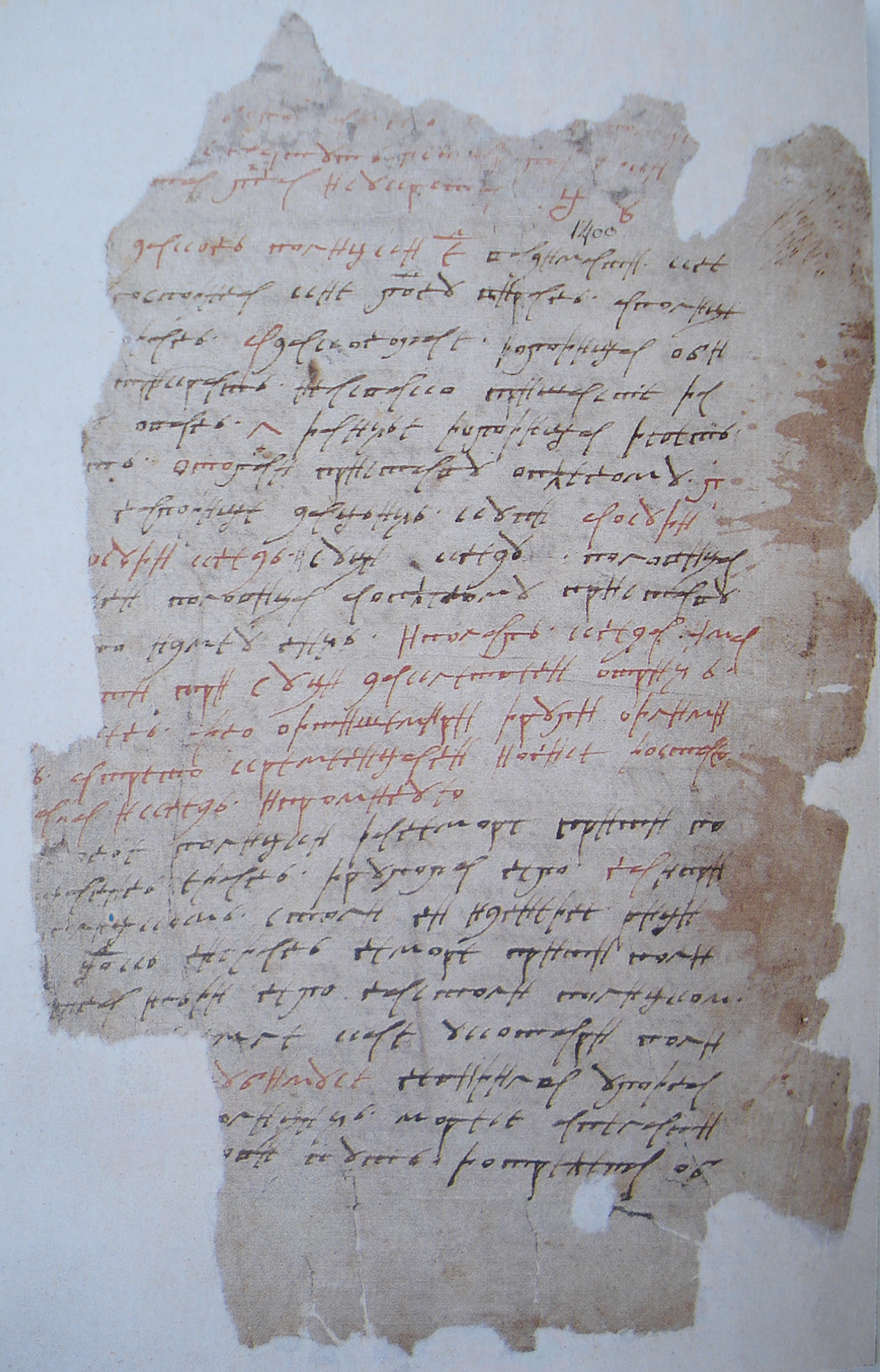
- Nikoljsko evandjelje (Gospel), Croatian parchment Cyrillic book, copied in around 1400 from older Glagolitic original by Krstyanin Hval (the name was given according to a Serbian monastery Nikolj where the manuscript was found, the book is now held in the Chester Beatty Library, Dublin),
- Sreckovicevo evandjelje (Gospel),
- the
Manuscript of Krstyanin Hval,
1404 (copied from older Glagolitic
original;
held in University Library in Bologna since 18th century),
the manuscript contains glagolitic letters on two places
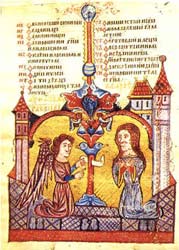
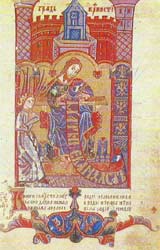
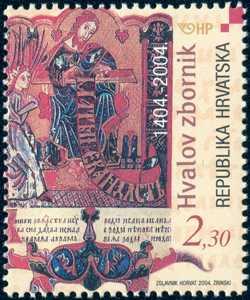
Hval's Manuscript, Croatian Post - the Manuscript of Krstyanin Radosav, 15th century (which contains three Glagolitic notes), kept in the Library of De Propaganda Fide in Rome, etc.
The first printed Croatian Cyrillic book was The Book of Hours (or the Dubrovnik breviary, or Oficje) published in Venice in 1512, prepared by Franjo Ratkovic from Dubrovnik. One copy is held in Paris in Bibliothèque Nationale. There is also another copy in the Codrington Library at All Souls College, Oxford (q.14.9); it was probably part of the founding bequest of Christopher Codrington in 1710. It is, admittedly, slightly less complete than the Paris copy, lacking 19 leaves. Many thanks to prof. Ralph Cleminson (University of Portsmouth, UK) for information about the Oxford copy. The third preserved copy is kept in Washington.
In 2012 an international conference "Croatian Cyrillic Heritage" (Hrvatska ćirilična baština) has been organized by Croatian Academy of Sciences and Arts, on the occasion of 500 years since the first printed Croatian Cyrillic book. The book of summaries of lectures: [PDF]. Proceedings from the conference will be published.Libro od mnozijeh razloga is an important Croatian Cyrillic handwritten miscellany from 1520, written in Dubrovnik (kept in the Archives of the Croatian Academy of Sciences and Arts in Zagreb). It is based on earlier Croatian chakavian and glagolitic manuscripts. See e.g. [Zaradija Kiš and Šimić, Cvijet kreposti, pp. 67-68 and facsimiles on pp. 277-325].
Cviet od kriposti duhovni i tieslnie prikoristan svakomu virnom karstianinu koi ga šti često, translation of Fiori di virtu (Flowers of Virtue), printed in Croatian Cyrillic in Venice by Bosnian Franciscan and bishop of Skradin, fra Pavao Posilović (cc 1597- cc 1657) in 1647 and 1701. (Two copies are kept in the Library of the Croatian Academy of Sciences, and in the National and University Library, both in Zagreb.) The book was reprinted in 2002 by a German scholar Wilfried Potthoff (Bonn). See e.g. [Zaradija Kiš and Šimić, Cvijet kreposti, pp. 69].
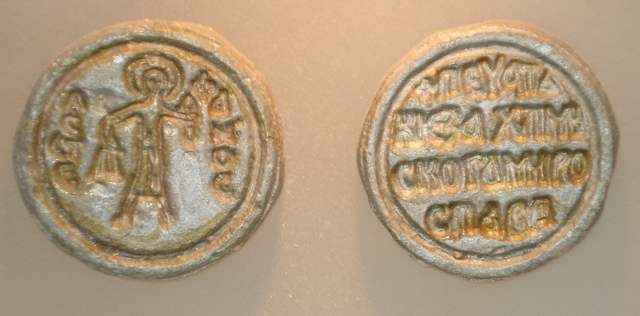
Franciscan Museum in Ljubuški, Franciscan seals in Croatian
Cyrillic
Many of the Croatian Cyrillic inscriptions are carved on tombstone monuments, called stechak.
According to the Austrian palaeographer Thorvi Eckhardt, the graphics of the Bosancica (Croatian Cyrillic) shows the greatest independence and individuality among all the national Cyrillic Scripts - Bulgarian, Macedonian, Montenegrin, Serbian, Ukrainian, Byelorussian, Russian (see her monograph Die slawischen Alphabete, Studium Generale VIII, 1967, p. 467).
She was also the first scholar to indicate the political loading in discussions about the Bosanica. In recent decades Serbian authors have openly monopolized Croatian Cyrillic as an exclusively Serbian Script. For more information see [Benedikta Zelic-Bucan].
A detailed palaeographic analysis of numerous epigraphic monuments found in Croatia and Bosnia-Herzegovina, related to inscriptions written in the Croatian Cyrillic, is contained in a monograph of Vinko Grubisic: "Grafija hrvatske lapidarne cirilice", KHR, München-Barcelona, 1978. Some of the characteristics of Croatian Cyrillic are:
-

the existence of unusually many ligatures on epigraphic Croatian Cyrillic monuments, obviously under the influence of Glagolitic script;
In the aforementioned Grubisic's book (p. 108) you will find a table of 50 interesting Cyrillic ligatures (click on left and rigth): ab (2), av (2), ai (2), al, amin', am, ao, ap, ar, al, vi, gi, gr, ez, iv, iy, in, ime, ish, jni, mc, ne, oe, oni (3) ni (3) pis, pl, pr, pa, rime, tv, tg, ti, til, ca ce, et, ma vi, am, ti mi. This is a unique characteristic of Croatian Cyrillic; - absence of tildes, contrary to Cyrillic scripts of other nations (Bulgarian, Macedonian, Serbian, Ukrainian, Russian);
- among all Cyrillic scripts only Croatian Cyrillic has the numerical value for CH (i.e. for chrv) equal to 1000, the same as in the Glagolitic script (see Grubisic's monograph, p. 116).
There exist many types of the Croatian Cyrillic - both carved in stone and handwritten:
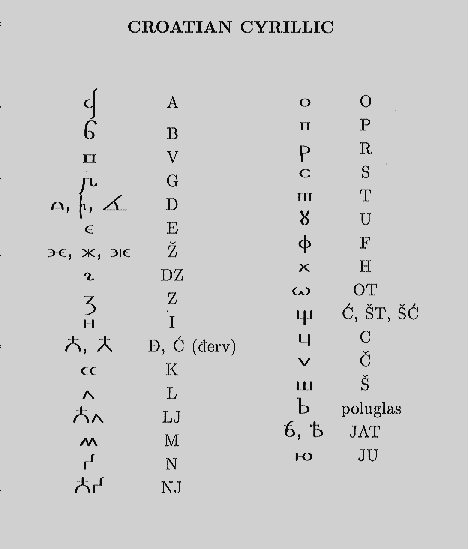
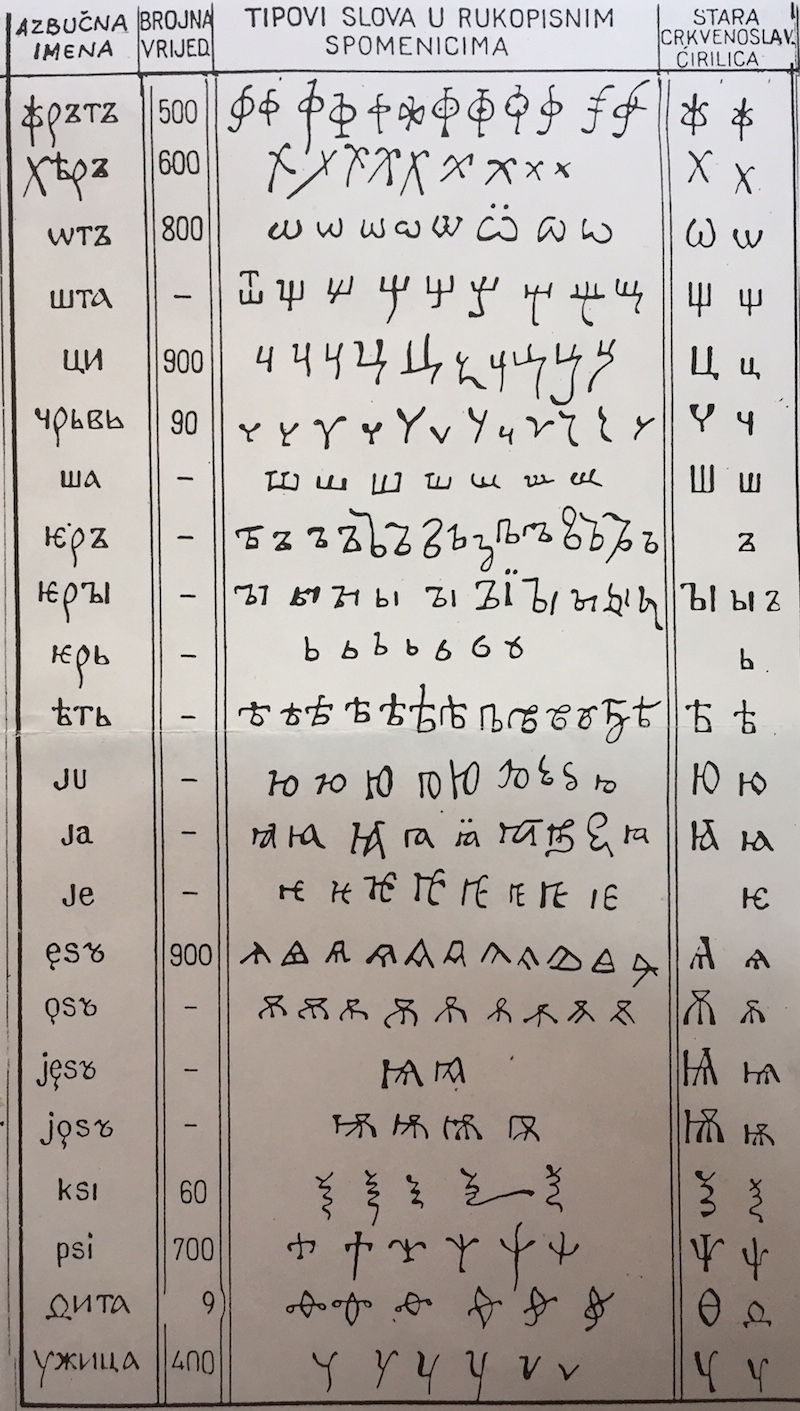
- a small table of Croatian Cyrillic letters,
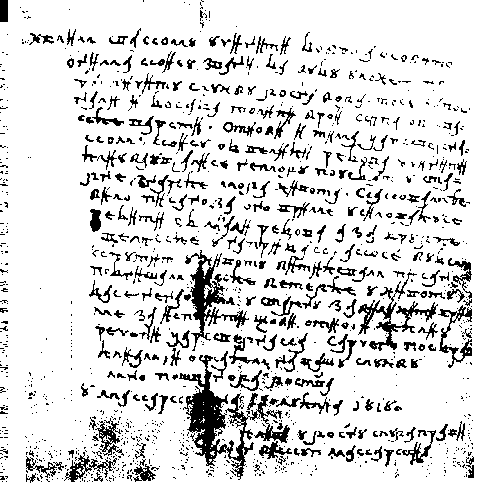
- the Croatian Cyrillic legal document written in the city of Makarska (on the Croatian littoral) in 18th century.
We know of 18 Croatian Cyrillic texts (documents, prayers, letters) that are a part of the famous Bercic collection, held in the Russian National Library in St. Petersburg. These texts contain among others also interesting correspondence between Muslim officials in Bosnia and Croats. One of the prayers written in Croatian cyrillic ends with "Amen" written twice: first in the Glagolitic and then in Croatian Cyrillic. Here is an example, provided by the National Library of Russia:
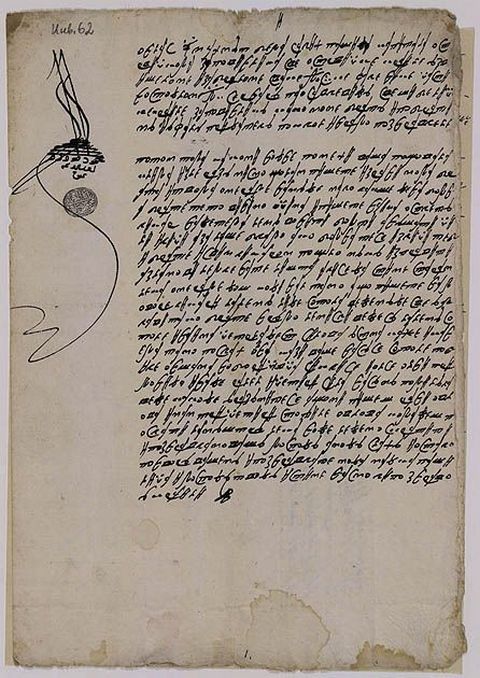
Mahmud
b. Salih, captain of Ostrovitsa and Bihach provinces.
Letter to Pavasovich, serdar of Shibenik and Skradin kapitenias
(provinces in Croatia [Šibenik and Skradin are Croatian
towns on
the Adriatic Sea; D.Ž.).
1135 A.H./1722 – 1723 A.D. 1 f., 305 x 209 mm, paper.
Coll. 67. Berchich.
No. 62.
The letter is written in cursive bosanchitsa script – a
variety
of Cyrillic used mainly by the Catholic and Moslem population of Bosnia and Herzegovina.
[Cyrillic mentioned Here
is Croatian Cyrillic, while Catholic population in Bosnia is Croatian
population, as well as a part of Moslem population. D.Ž.]
|
In the Royal Library of Stockholm
(Kungliga biblioteket) there is a huge Czech book Gigas
Librorum
from the 13th century, which in the 14th century was in Prague. It was
due to the Croatian
glagolites in Prague
that the Croatian glagolitic alphabet had been written on the inner
part of the cover page. I express my gratitude to Mr. Zdenko Naglic,
Göteborg, for this information. Here is the photo of the table
of Croatian
Glagolitic Script in Gigas
Librorum:
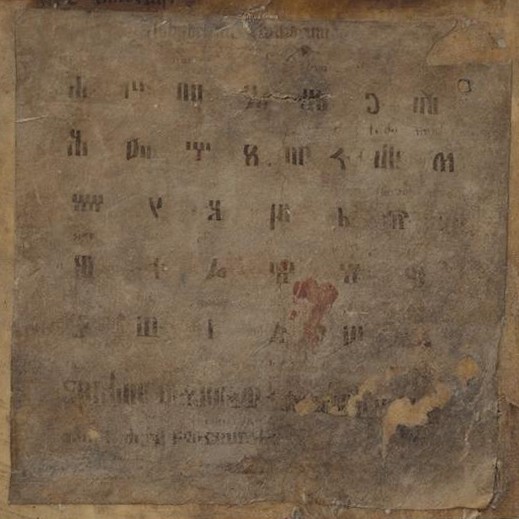
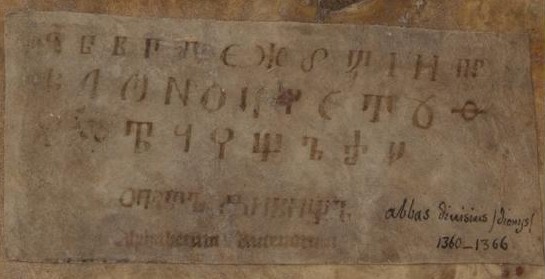
One can clearly see that the table is written on a separate vellum leaflet, subsequently glued to the page of Gigas Librorum. The photo of the page of on which one can see the table of the Glagolitic Script can be seen on the internet page of the Royal Library in Stockholm. My gratitude goes to Mr. Nenad Hancic-Matejic for information about the web adress. Undersigned on the glagolitic leaflet is Opat Divich, hardly readable. The same name can be seen on the neighbouring leaflet, glued on the same page to the right, containing the table of Croatian Cyrillic, signed lisibly with the name of the same Opat Divinic. Especially interesting is the last character in the first line: it is the Croatian Glagolitic djerv!
|
See a stone fragment (1640) from Modrus in Lika, inscribed with letters in Cyrillic and Latin script.
Austrian royal envoy Jerolim Zadranin writes a letter in
Croatian
Cyrillic on 11 February 1543 from Constantinople to Croatian
Ban
(governer) Baćan and other Croatian dignitaries to be in peace with
neighbouring Turks (Carski poslanik Jerolim Zadranin piše
hrvatskom ćirilicom banu hrvatskom
Baćanu i ostalim poglavarima 11. veljače 1543. u Carigradu, da budu u
miru sa susjednim Turcima:)
- The first sentence reads (Prva rečenica glasi): Izveličeni i zmožna gospodo, bani Hrvacki!
- ...da imam vam Slovinskim i Hrvackim banom pisati
- .. ne samo za Hrvatsku ali Slovinsku zemlju
- ...podložnikom u Požegi, Slovinie i Hrvatih
See Acta croatica,
p 243.
There are legal documents written in Croatian cyrillic which mention the Croatian name, as well as the surname Harvatić derived from Croatian name (Harvat = Hrvat = Croat):
Godine 1552. tijekom ispitivanja svjedoka u vezi parnice kneza Nikole Zrinjskoga s knezom Petrom Keglevićem poradi Selca, u dokumentu pisanom hrvatskom ćirilicom, spominje se kao jedan od svjedoka Varban Harvatić. Vidi Acta croatica, str. 252.
An important leaf containing Croatian Cyrilic text written in 1543-1563, as well as (to a minor extent) Croatian Glagolitic and Latin, can be seen in the so called Klimpeh Missal (Klingenbacher Missale, printed in 1501):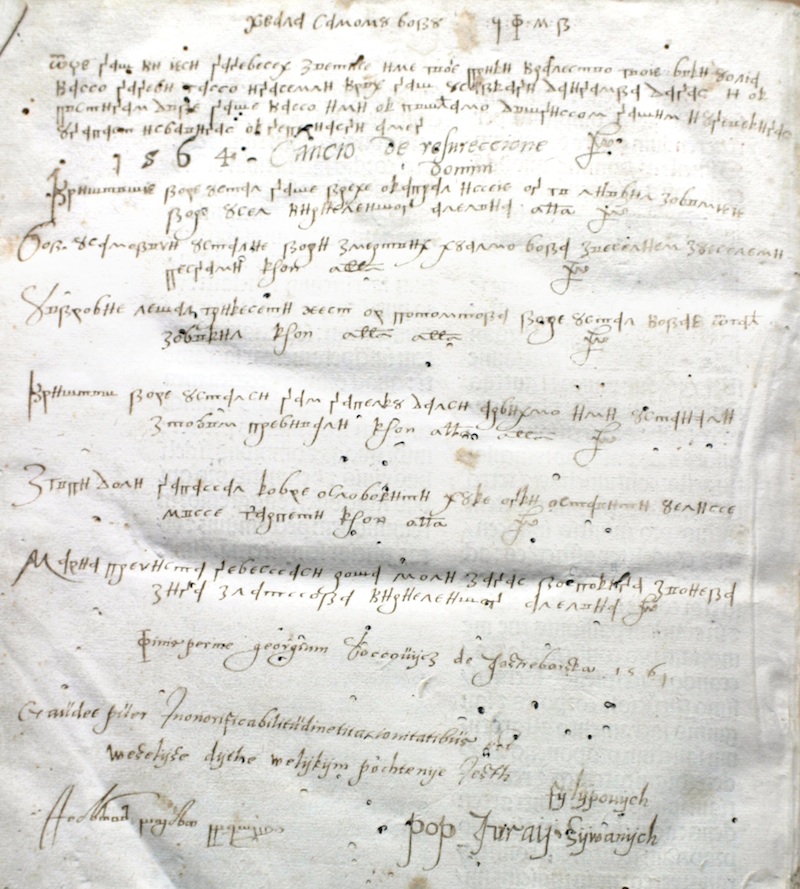
On the bottom left, we have a shrt text in very nice Croatian Glagolitic quickscript:
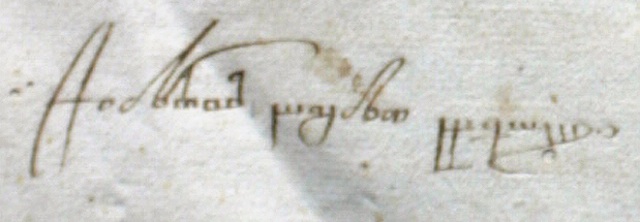
Zdravo budi bošju
Transcription of the text into Latin script (by Dr. Katharina Tyran) is provided below. It starts with Ourfather:
Hvala samomu Bogu :č:f:m:g: Otče naš ki jesi na nebeseh sveti se ime tvoje pridi kraljevstvo tvoje budi volja [tvoja] kako na nebi tako i na zemlji kruh na vsagdanji daj nam ga danas i od- pusti nam duge naše kako i mi odpušćamo dužnikom našim i unevedi nas u napast [na] izbavi nas od nepriazni amen 1564 Cancio de reureccione domini Kristuš je gore ustal naše grehe odapral i ke je on tu ljubil sobum je je gore uzel kirieleišon aleluja aleluja Bog vsamogući ustal je gore s mertvih hvalmo Bog s veseljim s veselemi pesnami krieleišon aleluja Vu grobi je ležal trideset i šest or potom toga gore ustal koga je otac zobudil kririeleišon aleluja aleluja Kristuš gore ustal si nam na peldu dal si ar bihmo i mi ustajali s tobom prebivali krielešon aleluja aleluja Stupi doli na pakal dobre osloboditi hude ondi ostaviti velike muke tarpeti kririeleišona aleluja Maria prečista nebeska si roža moli za nas gospodina svojega sina slatkoga krireleišon aleluja Finis per me Georgium Vuković de Jastrebarska 1561 Gaudet puer Inonorificabilitudinetitacionitatibus Veseli se dite velkim počtenje jest Filipović Zdravo budi božju pop Juray Simanić |
See also an article by Alojz Jembrih: Hrvatski zapis (1564.) Jurja Vukovića iz Jastrebarskoga u latinskom misalu župe Klimpuh [PDF], Kroatologija 2(2011)2: 44–67, where a somewhat different transcription is provided.
Croatian Protestants published The New Testament in 1563 in Urach, Germany, in two volumes (1000 copies of each):
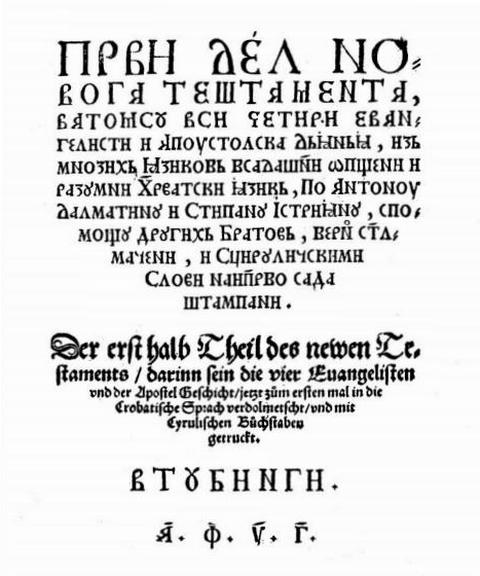
Prvi
dél No-
voga
Teštamenta,
va tom su vsi četiri Evan-
gelisti i Apustolska
d'jan'ja iz'
mnozih' jazikov' v sadašnji općeni i
razumni H'rvatski
jazik', po Antonu
Dalmatinu i Stipanu Istrijanu, s po-
moću drugih' bratov', verno st'l-
mačeni, i s ciruličskimi
slovi najp'rvo sada
štampani

This is again stressed on the same page in German - Crobatische Sparch:

The books were printed in Konzul's and Dalmatin's Croatian-Urach Cyrillic script, see Alojz Jembrih [PDF1], [PDF2]. The whole edition was prepared by Anton Dalmatin and Stipan Istrian, as well as by other brethern. The same book was published in Croatian Glagolitic Script in 1562/63, prepared by the same persons. Reprints of these books have been published in 2008 by the Theological Faculty "Matija Vlačić Ilirik" in Zagreb, where you can find more information.
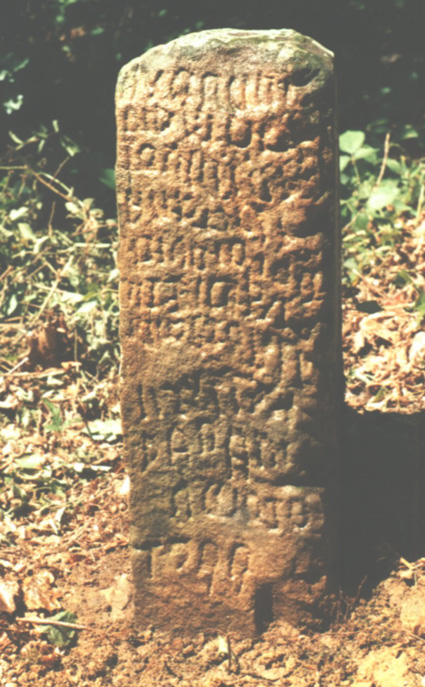
Here is an interesting monument from central Bosnia with inscription for which it is difficult to decide is it Croatian glagolitic, cyrillic, or something else:
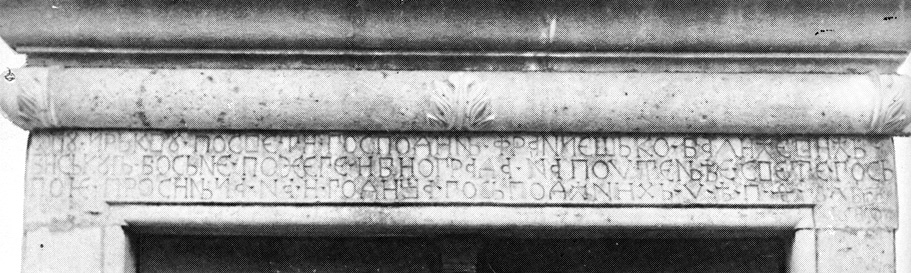
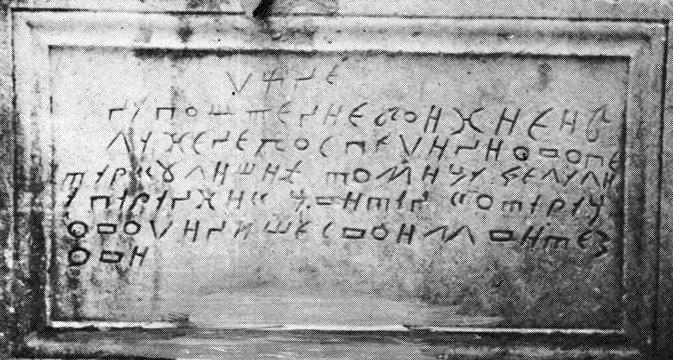
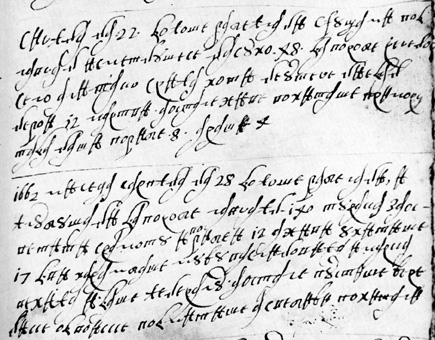
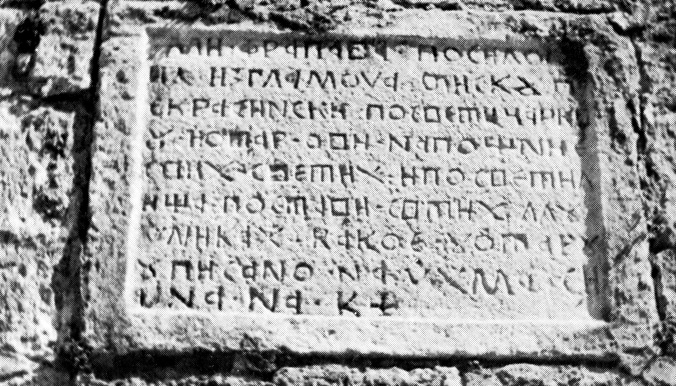
We illustrate some of numerous very interesting monuments of Croatian Cyrillic from the Makarska area, see [fra Karlo Jurisic].
 |
 |
 |
 |
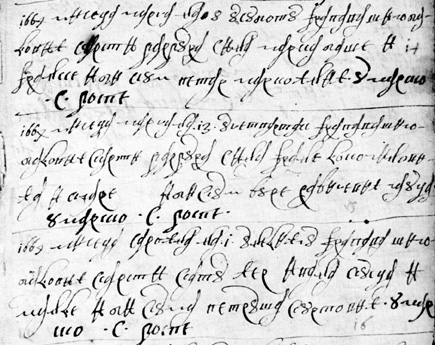
It is interesting that in the franciscan convent in Makarska a baptismal parish register is preserved from 1664, written in Croatian Cyrillic, see [fra Karlo Jurisic, pp. 152-153]:
 |
In the same monograph one can find an extremely interesting example of official correspondence with Turkish officials in Herzegovina written in Croatian Cyrillic in 1498, dealing with the destiny of franciscans in Zaostrog, see [fra Karlo Jurisic, pp. 200-201].
In the town of Zagvozd behind the beautiful mountain of Biokovo one can see a lovely Catholic church of all Saints with Croatian Cyrillic inscription from 1644:
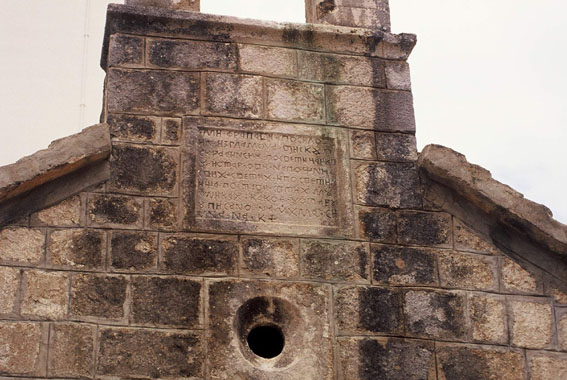
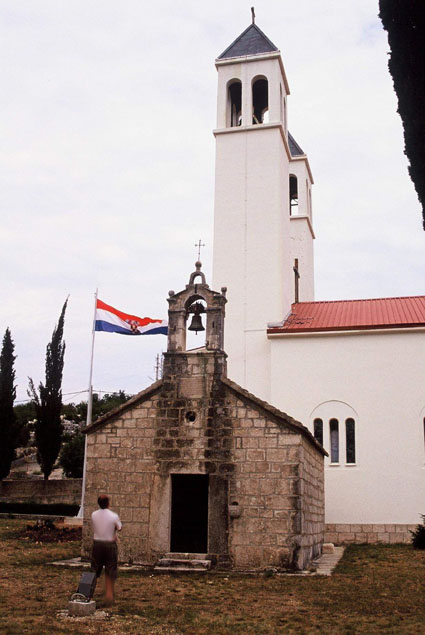
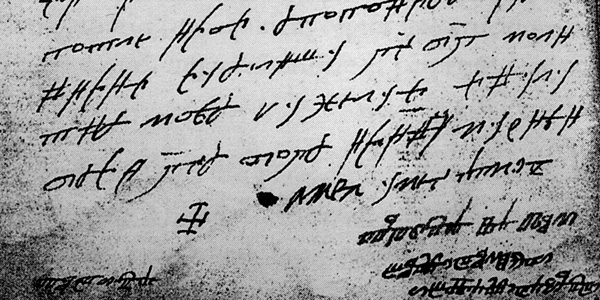
You can listen to the text, narrated by Stjepan Bahert, drama artist: Glagoljski zapis don Bare Pifrovica iz okolice Zadra. In 1636. Croatian glagolitic priest Bare Piforovic wrote in the Registry of Dead from the parish of Petrcane near the city of Zadar the following lines in the Croatian Cyrillic: "Ja, dom Bare Pifrovic, to pisah krvaski, curilicu i latinski..." (Me, don Bare Pifrovic, wrote this lines in Croatian, in Cyrillic and Latin...). See [Hercigonja, Glagoljaštvo i glagoljica].
In the beautiful Franciscan monastery on the islet of Visovac on Krka river there is an inscription on the grave of fra Stipan Skopljanin (+ Visovac, 1609.) in the Croatian Cyrillic:
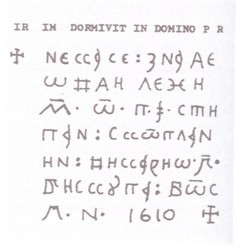
Photo from [Bogovic and Jurisic, p. 112]
| Nek se znade ovdi leži m.o.p.f. Sti- pan Skoplan- in vikario g. biskupa bos(ne) l(ita) n(a) 1610. |
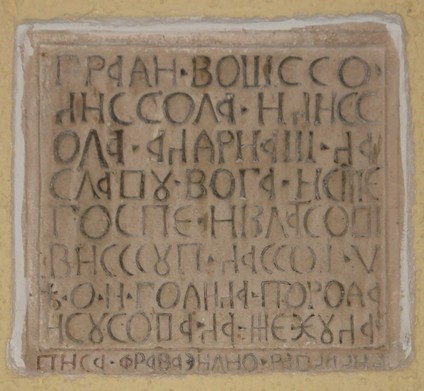
The above Croatian Cyrillic inscription can be seen inside the parish church of the village of Ravno, Eastern Herzgovina, not far from Dubrovnik. The following text is taken from www.rb-donjahercegovina.ba (follow the link for the photo):
THE TABLET IN THE CHURCH OF THE NATIVITY OF OUR LADY IN RAVNO. This tablet is set up in the Church of the Nativity of our Lady in Ravno, written in Croatian Cyrillic script (bosancica), testifying that Bosko and two men named Nikola Anrijasevic restored this Medieval church in 1579. The tablet was written by Fra. Bazilio, who calls himself "Ravjanin" (a man of Ravno) and was probably in the monastery in Slano. The Bishop blessed the church on 6th June 1579.Original text in Croatian (line by line):
Gradi Boško
Nikola i Nik
ola Andriaš, na slavu Boga i Sv(e)te
Gospe. I Blago(slo)vi
Biskup nakon 1.
5.7.9. godina poroda
Isusova. Na s(v)e(toga) žuna.
Pisa fra Bazilio Ravnanin.
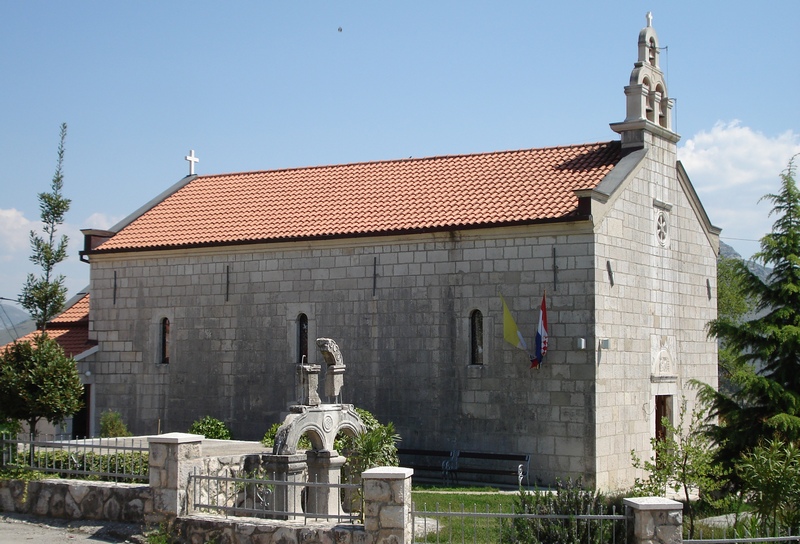
Parish
church in the village of Ravno
in 2007, damaged in
1991 when the Greater Serbain agression on BiH started.
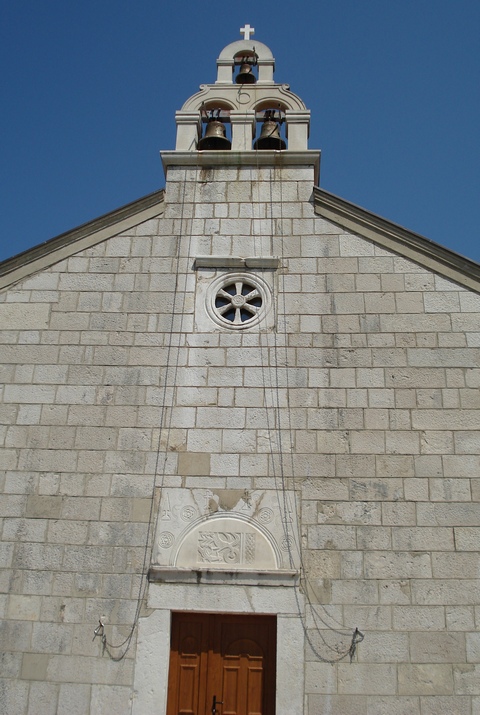
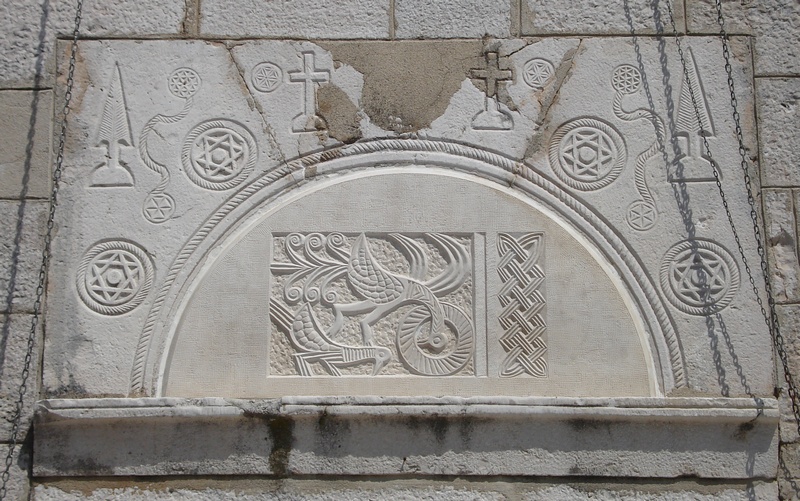
Village of Ravno, Eastern Herzegovina, not far from Dubrovnik.
We provide several documents published in Croatian Cyrillic in Eastern Herzegovina, not far from Dubrovnik, see [Dubljani]:
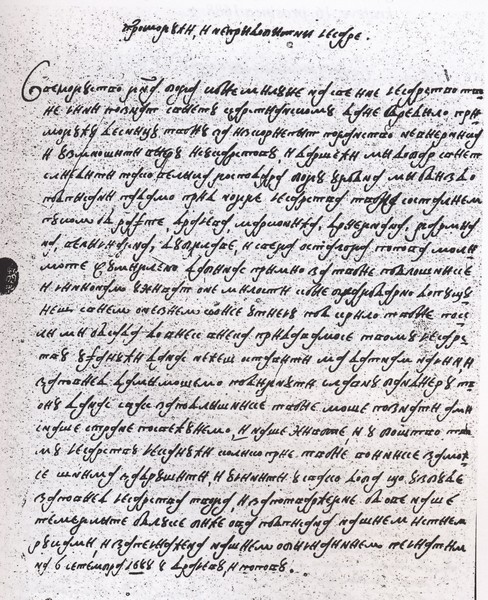
A Croatian Cyrillic text written by inhabitants from Ravno, Dracevo, Drijenjan, Grmljan, Velican, Dubljani and other parts of Popovo, written 1688, admitting Leopold I as their protector. See [Dubljani, p. 91].
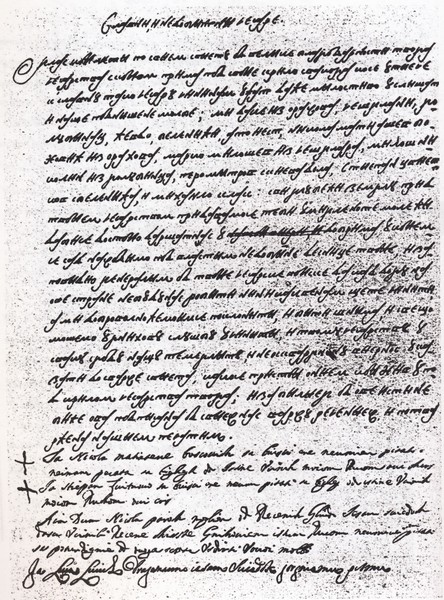
Representatives of Orahov Do,
Cesljar, golubinac, Kijev Do and Belinic
sending letter to emperor Leopold I asking him for protection in 1688.
See [Dubljani,
p. 92].
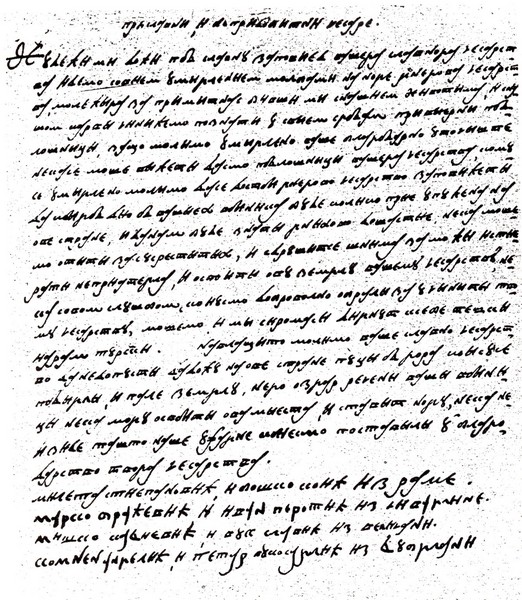
Representatives of Ravno, Cvaljin, Velican, and Dubljani sending a letter to Leopold I in 1690. See [Dubljani, p. 94].
Dr. Marinka Šimić:
- Jezik boljunskih natpisa, in Stolacko kulturno proljece, Godisnjak, godiste V, 2007., str. 175 - 189 (condensed version [PDF])
- Srednjovjekovni natpisi stolackog kraja, in Stolacko kulturno proljece, Godisnjak za povijest i kulturu, godiste VII, 2009., str. 119-146
- Jezik srednjovjekovnih
kamenih natpisa iz Hercegovine,
Matica hrvatska, Sarajevo 2009.
(250 pp) ISBN978-9958-830-34-1 (a presentation of Croatian Glagolitic
and Cyrillic monuments in Bosnia and Herzegovina can be seen on pp.
48-50)
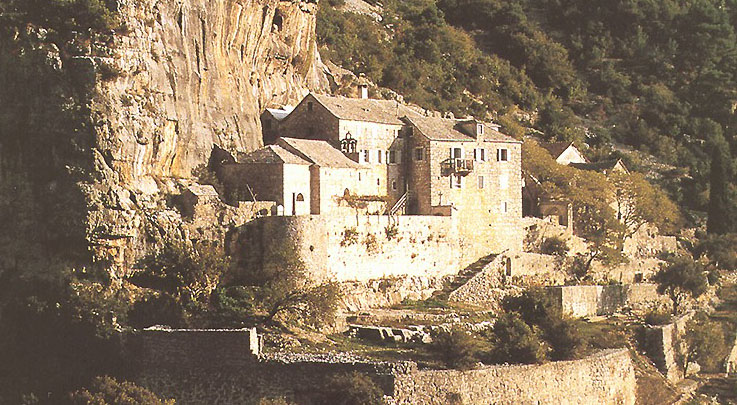
On the island of Brac there is a famous glagolitic convent of Blaca built in the 16th century:
Its interesting library keeps among others old Croatian Cyrillic manuscripts, like this one:
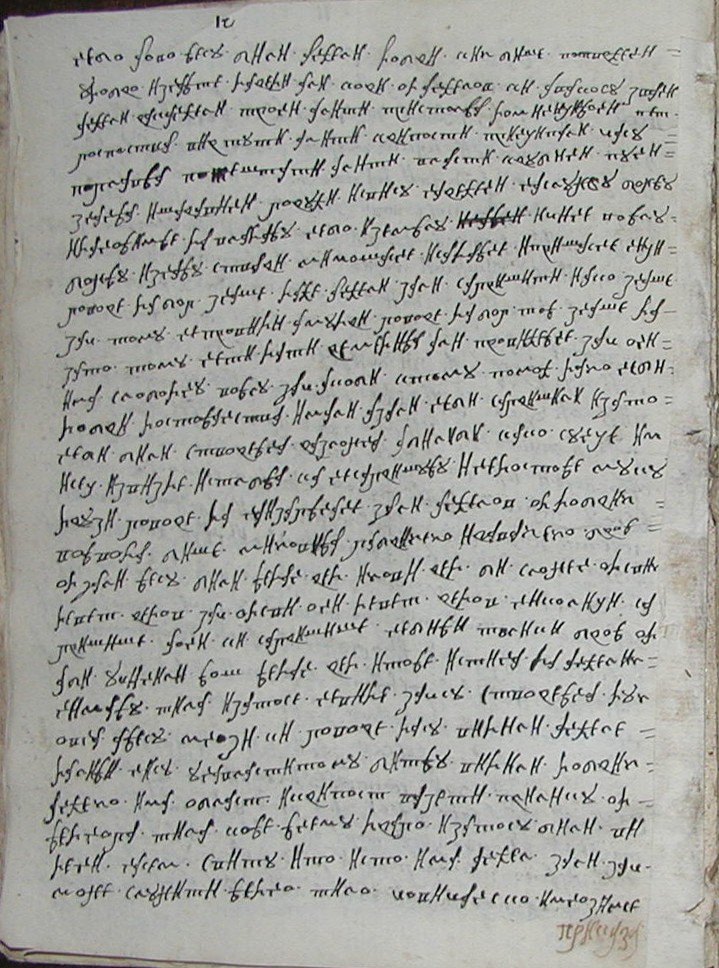
In fact, on the island of Brac near Split we know of six Glagolitic convents, founded by Glagolitic Catholic priests from Poljica, near the mountain of Mosor, who had to escape to the island during the Turkish onslaughts. These convents kept not only Croatian Cyrillic books, but also Croatian Glagolitic and Latin books.
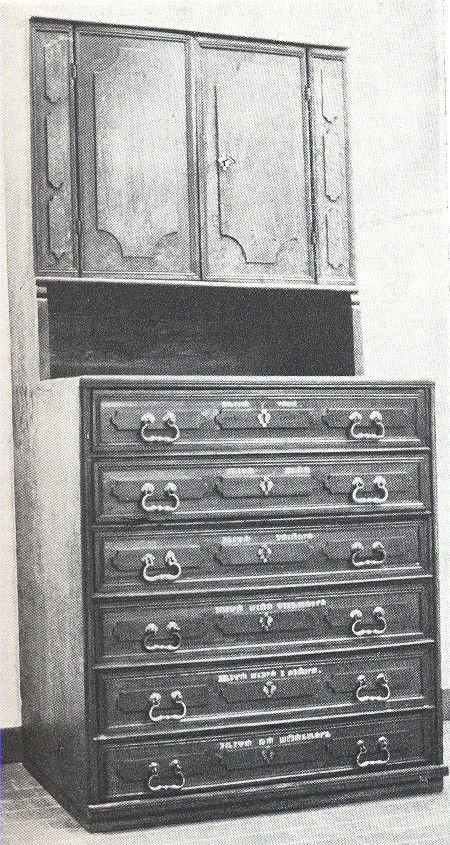
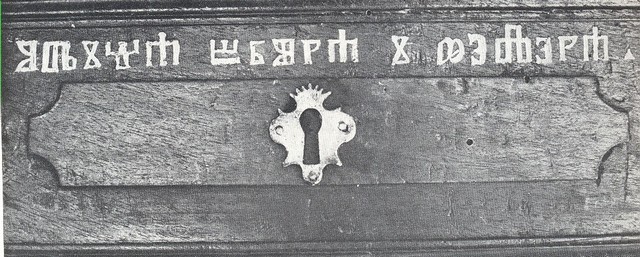
An interesting remain from Draceva Luka Glagolitic eremitage, kept in the Dominican Convent in the town of Bol on the island of Brac, is a wardrobe bearing Glagolitic inscriptions describing the color of dresses of priests. Also a remain of the first Croatian printed book (incunabulum) from 1483, printed in the Glagolitic script, is kept there, originating from Draceva Luka on the island of Brac.
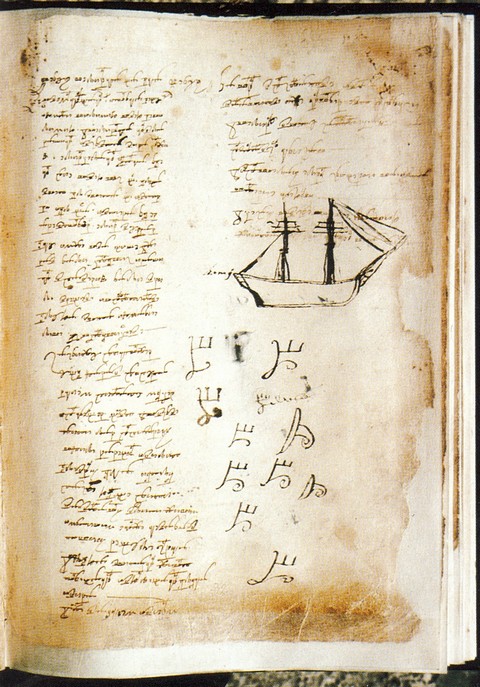
Croatian Glagolitic quicscript book found in a Glagolitic convent near Murvica, near famous Zlatni rat, on the island of Brač, see [Batelja, Apokalipsa u Zmajevoj Špilji]
There are several additional convents of the Poljica Glagolitic Catholic origin founded in 15.-16. st.:
- one on the island of Čiovo: Prizidnice (on the south-east of the island),
- one on the island of Šolta: Gospa u Borima (eastern part of the island, north of the G. Sela),
- six on the island of Brač: except the mentioned convents of Blaca, Dračeva Luka and Zmajeva špilja (Dragon's Cave), also Dutić, Silvio i Stipančić (near the village of Murvice by the famous Zlatni rat).
Edo Pivcevic: The Poljica Statute
Croatian nobles were familiar not only with the Croatian Glagolitic Script, but also with Croatian Cyrillic. We can illustrate this with the following text signed by Petar Zrinski (1621-1671) outstanding Croatian statesman and writer. It is contained in the "Libar od Spominka" (Book of Remebrances) written by Katarina Zrinska (1625-1673).
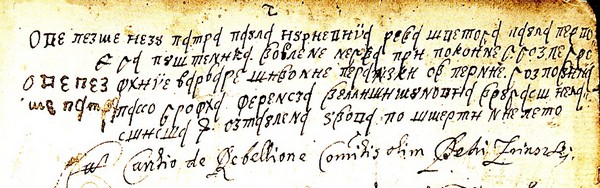
Acta croatica:
- oko 1550. Oporuka Jurja Keglevića (hrvatskom ćirilicom). 251
- 1552. Ispitivanje svjedoka o pravdi kneza Nikole Zrinjskoga s knezom Petrom Keglevićem poradi Selca (hrvatskom ćirilicom). 251 252
- 1564.-1576. U Beču. Knez Gašpar Keglević piše svojemu otcu Petru, kako je razne poslove u Beču obavio (hrvatskom ćirilicom). 261
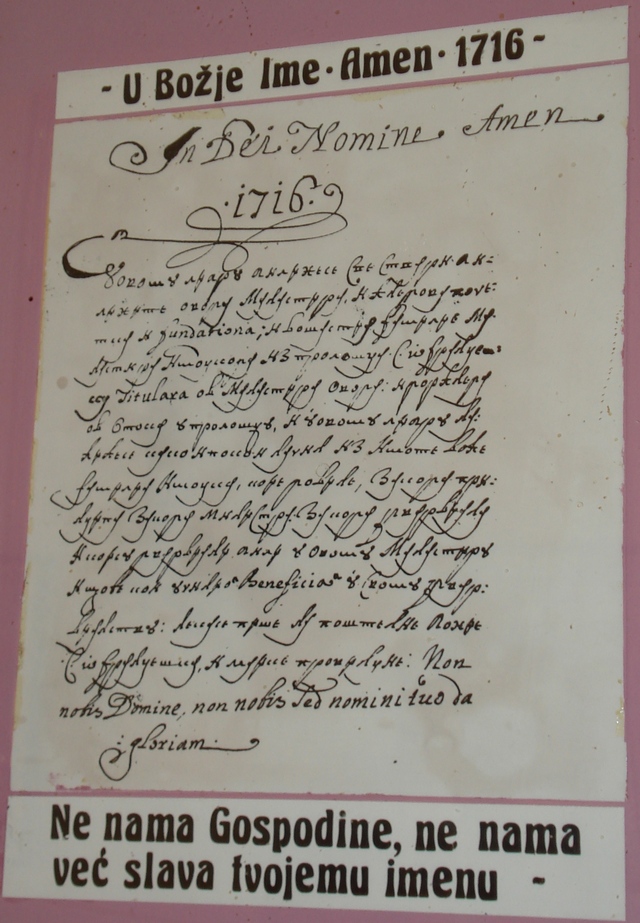
Museum of the town of Grude (BiH), Chronicle of fra Stjepan Vrljić from 1716, written in Croatian Cyrillic.
The first and the last sentences are the Latin Language.
In Dei Nomine Amen. ... Non nobis Domine, non nobis sed nomini tuo ad gloriam.
In the archives of the Nin Diocese (Nin is a town at the Croatian coast, not far from the city of Zadar) the following document dating from 1723 has been discovered, written in Croatian Cyrillic Script:
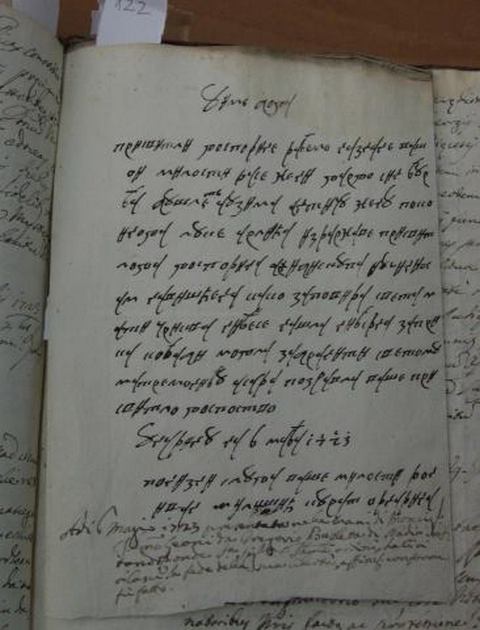
The document was written by don Ivan Mišlić, a Catholic priest in Nadin, and deals with a marriage in Nadin in 1723. We provide its transliteration from Croatian Cyrillic into Latin script:
U
ime Boga
Prisvitli gospodine daemo na znane vašoi milosti da se ženi
Gargo sin Jurja Bušlete a uzima Anticu ženu pokoinoga Luke
Arlića iz daržave prisvitloga gospodina arhibiskupa i ucinil san
navišćenja kako zapovida sveta mati crikva i nije se
našla nijedna
zaprika koja bi mogla
zabraniti svetomu matremoniju a sada pozdravla vaše
prisvitlo gospodstvo.U Nadinu na 6 maja 1723 Ponizni sluga vaše milosti don Ivan Milišić kurat od Nadina |
We owe our gratitude to Mr. Ivica Glavan, University of Zadar, for sending us this interesting document.
In 2014, a monumental monograph [Kujundzic] has been published about a little known and very importyant Croatian medical book, dating from the mid 18th century. It contains as many as 1700 medical recepies, writen in Croatian Cyrilic Script (poljičica). While the original text contains 406 readable pages, the scholarly study was published in 2014 on 756 pp. This extensive and important monument of Croatian language and culture dates from about 1750, and originates probably from the region of Poljica, that is, from the region between Split and Omiš, arround the mountain of Mosor. The language of the text is close to contemporary Croatian štokavian, based on older čakavian Croatian speech. The vocabulary is ikavian: misec (mjesec - moon), bilo (bijelo - white), mliko (mlijeko - milk), liči (liječi - cure), imišaj (izmješaj - mix), cviće (cvijeće - flowers), slip (slijep - blind), vitar (vjetar - wind), medvid (medvjed - bear), odića (odjeća - clothing), svića (svijeća - candle), etc. Sources of some of the recepies are explicitly mentioned. For example, the name of distingushed Catalonian scholar Arnaldus de Villanova is mentioned in the book as Rinalod s Novog Sela (in the recepy no. 912). The name of Plinius is mentioned in 35 recepies, of Dioskurid in 25, while the name of Plato is mentioned in 17 recepies. The book has been discovered in 1920/21 in the village of Budimir near Trilj dating from around 1750, and is probably a copy of an even older book.
Prof.dr. Slavko Kovačić: Croatian Glagolitic heritage in the Split Archdiocese
Rev. Dr. Slavko Kovačić, professor of Theology at the University of Split, distinguished church historian, supplied us with the following very interesting information concerning the Croatian Cyrillic script. We express our gratitude for his permition to use the data and photos (exhibited in this section) from his lecture delivered in Zagreb in 2017, organized by the Society of the Friends of the Glagolitic Script (Scripturae Glagoliticae Amicorum Societas).
There are numerous preserved documents, written in Croatian Glatolic and Cyrillic, proving that the Glagolitic mass was served even in the Split Cathedral.
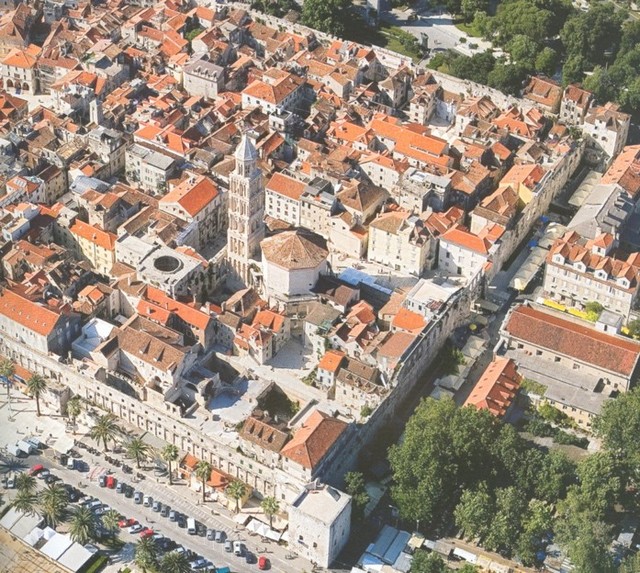
The Split Cathedral is a part of the famous Diocletian Palace
Registers of Masses delivered in the Split Cathedral:
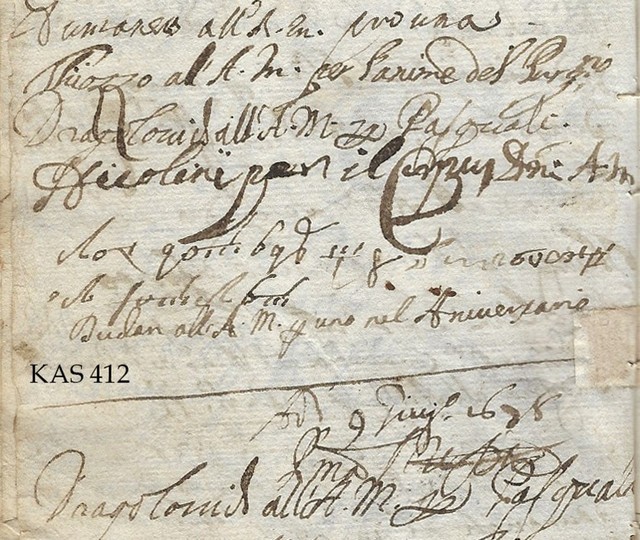
In the middle: Don Gargo Burmetić od Zadra (from Zadar, inscribed in Glagolitic quickscript)
KAS = Kaptolski Arhiv Split (Split Chapter Archive)
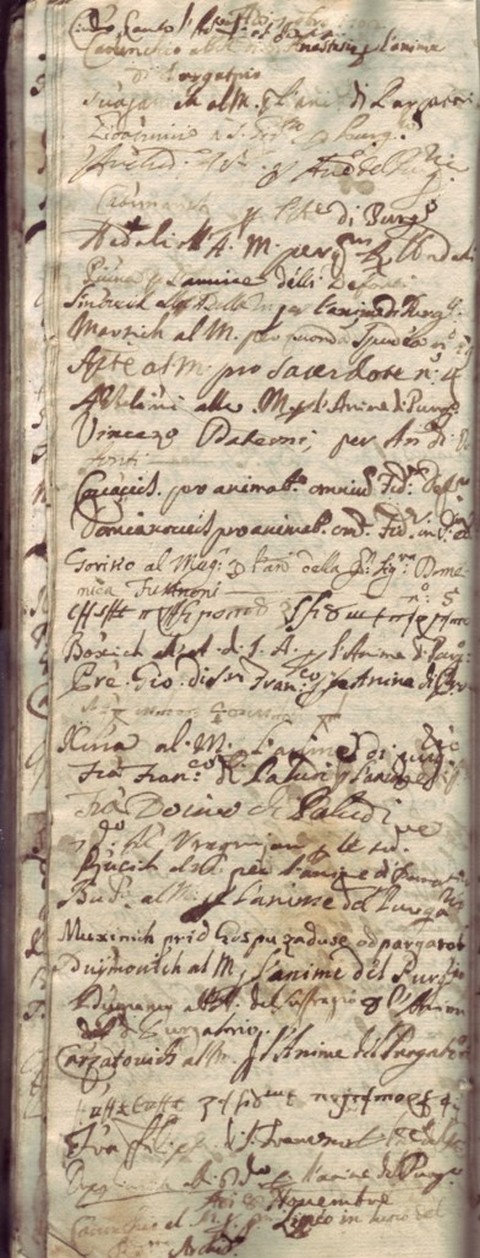
In the middle - a line in the Glagaolitic, and in the fifth line from below in Croatian Cyrillic
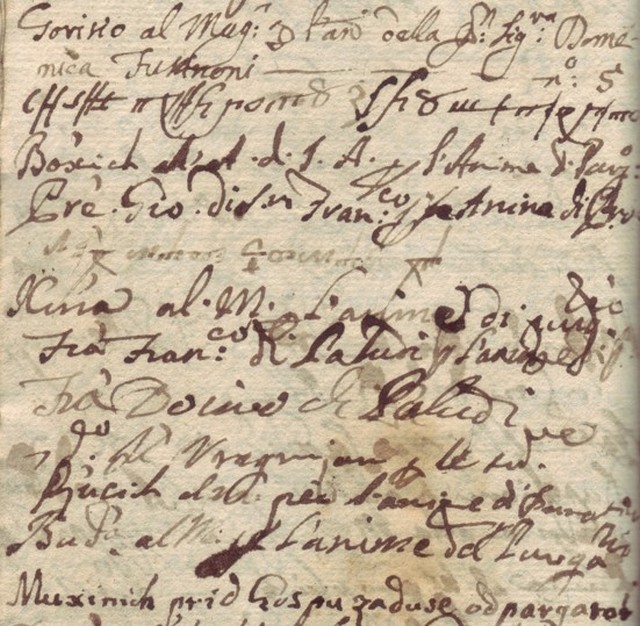
In the middle: Don Mate Simara na ... (signature in the Glagolitic quickscript)
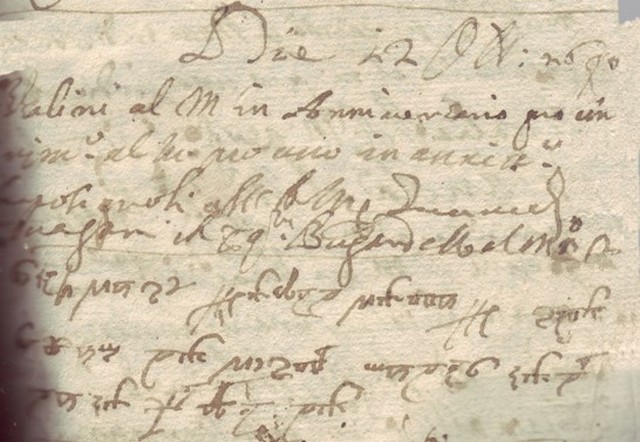
Rih misi Jadro Matij Iha-
ržić na mesto Šiner kano-
nika Bl... na
Glagolitic quickscript in the last three lines
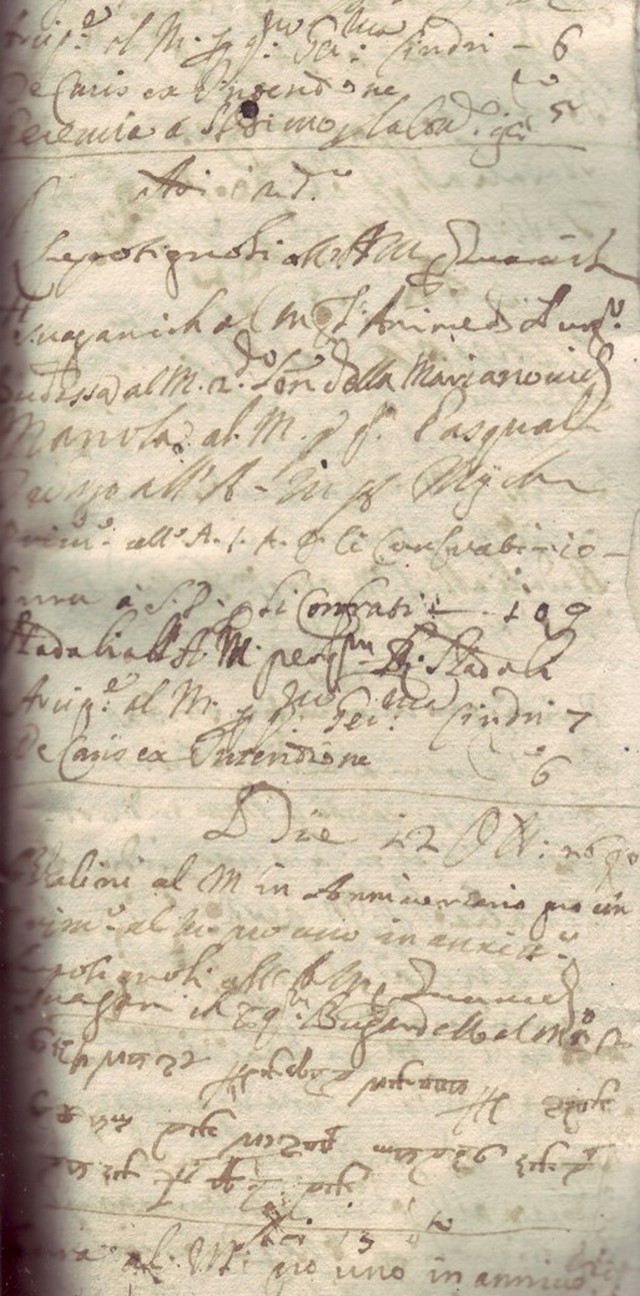
Glagolitic quickscript in the three lines near the bottom
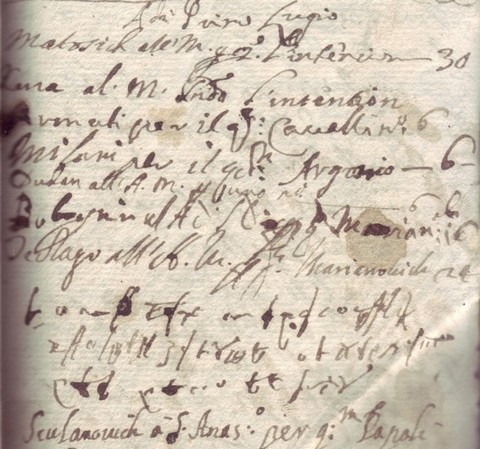
Three lines near the bottom written in Croatian Cyrillic
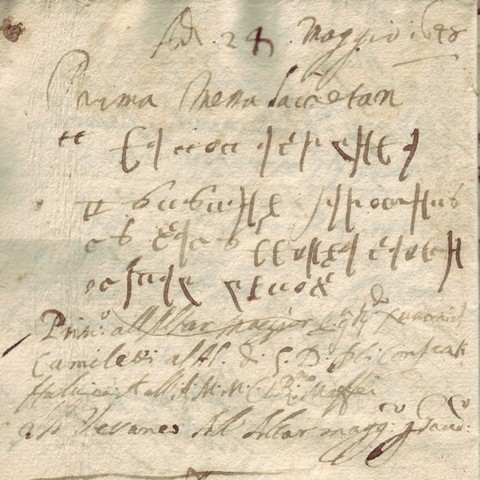
In the middle: Croatian Cyrillic, 1678
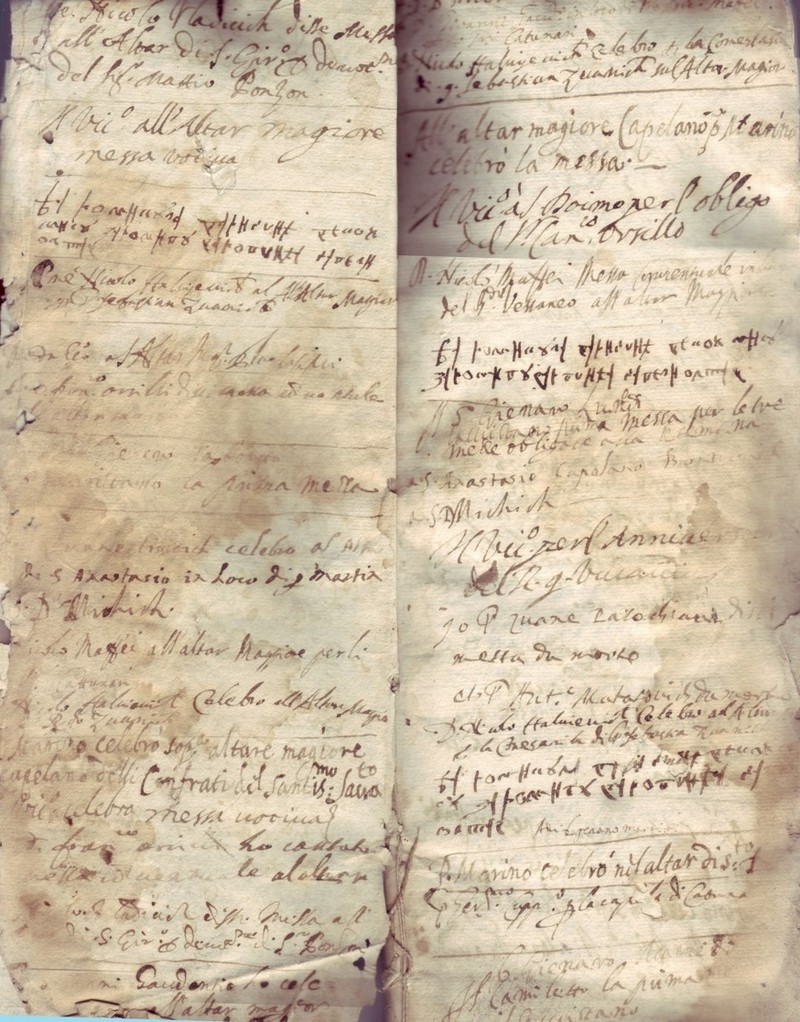
Several inscription in Croatian Cyrillic
Some of the documents kept in the Split Chapter:
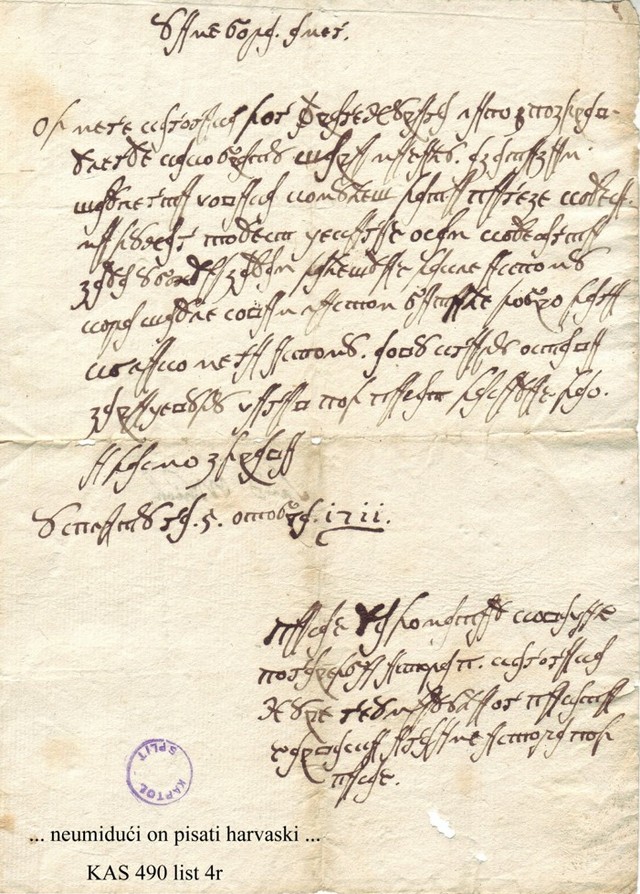
U ime Boga amen...
...
U Splitu na 5. otobra 1711.
Document written in Croatian Cyrillic in Split in 1711.
KAS = Kaptolski Arhiv Split (Split Chapter Archive)
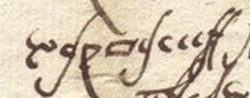
arvaski (i.e., in Croatian), appearing in the beginning of
the second-last line of the above document
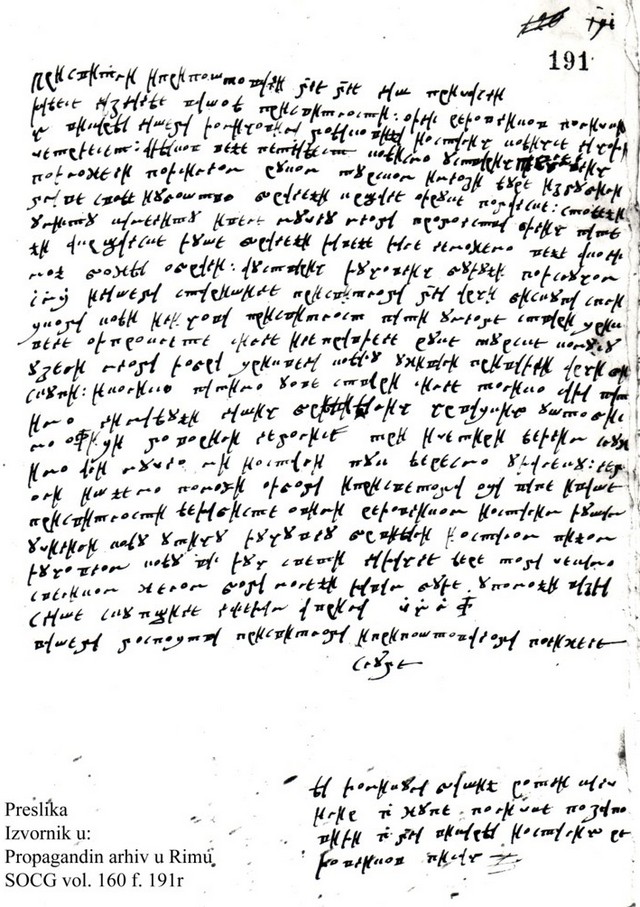
A document written in Croatian Cyrillic in Poljica Principality near the city of Split
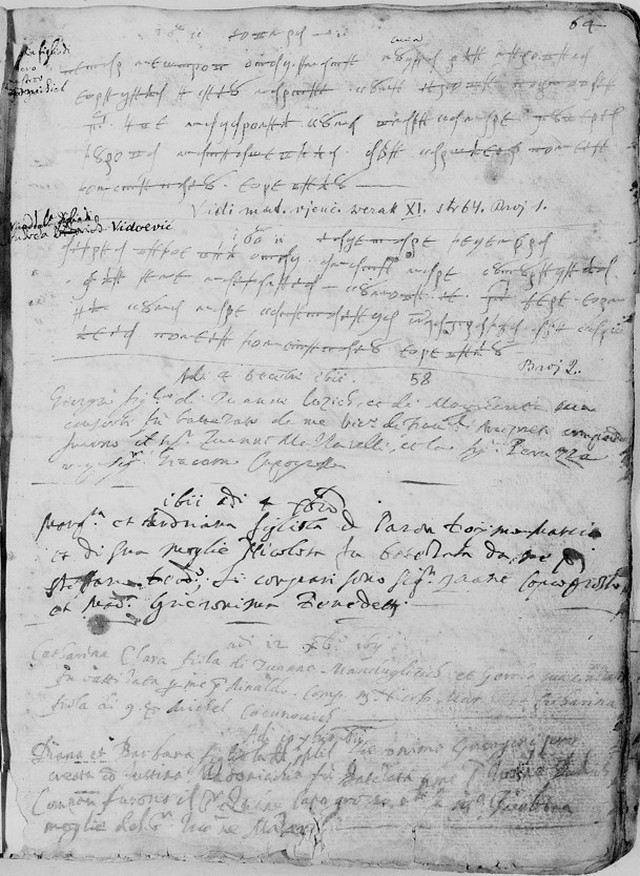
From a book of registers of the Split Cathedral, containing inscriptions in Croatian Cyrillic, 1611
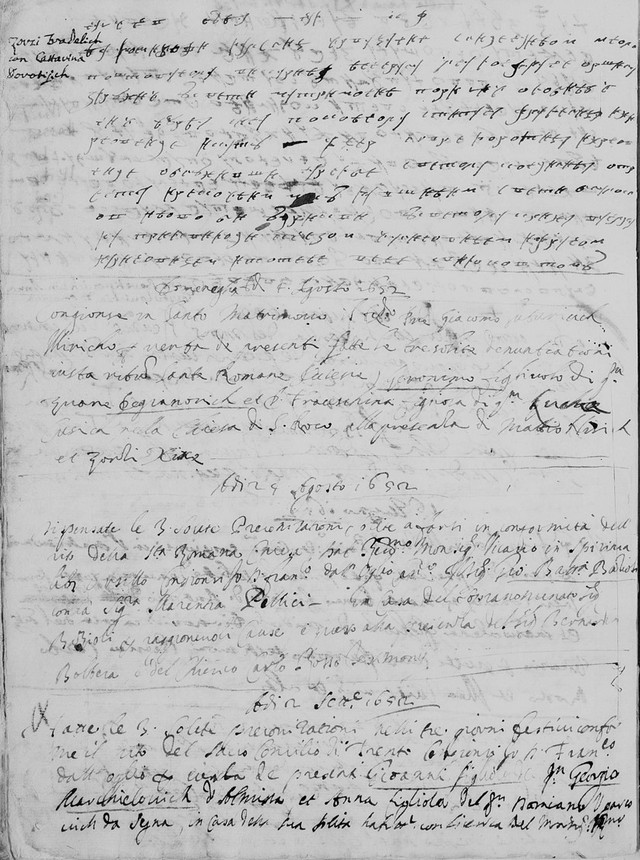
From a book of registers of the Split Cathedral, containing inscriptions in Croatian Cyrillic, 1652
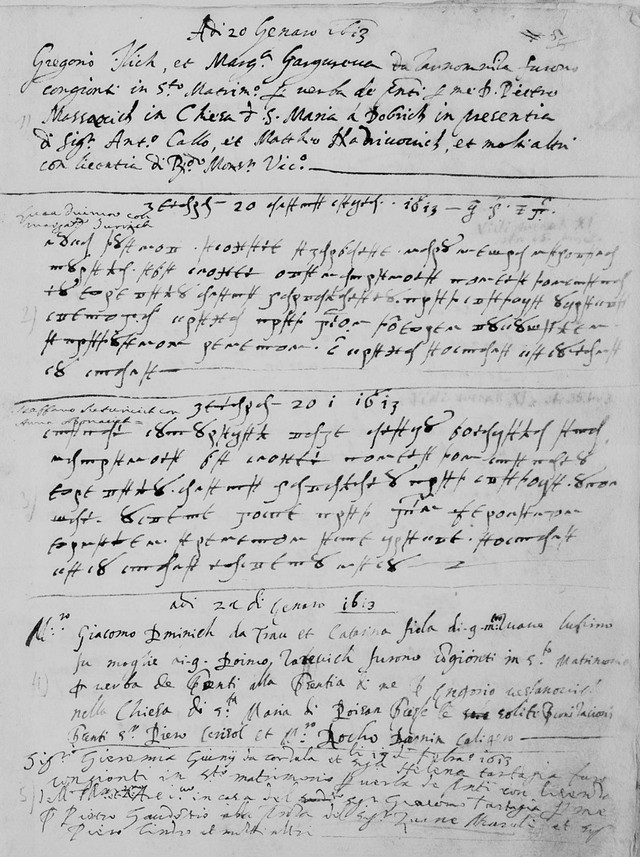
From a book of registers of the Split Cathedral, containing inscriptions in Croatian Cyrillic, 1613

From a book of registers of the Split Cathedral, with inscriptions in Croatian Cyrillic
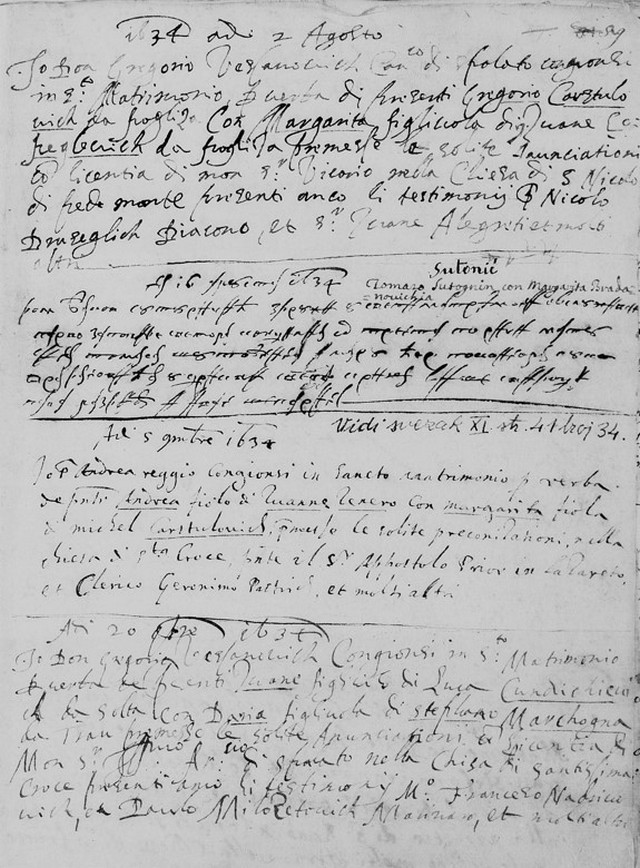
From a book of registers of the Split Cathedral, containing inscriptions in Croatian Cyrillic, 1634
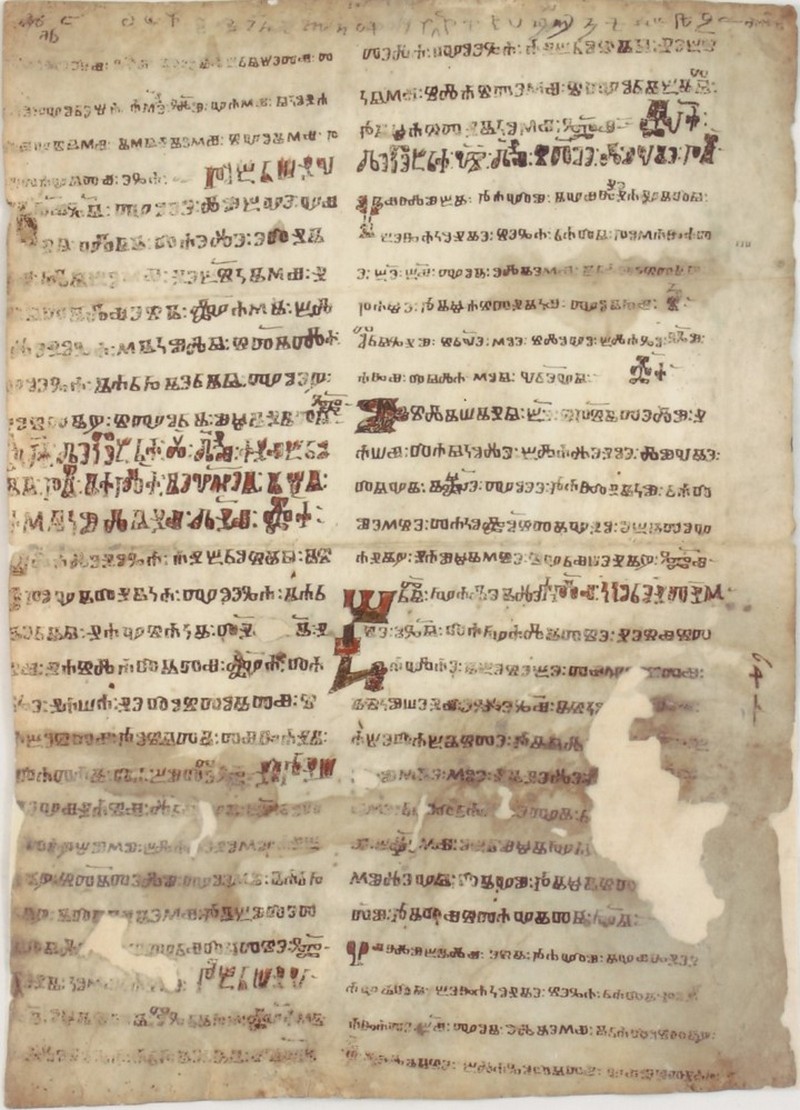
The Split fragment of the Glagolitic missal, dating from the 12/13th century,
according to Slavko Kovačić has been written in the Split archdiocese.
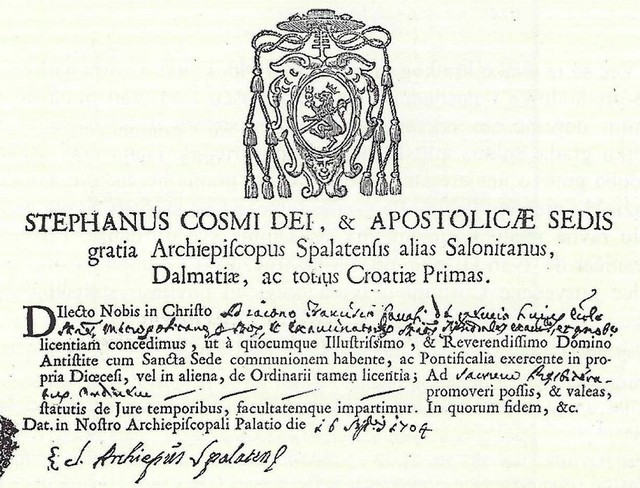
Stephan Cosmi, archbishop of Split, Salona, Dalmatia and primas of the whole of Croatia.
Stephan Cosmi is of Italian origin, and very important figure in preserving the Glagolitic tradition in Croatia.
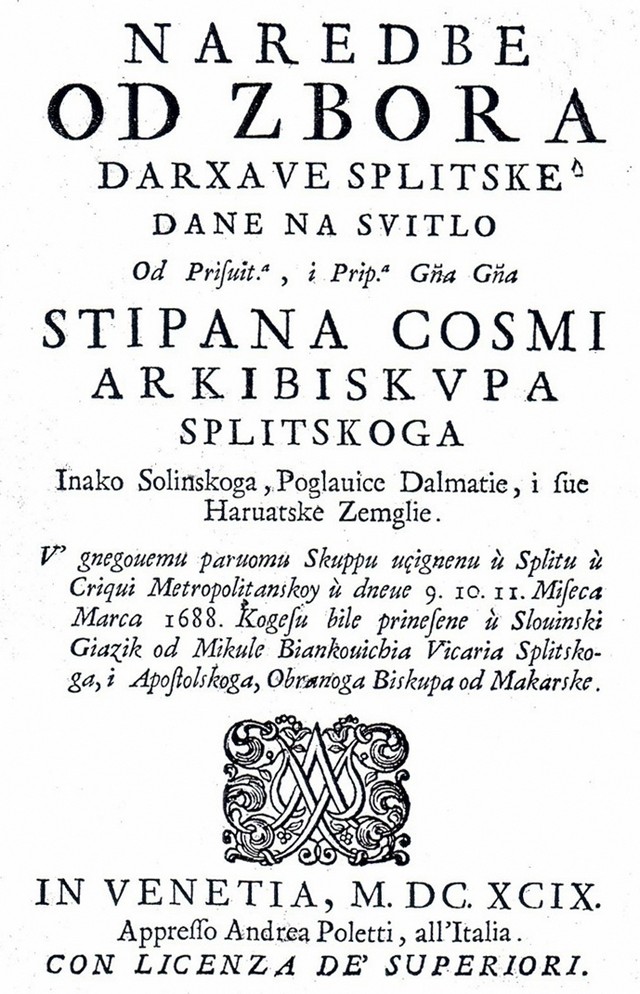
Stipan Cosmi, archbishop of Split,
as well as of Solin, ruler of Dalmatia and of the whole Croatian Country.
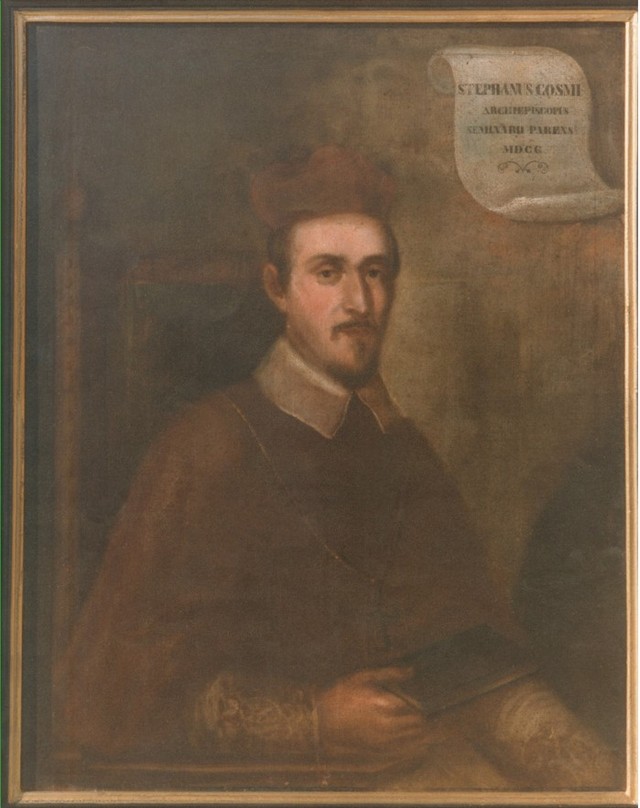
Stephanus Cosmi (1629-1707), born in Venice, the Split archbishop since 1683,
supported publishing Glagolitic church books, and helped numerous refugees exiled from
neighboring territories occupied by the Turks. He also founded the the first gymnasium
in Split in 1700, the Illyric Academy in 1703, as well as the first City Library.
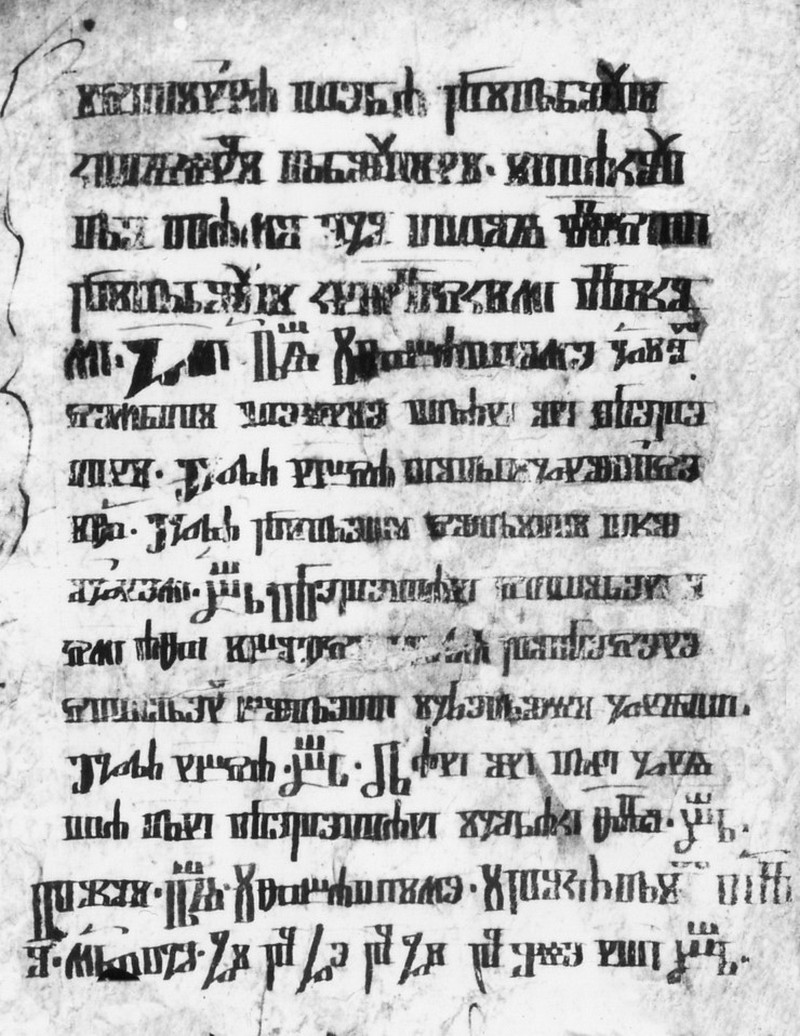
The Topić glagolitic fragment found in the Split Archdiocese, kept in the Old Slavonic Institute in Zagreb.
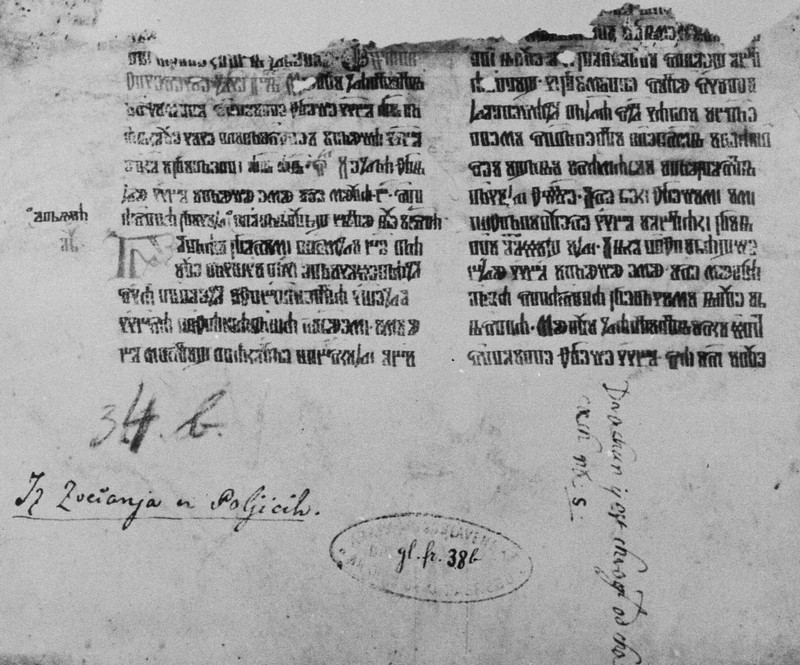
The Zvečanj glagolitc fragment, found in Zvečanj in Poljice Principality
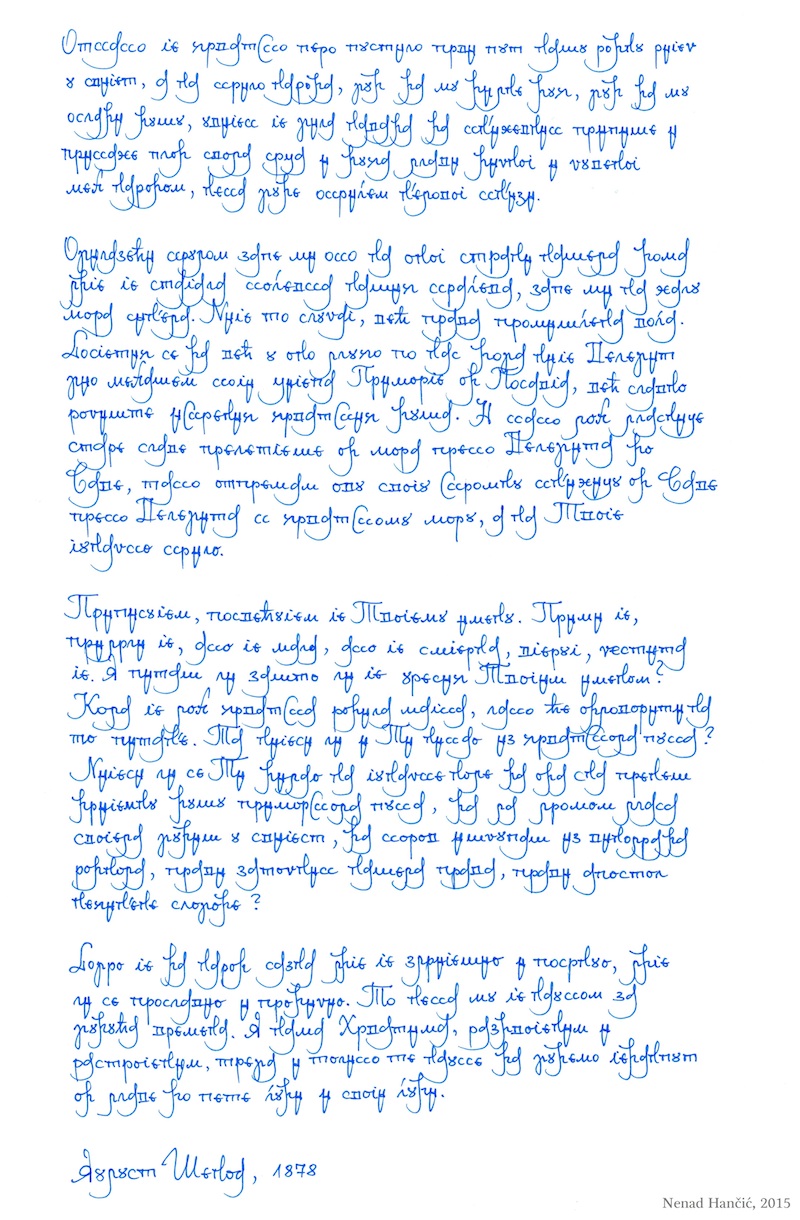
Hrvatska ćirilica -
Croatian Cyrillic
August Šenoa: Seljačka buna, predgovor. Napisao
Nenad Hančić, 2015.
Anto Ivić: Matične knjige
Župe Ivanjska 1729.-1779.
(monografija), Banja Luka - Sarajevo 2017. g., 422 str., ISBN 978
9958999192 (The Registries of the Roman Catholic Parish of Ivanjska
near Banja Luka from 1729 to 1779)
Sažetak.
U knjizi su prezentirane najstarije sačuvane matične knjige krštenih i
umrlih župe Ivanjska od 1729. do 1779. godine. Pisane su bosanicom na
hrvatskom jeziku te latinskim jezikom i pismom. To su najstarije
matične knjige koje su sačuvane na prostoru današnje Bosanske Krajine.
Župa Ivanjska bila je jedna od 30 katoličkih župa koje su postojale
polovicom 18. stoljeća na području Apostolskog vikarijata u otomanskoj
Bosni. Prostirala se na prostoru od sjevero-zapadno od Banja Luke do
rijeke Save. U matičnim knjigama je zabilježeno 1311 različitih
prezimena i prezimenskih inačica. Knjiga sadrži kazalo prezimena i
kazalo zemljopisnih pojmova. Nakon uvoda, u prvom poglavlju knjige
objašnjena je metodologija transliteracije i transkripcije teksta ovih
matičnih knjiga.
Anto Ivić: Matične knjige Župe Banja Luka
1753.-1814. (monografija), Banja Luka 2017. g., 434 str., ISBN
978-9926-8145-0-2 (The Registries of the Roman Catholic Parish Banja
Luka from 1753 to 1814)
Sažetak.
U knjizi su prezentirane najstarije sačuvane matične knjige župe Banja
Luka. Započinju 1753. godine, a pojedini svesci se završavaju 1792.
(matice vjenčanih), 1793. (matice umrlih) i 1814. godine (matice
krštenih). Pisane su bosanicom na hrvatskom jeziku te latinskim pismom
i jezikom. Nakon demografske katastrofe u Bečkom ratu, župa Banja Luke
bila je jedna od 30 katoličkih župa koje su postojale polovicom 18.
stoljeća na području Apostolskog vikarijata u otomanskoj Bosni. U
matičnim knjigama su zabilježena 1163 različita prezimena i prezimenske
inačice. Knjiga sadrži kazalo prezimena i kazalo zemljopisnih pojmova.
U predgovoru je opisana sudbina ovih matičnih knjiga u proteklih 30
godina. U prvom poglavlju knjige objašnjena je metodologija
transliteracije i transkripcije ovih matičnih knjiga.
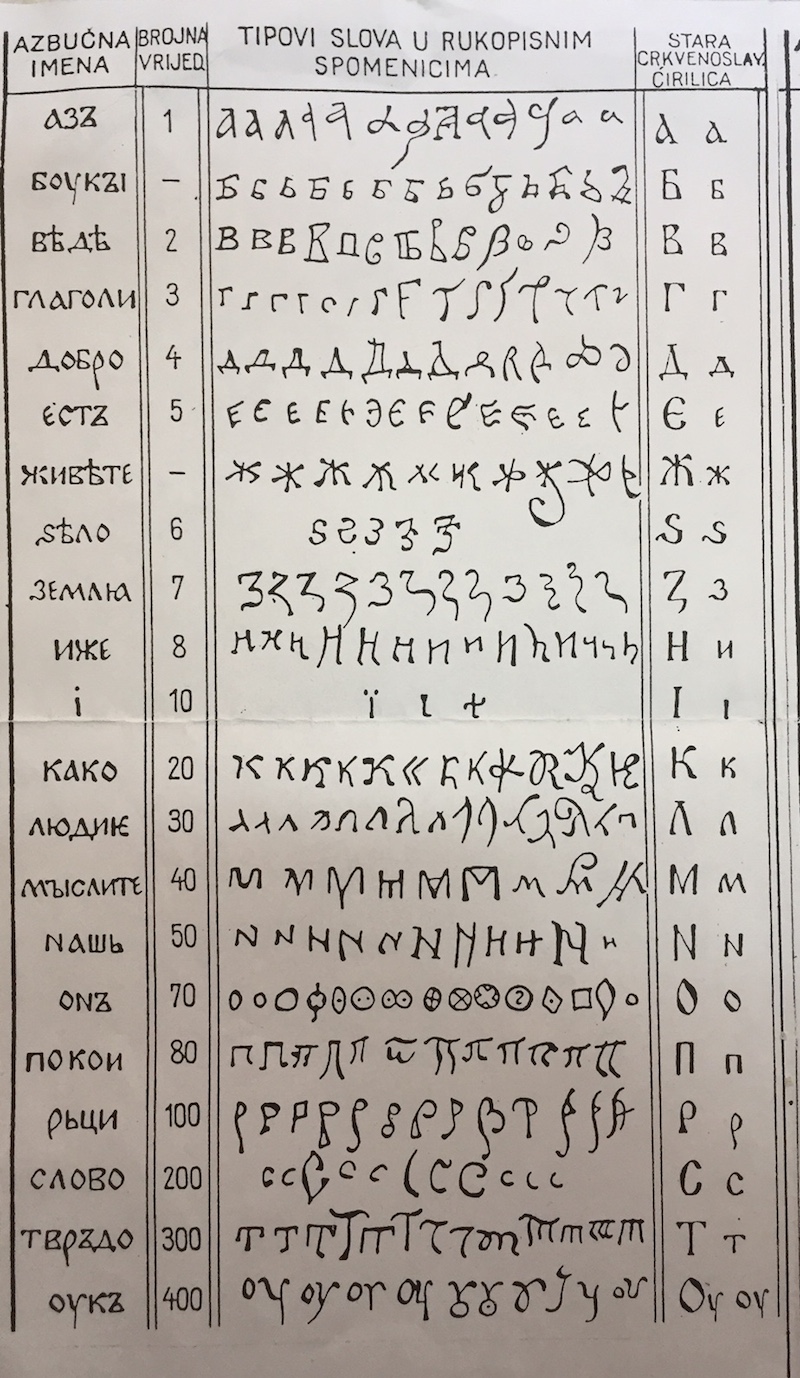
Table of Cyrillic Script sent in 1997 to D.Ž. by Benedikta Zelić Bućan (1918-2013, Split)
See also the following detailed map of Croatian Cyrillic in Dalmatia [JPG] in six columns, created by Benedikta Zelić Bučan, representing
- Split Poljica in the XVth ct.
- Split from XVI till XIX ct.
- The Split Diocese in XVII ct.
- Makarska Diocese in the XVII ct.
- Muslim documents from the Turkish rule in Dalmatio from XVI till XVII ct.
For more information see
- Poljički
statut, Omiš, 2019.
- [Dubljani]
- [Hercigonja]
- [fra Karlo Jurisic]
- [Kosic]
- [Maric, Simic, Skegro]
- Benedikta Zelić Bučan: Bosančica
ili hrvatska ćirilica u srednjoj Dalmaciji,
novo prošireno izdanje, izdao Državni arhiv u Splitu, kompjutorski slog
Redak, Split 2000., 1-135 str. + 4 lista s tablama. Prikaz dr. don
Slavka Kovačića: [PDF]
- [Zelic-Bucan]
- Benedikta Zelić Bučan: Bosančica u srednjoj Dalmaciji, Split 1961.
- Ante
Škobalj:
- Obredne gomile, Sveti Križ na Čiovu 1970.
- Vjera starih Hrvata na reljefu u Zmajevoj spilji na otoku Braču / Prilog poznavanju vjere Poljičkih Glagoljaša i Bosanskih Krstjana i starih Hrvata uopće, U vlastitoj nakladi, Duće 1986.
- Marko Rimac, Ivan Botica: Hrvatska ćirilica u glagoljskim matičnim knjigama zapadno od Krke, u [Galović (ed): Az grišni diak Branko pridivkom Fučić], str. 521-550
- Ivan Kosić:
-
Croatian Cyrillic manuscripts in the
Manuscript and
Old Book Collection Fund at the National and University Library in
Zagreb, Slovo, Vol. 56-57, 2008,
241-268
- Album hrvatske
ćirilice, NSK Zagreb, 2018. ISBN 978-953-500-174-4 (396 pp.)
- Album hrvatske
ćirilice, NSK Zagreb, 2018. ISBN 978-953-500-174-4 (396 pp.)
- Milka Tica: Stećci od Zgošće do Ledinca, naklada Jurčić, Zagreb 2011.
- Hrvatski ćirilični molitvenik iz 1512. (Croatian Cyrillic Prayer Book From 1512), with commentary of Anica Nazor, published by HAZU (Croatian Academy of Sciences and Arts), Matica Hrvatska, NSK (National and University Library), Zagreb, 2013, ISBN: 978-953-154-212-8
- Ivica Vigato: Glagoljica i hrvatska ćirilica u Spisima Ninske Biskupije, Slovo Rogovsko, br. 2, 2014., str. 15-17
- Grozdana Franov
Živković:
- Dopisivanje mletačkih i turskih vlasti u 17. st. dva pisma iz 1642. i 1643. na hrvatskoj ćirilici, Slovo Rogovsko, br. 2, 2014., str. 18-20
- Ženidbeni spisi iz arhiva Ninske biskupije: dopisivanje župnika Slivnice i Smiljana (Lika) na hrvatskoj ćirilici (bosanici), Slovo rogovsko, br. 3, Zadar 2015., str. 11-12.
- Glagoljica i hrvatska ćirilica (bosanica) u Popovićima, Slovo rogovsko br. 4, Zadar 2016., 23-26.
- Glagoljica i hrvatska ćirilica u Poličniku, Slovo
Rogovsko br. 5, Zadar 2017., str. 20-27.
- Obavijest o prošćenju
podarenom od pape Benedikta Trinestoga pisana hrvatskom ćirilicom
(bosanicom) iz godine 1724, Slovo rogovsko br. 6, Zadar 2018., str.
25-26.
- Kristijan Juran:
- Hrvatska ćirilica (bosančica) u spisima Šibenske biskupije (1), Slovo Rogovsko, br. 2, 2014., str. 57
- --- , Marin Banović i Mihovil Šetka: Hrvatska ćirilica (bosančica) u spisima Šibenske biskupije (2), Slovo rogovsko, br. 3, Zadar 2015., str. 50-51.
- Hrvatska ćirilica (bosanica) u
spisima Šibenske biskupije (3), Slovo rogovsko, br. 4 (2016).
- Hrvatska ćirilica u spisima Šibenske biskupije (4), Slovo rogovsko, 2017., str. 66-67.
- Hrvatska ćirilica u spisima Šibenske biskupije (5), Slovo rogovsko, 2018., str. 52-54.
- Nikola Kujundžić (ed.): Velika sinjska ljekaruša, Farmaceutsko-biokemijski fakultet Sveučilišta u Zagrebu, HAZU, Matica hrvatska, Zagreb 2014. (description of the book: [PDF])
- Svjetlana Olegovna Vjalova: Horvatskie kirillicheskie pamjatniki XVI-XIX v. sobranija I. Berčića v Rossijskoj Nacional'noj Biblioteke (Croatian Cyrillic monouments from XVI to XIX c. from the Berčić collection in the Russian National Library), in the Russian, Filologij 63 (2015), 223-243.
- Ante Nazor (u suradnji s Ante Narančom): Matična knjiga vjenčanih župe Jesenice 1736. - 1830., Zagreb 2012, ISBN 978-953-7659-11-0
- Hrvatska ćirilična baština / Croatian Cyrillic heritage [PDF] (authors: Stjepan Damjanović, Anica Nazor, Lejla Nakaš, Josip Lisac, Milica Lukić, Vera Blažević Kezić, Ivan Botica, Marko Rimac, Milko Brković, pp. 4-28), in Hrvatska revija, no. 4, Zagreb 2012.
- Milko Brković: Neobjavljene poljičke ćiriličke isprave [PDF], Filologija 63, Zagreb 2014, str.
33-71.
- [Zaradija Kiš i Šimić, Cvijet kreposti]
- Mateo Žagar: Hrvatska ćirilica dio je bogatstva hrvatske povijesne raznolikosti
- Ivan Botica i Tomislava Bošnjak Botica: Hrvatskoćirilična pisma iz Imotske krajine makarskomu biskupu // Imotski 1717. - Zbornik radova / Rimac, Marko; Alduk, Ivan (ur.). Split: Književni krug Split, 2024. str. 97-115
- Ivan Botica i Ružica Brčić: Hrvatskoćirilični zapisi s poljičkoga i omiškoga prostora [PDF] (iz Zbirke isprava i rukopisa pisanih bosančicom), Fontes: izvori za hrvatsku povijest, Vol. 23 No. 1, 2017., str. 29-161.
- Ivan Botica i Marko Rimac: Na raskrižju civilizacija - tri pismovna sustava na Zalinoj kuli u Igranima nedaleko od Makarske // u Botica, Ivan; Galović, Tomislav; Karbić, Damir et al. (ur.).: MAGISTRA FAMOSA. Zbornik u čast Mirjane Matijević Sokol, Književni krug Split, 2024., str. 754-784
- Michael Jukić: HRVATSKA BAŠTINA ̶ Hrvatska ćirilica
- Anto Ivić, bibliografija radova (matične knjige Župe Ivanjska
u BiH, Župe Banja Luka, itd.), Independent
Academia
- Tomislav Perković (ur.): a) Libar od Garduna i Čaporica, matične knjige krštenih, vjenčanih i umrlih 1717.-1839., Split 2024.; b) Faksimili. Dar gradonačelnika Biograda n/M Ivana Kneza, povodom obilježavanja Dana grada Biograda n/M 17. siječnja 2026.
- Mate Banić i Ivan Banić: Matične knjige župe Donji Dolac, Književni krug Split, 2026. (matične knjige krštenih, umrlih i vjenčanih iz 19. st., pisane hrvatskom ćirilicom)
Croatian Cyrillic font "Arvatica fra Divkovic", created by Nenad Hančić in 2016
Poljica
POVIJEST HRVATSKOGA JEZIKA - Identiteti međusobno razumljivih jezika hr, sr, bs, me - hrvatski jezik
- Identities of mutually intelligible languages: Croatian, Serbian, Bosnian and Montenegrin (youtube)
- IDENTITIES of mutually intelligible languages - Croatian, Serbian, BS, ME, PART 2: historical survey (youtube)
- Identities of mutually intelligible languages: Croatian, Serbian, Bosnian and Montenegrin (archive.org)
- IDENTITIES of mutually intelligible languages - Croatian, Serbian, BS, ME, PART 2: historical survey (archive.org)
Croatia - an overview of its History, Culture and Science