Chords for Croatian Folk Songs
© by Darko Žubrinić, Zagreb (1995)Index:
- Pastirče mlado i milo
- Bože čuvaj Hrvatsku
- Dobro jutro, moj svečaru (Imendanska, Rođendanska)
- Fala
- Hej, salaši
- Ima jedna kućica
- Kolo igra, tamburica svira (himna Bunjevačkih Hrvata)
- Kraj kapele sv. Ane
- Marijana
- Ne dirajte mi ravnicu
- Oj, jesenske duge noći
- Popevke sem slagal
- Ribar plete mrižu svoju
- Sidi Mara na kamen studencu
- Sinoć kad sam ti proša
- S onu stranu Plive
- S ponistre se vidi Šolta
- Tena
- Uzalud vam trud svirači
- Već odavno spremam svog mrkova
- Veliko je more
- Vila Velebita
- Vu plavem trnaci
- Za nikaj na svetu ja menjal te nebi

Prvo hrvatsko seljačko mladenačko tamburaško društvo ŽICA u Šestinama,
1927
(The first Croatian peasant youth tamburitza society STRING in Šestine
in Zagreb, 1927)
Source - Kruno Vuk: 160 godina školstva u Šestinama (160 yearas of
schooling in Šestine - part of city of Zagreb),
pp. 52-57, Zagreb moj grad,
No. 90, Spring 2024 (photo on p. 55)
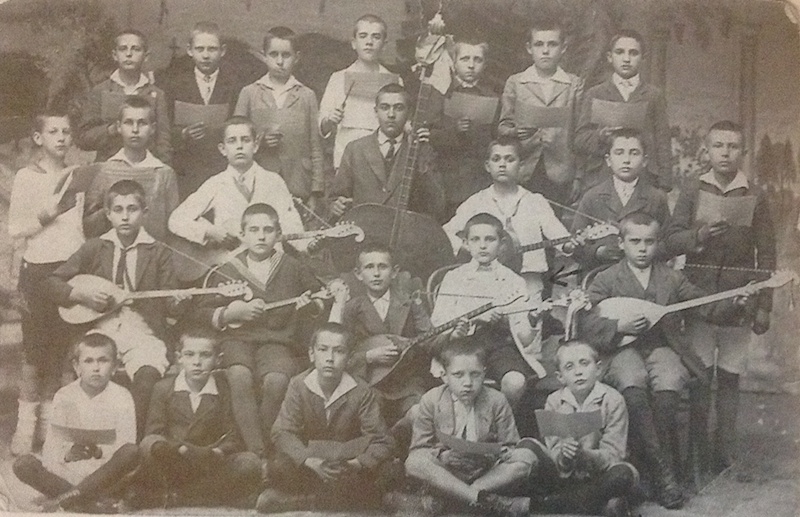
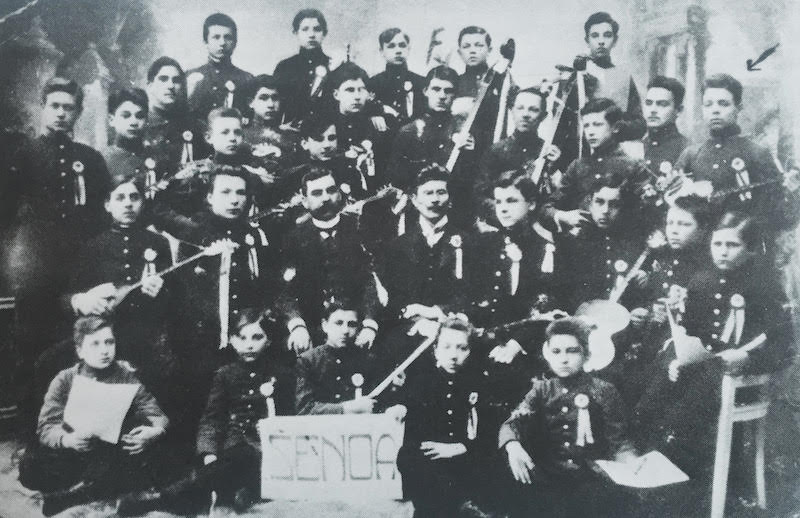
The town of Senj, Pjevačko tamburaško društvo Orlovo gnijezdo
(Singing Tamburatza Society Eagle's Nest),
Ožegovićianum School in Senj, 1919/1920. In the second row, 2nd from
the left, is Pavao Tijan
(distinguished Croatian lexicographer) playing bisernica. Source of the
photo [Tijan].
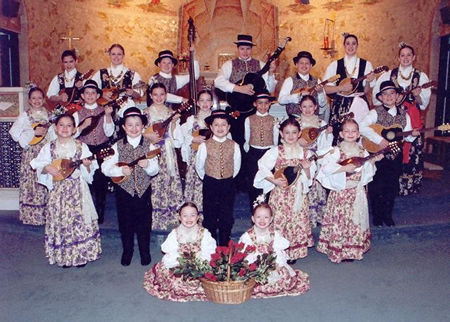
North
Hills Junior Tamburitzans, USA
Several useful harmonic recepies
The creation of this HTML has been motivated by the interest shown for our folk songs, that I noticed while browsing through the letters sent to the webmaster of the Croatian home page (mr. Josip Jurich). I provide my comments in English, since there are many Croats and their descendants throughout the world who do not speak Croatian any more, or only very little.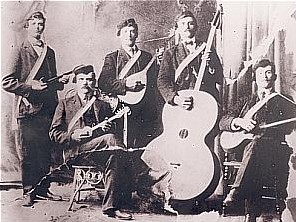
Croatian
tamburitza band from
Busevec near Zagreb,
performing in Cleveland, USA, in 1905 (Archives of Seljacke sloga -
Busevec)
many thanks to Mr. Marinko
Katulic for permission
Let me start with a very nice (and simple) song Ne dirajte mi ravnicu (listen to it!), which for sure will live among the Croats for many generations.

Village
of Samarica
in Moslavina, North of Croatia
A word of caution for the Croatian reader: the tone or chord B is used in the meaning of the American notation, which differs from the Croatian: in Croatia we would write H instead of B. Thus
the American B = the
Croatian H, and
the American B flat (Bb) = Croatian B.
The American notation, which we use here, is accepted also in some European countries, especially in jazz literature.
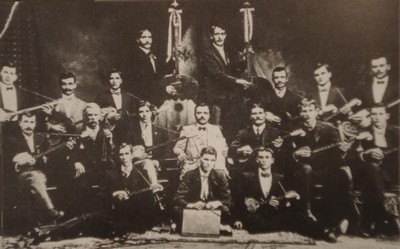
Boulder-based Croatian tamburica orchestra in Boulder, Western Australia, 1910s, see [Sutalo]
Ne dirajte mi ravnicu
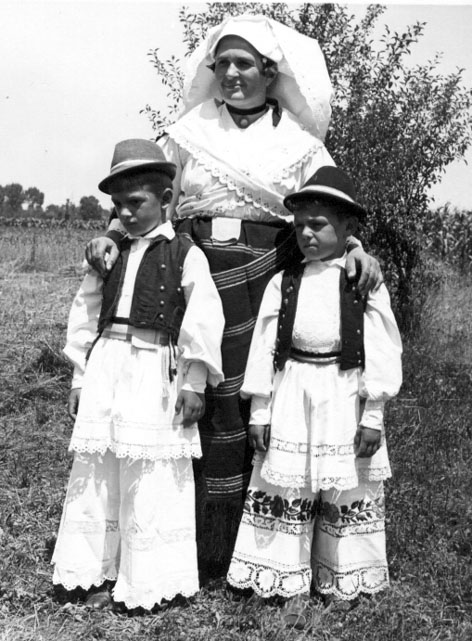 Miroslav
Škoro
Miroslav
Škoro
     G              Am
1. Večeras mi dobri ljudi
           D7         G
   nemojte ništa pričati.
    G              Am
   Neka suze mirno teku
          D7         G
   pa che manje boljeti.


   Refrain (2x):

   C             D7
   Ne dirajte mi večeras
   G       B7   Em   Cm
   uspomene u meni.
   G                Am
   Ne dirajte mi ravnicu,
       Am       D7   G
   jer ja ću se vratiti.


2. Mene zovu moja polja,
   mene zovu tambure,
   prije nego sklopim oči,
   da još jednom vidim sve.
   2xR.


3. Još u sebi čujem majku,
   kako tužno govori:
   "Kad se jednom vratiš sine,
   ja ću te čekati."
   2xR.
My deep gratitude for the above very nice authentic photo goes to Dr. Zdenka Lechner. The photo below I obtained by Mr. Ivo Lusic from South Africa.
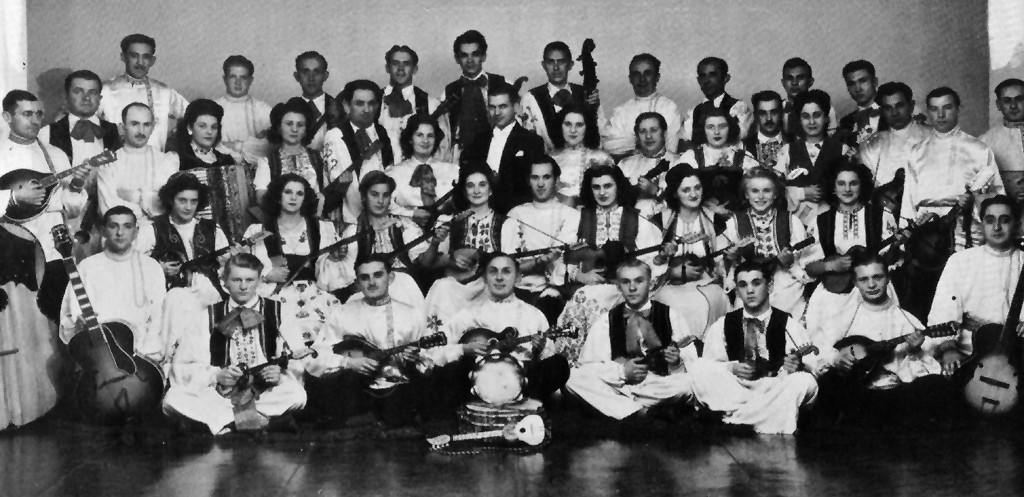
Croatian
Tamburitza players
from Johannesburg,
South Africa, 1940s
I shall try to describe some general principles that are useful for guitar accompaniment. Of course, all that follows applies to any other polyphonic instrument (piano, harmonica), not only guitar. I believe I have some "qualifications'' after many years of amateur experience (I started to play guitar as a student). This manual (or rather a harmonic cook-book) is a gift four You, if You are a "beginner". Let me concentrate on two most important things for the guitar harmony:
- back-cycling (in Croatian: ~odmotavanje),
- parallel chords,
without dwelling into cumbersome theoretical details. We strive to be practical oriented. Don't be scared with what follows. All this is quite easy if you have a minimum of patience.
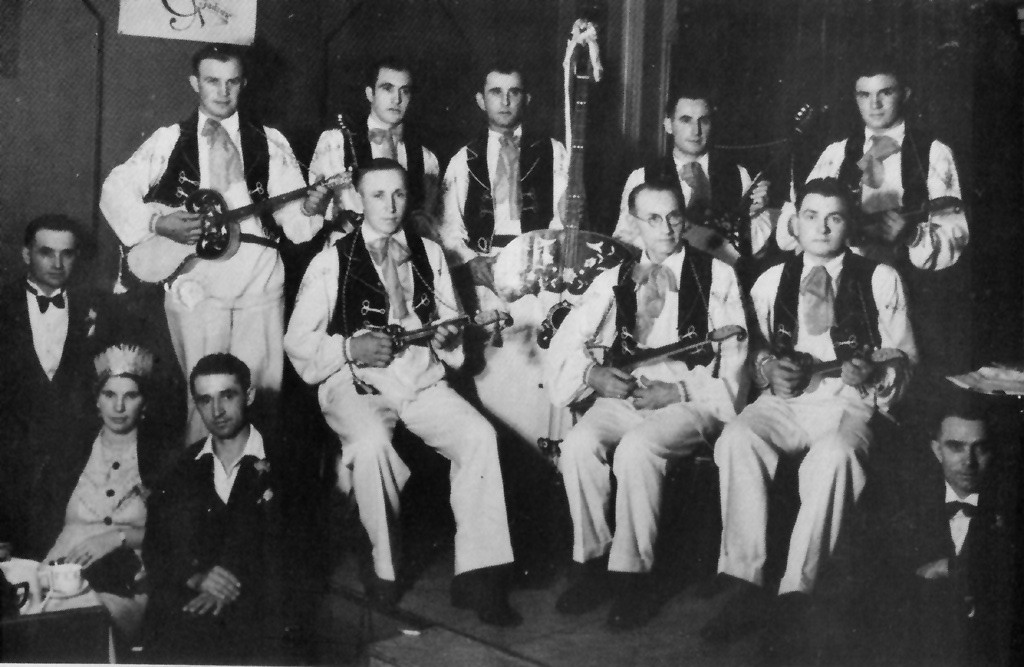
Croatian
tamburitza orchestra Jadran
Johannesburg, South Africa, 1937
Comments There are three interesting harmonic points in this song: back-cycling, the role of B7 and Cm.
- The Am (appearing
above `ljudi') is a start of a well known
harmonic mechanism called back-cycling
(from G in our
situation).
If the tonic (to be defined below) is G major, we
simply play two or three chords on the cycle
of
fourths (12 chords)
B -> E -> A -> D -> G -> C -> F -> Bb -> Eb=D# -> G# -> C# -> F# (-> B)
preceding G, i.e.:
A -> D -> G, or in our situation Am -> D7 -> G.
In other words, we go BACK along the CYCLE of fourths. The above cycle of fourths, if read in the opposite direction (i.e. by reversing the arrows), becomes the cycle of fifths (quints). You will do a great thing in understanding your guitar play if you try to learn it by heart (this will not come just overnight).
- For what follows we
need a little preparation:
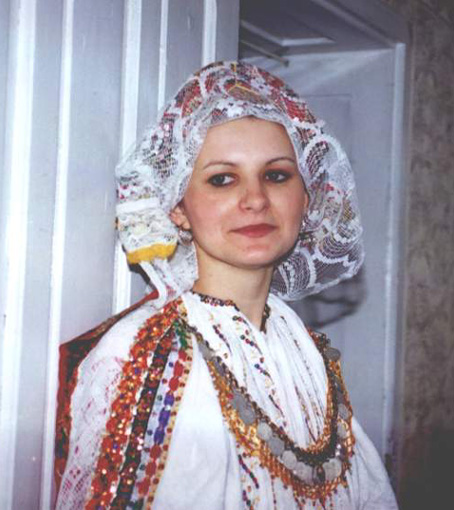 Let
us give a simple, practical definition of the
parallel minor
corresponding to some major chord. I'll give a geometrical
definition based on the cycle of fourths.
If we start say with the G major
chord on the cycle of fourths, then we go three steps BACK
to obtain E(m). So Em is the parallel minor chord
corresponding to G.
Similarly, the parallel minor of C is Am, of D is Bm etc.
Let
us give a simple, practical definition of the
parallel minor
corresponding to some major chord. I'll give a geometrical
definition based on the cycle of fourths.
If we start say with the G major
chord on the cycle of fourths, then we go three steps BACK
to obtain E(m). So Em is the parallel minor chord
corresponding to G.
Similarly, the parallel minor of C is Am, of D is Bm etc. - Less important, but often useful (especially for some songs from Meddimurje) is the notion of secondary parallel minor chord corresponding to a given major chord. We go one step more back on the cycle of fourths, i.e. four steps (instead of three). Thus for instance, starting from G, then going back four steps, we arrive to B(m), which is the secondary parallel minor of G.
- Conversely, if we start with say Em, then we say that G is the parallel MAJOR corresponding to Em. Similarly, G is the secondary parallel major corresponding to Bm.
- It is quite
important to know the major chords and
their
parallel minors (and conversely). To summarize, we give a
list of six most important triples of chords (in the natural
order with respect to the cycle of fourths):
 Parallel Secondary
Major chords minor chords parallel minors
 E C#m G#m
 A F#m C#m
 D Bm F#m
 G Em Bm
 C Am Em
 F Dm Am
For the remaining six cases you can try to find the corresponding tripples yourself. In any case, the pairs in the first two columns in the above table are the most important.
- If you ever try to harmonize of a song, you first start with a cycle of fourths. Next you think about parallels that will fill a trivial harmonization.
- One more convention: if a song is harmonized in, say, G major as a basic tonality (the so called tonic), then its left and right neighbour on the cycle of fourths are called dominant and subdominant respectively.
- A very useful remark: if a song has a minor tonality, then for sure you must expect the chords corresponding to the tonality of the PARALLEL MAJOR to appear in the song.
- The role of B7 in this song is to connect G (tonic) and Em (the corresponding parallel minor). It is possible to omit it, but the accompaniment then loses a lots of its flavor. Note that B7 precedes Em on the cycle of fourths, so it can be considered as a `local back-cycling' from Em with only one step.
- The Cm can be viewed to have a subdominant role with respect to G (subdominant is C), and it can also be omitted (at the expense of the loss of a very nice harmonic drive). In practice most often Eb is used instead of Cm (Zlatni dukati). Note that the chord Eb (=D#) is just a parallel major to Cm. In my opinion, Cm is much better, and more in the spirit of the song.
- A small but nice
variation is possible in the second line,
and
the corresponding lines in the song:
C D7 G
We have introduced C instead of D7. Here C is in fact a parallel major of Am. Through this variation of Am we proceed with backcycling: Am -> (C) -> D7 -> G.
Nemojte ništa pitati - A useful exercise for the beginner would be to play the whole song using trivial harmonization: G (tonic), D (dominant) and C (subdominant), and then to see how the above mentioned harmonic mechanisms ``fill in''.
- Exercise: try to harmonize the whole song starting with D as tonic (then try with C, A,...)
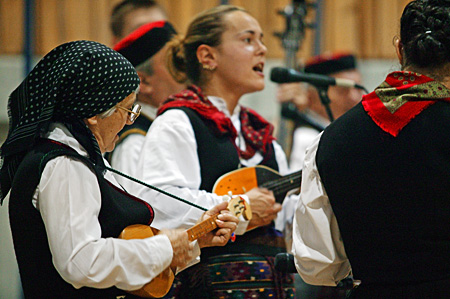
The Lika Night in Bazenheid, Switzerland
two generations of female players of tamburica from Lika

Village
of Samarica
in Moslavina 1936, North of Croatia
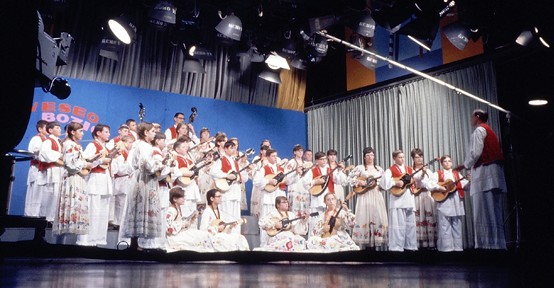 |
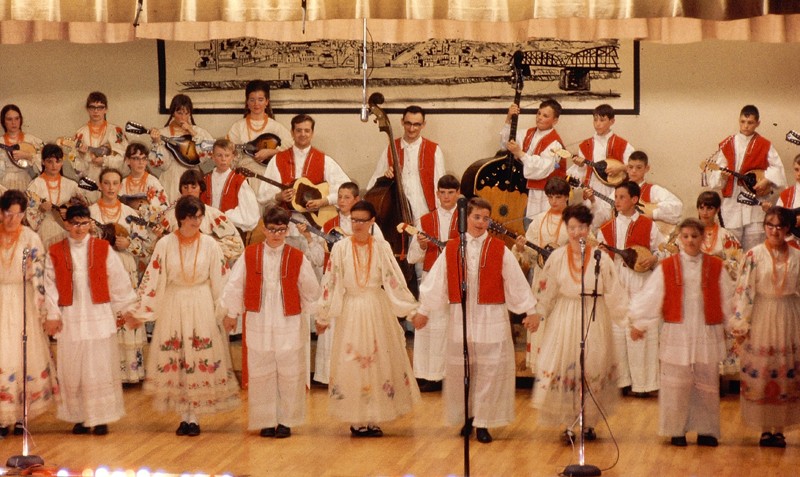 |
Croatian Christmas on Strawberry Hill, Kansas City, USA
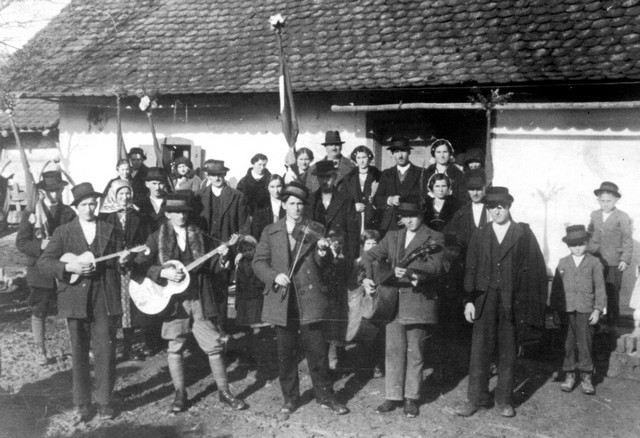
Village
of Samarica
in Moslavina, North of Croatia
Pastirče mlado i milo
	C      F   C
 1. Pastirče mlado i milo
        C     F     C
    što si se tako snuždilo?
        Am    E7   F    C
    Pastirče mlado i milo     |
        F     A7     Dm   C   |  2x
    što si se tako snuždilo?  |


 2. Il ti je stado nestalo,
     il ti je srce klonulo? ...

 3. Nit mi je stado nestalo,
     nit mi je srce klonulo. ...

 4. Moja je draga umrla
     koja me vjerno ljubila. ...

 5. Ja uzmem frulu da sviram
     i svoju dragu dozivam. ...

 6. Sva gora ječi od frule
     a moja draga ne čuje. ...
This Croatian folk song was known to have been sung along the Una river in the vicinity of the town of Dubica. Information by the courtesy of Katica Delić, Hrvatska Dubica.
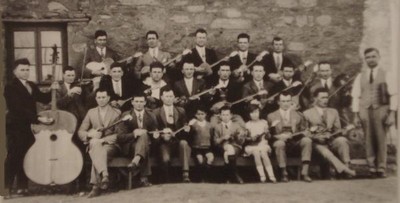
Broken
Hill-based Croatian
tamburica orchestra in Broken Hill, New South Wales, Australia, 1929,
see [Sutalo]
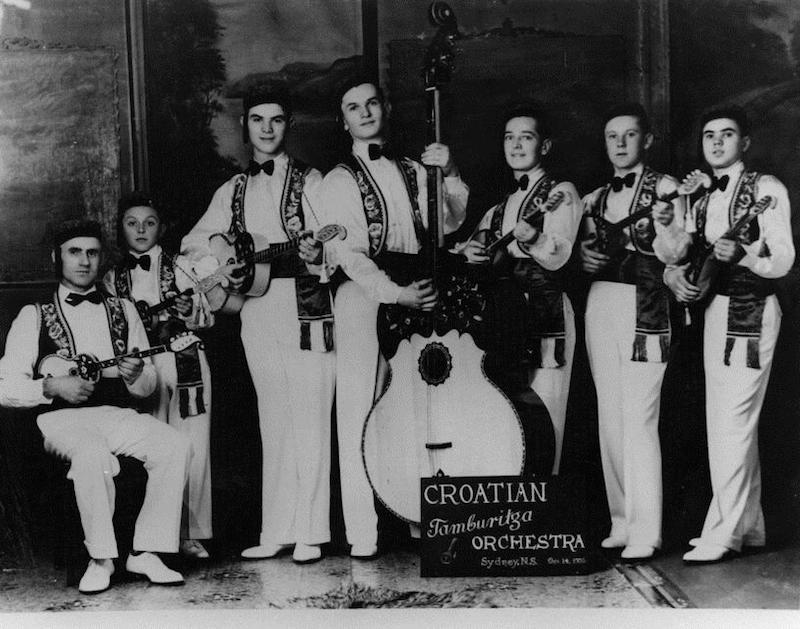
Croatian Tamburitza Orchestra in Sydney, 1930. Photo from Beaton Institute.
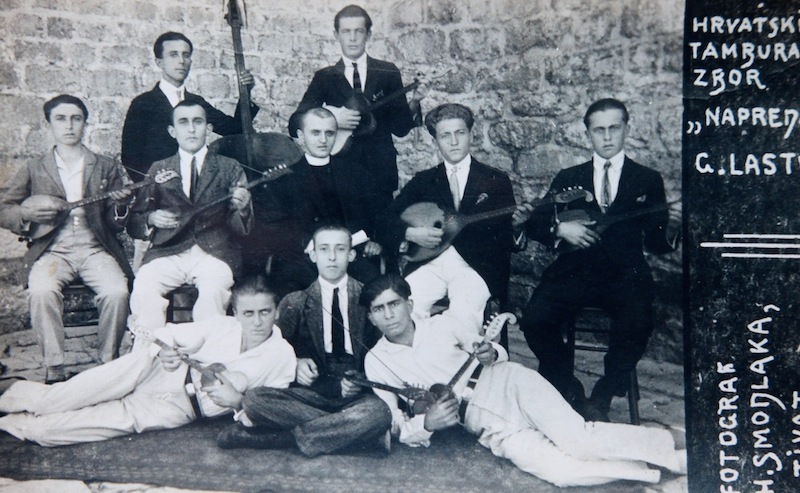
Croatian tamburitza choir "Napredak", Gornja
Lastva, 1919, Boka kotorska
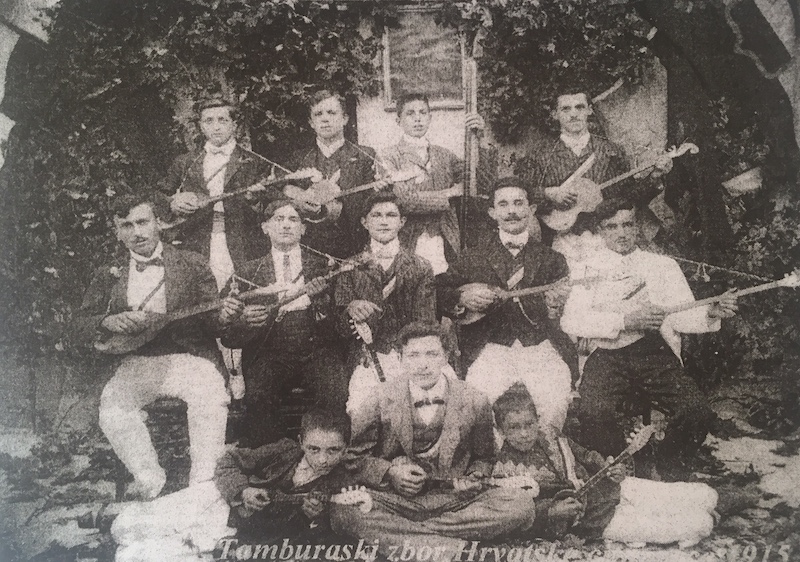
Tamburitza choir of Croatian Savings Bank, Donja Lastva, 1915, Boka kotorska;
source [Čurić ed.].
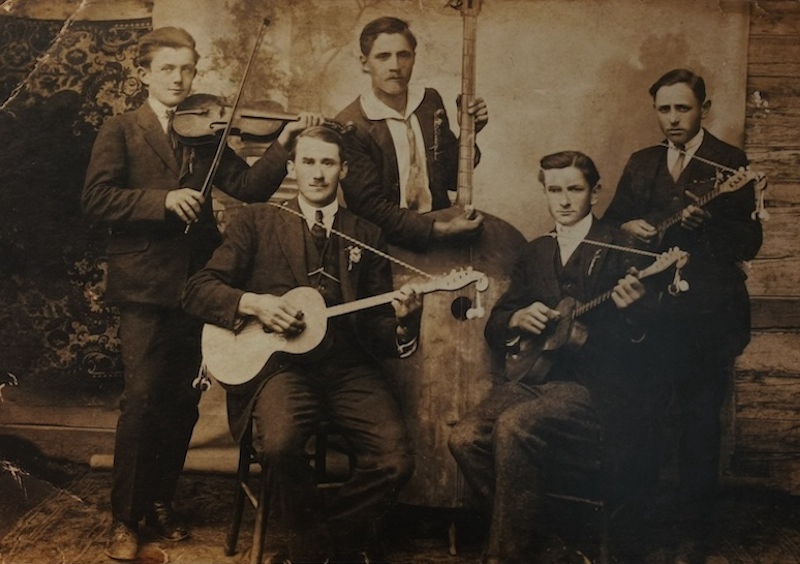
Tamburitza players from Rakovec ob Sotli in Slovenia, near its border with Croatia, in 1925.
 Let
me add one of my favourite songs, a
true jewel in both music and verses, very popular among the Croats and
others in Bačka and Srijem. The harmonization below differs
considerably from the usual one that we can hear on recorded materials,
including also the interpretation of the famous orchestra of Janika
Balazz, the uncrowned king of tamburitza (sedam tamburassa Janike
Balazza). This Bogdan's song is written in ikavina
dialect (for
example "divojka, pisma"), typical Croatian dialect, now disappearing
among the Croats in Backa (Bunjevci
and Sokci),
due to intensive serbization. Ikavian dialect is still very widespread
also in Croatia and Bosnia
and Herzegovina,
and has a tremendous literature since the time of Marko Marulic
(15th century).
Let
me add one of my favourite songs, a
true jewel in both music and verses, very popular among the Croats and
others in Bačka and Srijem. The harmonization below differs
considerably from the usual one that we can hear on recorded materials,
including also the interpretation of the famous orchestra of Janika
Balazz, the uncrowned king of tamburitza (sedam tamburassa Janike
Balazza). This Bogdan's song is written in ikavina
dialect (for
example "divojka, pisma"), typical Croatian dialect, now disappearing
among the Croats in Backa (Bunjevci
and Sokci),
due to intensive serbization. Ikavian dialect is still very widespread
also in Croatia and Bosnia
and Herzegovina,
and has a tremendous literature since the time of Marko Marulic
(15th century).
Već odavno spremam svog mrkova
Zvonko Bogdan
Dm Gm Dm G0 D0A7Dm CSee also another Bogdan's beautiful song written in the Croatian ikavian dialect: Hej, salaši.
1. Već odavno spremam svog mrkova,
F Bb F C C7 F A7
da se prođem ka-som od miline.
Bb E7 F D7 Gm C7 F A7
Da obiđem staze, staze svog djetinjstva, |
Dm Gm Dm C C7F A7 | 2x
Dm Gm Dm G0 D0 A7Dm |
za salašom želja da me mine. |
Refrain:
F C F
Neću više ići na tu stranu,
jer ne mogu suze oku skriti.
Nema više starog čardaka ni đerma, | 2x (the same
ni debela 'lada od bagrema. | harm. as above)
Ili moram tugom okrenuti glavu, | 2x (the same
il plakati ili se napiti. | harm. as above)
2. Nema više dobrih tamburaša,
fijakera, snaša, i salaša.
nema više konja, konja koji jure, | 2x
a u stvari nikuda ne žure. |
(without refrain)
3. Vrag nek nosi moje snove puste,
divojačke duge kose guste.
Vrag nek nosi tugom dobre tamburaše,
fijakere, pisme i salaše.
Refrain:
Neću više ići na tu stranu,
jer ne mogu suze oku skriti.
Ili moram tugom okrenuti glavu,
il plakati ili se napiti.
Comments:
- D0 = Ddim. Its usage often yields a very nice `sporadic' bass melody. You can also play A7 instead of D0.
- E7 is surprising, and sounds very nice. It connects the chords Bb and F. More precisely, the idea is to fill in the passage from Bb to F by using the chord diminished by ONE degree with respect to F: this is E7. In other words, we enter F from below. It is worth noting that it is precisely the seventh in the E7 chord, which gives the same tone as the one in the melody in the moment of usage!
- To see the meaning of this chord (E7), try to play the song without E7, i.e. with Bb instead.
- There is a lots of
back-cycling here:
- C -> F,
- D7 -> Gm -> C7 -> F (look at the cycle of fourths above).
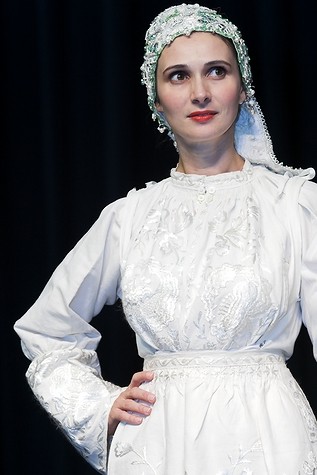
CroatiaFest 2005, Seattle, USA,
Photo - Jal Schrof
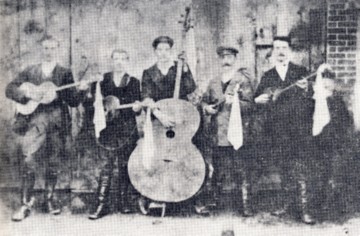
Croatian
tamburitza orchestra
from Virje, nicely decorated with white scarfs;
beginning of 20th century [Ivancan,
p. 121]
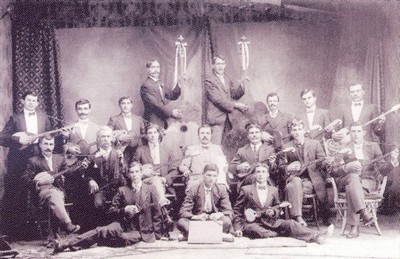
Croatian
tamburitza orchestra
in Australia, 1910
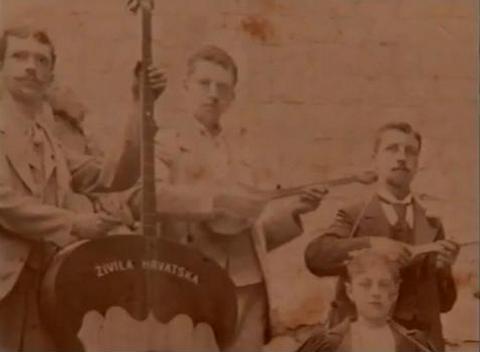
Tamburitza orchestra
in Janjina on Pelješac peninsula,
with inscription "Živila Hrvatska" - "Long Live Croatia" on the bass.
Janjina is the birthplace of Miho Bjelovučić, father of the famous
Ivan Bjelovučić
who was the first in history to fly over the Alps in 1913.

Female Tamburitza Orchestra from the town of Hrvatska Kostajnica.
The conductor in the middle is enjoying the sound of music. Photo from the monograph
Josip Pleadin: Učiteljica Antonija Jozičić (1869-1945), published by Esperanto Documentation Center in Ðurđevec 2024.
Antonija Jozičić is on the photo sitting on the far right.
The town of Hrvatska Kostajnica was severely damaged during the 1991-1995 Serbian aggression on Croatia.
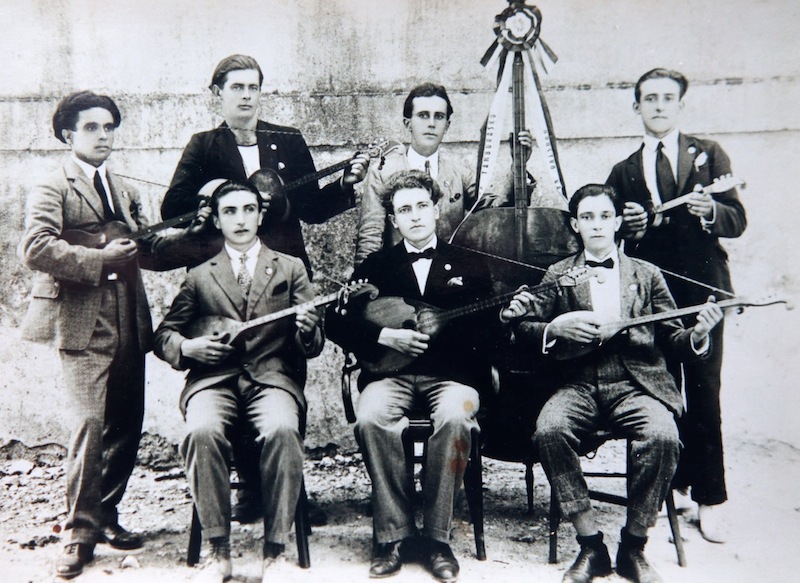
Croatian tamburitza choir "Napredak", Gornja Lastva, 1939
(founded in 1919), Boka
kotorska; source [Čurić ed.].
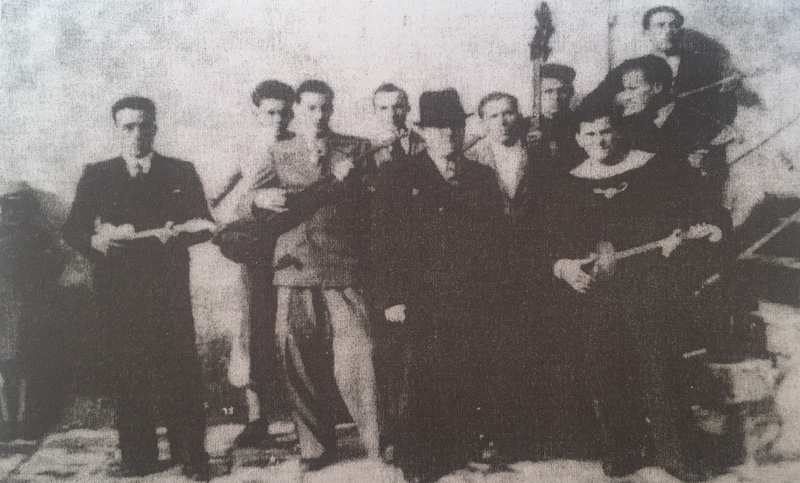
Croatian tamburitza choir "Zmajević", Perast, 1900, Boka kotorska;
source [Čurić ed.].
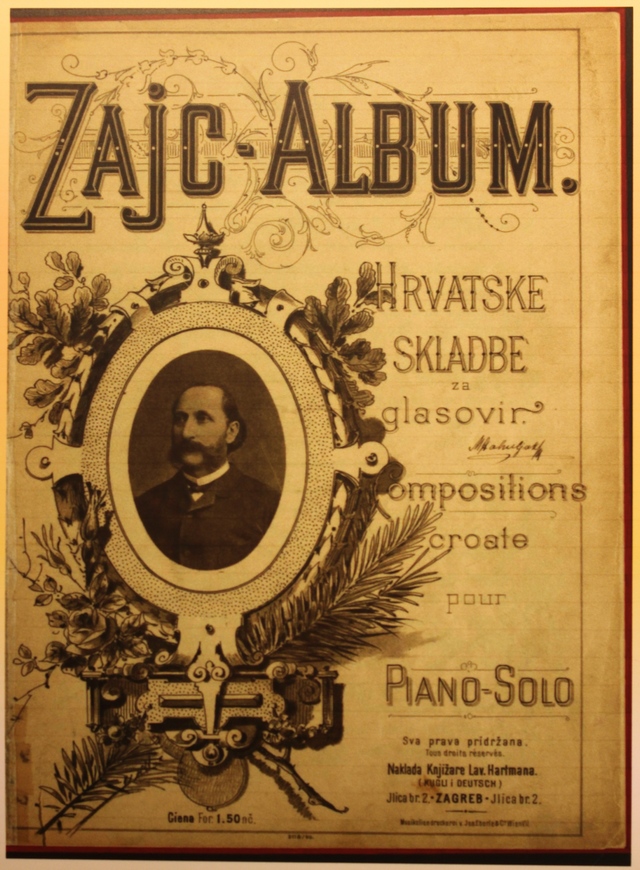
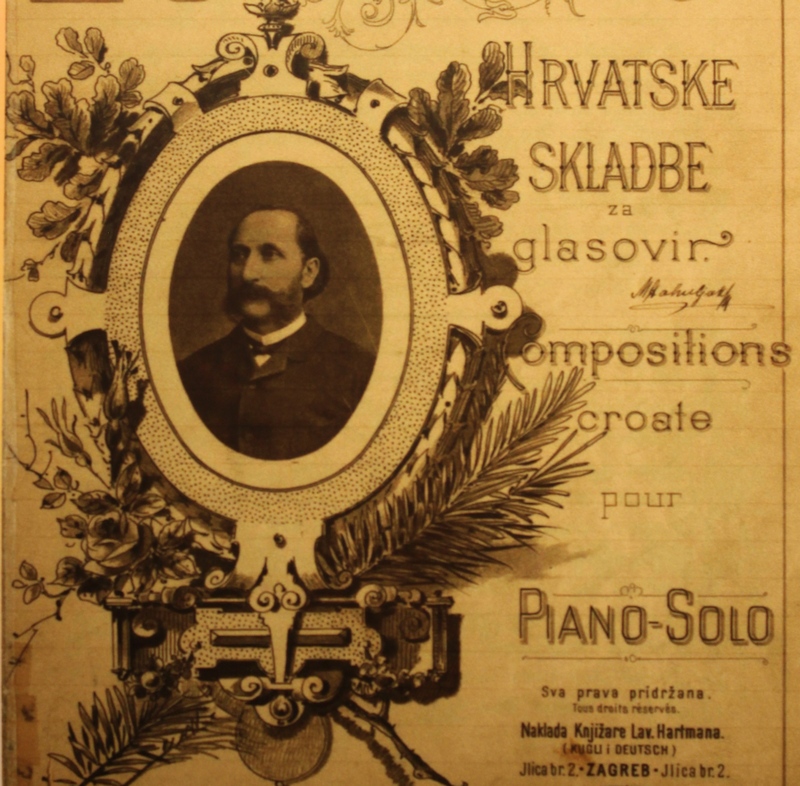
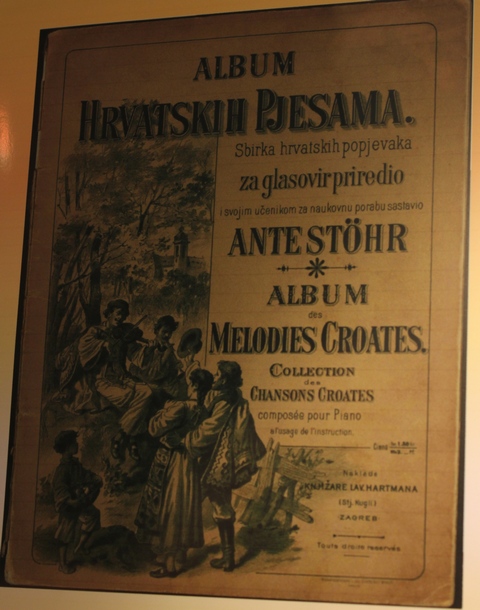
Ivan pl. Zajc: Hrvaske
skladbe za glasovir, Zagreb 1890.
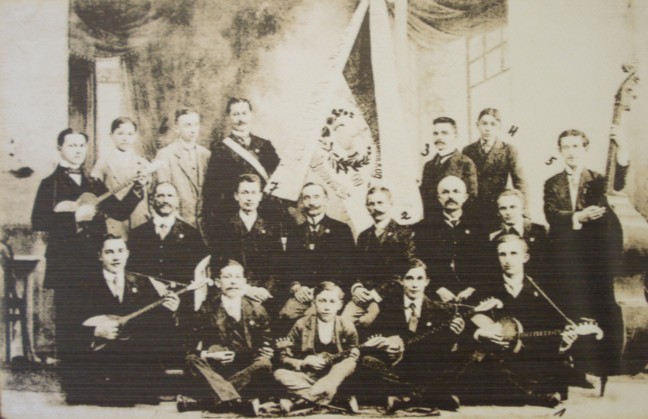
Tamburica
orchestra from
Bjelovar, around 1900.
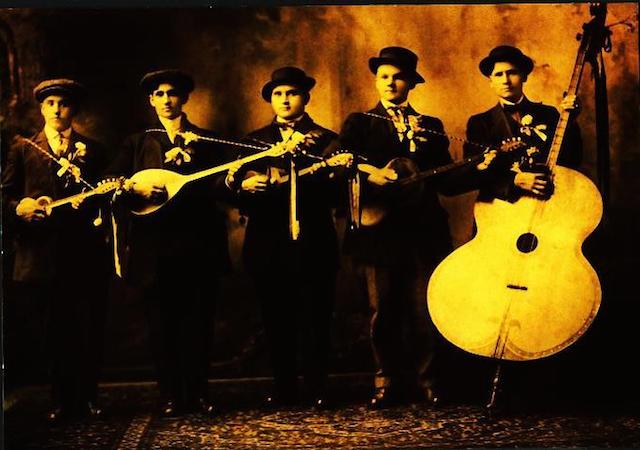
Old Tambura Band, Youngstown, Ohio, USA
Another jewel. Kajkavian verses by Dragutin Domjanić, music by Vlaho Paljetak (born in Dubrovnik!).
Popevke sem slagal
      G
 1. Popevke sem slagal,
      Em  D7  G    E7
    i rožice bral,
        Am        D7
    i (v)su svoju radost
        Am     D7  G
    sem drugim ja dal.

 2. Al' žalost navek sem,
    vu srcu ja skril,
    ni nigdo me žalil,
    i sam sem tak bil.

    G           G7
 3. Al' v mojem srcu,
        E7        Am
    tam suzah vam ni,
      Cm       G Em
    i če mi je teško
      A7    D7 G
    popevka zvoni.

    Če siromak sem
    se drugim bi dal
    popevke i srce
    i ne bu mi žal.
Vlaho Paljetak (1893-1944), born in Dubrovnik, left us beautiful verses and music in kajkavian language of the Croatian north-west.
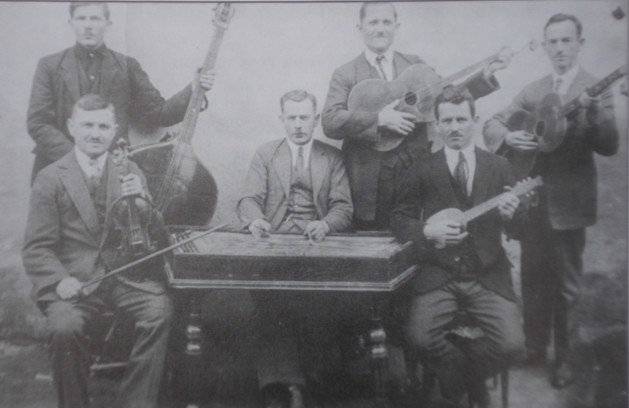
Vocinski
tamburaski orkestar
(Vocin tamburitza orchestra), 1928,
photo kept in Zavicajni muzej Slatina
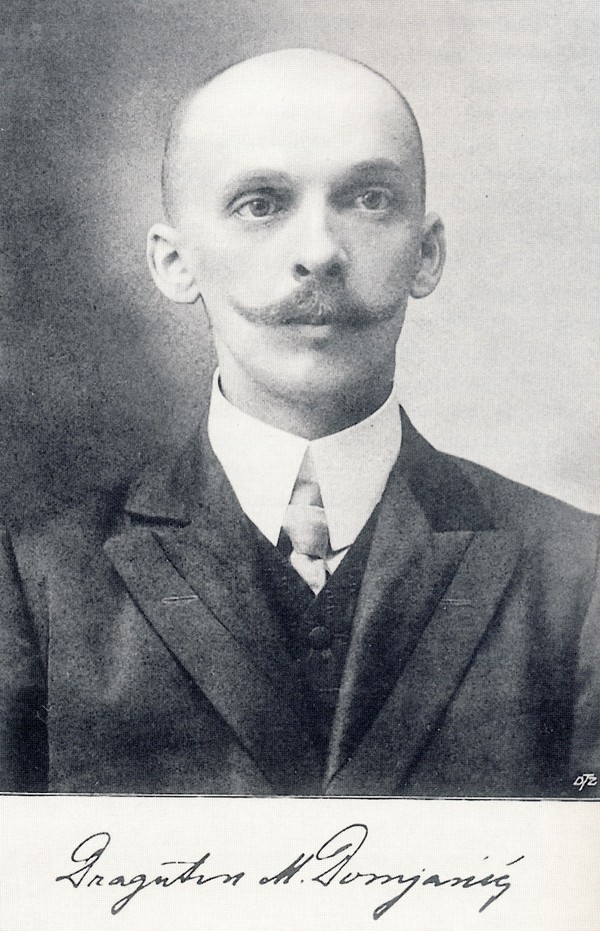
Dragutin Domjanić (1875-1933), a very popular kajkavian poet (kaj = what, as well as ča and što), wrote that according to their family tradition they stem from Bosnia. He was a stipendist of the cultural society Napredak from Bosnia and Herzegovina. See his verses1, verses2, verses3.
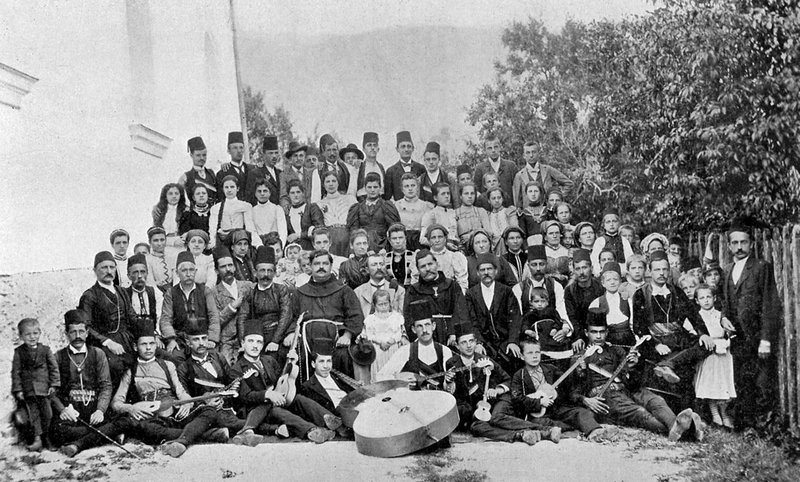
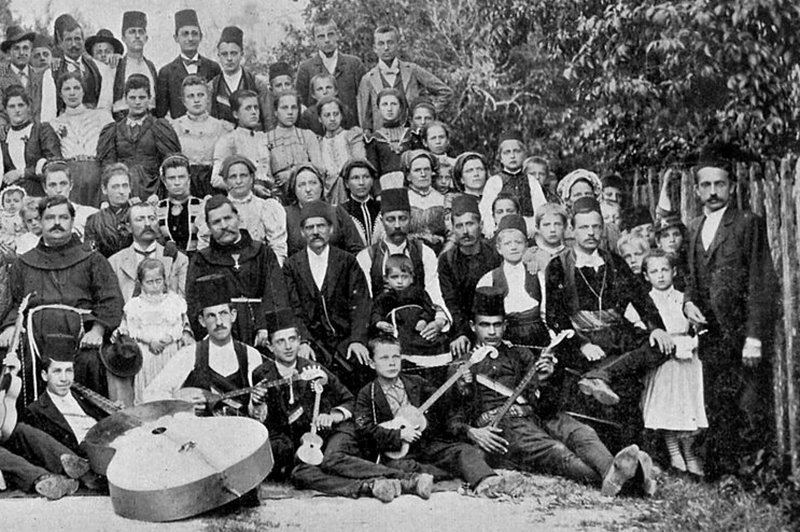
Dolac kraj Travnika, BiH, cc 1900. Photo by the courtesy of Franjo Marić.
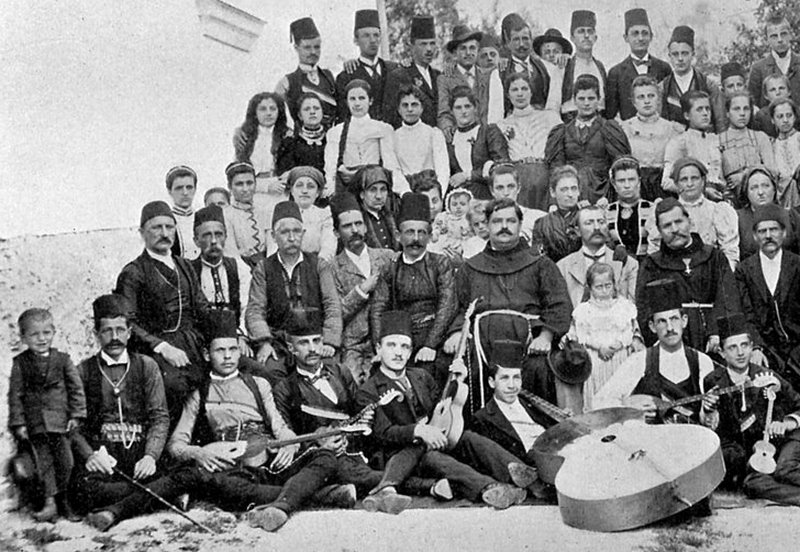
Bosnian Croats, with unaviodable "uncles" - Bosnian Franciscans.
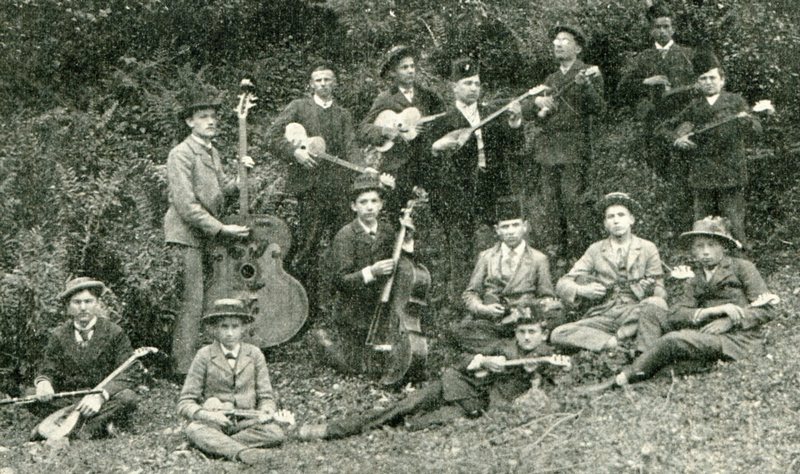
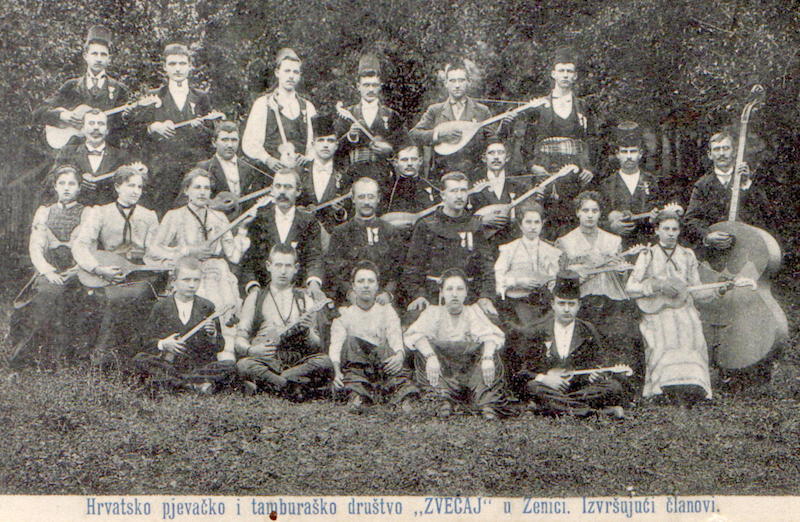
Hrvatsko pjevačko i tamburaško društvo "ZVEČAJ" u Zenici (Croatian singing and tamburitza society "Zvečaj" in Zenica).
Zenica, BiH 1905. Photo by the courtesy of Franjo Marić.
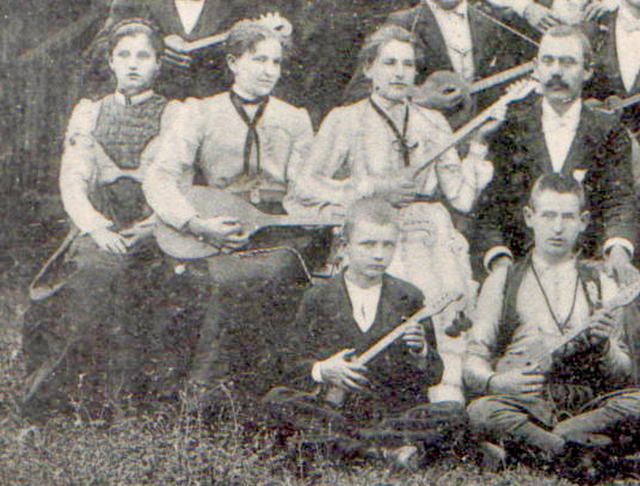
Croatian women in Bosnia and Herzegovina play tamburtiza instruments as well.
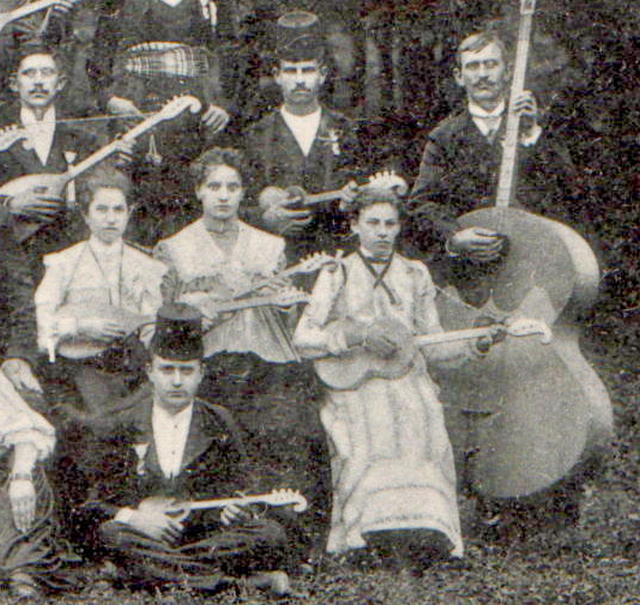
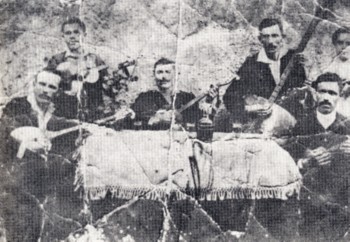
Tamburitza
players from Virje
from the turn of 19/ 20th centuries [Ivancan,
p.
205]
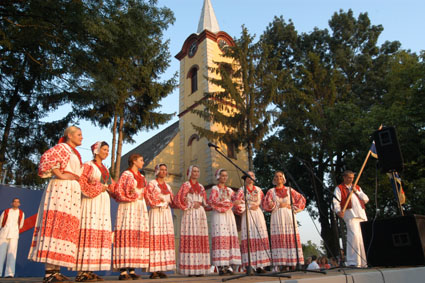
Many
thanks to Ipik
for very nice
photos of Croatian national costumes.
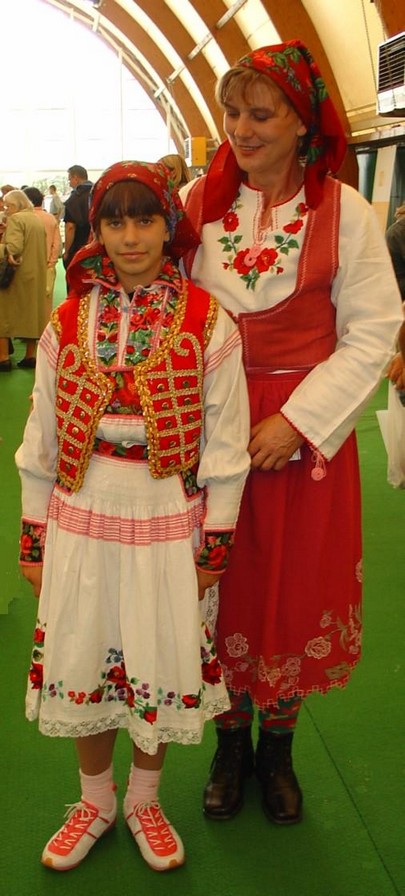 |
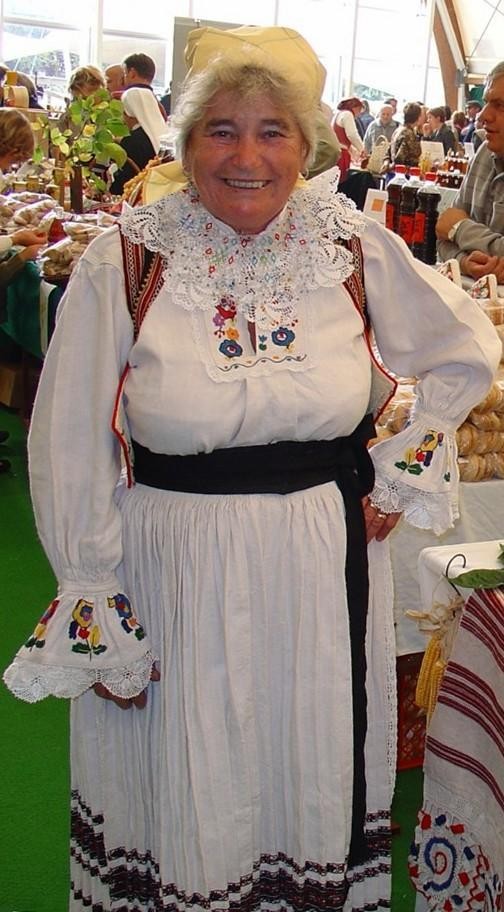 |
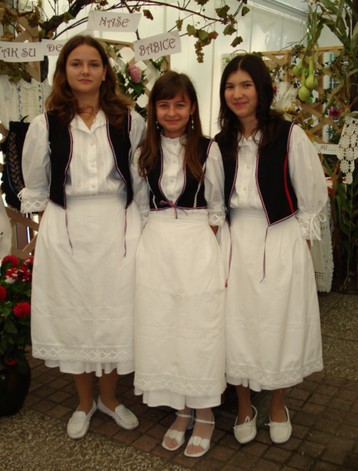
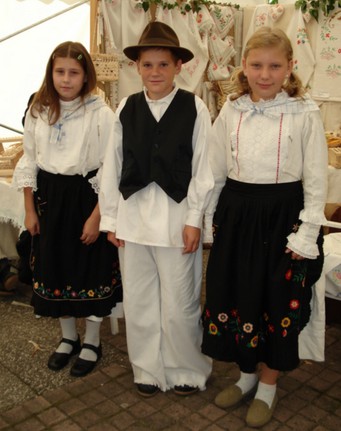
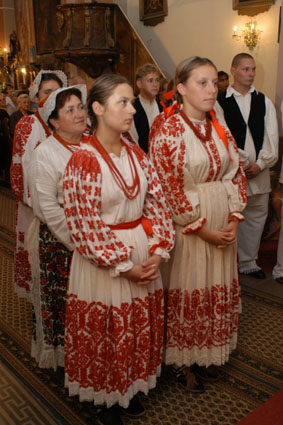
Women in Croatian national costumes from the environs of Zagreb, Bocarski dom, Zagreb, 2006 (festival of Croatian gastronomy)
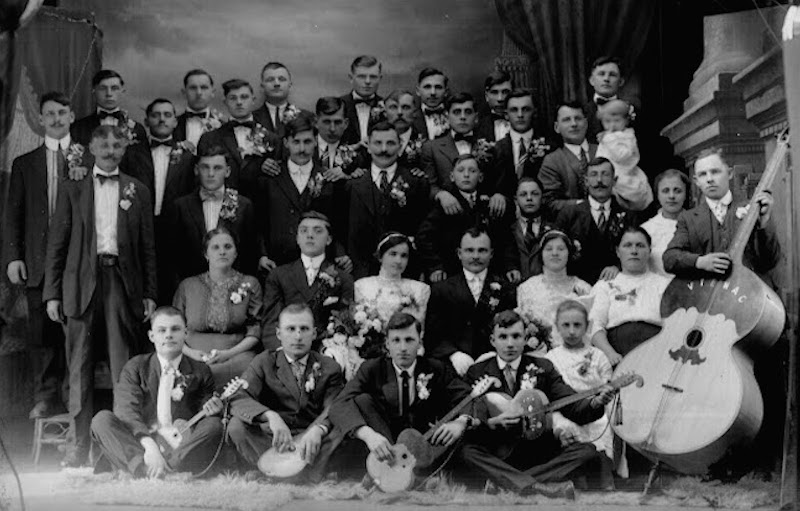
Croatian Tamburica Band at the wedding, ca 1930, USA
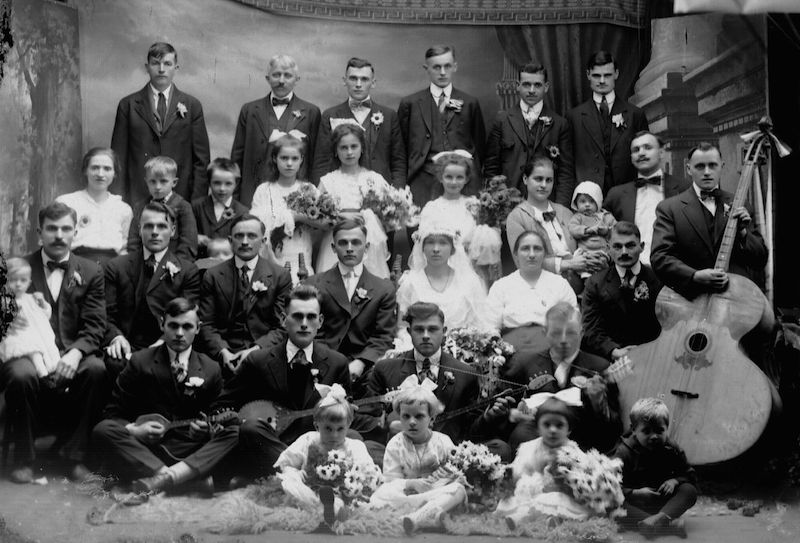
Croatian Tamburica Band at the wedding, ca 1930, USA. Source.
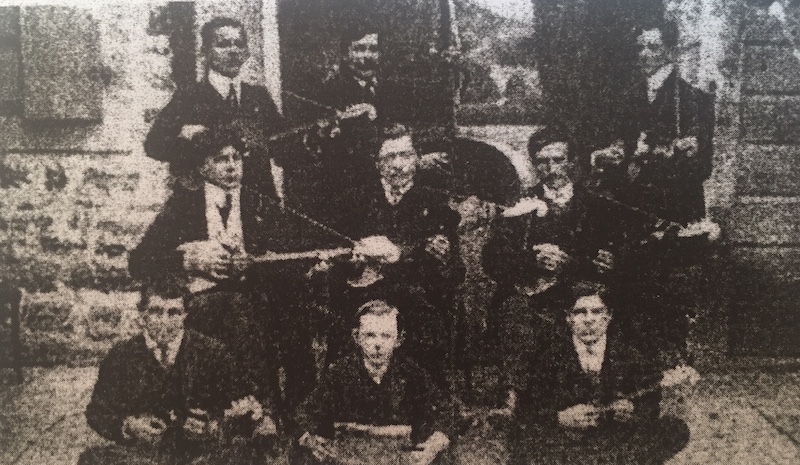
Croatian tamburitza choir "Starčević", Tivat, 1906, Boka kotorska; source [Čurić ed.].
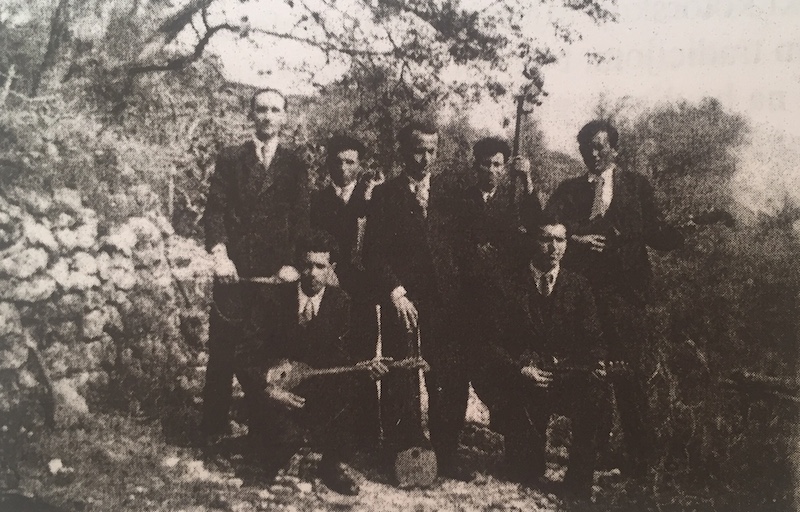
Tamburitza choir "Sloga", Mrčevac, Boka kotorska; source [Čurić ed.].
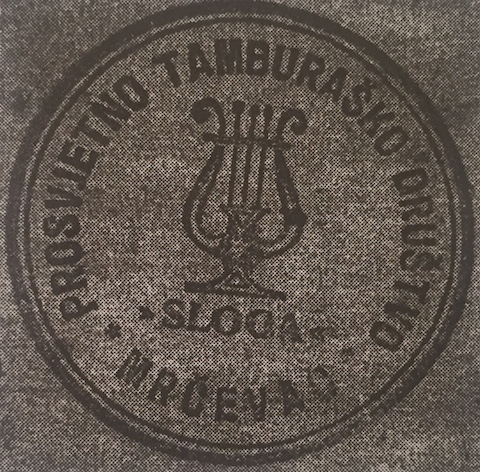
Seal of the Mrčevac tamburitza choir "Sloga", Boka kotorska; source [Čurić ed.].
Fala
Verses: Dragutin Domjanić, music: Vlaho Paljetak
      G    C     G
1. Za saku dobru reč,
       C    G0     G
   kaj reči si mi znala!
       Am           D7
    Za saki pogled tvoj,
       A7    D7       D
    za saki smeh tvoj fala!

2. Tak malo dobrega,
   v živlenju tuj se najde.
   I če je sunca trag,
   za oblak tak i zajde.

       G  F  E7   Am
3. Jer ti si srcu mi,
   Am       D7    G
   tak puno sunca dala!
       G  F  E7     Am
   Kaj morem ti neg reč,
      Am       D7 G
   od seg ti srca fala.
 (repeat 3.)
 |
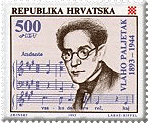 |
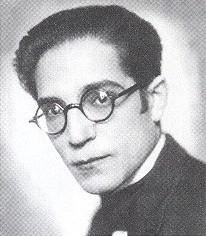
Vlaho Paljetak (1893-1944), born in Dubrovnik, on the photo and on the stamp.
The song has been rearranged by a well known conductor Emil Cosetto, on the occasion of Tito's death in 1980. It is regrettable that the message of this beautiful, innocent song has been so distorted.

Tamburitza diletant choir in Dubrovniku (photo taken in the Monastery
of Minor Brothers). Photo published by
Prosvjeta (Education) in
1903 in Zagreb. Its editor-in-chief was Emilij Laszowski.
Many thanks to Stjepan Sučić for sending us the photo.
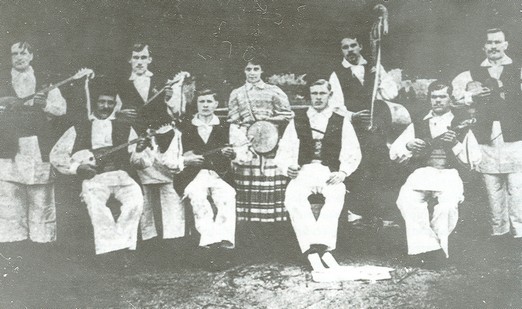
Hrvatsko
pjevačko društvo
"Lovor" founded in Slunj in 1876.
(Toma Žganec: Rastoke, Na slapovima
Slunjčice, Zagreb 1990., str. 106)
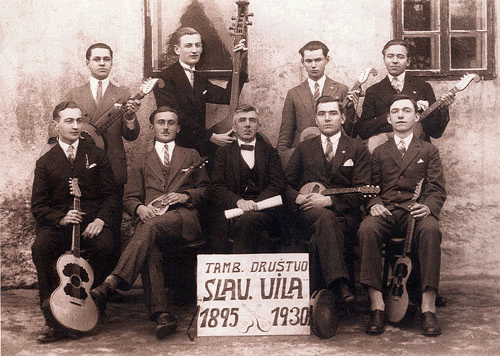
Tamburaško
društvo Slavonska vila iz Orahovice, 1930, source.
Stoje: Ivica Grbić, Franjo Hocenski, Josip Filaković, Franjo Kikel.
Sjede: Ladislav Hocenski, Vencl Konopek, učitelj društva
Viktor
Albih (stolar),
Vlatko Voćinkić i Stjepan Bradač.
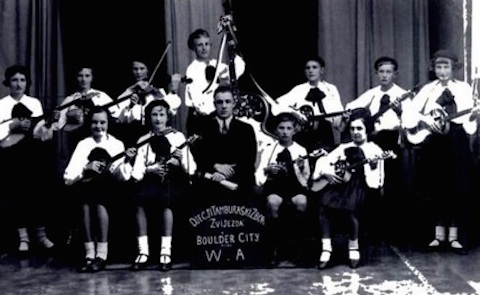
Dječji tamburaški zbor Zvijezda (Children Tamburitza Orchestra Star), Boulder City, West Australia, 1936.
Source [Šutalo, p. 209].
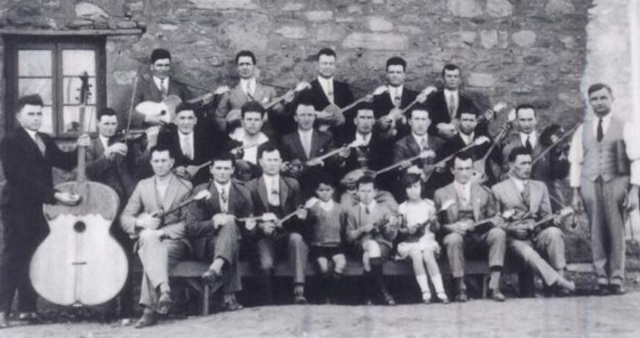
Croatian Tamburitza Orchestra Broken Hill, New South Wales, Australia, 1929. Source [Šutalo, p. 204].
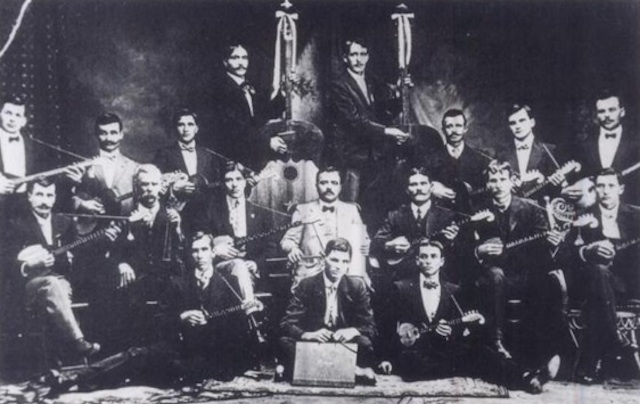
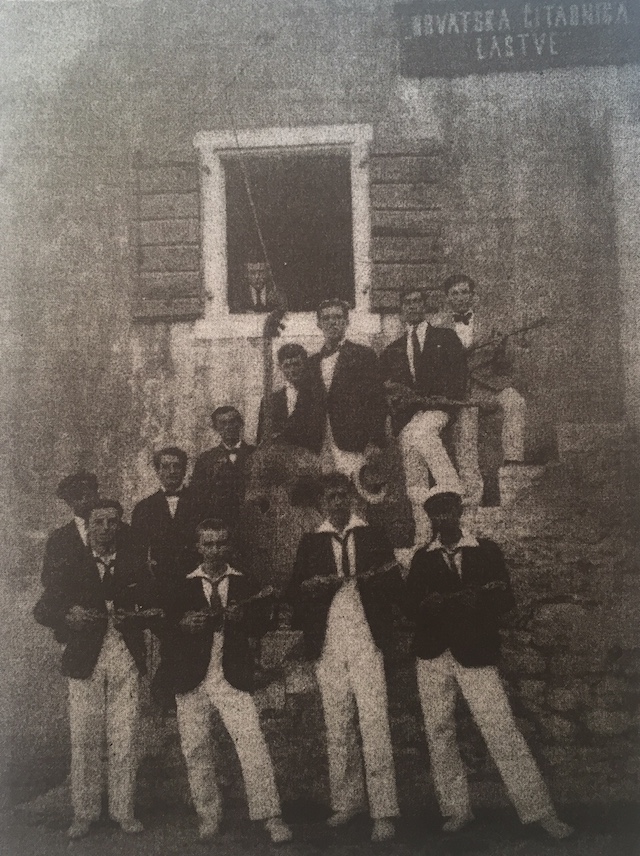
Tamburitza choir of Croatian Savings Bank, Donja Lastva, 1912, Boka kotorska; source [Čurić ed.].
Above the window on the right: Hrvatska čitaonica Lastve (Croatian Reading Room of Lastva).
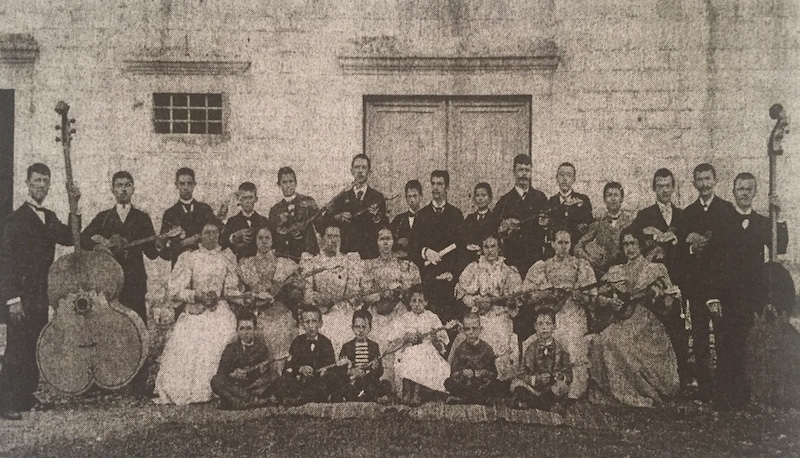
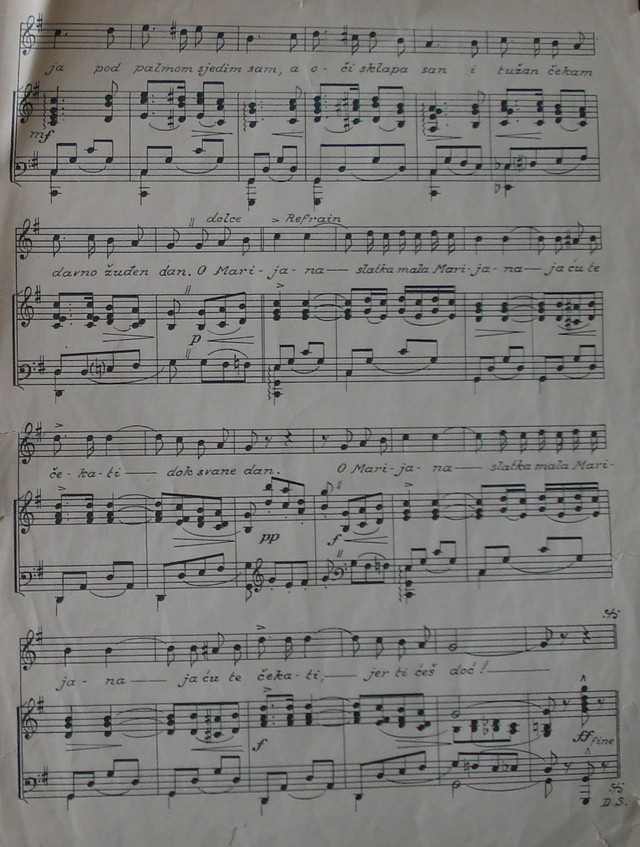
Marijana
Verses and music: Vlaho Paljetak
It is interesting and little known that in Japan there exist two recordings of Vlaho Paljetak's well known song Marijana - in the Japanese language, and the song was very popular in that country!
We invite you to listen to Vlaho Paljetak's tune O, MARIJANA, sung by Seiji Tanaka in Japanese and Croatian, recorded in 1976:
|
O
MARIJANA [mp3]
3.6 MB
|
By the courtesy of Dr. Drago Stambuk, Croatian ambassador in Tokyo.
I had opportunity to listen them on two records issued in Japan, when I visited Mr. Mario Kinel in his apartment in Zagreb (Mr. Kinel was a well known pop-music composer and translator; he even translated Vu plavem trnaci into Italian and German). Of course, out of Japanese verses I understood only - Marijana.
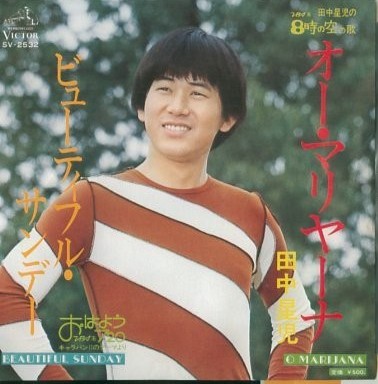
O Marijana (see bottom on the right), issued in Japan in1976, sung by Seiji Tanaka, Japanese pop singer born in 1947.
Marijana is also very popular in Czechia. It was included in both Croatian original and Czech translation into the book "Sveove Evergreeny" (World's Evergreens), published in Prague in 2000 (Petr Jansky - MUSIC CHEB). Except in Czech and Japanese, Marijana has been translated and sung in Italian, German, Russian, and Romanian.
In addition to this, I learned that a famous american actor Harry Dean Stanton ("Texas Paris Texas") sang the whole Marijana in superb Croatian to Mr Nenad Bach (personal information by Mr Nenad Bach).
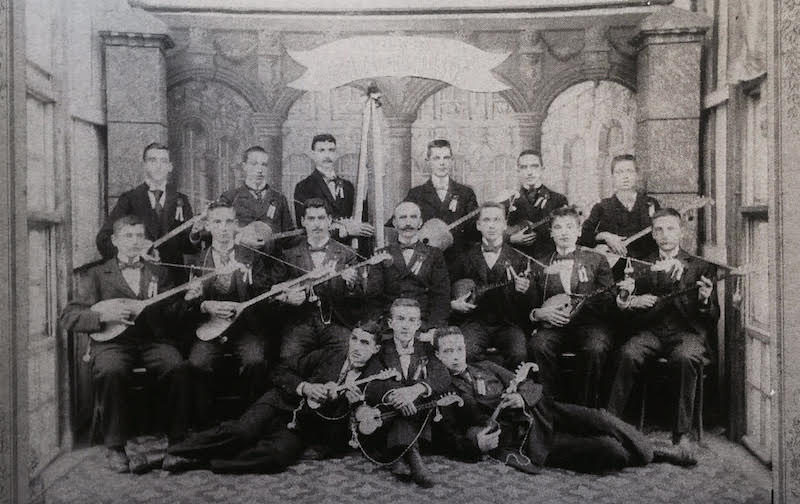
Gundulić tamburitza
orchestra in Dubrovnik,
around 1898. Source [Miho Demović,
Glazba i glazbenici
na području bivše Dubrovačke Republike za vrijeme austrijske uprave
1814.-1914., p 111].
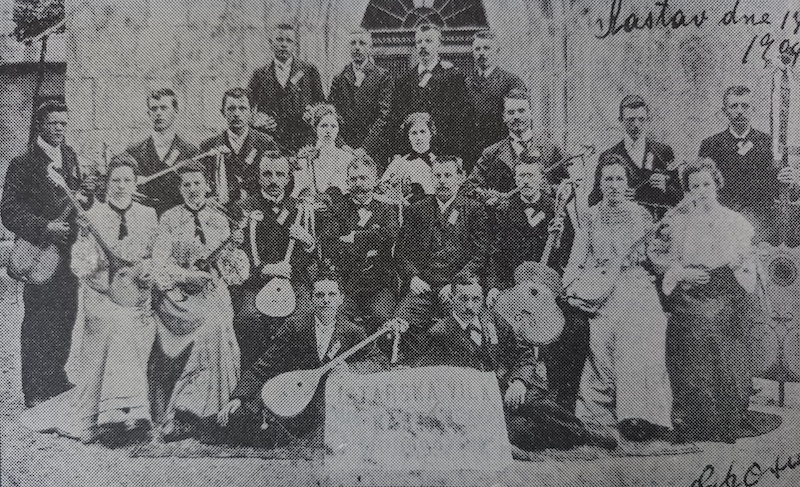
Tamburitza orchestra Istarska vila
(Istrian Fairy) in Kastav
near Rijeka, 1904. Note that ladies are also playing tamburitzas.
Darinko Munić: Jedno stoljeće Kulturno-prosvjetnoga društva Istarska
vila Kastav [PDF]
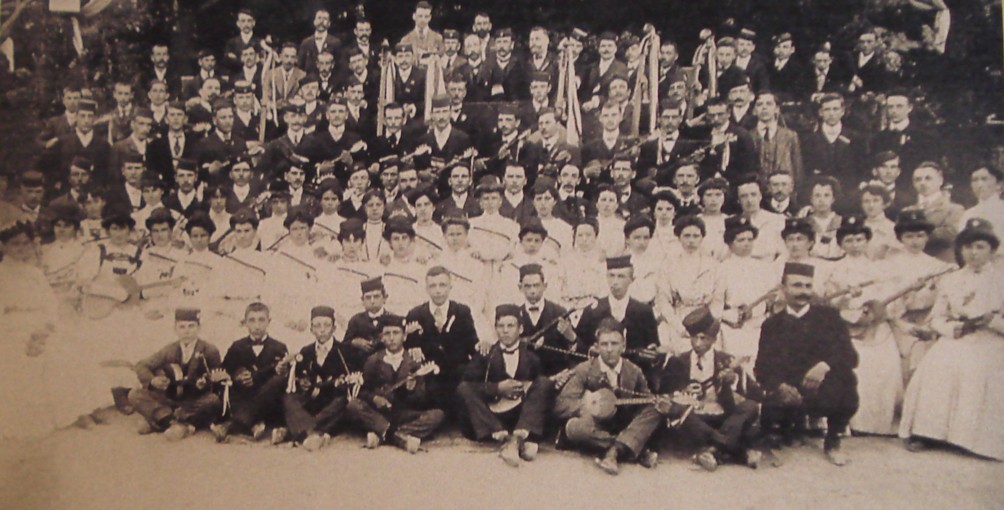
United
choirs of the Kastav
region near Rijeka, 1908
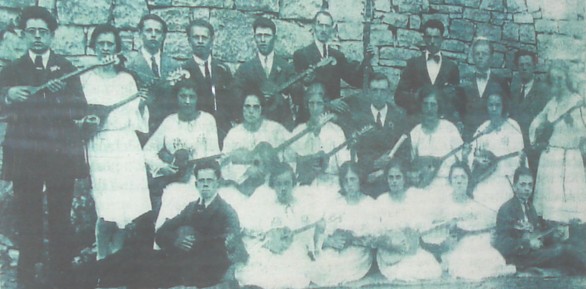
Tamburitza orchestra Spinčići
in Kastav, 1922
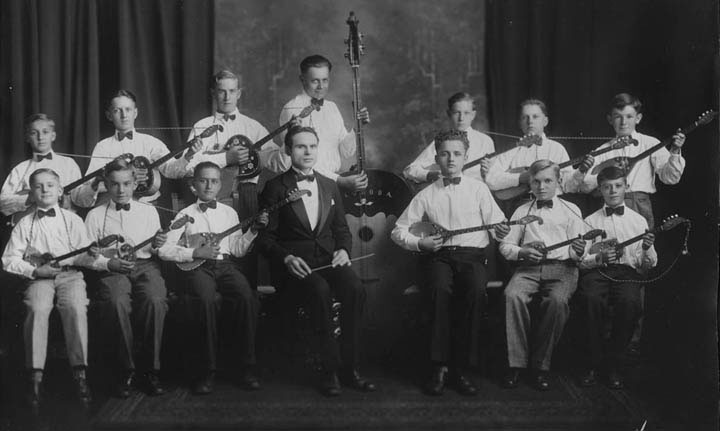 |
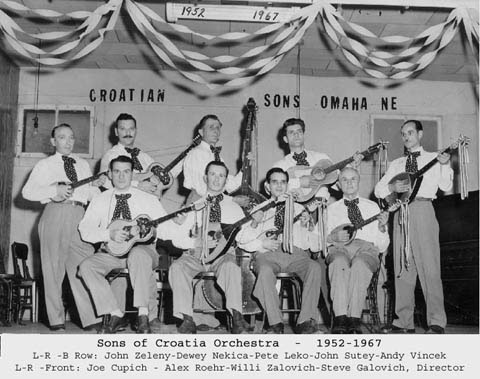 |
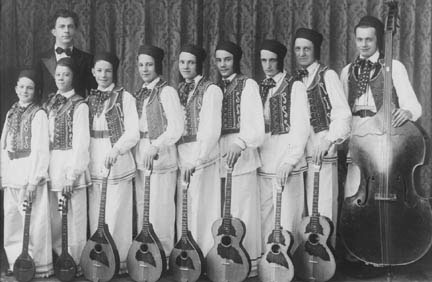 |
I know it would be a fatal mistake not to provide an example for the people from Dalmatia (they are quite sensitive). Here is a nice back-cycling:
C#7 -> F#m -> B7 -> E
Try to harmonize the rest of this exceptional song yourself.
S ponistre se vidi Šolta
text: Zdenko Runjić
music: Oliver Dragojević
 E
 Šoto voce piva klapa,
      C#7         F#m
 u to gluho litnje doba,
 B7
 i prolazi ispod skala
 F#m        B7      E
 di se suši tvoja roba.


 Do pergula riči lete,
 tu se misec smije gradu.
 Ti se dižeš iz kočeta,
 da poslušaš serenadu.

        C#7         F#m ...
 S ponistre se vidi Šolta,
 piva klapa ispod volta.
 U daljini svitle koče,
 piva klapa šoto voce.


 Ti se ozireš po sobi,
 slika je na kantunalu,
 onceg ća ga more odni
 u dalekem fortunalu.


 Opustila davno riva,
 zatvoreni su portuni.
 Šoto voce klapa piva,
 tvoji mirišu lancuni.


 Tiho razmičeš koltrinu,
 zrila si ka litnje voće,
 o ljubavi i o vinu,
 piva klapa šoto voce.


 S ponistre se vidi Šolta,
 piva klapa ispod volta.
 U daljini svitle koće,
 piva klapa šoto voce.


 Niko neće te kaštigat,
 kad bi skinila korotu.
 Život che te svu deštigat,
 A još moreš dat lipotu.


 S ponistre se vidi Šolta,
 žmiga svitlo ispod volta.
 U po volta kada pasa,
 piva klapa ispod glasa.
By the way, don't miss the following beautiful Dalmatian klapa songs web site. Chapeau! See also another klapa songs web site.
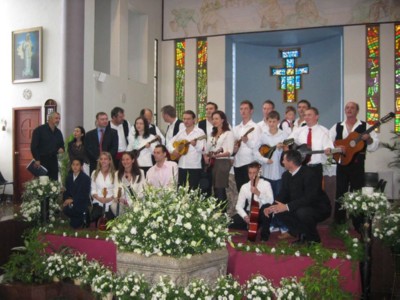
Tamburitza
orchestra performing
after Easter Mass 2006 in South Africa
(many thanks to Mr Ivo Lusic, Johannesburg)
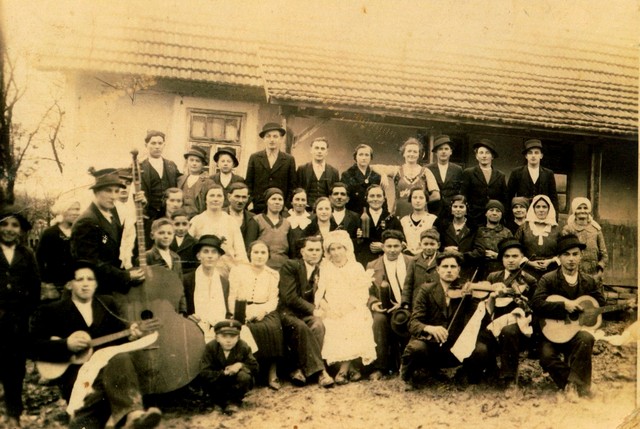
Wedding
in the village of Samarica,
Moslavina, North of Croatia
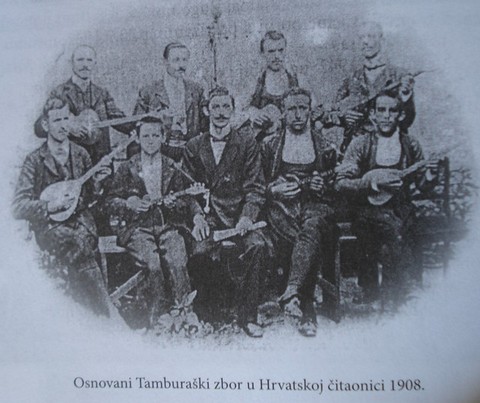
Tamburitza
orchestra in the Croatian reading room in 1908 in Bugojno, Bosnia and Herzegovina.
Source Antun Lučić ed.: S
Napretkom kroz stoljeće 1906.-2006.,
HKD Napredak, Bugojno 2006.
ISBN 978-9958-9134-0-2
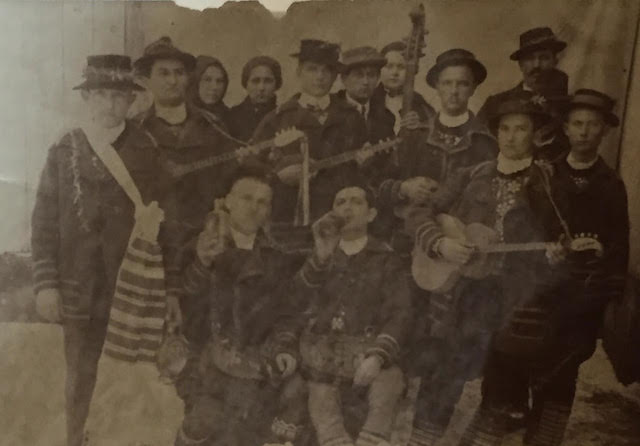
Tamburica orchestra in the town of Županja, from
the beginning of the 20th century.

Tamburica orchestra in the town of Županja; photo
from 1938; information by the courtesy of Kristina Šestan.
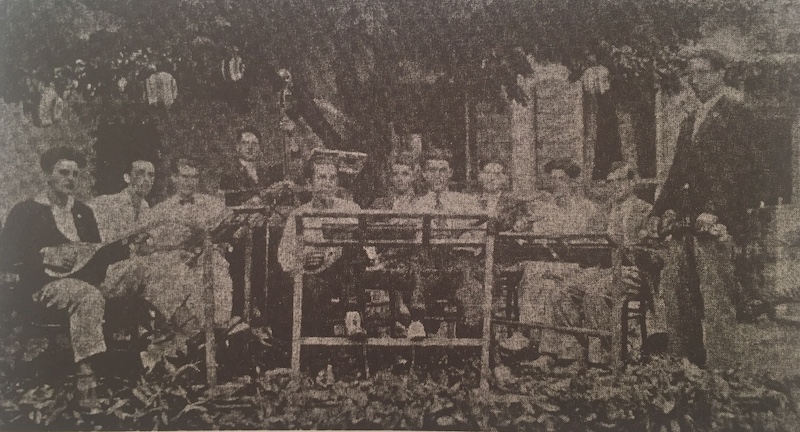
Croatian tamburitza choir Sloga, Prčanj, cc 1903, Boka kotorska; source
[Čurić ed.].

Tamburitza orchestra "Kalnik", 1913, in the city of Križevci NE of Zagreb.

Tamburitza orchestra "Kalnik", 1923, in the
city of Križevci NE of Zagreb (65 km). Mixed orchestra: 14 men and 10
women.
The Music school of Albert Štriga
in Križevci has a Tambura Department.
The above two photos are from the following monograph:
Renata Husinec and Petar Delić: To
je Hrvatsko pjevačko društvo "Kalnik", Matica hrvatska,
Križevci, 1992.
Many thanks to Martina Valec-Rebić, prof., for this information.
The further step in harmonization would be to describe possible alterations within the same (constant) chord, which in fact leads to the jazz harmony. This can be applied even to such a simple song as:
Sinoć kad sam ti proša
A Aj7 A6 Aj7which sounds very nice. Here Aj7 stands for Amaj7. Note the back-cycling here too, which is essentially:
Sinoć kad sam ti proša,
A Aj7 F#7 Bm E
mimo te bile dvore vidim te dušo Mare.
D E
Vidim te dušo Mare,
E7 A
di s drugim govoriš.
....
F#7 -> Bm -> E -> E
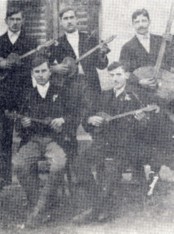
Tamburitza
orchestra conducted
by left-handed player Antun Kranjec,
Molve 1918 [Ivancan,
p. 196]
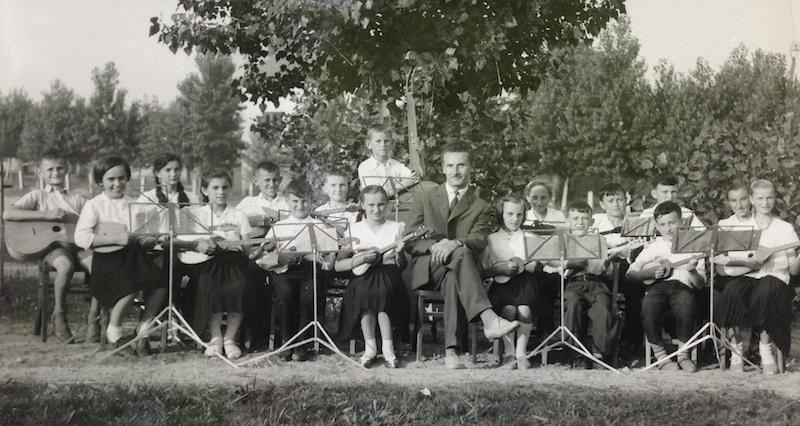
Dragutin
Božić, schoolteacher with his class in Molve, 1961. Music
instruments
produced by the Kos family enterprise in Pitomača.
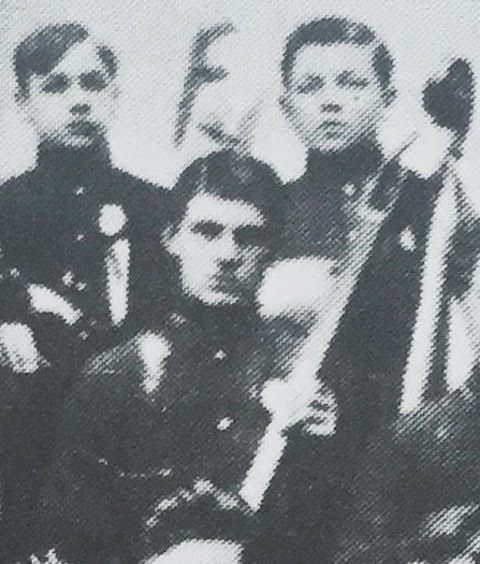
as a student of the Crafts School in Zagreb.
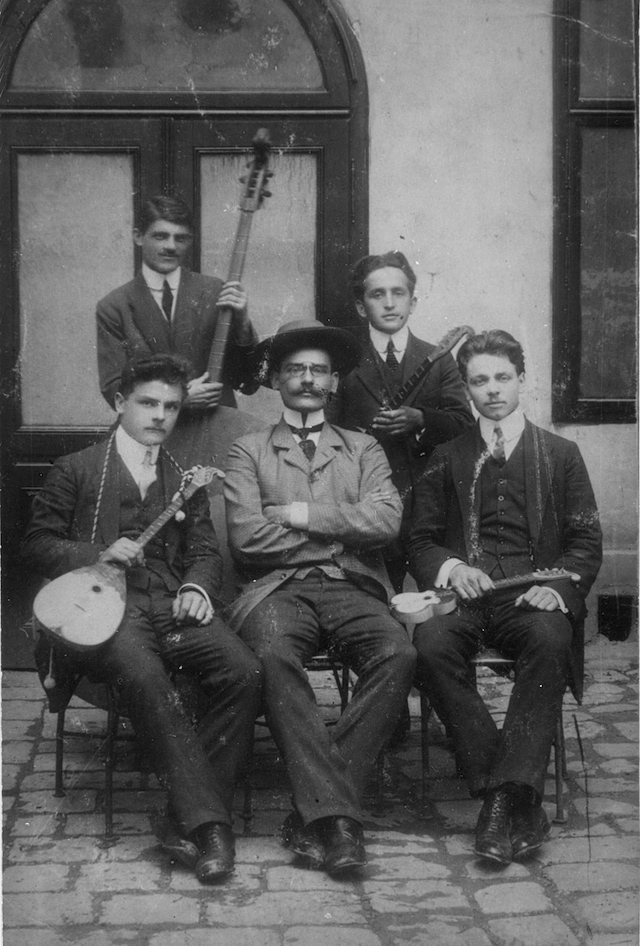
Rudolf Fizir with his bas among Croatian tamburitza players in Wiener Neustadt in Austria.
Of course, many songs do
not `tolerate' excessive harmonization, which is probably the
case with the above song too. Another `extreme' is for
instance Vu plavem trnaci,
a real (harmonic)
challenge. I like this song very much.
Vu plavem trnaci
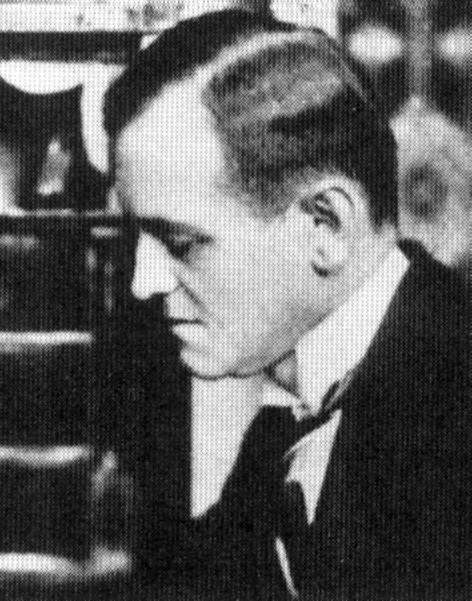
Gjuro Prejac (1870 - 1936)
       G       Gm      AmD7    G
1. Vu plavem trnaci mi hiža stoji,
       G       D        A7     D
   od zelenih vejah je videti ni.
     C D7       G Gm     AmD7    G
   Bogica je z'dreva, ne vufa se reva
     G0          G Em      Am D7   G
   pokazat pred ljudmi kak da se boji.

        Em       Am          B7     Em
   Vre slaba je, stara prek stotinu let,
       F#      B       F#        B
   od njezine brajde posušil se cvet.
      Am        B7       Am       B7
   Od blata je zbita, i škopom pokrita,
      Am         Em         C         B7
   ne moreš prav znati je'l hiža il' klet.

       Am       D7      G         Em
   Nju muški su žuli prinesli na svet,
      Am       D7       G          G7
   za onda dok Zagorec bil je još kmet.
     Am      D7        C0      Em
   I bila je bela, i z'mirom vesela, |
      D#7     G Em    AmD7     G     | 2x
   a danas od tuge se hoće podret.   |


2. I vnogi se lajtić vu njoj je ispil,
   plebanuš, vučitelj tu vinček je pil!
   Z gosponom pogaču i orehovnjaču
   je mužek rad drobil i srećen je bil.

   Pod malim oblčcekom fantić je stal,
   prelubleno dekle potiho je zval.
   I vnogi je pušlec zamenil za kušlec,
   i morti je fantić v komori i spal.

   V toj hiži se rodil je vnogi vojak,
   i vsaki je sledni bil pravi junak!
   Za tujca vojeval i krv je proleval,
   za falu su rekli mu da je bedak!


3. I hižica tiha ščekuje on čas,
   kad jenkrat i Zagorcu došel bu spas!
   Na oko je tiha, al veter zmir njiha,
   vu vejah šumechih starinski jen glas:

   em Zagorcu samo je Zagorje raj,
   nigdar nebu zabil govoriti kaj.
   Dok krv je proleval on zmir je popeval:
   Še jenkrat bi rad videl zagorski kraj!

   Pretrpel je muke črez jezero let,
   al zopet bu brajda potirala cvet.
   Iz našega gorja vre javla se zorja,
   vesela i srećna bu hizza i klet!
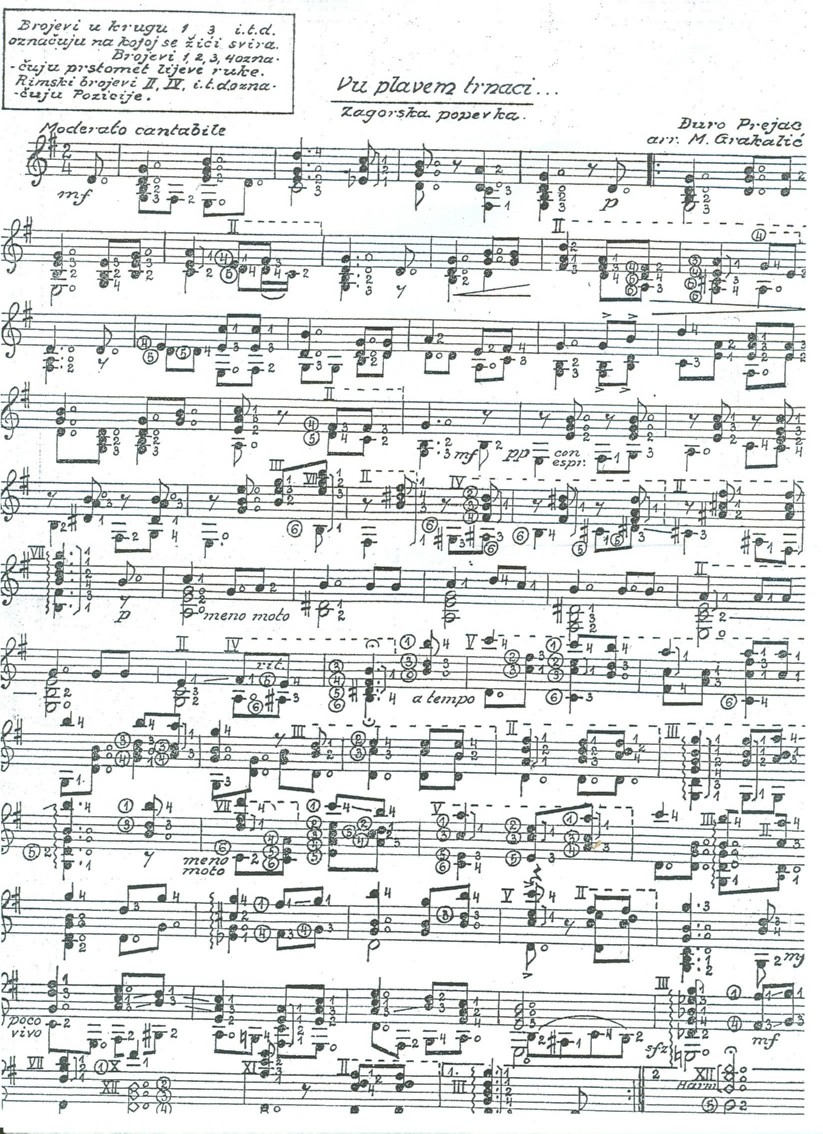
Milan Grakalić (Medulin, 1909 - 1979), an excellent Croatian guitarist (and architect), has arranged Vu plavem trnaci for classical guitar, see the scores. For more details see Andrija Tomasek: "Vu plavem trnaci", Matis d.o.o. Pregrada, 2005, ISBN: 953-96561-9-2. Many thanks to Professor Tomasek for scores.
When you visit the castle of Veliki Tabor, don't miss to see the room devoted to Gjuro Prejac, who was born in the nearby village of Desinic.
Tamburitzas
of Stjepan
Radic,
source [Tomicic]
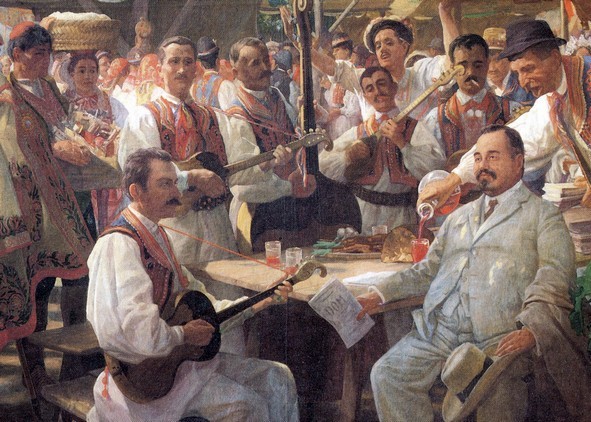
Ivan Tišov: Č Stjepan
Radic with Croatian peasants in
Zagreb, source [Tomicic]
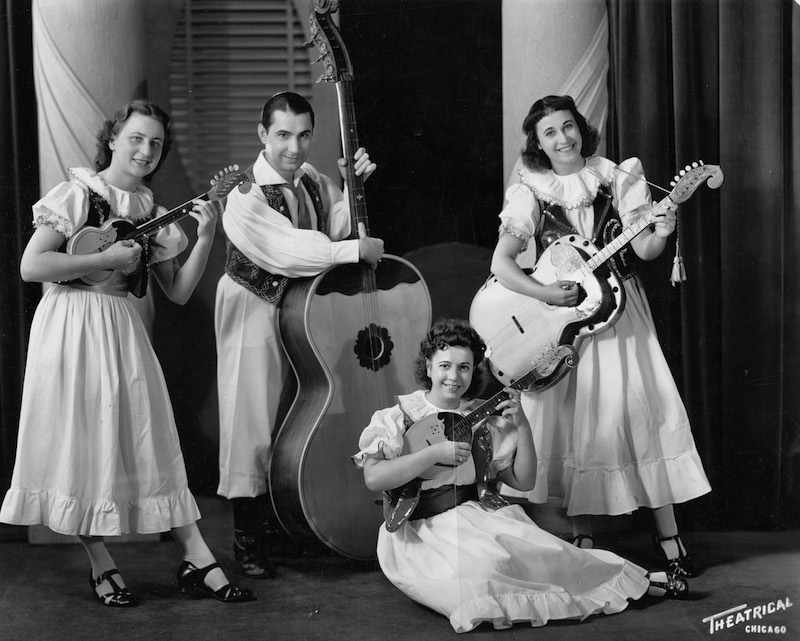
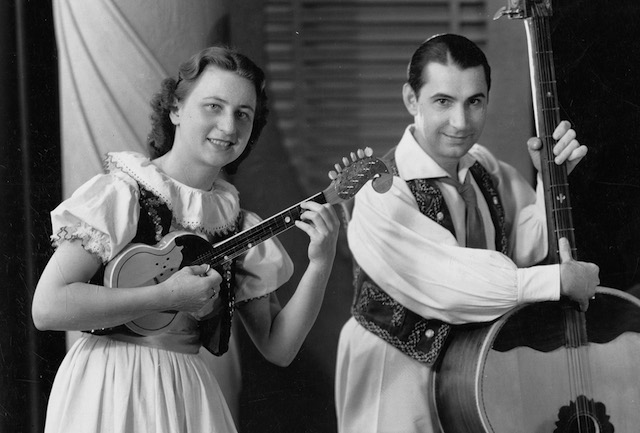
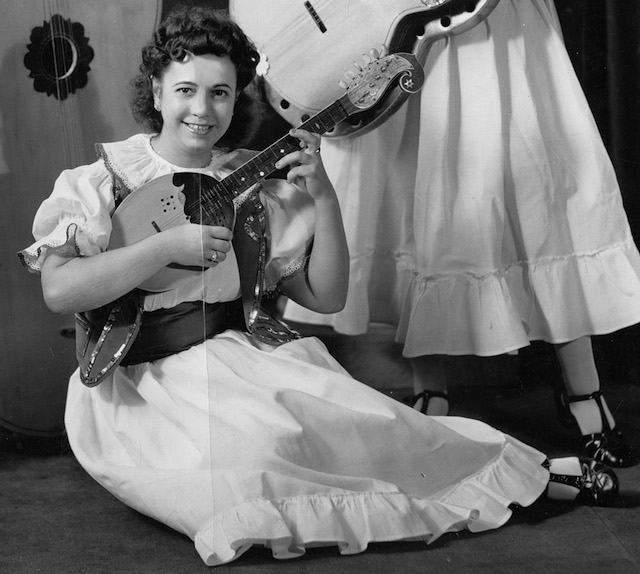
The Elias Tamburitzans, also
known as the Croatian Tamburitza Ensemble, existing probably between
the two World Wars. Left to Right: Martha Elias,
Charles Elias, Mary Filipovich, Anne Elias. Source: Helene
Stratman-Thomas Collection, Mills Music Library, University of
Wisconsin-Madison. See James P. Leary and Folksongs of Another America.
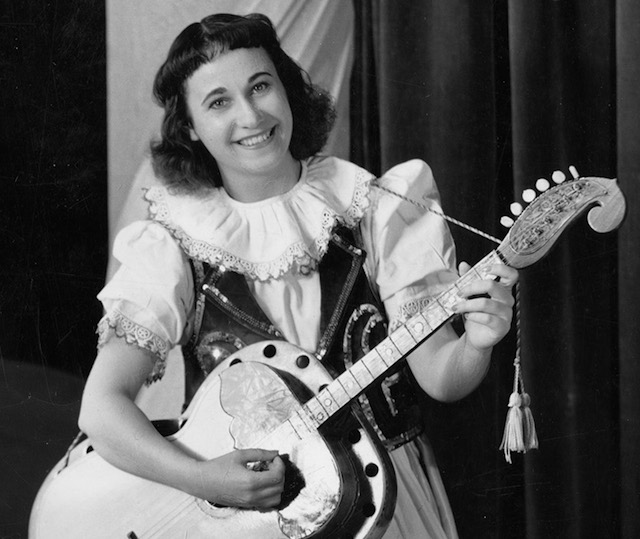
The accompaniment of the following very nice song can be also be ``sprinkled'' with back-cycling: Em -> A7 -> D, or B7 -> Em -> A7 -> D.
Oj, jesenske duge noći
Ivan Trnski
D Em A7 DIn the third line you may also use back-cycling:
Oj, jesenske duge noći, oj!
D B7 Em A7
Oj, jesenske duge noći,
D A7 D
reko dragi da će dochi, oj!
D A7 D
Čuj me dragi čuj!
(repeat last three lines)
....
 D    Bm    Em     A7   D
 reko dragi da će doći, oj!
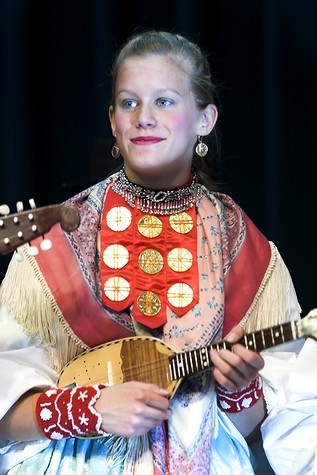
CroatiaFest 2005, Seattle, USA,
Photo - Jal Schrof
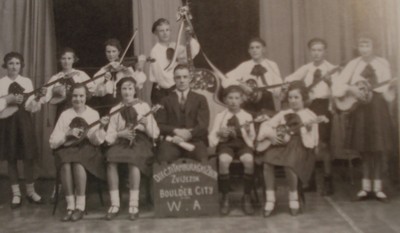
Children's
tamburica orchestra
Zvijezda (Star) in Boulder City, Western Australia, 1936, see [Sutalo]
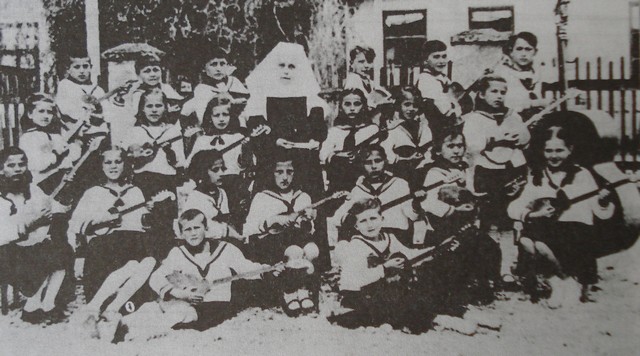
Tamburitza
orchestra in
Bugojno, Bosnia and Herzegovina,
in the first half of 20th century,
directed by a nun.
Note that there are many girls. Source
[Antun
Lučić ed.]
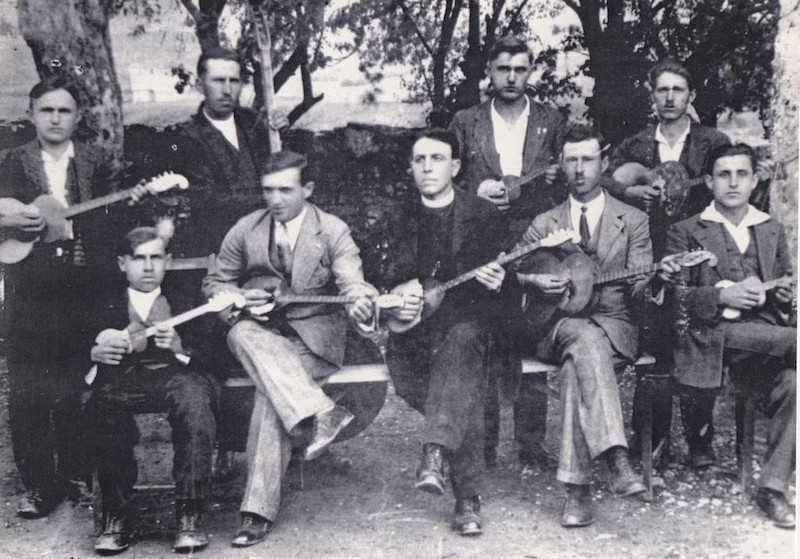
Saborsko tamburitza orchestra
in 1930s, Gorski Kotar, Croatia. Standing: Ivan Špehar (Zec), Josip
Grdić (Æilim), Petar Sertić (Pera Mašin), Vuković Mate (Mateša).
Sitting: Nikola Špehar, Slavko Katušin - teacher in Saborsko, Joso
Vukelić - Catholic priest in Saborsko, Marko Grdić (Markica Josin),
Pave Vuković (Maljićev). Source of the photo Saborčanski tamburaški zbor iz 30-tih godina prošlog
stoljeća.
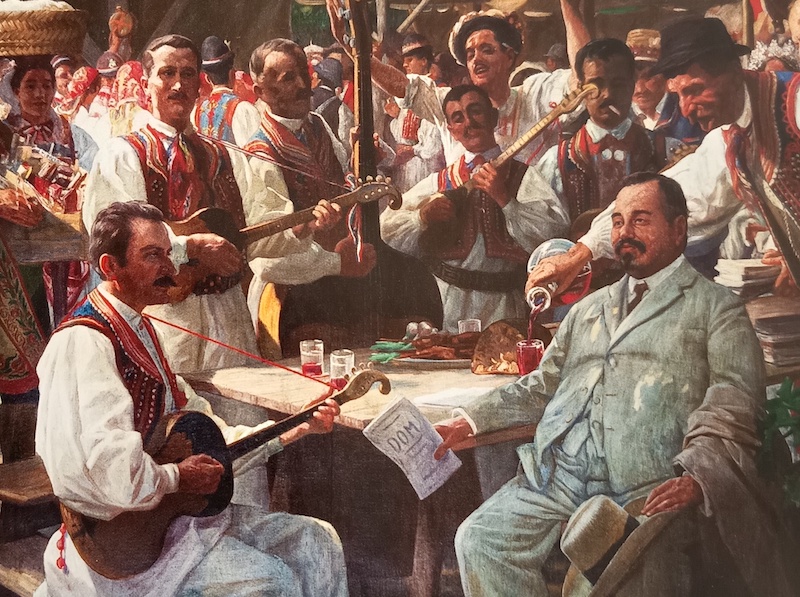
Ivan Tišov, distinguished Croatian painter: Stjepan Radić in 1928, in the year of his
assasination in the Belgrade parliament
(this is the central part of Tišov's drawing). Stjepan Radić was very
fond of tamburitza, which he also played himself.
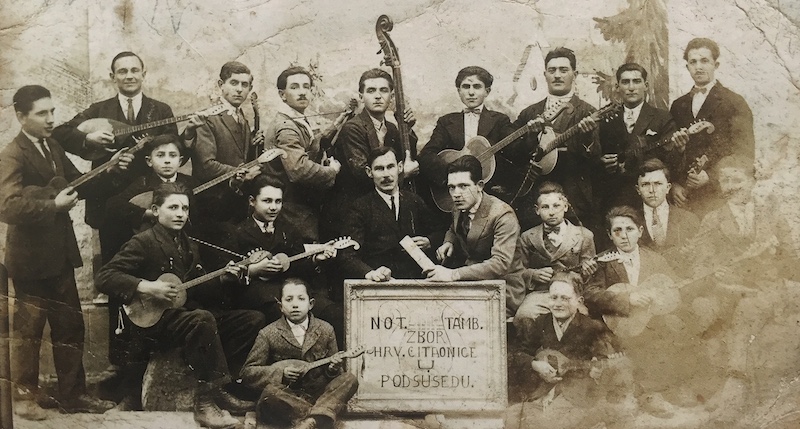
Tamburitzans in Podsused near
Zagreb, around 1931-1932, from the monograph of don Tunjo Blažević: Podsused - vjerski život i tradicija,
Podsused 2009, p. 173.
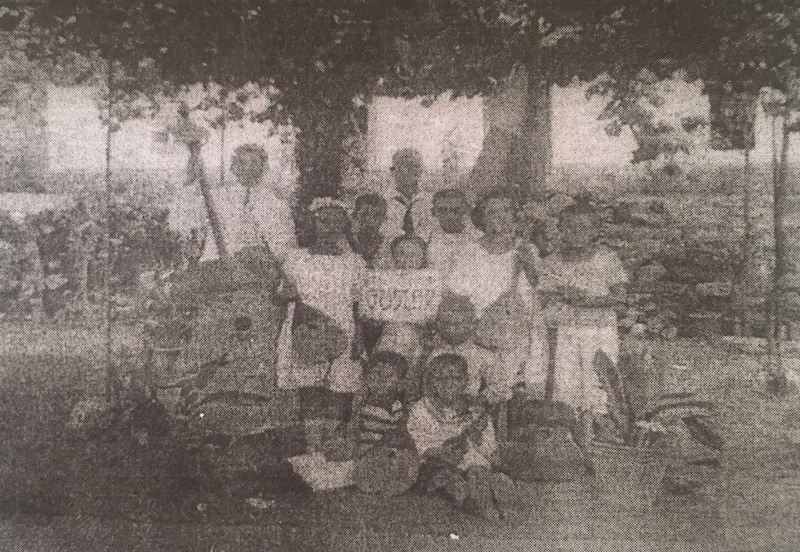
Croatian Tamburitza choir Guslar,
Stoliv 1919, Boka kotorska;
source [Čurić ed.].
Ima jedna kućica
Text: Vinko Kos, music: Jakov Gotovac
 A
Ima jedna kućica
 D
draga srcu mom.
 D        E     A
Ta kućica pod lipom |
 E            D (A) | 2x
stari je moj dom.   |
U njoj živi majčica
dobar otac moj.
A i meni najljepše
živjet je u njoj.
Kućo draga kućice
čuvao te Bog,
jak i vjeran branitelj
starog doma mog.
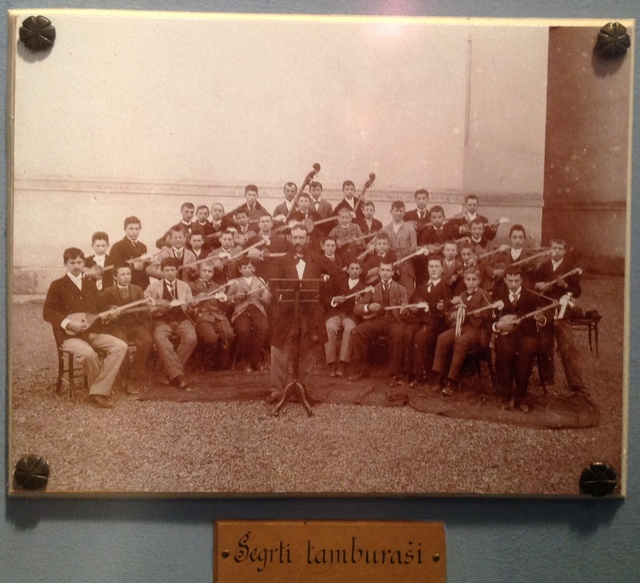
Photo of young
Croatian entrepreneurs - Tamburitzans,
exhibited in the Croatian School Museum (Hrvatski
školski muzej)
in Zagreb.
The photo is probably from approx. 1900.
Ova pjesma se u Hrvatskoj do godine 1945. pjevala na stari način. Nakon 1945. nije se smjela pjevati ili pojavljivati u knjigama u tom obliku (radi "čuvao te Bog"). Da bi pjesma bila spašena, unesena je preinaka u zadnjoj kitici. Složio ju je Velimir Žubrinić, učitelj i ravnatelj OŠ u Kozjaku, malom selu kod Krapine, zajedno sa svojom suprugom Katicom rođ. Suntešić:
Kućo draga kućice,mili dome moj,
bit će vjeran branitelj
tebi sinak tvoj.
Katica Suntešić je kao dijete tu pjesmu naučila godine 1942. od svoje učiteljice Štefice Rubin u osnovnoj školi u Svetom Križu Začretje (Štefica Rubin, židvoskog podrijetla, tragično je stradala 1943. prigodom partizanskog napada na vlak na putu za Zagreb). Usmenom predajom ta se inačica vrlo brzo proširila ne samo u Hrvatskoj, nego i izvan domovine, pa i među Hrvatima SAD-a koji znadu čini se samo ovu drugu inačicu.
Autori teksta i melodije izvorne pjesme nisu nam poznati. Sadržaj pjesme "Ima jedna kućica" nudi prekrasne motive za domoljublje i likovno izražavanje djece. Treba zahvaliti učiteljici Štefici Rubin što je djecu u školi učila tu pjesmu, te roditeljima Katice Suntešić, Barici i Petru, koji su joj usadili ljubav prema pjesmi. Zanimljivo je da se obje inačice navode u knjizi [Duša narodna], na str. 51 i 88.
O toj pjesmi govori istaknuta hrvatska pjevačica Lada Kos u filmu Neprijatelj naroda redateljice Višnje Starešine. Test pjesme je napisao njezin otac Vinko Kos (1914.-1945.), koji je stradao na Križnom putu.
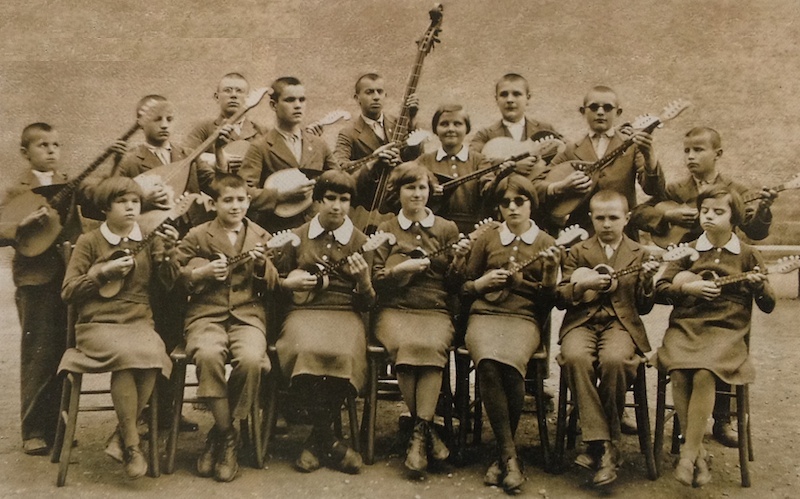
Blind tamburitza players in Zagreb, from the School "Vinko Bek" for blind children. Photo from around 1920.
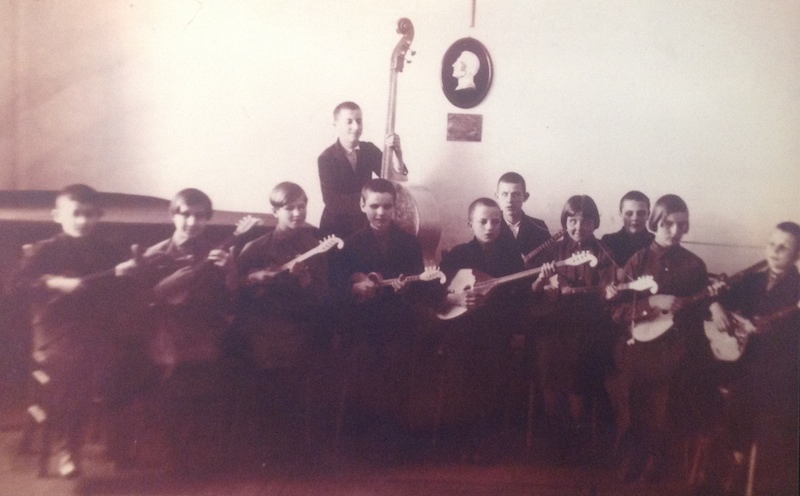
Blind tamburitza players from the School "Vinko Bek" for blind children. Photo from around 1920,
exhibited in the Typhlological Museum in Zagreb.
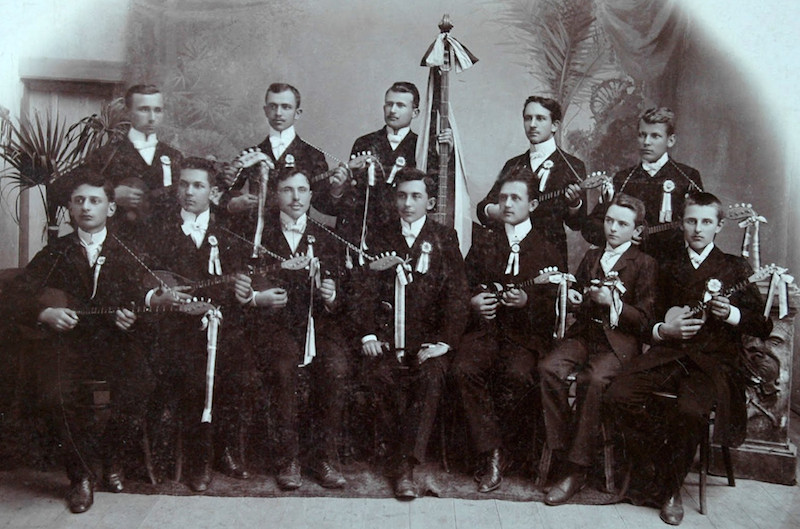
Tamburitza choir Osvit (Dawn), Požega, founded in 1892.
U Nadbiskupskom sirotištu je 1887. osnovano prvo tamburaško društvo Bisernica, a od 1892. pri Gimnaziji djeluje tamburaški zbor Osvit. Oba orkestra, kao i pjevački zbor Lira u prvim desetljećima XX. st. vodio je dr. Josip Andrić (1894.-1967.), tada đak požeške Gimnazije. Izvor www.ss-glazbena-pozega.skole.hr/skola/povijest
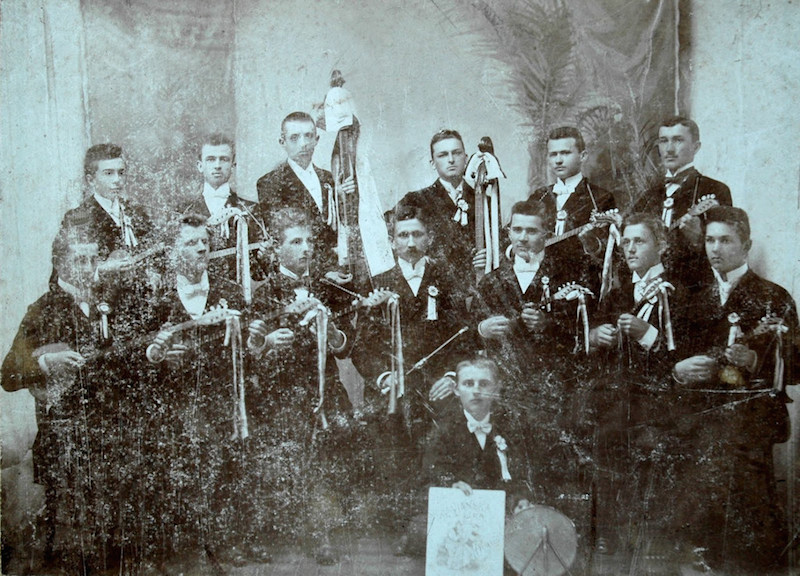
Tamburitza choir bisernica, Požega, founded in 1887.
Kad se Tena udavala
          G         B7
1. Kad se Tena udavala,

   C          D7      G
   od čaše se nisam mako.

       G            B7
   žalio sam sudbu svoju,

   C           D7       G
   Danima sam stalno plako.


   Refrain (2x):

   G        B7     C
   Udaše mi moju Tenu,

   Am       D7     G
   Doveli i tamburaše,

   G         E7      Am
   Meni osta samo želja

   Am      D7     G
   I neispijene čaše.


2. Majka vicce: Što si bisan,
   zašto konje tučeš sine?
   Pa i drugih cura ima,
   sve su lipe sve su fine.
   2xR.
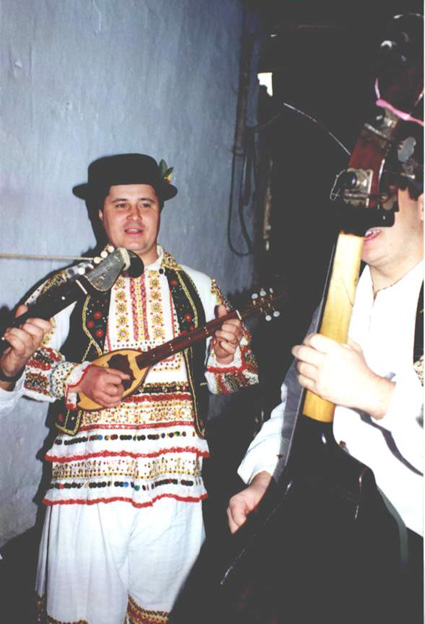
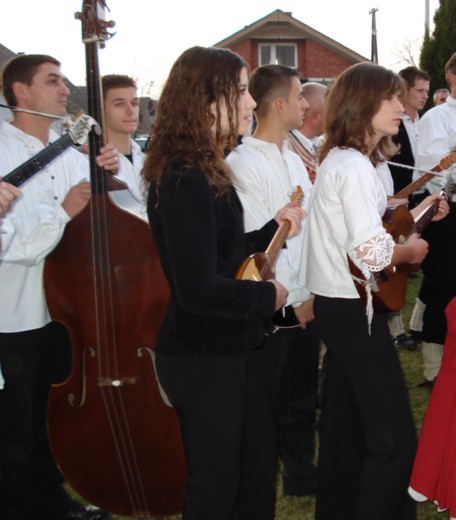
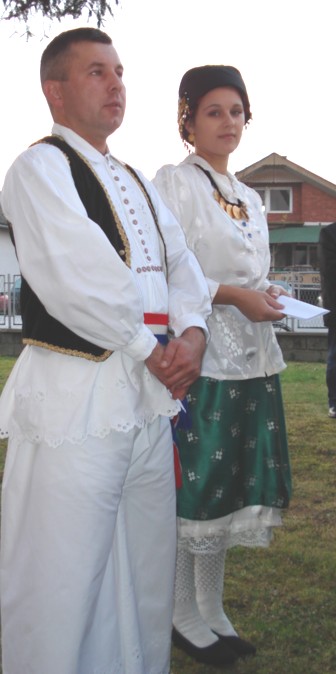
Many thanks to Mr. Darko Varga for having contributed nice photos representing national costumes from the village of Draz (Baranja near Danube river).

Ivanovci,
Slavonija, Croatia,
from the blessing ceremony of installing two church bells made in
Innsbruck, Austria, 2006.
The ceremony has been led by bishop Marin
Srakić, born in that village.
 |
 |
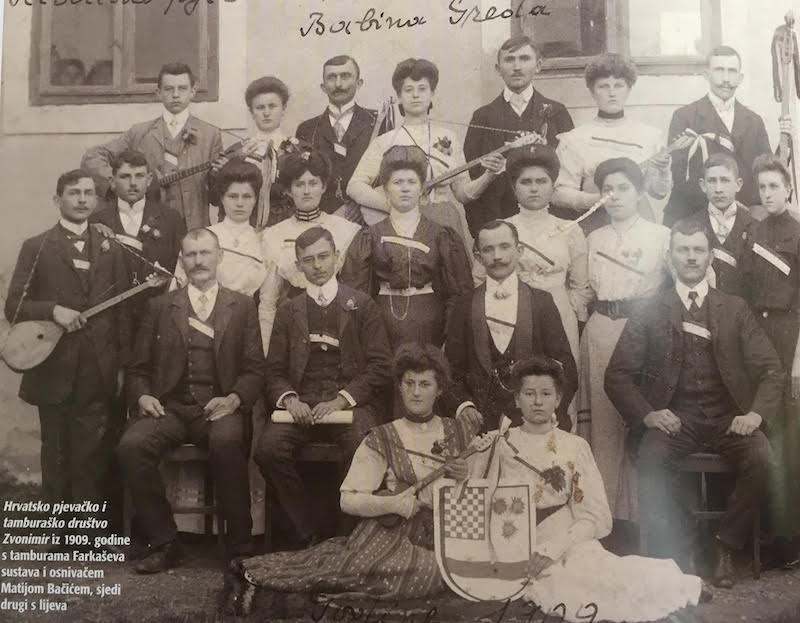
Hrvatsko pjevačko tamburaško društvo "Zvonimir", Babina Greda, 1909.
(Croatian singing and tamburitza society "Zvonimir", from Babina Greda,
1909). Source Mihael Ferić: Hrvatski
tamburaški brevijar /
The Croatian Tambura Breviary, Šokadija,
Zagreb, 2011., fascinating book with 1300 photos on 500 pp. Two girls
are sitting by the Croatian Coat
of Arms.
Uzalud vam trud svirači
Prljavo kazalište
   Bm                 Em
1. Sto put sam se evo zakleo,
    A7           D         F#7
   pred jutro te prevario.
   Bm                   Em
   Drugoj ja sam bagrem nosio,
   A7            D
   tebe iznevjerio.


2. Sto put sam se evo zakleo,
   pa te prevario.
   Sad bih dukate od jada
   D0    F#7     Bm
   Baš u blato bacio.


   Refrain (2x):

   Bm               Em
   A za oblak mi se mjesec skrio,
   A7        D F#7
   sakrio mi pute.
   Bm              Em
   Uzalud vam trud svirači,
   Bm           F#7     Bm
   za drugog su dunje žute.


2. A ja evo nekad sjetim se,
   što moj ćaća znao reći je,
   Sveti duše s idile slavonske,
   uz pjesmu prebole, al ne oproste.

   2xR.

3. Uz pjesmu mi se evo rodimo
   uz pjesmu umiremo.
   Slavonijo, tko te nije volio,
   ne zna što je izgubio.
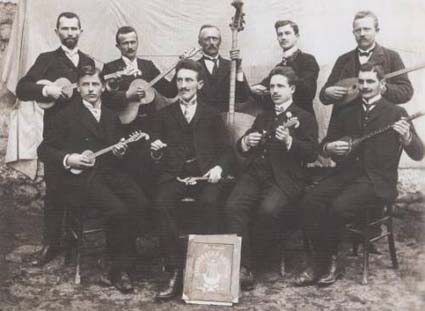
Croatian
tamburitzans in
Slovenia around 1910
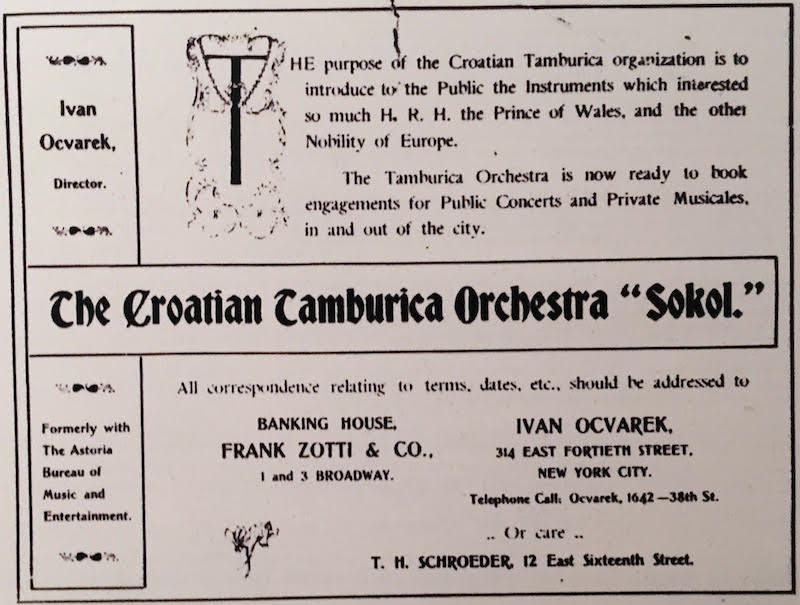
H. R. H. the Prince of Wales was very
interested in tamburitza instruments, as well as other Nobility of
Europe.
Source of the photo Tambura Museum, Slavonski Brod.

Croatian Tamburitza Orchestra "Sokol" (Falcon) in New York, circa 1900.
Source Vladimir Novak:
CROATIANS IN AMERICA, A Photomonograph, Zagreb - Croatia, 2013

Kansas City Tamburitzans (from Strawbery Hill),
circa 1905. Photo by the courtesy of dr. Ante Čuvalo.
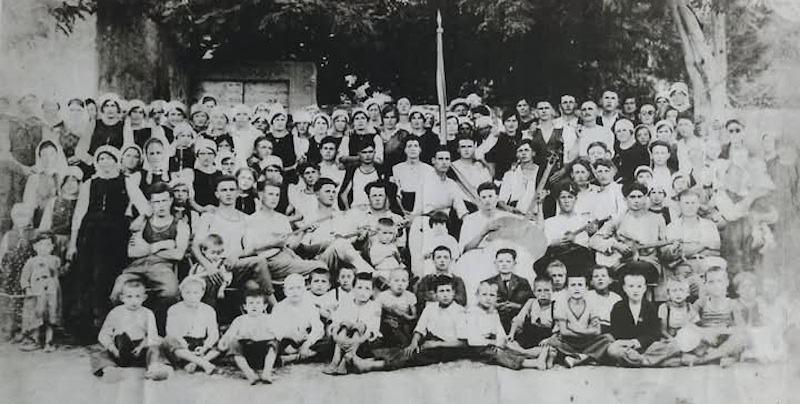
Tamburitza orchestra in the town of Tkon on the island of Pašman near Zadar, Croatia,
from the beginning of the 20th century.
Photo sent to us by Dražen Pribilović, Tkon.
S onu stranu Plive
Traditional song of Bosnian Croats
     D              A
1. S onu stranu Plive
    Em     A       D
   gajtan trava raste.
   G              D
   Po njoj pasu ovce,      |
   Bm        D    A    D   | 2x
   čuvalo ih mo - o - mče. |

2. Momče tužno plače,
   još tužnije ječi:
   Svaka tuđa zemlja
   tuga je golema.

3. U tuđemu svijetu
   bez oca i majke,
   svaka tuđa zemlja
   tuga je golema.
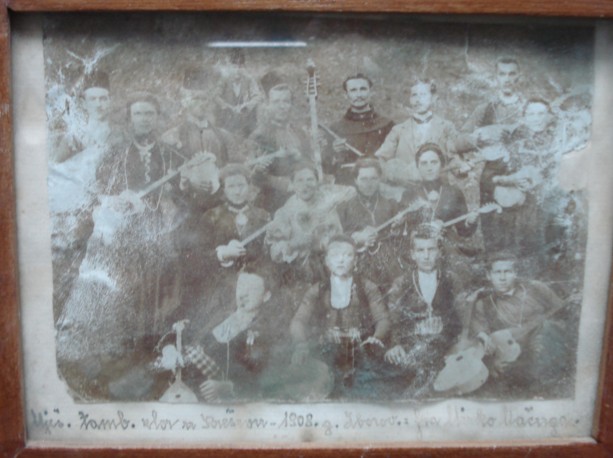
Mixed
tamburitza orchestra from Kreševo, 1908,
BiH
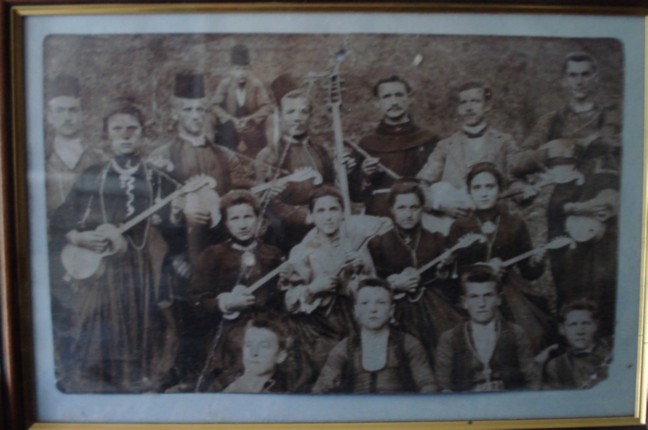
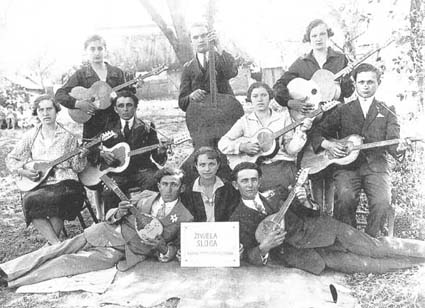
Virovitica
(Živjela sloga), 1919
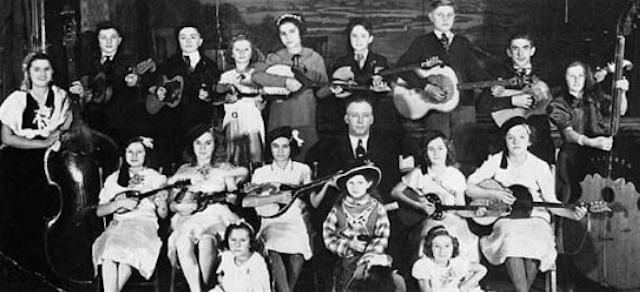
Croatian tamburitzans from Sudbury Ontario, Canada, from 1937 (above)
and 1940 (below).
Note that mostly women are players. Source Vinko Grubišić:
Usponi i padovi Hrvatske seljačke stranke u Kanadi,
Hrvatska revija , no. 4, Zagreb 2012., pp. 84-90.
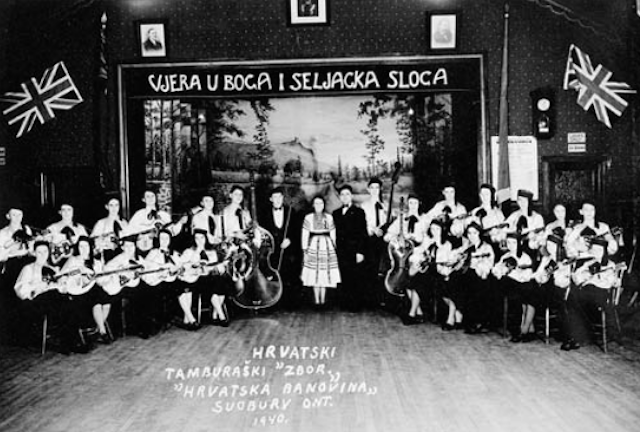
Hrvatski tamburaški zbor "Hrvatska Banovina" (Croatian tamburitza choir
"Croatian Banovina"),
Sudbury Ont. 1940. The inscription above the orchestra reads as
VJERA U BOGA I SELJAČKA SLOGA (Belief in God and peasant concord)
Another song by Zvonko
Bogdan written in the sweet Croatian ikavian
dialect.
PIVAJTE PISME BUNJEVAČKE!
Hej, salaši
Zvonko Bogdan
   A      E        E7        A
1. Hej, salaši na sjeveru Bačke,
   A   E                E7 A
   u vama su pisme bunjevačke.
   A    G7   F#7          Bm   Dm
   A tambura tako lipo svira,     |
   E          A           E A     | 2x
   ko da note par slavuja bira.   |

R. Ni svatova nigdi takih nema,
   ko kad baćo kćer na udaj' sprema.
   Na snaši se bili šlajer vije,
   ko kad zimi snig salaš pokrije.

2. Hej, Bunjevci na sjeveru Bačke!
   Sačuvajte pisme bunjevačke!
   Pivajte ih još puno godina,
   vaša j' grana mala, al' je fina.

R. I lumpujte, al' lipo polako.
   Nek se divi i nek vidi svako.
   Pa nek vranci pokidaju štrange,
   kad se krenu momci na vašange.

 štrange = remenovi
 vašange = maškare
The melody of the song Fijaker stari, for which Zvonko Bogdan wrote verses, is known in Croatia for very long, at least from the beginning of 20th century. Indeed, Bogdan has taken the melody of an old Croatian song Zrtva ljubavi, known at least from the beginning of the 20th century. I owe this information to Dunja Knebl, well known interpreter of old, forgotten Croatian songs, in particular from Međimurje.
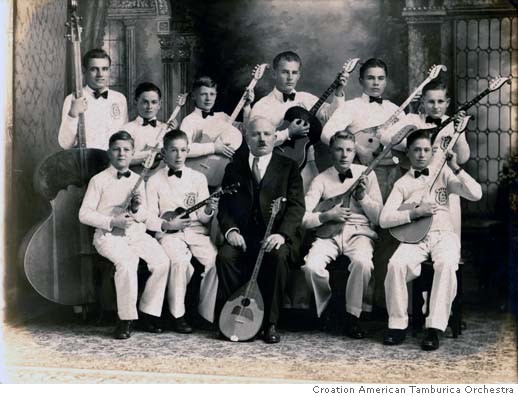
Those wishing to learn more about the history of Bačka Croats (Bunjevci and Šokci) may consult the following books written by Ante Sekulich (born in Backa):
- Bački Hrvati - Narodni život i običaji, Zbornik za narodni život i običaje Južnih Slavena 52, JAZU (now HAZU - Croatian Academy of Sciences and Arts), Zagreb, 1991 (519 pages)
- Rasprave o jeziku bačkih Hrvata, Matica hrvatska, Zagreb, 1997 (291 pages)
- Umjetnost i graditeljstvo bačkih Hrvata, Matica hrvatska, Zagreb, 1998 (171 pages)
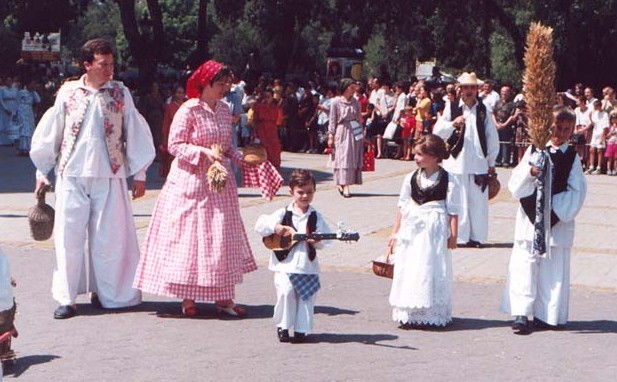
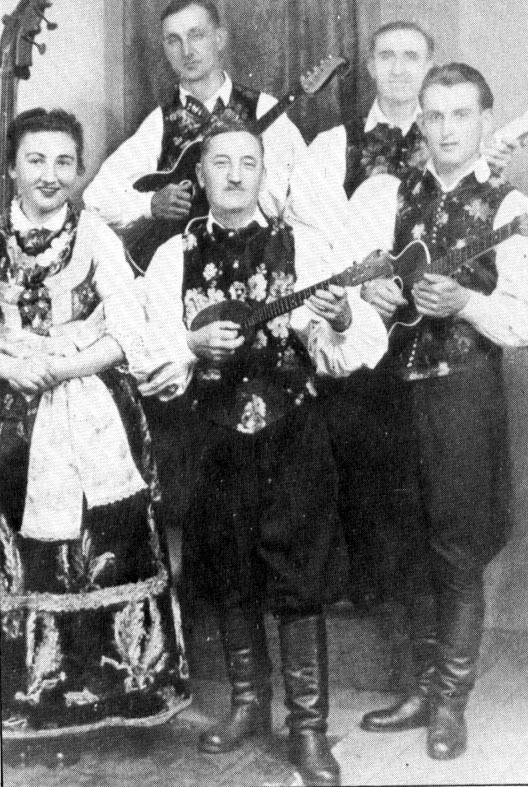
Another
classic of tamburitza play, one of the most popular among the Bunjevci
Croats in Bačka.
Kolo igra, tamburica svira
verses by N. Kujundžić, music by S. Mukić
D A DOne of the greatest tamburitza players among Backa Croats was Pere Tumbas - Hajo (Bunjevac, dika Bačkih Hrvata iz bile Subotice).
1. Kolo igra, tamburica svira,
G G7 D
pisma ječi, neda noći mira.
Svud se čuje, svud se širom znade,
Da Bunjevac dušu ne izdade.
G C C0 G
R. Veseli se, svako mu se divi, |
D D7 G | 2x
nek se znade da Bunjevac živi! |
2. Nije majka rodila junaka,
ko' što j'sinak divnih Bunjevaka!
Nit će majka roditi junaka,
ko' Bunjevca, tak(v)og veseljaka.
R. Kolo vodi, svaki mu se divi,
nek se znade da Bunjevac živi!
3. Ni divojke ne biše u nane,
ko' što j'ćerka bunjevačke grane.
Svilu nosi, a zlatom se krasi,
crne oči, crne su joj vlasi!
R. Kolo igra, svaki joj se divi.
Nek se znade da Bunjevac živi!
4. Ori, pismo, tambur tamburice,
nek se čuju daleko ti žice.
Nek se gori, a i doli znade,
da Bunjevac dušu ne izdade!
R. Prelo kupi, svaki mu se divi.
Nek se znade da Bunjevac živi!
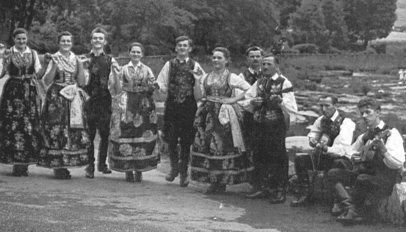
Hajo
(third from the right)
with his orchestra
in Langolen, England, 1952
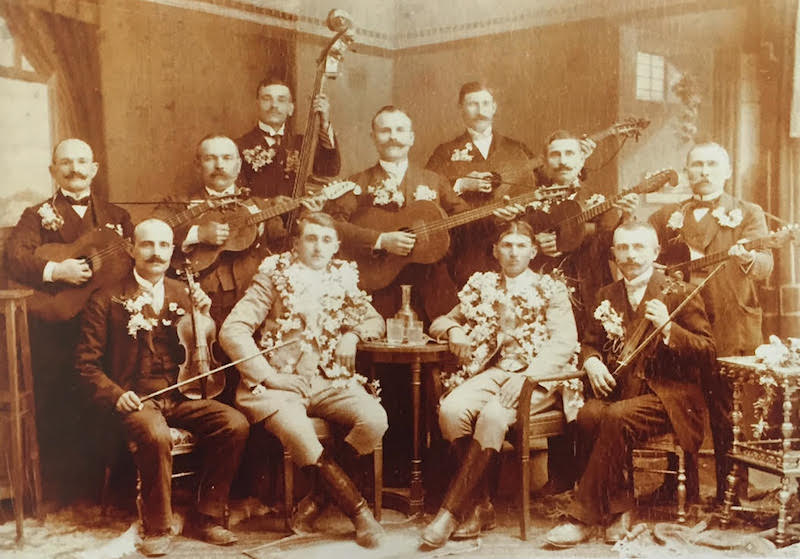
Bunjevci Croatians in Bačka:
polivači accompanied with tamburitza orchestra, Subotica 1914.
Source Naco Zelić: Slikovali smo se.
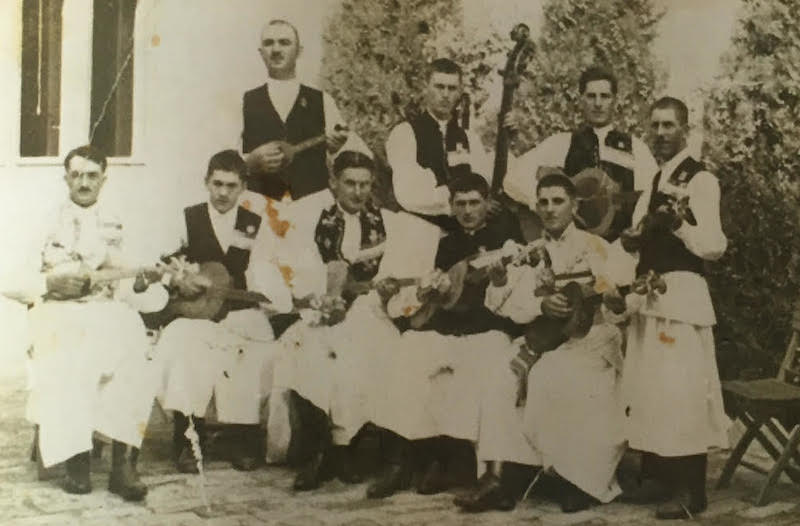
Bunjevci Croatians in Bačka:
Tamburitza players from Tavankut 1938. Source Naco Zelić: Slikovali smo se.
Many thanks to Mr. Naco Zelić for permission to reproduce these photos
here.
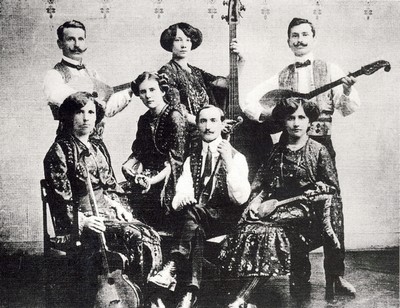
Tamburitza orchestra originating from
Varaždin, Croatia, as guests in the USA, 1900.
Note a nice lady playing bass,
which is rather unusual. Source: Mr. Vladimir
Novak, Zagreb.
Kraj kapele sv. Ane
Marko Vukasović, Stojdraga, Žumberak
  Dm                     Gm
U tankoj knjizi mojega života
 A7                       Dm
pronađe se mnoga lijepa strana
    Dm                   Gm
al sreću ćutim ponajveću tada
 A7                       Dm
kad se sjetim mladenačkih dana.

 F                          C
Slušam pjesme svojih prijatelja,
 C            Bb7        A7
slušam pjesme radosti i veselja.
 Dm                    Gm    E
Vidim dragu što me sad ostavlja,
 C                     C7  F    C7
nju mi srce još ne zaboravlja.

                  F
Kraj kapele svete Ane
C#+        Gm      C7   F
prošla je mladost naša sva.
F  C#+         GmC7
Mala tek klupa ona,
     Gm         C7           F    F7
sve slatke naše tajne pričat zna.

Bb  Bb0                     F     Dm
Tamo, sprovodili smo sretne dane,
             Gm        C7
u zagrljaju ljubavnom,
C7           Bb7A7   C7
u carstvu prirodnom.

	          F    C#+
Kraj kapele svete Ane,
              Gm      C7    F
u samoborskom divnom kraju tom
Kapela sv. Ane is near the town of Samobor.

www.croatoan.ca,
Croatian
folklore ensemble Croatoan,
Ottawa, Canada
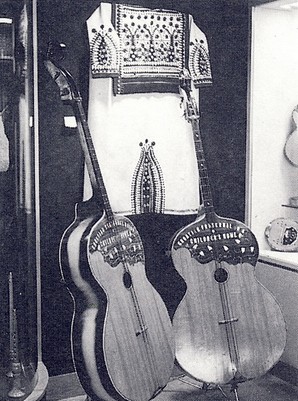
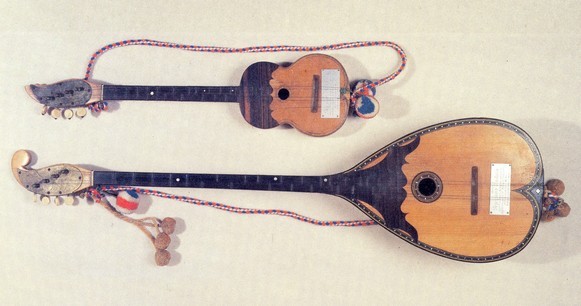
Tamburitza instruments
exhibited in the Museum of Croatian Fraternal Union in Pittsburgh, USA.
Source: George Prpic, The
Croatian Immigrants in America,
New
York, 1971.
Sidi Mara na kamen studencu
Traditional Croatian song from Srijem
Em Am B7vincu = vinac (vijenac) = here has the meaning of prayer-book (molitvenik)
1. Sidi Mara na kamen studencu,
Am6 B7 Em
svoju tajnu otkrila je vincu.
G C G0 G
Suzama ga orosila Mara, |
G C G D7 G | 2x
sudbinu je svoju oplakala. |
2. Maro, Maro, od bisera grano,
Maro, Maro, sunce ogrijano.
Lipča si od biloga goluba,
pođi za me i budi mi ljuba.
3. Od lozice mladog vinograda,
Lipa Maro, pravi'ću ti lada.
Nosi'chu te na rukama dvima,
jer od mene boljeg momka nima.
4. Što che meni i srebro i zlato,
kad ja nimam što je srcu drago.
Imala sam svoga zaručnika,
bio mi je i ponos i dika.
It is little known that this very old and popular Croatian song was originally sung in IKAVIAN dialect. Here we present its version from the city of Subotica, as the Bunjevci Croats used to sing until mid 20th century. I learned this from older people from Subotica, whose grandparents sang it like this.
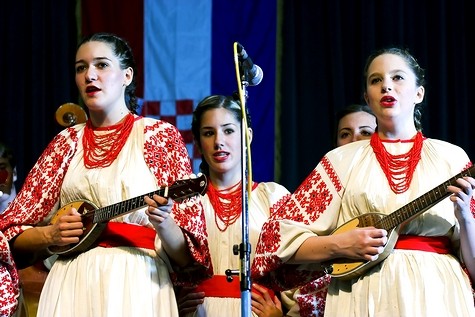
CroatiaFest 2005, Seattle, USA,
Photo - Jal Schrof
It seems that "Sidi
Mara..." is therigin for the melody of ALOHA
OE (Farewell to Thee), famous
Hawaiian song and the national anthem of Hawaii. Its words were written
by Her Majesty Queen
Liliuokalani
around 1877.
Possible Croatian origin for the melody of ALOHA OE
is indicated in an article written by John Berger in HAWAII
MAGAZINE, August 1996, p. 41. Very close relation between
the melody of "Sidi Mara..." and ALOHA OE has been indicated
by Branimir Vidmar,
Timmins, Ontario, Canada, 1978. Vidmar also
indicated
that the melody is close to American gospel "How Great
Thou Art," composed by K. Hine. It is also worth noting
that "Sidi Mara..." has
Austro-German version called Die
Träne, and
the English version is The Tear
(this can also
be seen from Vidmar's sheet music). As stated in Ripley's Believe
it or
not, Hawaiian music is the
creation of a German
bandmaster captain Henry Berger
(1844-1929), invited to
Hawaii by King Kamehameha V in 1872. Berger composed the
first Hawaiian songs which "he adapted from German folk
tunes." He composed 72 famous Hawaiian songs, including
ALOHA OE and the Hawaiian national song. We can be pretty
sure that the "German tune" adapted to Hawaiian ALOHA OE was
in fact Croatian song "Sidi Mara...", which Berger obviously
knew as "Die Träne."
I
express my gratitude to Adam Eterovich, USA,
for
copies of sheet music which very clearly confirm the above views,
and for the above mentioned article from Hawaii
Magazine.
It is also worth noting that, according to Eterovic, the husband
Hawaiian Queen Liliuokalani was a Croata - John
Dominis,
whose father was born in Venice, and whose grandfather was
born on the Croatian island of Brac, in the lovely town of
Pucisca. Recall that Dominis = Gospodnetic, for example Marko Antun de Dominis.
Eterovic believes that Hawaiian Queen could have opportunity
to hear the Croatian song "Sidi Mara..." when she was hosted by the
English
Queen.
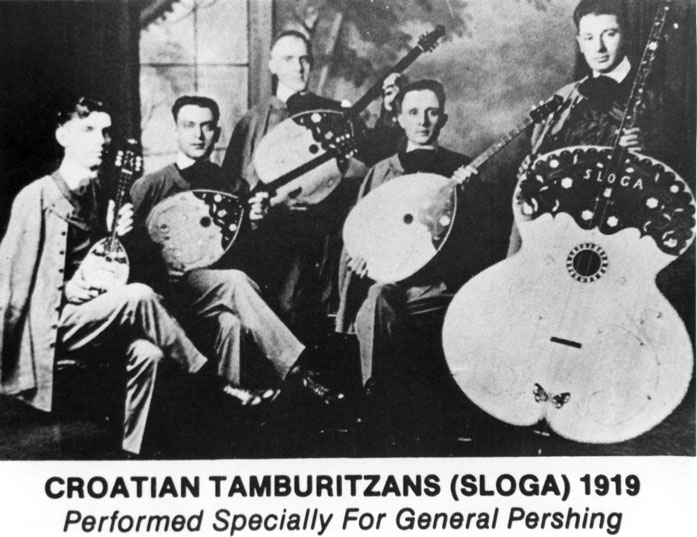
Very beautiful and original type of songs among Bunjevci Croats in Bačka are the so called groktalice. They are very emotional, sung slowly in a trembling voice, without any instrumental accompaniment.
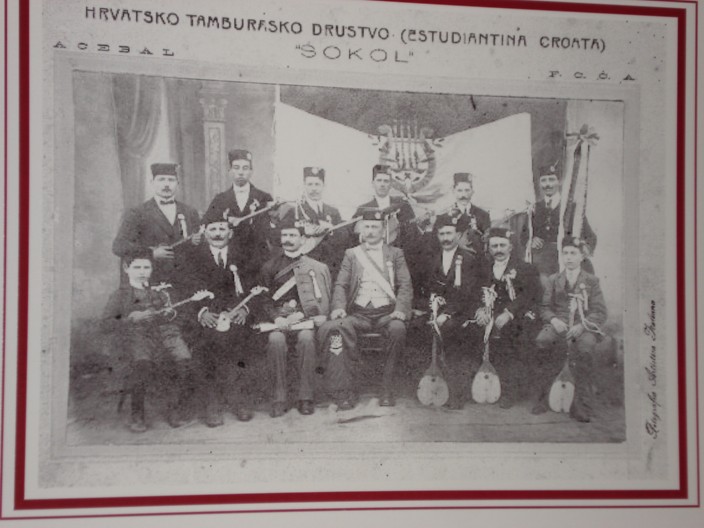
Croatian
tamburitza orchestra
Falcon - Hrvatski tamburaski orkestar Sokol,
Argentina, 1919 (from an exhibition Los Croatas en Argentina, Carmen
Verlichak,
Matica iseljenika, Zagreb 2007)
Here is a well known children's verse from Subotica, as older people still remember:
Eci,
peci, pec,
ti si mali zec,
a ja mala pripelica,
eci peci pec.
Note "pripelica" instead of "vjeverica"!
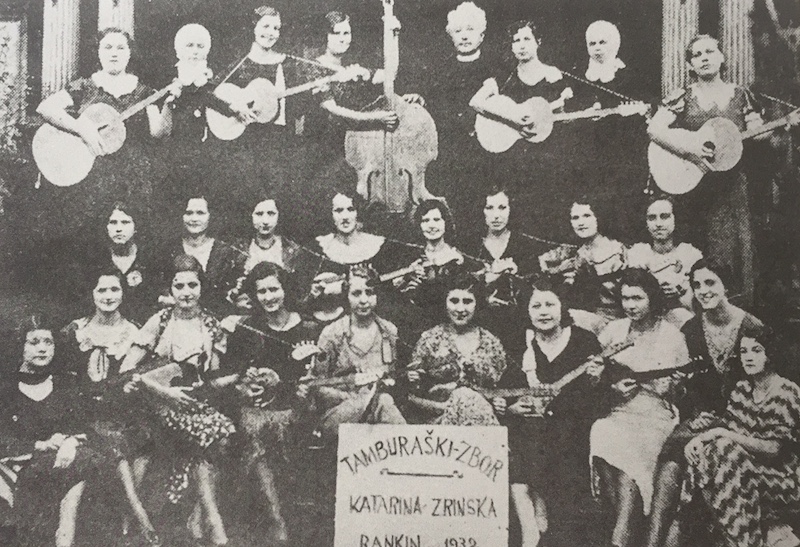
Tamburitza orchestra Katarina
Zrinska, Rankin, USA, 1932, composed entirely of ladies.
Source of the
photo [Vladimir Novak,
Croatians in America].
Veliko je more
Traditional Croatian song
 A
Veliko je more,
 A           E
ne vidiš mu kraja.
           E
Tamo u daljini
 E              A
sa nebom se spaja.
U dubini njemu
sto se čuda krije.
Galebova jato
nad njime se krije.
Po njem bijela lađa
u daljinu plovi.
Na njoj su mornari
hrabri sokolovi.
Na žalu su djeca,
molitvom ih prate,
da se svome domu
opet sretno vrate.
I learned this song from my mother Katica Žubrinić b. Suntešić, and she learned it in 1942 from her school-teacher Štefica Rubin in Sveti Križ Začretje.
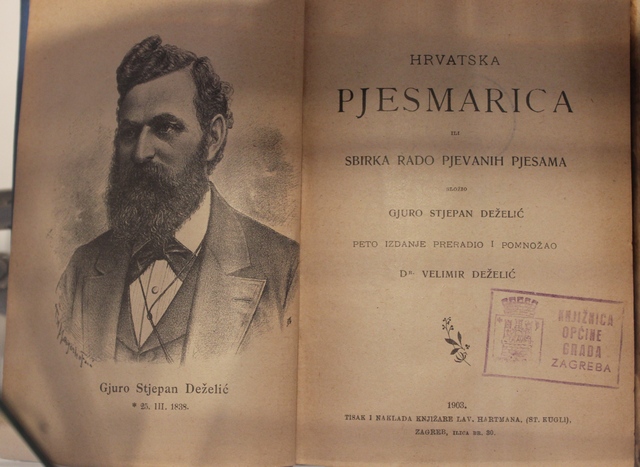
Gjuro Stjepan Deželić: Hrvatska pjesmarica, Zagreb, 1903.
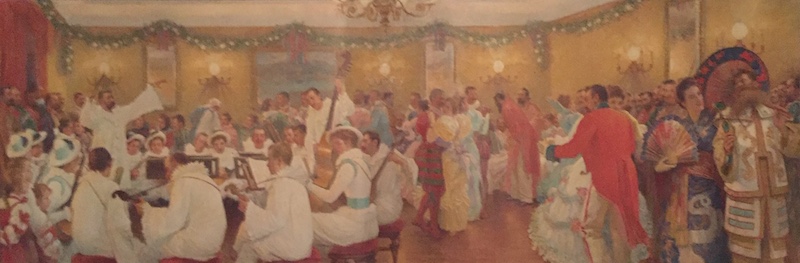
Vlaho Bukovac: Cavtat tamburitza orchestra (Cavtat is a small, very
nice Croatian town near Dubrovnik), around 1900.
All the persons appearing on the photo are known. This painting (of
large dimensions) is kept in the Baltazar Bogisic Museum in Cavtat.
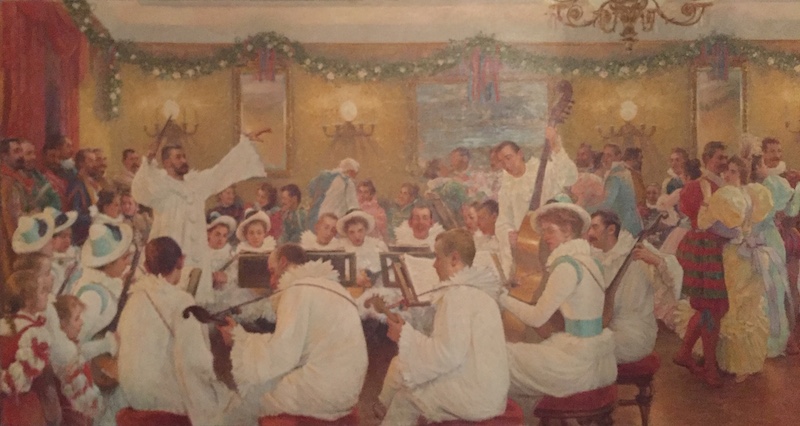
A detail from the above photo, the left part.
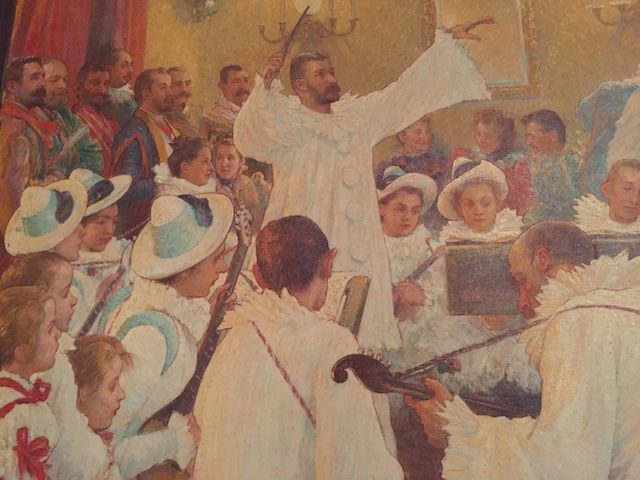
Vlaho Bukovac is sitting on the right, playing tamburitza. On the left
are his three children,
and just above his forhead is his wife, also playing tamburitza.
As we can see, tamburitza play had
a great social role, in which both men and women actively participated.
ZAPIVAJ PISMU RIBARU STARI!
Ribar plete mrižu svoju
Traditional Croatian song
          D     G     D
1. Ribar plete mrižu svoju,
   Bm    Em    A  D
   koja njemu triba.
         G            A  D
   A tko će je sutra plesti,
   Bm      Em   A D    D7
   baš ga nije briga.


           G                D
   Zapivaj pismu, ribaru stari,

   Bm        Em      A D
   jer to je pisma o moru. 2x


2. More divno, more plavo,
   ti si meni drago.
   Ti si čežnja srca moga,
   ti si moje blago.

   Biseru divni, rodnog mi kraja,
   lipota tvoja me opaja.
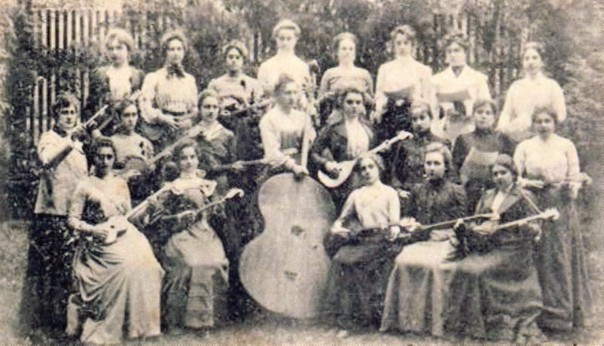
Tamburaški
zbor "Kluba
učiteljica" (Tamburitza orchestra of Women's Professor's Club, Vrbnik,
island of Krk),
source: Prof. Mira Katunar, Vrbnik
- grad "popi i
mestric", Vrbnički Vidici, p
16, 2006, Vrbnik (photo around 1900?)
VILA VELEBITA
         A                E
1. Oj ti vilo, vilo Velebita
   E               A
   Ti našeg roda diko
   A                       E
   Tvoja slava jeste nama sveta
   E              A
   Tebi Hrvat' kliko:

           D     A
R. Ti vilo Velebita
            D      A
   Ti našeg roda diko.
   A
   Živila premila
   A
   Živila premila

   D          E    A
   Živila, oj premila

            E       A
   Ti vilo svih Hrvata.

2. Velebite, vilovito stijenje,
   ja ljubim tvoje smilje,
   Ljubim tvoga u gorici vuka
   ličkoga hajduka.

R.
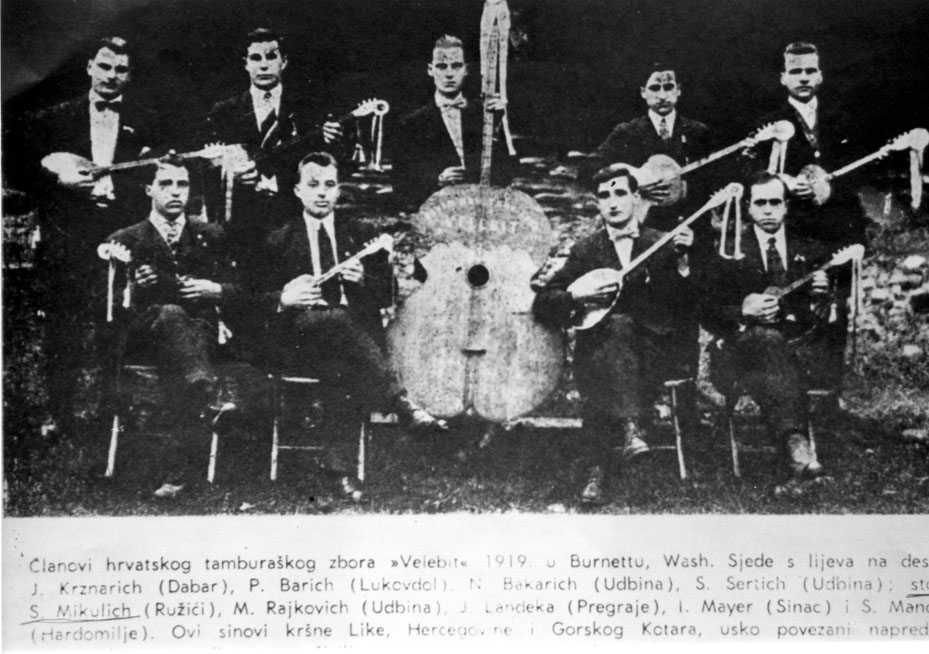
Tamburitza
orchestra "Velebit" from Croatia in
the USA, 1919
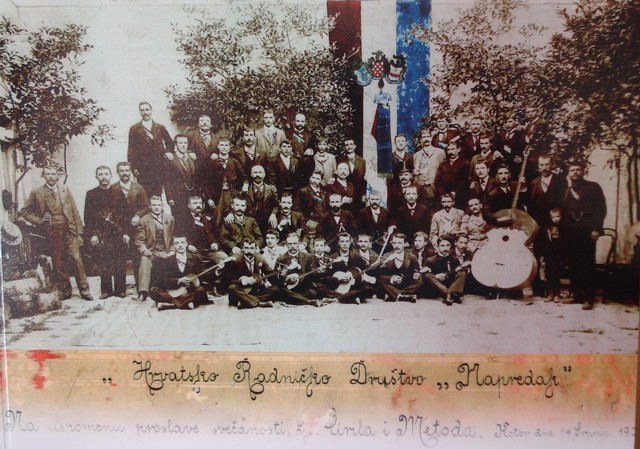
Croatian
Working Society Progress (Hrvatsko
Radničko Društvo Napredak), Kotor
1901
From the front cover page of Stolačko
kulturno proljece,
Godišnjak za
povijest i kulturu, god. VII., 2009.
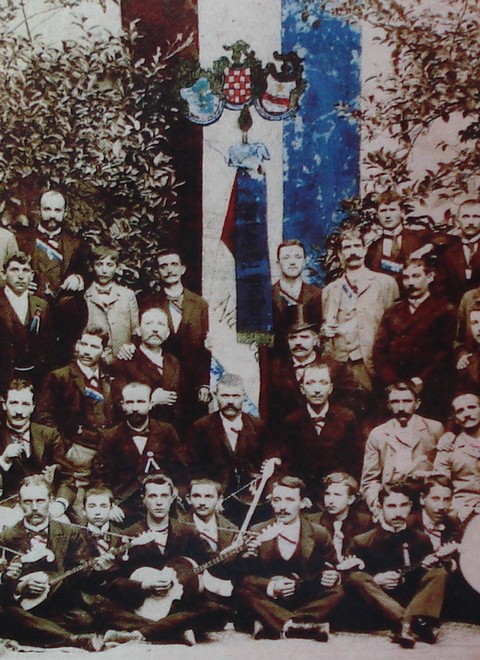
Note Croatian
Coat of Arms on the tricolor
flag
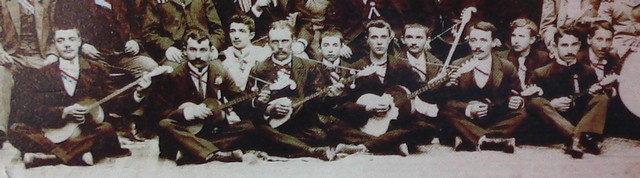
Croatian
tamburitza players in
Kotor in 1901; source [Čurić
ed.].
If you want to create excellent atmosphere at a birthday party, I suggest you the following very attractive traditional song from the north of Croatia, with fantastic music and verses:
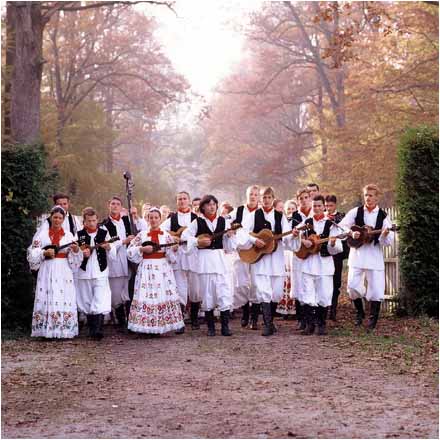 Dobro
jutro moj svečaru (Rođendanska)
Dobro
jutro moj svečaru (Rođendanska)
Traditional from Podravina
D G DMany thanks to Mr. Robert Los for permission to use the above photo.
1. Dobro jutro moj svečaru,
D G D
dobro jutro ti želim!
D G D
Ja ti sviram, ja ti pjevam, |
Em A7 D | 2x
čestita-am ti rođendan! |
2. Sretna bila tvoja majka,
koja te je rodila!
Koja te je svojim mlijekom
na noge postavila!
3. Srebra nemam, zlata nemam,
nemam ništa da ti dam!
Samo ovu pjesmu pjevam,
za tvoj mili rođendan!
svečar = slavljenik
One can hear very often the following variant instead the third stanza (you can add it as the fourth stanza if you want):
3' Mnogo ljeta sretan bio,
   mnogo ljeta živio!
   U ljubavi sretan bio,
   mnogo lje-eta doži-ivio!
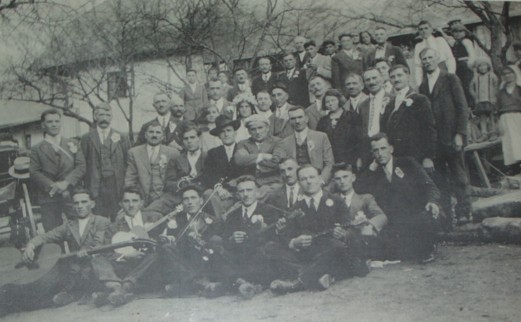
Wedding in Zumberak (near Zagreb), 1930.

Beautiful song about Zagreb in the kajkavian language.
Za nikaj na svetu ja menjal te nebi
Unofficial anthem of Zagreb, by Drago Brahm
      G        B7       C          G
1. Za nikaj na svetu ja menjal te nebi,
       Am         D7      G     C G
   moj Zagreb tak imam te rad!
         G      B7       C         G
   Svoj dom i veselje se našel vu tebi,
      Am       D7        G
   za mene najljepši si grad!
       C       D7         G       E7
   Se vugle ti poznam, se vulice znam,
      A7                Am7          D7
   vu tebi sem srećen i nigdar nis' sam.
     G          B7       C         E7
   I gde god vu svetu, popeval bum rad,

      A7              Am7      D7 G#+
   tu malu popevku posluhni ju sa-ad:


       G   Am  D7 G         G7
R. Jer ti, ti, najdrajši si mi,
        C       D7        G        Em
   najslajša popevka v živlenju si mi!
      C      D7      G     F   E7
   Vu mojemu srcu najlepši si grad,
       Am7        D7       G    C G
   moj Zagreb tak imam te rad!


2. Nigdar se ne vrneju najljepši cajti,
   kaj v tebi sem sprovel ih ja.
   Ali ipak vu tebi ja štel bi se najti,
   i srećen bi bil, to se zna.
   Ja sikud bi išel, naluknul se rad,
   z uspinjačom otpelal bi v gornji se grad.
   Pogledal bi Zagreb, i kušlec mu dal,
   još jenput spopeval kaj lepše bi znal!

   R.


3. Se kaptolske hiže i vu njem se crkve
   se blešćju v sunčeku sad.
   Al' ipak to jesu najlepše starine
   kaj ima ih naš gornji grad.
   I Sava se cakli, i potoki si,
   a z Gornjega Grada nam cinkuš zvoni.
   I gda buš me Zagreb ti trebal il zval,
   svoj život i srce za tebe bum dal!

 R.
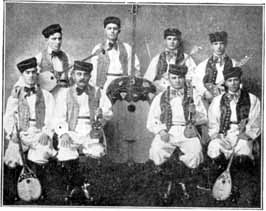
Croatian tamburitza orchestra in Buffalo, USA, 1887.

Photos by the courtesy of Emina
Kurtagić, Zagreb.
These are Croatian captives on the Russian front, 1916-1918. Her
grandfather, Karlo Spiller (Osijek), is playing the bass.

Bože
čuvaj Hrvatsku
    D   Em    A     D
1. Bože čuvaj Hrvatsku,
    D    A    D
   moj dragi dom,
    G    A     D   Bm
   ljude koji blaguju
   Em    A     D
   pri oltaru tvom.


2. Nek se sliju molitve,
   sve u jedan glas.
   Čuvaj ovo sveto tle,
   blagoslovi nas.


   Em   A    D
3. Ako treba Gospode,
   Em   A    D      D7
   evo primi zavjet moj.
   G     A     D   Bm
   Uzmi život od mene
   Em    A      D
   pa ga podaj njoj.


4. I u dobru i u zlu
   budi s nama, budi s njom.
   Bože čuvaj Hrvatsku,
   moj dragi dom,

   Bože čuvaj Hrvatsku, moj dragi dom.

Tamburitza orchestra in the city of Hvar on the island of Hvar, 1902-1912.
Source: Zbirka hvarskog povijesnog kazališta, katalog, Muzej hvarske baštine, Hvar 2024., str. 132.
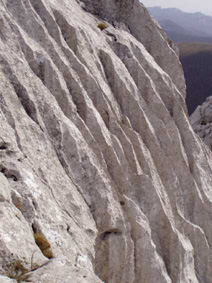
Interesting harmonic passages can be obtained in some of our folk songs using + (or aug) chords, for example in ``Poleg jene velke gore'' or ``Kraj kapele sv. Ane''.
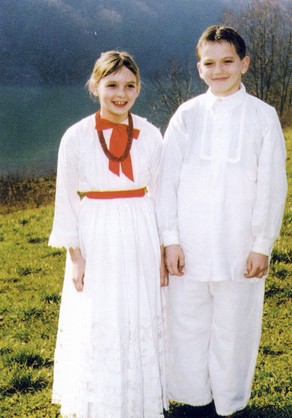
Croatian
national costume from
the Pokupsko region
(river Kupa, south of Zagreb).
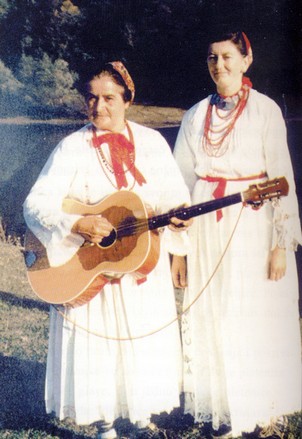
Croatian
women from the
Pokupsko region
(Kupa river south of Zagreb).
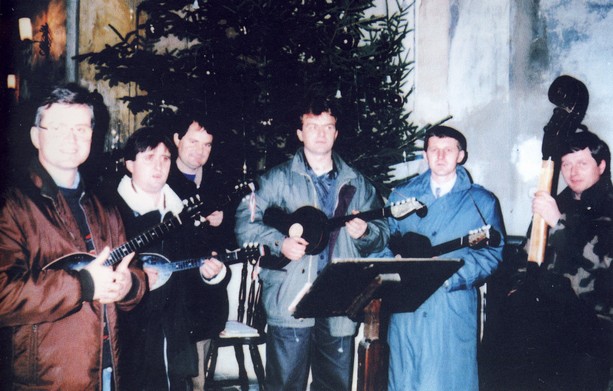
Pokupsko
tamburitza players
celebrating Christmas...
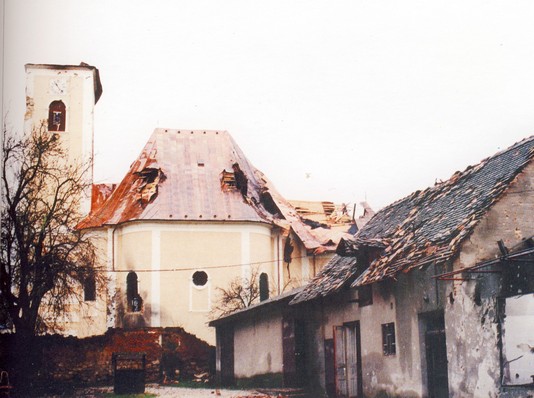 |
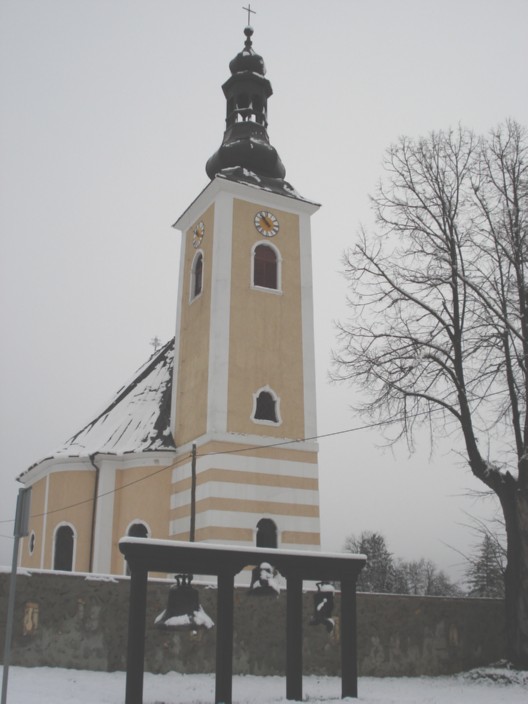 |
... in their ruined church on the left. Reproduced from [Pokupsko], many thanks to Mr. Božidar Škrinjarić for permission. On the right is the renovated church (2007), with three shattered bells in front of it, destroyed during the Greater Serbian agression in 1991.
I hope that with these few musical examples I managed to convince You in the usefulness of back-cycling and parallel chords. You will hear them very often on recorded materials on the radio and elsewhere (just listen carefully). I assure you that Croatian folk provides an amazing amount of examples for many interesting harmonic mechanisms! If you don't believe, look at:
Međimurske narodne pjesme
More details can be found in my booklet ``Gitara za radoznalce'' (some libraries in Zagreb possess it). For those interested I must say that at this moment it is not available.
Remark In the literature you will see the song ``Oj, jesenske duge noći'' sometimes attributed to Branko Radičević, which is wrong (this error appears in my booklet as well!) - the author is Ivan Trnski, a Croatian poet.
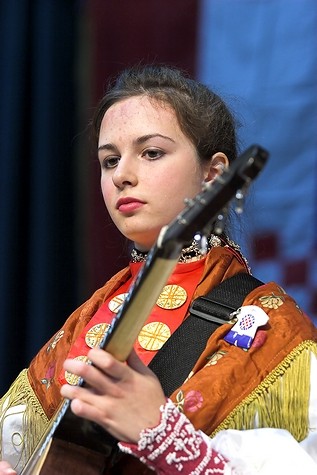
CroatiaFest 2005, Seattle, USA,
Photo - Jal Schrof
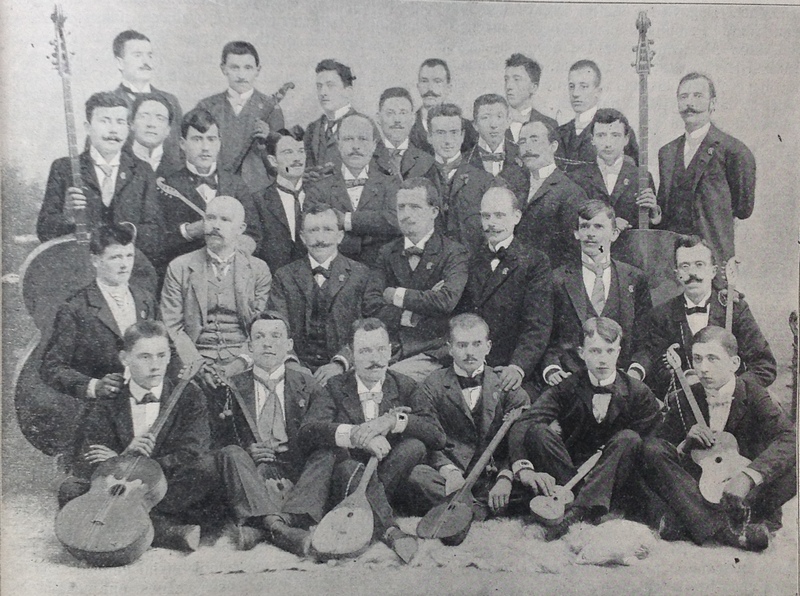
Singing and
tamburitza society Laurel
(Pjevačko i
tamburaško društvo Lovor)
from Opatija, not later than 1907.
Veliki Æirilo-Metodski koledar za 1907., str. 85
A final remark (with best intentions): The Institute of Folklore in Zagreb possesses an extremely valuable collection of more than 2000 folk songs collected mostly among the Croats in Bačka and Srijem by dr. Josip Andrić (1894-1967). Unfortunately, they are still unpublished. Maybe this remark will be a necessary impetus to make this invaluable collection accessible to the wider audience, especially to those youngsters playing tamburitza. Our national instrument is an object of the study on the Academy of Music in Zagreb, similarly as done by other nations having their own national instruments.
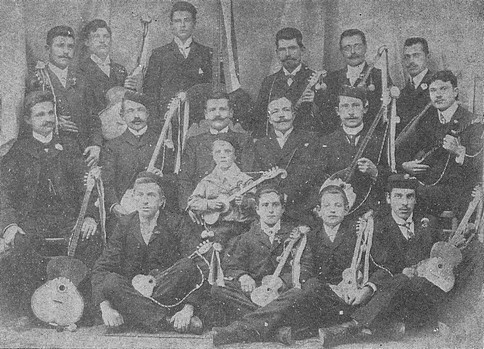
Croats
in Punta Arenas, Chile
(Magallanes region), with their tamburitzas
Croatian tamburitza band
Tomislav in Punta Arenas, 1905
Hrvatsko tamburasko
društvo Tomislav, Punta Arenas,
1905
(photo from Lj. Antić, Hrvati u J. Americi, Zagreb, 1991, pp 182 and
266)
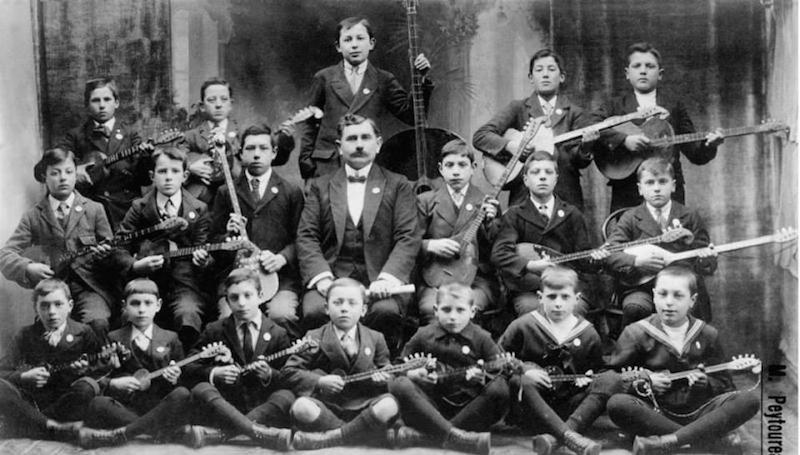
Hrvatsko tamburaško društvo Tomislav (Croatian tamburitza band
Tomislav), Punta Arenas, Chile, 1916.
The most beautiful book I know, devoted to the thorough treatment of Croatian folk songs in Croatia as well as in Bosnia and Herzegovina and Serbia, comprising excellent photos of various dances and national costumes, is
dr. Vinko Žganec: Hrvatske narodne pjesme (Croatian folk songs)
published by Seljačka sloga, Zagreb 1951, with the parallel text in English. I saw it (to my greatest surprise) for the first time in May 1995. I suspect it was simply removed from our libraries in the fifties, for the reasons we can easily guess. Vinko Žganec collected more than 25,000 songs, among them 15,000 from his native Međimurje.
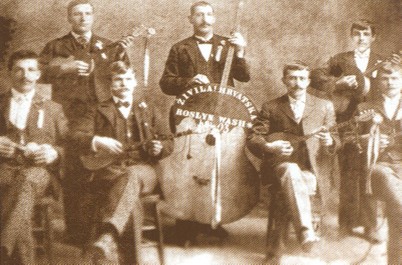
Tamburitza
orchestra "Zivila
Hrvatska" (Long Live Croatia), USA,
performed in White House for president F.
Roosewelt in 1900.

Croatian tamburitza choir "Lisinski" on the islnad of Vis. Photo
published in Prosvjeta
(Education) in Zagreb in 1903.
Its editor-in-chief was Emilij Laszowski. Note that almost half of the
choir consists of ladies.
Many thanks to Stjepan Sučić for sending us the photo.
I would recommend the reader an excellent book by Siniša Leopold, with a short history of tamburitza and accompanied with many Croatian folk songs, as well as some other references:
- Mihael
Ferić:
- Zasvirajte tambure 1, 2, Kulturni centar Gatalinka, Vinkovci, 2002 and 2003, ISBN:953-98989-1-9 and ISBN 953-98989-2-7 repectively
- Hrvatski tamburaški brevijar / The Croatian Tambura Breviary, Šokadija, Zagreb, 2011., fascinating book with 1300 photos on 500 pp.
- Tambura Museum, Slavonski Brod
- Siniša Leopold: Tambura u Hrvata, Golden marketing, Zagreb, 1995; for those wishing to know more about tamburitza play see
- Željko Bradić, Siniša Leopold: Skola za tamburicu, 2, kvartnog sustava, udzbenik za 1. i 2. razred osn. gl. skole, Skolska knjiga 92.
- Stipan Krekić: Tamburaška početnica, 84 str., Croatica, Budimpešta, 2003.
- Mate Kliković, Feri Sučić: Zajačimo si : zbirka najobljubljenijih hrvatskih jačak - 4. izd. s notami. - Željezno: Hrvatsko kulturno društvo u Gradišću - Kroatischer Kulturverein im Burgenland, 2003. - 159 str.
- Michael Savor: The Tamburitza and the preservation of Croatian folk music, on this web.
- Kolar, Walter W.: An Introduction to Croatian Musical Folklore, (Tamburitza) Pittsburgh, PA 1981
- Ivan Ivančan: Narodni plesni običaji Podravine 1., Kulturno-prosvjetni sabor Hrvatske, Zagreb 1989.
- Slavica
i Lana Moslavac: Kad
zasvira
lane moje, Pjesme i plesovi
Moslavine i hrvatske Posavine, Muzej
Moslavine Kutina, Kutina 2007.,
ISMN M-9013596-0-4 - Slavko Topić, Niko Luburić: Duša naroda, Svjetlo riječi, Sarajevo - Zagreb, 2007., ISBN 978-953-7091-41-5
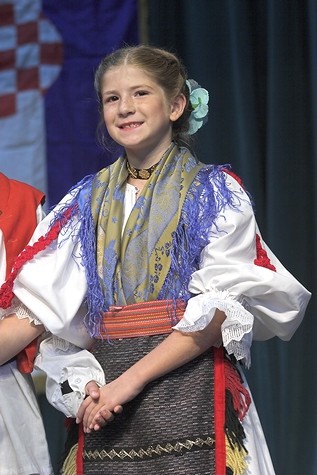
CroatiaFest 2005, Seattle, USA,
Photo - Jal Schrof
Tamburica links in Austria:
- www.tamburica.at, by Kristijan Karall
- Tamburaski Orkestar i zbor Pinkovac
- Krostischer Musikverein Tamburica, Hrvatsko glazbeno drustvo Tamburica, Voralberg
Tamburitza music in the USA:
- Croatian Fraternal Union (has 35 junior tamburitza ensembles!)
- www.sidromusic.com
For further information (sheet music, collections etc.) please contact:
- Muzička naklada, Zagreb, Nikole Tesle 10, Zagreb, tel. (+385-1) 481 14 41. Musical instruments.
- LADO
- Savez glazbeno-estradnih umjetnika izvođača Hrvatske, Zagreb, fax 01/445716,
- Školska knjiga.
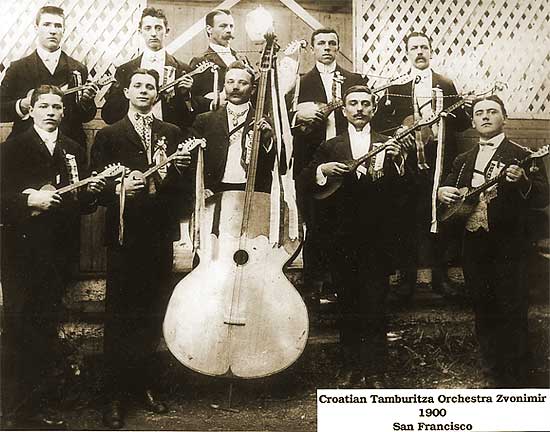
Croatian
Tamburitza Orchestra
Zvonimir, 1900, San Francisco, USA,
photo from Croatian
American Web
The following photos appear in a film by Jakov
Sedlar, Croats and Australia


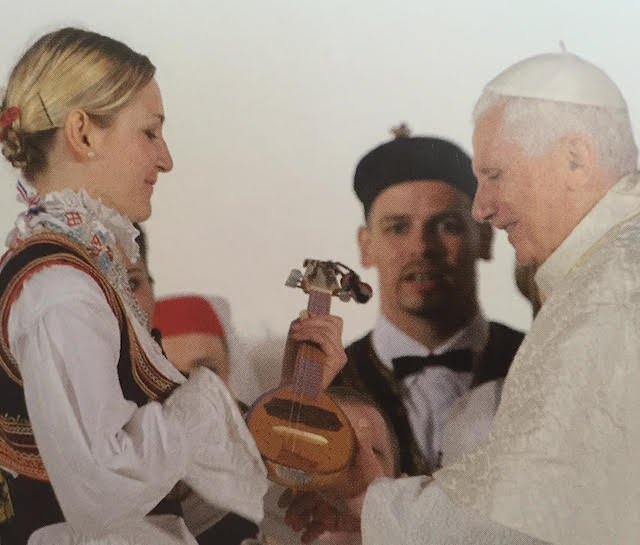
Tamburiza made by Andrija Franić from Županja, donated to Pope Benedict
XVI
during his apostolic visit to Croatia in 2011.
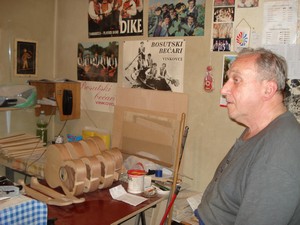
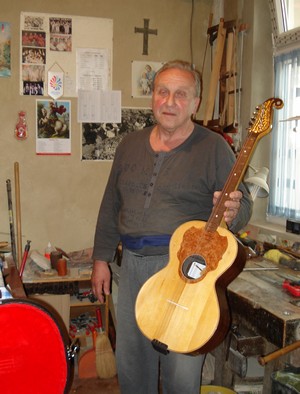
Mr. Ðuro Zarić, Vinkovci,
builder of tamburitzas
We would like to provide several addresses for those wishing to buy top quality tambura instruments (bisernica, prim, brač, bas prim, bugarija, čelo, bas):
- Djuro Zarić, Vinkovci, Duga ul. 37, tel. +385 32 334 743
- G. Tatić, Osijek, Kneza Borne 85, tel. +385 54 163 606 (prim)
- Nikolić Ilija, Osijek, Medulinska 20, tel. + 385 54 557 224 (brac = bas-prim)
- Marinko Katulić, Croatia - 10417 Busevec, Novo Selo bb, tel. +385 1 765 238
- Ivan Djuretić, Velika Gorica, tel. +385 1 714 385
- Postojnski Stanko, Srebrnjak 109, Zagreb (metal strings for all tambura instruments)
- Mr Kos, Pitomača.
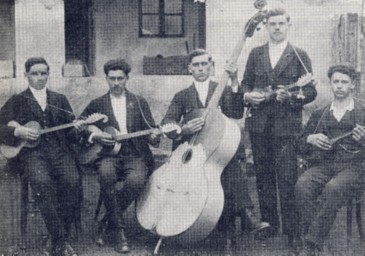
Tomo
Kos, a well known builder
of tamburas,
with his band from Pitomača, 1924 [Ivančan,
p.
177]
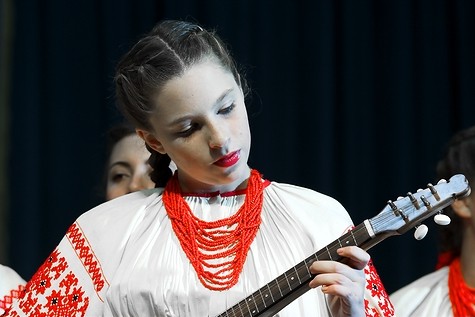
CroatiaFest 2005, Seattle, USA,
Photo - Jal Schrof
Branimir Kvartuč: Ðakovački vezovi (Ðakovo Embroidery)
- Croatian music
- Međimurske narodne pjesme
- Chords for Croatian Christmas songs
- MUZEJ TAMBURE, Brod
- Mihael Feric founded Tambura Museum in Brod na Savi
Croatia unique in the world
- Brodsko posavski vremeplov tambure
- Preservation of music tradition in Moslavina Croatia
- Stjepan Veckovic founder of Croatian Bagpipe Orchestra
- Tamburaski orkestar "dr. Antuna Barca", Grizane, Vinodol, Croatia
- Tekstovi mnogobrojnih hrvatskih narodnih pjesama
- The largest collection of Croatian songs on internet
- Planinarska pjesmarica
- CROATIAN TAMBURICA ORCHESTRA, Tingley Chautauqau, 1917, USA
- Najstariji tamburaški orkestri u Križevcima