Croatia - Great Britain
overview of historical relations - a sketch
Darko Zubrinic, 2004.Contents:
- General
- Dubrovnik
- Science
- Croatian Latinists
- Art
- Croatian Glagolitic Script
- Music
- Croats in Bosnia and Herzegovina
- WW1 - WW2
- The Lipik Orphanage and Colonel Mark Cook
- Sports
- Croatian mariners and captains
- International terminology
- Literature
www.hr/darko/etf/et01.html
www.hr/darko/etf/cravate.html
It is interesting that King Richard the Lion-Hearted (1157-1199) sojourned in Zadar (and not in Dubrovnik as it has been believed). Also Henry of Lancaster, the future King Henry IV, visited Zadar and Dubrovnik during his pilgrimage to the Holy Land in 1392 and 1393. See [Mardesic], p. 134-135.
George Bernard Shaw once visited Kornati, and wrote the following "On the last day of the Creation God desired to crown his work, and thus created the Kornati Islands out of tears, stars and breath"
Interesting impressions about the Croats can be seen in ``The Journey'' written by Thomas Watkins, published in London in 1792 (second edition in 1794). He praises Croatian soldiers (Esclavonian soldiers) and sailors. He was enthralled by the beauty of Dubrovnik, its hospitality, competent administration, high level of education and scholarship found among many of its inhabitants. He also cited some of the verses that the Durbovnik poets addressed to him as a guest. Talking about inhabitants of Dalmatia, he stated that they are ``in their attire and manners not unlike highland Scots - bold, honest, simple and so incured to inclement weather that even now, when the snow is 4 inches high, some of them (as I can see from my window) spend the night round a small fire in the open'' (see [Mardesic], p. 186).
It is interesting that Thomas Fink from the University of Cambridge defended his doctoral thesis in physics dealing with - ties! Also a recent monograph has been issued devoted to various applications of ties in science: The 85 Ways to Tie a Tie: The Science and Aesthetics of Tie Knots, by Thomas Fink Yong Mao Fourth Estate: 1999.
Croatian soldiers served in many European armies since the seventeenth century. So in the French army in the 17th century, during the reign of Louis XIII, there was a cavalry composed exclusively of the Croats, called Royal - Cravate, which existed in the period of 1664-1789. These soldiers gave the world something that is today unavoidable in fashion: the tie, called la cravate by the French and by the Germans die Krawatte - the expression was coined from the Croatian name, and mentioned for the first time in 1651. The name entered also
- the Italian language - Cravatta
- Spanish - Corbata
- Portugese - Gravata
- Croatian - Kravata
- Irish - Carabhat
- English - Cravat
- Swedish - Kravatt
- Finnish - Kravatti
- Flemish - Krawaat
- Polish - Krawat
- Ukrainian - Kravatka
- Romanian - Cravata
and many other. So when you wear a tie, remember its Croatian origin.
Branko Franolic, London:
CROATIAN SOLDIERS AID BRITAIN AGAINST NAPOLEON
The territory of the famous Republic of Dubrovnik (Ragusa), though somehow disconnected from the main part of Croatia, was able to keep balance with great forces, which always had respect for its economic welbeing and culture, and it remained free due to its numerous diplomatic and economic relations. This earliest Croatian city-state had as many as 85 consulates in various seaports throughout the Mediterranean, and diplomatic representatives in Barcelona, Madrid, Rome, Vienna, Paris and London. Dubrovnik was especially flourishing from the 15th to the 18th century, and was the chief rival to Venice. In the 16th century Dubrovnik had a fleet of 200 larger ships, which grew to 300 in the 18th century. Around 1780 the ships from Dubrovnik were sailed to New York, Baltimore etc. The English word ARGOSY (= Ragusin ship; Ragusa = Dubrovnik) soon after the first Dubrovnik ships arrived in England in 1510, became synonymous with a large, rich cargo ship.
Dubrovnik's 1395 Inusrance Law is the oldest in Europe. It had all aspects of contemporary maritime insurance. This law is three centuries older than Lloyd's insurance, London, which dates from the end of 17th century.
Let us mention the name of Dobric Dobricevic (Boninus de Boninis de Ragusia), Ragusan born on the island of Lastovo, 1454-1528, who worked as a typographer in Venice, Verona, Brescia. His last years he spent as the dean of the Cathedral church in Treviso. His bilingual (Latin - Italian) editions of "Aesopus moralisatus, Dante's "Cantica" and "Commedia del Divino" were printed first in Brescia in 1487, and then also in Lyon, France. We know of about 50 of his editions, the greatest number belonging to the period of 1483-1491 that he spent in Brescia - about 40. Croatia is in possession of 19 of his editions in 30 copies. The greatest number of his editions is in possession of the British Museum, London (22).
The
first cofee-house in England was
opened in London in the 17th century by a native of Dubrovnik, a
certain Pasque Rosee
(probably distorted form of Raguseo).
In
1983 at North Stoneham, England (a few kilometers from Southampton), a
stone slab was uncovered under a boarded floor near the choir stall in
the Church of North Stoneham (6 feet 8 inches by 3 feet 8 inches). It
contains emblems of St Mathew, St Luke, St Mark and St John. Carved
around the edge of the stone is the inscription: "The Guild of the
Slavonians (Croats) in the year 1491." It is very probable that the
stone was initially in Southampton in a chapel that belonged to the
Guild of Croatian mariners there. One of the earliest Croatian mariners
in Southampton is Blasius de Jar' from Zadar, mentioned already in
1396, while in the 15th century there are many other Croatians in
Venetian galleys: from Dubrovnik, Zadar, Split, Zagreb, Kotor, Budva,
Bar. Moreover, according to collected data from that period we know
that a great part of the staff in Venetian galleys was composed of the
Croats. See [Eterovich],
p. 21, and Lovorka Coralic: Hrvatska bratovstina u juznoj Engleskoj
(XV.-XVI.st.), Marulic, 1998, No1, p.53-59.
Gjuro Baglivi (born in Dubrovnik, 1668-1707) was a professor of anatomy and theoretical medicine in Rome (Sapienza) already at the age of 28, and the Pope's physician. He developed a theory that living fibre was the anatomical and physiological element of all pathological processes (fibral pathology). He also had some essential discoveries in the fine structure of muscles. His collected works written in the Latin language had more than 20 editions, translated into Italian, French, German and English. Acadé Française accepted him as "membre d'honneur". Baglivi was also a member of the Royal Society in London and of the Accademia dell'Arcadia. (founded in 1790 by Anton Mario Lorgna, who was born in Knin!!!)-->
The greatest and most famous Croatian philosopher and scientist Rudjer Boskovic (Boscovich, 1711-1787), was born in Dubrovnik, where he was educated in the Jesuit Collegium. He was a member of the Royal Society of London, a member of St.Petersbug Academy, "membre correspondant" of the French Academie Royale des Sciences, a member of the Accademia dell'Arcadia, a professor at many European universities. Very delicate work on repairing the cupola of St. Peter's church in the Vatican (diameter: 42m) was entrusted to R. Boskovic, a proof that he was a leading European authority for static computations and civil engineering of that time. Upon the request of Austrian Empress Maria Theresia, Boskovic was solving the problem of stability of Royal Library (now National Library) in Vienna.
Boskovic stayed 7 months in England and met many famous scientists there: James Bradley (famous astronomer), George Parker (president of the Royal Academy), Samuel Johnson (Lexicographer), Edmund Burke (philosopher and political writer), Joshua Reynolds (the first president of the Royal Academy of Arts), and others. It is interesting that in England he designed a telescope filled with water in all its components, which was implemented at the Greenwich observatory in 1871, that is, 84 years after his death. He also met Benjmanin Franklin, who showed him some of his electrical experiments, see an article by Branko Franolic.
Boskovic was also a brilliant Croatian Latinist poet. He wrote an extensive scientific epic De solis et lunae defectibus (On Solar nad Lunar Eclipse) published in London in 1760. It contains 5570 Latin verses, and was dedicated to the Royal Society of England whose memeber he was. In the title one can read "Father r. Boskovic, of the Jesuit Order", although at that time it was forbidden for Jesuits to live and work in England. The epic was written in the manner of Roman classics, in dactilus hexameter.
For more information see Latin as literary language among the Croats
When Charles Burney, a well known English musicologist, met Boskovic in Milan, he wrote: ...if all Jesuits were like this father, who uses the higher science and the work of mind to advance science for the happiness of mankind, then it were to be wished that this society were as durable as is this world. Boskovic was buried in the church of S. Maria Podone in Milano.
French astronomer Joseph-Jerome de Lalande wrote the following lines in his book Voyage en Italie:
Le plus grand mathématicen que l'aie connu à Rome est M. Boscovich, alors jésuite: il est né à Raguse en 1711, mais il vint à Rome étant encore fort jeune, et après avoir longtemps professé les mathématiques au collège romain il fut fait professeur à Milan et ensuite à Pavie; mais l'on voyait avec peine des talents supérieurs comme les siens, concentrés dans cette derniére ville; non seulement il n'y a personne en Italie dont les ouvrages soient aussi célàbres dans toute l'Europe que les siens, mais je ne connais pas de géomètre plus spirituel et plus profond que lui. Sa mesure de la terre, son beau traité sur la loi de la pesanteur, ses découvertes sur la lumière et sur diverses parties de la physisque, de l'astronomie, de la géométrie, son poème sur les éclipses, imprimé à Londres, à Venise et à Paris, peuvent doner une idée du nombre et de l'étendue de ses talents; mais il faut l'avoir connu particulérement, pour savoir combien il a de génie, combien son caractère est aimable, sa conversation intéressante, et ses idées sublimes dans tout les genres. En 1773, il a été appelé en France et naturalisé Français. Il est actuellement [1784] à Bassano, occupé à faire imprimer ses nouveaux ouvrages, en cinq volumes.
William Thompson-Kelvin, the English physicist (19/20 centuries), once expressed his opinion that his atomic theory is a pure "Boskovicianism." Still earlier, Sir Humphry Davy, professor of physics and chemistry at the Royal Institution in London from 1802 till 1827, mentioned the name of Boskovic on several occasions in his Diary (Commonplace Book), accepting his atomistic theory. The diary is kept in the archives of the Royal Institution in London.
With his theory of forces R. Boskovic was a forerunner of modern physics for almost two centuries. It was described in his most important book Theoria Philosophiae naturalis (Vienna 1758, Venice 1763, London 1922, American edition in 1966).
Werner Heisenberg (Nobel prize for physics in 1932) wrote the following: Among scientists from the 18th century Boskovic occupies outstanding place as a theologian, philosopher, mathematician, and astronomer. His "Theoria philosophiae naturalis" announced hypotheses which were confirmed only in the course of last fifty years. Indeed, see his graph of regions attractive and repelling forces between material points (elementary particles), the closest region being repelling, tending to infinity (nuclear force!; see here; published in his Dissertationes de lumine pars secunda, 1748), and the farthest region is repelling, corresponding to gravitational force:
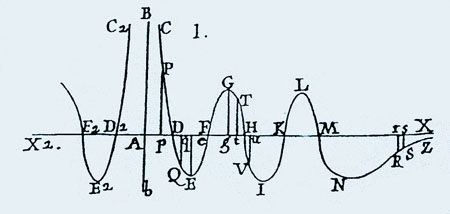
Robert Marsh, the author of Physics and Poets, credits Boskovic with the idea of FIELD. Faraday and others took the idea from him, see here. He was the first to apply probability to the theory of errors. Laplace and Gauss acknowledged their indebtedness to his work which led to the Legendre principle of least squares in statistics (stating that the best fitting line is the one with the smallest sum of squared residuals).

Portrait of Boskovic by the English painter Edge Pine (London, 1760).
One of the greatest English 20th century novlists Aldous Huxley, in Antic Hay (1923) mentions Boskovic, Leonardo, Michelangelo, Händel. In 1497, a German pilgrim Arnold von Harff wrote in his travel book a short list of 56 Croatian words, as he heard them when talking to citizens of Dubrovnik, with explanation in German. In the 16th century a German pilgrim Konrad von Grünemberg wrote that Dubrovnik is "the most important city in Croatian Kingdom" (die kunglich hobstat in Croattien). In 1506 an English Sir Richard Guylforde wrote that "Dubrovnik is in Sclavonia or Dalmatia, which is a province in Kingdom of Croatia." See [Raukar], pp. 360-362.
Ivan Mane Jarnovic (1740-1804) was an outstanding Croatian violinist and composer of the 18th century, probably from Dubrovnik. He had a true European career - playing, composing and conducting in France (Paris), Austria, Germany, Switzerland, Poland, Scandinavian countries, England. Also played the first violin in the orchestra of the Russian empress Katarina II. Jarnovic composed about 50 chamber instrumental pieces, 22 violin concerts (17 preserved), and is known for having introduced the romanza as a slow movement into the structure of the violin concert.
It is little known that
there was the Society of
Dalmatians in England already in
1590.
Personal
information by Adam S. Eterovich.
It is interesting that the Dubrovnik merchants had their settlement in the city of Gvendolin in India in the 16th century, where they built the Church of St. Blase in 1653, which exists even today. In Goa in India there existed a strong Dubrovnik colony around the Church of St. Blase. In 1540 there arrived St. Francis Xaver on his mission to India, and later to Japan.
Cornelia Wright (1757-1837), an English writer, in her "Authobiography'' left us important information about Raymund Kunic (Croatian latinist and grecist), whom she met in Rome. She also met Rugjer Boskovic in Paris, whom she admired as a "mathematician and astronomer and as a good Latin poet who like many of his countrymen had the gift of composing Latin verse with facility''. It is very likely due to her acquaintance with Kunic that the first translation of a Croatian poem into English arose (a poem by Ignjat Gjurgjevic, translated into English from its Latin translation).
Faust Vrancic performed a
jump with his parachute
somewhere in Venice in order to test it. This fact
is explicitly stated in a book written by English
bishop John Willkins
(1614-1672), secretary of the
Royal Society in London, only 30
years after the jump. The title of his
book which contains this important testimony about Faust
Vrancic is Mathematical Magic
of the Wonders that may be
Performed by Mechanical Geometry, part I: Concerning
Mechanical Powers Motion, part II, Deadloss or Mechanical
Motions, published in London in
1648.
See
Vladimir Muljevic: Hrvatski
znanstvenici Antun i Faust
Vrancic, Encyclopedia Moderna,
god. 14, II, Zagreb,
1993. I express my sincere gratitude to Professor Emeritus V. Muljevic
for this information.
Vrancic also described in his book Machinae Novae the first wind turbine.
Marin
Getaldic - Ghetaldus (1568-1626)
born in Dubrovnik,
was the most
outstanding Croatian scientist of his time.
He studied in Italy, England and Belgium.
His best results
are mainly in physics, especially optics, and mathematics.
Among his numerous books let us mention Promotus
Archimedus (Rome, 1603)
and De resolutione et
compositione mathematica (Rome,
1630),
in which Getaldic appears as a pioneer of
algebraization of geometry.
His contributions to geometry had been cited by Christian
Huygens and Edmond
Halley.
Getaldic is the constructor of the parabolic mirror (diameter 2/3 m),
kept today in the National Maritime Museum in London. During his
sojourn in Padova he met Galileo
Galilei, with whom he
corresponded regularly. He was a good friend to the French
mathematician F.
Viéte. The fact that
the post of professor of mathematics had been offered to him in Louvain
in Belgium, at that time one of the most famous university centers in
Europe, proves his high scientific reputation.
A
Venetian Paolo Scarpi wrote about him: In
mathematics he was like a demon, and in his heart - like an angel.
Ferdinand Konscak (born in Varazdin, 1703-1757), was a Jesuit and a Croatian missionary in North America. In 1752 he discovered that Baja California was not an island, as it had been believed until then, but a peninsula. There is a collection of rocky islets on the north of the Californian bay named in his honour as the Consag Rocks (Consag Rocas, or Roca de Consag, near San Felipe). Denis Diderot and D'Alambert used some of his maps for the French Encyclopedia, see "Encyclopedie", Supplement 5 Carte (Paris 1755-1780), where his name is cited as P. Consaque. Alexander Humbolt used his maps for his "Carte generale... de la Nouvelle Espagne", Paris, 1804, and also Arrowsmith in his "Map of America", London 1805. Konscak spoke various dialects of local Indians, in particular a very difficult dialect of Cochinin Indians. He described a sort of boomerang that Indians used for hunting rabbits. His diaries were printed already during his lifetime (published by Villa-Senor y Sanchez, Ortega-Balthasar and Venegas-Buriel), and after his death translated into many languages. The 1761 copy of Konscak's manuscript about California is held in The British Museum. His work Carta del P. Fernando Consag de la Compania de Jesus, Visistaro de las Misiones de Californias (43 pages) is kept in the British Museum in London, Library of Congress Harper in Washington, John Carter Library in Providence, Library of Pomona College in Pomona, Henry E. Hutington Library in San Marino. His life is described by outstanding american historian Peter Masten Dunne in his monograph Black Robes in Lower California, Los Angeles, 1952. Seven copies of his maps are published by Ernest J. Burrus in his work La obra cartografica, Madrid, 1967.
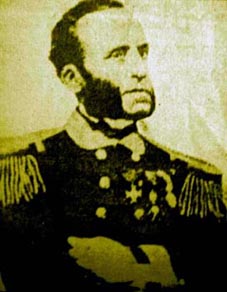
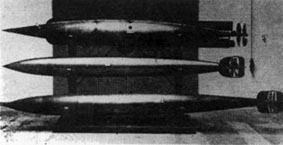
The first torpedo was constructed by Ivan Lupis Vukic in the 19th century in Rijeka, where its production had started in 1866 in the Whitehead factory. He was born in the village of Nakovane on the beautiful Peljesac peninsula near Dubrovnik.
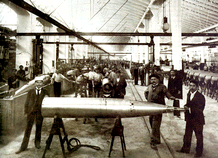
Eduard Miloslavic (1884-1952) was a descendant of Dubrovnik emigrants to the USA, born in Oakland, California. His family returned to Dubrovnik in 1889. Ed studied medicine in Vienna, where he became a professor of pathology. In 1920 an invitation came from the Marquette University in Wisconsin, USA, to take the chair of the full professor of pathology, bacteriology and forensic medicine. In subsequent years "Doc Milo", as colleagues called him, inaugurated criminal pathology in the USA. As an outstanding specialist he was also involved in investigations of crimes perpetrated by al Capone gang. He was one of the founders of the International Academy for Forensic Medicine, member of many American and European scientific societies and academies, and also vice president of the Croatian Fraternal Union (CFU) in the USA. In 1932 he moved to Zagreb, where he was a full professor at the Faculty of medicine until 1944, when he moved again to the USA. He was lecturing also pastoral medicine at the Faculty of Theology in Zagreb, and was known as ardent adversary of abortion and euthanasia. In 1940 he was elected member of the prestigious"Medico-Legal Society" in London, in 1941 promoted the full member of the Tzarist Leopoldine Carolingue Academy of Natural Sciences in Germany, and doctor "honoris causa" at the University of Vienna, where he started his scientific career. For his 1943 investigation of the slaughter of 12,000 Polish officers perpetrated by Soviets in the Katyn wood in 1940, see here. By the end of 1944 he moved again to the USA (St.Louis, Missouri), where he was working until his death. It is important to note that after his initiative in 1941 the Faculty of Medicine in Sarajevo was founded in 1944 during the NDH regime.
According to an article published in Vjesnik, December 27, 1992, due to his testimonies related to Katyn wood tragedy, Prof. Miloslavic was sentenced to death in absence by the ex-Yugoslavia.
Filip Vezdin or Wesdin (Paulinus a Sancto Bartolomaeo, 1748-1806), pioneer of European indology, was born in a Croatian village of Cimov (Hof am Leithagebirge) in Lower Austria in Burgenland (Gradisce). He completed his studies of philosophy and theology, Roman languages and English in Linz and Prague. Besides native Croatian he spoke Latin, Greek, Hebrew, German, Hungarian, Italian, Portuguese and English. As a Carmelitan missionary (with monastic name Paulin of St. Bartholomew) Vezdin was sent to India in 1776, where he learned Sanskrit and several Indian dialects.
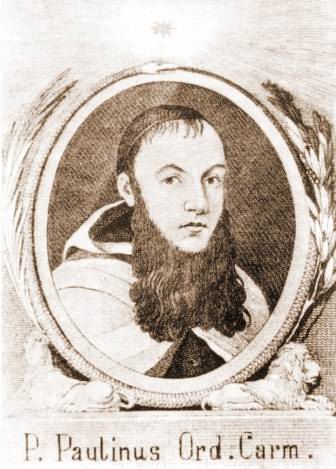
For more information see Filip Vezdin (in Croatian)
Vezdin is the author of Sidharubam seu gramatica samscrdamica, the first printed Sanskrit grammar in Europe, published in 1790 in Rome. Extended edition was published in 1804 and entitled Vyacarana seu locupletissima samsrdamicae linguae instituio. He wrote numerous works on Indian culture, and in addition to Sanskrit also learned Malayalam, the Malabar coastal language, in which he wrote his works as well. At the request of a local ruler, he wrote an English-Portuguese-Malayalam grammar. His works are kept in Rome, Vienna and Uppsala. The first methodical study of connections between indoeuropean languages is contained in his work De antiquitae et affimitate lingaue zendicae, samscrdamicae et germanicae disseratio, Rome 1798.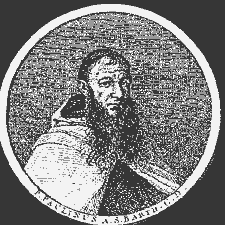
| Ivan Filip Vezdin, Burgenland Croat, Discalceate Carmelite, with the monastic name Paulin of St. Bartholomew, a missionary in Malabar from 1776 to 1789. The author of the first printed Sanskrit grammar and forerunner of Indian and Indo-European studies to the great honour of his homeland and the Croatian and Indian people. |
Ferdinand
Hadvig was a surgeon in Zagreb
who
completed his studies in Prague in 1791. There exist
documents confirming that already in 1792 he was vaccinating
children in Zagreb against smallpox. He was also teaching
parents about methods of prevention against smallpox.
Historians of medicine claim that the first smallpox
vaccination in Zagreb took place before the earliest known
such vaccination in England, which was considered to be the
earliest in Europe.
This
was discovered by Lelja Dobrinic,
outstanding Croatian historian, curator of the Zagreb City
Museum, see Vjesnik, May 29-30, 1999, p. 35.
Antun
Lucic (born in Split 1855,
Washington 1925)
discovered the first major gusher in Texas,
The Lucas gusher, flowing at the rate of 80,000
to 100,000 barrels per day, blew in in January 1901.
About 50,000 people came to see it.
This meant the earliest massive exploitation of
oil and petroleum in the world.
Antun Lucic, known as Anthony
F. Lucas (F. is after his father
Franjo,
mariner and shipbuilder from the
island of Hvar) believed that the nearby Spindletop
hill,
near
the town of Beaumont, covered a
vast pool of oil. His company
became one of the first oil companies in Texas.
Antun Lucic was a mining engineer who completed his studies at
the Politechnical institute in
Graz, Austria, where also his fellow countrymanNikola
Tesla later
studied.
By 1902, as many as 285 wells were operating on
Spindletop Hill and over 600 oil
companies had been chartered.
In this way Captain Anthony Lucas
enabled the United States to surpass Russia as the
world's leading oil producer.
With the Lucas gusher, a black-gold rush began,
and fortune-seekers from all over the world poured into Texas.
Over time, Houston became a center of the oil
industry, and a captive of the British-dominated global oil cartel.
In 1936 The American Institute
for Geological and Metalurgical
Investigations founded a prize
named after him: Antun Lucas
Gold Medal. A museum with 18 m
high granite obelisk was built in honour to
the Lucas gusher in Spindletop. There is also 1,5 m granite monument of
Lucic
with inscription saying that his
discovery revolutionarized
industry and transport,... and changed lives of
people in the whole world.
As to his nationality,
it is often mistakenly described as Austrian, and sometimes even
Italian (like in Who is Who in America, where there is also another
mistake - that he was born in Trieste). On his grave in Rock Creek,
Washington, he is said to be of Illiric
origin, where Illiric is a standard name for Croatian.
For more information about Anthony Lucas see here.
A very old mention of the name of HORITS, the ancient name of the Croats (Horvat), can be found in the Latin work ``Historia adversus'' Pagano by Paulus Orosius (9th century). Its translation into Old English has been made by King Alfred (871-901). See [Mardesic], p. 130.
In attempts to find Walter Raleigh's Lost Colony inhabited by the British Empire in 1587 on the island of Roanoke (near the Croatoan island, North Carolina, USA), the searchers found a CRO carved in Roman letters on a tree in 1590. Another big tree had a bark peeled off, and carved on it in capital letters was the word CROATOAN.
 Pavle
Balenovic is known for his deep
insight into the behaviour of wild animals in Croatia,
in particular of wolves.
He studied them during many years in the region of the Velebit
mountain.
See his beautiful web pages White
Paw.
He prepared an amazing documentary The
Wolf Man - the Diary
of Paul Balenovic,
about his friendship with the wolf Lik.
It was shown by the BBC
throughout the world with great success. The name of Lik
is
derived from LIKA,
a Croatian region
on the north of Velebit,
known for its beauty, its extremely difficult history, and its wolves.
Pavle
Balenovic is known for his deep
insight into the behaviour of wild animals in Croatia,
in particular of wolves.
He studied them during many years in the region of the Velebit
mountain.
See his beautiful web pages White
Paw.
He prepared an amazing documentary The
Wolf Man - the Diary
of Paul Balenovic,
about his friendship with the wolf Lik.
It was shown by the BBC
throughout the world with great success. The name of Lik
is
derived from LIKA,
a Croatian region
on the north of Velebit,
known for its beauty, its extremely difficult history, and its wolves.
One of the most outstanding Croatian scientist in history was Rugjer Boskovic (1711-1787), also brilliant Latinist poet. He wrote an extensive scientific poem De solis et lunae defectibus (On Solar nad Lunar Eclipse), published in London in 1760. It contains 5570 Latin verses, and was dedicated to the Royal Society of England whose member he was. In the title one can read "Father r. Boskovic, of the Jesuit Order", although at that time it was forbidden for Jesuits to live and work in England. The epic was written in the manner of Roman classics, in dactilus hexameter.
A Croatian Jesuit Mark Antun de Dominis (born as Marko Domnianich on the island of Rab, 1560-1624) ranked among the greatest European philosophers and scientist of his time. His career of a university professor started in Padova. He was especially esteemed in England, where he was invited by king James I. There he lived at the Court of the Archbishop of Cantebury and was appointed to be the Windsor Dean and the king's chancellor.
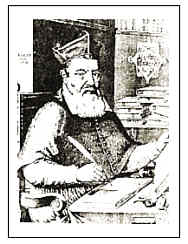
Dominis arrived to London in December 1616 with a great pomp after his apostasy from Rome. Four days after the spectacular welcome, Dominis was placed fifth place next to King James. This meant, according to the protocol of the time, that he was fifth in the hierarchy of the state. In 1617 he was lecturing in Cambridge and Oxford. In Cambridge he was awarded the title of doctor of divinity. His sermons in London were printed in Italian, English and Latin. His book "The Ecclesiastical State" was printed in Latin in England, with permission of the King.
It is interesting that Dominis introduced the word "puritan" into English in its modern meaning, which was earlier used only in theological literature and had a very narrow meaning.
His work in physics was cited in I. Newton's book "The optics" published in 1704 (page 147). Among other things he contributed to the explanation of the phenomenon of the double rainbow. His theory of tides was based on the idea of attractive force between the Moon and the Earth, which was later made precise in Newton's theory of gravitation. He also discovered the phenomenon of diffraction of white light (see G. Hund's "Geschite der Physik"). However, his main preoccupation was the problem of European peace and the reform of the Church. In 1618 his work "The Rocks of Christian Shipwrecke" was printed first in Italian, and then in English. It was held an important apologetic work of Protestant theology, and was soon translated into French. It was read throughout Europe.
After six years of stay in England his relation with the Anglican Church and the King himself cooled down, though he had given the Anglican Church one of the most important doctrinal weapons (for more details see [Mardesic], p. 162).
His work "De Republica
Ecclesiastica", which was published in ten books in London, brought him
the anathema of Rome. He was imprisoned by Inquisition and when he
died, the burial of his body was not allowed. It was burnt, together
with his manuscripts, on the square of Campo dei Fiori in Rome, where
Giordano Bruno had been burnt twenty four years earlier.
Branko
Franolic: Two Croatian refugees at St.
James’s Court at the beginning of the 17th century
An extremely interesting biography has Bartol Gyurgieuits (Bartol Jurjevic or Gjurgjevic, born in the region of Turopolje near Zagreb, known for nice wooden churches, 1506 - 1566?), a participant of the tragic battle on the Mohac field in 1526, where he was captured by the Turks and lived as a slave in many parts of the Turkish Empire. After 13 years of slavery he managed to escape. Since that time he traveled a lot throughout Europe, agitating for the creation of a strong union against the Ottoman Empire. His numerous writings in the Latin language were published first in Antwerpen (1544) and then extensively reprinted in many other languages: Italian, French, English, German, Spanish, Dutch, Hungarian, Polish, Czech etc. These extremely interesting testimonies about the Ottoman (Turkish) Empire can be found in the libraries of almost all larger European cities:
Paris, Rome, Vienna, Basel, Leiden, Wittenberg, Florence, London, Prague, Venice, Antwerpen, Liége, Worms, Nürenberg, Krakow, Lyon, Frankfurt etc. (e.g. in 44 towns of Germany alone) and in some cities of the USA.
Most of his writings
contain small dictionaries of the Croatian (which he calls Slavonian),
Turkish, Persian and Hungarian languages. As a part of his "De
afflictione...sub Turcae" (1544) he wrote the first known Croatian -
Latin dictionary (with the basic prayers: Our Father, such as Hail
Mary, Credo), which is also the first known dictionary among the
Croats. He is also the author of the practical Italian - Arabian -
Hebrew - Chaldean dictionary, added to the description of his
pilgrimage to Yerusalem when escaping from the Turkish slavery. It was
written in Italian: "Specchio della peregrinazione delli piu notabili
luoghi della Terra Santa", and the author signed it as Georgievicz de
Croatia. He also mentioned a Croatian Script, which is "different from
any other script in the world" (Glagolitic).
He indicates that the Croatian language is spoken among others on the
Constantinople court of Turkish sultans. Gyurgieuivits' works are also
of interest for the study of Islamic music.
He was not only the first Croatian author, but also the first Slav
author whose writings were popular throughout Europe. For more
information see [Zoric].
Branko
Franolic: Georgijevic's Description of Turkish
Ways and Customs: Unique Work Published in London in 1570
The Englishman Hugh Goughe wrote "The Ofspringe of the House of Ottomane" (1570) which is a translation of Gyurgieuits' book "De origine imperii Turcorum". In Goughe's book there is a dialogue in Croatian with a parallel English translation, alongside with two prayers in Croatian (Our father and Hail Mary). Gyugyieuits himself is called the "first Croatian lexicographer" in this book.
Regarding early dictionaries of the Croatian language, let us mention a German knight Arnold von Harf (1471-1505) who visited the Croatian lands along the coast during his pilgrimage to the Holy Land in 1496-1499. His book "Die Pilgerfahrt des Ritters Arnold von Herff von Cöln", published in Köln in 1860, includes a short conversational dictionary of the Croatian language containing 56 words and basic expressions. He also visited the beautiful, strong and freedom loving city of Dubrovnik (as he says), for which he states to be in the Croatian Kingdom - in den Koenynckrijh van Croatijen.
Croatian students studied
at many European Universities, starting from the Early Middle Ages. For
example, Herman Dalmatin
(1110-1154) was our first student who attended lectures of the famous
Thierry de Chartres in Paris in the thirties of the 12th century. Born
according to his own words in the heart of Istria, he wrote about 20
original books and translations, thus contributing a great deal to
natural philosophy and exact sciences in Europe. He traveled a lot, and
besides Latin and Greek mastered perfectly Arabic.
On
the left you can see an old drawing of Herman with an astrolabe in his
hand, shown with Euclid (from Chronica Maiora written by Matthew of
Paris in the 13th century). See a monograph by Zarko Dadic - Herman
of Dalmatia, Skolska knjiga,
Zagreb, 212 pp (parallel English and Croatian text).
He translated many important books from Arabian into Latin, like Euclid's Elements, Al-Khwarizmi's Tables (continuing the work of Adelard of Bath on both classics), Sahl ibn Bishr's (Arabian scientist of the Jewish origin, 9th century) Sextus astronomicae liber, Abu-Ma'ashar's Introduction to Astronomy, acquainting thus the West with Aristotel's thoughts, and in particular the oldest Latin redaction of Ptolomey's Planisphere (published in Toulouse 1143; in Islamic literature known as `Almagest'). Herman wrote an astrologico - cosmological treatise De essentiis (Béziers, 1143). With his English friend Robert from Ketton he worked on the translation of Kur'an. Herman's translations from Arabic represent an unavoidable ingredient of the so-called `Toledo corpus' of texts on Islam. Its main objective was to resist Islam not by force as the Crusaders did, but by understanding and love. As we know, the Arabic culture was a bridge across which the spiritual heritage of the Ancient Greeks came to the West.
The Croats were also present at the Court of the Andalusian califs in Cordoba (Spain). The body guard for califs was composed of islamized Croats. Among them the most famous were Wadha el-Ameri and Zahair Alameri (11th century). The Croatian kingdom maintained relations with the Califat, so that in 953 the Croatian legation visited Cordoba.
The oldest known map where the name of Croatia appears is El'Idrisi's map of the Mediterranean sea from 1154. The name of Croatia is written as Garuasia. This map was a supplement of El'Idrisi's book "The Joy of Those Who Long to Travel around the World".
Marulic left us many beautiful verses and the epic poem Judita written in the Croatian language, for which he says expressly to be written in the Croatian verses (versi harvatski). Some of his original verses are held in Glasgow (GB). His Judith was translated into English, Hungarian, French, Italian, and some parts into Spanish. Marulic translated from Latin into Croatian the famous "De imitatione Christi" by Thoma de Kempis.
The original Marulic's manuscript of "De institutione bene vivendi" has been stolen from the Croatian National Library in Zagreb around 1980. Any information about this would be appreciated.
According to investigations of a French specialist Charles Béné, Marulic's texts have been used extensively by Thomas More and Henry VIII. It is known that Marulic's "Evangelistarium" that was read by Henry VIII bears many comments by the King. It is considered that two of the king's three literary works were written under the influence of Marko Marulic.
Marulic's poem "Carmen de Doctrina Domini Nostri Jesu Christi pendentis in cruce" was translated into English as "A Dialogue between a Christian and Christ hanging on the Crosse" by Philip Howard, Earl of Arundel (1557-1595).
According to C. Verdiani, Marulic is also the author of the Florence Codex, which contains a biography of St Jerome written in the Croatian language. There he wrote
In Croatian: Jerolim je nass Dalmatin, on je dika, posstenje i slava i svitla kruna hrvatskoga jezika. It is worth mentioning that preserved manuscripts of Marko Marulic show that he also used the cursive glagolitic script.
Marko Marulic sent a dramatic letter to the Pope Hadrian VI, describing an extremely tragic position of the Croats threatened by the onslaughts of the Ottoman Empire and asking for help.
His books were known not only in the whole of Europe, but also in Japan (in the 16th century) and South America. For example, parts of De institutione bene vivendi were translated into Japanese already in 1585.
When St. Francis Xaver arrived to Kogoshima in Japan in 1549, he also brought Marulic's "De insitutione bene vivendi". According to bishop Hamao from Yokohama, president of Japanese Bishop's Conference and of Asian Caritas, the formation of earliest Japanese Christians had been very probably based on the spirituality of Marulic. See here (in Croatian). It is interesting that in Berlin a monument of Marko Marulic was set up in 2000. In the Library of Congress, Washington, a symposium was held devoted to his work.
Marko Marulic, Humanist from Split
Antun Vrancic (lat Antonius Verantius, hungarized name Antal Verancsics, born in Sibenik in 1504) studied in Padova, Vienna and Krakow. After spending almost 20 years as a secretary and diplomat at the court of Ivan Zapolja, he continued his career at the court of Ferdinand I Habsburg in 1549. As the king's envoy he had a delicate task to negotiate with the Turks (he spent altogether 6 years as a diplomat in Turkey). Together with a Flamish diplomat Busbeck he discovered the Ankara plate (Monumentum ancyranum, held in the National Museum in Vienna), which is quite important for understanding the history of the Roman Empire, especially during the time of the Emperor Augustus. As a diplomat he traveled to France, Italy, Poland, England (on a diplomatic mission to the court of King Henry VIII), Turkey etc., and was exchanging letters with Erasmus of Rotterdam. In Krakow, Poland, he published two collections of poetry in the Latin language ("Elagiae" and "Otia").
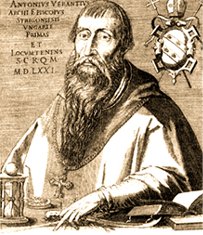
Portrait
of Antun Vrancic by outstanding Croatian
painter
Martin
Rota Kolunic from Sibenik
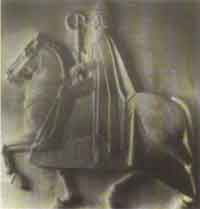
A significant Croat, born on the island of Hvar, very little known even among the Croats, was Ivan Franje Bjundovic (Giovanni Francesco Biondi, 1573-1645). After having met Sir Henry Watton, English ambassador in Venice, with whom he shared the same interests as a lawyer and literature fan, he journeyed to England and carried confidential messages to King James I. Obviously, he was considered a competent scholar and diplomat, since James himself entrusted him with important diplomatic missions.
Bjundovic wrote a trilogy in Italian: "Eromena", "La danzella desterrada" and "Il Corlabo", which had several editions. Their English translations enjoyed exceptional popularity, as well as German and French. His most important work is "History of the English Civil Wars", with his name appearing as Sir Francis Byondy. It was published in three volumes, where he described the Wars of the Roses. It was first published in Italian (L'istoria della Guerre civili d'Inghilterra) and printed in Venice in 1637-1644. Its English translation started to appear in 1641.
An important monograph describing Diocletian's Palace in Split is "Ruins of the Palace of the Emperor Diocletian at Spalatro in Dalmatia" written by Robert Adam in 1764, with his main associate Ch.L. Clerisseau. The author, an outstanding Scottish architect, mentions the beauty of Split and its favorable position and climate, stating that ``in the whole of the wide Roman Empire, not a single region could offer Diocletian a more marvelous place to withdraw to for a life of peace''. He designed several buildings in the style of Diocletian's palace (Syon House in Middlesex, Kedleston in Derbyshire, Adelphy Palace in London). Influences of his book can be seen even in St. Petersburg in Russia and in Virginia in the USA.
The octagonal Mausoleum of the Roman Emperor Diocletian was transformed into the Christian church of St Dominius (Dujam) already in the 7th century, representing very probably the oldest cathedral in the world. According to Danish scientist Ejnar Dyggve, St Dominius (Dujam), the earliest known bishop of Salona (4th century), originated from Syria or Mesopotamia. Local Split tradition also confirms this.
Julije Klovic, or Don Giulio Clovio de Croatia (1498-1578), is regarded as the last great representative of the classical European miniature. His works decorate many famous galleries: Uffizi in Florence, Museo di Capodimonte in Naples, Biblioteca Marciana in Venice, Galleria Sabanda in Torino, Bibliothek der Albertina in Vienna, Louvre in Paris, Towneley Public Library and Pierpont Morgan Library in New York (which is in possession of "Officium Virginis", 228 pages, his most famous and the best masterpiece, containing 30 valuable miniatures by his hand), the British Museum and Soane's Museum in London, Windsor Castle (Royal Library). His pupil was El Greco, who portrayed him in his work "Expelling merchants from the temple" (together with figures of Rafael, Michelangelo and Tizian, appearing on the bottom left of that work), now kept in The Minneapolis Institute of Arts (The William Hood Dunwoody Fund).
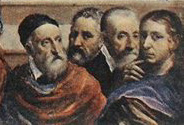
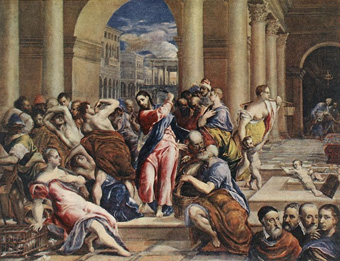
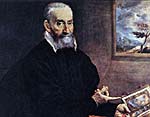
GEORGIVS JVLIVS CLOVIVS CROATA
His grave is situated near Michelangelo's Moses in the the church of S. Pietro in Vincoli, Rome, and bears an inscription "Pictor de Croatia".Andrija Medulic (Andrea Schiavone, Andrea Meldola de Hiadra), (~1500-1563), a painter born in Zadar or Nadin, started his artistic career in Sibenik and continued in Venice. His works of art are scattered throughout Europe: Zadar, Sibenik, Zagreb, Venice, Milano, Florence, Naples, Torino, Verona, Paris (Louvre), London, Oxford, Richmond, Dublin, Amsterdam, Vienna, Dresden, St. Petersburg, Belgrade. Medulic influenced Tintoretto, who stated that any true painter must possess at least one of his masterpieces. As Klovic, he also influenced El Greco, a famous Spanish painter of Greek origin. Medulic's paintings in the collection of Her Majesty the Queen
Ivan Mestrovic... His sculptures can be seen in London (Tate Gallery), Florence (in "Uffizi"), Torino, Rome, Prague (in Hradcany), Budapest, Chicago (Chicago Indians, Grand Central Park, see a postcard on the right from 1939), South Bend (Indiana, USA), Rochester (Minnesota, USA), Baton Rouge (Louisiana, USA) etc. He also carved a monument of the most outstanding Slovak writer Martin Kukucin (Matej Bencur) in Punta Arens (Patagonia, Argentina). Matej Bencur spent a part of his life in Croatia on the island of Brac and wrote a book about the life of the Croatian emigrants in South America. ...
Kristian KREKOVIC (Bosnian Croat, 1901- Palma de Mallorca 1985), pintor Croata - Peruano:
- portrayed the English Queen (in 1938, upon her request; the portrait is kept in the Buckingham palace in London, see [Sabater, p. 19]: "...Como expresión de su trabajo en esta época, basta citar el famosos retrato que hizo de la Reina María de Inglaterra, retrato que adorna una de las estancias del Palacio Real de Buckingham."),
- portrayed MAHATMA GANDHI in his atelier in Paris in 1931
|
||||||||||||||||||||||||
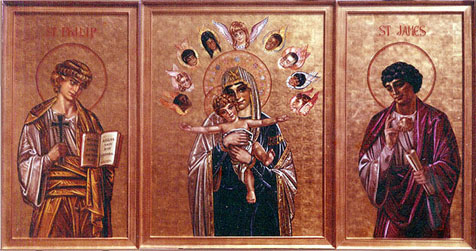
Oscar Nemon (1906-1985), outstanding sculptor and medallist, was born in Croatian town Osijek, and has Jewish roots (Oscar Neumann). Having obtained his baccalaureate in Osijek, in 1923 he moved to Vienna. He was inspired and supported by Ivan Mestrovic, a great Croatian sculptor.
In 1931 Nemon made a portrait of Sigmund Freud in person, for which Freud said to be "...a very good and astonishingly lifelike impression of me". After a short stay in Paris, having obtained bursary from his native city of Osijek, he went to Brussels in 1925, to study at the Academie des Beaux Arts. He stayed in touch with Osijek, and made for the city the monument "June Victims", commemorating the murder three Croatian members in the ex-Yugoslav Parliamnet in Belgrade in 1928, among them Stjepan Radic. In Burssels he made busts of King Albert I, Queen Astrid, and Auguste Vermeylen, a notable historian of the Flemish School of Painting.
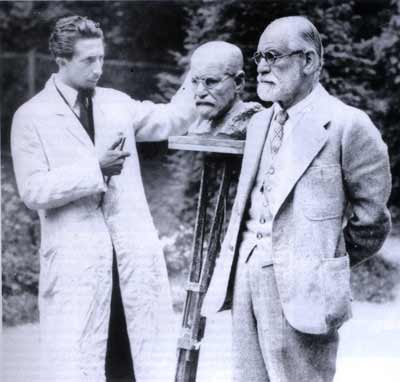
Oscar Nemon portraying Sigmund Freud in 1931, source
In 1938, due to the Nazi invasion of Belgium, he fled to England, and lived in Oxford. During the WWII a larger part of his family perished in the Holocaust, including his mother and brother. In subsequent years he made sculptures of many distinguished persons, like Winston Churchil (in 1965, upon the invitation of the British Government, and on the occasion of his death), Queen Elizabeth II, Queen Mother (upon her request), Dwight Eisenhower, Harry Truman, Viscount Montgomery (of Alamein), Harold Macmillan, Margaret Thatcher, etc. It is interesting that Winston Churchil in return made his amateur sculpture of Oscar Nemon.
His obsession was an architectural utopian project of Universal Center of Ethics, and in this respect he seems to be similar to his compatriot Kristian Krekovic. In 1981 he made a bronze relief for Canterbury Cathedral. His last major work was a National Air Force Memorial for the city of Toronto, Canada, unveiled by The Queen in Toronto in 1984.
For his exceptional achievements the University of St. Andrews in 1977 conferred Oscar Nemon an Honorary Doctorate of Letters. On the occasion of his death, a memorial retrospective exhibition of his works was organized in 1985 in Croatia, in his native city of Osijek.
Some web pages wrongly indicate that Nemon was born in (ex) Yugoslavia, which at that time did not exist. Nemon was born in Croatia, then a constituent of Austria-Hungary.
- Dalibor Prancevic: Zanemareni kipar Oscar Nemon, [PDF] (Neglected sculptor Oscar Nemon, in Croatian), Kvartal II - 4, Zagreb, 2005., pp 10-14.
- Branko Franolic: Oscar Nemon (1906-1985), Croatian sculptor in Britain, Croatian Times (Omaha, Nebraska, USA), Issue 15, March 1997
Ivana Brlic Mazuranic (1874-1938) is a very well known name among Croatian children. She wrote beautiful books of Croatian fairy tales, the most famous being Price iz davnine (Tales of Long Ago) that appeared in Zagreb in 1916. It was translated from Croatian into English by F.S. Copeland under the title:
|
Croatian Tales of
Long Ago
by Iv. Berlic Mazuranic |
and published in 1924. in London by George Alen & Unwin Ltd (260 pp, hardcover). These stories have become popular worldwide due to recent fantastic flash-art presentations, initiated by Helena Bulaja, Zagreb. See for example Neva, music and animation by Ed Beals. Books of Ivana Brlic Mazuranic were translated into all major world languages (more information in Croatian). Except in English, there exist also translations into
- Swedish (Stockholm, 1928)
- Danish (Kopenhagen, 1929/30)
- Czech (Prague, 1930)
- Russian (Zagreb [!], Skazki davnyago vremeni, 1930)
- Slovakian (T. sv. Martin, 1931)
- German (Salzburg, 1933)
- ...
- Chinese (1957)
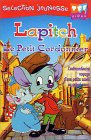 ...Une
des toutes dernieres productions originales de Croatia Film, "Lapitch -
Le petit cordonnier", tiré d'un conte de Ivana Brlic
Mazuranic, femme écrivain croate du XIXe siecle, est
actuellement le produit phare de l'école : avec plus de 300
000 cassettes vidéos vendues rien qu'en France,
commercialisées par TF1 Vidéo, il
représente la production audiovisuelle croate la plus
recherchée sur marché international. (source: Ambassade de Croatie en France).
...Une
des toutes dernieres productions originales de Croatia Film, "Lapitch -
Le petit cordonnier", tiré d'un conte de Ivana Brlic
Mazuranic, femme écrivain croate du XIXe siecle, est
actuellement le produit phare de l'école : avec plus de 300
000 cassettes vidéos vendues rien qu'en France,
commercialisées par TF1 Vidéo, il
représente la production audiovisuelle croate la plus
recherchée sur marché international. (source: Ambassade de Croatie en France).
A special importance
have about 150 Pre-Romanesque Croatian churches (9th to 11th century),
mostly along the coast. About 15 of them are well preserved (some of
them completely destroyed during the Greater Serbian aggression in
1991-1995). Probably the best example of old Croatian church
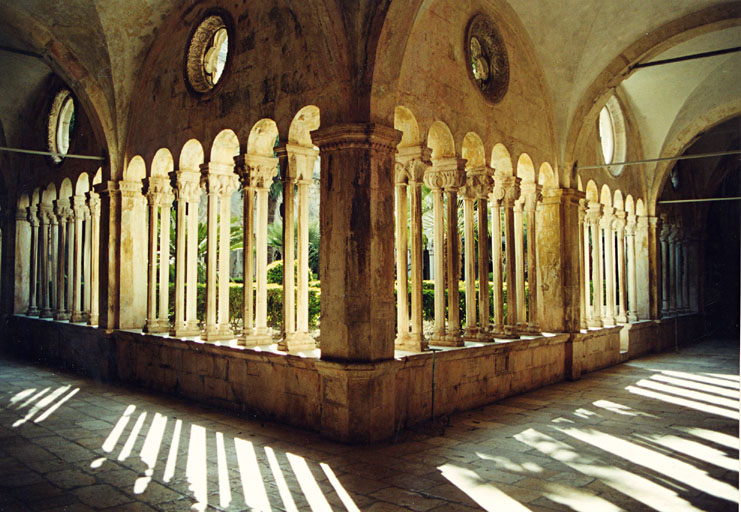
architecture is the Pre-Romanesque Chapel of Holy Cross in Nin built
around 800 AD (Sveti Kriz; see on the right; on the left is the small
church of Sveti Nikola). The British architect Thomas Graham Jackson
called it in 1887 the smallest
cathedral in the Christianity,
because of its monumental architectural conception.
The hilly area around the town of Ilok, is known since Ancient times as "Delicium Mundi", due to high quality white wines from their wineyards. The most famous is TRAMINAC, known as Royal Wine. It was served during the coronation of Queen Elisabeth, and is still represented in the Queen's collection of wines. The town of Ilok suffered very much during the Greater Serbian aggression on Croatia in 1990s.
www.hr/darko/etf/et03.html
www.hr/darko/etf/novi.html
www.hr/darko/etf/lika.html
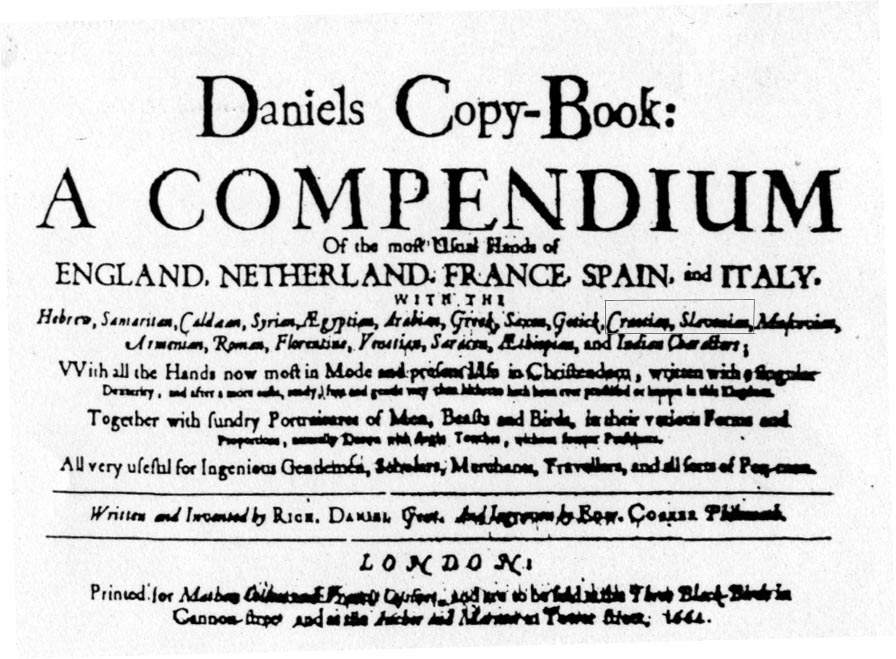
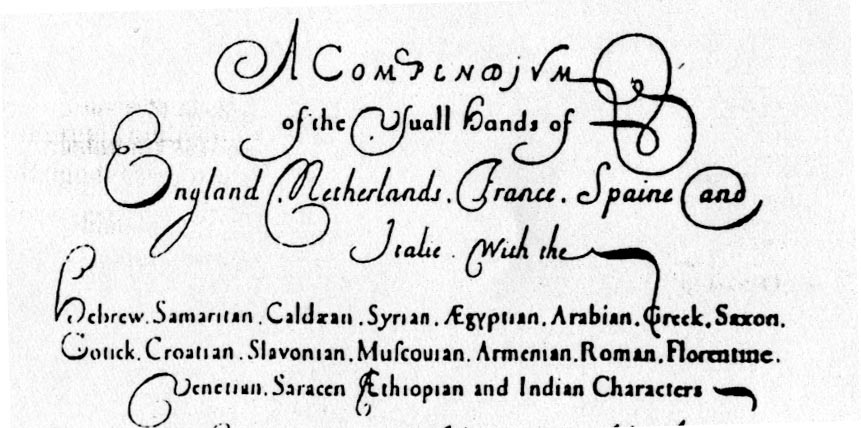
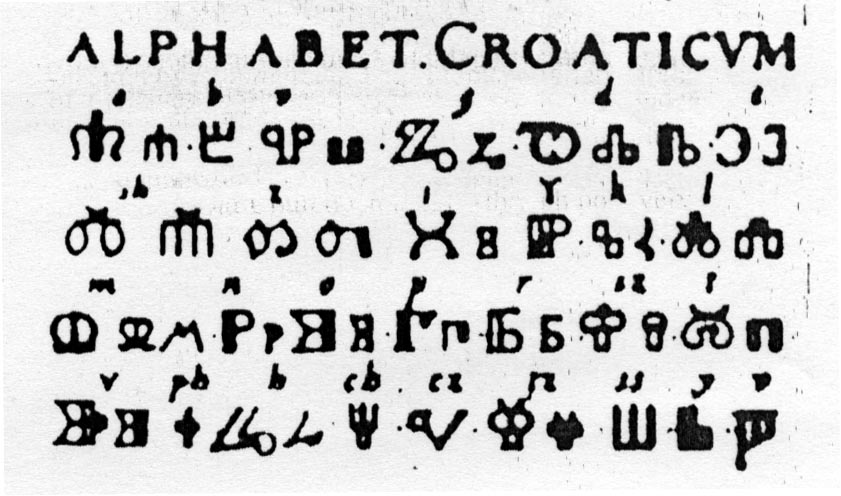 It
is interesting that a table of the Glagolitic Script was included as
early as in 1664 in a book prepared by Richard
Daniel and published in London.
It represents a catalogue of various Scripts in use in the Christian
world. The Glagolitic Script presented there is called expressly the Croatian
hand or Alphabetum
Charvaticum. The book contains
also the table of Croatian glagolitic
quick-script, which Daniel calls Sclavorum Alphabetum,
and Croatian
- Bosnian cyrillic (many thanks
to Professor Ralph
Cleminson for this information).
The book is entitled
It
is interesting that a table of the Glagolitic Script was included as
early as in 1664 in a book prepared by Richard
Daniel and published in London.
It represents a catalogue of various Scripts in use in the Christian
world. The Glagolitic Script presented there is called expressly the Croatian
hand or Alphabetum
Charvaticum. The book contains
also the table of Croatian glagolitic
quick-script, which Daniel calls Sclavorum Alphabetum,
and Croatian
- Bosnian cyrillic (many thanks
to Professor Ralph
Cleminson for this information).
The book is entitled
 |
 |
Croatian Glagolitic books in United Kingdom: London, Cambridge, Oxford
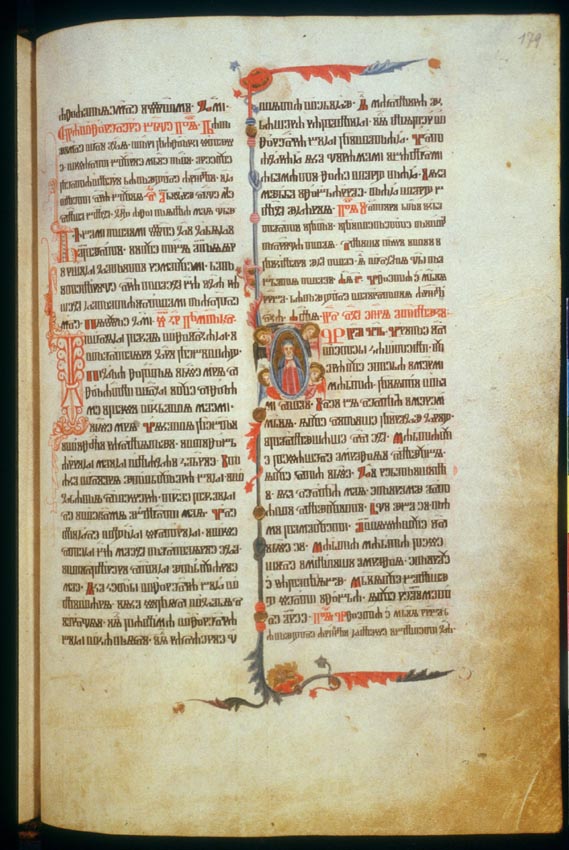 If
you live in Berlin,
Germany, then you can see the beautiful Berlin
Missal (218 vellum leaves, i.e.
436 pages written by Bartol Krbavac
in 1402), held in Staatsbibliothek (SBB-PK, Ms. Ham. 444). In 1624 a
Zadar archbishop sent it to Congregatio di Propaganda Fide in Rome in
order to prepare printed glagolitic books there. It is known that since
1808 the book was in Kensington House in London.
As a part of the so called Hamilton Collection (named according to a
Scottish collectioner Hamilton) it arrived from London to the Berlin
State Library in 1882, where it is also today.
If
you live in Berlin,
Germany, then you can see the beautiful Berlin
Missal (218 vellum leaves, i.e.
436 pages written by Bartol Krbavac
in 1402), held in Staatsbibliothek (SBB-PK, Ms. Ham. 444). In 1624 a
Zadar archbishop sent it to Congregatio di Propaganda Fide in Rome in
order to prepare printed glagolitic books there. It is known that since
1808 the book was in Kensington House in London.
As a part of the so called Hamilton Collection (named according to a
Scottish collectioner Hamilton) it arrived from London to the Berlin
State Library in 1882, where it is also today.
In London you can also see a Croatian Breviary from the 15th century and the London fragment from the 13th century, a copy Missal of Pavao Modrusanin printed in 1528.
Missal of Pavao Modrusanin, Venice, 1528 (one copy in Odessa, Cambridge, London, Prague, two in St.Petersburg, 3 in Zagreb)
Croatian Collections in The British Library
The New York Missal, 1400-1410 (Pierpont Morgan Library, until 1966 in London)
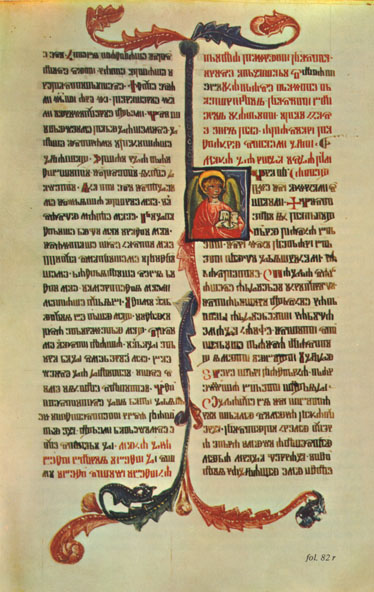 The New York Missal, 1400-1410
written in the region of Zadar or Lika-Krbava,
now in the possession of the Pierpont
Morgan Library in New York.
Reprinted by Verlag Otto Sagner Verlag (Munich) in 1977 with an
introduction by Henrik Birnbaum (USA).
The New York Missal, 1400-1410
written in the region of Zadar or Lika-Krbava,
now in the possession of the Pierpont
Morgan Library in New York.
Reprinted by Verlag Otto Sagner Verlag (Munich) in 1977 with an
introduction by Henrik Birnbaum (USA).
PROVENANCE:
Zadar or Lika-Krbava region. Frederick North, fifth Earl of Guilford
(1766-1827), with his bookplate; his sale, Evans, 1830, bought by
Thorpe for Sir Thomas Phillips. The underbidder was probably Sir
Frederic Madden, for the British Museum. Phillips paid the colossal
price for this manuscript at the Guilford sale, and considered it one
of his chief treasures. It was often produced at his "desserts of
manuscripts" for the admiration of visitors. This codex was considered
by Sir Thomas Phillips to be one of his chief treasures. In 1966 it was
bought by the Pierpont Morgan Library, New York. For more information
see Croatian
Glagolitic in the USA, [Birnbaum],
and a monograph (extended doctoral dissertation) written by Andrew
Corin: The
New York Missal: A Palaeographic and Phonetic Analysis,
272 pp, 1991, UCLA, Los Angeles, USA. Corin's analysis shows that the
book was written by at least 11 scribes, members of a large, unknown
glagolitic scriptorium.
- A Croatian Glagolitic miscellany from the first half of 15th century, held in Oxford (Bodleian Library), contains St. Patrick's Purgatory. The Oxford Miscellany also contains Philbert's Vision which originated probably in Latin in England in the 13th century.
- Tundal's vision (Visio Tugdali), an Irish legend from 12th century, is contained in the Petris Miscellany from 1468, the most important Glagolitic collection.
- De Morte Prologus (an imaginary discussion between Man and Death), contained in a Croatian Glagolitic miscellany from 15th century (National and University Library of Ljubljana, Slovenia), and in the Petris Miscellany from 1468.
According to Marin Tadin, Oxford Bodleian Glagolitic Missals (from Canconici collection) have large initials that are of considerable artistic merit.
Bernardinus de
Frangepanibus (or Bernardin
Frankapan, 1453-1529), a
survivor of the battle
of Krbava in 1493, delivered a
distressing address to the State Senate in Nuremberg, Oratio
pro Croatia, Nurenbergae in Senatu Principum Germaniae habita,
imploring western potentates for help. Bernardinus was one of the most
distinguished members of the family of Frankapans, which had been
linked for centuries with the destiny of Croatia. He concluded his
appeal by quoting Horace: "Et tua res agitur, paries quum proximus
ardet" ("You are concerned when your neighbour's house is burning").
A Glagolitic
Bible in possession of Bernardin
Frankapan in the beginning of 16th century is mentioned in [Bratulic,
Leksikon..., p. 150], and that there were no later news about its
destiny. Was this the Zadar Glagolitic Bible?
About Bernardin Frankapan as warrior and intellectual one can learn
from writing of Simun
Kozicic Benja
that "even under arms and with sword, all the time he writes and
translates".
Almost at the same time the oration delivered in the presence of the
Pope by Bernardinus's heroic son, Christopher
(1492-1527), left the press. He had become famous by virtue of his
strange destiny, and the several years he spent in captivity in Venice.
The Danish art historian, Henry Thode, dedicated his admirable book Frangipani's
ring, an event in the life of Henry Thode
(published by John Macqueen, London, 1900) to the memory of
Christopher. Only one copy of his Oratio
ad Adrianum Sextum Pont. Max. Christophori de Frangepanibus veg. Seg.
Modrusieque Comitis (Paris,
1523?) has survived, and it is held by the British Library. Christopher
had added to his oration a memorial, which begins: "Holy Father! the
counts, barons, nobles and people of the kingdom of Croatia, addressed
themselves to my lord and father speaking thus, `You who are the oldest
and mightiest among us must zealously put our case to our Holy Father
the Pope and to the apostolic Holy See and to Christian Princes and
Kings. Tell them with what ills, miseries, and anguish the Turks
torture and torment us, how in overrunning our country they forcibly
drag us into cruel captivity, how abandoned by all we are compelled
either to leave our homes and to wander abroad, and to make our way by
begging through the world, or to conclude a treaty with the Turks and
serve them if the protection and help of His Holiness is denied to
us"'.
Prince Philip and the Baska tablet
When Britain's Queen Elisabeth II and Prince Philip paid a visit to Zagreb in 1970s, they were invited to see the Gallery of the Yugoslav (now Croatian) Academy of Sciences and Arts. According to protocol, the visit was to last no more than 15 minutes. While leaving the main entrance hall, Prince Phillip (about 2m tall), surrounded by many people, accidentally turned his head, and noticed the huge Baska tablet (800 kg), exhibited in the Academy as one of the most important Croatian cultural monuments. The Prince, led by Academician Grga Novak, and accompanied by a long cortege of the diplomats and representatives of Yugoslav culture and politics of the day, approached this innocent monument, and asked: "What is this?" By the time scholars finally satisfied His Royal Highness's famous curiosity, protocol was in complete havoc.
Information supplied by Academician Petar Strcic, witness to this event, director of the Archives of the Croatian Academy of Sciences and Arts.

In addition, we might mention Mateja Matejic, Professor Emeritus of Ohio State University, in Columbus, Ohio, USA, who was to state in his lectures and books that the Baska tablet represents - a Serbian cultural monument! When he was once asked by an outstanding Croatian specialist of international reputation how he could claim this, he answered with a further gross indirection: "Serbian is an abbreviation for Serbo-Croatian."
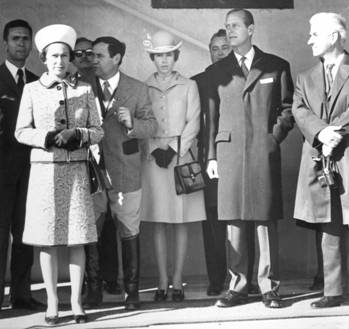
Queen Elisabeth II, Prince Philip, and Princess Margaret during their stay in Croatia in 1972 also visited the town of Djakovo. The Djakovo stud, mentioned for the first time in 1506, is among the oldest in Europe.
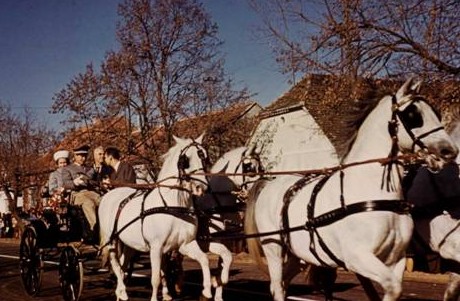
Photos from CROWN
Petar Hektorovic, a well known Croatian poet, nobleman, connoisseur of Latin language and classical literature, wrote his Ribanje i ribarsko prigovaranje in 1568, which is the first realistic epic poem of Croatian Renaissance literature. It provides four folk tunes accompanied with musical notation. The book has been translated from Croatian into English in 1979 by Edward Dennis Goy under the title Fishing and fishermans' conversation.
Ivan Mane Jarnovic (Italianized name Giornovichi, 1740-1804) was an outstanding Croatian violinist and composer of the 18th century, probably from Dubrovnik. He had a true European career - playing, composing and conducting in France (Paris), Austria, Germany, Switzerland, Poland, Scandinavian countries, England. Also played the first violin in the orchestra of the Russian empress Katarina II. Jarnovic composed about 50 chamber instrumental pieces, 22 violin concerts (17 preserved), and is known for having introduced the romanza as a slow movement into the structure of the violin concert. His life is described in a novel Jarnowick by G. Desnoisterres - Le Brisoys, Paris 1844, and in a collection Scènes de la vie d'artiste by P. Smith (Une leçon de Jarnovic, Paris, 1844).
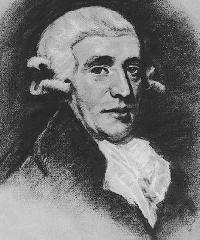 Our folk music is of great beauty and
variety. Some of its themes were used by famous European composers,
like Bedrich Smetana and Joseph Haydn, who spoke Croatian. Joseph Haydn
(1738-1803) was born in a Croatian ethnic enclave in Burgenland (Gradisce)
in Austria. For example the main theme of his London symphony no 164 in
D major (movement IV) is based on the well known Croatian traditional
song "Oj, Jelena, Jelena, jabuka zelena" (Oj, Jelena, Jelena, my green
apple). Also the final of his Es major symphony is based on the
Croatian folk song "Divojcica potok gazi" (A little girl treads on a
brook). And even the following song that is widely known in Croatia -
"Nikaj na svetu lepsega ni, nego gorica kad nam rodi..." (There is
nothing more beautiful in the world than a fruitful hill) was exploited
by Haydn (I
learned this on a wonderful 11th birthday party of my dear friend Ema
Tolic).
Our folk music is of great beauty and
variety. Some of its themes were used by famous European composers,
like Bedrich Smetana and Joseph Haydn, who spoke Croatian. Joseph Haydn
(1738-1803) was born in a Croatian ethnic enclave in Burgenland (Gradisce)
in Austria. For example the main theme of his London symphony no 164 in
D major (movement IV) is based on the well known Croatian traditional
song "Oj, Jelena, Jelena, jabuka zelena" (Oj, Jelena, Jelena, my green
apple). Also the final of his Es major symphony is based on the
Croatian folk song "Divojcica potok gazi" (A little girl treads on a
brook). And even the following song that is widely known in Croatia -
"Nikaj na svetu lepsega ni, nego gorica kad nam rodi..." (There is
nothing more beautiful in the world than a fruitful hill) was exploited
by Haydn (I
learned this on a wonderful 11th birthday party of my dear friend Ema
Tolic).
Sir William Henry Hadow, renowned English scholar and musicologist (1859-1937), lecturer in Oxford, editor in chief of the Oxford Encyclopedia of Music (1901-1905), and a leading influence in English education at all levels in the 1920s and 1930s, wrote a booklet entitled
in 1897 in London (published by Seely and co. limited; reprinted in 1972 by Freeport, New York). This and other references related to Joseph Haydn can be found at The Library of Congress Citations:
Author: Hadow, William Henry, Sir, 1859-1937.
Title: A Croatian composer; notes toward the study of Joseph Haydn.
Published: Freeport, N.Y., Books for Libraries Press [1972]
Description: 98 p. illus. 22 cm.
LC Call No.: ML410.H4 H3 1972
Dewey No.: 780/.92/4 B
ISBN: 0836968816
Notes: Reprint of the 1897 ed.
Subjects: Haydn, Joseph, 1732-1809.
Names, Personal -- Croatia.
Control No.: 72004147 /MN/r972
Here we reproduce the concluding paragraph of Haydn's short biography presented by MusicaClassica:
A distinguishing trait of Haydn's works was his frequent use of Croatian folk music for his melodic material. Wrote W. H. Hadow: "The Croatian melodies are bright, sensitive, piquant, but they seldom rise to any high level of dignity or earnestness. They belong to a temper which is marked rather by feeling and imagination than by any sustained breadth of thought, and hence, while they enrich their own field of art with great beauty, there are certain frontiers which they rarely cross, and from which, if crossed, they soon return." Even many of Haydn's original melodies are characterized by typical rhythmic and melodic qualities to be found in the Croatian folk songs. However, as Franze Bellinger has added, "Haydn's speech, like that of every genius, was not only that of his race, but of the world." To these Croatian characteristics, Haydn added his high inspiration and sensitivity, and produced a type of melody which, for the most part, is unmistakably his.
Haydn is a common Croatian family name. In the Croatian telephone book you can see the names of Hajdin, Hajdina, Hajdinjak, Hajdinac, Hajdinovic: 63 families in the Zagreb county, 91 families in Medimurje and Varazdin counties, 65 families in Primorsko-Goranska county; and altogether 320 families in the whole Croatia (1999). There is a village of Hajdine near Vrbovsko in Croatia, on the main road to Rijeka. The name Hajdin (= hajda's) is derived from hajda = buckwheat.
Parents of Franz Joseph Haydn are Mathias Haiden and Anna Maria Haidin, as can be seen on their grave in the Rohrau cemetary even today. This is stated by outstanding Croatian musicologist academician Lovro Zupanovic in his afterword to the book of [Kuhac, pp 305-306]. Academician Zupanovic stated also the following:
"It is a pity that in his time Kuhac did not know for team work, or could not (was not alowed to?) accomplish. Otherwise - the redactor [ie. Zupanovic] is firmly convinced on the basis of own experience - ... that for half of names listed [by Kuhac] in his Hystorical introduction he would have no problems in proving their Croatian descent. This especially holds for Franz Joseph Haydn..." (see [Kuhac, p. 305]).
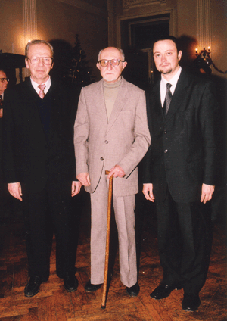
For those who can read Croatian, here is what academician Zupanovic wrote (see [Kuhac, pp 305-306]):
Mr Andjelko Nedo Paveskovic (living in Monte Carlo, from Poljica near Split) wrote several very interesting articles about Haydn:"©teta je ±to Kuhaè u svoje vrijeme nije znao za timski (grupni) rad, ili ga - ako mu je i bila poznata tehnika - nije umio/moga (smio?) ostvariti. Da mu je to uspjelo, on bi - prireðivaè je na osnovi vlastitog iskustva u to èvrsto uvjeren - zajedno s po jednim lingvistom, povjesnièarom, arheologom, teologom i jo± pokojim (strukovno srodnim) znanstvenikom za polovicu imena ±to ih je naveo u Historijskom uvodu argumentirano dokazao njihovo hrvatsko podrijetlo. To osobito vrijedi za Franza Josepha Haydna, sina Mathiasa Haden-a i Ane Marije Haidin kako pi±e na nadgrobnom spomeniku koji danas stoji na groblju u Rohrauu. U svoje vrijeme - uz iznimku engleskoga muzikologa W. H. Hadowa (1859.-1937.) - posebice u njemaèkim zemljama doèekana "na noµ" a danas posvema odbaèena, Kuhaèeva pretpostavka ostaje ako ni±ta drugo a ono curiosum sui generis.
- Skladatelj
Josip Haiden (Haydn)
Hrvat ili Nijemac? (Was Josip
Haiden Croatian or German?), Poljica, Gata, 2001, broj 26, pp. 61-107;
several interesting items from this long paper:
- Until 1954, the well known Grove's Dictionary of Music and Musicians, London, accepted the opinion of Haiden (Haydn) as the Croat (and since that year accepted the opinion of Schmid about his alleged German roots)
- Dutch historian of art Henrik van Loon (in 1937) and Canadian historian Murray Gibbon (in 1938) pointed out to the political motivations in these questions, and that it should not be allowed to "Teutons" to deny Croatian roots of Haiden
- Larousse Musique in 1957 considers the Slavic - Croatian of Haydn possible.
- Sir Kenneth Clark, in his TV presentation The Civilisation (famous for his book having the same title), shown by Swiss - Italian TV in 1970s, claims Haiden to be the Croat
- Anthony Hodgson in his book The Music of Joseph Haydn (London, 1976) considers Hayden to be the Croat born in Trstenik (Rohrau), and stresses notable presence of Croatian folk melodies in Heidens's famous symphonies
- [Remark by D.Z.:
Let us mention a very nice and lively presentation of Haydn's person
and music by Leonard Bernstein,
USA, in his TV show, where Bernstein was obviously citing long passages
from Hadow's book (stressing among others "non-Teutonic" character of
Haydn's music and his personal appearance), without mentioning neither
the book, nor its significant title, which we recall again:
A Croatian Composer;
Notes towards the study of Joseph Haydn] - Hayden included in his music about 30 Croatian folk melodies!
- Haydn's melody Gott erhalte (German National Anthem) is evidenced from Croatian Littoral and environs of Zagreb to Medjimurje on the North, and to Gradisce (Burgenland) in Austria
- El compositor Jose Haiden (Haydn, 1732-1809) y los Croatas (Con motivo de 190 anos de la muerte del compositor)
- El compositor Jose Haiden (Haydn, 1732-1809) y los Croatas (La presencia croata en Gradisce)
Let us add that the melody for the German national anthem, composed by Joseph Haydn, is based on a very old Croatian folk song ("V jutro rano se ja stanem, rano pred zorom...", see the Oxford Music Dictionary). It is also significant that Haydn himself named the song Volkslied, before it became the anthem. Compare the Croatian folk song

with the German national anthem:

See also sheet music taken from Austrian - American Magazine, March 2002. For more details see Hadow's analysis from his monograph A Croatian Composer; notes towards biography of Joseph Haydn (London 1897).
Ivan Padovec (1800-1873), born in the beautiful baroque town of Varazdin (known for its festivals of baroque music) was a guitar virtuoso, who gave concerts in Zagreb, Vienna, Prague, Budapest, Hamburg, London, in Poland, Russia etc. He constructed a ten string guitar. Also, he published his Teoretish - praktische Guitar - Schule in Vienna in 1842.
Illma de Murska (born as Ema Puksec in the town of Ogulin, 1834 - 1889) was an opera diva of international fame. She sang in Italy, Spain, Hungary, and her most fruitful period was in Wiena, Austria. She also sang in Berlin, Hamburg, Paris and London, and had tours in Australia, Russia, USA and New Zealand.
ZAGREB SOLOISTS... In the last 50 years they had more than 3500 concerts, among others in the Royal Albert Hall and Royal Festival Hall (London), in Carnegie Hall (New York), Musikverein (Viena), in Mozarteum (Salzburg), in Hercules (Münichen), in Tonhalle (Zürich), in Teatro Real (Madrid), in Concertgebouw (Amsterdam), in Salle Pleyel (Paris), in Santa Cecilia (Rome), in Cajkovski concert hall (Moscow), in Opera House (Sydney), in Festival Hall (Osaka), in Coliseo (Buenos Aires), in Victoria Hall (Singapuru). They also had solemn concerts at the General Assembly of the UN.
Lovro von Matacic, one of the greatest conductors of the 20th century (1899-1985), started his career in 1919 as conductor of orchestras in Osijek, Novi Sad, Ljubljana, Belgrade, Riga, and in Zagreb in 1932. From 1942-1945 he was conductor of the Vienna Opera. After 1945 he was imprisoned by the Yugoslav communist regime, and together with Croatian poet Tin Ujevic and painter Kristian Krekovic sentenced to confiscation of all movable and immovable property. In 1950's he became organizer of Festivals in Dubrovnik and Split. In 1956 Matacic moved to Germany to conduct East Berlin Opera and the famous Dresden Staatskapelle, then conducted at Bayreuth in 1959, and from 1961 to 1966 was Gereralmuikdirektor in Frakfurt. He was also guest conductor in Vienna Opera, Milan Scala, in Chicago, Naples, Palermo, Rome, London, Cleveland, Tokio, Prague, etc., and was elected the honorary director of the Japanese Orchestra in Tokio. From 1970 to 1980 he was conductor and artistic director of the Zagreb Philharmonic Orchestra, and almost simultaneously from 1973 to 1979 had the same role in the Monte Carlo Orchestra.
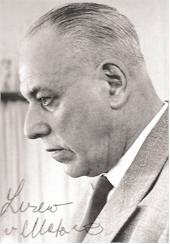
- the Bruckner Medal and of the International Bruckner Society, recipient of the Bruckner Ring from Viennese Symphonic Orchestra (one among only a few of the most outstanding conductors),
- recipient of the Smetana Medal from the Czech government and Janacek Medal,
- Hans von Bellow Medal from the Berlin Philharmonic Orchestra,
- medal for artistic work from the Prince Rainer of Monaco,
- the Cross of the First Order for Science and Art from the president of Republic of Austria,
- and of numerous recognitions in Croatia.
Andjelko Klobucar (1931), organ player and church music composer, played throughout Europe, including the church of Notre Dame in Paris, Westminster Abbey in London, Basilica of St. Maria degli Angeli in Assisi.
Mia Slavenska (born in Slavonski Brod, 1914-2002), became ballerina of the Zagreb Opera (1930-33), studied also in Vienna, and joined the Paris Opera in 1933. In London she danced with Anton Dolin before joining the Ballet Russe de Monte Carlo (1938-42). She later formed her own company, Ballet Variante.Iin 1953 she established the Slavenska-Franklin ballet company with Frederic Franklin. In 1950's she was primabalerina of the Metropolitan Opera. By the end of her career she was teaching in Los Angeles, California. Slavenska starred in a wonderful French film, La Mort du Cygne (1938).
The well known musical ``The Cantenbury Tales'', which played in London for quite a long time, was directed by Vlado Habunek, an outstanding name in theatrical life of Croatia.
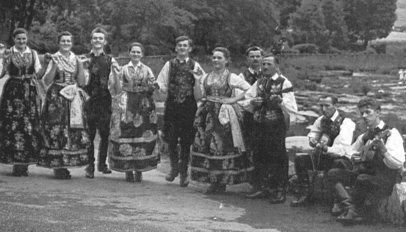
Bunjevci Croats in Backa
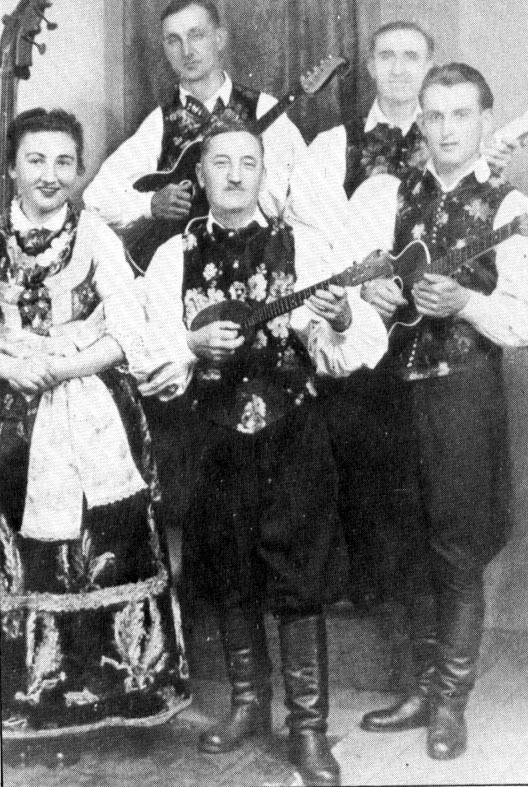 Pere
Tumbas - Hajo
(1891-1967), conductor, composer, and the famous tamburitza player, was
very active among Backa Croats in Subotica, which was his birthplace.
His greatest success was the sensational triumph at the "International
folklore festival" in Langolen in England in 1952, where his reduced 4
member orchestra (normally 7 players) and 8 dancers won the first
prize, among 16 best folklore groups of the world (including the
Russian balalayka group and Spanish flamenco players). The
administrative authorities in the Yugoslav capital Belgrade never gave
him opportunity again to show his brilliant tamburitza play outside of
former Yugoslavia. Despite this, the Croatian Tamburitza
society from Pittsburgh, directed by Walter Kolar, performed throughout
the USA many songs arranged or composed by Hajo. In the journal The
Tamburitzan, directed by Walter Kolar
(Pittsburg), Hajo has been represented as the most famous tamburitzan.
Pere
Tumbas - Hajo
(1891-1967), conductor, composer, and the famous tamburitza player, was
very active among Backa Croats in Subotica, which was his birthplace.
His greatest success was the sensational triumph at the "International
folklore festival" in Langolen in England in 1952, where his reduced 4
member orchestra (normally 7 players) and 8 dancers won the first
prize, among 16 best folklore groups of the world (including the
Russian balalayka group and Spanish flamenco players). The
administrative authorities in the Yugoslav capital Belgrade never gave
him opportunity again to show his brilliant tamburitza play outside of
former Yugoslavia. Despite this, the Croatian Tamburitza
society from Pittsburgh, directed by Walter Kolar, performed throughout
the USA many songs arranged or composed by Hajo. In the journal The
Tamburitzan, directed by Walter Kolar
(Pittsburg), Hajo has been represented as the most famous tamburitzan.
CROATS IN BOSNIA - HERZEGOVINA
Even the historical names of many officials in the Ottoman Empire reveal their origin (Hirwat = Hrvat or Horvat, which is a Croatian name for Croat): Mahmut-pasa Hirwat (= Hrvat), Rusten-pasa Hrvat, Pijali-pasa Hrvat, Sijavus-pasa Hrvat etc. In the 16th century a traveler and writer Marco A. Pigaffetta wrote that almost everybody on the Turkish court in Constantinople knows the Croatian language, and especially soldiers. Marco Pigafetta in his "Itinerario'' published in London in 1585 states: "In Istanbul it is customary to speak Croatian, a language which is understood by almost all official Turks, especially military men."
Petar Zrinski was also very educated, being a statesman, poet, composer, polyglot. He presented his legendary sword to the town of Perast in Boka kotorska during his sojourn there in 1654.
The letter sent by Petar Zrinski to his wife Katarina (in Croatian) just a day before his death is one of the most deeply moving texts ever written in the Croatian language. It was very soon translated and published in
- Croatian (Moje drago serce), Vienna, 1671,
- English (My dear soul), London, 1672,
- German (Mein liebes Herz), Vienna, 1671,
- French (Ma chere Femme), Paris, 1691,
- Italian:
- Mio Cuore, Vienna, 1671,
- Carisima Consorte, Dresden, 1672,
- Latin (Delicium meum), Vienna, 1671,
- Spanish (Querida Esposa mia), Madrid, 1687,
- Dutch (Myn Liefste Hert), Amsterdam, 1671,
- Hungarian (Anna Catharina), Budapest, 1671.
Letter by
Petar Zrinski to his wife Katarina
Written in Croatian language in 1671
English translation (My dear soul), London 1672
My dear soul!
I most humbly beg of you, that you would not grieve your self to excess, at the sight of this Letter. To morrow, Ah Madam, I must tell it you, Alas! To morrow about ten of the clock in the morning, we must lose our Heads, I, and your brother. To day we have taken our last farewell each of other; and now I come also to take leave of you, my dear Soul, for ever; entreating you that you will please to pardon me all things, whereby in all my life time, I have ever offended you. God who hat created me, will have pity on me, whom I will also beseech, for I hope I shall to morrow be in his presence, that we may see each other in eternal glory before his Throne. As to any thing else, I can write nothing, neither concerning my Son, nor any disposal of what I have in the World, having resigned all to the will of God. Afflict not your self beyond measure, for God will have it so. Newstadt, the last day of my life: Being the 29th. of April, at 7 a clock at night, in the year 1671. God preserve you and bless you, and my Daughter Aurora Veronica. Amen.
Peter Count of Zerin
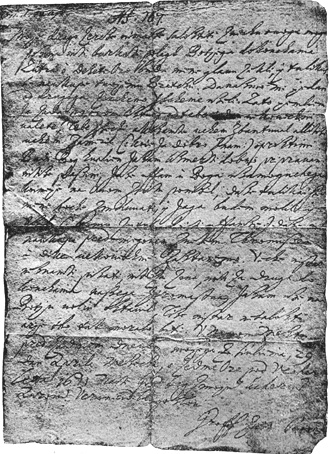
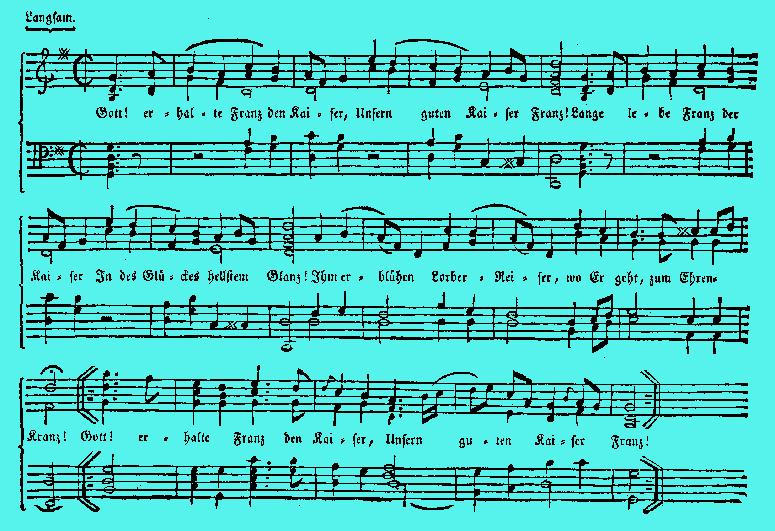
www.hr/darko/etf/et112.html
www.hr/darko/etf/jews.html
According to a report of the British Naval Intelligence Division from 1944, the Croatian "Roman Catholic clergy, following the example of monsignor Stepinac, the Zagreb Archbishop, energetically protested against ustasha persecutions of Serbs and Jews, as well as against government's attempts for forced conversion to Roman Catholicism" (written by experts from Oxford and Cambridge in 1944, with note `only for official use'). See Stefan, pp. 127-131.
An extremely valuable account on the terrorist methods of the Pan-Serbs in Yugoslavia between the two WWs has been written by Henri Pozzi, a brave French diplomat (his mother was English) and a close witness, in his book Black Hand over Europe, London, 1935. "Black hand" is the name of the Pan-Serbian secret terrorist organization, very close to the Royal court in Belgrade. It was the "Black hand" that organized the assassination of the Austrian archduke Ferdinand Habsburg in Sarajevo in 1914, which meant the beginning of the First WW.
The book contains an important article The Story of the Black Hand and the Great War by a Montenegrin intellectual Voislav M. Petrovich, p. 243-267. He committed suicide in London in 1934 after a violent campaign instituted against him and threats of the Black Hand. It is interesting that Petrovich had published a Serbain grammar in London in which he succeeded in getting the English Press to use the word "Serbia" instead of "Servia".
One of outstanding Croatian emigrants was Ante Ciliga (born in Istria, Segotica near Vodnjan, 1898 - 1992) who spent 6 years in Russian concentration camps: 1930 - 1936. His book Au pays du grand mensonge, Paris 1938 (In the land of great lie) revealed the truth about stalinist concentration camps to the world audience. It is probably the first anti-stalinist book, translated into many languages, including Japanese. He also spent one year (1942/1943) imprisoned in the Jasenovac concentration camp. Other books: The Russian Enigma, London 1940, Il labirinto jugoslavo, Rome 1983.
By the end of the Second World War the remaining parts of the NDH Army together with many civilians began to withdraw to Austria, and in the battles until 15 May 1945 they surrendered to the Yugoslav Army, which surrounded them. Many people who flew to Austria in mid-May 1945, were sent back by the British military authorities (who had jurisdiction over a part of Austria) to the Yugoslav partisans. Tens of thousands of soldiers and civil captives were killed after the capitulation. The symbol of the Croatian tragedy is the slaughter of Croats near the city of Bleiburg in Austria. Those who were not killed immediately, were forced to walk up to 700-800 km. (the infamous "death marches") with mass executions on the way, organized mostly by Serbian partisan officers. These death marches are known among the Croats as "krizni put" (Way of the Cross). Many sites of mass executions were discovered throughout Croatia and Slovenia after democratic changes in 1990.
- For more information see [Tolstoy] and [Zugaj],
- Zvonko Springer (Salzburg): Withdrawal and Death March, ...During recent construction works [in 2000] of a highway near Maribor (Republic of Slovenia) the roadbed crossed a filled in 1941 anti-tank trench whose length, one reckons, was some 2.5km. On the excavated part of it of some 70m one found and had to remove thousands of bones of some 1,200 skeletons of entirely decomposed male bodies. Considering some 15 skeletons per meter (!) in that excavated trench part only, one derives to say over 30,000 killed males being buried there... [the place of this horrific mass slaughter in Slovenia is still not marked by any visible sign].
- In 1999 the resources from the Republic of Slovenia reported of as many as 110 mass graves of Croats discovered in this state, victims of the "Way of the Cross" in 1945 immediately after the end of WW2. Among them there were not only soldiers, but also a large number of civilians. The Slovenian public was shocked by the size and number of these graves.
- In 2001 Slovenian sources reported of as many as 296 mass graves on their territory, and an estimate of about 190,000 Croats killed immediately after the end of WW2 (May 1945 and later), mostly Croats. Only in the region of Tezno woods Slovenian sources estimate about 60-80,000 killed. Many children bones have been found among the remains victims.
An attempt to answer an insinuation of the BBC
THE LIPIK ORPHANAGE AND COLONEL MARK COOK
The Lipik Orphanage and Colonel Mark Cook
© by Darko Zubrinic, Zagreb (1999)  The
Lipik Children's home was the first object to be destroyed by Serbian
forces in 19 August 1991. The shelling of the city of Lipik and Pakrac
started at 05.30 with the shelling of orphanage, which had 80 children,
aged between 3 and 16, sleeping at the time. They took refuge in a
cellar for 7 days until they could be evacuated. The orphanage
consisted of three buildings, including kitchen and dining room,
classrooms and recreation rooms, and all were badly damaged and gutted
by fire.
The
Lipik Children's home was the first object to be destroyed by Serbian
forces in 19 August 1991. The shelling of the city of Lipik and Pakrac
started at 05.30 with the shelling of orphanage, which had 80 children,
aged between 3 and 16, sleeping at the time. They took refuge in a
cellar for 7 days until they could be evacuated. The orphanage
consisted of three buildings, including kitchen and dining room,
classrooms and recreation rooms, and all were badly damaged and gutted
by fire.
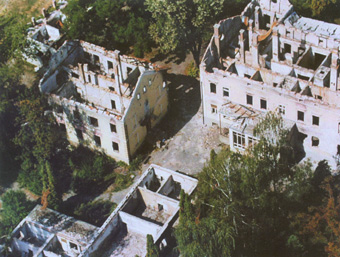
In October 1991 the largest Lipizzaner horse-farm in Croatia, situated near the town of Lipik, was bombed with napalm bombs.
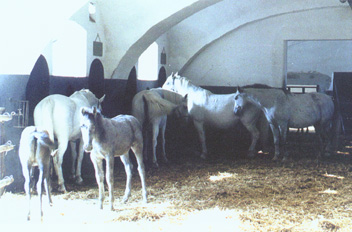
Colonel Mark Cook, the Commander of the British Contingent of the UNPROFOR in Croatia, supported by his family in Great Britain and together with British soldiers, initiated helping to rebuild the orphanage.
The Lipik Orphanage (Djecji Dom) was opened in December 1993. Here we should acknowledge also very important help in the reconstruction of the city of Lipik offered by Italian government.
Here are some excerpts from appeal of Colonel Marc Cook and his numerous supporters from Great Britain and other countries.
Here is a list of some of the donators, whose names are indicated on slates exhibited on walls of the renewed building:I made a promise to the kids to get them back into their Orphanage... You can't break promises to children.
Colonel Mark Cook
The Hearts of Gold calendar has been inspired by the work of Colonel Mark Cook, a Commander of the British Section of the UN Peace Keeping Force in Croatia. He saw first hand the devastating effects of an attack on the Children's Home in Lipik which reduced the building to rubble and left the children without their only home. These orphan children come from all three communities - Serb, Croat and Bosnian Moslem, yet they have grown up together in harmony. Now the future was bleak, suddenly their home was destroyed, their hopes shattered.
The children persuaded Colonel Cook to promise to rebuild the Orphanage. The work, which will cost one million pounds, is already underway with British troops assisting local architects and tradesmen. Thanks to the Colonel the children should be able to return to their home very soon.
This calendar will raise funds to ensure the Colonel's dream is realised. We asked some of the leading photographers in the country for their favourite pictures of children. We must thank them, together with all the companies who have freely donated their time and talent to produce and print this calendar. By buying it you have helped to create a safe place for the orphaned children of Lipik. Above all we want to congratulate Colonel Cook for his dedication and the vision to rebuild their home.
Esther Rantzen & Mike Smith
BBC
hearts of gold
1994 calendar IN AID OF
THE LIPIK ORPHANAGE
CROATIA
Mark Cook, Caroline Cook, H.R.H. Prince Hassan of Jordan, Cargilfield School, Breaside School, Sherborn Girls School, Letzebuerger Initiativ für Kroatien, Hall Grove School, Hrvatska Malteska Sluzba, Dan Eldon, Baroness Chalker, Paula Dumas - Dimmel, Mohammed El Fayed, Gerge Perinovic, Mladen Grbin, Stjepan Mandorelo, Anton Jurgens Charitable Trust, Peter Praxmarer, Suganya Lee, John Redwood, Bryan Sparrow, Sherborn Boys School, Tony Pratt, Brian Douglas, Marica Topic, Ros Hardie, Caro Brewster, Margaret Mc Lean.
|
|
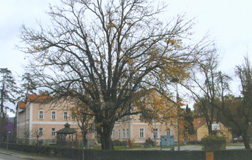 |
Numerous volunteers, as a rule very young, are offering their generous help in everyday work with orphans. Here are some of their impressions taken from the Guest Book of The Lipik Orphanage.
25. May 1999.
I have had the most amazing 6 months here at Lipik and I feel so privileged to have been given the chance to know you all.
Thank you for your friendship, love and patience (when I didn't understand!), and thank you for making my stay here so enjoyable. I take away many, many happy memories of the fun we had together and I will always have a special place for you in my heart.
I love you all so much, and will miss you more than words can say. But I will be back to see how you are getting on, and hopefully I will be able to have a swim in the basin then!
Take care of yourselves,
Big Hug!
Julia Abel
(Volonteer from November '98 to May '99)24-25 August 1998
I was once again drawn by here by the magic quality of the home and the special people in it. I think I came to retrieve my heart which I left here 1 year ago, but once again I am forced to leave in your possession. This is where it belongs! Keep going with the work, play and laughter, they are essential parts of childhood and I'm thrilled to find so much here. I'll be back soon I'm sure, I don't know when, but I will return.
Love always,
Ursula
Testimony of prim. dr. Fuad Secerbegovic about saving Bosnian children from chetnik persecutions during WW2
It is interesting that the first railway-track from Lipik to Vienna was built in 1861 by Henry D'Heureux - Gibel, a French enterprise dealing with exploitation of oak trees. Already in 1894 the town was electrified. In 1866 Lipik had 228 inhabitants: 222 Roman Catholics, 3 Pravoslavs, and 3 Jews.
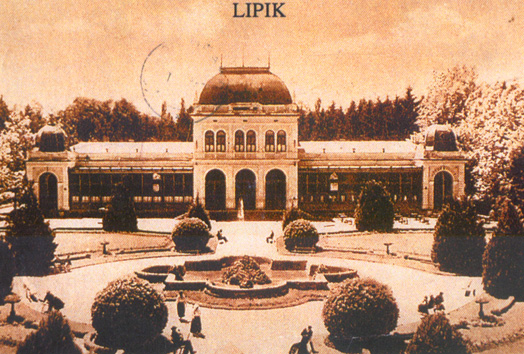
The town of Lipik is known for its very rich Recreation and Health Center, built already in the 19th century. It had
- baths with thermal mineral water, mineral water supply (300,000 liters per year),
- concert and congress hall, dancing hall,
- exceptionally cultivated park area,
- olympic swimming pool,
- cultural object (Kursalon) of zero category (neo renaissance object built in 1893 according to a project of Gustav Rath, architect from Budapest),
- hotel (four stars), hospital with hydrotherapeutic facilities,
- a small artificial lake with an island,
- tennis playgrounds,
- private villas in secession style, etc.
All of this was either destroyed or seriously damaged during Serbian shelling and bombing (including napalm bombs) in 1991.
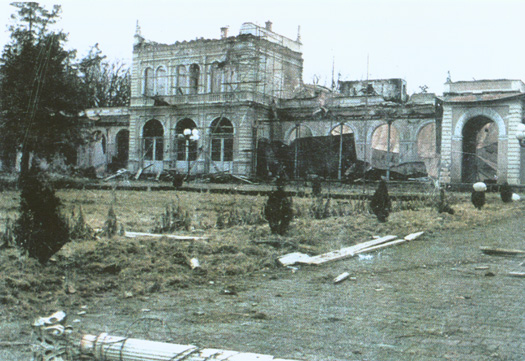
Numerous Croatian artists, above all those gathered within the association HLD SPEKTAR from Zagreb, donated altogether hundreds of their works of art to the future gallery of the town of Lipik. Many of them are exhibited in the Lipik Orphanage. Some artists from abroad also donated their works, like Janet Q. Treloar, London.
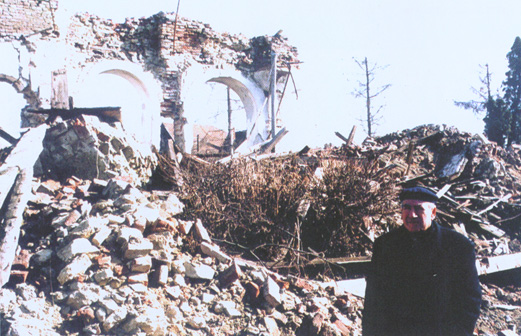
The champion of the Tournament of Cities (the future UEFA cup) in 1967 was "Dinamo", winning against Leeds (England) in the finals.
Goran Ivanisevic, Wimbledon, 2001 (three times Wimbledon finalist)
Veljko Rogosic was named International Long Distance Swimming Federation World Champion four times between 1971 and 1974. In 1998 this outstanding sportsman entered the International Marathon Swimming Hall of Fame. Rogosic swam La Manche (38 km) in 2004 at the age of 63!
CRAOTIAN MARINERS AND CAPTAINS
www.croatianhsitory.net/etf/mornari.html
Many of the early European expeditions to the western shore of the Atlantic finished with shipwrecks. So was the case with some ships from Dubrovnik in the 16th century. It is interesting to mention that the Croatan Indians in the USA could possibly be the descendants of the saved Croatian crew, as authenticated by their name, brown hair, blue eyes and some of the words in their language. Two large islands appear on the Molineaux map of Virginia, USA (1599), with the names Croatoan and Croatamonge (see [Eterovic], p. 30).
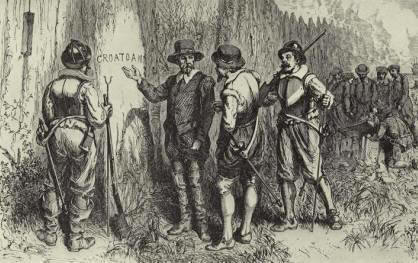
An American writer John Lawson in his 1714 chronicle wrote that among Croatan Indians of that time there was a legend of a 16th century shipwreck with mariners who saved themselves and stayed with Indians.
In attempts to find Walter Raleigh's Lost Colony inhabited by the British Empire in 1587 on the island of Roanoke (near the Croatoan island, North Carolina, USA), the searchers found a CRO carved in Roman letters on a tree in 1590. Another big tree had a bark peeled off, and carved on it in capital letters was the word CROATOAN.
...
Captain Mate Dulcic Hraste-Pucetov from the island of Hvar obtained a silver jug from the British Governement as a recognition for saving the boat "St. Croix". Gilted inside, 14.5 cm high and with diameter of the opening of 8.5 cm, the jug bears the the following inscription see [Mate Milicic et al., p 68]:
|
Presented by the British Government to captain Matteo Dulcich Hraste of the "Giovanni D" of Jelsa in acknowledgement of his humanity and kindness to the shipwrecked crew of the "St. Croix" of Jersey, 27 September 1877, abandoned at sea. |
International terminology:
- cravate
- pen (penkala)
- parachute
- psychology
- encyclopaedia
- dactyloscopy
- ship screw (propeller)
- Zeppelin (David Schwartz)
- Tesla, three phase system, radio, radar, X-rays, robot,...
- Moho layer
- torpedo
- Croatia/Great
Britain. The History of Cultural and Literary Relations,
Ivo Mardesic, The Bridge, Zagreb 1995,
- Branko
Franolic Books
on Croatia and Croatians: recorded in the British Library General
Catalogue, Vol 1, Zagreb,
London, New York, Toronto, Sidney, Croatian Information Center, 1996,
- A survey of Croatian bibliographies, compiled by Branko Franolic, Croatian Information Centre (Zagreb, London, New York, Toronto, Sydney), 2004, ISBN 953-6058-30-8
- Henri
Pozzi: Black
Hand over Europe, The Francis
Mott Co, London 1935 (the original French title was: La
Guerre revient); forbidden in
France and Yugoslavia, translated
into Italian, German, Hungarian, Bulgarian; the English 1935
edition reprinted by the Croatian information centre in
Zagreb, 1994, ISBN 953-6058-06-5
- Nikolai Tolstoy: Ministry and Murders, Bleiburg and Kocevski rog 1945, London, 1987 (the book is forbidden in G.B.),
- Robin Harris: Dubrovnik: A History, Saqi Books, 2003 (550 pp.)
Croatia - Australia
Croatia - Japan Croatia - South America