Croatia - Russia
overview of historical and cultural relations - a sketch
Darko Zubrinic, 2007.Contents:
- General
- Science
- Jelacic, Radic
- Art
- Dubrovnik
- Croatian Latinists, Humanists, and Encyclopaedists
- Croatian Glagolitic Script
- Music
- Sports
- Croatian mariners
- Cravate
- Liberté
- King of Dolls (Korol' kukol)
 The
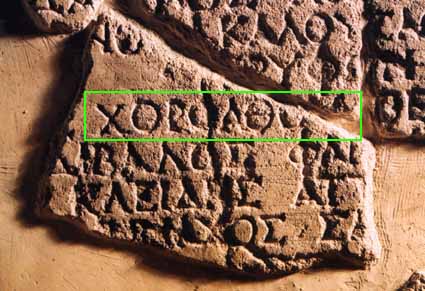
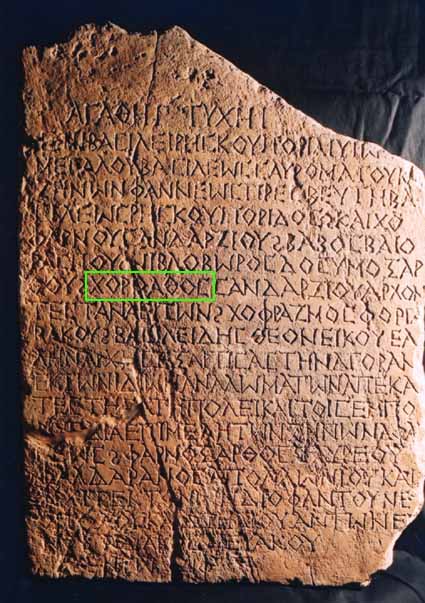
origins of the Croatian name are Iranian. The earliest mention of the
Croatian name as Horovathos
can be traced on two stone
inscriptions in Greek language and script, dating from around the year
200, found by the Black Sea (more precisely in the seaport Tanais on
the Azov sea, Krim). Both tablets are held in the Archeological museum
in St Petersburg, Russia.
The
origins of the Croatian name are Iranian. The earliest mention of the
Croatian name as Horovathos
can be traced on two stone
inscriptions in Greek language and script, dating from around the year
200, found by the Black Sea (more precisely in the seaport Tanais on
the Azov sea, Krim). Both tablets are held in the Archeological museum
in St Petersburg, Russia.
One of the confluents to Don river near the region of Azov is called Horvatos (see [Pascenko], p. 87). The Croatian name can be traced to different sites in Ukraine, also around Krakow in Poland, in Bohemia, and Austria, thus showing migrations of the Croatian tribes to their future homeland.
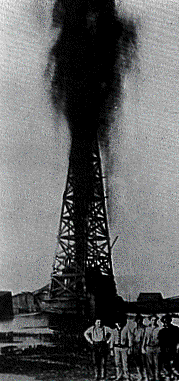 Antun Lucic
(americanized name is Anthony
F. Lucas; born in Split 1855,
died in Washington 1921)
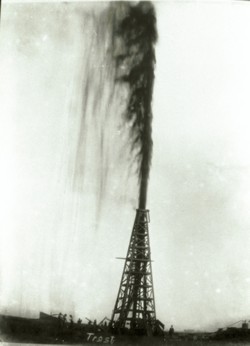
discovered the first major gusher in Texas, The
Lucas gusher,
flowing
at the rate of 80,000 to 100,000 barrels per day. It blew in January
1901. About
50,000 people came to see it. This meant the earliest massive
exploitation of
oil and petroleum in the world.
Antun Lucic, known as Anthony
F. Lucas (F. = Francis is after
his father
Franjo,
mariner and shipbuilder from the
island of Hvar) believed that the nearby Spindletop hill,
near the town of Beaumont,
covered a vast
pool of oil. His company became one of the first oil companies in
Texas. Antun
Lucic was a mining engineer who completed his studies at the
Polytechnic institute
in
Graz, Austria, where also his fellow countryman Nikola
Tesla later studied. By 1902, as
many as 285 wells were operating
on Spindletop
Hill and over 600 oil companies had been chartered (the population of
Spindletop
sprang from 8,000 in 1901 to 60,000 in 1902, i.e. in just a year!). In
this way
Captain Anthony Lucas enabled the United States to surpass Russia
as the world's
leading oil producer. With the Lucas gusher, a black-gold rush began,
and fortune-seekers
from all over the world poured into Texas. Over time, Houston became a
center
of the oil
industry, and a captive of the British-dominated global oil cartel.
Antun Lucic
(americanized name is Anthony
F. Lucas; born in Split 1855,
died in Washington 1921)
discovered the first major gusher in Texas, The
Lucas gusher,
flowing
at the rate of 80,000 to 100,000 barrels per day. It blew in January
1901. About
50,000 people came to see it. This meant the earliest massive
exploitation of
oil and petroleum in the world.
Antun Lucic, known as Anthony
F. Lucas (F. = Francis is after
his father
Franjo,
mariner and shipbuilder from the
island of Hvar) believed that the nearby Spindletop hill,
near the town of Beaumont,
covered a vast
pool of oil. His company became one of the first oil companies in
Texas. Antun
Lucic was a mining engineer who completed his studies at the
Polytechnic institute
in
Graz, Austria, where also his fellow countryman Nikola
Tesla later studied. By 1902, as
many as 285 wells were operating
on Spindletop
Hill and over 600 oil companies had been chartered (the population of
Spindletop
sprang from 8,000 in 1901 to 60,000 in 1902, i.e. in just a year!). In
this way
Captain Anthony Lucas enabled the United States to surpass Russia
as the world's
leading oil producer. With the Lucas gusher, a black-gold rush began,
and fortune-seekers
from all over the world poured into Texas. Over time, Houston became a
center
of the oil
industry, and a captive of the British-dominated global oil cartel.
Anthony Lucas (Antun Lucic) invented the so called "Christmas tree", which is the system of valves and pipes installed on the wellhead to harness a gusher. The "Christmas tree" is connected to the piping for transportation or storage of oil.
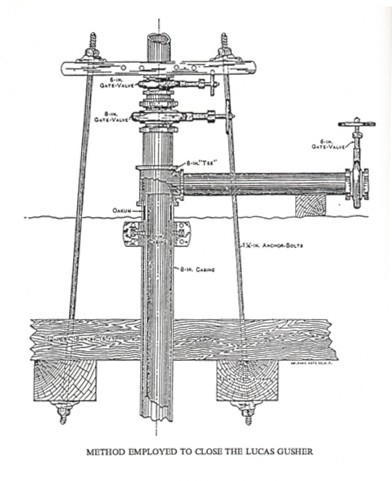
Christmas
tree invented by Anthony Lucas
in order to harness a gusher (photo from [McBeth])
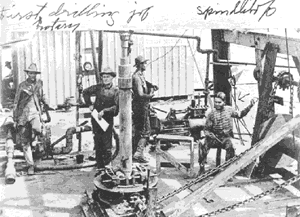
Anthony
Lucas and drilling crew,
photo from Math/Science
Nucleus for children
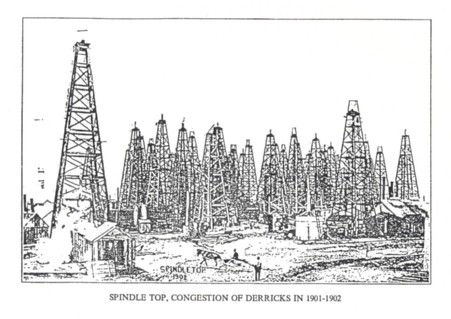
Spindle Top, congestion of derrics in 1901-1902 (photo from [McBeth])
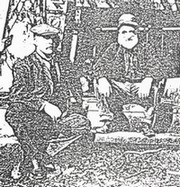
Antun Lucic (Anthony Lucas) on the left (photo from [McBeth])
The naval fuel board program adopted by the USA Government in 1901 specified that all the vessls should be equiped for the burning of oil as fuel. Railroads in increasing number were using it, and manufacturers were substituting it for coal and gas. At that time the automobile industry just began to develop, and the importance of Lucic's discovery for its further expansion was enormous.
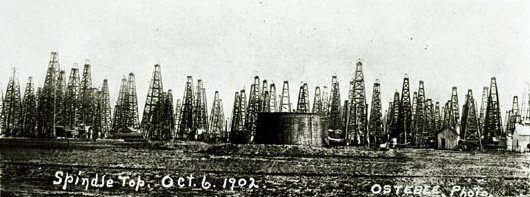
Spindle Top in 1902
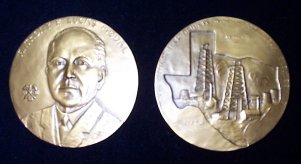
Antun Lucic is also considered to be the founder of modern petroleum reservoir engineering. He was consulting engineer in USA, Russia, Mexico, Algeria, and Romania. As an expert in mining he was elected the life long chairman of the American Committee for Oil and Gas (later called Petroleum Division, more information). In 1936 The American Institute for Geological and Metallurgical Investigations founded a prize named after him: Anthony F. Lucas Gold Medal.
A museum with 18 m high granite obelisk was built in honour to the Lucas gusher in Spindletop. There is also 1,5 m granite monument of Lucic with inscription saying that his discovery revolutionarized industry and transport,... and changed lives of people in the whole world.
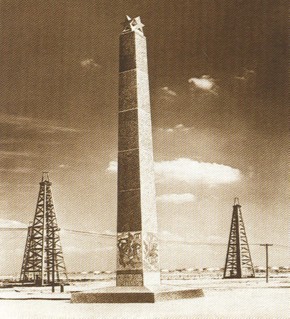
18
m high granite obelisk, built in honour
to the Lucas gusher, Spindletop, contains the following lines:
| On
This Spot on the Tenth Day of the Twentieth Century a New Era in Civilization Began |
In 1943 Lucas' son and daughter-in-law established charitable foundation in his name.
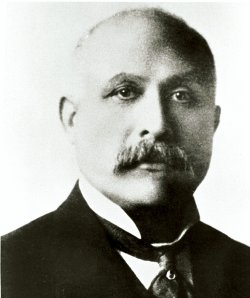
Antun Lucic (Anthony F. Lucas) is placed among 200 of most deserving Americans in the course of the entire history of the USA. There are a street and an Elementary school bearing his name in the City of Beaumont, Texas.
As to his nationality, it is often mistakenly described as Austrian, and sometimes even Italian (like in Who is Who in America, where there is also another mistake - that he was born in Trieste). On his grave in Rock Creek, Washington, he is said to be of Illiric origin, where Illiric is a standard name for Croatian. For more information about Anthony Lucas see here, and also
- Lucas, Anthony Francis (The Handbook of Texas)
- Who Was Anthony F. Lucas? (for children)
- Anthony (Luchich) Lucas
- www.spindletop.org, where he is wrongly designated as "Austrian"
- Spindletop, Texas
- James Anthony Clark and Michel T. Halbouty: Spindletop, New York, Random House, 1952
- Everett DeGoyler: Anthony F. Lucas and Spindletop, Southwest Review 30, Fall 1945
- Reyd Sayers McBeth: Pioneering the Gulf Coast; a story of the life and accomplishments of Capt. Anthony F. Lucas, New York 1918; reprinted and revised by INA Naftaplin in Zagreb, 1998, ISBN 953-96949-5-7, translation into Croatian - Antun Lucic, Zacetnik traganja za naftom na obali meksickog zaljeva, ISBN 953-96949-4-9
The scientific activity of Vladimir Varicak (1865-1942), professor of mathematics at the University of Zagreb, was mainly in non-Euclidean geometry and its applications to Einstein's theory of relativity. His lecture delivered in 1911 at the German Mathematical Society in Karlsruhe has been published in 1912 in Jahresberichte der Deutschen Mathematike Vereinigung, and translated from German into Polish (Warszaw, 1913), Russian (St. Petersburg, 1914), French (Paris, 1914). His most important work is the monograph Darstellung der Relativitätstheorie im dreidimensionalen Lobatschefskijschen Raume, Zagreb, 1924, which has been been cited by many authors to these days.
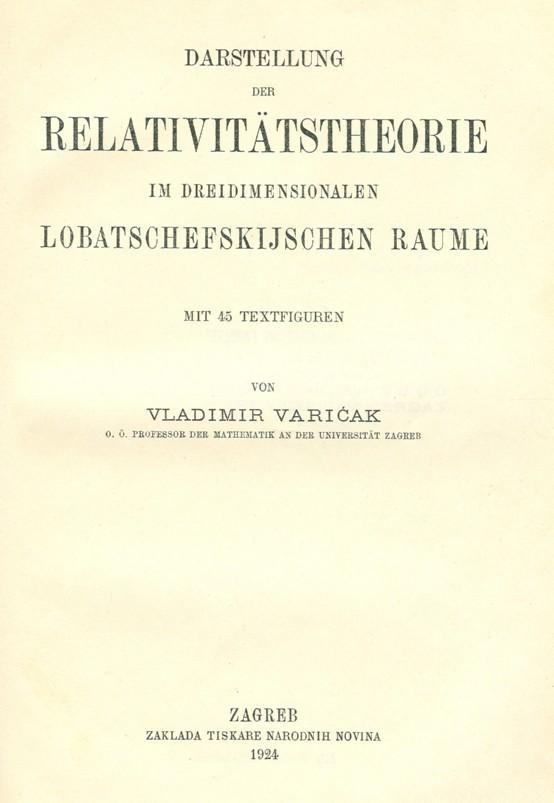
The results of his work have been cited also in Wolfgang Pauli's Relativitätstheorie. One of his students at the University of Zagreb was Vilim Feller, that is, William Feller, a famous Croatian - American mathematician.
One of the most outstanding representatives of photochemistry was Ivan Plotnikov (1878-1955), a Russian emigrant to Croatia (1918) and a professor of physical chemistry in Zagreb.
Fran Bosnjakovic (1902-1993), born in Zagreb, was one of world's leading experts in technical thermodynamics. Educated in Zagreb, where his scientific career started in 1926, he moved to Dresden, Germany, in 1928. In 1931 he became university teacher at Dresden High Mechanical Engineering School. After a short stay in Belgrade, he moved back to the University of Zagreb in 1936. After 1945, during the Yugoslav communist regime, he was degraded to two years of forced labor. In 1951 he became rector of the University of Zagreb.
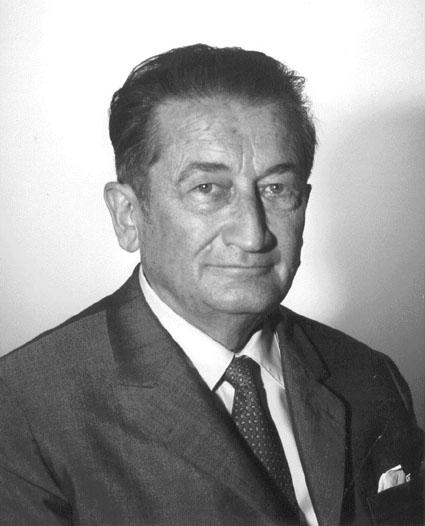 Since
1953 he started lecturing at the High technical
school in Braunschweig in Germany, where he became head of the
Department for thermodynamics and director of the Thermotechnical
institute. In 1961 he founded the Institute
of Thermodynamics for
Aeronautics and Astronautics at
the University of Stuttgart,
Germany, that he led until his retirement in 1968. He also established
groups for Irreversible Thermodynamics, Mass Transfer and
Thermokinetics, Radiation and Plasma, and Heat Transfer. It is
interesting that his textbook Technische
Thermodynamik,
published already in 1935 in Dresden, had seven improved and extended
editions in Germany, and was translated into English (Technical
Thermodynamics) and Russian
(Tehnicheskaya
termodinamika). The Croatian translation had five editions (Nauka o
toplini). See his list of publications
held at the University of
Stuttgart.
Since
1953 he started lecturing at the High technical
school in Braunschweig in Germany, where he became head of the
Department for thermodynamics and director of the Thermotechnical
institute. In 1961 he founded the Institute
of Thermodynamics for
Aeronautics and Astronautics at
the University of Stuttgart,
Germany, that he led until his retirement in 1968. He also established
groups for Irreversible Thermodynamics, Mass Transfer and
Thermokinetics, Radiation and Plasma, and Heat Transfer. It is
interesting that his textbook Technische
Thermodynamik,
published already in 1935 in Dresden, had seven improved and extended
editions in Germany, and was translated into English (Technical
Thermodynamics) and Russian
(Tehnicheskaya
termodinamika). The Croatian translation had five editions (Nauka o
toplini). See his list of publications
held at the University of
Stuttgart.
Professor Bosnjakovic obtained honorary doctorate from High Technical School RWTH Aachen, Grashof's medal from the German Society of Engineers VDI in 1969, gold medal from the Associazione Termotechnica Italiana in Padova in 1966, another gold medal from the Institut français des combustibles et de l'énergie in Paris. On the occasion of his 80'th birthday in 1982 the German Society of Engineers VDI issued a special publication devoted to his scientific work. In 1987, on the occasion of his 85'th birthday, a solemn colloquium was organized by the Technical University of Stuttgart. Also, he was a member of
- Academies in Heidelberg (Heidelberger Akademie der Wissesnschaften),
- Braunschweig (Braunschweigsche Wissenschaftliche Gesellschaft),
- Assoziazione Termotecnica Italiana in Padova, 1966 (recipient of gold medal),
- Istituto Veneto di Scienze, Lettere ed Arti in Venice,
- honorable member of Institut International du Froid (International Institute of Refrigeration) since 1960,
- Institut francais des combustibles et de l'energie, 1970 (recipient of the medal),
- Croatian Academy of Sciences and Arts (1992, i.e., only after the fall of ex Yugoslavia, and a year before the death of Bosnjakovic).
Denn das Ingenierwessen is vor allem auch ein Beruf des Könnes und der verantwortungsvollen Gestaltung, wofür wissenschaftliche Grundlagen nur einen, wenn auch beachtlichen, notwendigen Teil bilden.
ECOS 2002 International conference, organized by the Institute for Energy Engineering at the Technical University of Berlin, has been dedicated to the memory of Fran Bosnjakovic.
Bosnjakovic's "Technische Thermodynamik" had till the year 2000 altogether thirty editions in four languages (German, English, Russian, and Croatian).
- In 1945 the book was translated as "Technical Thermodynamics I" by Edwards Brothers Inc, Ann Arbor, Michigan, USA (unauthorized translation), and the same year "Technical Thermodynamics II" (by the same publisher, also unauthorized translation).
- The first Croatian edition appeared in 1947 in Zagreb.
- The first Russian edition "Tehicheskaya termodinamika, chast' pervaya" of Bosnjakovic's monograph appeared in 1955, published by the State Energetic Publishing House (Gosudarstvennoe energeticheskoe izdatel'stvo), Moscow and Leningrad. The second part of the Russian edition was issued in 1956. In their Preface to the book the translators stress the excellency of exposition, and in depth theoretical analysis. A sample of Russian edition sent to professor Bosnjakovic contains the following dedication: Glubokouvazhaemomu profesoru Bosnjakovicu ot perevodchika etoj prekrasnoj knigi, na pamyat', V.A. Kirillin [one of translators], 1969, Moskva.
- The authorized editions of Bosnjakovic's books in the USA were published in 1965 by Holt, Reinhart and Winston, New York (20 year after unauthorized edition).
For more information see: Fran Bosnjakovic, Spomenica posvecena 100. obljetnici rodjenja, uredio Mladen Andrassy, Zagreb, 2001. ISSBN 953-6002-21-3
William Feller (Vilim, Willy, Willi, 1906-1970) is a well known name among mathematicians dealing with probability theory. He was born and educated in Zagreb as Vilim Feller, where he studied mathematics, and earned the degree of Master of Science in mathematics in 1925. Already the next year, at the age of 20, he defended his doctoral degree in mathematics at the University of Göttingen, at that time the strongest mathematical center in the world. He was a professor at the Universities of Kiel, Copenhagen, Stockholm, Lund, Providence, Princeton etc., a member of many scientific organizations. Many important mathematical notions bear his name: Feller's process, Feller's transition function, Feller's semigroup, Feller's property. He is best known for his monograph "An Introduction to Probability Theory and its Applications", Volumes I and II, on 1153 pp., translated into Russian(with foreword of Kolmogorov), Chinese and Polish. They are considered among the best mathematical textbooks written in the 20th century. At the International Congress of Mathematicians held in 1958 in Edinburgh, William Feller gave a plenary talk "Some new connections between probability and classical analysis."
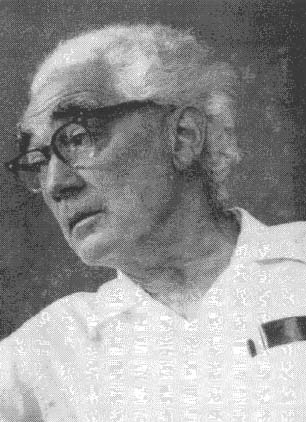
For more information see William Feller (photo by Paul Halmos).
Feller was among those who initiated issuing the important Mathematical Reviews journal, and was its first executive editor (1944-1945). He worked with von Neumann, one of the creators of modern computers. Feller was awarded the National Medal of Science of the USA in 1969. He was in touch with his relatives in Zagreb, as well as with his colleagues at the University of Zagreb.
Joseph Doob, a renowned American mathematician, wrote about Feller the following:
Those who knew him personally remember Feller best for his gusto, the pleasure with which he met life, and the excitement with which he drew on his endless fund of anecdotes about life and its absurdities, particularly the absurdities involving mathematics and mathematicians. To listen to his lecture was a unique experience, for no one else could lecture with such intense excitement. No one could generated in himself as well as in his auditors so much intense excitement. In losing him, the world of mathematics has lost one of its strongest personalities as well as one of its strongest researchers.
Vilim Feller, extensive biography, with emphasis on his life in Zagreb, Croatia
It seems to be little known that William Feller wrote a review of the famous book by outstanding Russian mathematician A.N. Kolmogorov (1903-1987), Grundbegriffe der Wahrscheinlichkeitsrechnung [English translation of the book], 1933, in which theoretical foundations of Probability Theory have been laid down:
William Feller: Review of Kolmogorov (1933), Zentralblatt für Mathematik und ihre Grenzegebiete, 7:216, 1934.
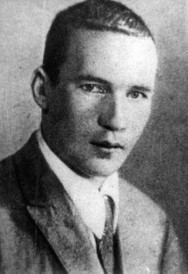
A.N. Kolmogorov
(1903-1988) around 1930,
photo from My
Pictures from the History of Mathematics
by
D.E. Cameron
Here is a part of Feller's review of Kolmogrov's Grundbegriffe for Zentrablatt, taken from [Shaffer and Vovk, p. 56]:
The calculus of probabilities is constructed axiomatically, with no gaps and in the greatest generality, and for the frst time systematically integrated, fully and naturally, with abstract measure theory. The axiom system is certainly the simplest imaginable. . . . The great generality is noteworthy; probabilities in infinite dimensional spaces of arbitrary cardinality are dealt with. . . . The presentation is very precise, but rather terse, directed to the reader who is not unfamiliar with the material. Measure theory is assumed.
It is to be noted that Feller was only 27 years old when this book was published, while Kolmogorov was 30. We need to mention that there exists the Kolmogorov–Feller Equation in Probability Theory. Also, Kolmogorov wrote Foreword to the second Russian edition of Volume I of Feller's famous book An Introduction to Probability Theory and Its Applications.
Russian editions
Feller, V. Vvedenie v teoriyu veroyatnostei i eë prilozeniya. (Diskretnye raspredeleniya.) (Russian) [An introduction to probability theory and its applications. (Discrete distributions.)] Izdat. Inostrannoj Literatury, Moscow, 1951. 427 pp.
Feller, V.: Vvedenie v teoriyu veroyatnostej i ee prilozheniya. Tom 1. (Russian) [An introduction to probability theory and its applications. Vol. 1] Translated from the English by R. L. Dobrusin, A. A. Juskevic and S. A. Molcanov. Edited by E. B. Dynkin, with an introduction by A. N. Kolmogorov. Second edition, reprinted Izdat. ``Mir'', Moscow 1964 and 1967 (reprinted 1964 edition). 498 pp.
Feller, V.: Vvedenie v teoriyu veroyatnostej i ee prilozheniya. Tom 2. (Russian) [An introduction to probability theory and its applications. Vol. 2] Translated from the English by Ju. V. Prohorov Izdat. ``Mir'', Moscow, 1967. 752 pp.
Feller, V.: Vvedenie v teoriyu veroyatnostej i ee prilozheniya. Tom 1. (Russian) [An introduction to probability theory and its applications. Vol. 1] Translated from the third English edition and with a preface by Yu. V. Prokhorov. Second edition. With a preface by A. N. Kolmogorov. ``Mir'', Moscow, 1984. 528 pp.
Feller, V.: Vvedenie v teoriyu veroyatnostej i ee prilozheniya. Tom 2. (Russian) [An introduction to probability theory and its applications. Vol. 2] Translated from the second English edition and with a preface by Yu. V. Prokhorov. Second edition. ``Mir'', Moscow, 1984. 752 pp.
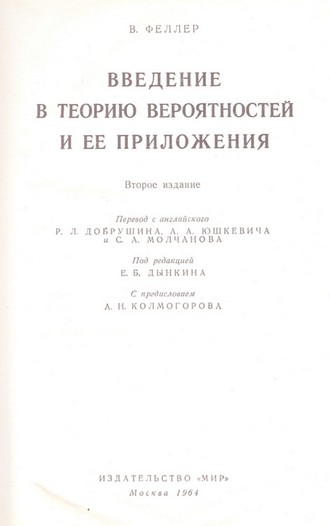
1964 second Russian translation
of Feller's Volume 1,
with foreword of A.N. Kolmogorov
From the Foreword to the second Russian edition to Feller's book (Volume I, Moscow 1964), written by A.N. Kolmogorov:
The first edition of Feller's book already obtained a widespread approval in the USSR. Now we bring to the reader's attention the translation of the second English edition, improved and added to by the author in many details. ... It is precisely this choice of material which enables Feller's book to occupy an independent place in the literature on probability theory. ... ... By the choice of problems Feller brings to light their solving by "direct", and specifically probabilistic means. This tendency to see behind analytical transformations their "probabilistic" sense, belongs to the most valuable features of Feller's book. Deserving our attention is also the author's effort in the book in clearly illustrating the character of effects of probabilistic laws on carefully chosen examples . In many cases the author manages to introduce the reader into really interesting questions of comparation between statistical data and probabilistic theory of events. ... (translated from Russian by D.Z.)
Yu. V. Prokhorov in his foreword to the first Russian edition of Volume II wrote the following:
... Professor Feller, having learned about the prepartion of the second volume, kindly sent us a list of many necessary corrections, that were included into the text. I am very grateful to him for his kindness. ... (translated form Russian by D.Z.)
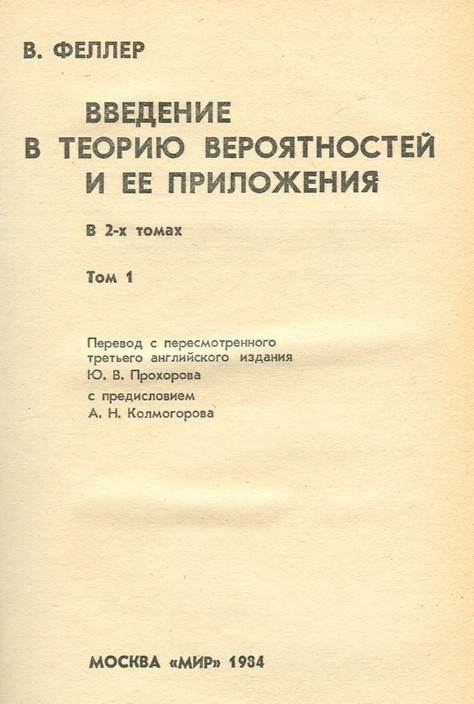
1984 third Russian translation
of the third English edition of Volume 1 of Feller's monograph,
also with foreword by A.N. Kolmogorov
It is surprising to read the following sentence of Yu.V. Prokhorov in his foreword to the Russian 1984 translation of the third English edition of Volume 1:
There is no any other book on probability theory comparable to this one - it so successfully comprises mathematical austerity, excellency of proofs, and the quantity of considered applications. Expounding the most complex mathematical questions, the author does not omit from sight the real world phenomena, where a developed theory can be applied. The character of the book is such that it will not age for a very long time. (translated form Russian by D.Z.)
Many mathematical notions bear his name:
|
|
The list has been obtained using mathematical references from MathSciNet covering the period between 1970 (since Feller's death) and 2007, citing Feller's name.
Paul C. Kettler, Norway:
...the personal aspects of creative lives are just as important I believe as the professional aspects. At the lowest level, it is personal interaction, after all, which produces great collaborations. Feller and Kolmogorov, across continents and ideologies, is the perfect example.
E.B. Dynkin: Markovskie processy, Gosudarstvennoe izdatel'stvo fiziko-matematicheskoj literatury, Moskva 1963
4. Fellerovskie perehodnye funkcii v kompaktah
The ambitious and voluminous Encyclopedia of Mathematics issued in the former USSR in five books (Matematicheskaya enciklpediya 1-5, Moscow, 1977-1985), has an extensive article entitled Feller process (Fellerovskij process, Volume 5), written by S.N. Smirnov. The author states that Feller processes (introduced in 1952) represent probabilistic generalizations of topological dynamics. The article mentions some other articles and books related to Feller processes, for example, Dynkin and
I.V. Girsanov: Teorija verojatnostej i ee primenenija, 1960, t. 5, No 3, pp. 314-330.
Agabekov SA is world's famous company seated in Geneva, Switzerland, dealing with exterior lighting design. Mr Youri Agabekov, the founder of the company, has Croatian roots: his father is Ladislav Zerjavic, from Hrvatsko Zagorje near Zagreb. His products have been used to cover with soft lighting such buildings like (photos by kind permission of Mr. Youri Agabekov):
- the Vatican
- Louvre, Paris
- Bolshoi Theatre, Moscow
- Saint Michel Bridge, Paris
- Palace of Sponza in Dubrovnik, Croatia
- Villa Astra in Lovran, Croatia
- Guernica by P. Picasso, Paris
- College de France, Paris
- Kingston Bridge, London
- Siltassari and Pitkäslita Bridges in Helsinki (Finland)
- Museum Arqueologic de Catalunya and Cathedral of Barcelona
- Cathedral of Palma de Mallorca, Spain
- Queen's Residence "Parlement" in Holland
- Princely Palace of Monaco
- National Museum Singapore
- Palacio National Mexico
- Banque Européenne in Bruxelles (Belgium)
- National Bank of Greece in Athens
- Bank of Luxemburg, etc.
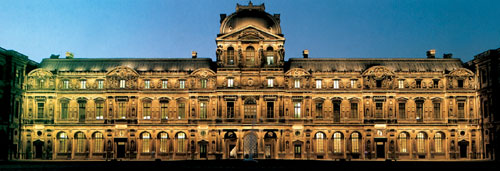
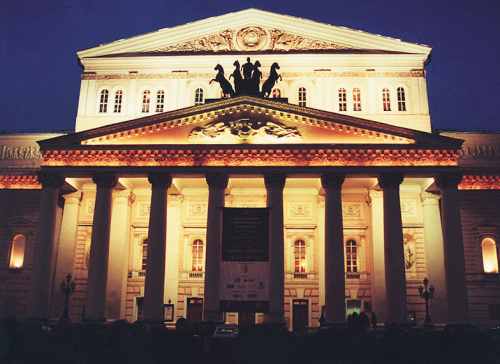
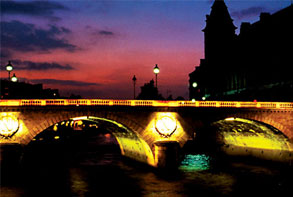
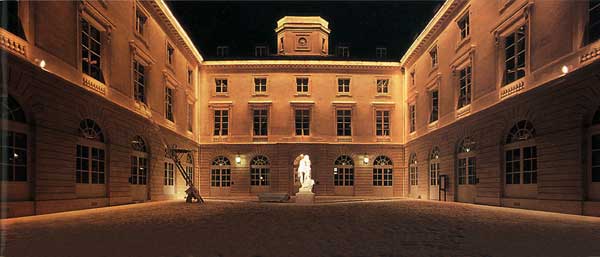
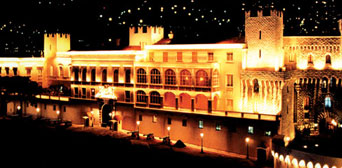
Mr Youri Agabekov is a Croat born in Russia, living in Switzerland (Geneva) and in Croatia (Zagreb). His company, Agabekov SA, has 80 representatives throughout the world. Here is the logo of the company devoted to his wife Branka:

Light fixture, United States Patent 4158221 by Youri Agabekov; some of his patents are also held in Japan
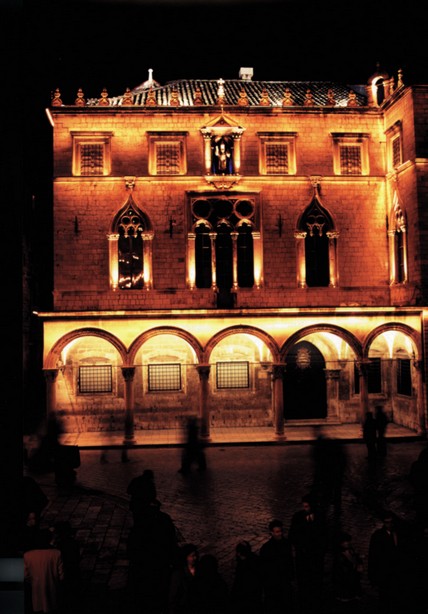
Franz Leopold Jelacic (1808 Dorpat-Tartu / Estonia - 1888 Kazan / Russia) is a descendant of noble Croatian family of Jelacic (Russian branch). He studied in Vilnius in Lithuania. After his specialization in Berlin, Vienna, Paris and Munich, he founded The University Clinic in Kazan, for which he obtained felicitations from a minister in 1845.
Vladimir Sertic (1901-1983) was a microbiologist. He discovered and classified several bacteriophages, among others the famous Fi X 174. He was working for 11 years (1929-1940) in Paris in the Laboratory of Felix d'Herelle, the discoverer of bacteriophages. His collaborator in Paris was Nikolai Bulgakov, who emigrated from the Soviet Union and completed his medical studies in Zagreb. The famous Russian writer Michail Bulgakov (the author of `Master and Marguerite') was Nikolai's brother.
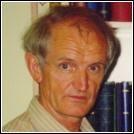 Dr. Borislav Arapovic
is a honorary director of
Biblical institute in Stockholm, Sweden. Born in Bisine, Bosnia and Herzegovina,
in 1935, studied in
Zagreb, emigrated in 1965 to Sweden due to political reasons, in
Stockholm obtained his Ph.D. In 1973 he founded The
Institute for
Translation of The Bible into Languages of (former) Soviet
Union. In 1996 the Russian
Academy of Sciences conferred him a
doctorate
honoris causa. In 1999 he was elected foreign member of the Russian
Academy
of
Sciences. For the creation
of the Children’s Bible in
1983, Dr. Borislav Arapovic
was awarded the Leo Tolstoy
medal by the Russian
Children’s Fund. In the period
of 1983-90 ten editions of the Children’s Bible in five
million
copies
were printed for free distribution in Russia.
Photo
from the Institute
for Bible Translation, Russia.
For those who can read Russian, see Institut
perevoda Biblii.
Dr. Borislav Arapovic
is a honorary director of
Biblical institute in Stockholm, Sweden. Born in Bisine, Bosnia and Herzegovina,
in 1935, studied in
Zagreb, emigrated in 1965 to Sweden due to political reasons, in
Stockholm obtained his Ph.D. In 1973 he founded The
Institute for
Translation of The Bible into Languages of (former) Soviet
Union. In 1996 the Russian
Academy of Sciences conferred him a
doctorate
honoris causa. In 1999 he was elected foreign member of the Russian
Academy
of
Sciences. For the creation
of the Children’s Bible in
1983, Dr. Borislav Arapovic
was awarded the Leo Tolstoy
medal by the Russian
Children’s Fund. In the period
of 1983-90 ten editions of the Children’s Bible in five
million
copies
were printed for free distribution in Russia.
Photo
from the Institute
for Bible Translation, Russia.
For those who can read Russian, see Institut
perevoda Biblii.
An amazing anti-war, pacifist sermon was given in 1778 by an anonymous Croatian preacher to Croatian soldiers, immediately before the battle between Austrian and Prussian troops in Bohemia:
At that time majority of soldiers for Austrian army were recruited from Croats (that's how the necktie, ie., Cravate, had spread throughout the world): out of 80-100,000 Austrian soldiers, about 60,000 were Croats. While the Croatian original of this remarkable sermon is still unknown, that same year eight translations were published in German, Dutch and Swedish, and in Latvian in 1804:- German: one edition from 1778;
- Dutch: three editions from 1778, published in the Hague (!), Amsterdam, and Leeuwarden;
- Swedish: 1778 edition in Norrköping, 1779 edition in Stockholm;
- Latvian: Riga - Leipzig 1804, reprint of Latvian and German translations in Riga 1804, Latvian translation in Jelgawa in 1805.
|
|
Here are title pages of Dutch and German 1778 editions:
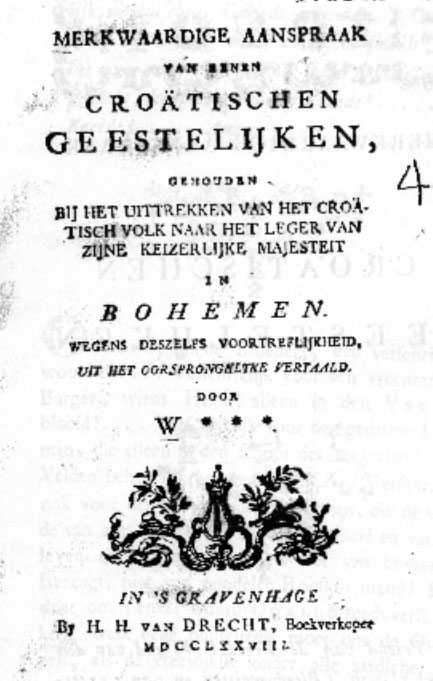
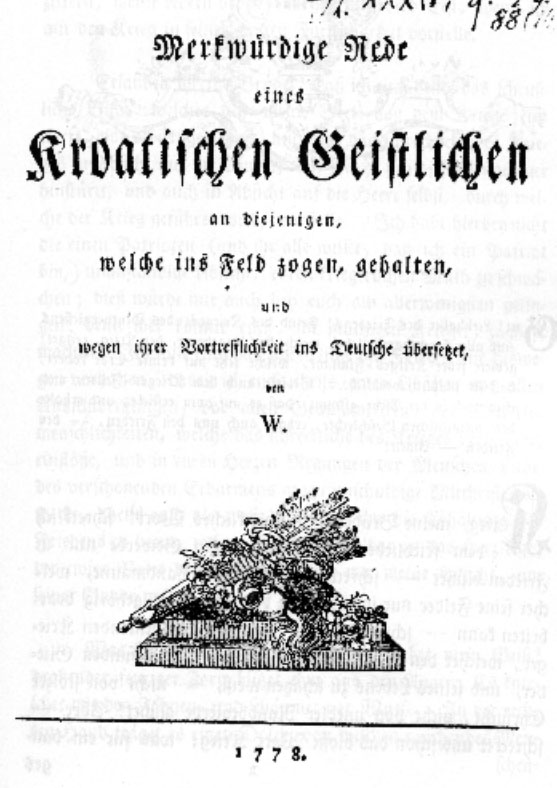
The German 1778 translation was retranslated back to Croatian language in Arapovic's monograph in 1999, where you can find also its English translation. It is very probable that the text was published in some other west-European languages as well. Note that this universal message of peace, religious tolerance and patriotism was translated in enemy countries (with respect to Austria), that were a part of Protestant Christianity.
Reference: Borislav Arapovic, Hrvatski mirospis 1778, Matica hrvatska, Mostar, 1999, ISBN 9958-9448-2-0
JELACIC - written by Michel Iellatchitch, France
Introduction
Depuis longtemps, des membres de la famille Jelacic ont oeuvré à la sauvegarde de la mémoire de la famille, notamment par la conservation d'archives et la consignation de souvenirs - anecdotiques ou grands événements - par écrit.
Je leur dédis ce document qui a pour prétention de présenter une petite partie de l'histoire de la famille. Ce travail est loin d'être achevé, et j'espère pouvoir le développer progressivement.
Origines
Selon l'historien R. Lopasic, les Jelacic sont originaires de la région de Bihac. Lors de l'invasion turque, ils quittèrent cette région pour Letovanic, Biševic, Posavje et Turovo Polje [aujourd'hui Turopolje, au sud de Zagreb] au 17ème siècle, où ils changèrent leur nom en Buzinski, en référence à leur propriété de Buzin à Turovo Polje (R. Lopasic, "Bihac i bihacka krajina", 1890).
Les recherches généalogiques ont permis de remonter jusqu'à Antonius Jelacic, qui vivait dans la seconde moitié du 15ème siècle.
Auparavant, on trouve des traces en Herzegovine, où un Stanoje Jellacsics fut nommé capitaine à Klis le 2 février 1388. Le 2 mai 1390 à Sutjeska, le roi Tvrtko partagea le territoire de Split. Les bénéficiaires furent Triphon Aulae Prothorestarius, Michel de Ragusio electus Tinniensis (également évêque de Knin), Comes Stanoje Jelašic et Vladoje Logogetha. Cependant, aucun lien n’a pu être établi entre ce Jellacsics et le reste de la famille.
Paulus Jelacic, fils d’Antonius, reçut en 1515 du roi Vladislaus II Jaguellon des terres situées sur la rive droite de la rivière Kupa, près de Lasinje. Cet endroit était connu sous le nom de “ Jelacicevo selo ”. Les Jelacic le quittèrent après 1568.
En 1627, un récit de duel entre seigneurs croates et turcs mentionne un Vuk Jelacic, capitaine à Letovanic (Ratkay : Memoriae regnum et banorim - Vitezovic, kronika hrvatska). Ce village est situé sur la rive gauche de la rivière Kupa.
Le nom complet, du moins pour une partie de la famille, est Jelacic de Buzim (Jelacic od Buzima). Cette dénomination apparait dans les écrits pour Franz (1746 - 1810) et son fils Josip (1801 - 1859, ban de Croatie). Il s'agirait du village de Buzim situé dans la région de Lika, à une dizaine de kilomètre de Gospic.
Au cours de l'histoire, des Jelacic ont quitté la Croatie : pour la Hongrie en 1609, pour la Russie en 1740. Après le premier conflit mondial, l'émigration a été accentuée. Des Jelacic sont partis dans les différents pays d'Europe, en Amérique du Nord et du Sud, en Chine, en Australie, créant ainsi de nouvelles branches. L'orthographe du nom a aussi évolué, en s'adaptant aux langues de ces pays : la version croate - Jelacic -, a été déclinée en Ielachijch, Jelachich, Jellachich, Jellatchitch ou Iellatchitch, sans oublier la version cyrilique.
La branche russe
En 1740, Saint Pétersbourg est un vaste chantier. La ville a été fondée trente sept ans plus tôt dans l'embouchure de la Néva par le Tsar Pierre 1er dit "Pierre le Grand" et est devenue la nouvelle capitale de l'empire russe. Le Tsar souhaitait ainsi ouvrir largement la Russie à l'Occident. Cependant, depuis la mort de son fondateur en 1725, "le pays semble complètement absorbé par les luttes continuelles pour le pouvoir entre des prétendants incapables, par l'ascension et la chute, indéfiniment répétées, de non moins déplorables favoris, par des intrigues de cours de toute espèce, la terreur policière de Biron" (Michael T. Florinsky, 1894-?, économiste et historien américain d'origine russe). De 1730 à 1740, l'impératrice Anne, nièce de Pierre le Grand, occupe le trône de Russie. Son règne est présenté traditionnellement comme une période dominée par des favoris allemands, qualifiés de "parti allemand". Fin 1741, Elizabeth, fille du Tsar Pierre le Grand, poussée les partisans d'un pouvoir dans des mains russes, renversa le jeune Tsar Ivan VI (un bébé de quelques mois, un arrière petit neveu de Pierre le Grand) qui succéda à Anne et devint ainsi la Tsarine Elizabeth.
C'est dans ce climat que, vers 1740, Franz-Luka Jelacic arrive à Saint Pétersbourg. Il semble qu'il ait voulu échapper à une carrière ecclésiastique, et il a ainsi tenté sa chance dans cette Russie qui s'ouvrait à l'Occident.
Franz-Luka, son fils et ses petits enfants restèrent catholiques et résidèrent dans la partie occidentale de la Russie, à Saint Pétersbourg ou dans les pays baltes annexés. C'est son dernier petit-fils, Franz-Leopold, qui franchit le pas de l'intégration en épousant une Russe et en se convertissant à l'orthodoxie. Franz-Luka fit naître la branche russe, Franz-Leopold l'enracina. Tous les Jelacic russe descendent de Franz-Leopold et ils vécurent en Russie jusqu'aux révolutions de 1917.
Le leader croate Stjepan Radic connu Evgueni, un des petits fils de Franz Leopold. Il écrivit un article dans le journal "Hrvatsko Kolo" en 1909 : "Ruska grana nasih Jelacica" ("La branche russe de nos Jelacic", texte en Anglais)
Les évènements à partir de 1914 brisèrent la branche russe. Certains périrent pendant la guerre mondiale ou la guerre civile, certains restèrent et furent victimes des tribunaux révolutionnaires ou des purges staliniennes, enfin d'autres purent quitter la Russie et connurent des fortunes diverses. Les descendants de ces-derniers vivent aujourd'hui principalement en France, Grande-Bretagne et en Australie où de nouvelles branches de la famille ont pris racine.
...source
En détails :
Vers 1740, Franz ou Franz-Luka (°1720 à Vienne / Autriche- après 1776 à Moscou / Russie) partit s’installer à St Pétersbourg, en Russie. Il y étudia la médecine et fut diplômé en 1743 à l’hôpital général de St Pétersbourg. Il participa en tant que médecin à trois expéditions en Chine (1747, 1754-1756 et 1757-1764). En 1756, il fut chirurgien à l'hôpital principal de Moscou, puis en 1764 chirurgien à l’hôpital général de St Pétersbourg.
Il eut un fils, Josef-Anton, nommé sans doute ainsi en l’honneur des deux frères de Franz-Luka.
Josef-Anton était traducteur auprès de l’administration économique de la région de Derp-Pernau (aujourd’hui Tartu en Estonie). En 1802, il fut engagé à la " Kaiserliche Universität zu Dorpart " (l'université impériale de Dorpat) en tant que lecteur et traducteur de Russe pour la correspondance officielle. Cette université venait d’être rouverte par Alexandre 1er, après avoir été fermée pendant plus d’un siècle suite à l’annexion de la région par Pierre le Grand. En 1804, il fut nommé professeur de Russe au lycée (Gymnasium) de Dorpat.
Marié à Johanna Dorothea Palen, il eut douze enfants :
1.1.1 : Maria Elisabeth
(1787-1797),
1.1.2 : Joseph Cornelius
(1788-1791),
1.1.3 : Johanna Catharina
(1790-1791),
1.1.4 : Josephine Dorothea
(1792-1847),
1.1.5 : Anna Dorothea
(°1794),
1.1.6 : Friderica Amalia
(°1796),
1.1.7 : Emilia Aurora
(1798-1887),
1.1.8 : Adolph Gustav
(°1800),
1.1.9 : Wilhelm Eduard
(°1802), sa
descendance s'installa en Pologne
1.1.10 : Catharina Adelheide
(1804-1805),
1.1.11 : Anton Julius
(°1806) et
1.1.12 : Franz Leopold (1808-1888)
.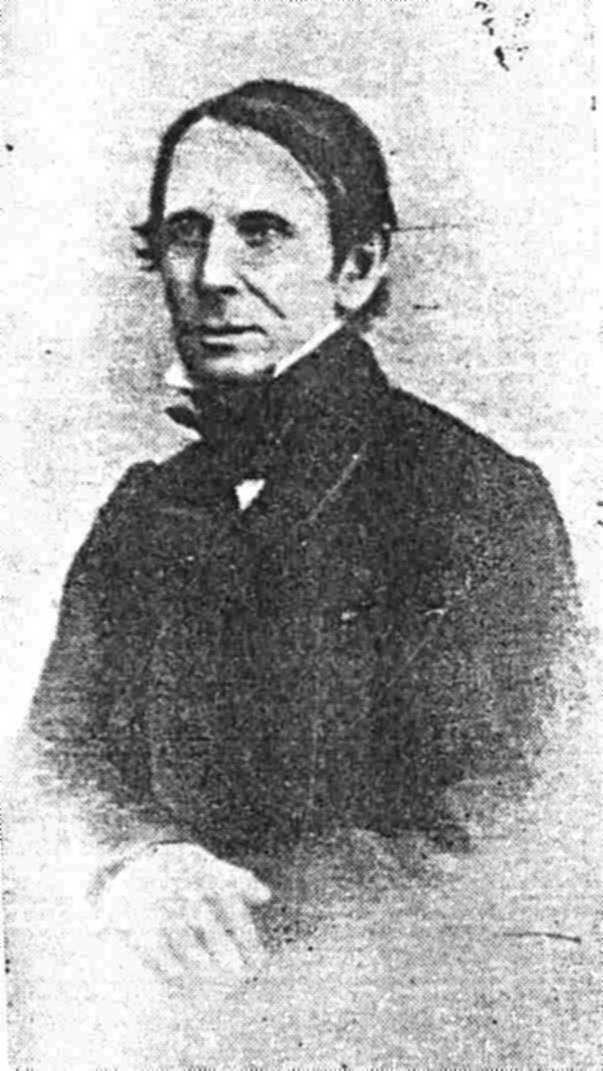
(Franz Ossipovitch Jelacic, archives URSS)
Franz Leopold (°1808 à Dorpat-Tartu / Estonie - 1888 à Kazan / Russie) étudia à l’université de Vilno (aujourd’hui Vilnius – Lituanie) où il obtint un doctorat de médecine en 1832. En 1834 il accéda à la chaire de médecine à l’université de Kazan, où il se spécialisa dans l’ophtalmologie. Après un voyage d'étude de neuf mois à l'étranger (Berlin, Vienne, Paris, Munich) au cours duquel il acheta du matériel médical, il fonda la clinique universitaire de Kazan, ce qui lui valu les félicitations du ministre en 1845. Il fut nommé professeur émérite en 1859 et membre d'honneur de l'université en 1864.
Jusqu'alors, tous les Jelacic étaient catholiques. Afin de pouvoir épouser Maria Razumosky, russe orthodoxe, Franz-Leopold (ou Franz Ossipovitch Iellatchitch en russe) se convertit à la religion orthodoxe.
Marié à Maria K. Razumovsky (1821-1881), il eut quatre enfants :
1.1.12.1 : Nicolas (1841-1877),
Nicolas s'installa en Ukraine.
Marié
à Catherine K. Kholodowsky
(1850-1910),
(Soeur
de Sophia (1851-1929) et Anna (1854-1939), cf 1.1.12.4 Alexandre)
il
eut un enfant :
1.1.12.1.1 : Kyril (1869 - 1895),
Marié à Ludmila K. Pomian-Pomazansky (1866 - 1944), il eut deux enfants :
1.1.12.1.1.1 : Alexis (1892 - 1941),
Il émigra après la révolution russe de 1917 en Yougoslavie,
Marié à Maria A. Karpitzky (1885 - 1966),
1.1.12.1.1.1.x : Leur descendance vit aujourd’hui en Croatie.
1.1.12.1.1.2 : Alexandre (1894 - 1911),
1.1.12.2 : Julia (1843-1913),
Julie épousa de Baron Friedrich v. Rosen. Leur descendance vit aujourd’hui en Russie, Allemagne et Autriche
1.1.12.3 : Michel (1845-1917),
Michel fut juge à Samara.
1.1.12.3.x : Sa descendance vit aujourd’hui au Brésil et en Irlande mais ne porte plus le nom de Jelacic.
1.1.12.4 : Alexandre (1847-1916).
Alexandre (1847 à Kazan / Russie -1916 à St Petersbourg / Russie) fut juriste, spécialiste de problèmes agraires. Il avait hérité de la propriété familiale "Pavlovka" dans le gouvernement de Samara.
Marié
à Sophia K. Kholodowsky
(1851-1929),
(La
sœur de Sophia et de Catherine Kholodowsky, Anna (1854-1939)
épousa Féodor Stravinsky (1845-1902). Ils eurent
quatre
enfants, dont Igor Stravinsky (1882-1971))
il
eut cinq enfants :
1.1.12.4.1 : Nicolas (1872-1938).
Nicolas (1872-1938) fit des études de droit, fut secrétaire adjoint du Conseil d’Etat à St Pétersbourg, puis conseiller juridique auprès du Métropolite Benjamen de St Pétersbourg. Condamné à mort en 1922, gracié et exilé, il sera à nouveau arrêté et fusillé en 1938.
Marié
à Nathalia I. Polonski (1870-1929),
(Nathalia Polonski
était la fille du
poète russe Iakov Polonski (1819-1898))
il
eut deux enfants :
1.1.12.4.1.1 : Nicolas (1894-1917) et
1.1.12.4.1.2 : Georges (1897-1976).
Georges (1897 à St Petersbourg / Russie -1976 à Paris / France) fit parti du corps des Pages (promotion du 01/02/1917) et intégra le régiment Préobrajenski. Après la révolution bolchevique, il rejoignit les armées blanches des généraux Korniloff et Denikine. Après la guerre civile, il émigra en France. La transcription du nom Jelacic (écrit en cyrillique russe) en Français donna "Iellatchitch". L'auteur de ces lignes est un de ses petit-enfants.
Marié
à Irène S. Wilczkowski (1902
- 1989)
(Irène
Wilczkowski (1902 à St Petersbourg / Russie - 1989
à
Paris / France), fille de Serge Wilczkowski (1871-1934,
général de brigade, colonel à la suite
du
Régiment des gardes Préobrajensky,
délégué de Sa Majesté
l’Impératrice de Russie au service des
blessés,
commandeur de l’ordre de St Wladimir)).
1.1.12.4.1.2.x : Leur descendance vit aujourd'hui en France, principalement en région parisienne.
1.1.12.4.2 : Serge (1874-1940),
Serge fut rédacteur du journal "Pays de Volga" en 1914-1915 et "Jour de Volga" en 1915-1918. Il participa au gouvernement provisoire de Samara en 1918. Après la chute du gouvernement provisoire de l'amiral Koltchak, il émigra en Chine. Il est mort à Pékin (Chine) en 1940 sans descendance.
1.1.12.4.3 : Michel (1877-1922),
Michel fut un auteur de pièces de théatre dramatique.
1.1.12.4.3.x : Sa descendance vit aujourd'hui en Australie, en Grande-Bretagne, en Russie et au Brésil.
1.1.12.4.4 : Evgueni (1882-1944),
Evgueni étudia à l'université de St Petersbourg et se spécialisa dans les problèmes d'éducation et de lutte contre l'illettrisme. Il enseigna dans la région de St Petersbourg en 1903-1906. Il vécut à Samara en 1909-1910. Après la révolution russe, il émigra en Yougoslavie ou il fut assassiné en 1944.
Marié à Véra v. Richter,
1.1.12.4.4.x : Leur descendance vit aujourd'hui en Italie et en Serbie.
1.1.12.4.5 : Gabriel (1894-1941),
1.1.12.4.5.x : Sa descendance vit aujourd'hui au Brésil.
source: radic.html
THE RUSSIAN BRANCH OF OUR JELACIC'S
Written by STJEPAN RADIC
Hrvatsko Kolo, Zagreb, 1909, p. 278-304. 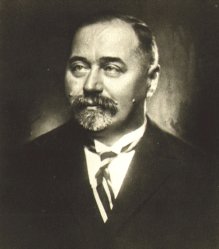
The name of this Jelacic was Franjo Luka, and he was educated at Viennese Jesuits, from where he escaped to Russia. One of his descendants, Franjo Josipovic Jelacic, was a famous surgeon (1808-1888) and as a university professor of Kazan has a great merit for founding the Kazan clinic, as we learn from the same encyclopedia.
As soon as this Franjo Jelacic married with a Pravoslav Russian, he accepted pravoslav faith (according to the laws of the time), and until that time our Jelacic's were Catholics. The son of Franjo - Aleksandar Francevic Jelacic, was a famous lawyer and the head of exceptionally respected and educated family of Russian Jelacic's. He had five grown up sons, and two of them were distinguished with their literary and educational work.
Russian Jelacic's preserved their Croatian traditions, and they are especially proud of their famous ban [viceroy] Jelacic. They sojourned already in Opatija, and also visited Zagreb, and of course, the Jelacic monument [on the Zagreb main square] in the first place. Aleksandar Jelacic is a liberal of English character, as was the case with almost all Russian thinkers in the 60s of the last [19th] century. Their sons belong to different political camps, but all of them are very important and extraordinarily educated people.
1. MIHAJLO JELACIC: THREE DRAMAS
The third son of Aleksandar Jelacic, Mihajlo, became reputed after his three theatric pieces: "Duke's palace," "Expropriation," and "Burnt vessels." [^1 M.A. Jelachich': Knyazhij dvor'. Ekspropriaciya. Sozhzhennye korabli. str 255. - ...S. Petersburg'. 1909. T-vo Hudzhestv. pechati. C. 2 Rub.] All these three dramas were published in the beginning of 1909, all of them deal with the most recent questions of the Russian contemporary life, all of them are written with great mastery from dramatists point of view, and all of them are very important for knowing contemporary Russia. In all of these works also author's thinking about important questions is reflected, and therefore they represent a valuable source of information about Mihajlo Jelacic and the whole noble Croato-Russian family. It would be valuable and necessary to see all three dramas also on Croatian stages, and its Croatian translation would be a contribution to Croatian drama literature. Our writers would find immediately a rare ideal, which would be much inspiring than nonslavic dramas.Now let us see in passing the content of these three dramas, and then let us translate literally several passages that reflect contemporary situation in Russia, as well as the view of the writer.
[...Here we skip more than 20 pages...]
2. EVGENIJ JELACIC
[p. 301] I do not know Mihajlo Jelacic personally. He lives far away from St. Petersburg, somewhere in the Samara gubernia [region] below Kazan, on the estate of his father. It seems that he was very unhappy in his life, and experienced a lots, and probably that is why he is such a deep psychologist. His younger brother Evgenij, at least as I used to know him, is a pure bliss and happiness. Everything that I read and hear about the influence of the spirit on human body, how wise ideas reflect on countenance, and how inner happiness transforms a human being - all this I saw at Evgenij Jelacic with my own eyes.The first time I met him was on his lecture delivered in a large hall, called "Solyanoj gorodok" [Solty town], where he spoke with such easiness about difficult question, about homeland of a man of the north, as if he tells us a magic eastern story. He had two lectures, both about two hours, with a 15 minute pause, and there was no any listener with expression of boredom on his face, and one could hear nothing but praise and expressions of satisfaction. The Russian community can be rightfully proud of such a lecturer.
Only since recently Evgenij Jelacic is more than thirty years old, but he is so deep in some branches of natural sciences, and carefully follows newest achievements in this field, so that in some areas he is already an authority. In any case, he represents a scientific poplarizer that I had no opportunity to either see or hear.
Evgenij Jelacic works continuously and indefatigably on a question related to Ambulant Museum of Teaching.
At first he had only several teaching instruments, that were circulating between several St. Petersburg teachers, deeply involved in intuititve instruction. Now this has become a large collection of thousands and thousands of teaching instruments, situated in a special building, systematically classified, which is continuously growing and improving, and being used far outside St. Petersburg. What is most important, this ambulant museum in St. Petersburg has become a center of about a hundred of similar regional museums, and besides this it supplies more and more primary schools with various teaching aids, starting with huge wall illustrations, to very rare animal preparations. To this end a museum has its own workshop and many lecturers, which work with apostolic zeal and dedication. Among them is also Evgenij Jelacic, in the first lines.
It is a great pleasure to see him and hear him, when he shows you one room after another in the museum, and when each object is being revived not only with his thorough knowledge, but also with his inexhaustible enthusiasm. You really feel that his enthusiasm is of divine origin, since only due to this supernatural force is it possible to obtain with so modest means such great successes.
Evegenij Jelacic is the same also in his apartment. Everything recalls his educative work and as soon you start to discuss with him about this, he is no more a meagre man, with untidy beard, and often with more than usual dresses. And when he sits, and especially when he stands up, and while speaking walks into his workshop, it seems as if he grew up, and his whole figure is flooded with an extraordinary ecstasy from his glowing eyes and enthusiasted soul.
Besides his study of natural sciences and besides his work on ambulant museum, Evgenij Jelacic is also occupied with writing for children, and especially for youngest children.
[Now follows one page describing his books and booklets for children, 1p]
So, why to count all these books, since it would be more useful to read or at least to examine this whole little library of natural sciences, which we, the Croats, have so much neglected, and which can be seen on every step.
With the breadth and depth of his education, with his enthusiasm for educational work among larges and most neglected masses of workers and peasants, with easiness of his narration and with his industriousness, Evgenij Jelacic is without any doubt such a cultural phenomenon which leaves deep traces even in a big nation, and for a small people he would create a new educational epoch. Let us hope that the youngest Jelacic, who is an enthusiasted pupil of his brother Evgenij, will pay a visit to his old motherland first of all at its University, and than also serve his little Croatia, in the region where so many Slavs carried their talents away into foregin lands that are even more developed after all.
This paper of Stjepan Radic was brought to our attention by professor Gordana Linke, Zagreb
Translated from Croatian by Darko Zubrinic (1999).
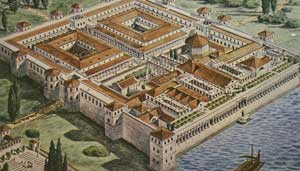
An important monograph describing Diocletian's Palace in Split is "Ruins of the Palace of the Emperor Diocletian at Spalatro in Dalmatia" written by Robert Adam in 1764, with his main associate Ch.L. Clerisseau. The author, an outstanding Scottish architect, mentions the beauty of Split and its favorable position and climate, stating that ``in the whole of the wide Roman Empire, not a single region could offer Diocletian a more marvelous place to withdraw to for a life of peace''. He designed several buildings in the style of Diocletian's palace (Syon House in Middlesex, Kedleston in Derbyshire, Adelphy Palace in London). Influences of his book can be seen even in St. Petersburg in Russia and in Virginia in the USA.
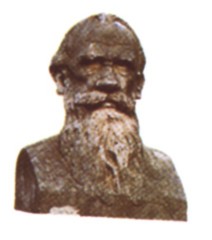
It will be interesting for Russian readers to know that the earliest monument built in honour of the famous writer L.N. Tolstoy (1828-1910) was erected not in Yasnaya Polyana, but in Selca (1911, a year after his death), a small and lovely town on the island of Brac, which has a great tradition in stonemasonry.
Aleksandar Antoljevic Zvjagin, outstanding Russian painter living in Croatia, created beautiful masterpieces for Croatian churches and convents both in Croatia and in Bosnia-Herzegovina. See for example his St Francis taming a wolf, kept in front of the famous Franciscan convent on the islet of Kosljun near the island of Krk.
Ivana Brlic Mazuranic (1874-1938) is a very well known name among Croatian children. She wrote beautiful books of Croatian fairy tales, the most famous being Price iz davnine (Tales of Long Ago) that appeared in Zagreb in 1916. It was translated from Croatian into English by F.S. Copeland under the title:
|
Croatian Tales of
Long Ago
by Iv. Berlic Mazuranic |
and published in 1924. in London by George Alen & Unwin Ltd (260 pp, hardcover). These stories have become popular worldwide due to recent fantastic flash-art presentations, initiated by Helena Bulaja, Zagreb. See for example Neva, music and animation by Ed Beals. Books of Ivana Brlic Mazuranic were translated into all major world languages (more information in Croatian). Except in English, there exist also translations into
- Swedish (Stockholm, 1928)
- Danish (Kopenhagen, 1929/30)
- Czech (Prague, 1930)
- Russian (Zagreb [!], Skazki davnyago vremeni, 1930)
- Slovakian (T. sv. Martin, 1931)
- German (Salzburg, 1933)
- ...
- Chinese (1957)
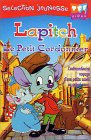 ...Une
des toutes
dernieres productions originales de Croatia Film, "Lapitch - Le petit
cordonnier", tiré d'un conte de Ivana Brlic Mazuranic, femme
écrivain croate du XIXe siecle, est actuellement le produit
phare de l'école : avec plus de 300 000 cassettes
vidéos
vendues rien qu'en France, commercialisées par TF1
Vidéo,
il représente la production audiovisuelle croate la plus
recherchée sur marché international. (source: Ambassade de Croatie en France).
...Une
des toutes
dernieres productions originales de Croatia Film, "Lapitch - Le petit
cordonnier", tiré d'un conte de Ivana Brlic Mazuranic, femme
écrivain croate du XIXe siecle, est actuellement le produit
phare de l'école : avec plus de 300 000 cassettes
vidéos
vendues rien qu'en France, commercialisées par TF1
Vidéo,
il représente la production audiovisuelle croate la plus
recherchée sur marché international. (source: Ambassade de Croatie en France).
Ivan Mane Jarnovic (1740-1804) was an outstanding Croatian violinist and composer of the 18th century, probably from Dubrovnik. He had a true European career - playing, composing and conducting in France (Paris), Austria, Germany, Switzerland, Poland, Scandinavian countries, England. Also played the first violin in the orchestra of the Russian empress Katarina II. Jarnovic composed about 50 chamber instrumental pieces, 22 violin concerts (17 preserved), and is known for having introduced the romanza as a slow movement into the structure of the violin concert. His life is described in a novel Jarnowick by G. Desnoisterres - Le Brisoys, Paris 1844, and in a collection Scènes de la vie d'artiste by P. Smith (Une leçon de Jarnovic, Paris, 1844).
 Bonifacije
Drkolica (known also as
Darcoliza, Drakolica, Drkolicic,
Ragusinus, Stjepovic etc.), born on the island of Lopud near Dubrovnik
in the beginning of 16th century, started his career as a Franciscan
and continued his study of philosophy in Paris. In Rome he met many
famous persons, including the future pope Sixto V,
whose roots are Croatian on his fathers side. Since 1550 he was
appointed the apostolic guardian in Jerusalem, and apostolic vicar of
the Holly Land, which meant that he was responsible for all Catholics
on the Near East. With his diplomatic skills, having visited several
times Constantinople and once Persia, he managed to renew all
sanctuaries in Palestine. He renewed the basilica of St. Grave, and was
the first after St. Hellena, mother of tsar Constantine, to enter and
examine the St. Grave, about which he made a written report. Since
1561. he is apostolic visitator in Hungary, Poland and Russia. In 1564.
he was appointed the Ston bishop (Ston is a lovely town near
Dubrovnik). He was also in mission of Pope Pio IV in Russia
at
Tsar Ivan Grozny, and in
Spain at King Phillip II. His book Liber
de perenni cultu Terrae Sanctae
(Venice 1573, 2nd edition in 1875)
dedicated to pilgrims, is important for the study of situation in
Palestine in his time. He also published his speech held at the Trident
council, in the booklet Liber
de ortu clerricorum in ecclesia
(Venice, 1573). For more details see [Zoric].
Bonifacije
Drkolica (known also as
Darcoliza, Drakolica, Drkolicic,
Ragusinus, Stjepovic etc.), born on the island of Lopud near Dubrovnik
in the beginning of 16th century, started his career as a Franciscan
and continued his study of philosophy in Paris. In Rome he met many
famous persons, including the future pope Sixto V,
whose roots are Croatian on his fathers side. Since 1550 he was
appointed the apostolic guardian in Jerusalem, and apostolic vicar of
the Holly Land, which meant that he was responsible for all Catholics
on the Near East. With his diplomatic skills, having visited several
times Constantinople and once Persia, he managed to renew all
sanctuaries in Palestine. He renewed the basilica of St. Grave, and was
the first after St. Hellena, mother of tsar Constantine, to enter and
examine the St. Grave, about which he made a written report. Since
1561. he is apostolic visitator in Hungary, Poland and Russia. In 1564.
he was appointed the Ston bishop (Ston is a lovely town near
Dubrovnik). He was also in mission of Pope Pio IV in Russia
at
Tsar Ivan Grozny, and in
Spain at King Phillip II. His book Liber
de perenni cultu Terrae Sanctae
(Venice 1573, 2nd edition in 1875)
dedicated to pilgrims, is important for the study of situation in
Palestine in his time. He also published his speech held at the Trident
council, in the booklet Liber
de ortu clerricorum in ecclesia
(Venice, 1573). For more details see [Zoric].
The greatest and most famous Croatian philosopher and scientist Rudjer Boskovic (Boscovich, 1711-1787), was born in Dubrovnik, where he was educated in the Jesuit Collegium. He was a member of the Royal Society of London, a member of St.Petersbug Academy, "membre correspondant" of the French Academie Royale des Sciences, a member of the Accademia dell'Arcadia, a professor at many European universities. Very delicate work on repairing the cupola of St. Peter's church in the Vatican (diameter: 42m) was entrusted to R. Boskovic, a proof that he was a leading European authority for static computations and civil engineering of that time. Upon the request of Austrian Empress Maria Theresia, Boskovic was solving the problem of stability of Royal Library (now National Library) in Vienna.

Portrait of Boskovic by the English painter Edge Pine (London, 1760).
He was also the founder of the astronomical observatory in Brera near Milan. In 1773 a charter granted by Louis XV made him a French subject. Soon he was appointed by Louis XV to a very prestigious position and became the Director of Naval Optics of the French Navy in Paris (Optique Militaire de la Marine Royale de France). He left to his adoptive country an achromatic telescope and micrometer. Boskovic spent nine years in France, and became a good friend to many outstanding scientist, like the mathematician Clairaut, Lalande, Buffon. When D'Alembert took him for Italian, he hastened to correct him.
Boskovic stayed 7 months in England and met many famous scientists there: James Bradley (famous astronomer), George Parker (president of the Royal Academy), Samuel Johnson (Lexicographer), Edmund Burke (philosopher and political writer), Joshua Reynolds (the first president of the Royal Academy of Arts), and others. It is interesting that in England he designed a telescope filled with water in all its components, which was implemented at the Greenwich observatory in 1871, that is, 84 years after his death. He also met Benjmanin Franklin, who showed him some of his electrical experiments, see an article by Branko Franolic.
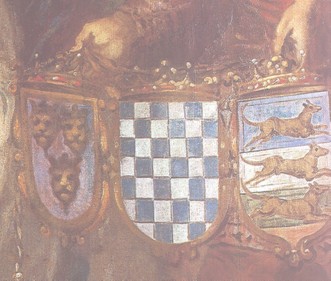
A
detail from the Jesuit Collegium where R.
Boskovic was educated,
17th century, representing coat of arms
of
the Kingdom of Croatia,
Slavonia and Dalmatia,
Boskovic was also a brilliant Croatian Latinist poet. He wrote an extensive scientific epic De solis et lunae defectibus (On Solar and Lunar Eclipse) published in London in 1760. It contains 5570 Latin verses, and was dedicated to the Royal Society of England whose member he was. In the title one can read "Father r. Boskovic, of the Jesuit Order", although at that time it was forbidden for Jesuits to live and work in England. The epic was written in the manner of Roman classics, in dactilus hexameter.
For more information see Latin as literary language among the Croats
When Charles Burney, a well known English musicologist, met Boskovic in Milan, he wrote: ...if all Jesuits were like this father, who uses the higher science and the work of mind to advance science for the happiness of mankind, then it were to be wished that this society were as durable as is this world. Boskovic was buried in the church of S. Maria Podone in Milano.
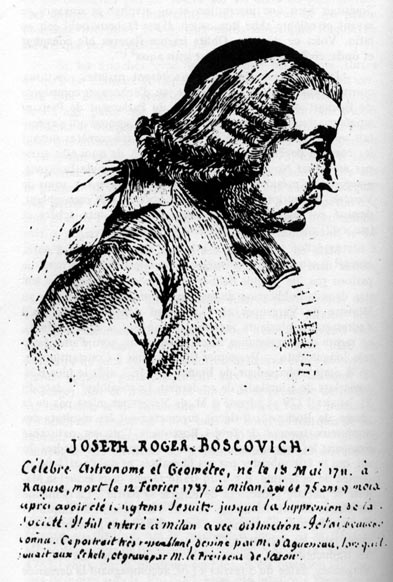
Le plus grand mathématicen que l'aie connu à Rome est M. Boscovich, alors jésuite: il est né à Raguse en 1711, mais il vint à Rome étant encore fort jeune, et après avoir longtemps professé les mathématiques au collège romain il fut fait professeur à Milan et ensuite à Pavie; mais l'on voyait avec peine des talents supérieurs comme les siens, concentrés dans cette derniére ville; non seulement il n'y a personne en Italie dont les ouvrages soient aussi célàbres dans toute l'Europe que les siens, mais je ne connais pas de géomètre plus spirituel et plus profond que lui. Sa mesure de la terre, son beau traité sur la loi de la pesanteur, ses découvertes sur la lumière et sur diverses parties de la physisque, de l'astronomie, de la géométrie, son poème sur les éclipses, imprimé à Londres, à Venise et à Paris, peuvent doner une idée du nombre et de l'étendue de ses talents; mais il faut l'avoir connu particulérement, pour savoir combien il a de génie, combien son caractère est aimable, sa conversation intéressante, et ses idées sublimes dans tout les genres. En 1773, il a été appelé en France et naturalisé Français. Il est actuellement [1784] à Bassano, occupé à faire imprimer ses nouveaux ouvrages, en cinq volumes.
William Thompson-Kelvin, the English physicist (19/20 centuries), once expressed his opinion that his atomic theory is a pure "Boskovicianism." Still earlier, Sir Humphry Davy, professor of physics and chemistry at the Royal Institution in London from 1802 till 1827, mentioned the name of Boskovic on several occasions in his Diary (Commonplace Book), accepting his atomistic theory. The diary is kept in the archives of the Royal Institution in London. Also a famous Irish mathematician and physicist R.W. Hamilton wrote extensively about Boskovic's theory of forces.
With his theory of forces R. Boskovic was a forerunner of modern physics for almost two centuries. It was described in his most important book Theoria Philosophiae naturalis (Vienna 1758, Venice 1763, London 1922, American edition in 1966).
Werner Heisenberg (Nobel prize for physics in 1932) wrote the following:
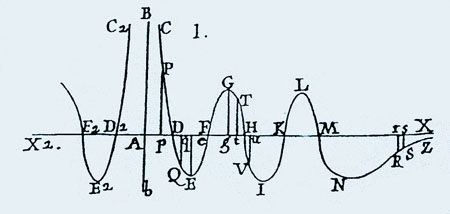
Among scientists from the 18th century Boskovic occupies outstanding place as a theologian, philosopher, mathematician, and astronomer. His "Theoria philosophiae naturalis" announced hypotheses which were confirmed only in the course of last fifty years.Indeed, see his graph of regions of attractive and repelling forces between material points (elementary particles), the closest region being repelling, tending to infinity (nuclear force!; see here; published in his Dissertationes de lumine pars secunda, 1748), and the farthest region is repelling, corresponding to gravitational force:
Robert Marsh, the author of Physics and Poets, credits Boskovic with the idea of FIELD. Faraday and others took the idea from him, see here. He was the first to apply probability to the theory of errors. Laplace and Gauss acknowledged their indebtedness to his work which led to the Legendre principle of least squares in statistics (stating that the best fitting line is the one with the smallest sum of squared residuals).
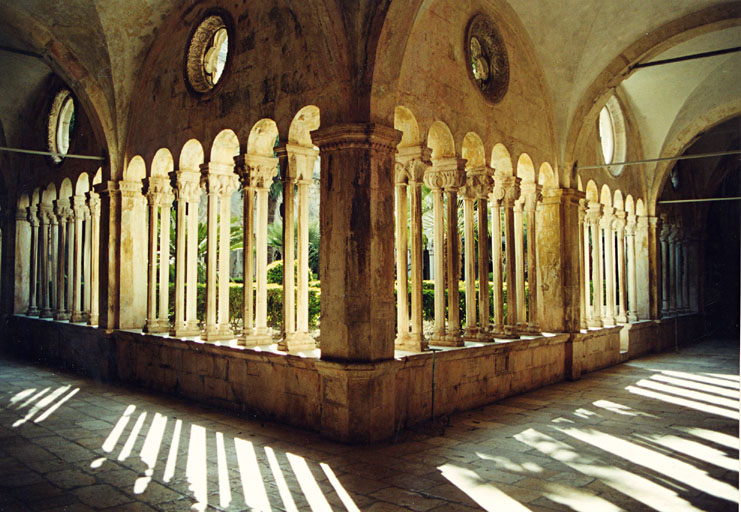
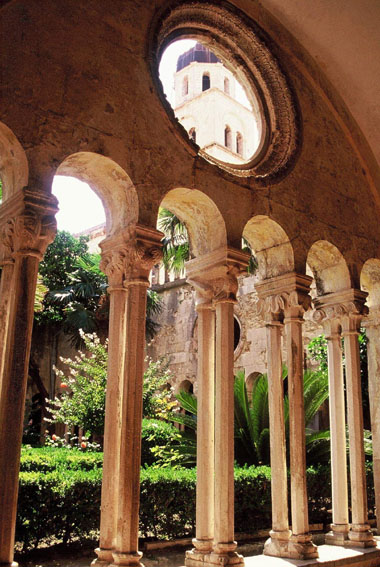
- altogether 180 items and including 66 scientific treatises, plus
- rich correspondence comprising over 2,000 letters, among others with Euler, D'Alambert, Lagrange, Laplace, Jacobi and Bernoulli; he had intense correspondence with his friend Voltaire.
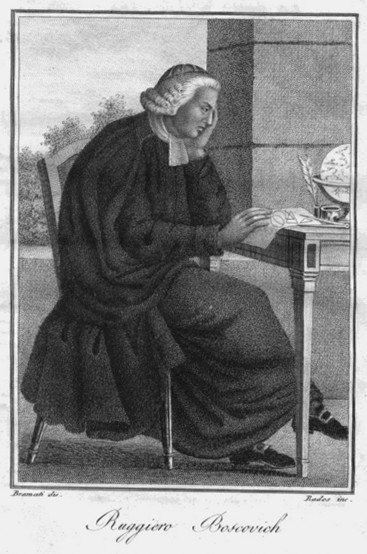
A portrait of Boskovic,
published in Milano in 1818 in a collection of famous
people living between 18th century the beginning of the 19th.
(many thanks to Dr Luca Leoni, Italy, for the photo)
BOKA KOTORSKA
The Bokelj's had a very strong fleet, which counted as many as 300 ships in the 18th century. Boka was a rival to Dubrovnik and Venice. It is worth mentioning that one of the Bokeljs - Matej Zmajevic or Matija Zmajevic (1680-1735) - was the admiral of Baltic navy and the ship-builder of the famous Russian tsar Peter I the Great, and for whom he built a fleet in Voronez. Matej Zmajevic had great successes in maritime battles against Sweden, and for this reason he was decorated with the order of Aleksandar Nevski. Zmajevic was buried with greatest military honours in the Catholic church in Moscow. Peter the Great sent some of his young officers (bolyars) to the town of Perast in Boka in order to study maritime sciences there.
It is interesting that Tripun Kotoran, a Kotor goldsmith, worked on the court of Ivan Grozny in Moscow in 1476. One of the earliest Croatian typographers was Andrija Paltasic (~1450-1500), born in the town of Kotor. He was one of the best Venetian typographers around 1480, who printed more than 40 incunabula, among them the Bible in Italian language. We also mention by the way that a very old missal from 12th century - the Kotor missal, is held in St. Petersburg, Russia.
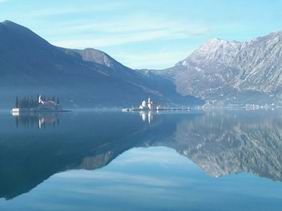
When a Russian travel-writer P.A. Tolstoy visited Boka in 1698, he noted that the local hills are also inhabited by the Croats.
CROATIAN LATINISTS, HUMANISTS AND ENCYCLOPAEDISTS
A Croatian Dominican priest Beniamin was editor in chief of the first Russian Bible (finished in 1499) written in Russian Church Slavonic. It was the first Bible also among all Orthodox Christian Slavs. It served as a basis of later printed Russian editions in 1580-81 and 1663, which had spread among Orthodox Christian Slavs. Beniamin's original translations of the Vulgata are even today left unchanged in many parts of the contemporary Russian Bible. It is interesting that the old Russian Bible has many Croatian characteristics in phonetics, morphology and vocabulary, for example,
- kovac (blacksmith)
- loviti (to hunt)
- plijen (prey)
- staja (stable)
- stijena (rock)
- nastojati (to strive)
- puk (common people)
- obitelj (family)
- and even - gusterna (stone water cistern)!
According to the famous
Russian church historian Makarij,
Beniamin was the chief personality in the creation of Genadij's
Bible. This undertaking was
of great importance for the
Russian Church, in particular for the development of Russian spiritual
literature. Beniamin also translated the 8th part of the latest 1486
Strasbourg edition of the famous work Rationale
divinorum officiorum
of Guilelemus Durandus - Spectator, which was devoted to calendar
calculations and astronomy. In this way Beniamin influenced also the
development of Russian astronomical terminology, in particular -
Russian names for star constellations. According to Vladimir
Rozov (Russian emigrant in
Zagreb), Beniamin (or Venjamin
as he is called in the Russian literature) represents the
earliest
humanist on the Russian soil,
and furthermore, Beniamin was
actually editor in chief
of the first complete Church-Slavonic
Bible among Pravoslav Slavs. Beniamin also had important role in
opening new schools in Novgorod (until that time there were no real
schools in Russia). The name of Croatian Dominican Beniamin is
completely unknown among Croats in time when these lines are written
(1999), except to several specialists. The Croats can be rightfully
proud of this little known person for his great Ecumenical role.
Beniamin's mission in Russia represents an important and almost
forgotten bridge between Catholic and Orthodox Christianity.
-
Literature:
- Vladimir Rozov: Hrvatski
dominikanac Venjamin u Rusiji,
Nastavni vjesnik, knj. 41, sv. 8-10,
Zagreb, 1933, 302-336. See also here.
Vladimir Alekseevic Rozov (1876-1940), born in Kyiv, capital of Ukraine, in the family of professor of the Kyiv Spiritual Academy. In 1903 graduated from the Kyiv University (Faculty of Philosophy). In 1907-1908 investigated the Slavic manuscripts on the Near East. Professor of Slavic philology in the Nizyn Institute (1916) in Ukraine. Professor at the University of Tavrid (1918-1920; Tavrid is today's Herson in Ukraine). Lectured Russian language at the University of Zagreb (1920-1940), and died in Zagreb. Literary critic, culturologist, publicist, investigator of Russian-Croatian relations, author of many articles. [more]. Many thanks to Mr. Oleh Hirnyk, Lviv, Ukraine, for kind help. - Zarko Dadic: O hrvatskom dominikancu Benjaminu i njegovoj ulozi na dvoru novgorodskog arhiepiskopa Genadija, Croatica christiana, XIII, (1989) 23, str. 44-48.
- an article by academician Zarko Dadic
- Franjo Sanjek: Dominikanci u Rijeci i Hrvatskom primorju, Sveti Vid VIII, zbornik, Izdavacki centar Rijeka 2003.
A Croatian theologist, ecumenist panslavist and musicologist Juraj Krizanic (1618-1683) was trying to initiate the dialog on the unification of the Russian Church with Rome. He dreamed about an open and peaceful dialog with Orthodox Christians. His major works are "Politika" (in Russian), written during his 15 year exile to Siberia and the panslavic grammatical book "Gramaticcno iskazanie ob ruskom jaziku" (Tobolsk, 1665), as well as "Razgovory ob vladatelstvu", written in panslavic Esperanto that he invented. He also spent some time in Ukraine, where he had close ties with some of leading scholars. Krizanic wrote "Historia de Siberia" in 1680, with dedication to Jan Sobiesky. It is known that during his sojourn in Rome he supervised a publication of musical works of the Portuguese king D. João IV. According to Krizanic's systematization of science, music should be regarded as a part of mathematics. He wrote his "Asserta musicalia nova" in 1650. Krizanic died near Vienna while participating in its defence against the Turks in the Ukrainian troops that adjoined the troops of the Polish king Jan Sobiesky.
According to a Russian historian S.M. Solovev (see his Istorija Rosii s drevnejshih vremen, vol. XIII, Sanktpeterburg 1868), Krizanic's book Razgovory ob vladatel'stve (Discussion about Governement) served as a handbook to Peter the Great, founder of the modern Russian state.
Vladimir Solovev (or Soloviev, Solovjov, correct reading: Solovyov, 1853-1900), outstanding Russian humanist, religious philosopher and poet, spent a part of his life in Croatia, with Croatian bishop Josip Juraj Strossmayer and in Zagreb. In Zagreb Soloviev published his book Istoriya i budushchnost' teokratii (The History and future of Theocracy) in 1886, the first volume of projected (but never completed) three volume work. Let us cite a part of a speech of Pope John Paul II (1 September 1996): For him the very basis of culture was recognition of the unconditional existence of others. Hence his rejection of a monolithic type of cultural universalism, incapable of respecting and accepting civilization's many different expressions. He was consistent with this view even when he became an ardent, impassioned prophet of ecumenism, doing all in his power for reunification between Orthodoxy and Catholicism.

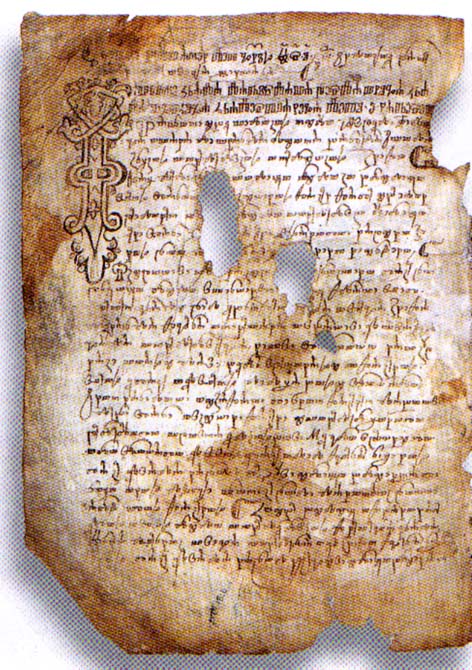 ne
of the earliest and most important
Croatian legal documents is The
Vinodol Code, very different
from the Roman law, written in the
Glagolitic alphabet in 1288. It also introduced the institution of
witnesses. It was unique in Europe by determining moral protection and
integrity of women. The Vinodol Code does not allow torture during
legal proceedings, and is considered to be one of the most important
documents of medieval Europe. Among the Slav Codes only the Rus'
Code "Pravda" is slightly older
(1282). The first Croatian edition
of the Vinodol Code was published in Zagreb in 1843. Two of its Russian
translations with comments
were issued soon after: in Moscow
in 1846 and in St. Petersburg in 1878. A translation of the Vinodol
Code into Polish appeared in 1856 and into French in 1896 (Jules Preux:
La Loi du Vinodol traduite et annotée // Nouv. rev. hist. du
droit français et étranger. - 1896). The code was
published in many European countries: it was translated into at least
nine languages. For more information see here,
and at the Croatian National and University
Library in
Zagreb.
ne
of the earliest and most important
Croatian legal documents is The
Vinodol Code, very different
from the Roman law, written in the
Glagolitic alphabet in 1288. It also introduced the institution of
witnesses. It was unique in Europe by determining moral protection and
integrity of women. The Vinodol Code does not allow torture during
legal proceedings, and is considered to be one of the most important
documents of medieval Europe. Among the Slav Codes only the Rus'
Code "Pravda" is slightly older
(1282). The first Croatian edition
of the Vinodol Code was published in Zagreb in 1843. Two of its Russian
translations with comments
were issued soon after: in Moscow
in 1846 and in St. Petersburg in 1878. A translation of the Vinodol
Code into Polish appeared in 1856 and into French in 1896 (Jules Preux:
La Loi du Vinodol traduite et annotée // Nouv. rev. hist. du
droit français et étranger. - 1896). The code was
published in many European countries: it was translated into at least
nine languages. For more information see here,
and at the Croatian National and University
Library in
Zagreb.
Vinodolski zakon 1288, scrollable book, National and University Library, Zagreb
The Statute of the Poljica Principality
(1444, near Split),
was
written in the Croatian
Cyrillic Script. The
Poljica Principality (Poljicka knezija) was a unique phenomenon in
Europe. It existed continuously for almost seven centuries, with its
own very original legal system. Russian scientist P.
Alexeev believes
that Thomas More wrote his ``Utopia (The Perfect State)'' (Louvain,
1516) inspired by the Poljica Principality. Thomas More calls Poljica
man - Poly(it)eritu, i.e. those who use more scripts (3 scripts:
Glagolitic, Cyrillic, and Latin). Legend has it that the Principality
was founded by three sons of dethroned Croatian king Miroslav in the
mid 10th century. It was abolished during the French rule in 1807. As
remarked by scientists already in the 19th century, the "Poljica
Statute" is very closely related to the above mentioned Ruskaya Pravda,
though they appeared in very distant areas (Kiev and Dalmatia). See [Pascenko],
p. 272.
One
of the items of Poljica statute is that
"everybody has the right to live," contrary to many medieval European
laws replete with punishments involving torture. Thomas More added to
the 1516 edition of his Utopia a frontispiece showing 4 lines in the
Utopian language and Utopian alphabet. According to Alexeev, those who
know Glagolitic script, at a first glance cannot resist the idea that
``some letters in these four lines are in fact written in the
Glagolitic script'' (see [Mardesic],
p. 147).
A
Croatian Glagolitic Dominican priest Beniamin
de Croatia,
born probably in Split,
participated in the preparation of Gennadij's
Bible, the oldest
Russian Bible (finished in 1499). He was the chief collaborator of the Novgorod
Archbishop Gennadij, where
he spent about 20 years
(~1490-1510), at that time the capital of Russia. Beniamin translated
large portions from the Latin text of Vulgata into Russian (e.g. the
Book of Macabians, the Ezra sermons and some other). It is therefore
not surprising that some elements of the Croatian language can be
traced in this oldest Russian Bible. Beniamin translated also other
western books into Russian. Until his arrival Russia was in contact
almost exclusively with Byzantine culture. See [Gregory
Peroche], p. 69.
I
would like to thank academician Eduard
Hercigonja for bringing my attention to Beniamin. See [Horvat,
p. 17], and an article by academician
Zarko Dadic
 t is
worth mentioning that some Russian
monks had been using the
Glagolitic as a secret Script. The
latest known case dates back to the 17th century. Even today some
children in Croatia use it for the same purpose. And some of my
students as well...
t is
worth mentioning that some Russian
monks had been using the
Glagolitic as a secret Script. The
latest known case dates back to the 17th century. Even today some
children in Croatia use it for the same purpose. And some of my
students as well...
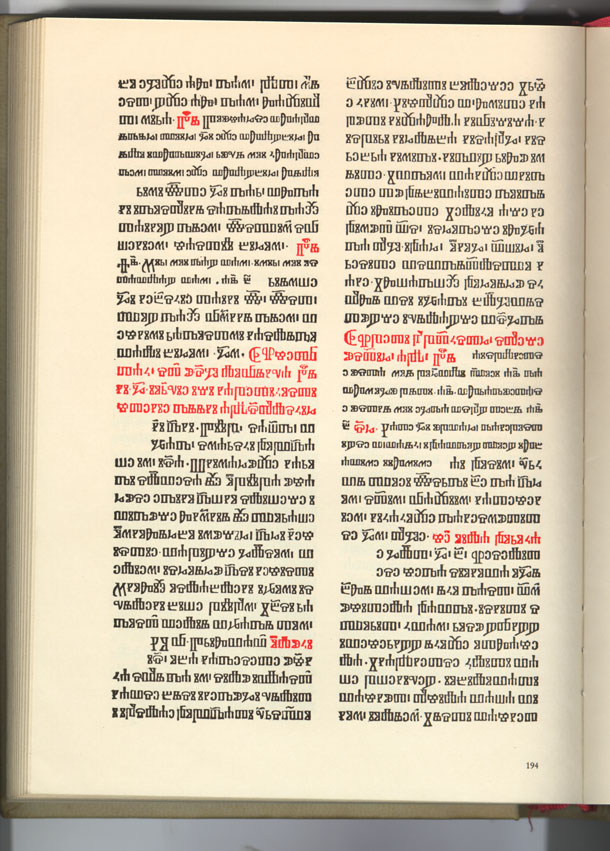 The first Croatian
printed book in Glagolitic
letters appeared as early as 1483,
only 28 years after Gutenberg's Bible, 6 years after the first printed
book in Paris and Venice, one year before Stockholm, 58 years before
Berlin and 70 years before Moscow. It was a Missal
(440 pp,
19x26 cm), unfortunately it is not known where it was printed. The
Croatian Glagolitic Script was the fifth to appear in the history of
European printing, very soon after the Latin, Gothic, Greek and Hebrew
scripts. Eleven preserved copies of the first Croatian incunabulum are
kept
in
The first Croatian
printed book in Glagolitic
letters appeared as early as 1483,
only 28 years after Gutenberg's Bible, 6 years after the first printed
book in Paris and Venice, one year before Stockholm, 58 years before
Berlin and 70 years before Moscow. It was a Missal
(440 pp,
19x26 cm), unfortunately it is not known where it was printed. The
Croatian Glagolitic Script was the fifth to appear in the history of
European printing, very soon after the Latin, Gothic, Greek and Hebrew
scripts. Eleven preserved copies of the first Croatian incunabulum are
kept
in
- The Library of Congress in Washington,
- in the Russian National Library in St. Petersburg,
- in the National Library in Vienna,
- in Apostolic Library in the Vatican (two copies),
- and in Croatia (six copies).
See a nice web-page devoted to Croatian editio princeps provided by the British Library, London.
There are altogether 71 printed Croatian glagolitic editions in the period from 1483 till 1812 (the so called old-printed glagolitic editions, which do not include Parcic 1893 and several later editions, named so by [Kruming] - in Russian: staropecatnye glagoliceskie knigi). According to Kruming's classification, there are
- 6 incunabulae (15th century),
- 13 from the first half of 16th century,
- 16 from the second half of 16th century,
- 8 from the 17th century,
- 27 from the 18th century,
- 1 from the 19th century (1812).
- Kosinj, 1 (Kosinj breviary from 1491),
- Senj, 7 (1494-1508),
- Rijeka, 6 (1530-31),
- Bologna, 1 (1492, lost incunabulum), 1,
- Venice, 12 (1493-1561),
- Rome (The Vatican), 29 (1628-1812)
- Tübingen, 13 (protestant editions, 1561-1565),
- Nürenberg, 2 (protestant editions, 1561-1565).
I made two changes in Kruming's classification: first, I attributed the 1491 glagolitic breviary (the only known copy is kept in Marciana in Venice) to the Kosinj printing house in Lika, not to a Venice printing house, and second, also the Bologna lost incunabulum (Ispovid opcena) from 1492, prepared by Matej Zadranin, was included at the expense of Kruming's number of books printed in Venice (14). According to Kruming's own words, his monograph (having 224 pages) should have been at least five times larger in order to provide a satisfactory presentation of printed Croatian glagolitic books!
If you are a citizen of St. Petersburg in Russia, then you can see five complete codices and the important Bercic Collection, comprising 154 Croatian Glagolitic books and fragments (altogether 386 preserved folia), and 53 texts in cursive Croatian Glagolitic, written between the 13th and 16th centuries, including five codices. The collection was a result of many years of painstaking efforts of Glagolitic priest and academician Ivan Bercic (Zadar, 1824-1870). Bought by the Russian Academy of Sciences in 1874, it is held in the world famous Saltykov-Shchedrin Library (former Imperatorskaya publicnaya biblioteka, now Russian National Library). The Bercic collection represents the most important collection of Croatian Glagolitic heritage kept outside of Croatia, and contains remains of
- 55 Glagolitic missals,
- 77 breviaries and
- 7 literary collections.
- in Croatia (6),
- The Vatican Library (2),
- Vienna (National Library, 1)
- and in Washington (The Library of Congress, 1).
- 53 handwritten cursive glagolitic texts (legal documents, prayers) from 1460 till 18th century, originating mostly from Croatian coast,
- 10 documents texts in the the Croatian cyrillic (documents, prayers, letters), written between 1538 and 18th century,
- 10 texts in the Latin
script (letters, prayers,
transliterations from the Glagolitic), written between 1555 and 19th
century.
Crotian glagolitic in Russia (in Croatian)
If you are a citizen of Moscow then you can see a fragment of handwritten Glagolitic breviary (1493) in the State Library (Gosudarstvennaya biblioteka), and an older Glagolitic breviary (250 folia), written in 1442-43 (bought in 1860 from the Turks by the Russian archeologist Sevastyanov for the Rumyancin library in Moscow). There are also Moscow fragments of a Croatian glagolitic missal from the 15th century have, written in a Paulist convent of St. Spas near Senj., and kept in the State Historical Museum in Moscow (Gosudarstvenny istoricheskij muzej, the collection of manuscripts of A.D. Chertkov, No. 387). A Russian scientist A.A. Kruming published a catalogue of printed Croatian Glagolitic books.
Ivan Mane Jarnovic (Italianized name Giornovichi, 1740-1804) was an outstanding Croatian violinist and composer of the 18th century, probably from Dubrovnik. He had a true European career - playing, composing and conducting in France (Paris), Austria, Germany, Switzerland, Poland, Scandinavian countries, England. Also played the first violin in the orchestra of the Russian empress Katarina II. Jarnovic composed about 50 chamber instrumental pieces, 22 violin concerts (17 preserved), and is known for having introduced the romanza as a slow movement into the structure of the violin concert. His life is described in a novel Jarnowick by G. Desnoisterres - Le Brisoys, Paris 1844, and in a collection Scènes de la vie d'artiste by P. Smith (Une leçon de Jarnovic, Paris, 1844).
The first national operas among the Slavs were composed by Russians (M. I. Glinka, 1836, 1842), then the Croats follow immediately. Vatroslav Lisinski composed the first Croatian national opera "Ljubav i zloba" ("Love and malice") in 1846. Then follow the Czechs (B. Smetana in 1862), and these three nations are the only ones among the Slavs who have national operas.
The verses for the Croatian national anthem Our Beautiful Homeland (Lijepa nasa domovino) were written by a Croatian poet and diplomat Antun Mihanovic (1796-1861).
|
Lijepa
naša domovino
|
Our
Beautiful Homeland
|
| Lijepa naša domovino, Oj junaèka zemljo mila, Stare slave djedovino, Da bi vazda èesna bila! |
Beautiful
is our homeland,
|
| Mila, kano si nam slavna, Mila si nam ti jedina, Mila, kuda si nam ravna, Mila, kuda si planina! |
You
are our only glory,
|
| Teci, Sava hitra, teci Nit ti Dunaj silu gubi, Kud li šumiš, svijetu reci: Da svog doma Hrvat ljubi. |
Sava,
Drava, keep on flowing,
|
| Dok mu njive sunce grije, Dok mu hrastje bura vije, Dok mu mrtve grob sakrije, Dok mu živo srce bije! |
When
his fields are kissed by sunshine,
|
A famous Ukrainian linguist Agatangel Efimovic Krimski, or Agatangel Kryms'kij (1871-1942), founder of the Ukrainian Academy of Sciences, and its lifelong president, suggested during the 1934 Congress of Soviet writers that the USSR national anthem should be composed according to Croatian anthem. Maksim Gorki, his close friend, claimed that the Croatian anthem is the most beautiful among anthems of all peoples of the world, since he had opportunity to listen to it from some Croats during a fair held in Nizhnij Novgorod. See Dragutin Em. Safar: Krimski - veliki prijatelj Hrvata, Marulic 5/2001, Zagreb, pp 943 -946. Maksim Gorki translated Lijepa Nasa from Croatian into Russian, see [Sekulic, p. 374].
Ivan Padovec (1800-1873), born in the beautiful baroque town of Varazdin (known for its festivals of baroque music) was a guitar virtuoso, who gave concerts in Zagreb, Vienna, Prague, Budapest, Hamburg, London, in Poland, Russia etc. He constructed a ten string guitar. Also, he published his Teoretish - praktische Guitar - Schule in Vienna in 1842.
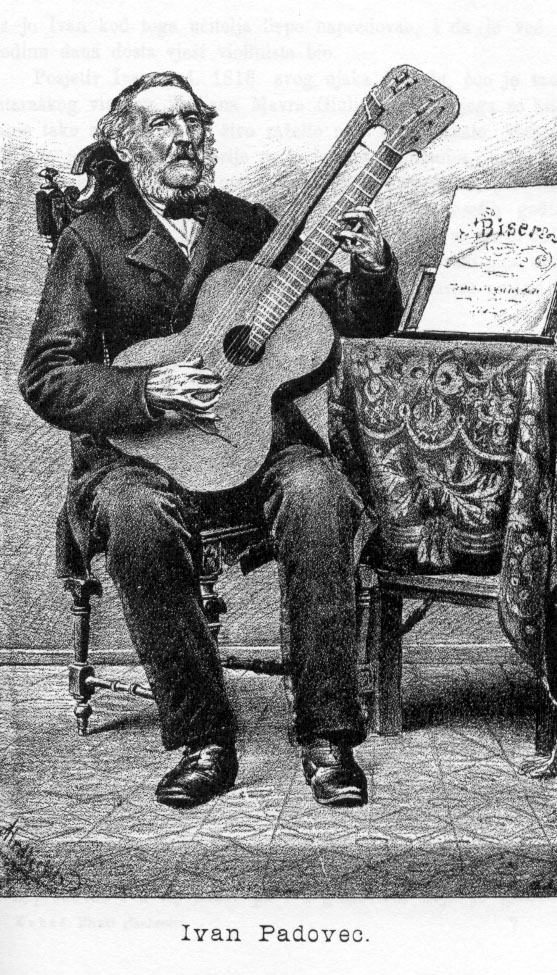
Mirko Orlic: Ivan Padovec, Croatian guitarist of europen renown, Gitara 2, 2000., in Croatian [PDF]
Illma de Murska (born as Ema Puksec in the town of Ogulin, 1834 - 1889) was an opera diva of international fame. She sang in Italy, Spain, Hungary, and her most fruitful period was in Vienna, Austria. She also sang in Berlin, Hamburg, Paris and London, and had tours in Australia, Russia, USA and New Zealand. In St. Petersburg she was singing at the Court and the Russian Czarina crowned her with a brilliant diadem (see here for more details).
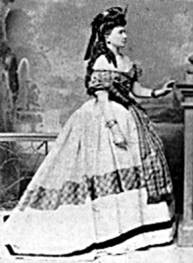
The prima donna Ilma di Murska on the London stage
Milka Trnina (or Ternina, 1863-1941); according to Giacomo Puccini, author of the famous opera Tosca, she was the best "Tosca" that he had opportunity to listen to (on the London première in 1900); see Milka Ternina at the Royal Opera House, Covent Garden; only in Convent Garden in London Milka had 56 performances between 1895 and 1906. Also, she was the first Tosca in Great Britain and in the United States.
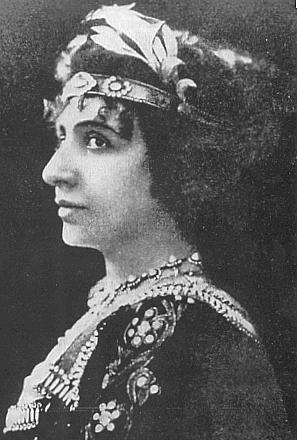
Nada Premerl: Milka Ternina and the Royal Opera House (in English and Croatian), Muzej Grada Zagreba, Zagreb 2006. ISBN 953-6942-24-0
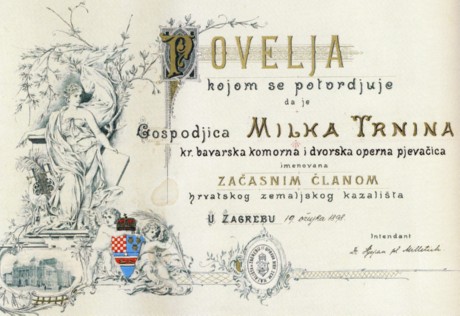
1898 Charter from the Croatian National Theatre in Zagreb conferring honorary membership to Milka Trnina (source [Premerl, p 86]), containing the Croatian Coat of Arms
Did You know that the name of the famous MILKA chocolate, Switzerland, had been given in honour to Milka Trnina, Croatian opera diva?
Saviez vous que le célébre chocolat porte le nom de "Milka" en l'honneur de Milka Trnina, chanteuse d'opéra originaire d'Ivanic Grad en Croatie. Le fondateur de la marque étant un admirateur de la diva croate, il décida de donner son nom, Milka, a son entreprise et son chocolat.

Djurdjica Bjedov won the Olympic gold medal in swimming (Mexico, 1968). In 1998, in the finals of the European Championship held in Sheffield, England, Milos Milosevic set the new world record in the 50 meter butterfly (23:30), thus beating the world record of the Russian swimmer Denis Pankratov, that many held unbeatable. Milos is a native of Split, now living and training in Rijeka. European champion in 2000 in backstroke swimming with 1:58.62 on 200m is Gordan Kozulj.
We feel it necessary to mention Gari Kasparov, a famous Russian chess player, the former champion of the world. He played as a member of chess teams of Vukovar (in exile from 1991 to 1998) and Sarajevo.

Timofey Raskolnikov, Russia: ...Divine Interference...
Croatian mariners in the ARCTIC EXPEDITION in 1872-1874
© by Darko Zubrinic, Zagreb (2000)Many Arctic expeditions in the 19th century ended with shipwrecks. Probably the best known is Franklin's expedition (1845) which had tragic human losses: as many as 120 people died. Twenty expeditions were organized in order to find and save them, but in vain.
The Austrian-Hungarian state, which at that time included also Croatian coast, planned expedition to NE of Novaya Zemlya, and to find the so called North East Passage. This led to the discovery of Franz Josef Land in 1873, a collection of about 85 islands in the Arctic Ocean, now a Russian National Park called Zemlya Franca Iosifa.
The ship named Tegetthoff was built up in the German port Bremen using a special new technology, in order to endure extremely low temperatures and dangerous ice pressure (32 m long, 7 m wide, 220 tons). The crew was composed of 24 persons, members of Austrian-Hungarian marine in the Adriatic sea. It is interesting that the Croats were predominant in the crew. It was composed 9 Austrians, 1 Hungarian, 1 Moravian Czech, 1 Italian (?), and as many as 12 Croats from various parts of Croatian coast (Rijeka, Cres, Bakar, Volosko, Lovran, Plomin, Mali Losinj, Brac, Hvar). The names of these Croatian mariners are:
- Petar Lusina (from the island of Cres),
- Lovro Marolla (from Rijeka),
- Ante Vecerina (from Draga near Rijeka),
- Petar Falesic (from Bakar),
- Juraj Stiglic (from Bakar),
- Jakov Sucic (from Volosko),
- Fran Lettis (from Volosko),
- Vicko Palmic (from Volosko),
- Josip Latkovic (from Plomin),
- Ante Katarinic (from Mali Losinj),
- Ante Lukinovic (from Pucisca on the island of Brac),
- Ante Zaninovic (from Sv. Nedilja on the island of Hvar).
In his diary Julius Payer includes Ante Scarpa from Trieste into Slavonic (Croatian) group, see [Kunicic], p. 40, and according to Kunicic the Croatian crew had 13 members (see p. 2), not 12. Also every Sunday the Croats read parts of Evangel in Croatian (scavet), which belongs to glagolitic tradition, see [Kunicic] p. 38. On Christmas they sang a well known song "U se vrime godista", and remember their customs. The crew had a small library with about 400 books, half of them scientific. And a part of books was in Croatian.
For the complete list of names and other details related to this expedition, see here. There were some objections addressed to Karl Weyprecht, captain of the ship, why he chose so many Croats, instead of Tyrol Austrians. He answered that he counts on endurance, discipline and experience of Croatian mariners, and the fact that they do not drink.
Very important for success of this carefully planned and dangerous expedition was the presence of eight dogs. The expedition led to the discovery of Franz Josef's Land in the Arctic.
In 1872, when the expedition sailed off from the port of Bremen, weather condition and temperature were particularly severe. A result of ice movement was that the sailboat became wedged in the mass of ice for two years! At that time it was not possible to communicate with the rest of the world as it is today. During these two years the crew, although in extremely difficult situation, performed numerous scientific investigations. The preserved log-book testimonies about very serious and well organized everyday life and work. As the ice moved slowly northward, the mountains emerged, that they named Franz Josef's Land. It had been decided to leave the location of the ship, and carry three auxiliary saving ships on sledges, tugged with dogs and people. In dramatic 800 kilometers that they covered mostly on foot under very difficult conditions, they discovered numerous new interesting places. So today we have places like the Cape of Fiume (= the town of Rijeka, on Croatian littoral), and the Cape of Klagenfurt (a town in Austria).
One of participants of this adventure was Eling Carlson from Norway, connoisseur of northern seas. Unfortunately, one member died due to sickness: Oton Kriz from Moravia (today in Czechia). After about two years of stay in the Arctic the ship Thegetthoff was left by the whole crew in the ocean of ice, and 23 people set off back to Europe in three small saving ships. For almost three months people and dogs had to tug boats on sledges, and then during next nine days they had to row until they finally met two russian fishing boats near Novaya Zemlya.
As stated in [Kunicic], p. 122, there is no king in the world that would be accepted with such hospitality and joy as those totally exhausted people were accepted by Russian mariners. It is very probable that Croatian mariners were able to communicate with Russians, since Croatian and Russian languages are relatively close. Among all members of the expedition only Petar Lusina (from the island of Cres) knew Russian. Besides his native Croatian, he also spoke English, French and Italian. Members of the expedition learned many news that have happened in Europe during two and a half years of their expedition. The two boats took them to Vardoe in Norway, for which russian mariners have sacrificed four days of their fishing, plus four days for the return.
Upon successful arrival to Europe, with help of Russian and Norwegian navy, members of expedition reached Hamburg. In Vienna a glorious welcome was organised, and all of them obtained honorary citizenship in Austrian-Hungarian state. A grand "banchetto" was organized in the Croatian town of Volosko near Rijeka. The overall expenses were such that the expedition ended with +17.61 forints, which we know from a very detailed and pedantic final account.
Among numerous financial supporters of this daring exploit was Dora Pejacevic, a Croatian composer.
It is interesting that experiences of this expedition were important in the preparation of Amundsen's expedition to Arctic about 30 years later.
Croatian descent of half of the crew was not even mentioned in the existing literature available in German, English, and Italian. In Croatia itself, the expedition was described by Eugen Kumicic.
It also worth mentioning that in 1882, as a part of the First International Geophysical Year, another very ambitious and successful expedition had been organized to the region of Greenland (in the part which is north of Island). Also in this case, in the crew composed of 12 half of them were Croats. Their names are
Ivan Samanic, Josip Baretincic, Anton Mikacic, Anton Lukinovic, Jakov Succic, Tomas Diminich. For the remaining names of the crew and other details see here.
References:
- Das Tagebuch des Maschinisten Otto Krisch Österreichisch-Ungarische Nordpolexpedition von 1872 bis 1874 Hrsg.: Egon Reichhardt (Leykam Verlag 1973) [Payer & Weyprecht]
- Die Österreich-Ungarische Nordpol Expedition In den Jahren 1869-1874 Julius Payer (A.Hölder,Wien 1876 )
- FRANZ-JOSEFS-LAND -.-: ÖSTERREICHISCHE NATIONALBIBLIOTHEK: 100 Jahre Franz-Josefs-Land. Zur Erinnerung an die Entdeckungsreise der Österreichisch-Ungarischen Nordpol-Expedition 1872-1874 unter Julius von Payer und Carl Weyprecht. Katalog der Ausstellung 1973. Mit 24 Taf. Wien, o.V., 1973. Okart., g.e. XII, 128 pp.
- Austro-Hungarian North Pole Expedition 1872-74 (Franz Josef's Land)
- Petar Kunicic, Hrvati na Ledenom moru, putovanje po sjeveru s hrvatskim mornarima, po izvjescu Julija Payera (pretisak iz 1893.g.), Dom & Svijet, Zagreb, 1994. (Petar Kunicic was a teacher on the island of Vis)
It was Mr Miljenko Smokvina from Rijeka who noticed from the names of members of the crew that many of them are Croatian. After painstaking study that he undertook in 1990s, he discovered many new interesting details about these brave Croatian mariners.
I express my deepest gratitude to Mr Miljenko Smokvina for his kind help during the preparation of this web page, and also to Matica hrvatska for having organized very interesting lectures about history and culture of the city of Rijeka, presented by members of Matica hrvatska Rijeka in April 2000 in Zagreb.
Back to Croatian mariners in the New World; Croatian Guilds and Collegiums
Croatian soldiers served in many European armies since the seventeenth century. So in the French army in the 17th century, during the reign of Louis XIII, there was a cavalry composed exclusively of the Croats, called Royal - Cravate, which existed in the period of 1664-1789. These soldiers gave the world something that is today unavoidable in fashion: the tie, called la cravate by the French and by the Germans die Krawatte - the expression was coined from the Croatian name, and mentioned for the first time in 1651. The name entered also
- the Italian language - Cravatta
- Spanish - Corbata
- Portugese - Gravata
- Croatian - Kravata
- Irish - Carabhat
- English - Cravat
- Swedish - Kravatt
- Finnish - Kravatti
- Flemish - Krawaat
- Polish - Krawat
- Ukrainian - Kravatka
- Romanian - Cravata
and many other. So when you wear a tie, remember its Croatian origin.
Many variants of the Croatian name can be found in old documents (for more information see eg. [Klaic, Hrvati i Hrvatska]):
Crovat, Cravat (-> cravate), Crobat, Corbat, Krabat,
Charwath, Crawat, Krawat, Churbate, Grawat,
Charwaten, Corbetha, Curewate, Corwate,
Chrowat,Crowat, etc.
In Italy one can encounter the second names of Cravati, Cravatti, Cravetto, Cravedi, Craviotto, Croattimi, Croatto, obviously all of them derived from the Croatian name. You can easily check this in Italian phone books.
...
Two Croatian regiments of Royal Cravate were under the French flag in military operations undertaken by Napoleon I in Russia. Especially important was their insurance of Napoleon's retreat from Russia across Berezino in 1812/13. More than two thirds of the Croats lost their lives: 400 soldiers and 10 officers, plus 357 dead of famine and freezing. Only 296 survived. According to Marmont, Napoleon declared: ``I never had more courageous and better soldiers''. According to [Dolbeau], p 18, Napoleon addressed the following message to these 296 Croatian survivors:
Hier, j'ai pu m'assurer de mes propres yeux de votre courage et de votre fidélité. Vous avez acquis la gloire immortelle et l'estime, et je vous place parmi mes meilleurs troupes. Pour votre courage, je vous promets de vous accorder tout ce que vous me demanderez de bon droit lorsque nous serons de retour. Je suis satisfait de vous, très satisfait.
Demobilized in 1814, only several officers stayed in France, like the "fameux général" Marko Sljivaric, comte de Heldenburg (1762-1838), who became commander of the city of Antibes.
In the French Military Museum in Paris (Maison des Invalides) there is a memorial tablet containing the following words (``To the memory of Croatian regiments that under the French flag have shared the glory of the French Army''):
|
|
The historical tragedy of the Croats was that they had to fight against each other in opposing armies, like in French and Austrian army, Turkish, Venetian.
One of outstanding Croatian emigrants was Ante Ciliga (born in Istria, Segotica near Vodnjan, 1898 - 1992) who spent 6 years in Russian concentration camps: 1930 - 1936. His book Au pays du grand mensonge, Paris 1938 (In the land of great lie) revealed the truth about stalinist concentration camps to the world audience. It is probably the first anti-stalinist book, translated into many languages, including Japanese. He also spent one year (1942/1943) imprisoned in the Jasenovac concentration camp. Other books: The Russian Enigma, London 1940, Il labirinto jugoslavo, Rome 1983.
Source (available also in Russian language, translated from English by Dmitry Vedushenko)
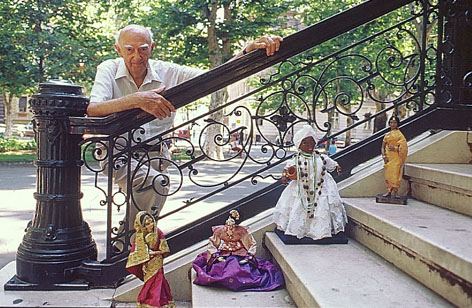
...Nikolai Podgorny, president of Russia, donated 15 dolls: one from each of fifteen former Soviet republics. It is interesting that during an exhibition dolls held in the province of La Pampa in Argentina a Russian doll had disappeared. Calls from local radio were frequently broadcast during the whole day in order to find it, but in vain. Finally, a father of a 5 year old child brought it the next day, saying with excuses that he has found it in his car. Mr. Perinic is very proud that children stay very long at his exhibitions. Their parents just as well.
Gift to the King of Dolls from president Vladimir Putin, 2005:
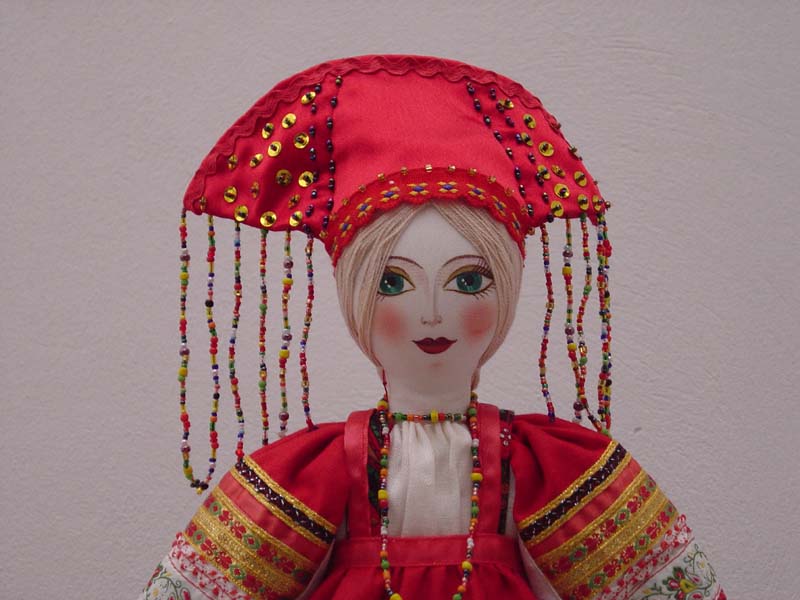 |
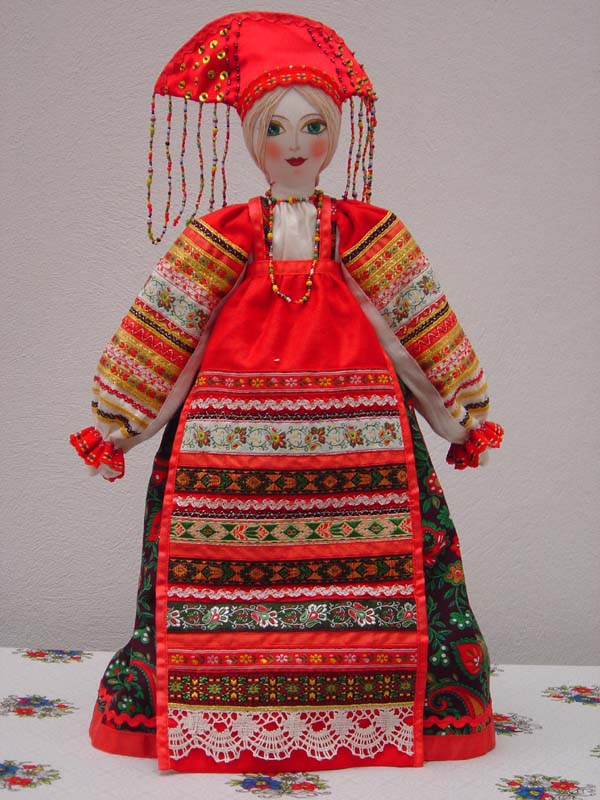 |
Tihana Rendić and Karmen Šoštarić won the first place at the international lace contest in Russia 2011. Croatian lace has centuries old tradition.
Selected literature:
- [Hrvatska/Rusija]
- [Puskadija-Ribkin, Emigranti iz Rusije u kulturnom i znanstvenom zivotu Zagreba]
Croatia - Australia
Croatia - Japan Croatia - South America
Croatia - its History, Culture and Science