Croatian mariners
in the New World;
Croatian Guilds and Collegiums
©
by Darko Zubrinic, Zagreb (1995)
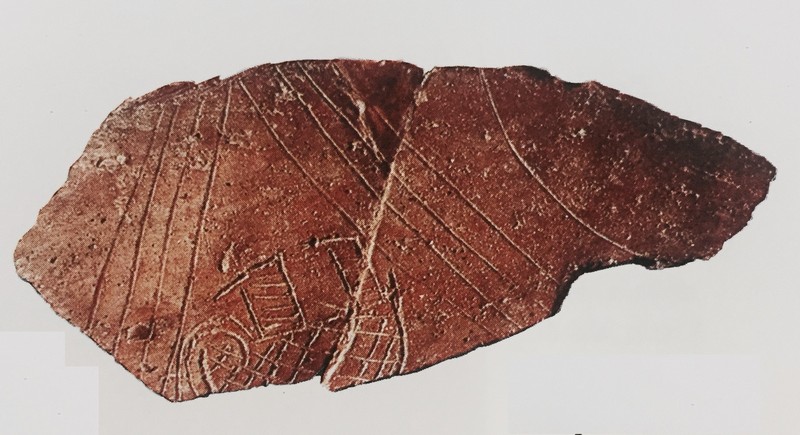
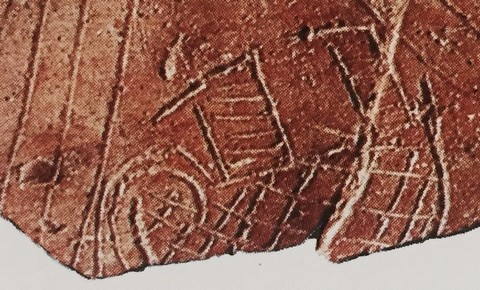
The oldest drawing a ship in Europe, from 2700 BC, discovered in Grapčeva špilja (Grabac Cave) on the island of Hvar, Croatia.
Photo from Bože Mimica: Dalmacija u moru svjetlosti, 1. Dio, Rijeka, 2004.
The oldest known Croatian Guild of merchants in Italy was founded in 1375 in the city of Recanti - Faternitas Sclauourm Sancti Petri Martiris. According to Venetian archives, nearly 20% of the eastern part of the city of Venice called Castello was Croatian. Even today there are streets, squares, passages, bridges and churches in Venice that bear witness of the presence of Croats during many centuries, most often in the name of Schiavone, Brazza (= the island of Brac), Lesina (= the island of Hvar) etc. For more details see an article by Lovorka Coralic in [Croazia/Italia].
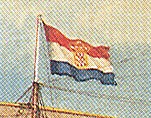
Croatian coat of arms
(on threecolor flag), on the left mast of the Enrica
brig,
built in Rijeka in 1868
In the church of S. Pietro di Castello on the islet Olivolo in Venice, there are interesting traces of close ties with Croats:
- grand church organs were built by fra Petar Nakic (1694 - after 1769),
- in the small lateral chapel of S. Pietro di Castello, on the left of the main alter, there are two epitaphs mentioning the name of Nikola Ivanusic, Split captain and shipbuilder, who had his home in Venice (Corte Schiavona), member of the Croatian brotherhood of St. Juraj and Tripun in the Serenissima.
The Guild of St. Jerome in Udine was founded in 1452.
Very important Croatian Congregation of St. Jerome in Rome was founded in the beginning of the 15th century, and already in 1453 had its church in Rome, with the associated hospital and guest-house for pilgrims, refugees and exiles from the Croatian ethnic areas occupied by the Turks. It is interesting that besides the Latin Mass also Glagolitic Liturgy had been served regularly in the Church of St Jerome, with the use of Glagolitic missals and breviaries. The congregation exists even today, under the name of Croatian Papal Collegium of St. Jerome. The name was given by a rescript of Pope Paul VI in 1971.
Also very important in educating our students was a Croatian Collegium in Bologna (1553-1781), founded first as Collegium Hungarica - Illyricum, then soon Croatized, as Hungarians had their own Collegium Hungaricum in Rome since 1578.
Collegium Illyricum in Loreto was founded in 1580, intended to educate Croatian youth, with 30-36 students. It was acting with interruptions until 1860. During three centuries about 1,000 Croatian students were educated there. The most outstanding of them was Bartol Kasic (1571-1650), author of the first Croatian grammar (Rome, 1604).
It is indicative that just near the main square Palazzo Papale in Loreto there is Palazzo Illirico (Croatian square).
The earliest known description of a sporting event in Croatia is from the 16th century. It reffered to the 1593 regatta of seventy four (yes, 74) wooden fishing boats called falkusa, from the harbour of the town of Komiza on the island of Vis to the islet of Palagruza. It was the oldest known boat race in Europe. Falkusa is autochthonous Croatian boat of 9m of length, with the mast of equal size, in use from 11th or 12th century until the middle of the 20th century. A crew was composed of five rowers, and the marathon covered 42 miles, for which about five to fifteen hours of continuous and exhausting rowing was necessary, depending on weather conditions.
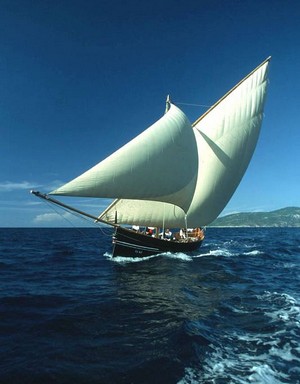
Falkusa, autochthonous Croatian boat from the town of Komiza, island of Vis
The very start of the marathon of the armada was announced by a cannon from the Renaissance tower in the Komiza harbour early in the morning of 20th May. One can imagine the foam raised by 74 boats and 370 rows in the harbour! The description of this interesting event is kept in the Liber Comissiae in the parish of the town of Vis on the island of Vis. In 1998 falkusa was included into the UNESCO World Heritage List. See Prvi zapis o Palagurskoj regati (in Croatian), Gajeta Falkusa, Vis (in Polish), The Falkusa.
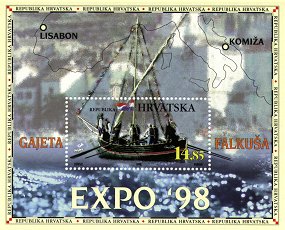
A Croatian falkusa sailed from Komiza to Lisabon to be exhibited at EXPO'98, where Croatia was the greatest surprise. Postage stamp designed by Danijel Popovic, Zagreb.
The next earliest known description of a sporting event in Croatia is from the 18th century (1764). It referred to the regatta of two fishing boats representing the cities of Split and Makarska, from an islet near Milna on the island of Brac to the Split harbour. It was the Makaran boat that triumphed!
One of truly fascinating exploits in which Croatian mariners participated is related to ARCTIC EXPEDITION in 1872-1874, organized by the then Austrian-Hungarian Empire. The Croats at that time had the status of Kingdom within the Empire.
Source Croatian Sports.
The name of Ragusa (=Dubrovnik) and St Vlaho, patron of Ragusa, and also other Croatian names appear on old maps of Central America already in the 16th, soon after discoveries of Cristophor Columbus, John and Sebastian Cabot. Capo de Arause appears on John Cabot's map (15th century) between New York and Cape Cod. Arase was a corrupted Spanish, Portuguese and Italian pronunciation of Ragusa (Dubrovnik).
Some of Sebastian Cabot's mariners were Bozo de Araguz (from Ragusa), Stephen de Lezna (= Lesina = Hvar, Croatian island), Stephen de Arva (= Arbe = island of Rab). According to Adam S. Eterovich about 20 percent of S. Cabot's crew was Croatian.
Croatian mariners organized a chapel of Saint Vlaho in the Church of Santa Maria di Castello in Genoa in the 1400's. The name of Ragusa has many variations: Aragoso, Arause, Araguz, Rhagusi, Ragoza, Rausa etc. Also the name of St Vlaho, patron of Ragusa (Dubrovnik): Bigio, Blaas, Blas, Blaise, Blaze, Braz, Bras.
In the area of Panama there is an Otoque island (otok = island in Croatian!), close to the Pacific side of the Panama canal. In the same area there is Saboga island (sa Boga = za Boga = for God). More to the south there is Punta Mala (mala = small in Croatian, i.e. a small point). In the Panam area the name of San Blas (= St Vlaho, patron of Ragusa) is mentioned several times: San Blas Point, San Blas Bay, San Blas Mountains.
Sebastian Cabot also traveled to Brazil, Uruguay, Argentina and Paraguay. His map of the voyage to the Rio De La Plata in 1526-30 has a bay Mime Ragoso - or "just like Ragusa", which is in Brazil! It is interesting that ship's officer on this voyage was Matias Mafrolo, who was Slavonian, i.e. the Croat.
An important discovery of
Adam S. Eterovich
regarding the Croats in the New World covers
several obviously Ragusan names of mariners in the famous Columbus
crew in 1492: Martin de Araguis,
Pedro de
Arague.
For
more details see [Eterovic],
p. 32-38.
It is a fact that Giovanni Verrazano gave also Dalmatian and Croatian names to various toponyms in the New World during his voyages along the Atlantic coast of New England, New York, the Carolinas, Florida in 1523-1524 (Malabrigo, S. Blas, Mala gente, Costa do Brada, Golfo di Castelli, Fiume, Brioni etc.). In a book by Jacques Habert on the Voyages of Verrazano a chapter heading is entitled "La Dalmatie de Nouveau Monde", 1964 (Dalmatia of the New World), in a book by Carlos Pazzini we have "La Dalmazia Del Nuouvo Mondo", The American Scenic and Historical Society in a description of the American coast has a heading "Dalmatia of the New World", 1910. According to Adam Eterovich, the fact that Verrazano has no geneaology in Italy or France seems to suggest to seek his roots in Dalmatia, not in Italy: Giovanni -Ivan, Verrazano - Veratius, Vrantzius, Vranyczany, Vranjanin, Vrancic. The nobility of Europe always maintained very detailed and accurate geneaologies for rights of title, succession and property. E.G. Tudor in his Tudor Geography (1934, London) states: "A majority of the mariners and the pilots on the king's ships at this period were foreigners - Ragusans (listed first), Venetians (mostly our "Sclavonians", since Dalmatia at that time belonged to Venice, and represented about 70% of its entire territory), Genovese, Normans and Bretons". This was noted by the French Ambassador Marillac in 1540. See Adam S. Eterovich's "The Verrazano voyages to America and Canada 1523-1524", Croatia in the New World, Ragusan Press, San Carlos, USA, 1990.
As for the Dalmatia of the New World, it is possible that even the name of the Potomac river in Washington is of the Croatian origin: potomak = descendant. The name of Long Island in New York might correspond to the Croatian island called Dugi Otok (= long island).
There are very strong and convincing indications that even Marco Polo was a descendant of the Croats (Marko Pilich).
Many of the early European expeditions to the western shore of the Atlantic finished with shipwrecks. So was the case with some ships from Dubrovnik in the 16th century. It is interesting to mention that the Croatan Indians in the USA could possibly be the descendants of the saved Croatian crew, as authenticated by their name, brown hair, blue eyes and some of the words in their language. Two large islands appear on the Molineaux map of Virginia, USA (1599), with the names Croatoan and Croatamonge (see [Eterovic], p. 30).
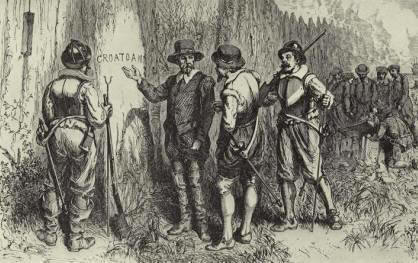
An American writer John Lawson in his 1714 chronicle wrote that among Croatan Indians of that time there was a legend of a 16th century shipwreck with mariners who saved themselves and stayed with Indians.
In attempts to find Walter Raleigh's Lost Colony inhabited by the British Empire in 1587 on the island of Roanoke (near the Croatoan island, North Carolina, USA), the searchers found a CRO carved in Roman letters on a tree in 1590. Another big tree had a bark peeled off, and carved on it in capital letters was the word CROATOAN. For more information see CROATOAN – The "Lost Colony" of Roanoke, written by Ivan Marjanovic De Tonya (Croatian American poet and author).
It is indicative that a (French?) lexicographer and maritime historian J. Jal included in his Glossair nautique about 500 original Croatian maritime terms.
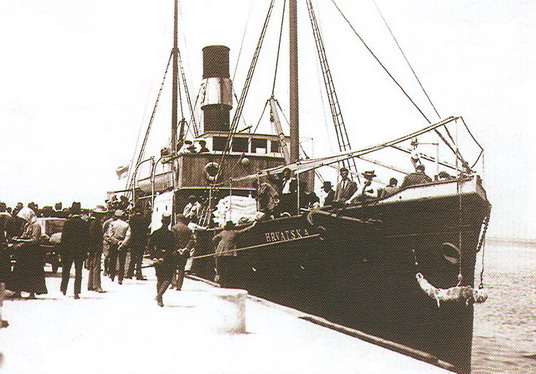
Steamship
Hrvatska (Croatia), 1904
(from R.F. Barbalic, I. Marendic: Onput,
kad smo partili, MH Rijeka,
2004, with permission of Mr. Darko Dekovic)
One of truly fascinating exploits in which Croatian mariners participated is related to ARCTIC EXPEDITION in 1872-1874, organized by the Austrian-Hungarian state.
Captain Mate Dulcic Hraste-Pucetov from the island of Hvar obtained a silver jug from the British Governement as a recognition for saving the boat "St. Croix". Gilted inside, 14.5 cm high and with diameter of the opening of 8.5 cm, the jug bears the the following inscription see [Mate Milicic et al., p 68]:
|
Presented by the British Government to captain Matteo Dulcich Hraste of the "Giovanni D" of Jelsa in acknowledgement of his humanity and kindness to the shipwrecked crew of the "St. Croix" of Jersey, 27 September 1877, abandoned at sea. |
Captain Marko Vekarich, Master of the Austro-Hungarian Barque "Isaac", received the following letter from the Government of Canada for saving the shipwrecked crew of Canadian ship "Angle" in the Atlantic (the letter is kept in the town of Orebic, Peljesac peninsula near Dubrovnik):
|
OFFICIAL SEAL Ottawa, 12th February 1879 SirHer Majesty's Government having brought under the notice of this Department the circumstances connected with the wrecke of the "Angle" of St. John, New Bruswick, and the services rendered by you, as Master of the "Isaac", to the shipwrecked crew, it affords me much satisfaction to convey to you the thanks of the Government of Canada and to request your acceptance of the accompaning gold watch, which has been awarded in recognition of you human and generous services.
I am, Sir, |
In 1861 captain Jozo Sunj from Orebic (Peljesac peninsula), Master of the Barque "Nicolo Despot", obtained official recognition and gold chronometer with engraved dedication from Abraham Lincoln, president of the USA, for having saved the crew of the USA sailor "Homer" in the Atlantic.
Society for building and exploitation of long range navigation vessels (later Maritime Society of Peljesac) in Orebic was founded in 1865. In 1873 the Society had 90 great and nice vessels with total weight of 45000 tons, with 2000 employed, out of which 250 were captains. The Society existed until 1891.
The Hrvat (Croat) steamship, the first Croatian steamship, was built in the Rijeka Technical Factory (Stabilimento tecnico fiumano) to plans by the Rijeka engineer Otto Schlick and launched on 13th July 1872 as the first ship of its kind built on the Croatian coast for a domestic customer. It was ordered by the Shipping society from Senj that intended to establish a line of passenger and cargo ships between Rijeka and Senj. The ship was made of iron, was 34.65 m long and 4.80 m wide, and powered by a 130-horsepower steam engine. It had a capacity of 82 gross register tons and a crew of nine. Regular passage between the two harbours was established on the 7th September of the same year. Initially it sailed five times a week in summer and three times a week in winter, with stops in Novi Vinodolski, Selce, Crikvenica, Voz, Kraljevica and Bakar. The ship sailed under the flag of the Ungaro-Croata shipping company. It was sold in 1903 in Mali Lošinj where it was renowned, and resold to Izola under the name of Besenghi. It disappeared from the list of ships in 1916. Source of the text www.kvarner.hr .
Croatian Coats of Arms
on ships,
mostly brigs,
of the Rijeka bay in the 19th century
The brig is a two-masted sailing ship where both masts are square rigged. The rear mast carries a gaff sail as well, see definitions of various shiptypes here
I express my sincere gratitude
to Mr Darko Dekovic, Rijeka,
for permission to use photos from a wonderful monograph [Barbalic,
Marendic].
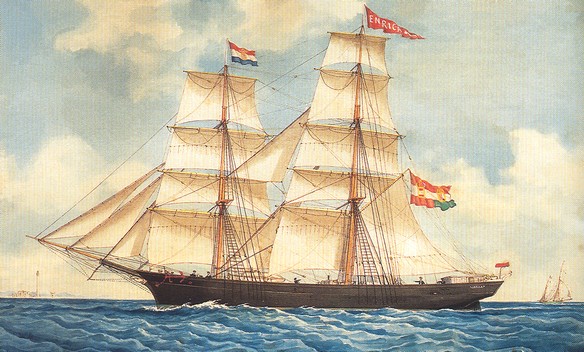
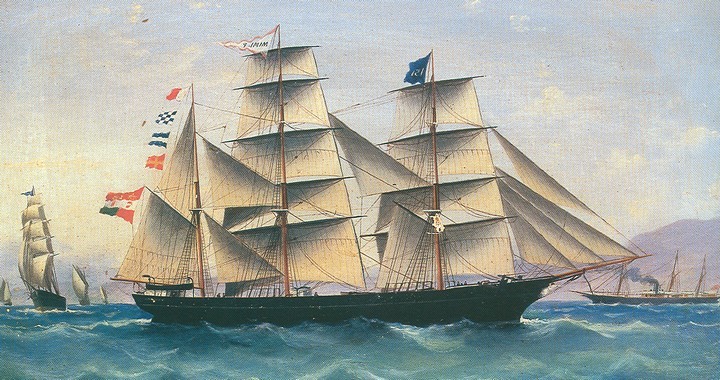
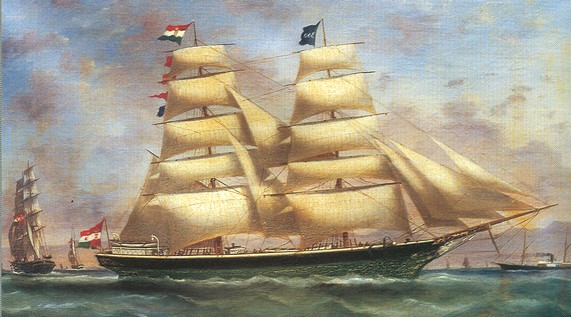
Croatian
coat of arms (on threecolor flag) on
the front mast of the Enrica brig
built in 1868 in Rijeka,
40 m long. Captian Paskval Stipanovic, travelled to New York, Belfast,
Queenstown, Cardiff, Montreal, Gibraltar
Painted by a French painter Antoine Roux, junior, 1892
(photo from [Barbalic,
Marendic, p. 16] )
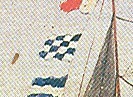
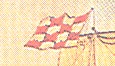
Croatian coat of arms in blue color on the barg Mimi
P(ajkuric),
built in Rijeka in 1866 (photo from [Barbalic, Marendic,
p. 56])
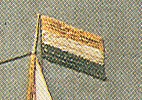
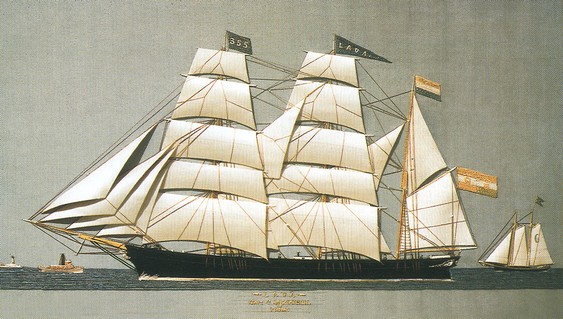
Croatian threecolor flag on barg Lada, built
in Rijeka in 1871
(photo of the silk work from [Barbalic,
Marendic, p. 62])
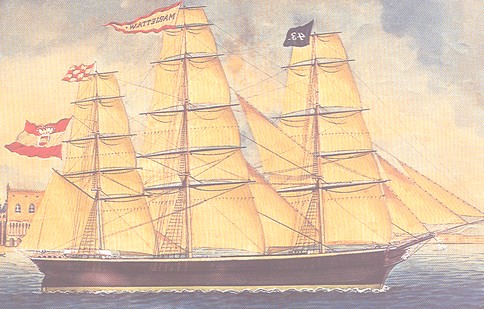
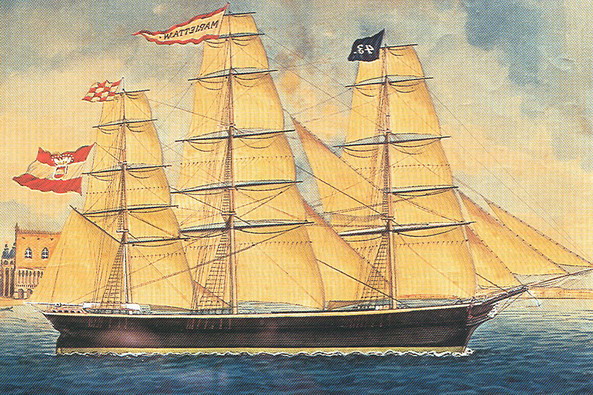
Croatian coat of arms on nave Marietta
W(allner) (born
Bakarcic), built in Rijeka in 1863 (photo from [Barbalic,
Marendic, p. 73])
Two
Croatian coats of arms on the Kostrena
steamer
(photo from [Barbalic,
Marendic, p. 77]):
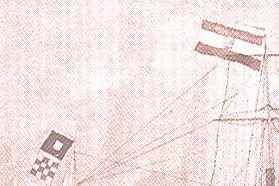
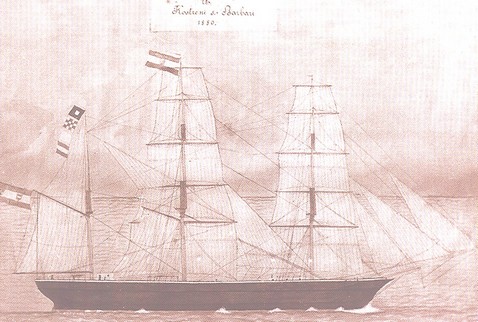
Pepe Medanovic,
captain of a steamer "Kostrena",
saved a French steamer Gaulois in Biskay bay in very difficult
conditions. The French president conferred a medal. Maritime press
reported on this saving throughout the world.
See the facsimile from [Barbalic, Marendic, p. 77]:
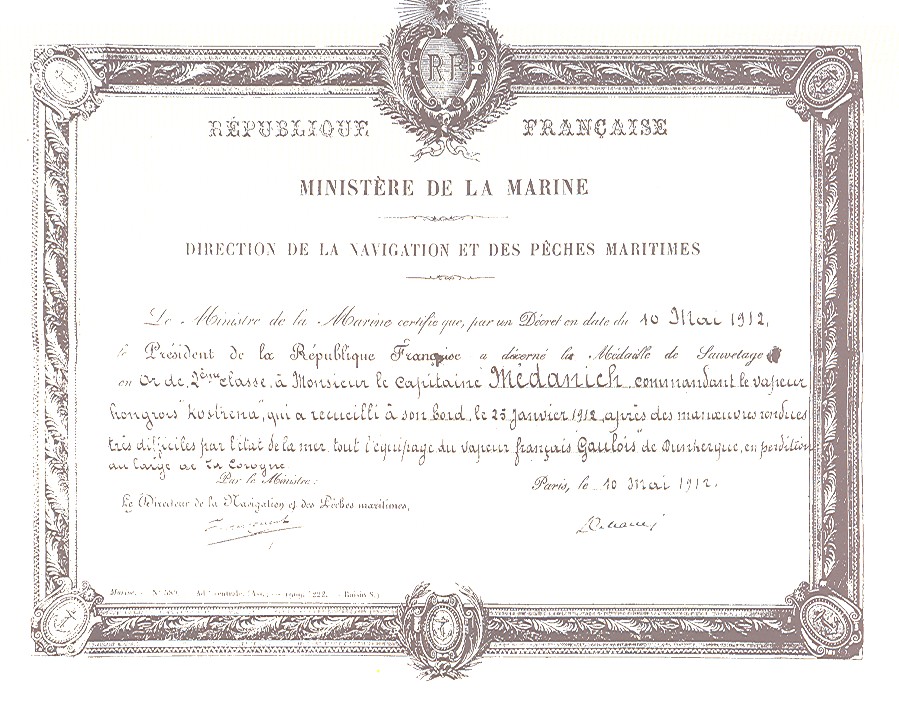
|
RÉPUBLIQUE FRANÇAISE MINISTÈRE DE LA MARINE DIRECTION DE LA NAVIGAITON ET DES PÊCHES MARITIMES Le
Ministre de la Marine certifie que, par
Décret en date du 10 mai 1912, le Président de la
République Française a
décerné la
Médaille de Sauvetage en or de 2ême classe
à
Monsieur le capitaine Medanovich commandant le vapeur hongrois (!)
"Kostrena", qui a recueilli à son bord, le 25 janvier 1912,
aprés de maneuvres rendues trés difficiles Par Directeur de la Navitation et les Pêches Maritimes [signature] Paris, le 10 Mai 1912 [signature]
|
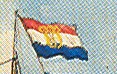
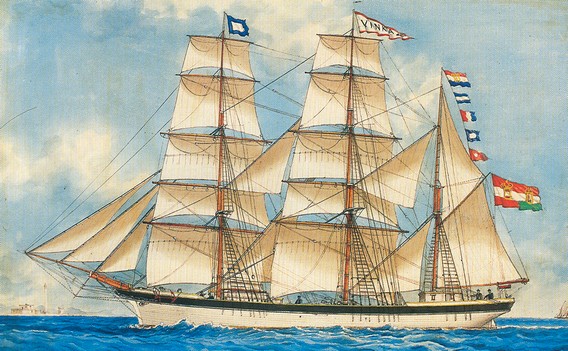
Barg Vinka
with Croatian threecolor and a sketch of Croatian
coat of arms, built in Sunderland in Great Britain in 1865, since 1879
in Croatia, in Kostrena. (photo from [Barbalic,
Marendic, p. 78])

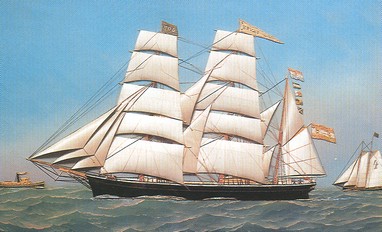
Barg Hrvat (The Croat), built in 1875 in Bakar (photo of the silk work from [Barbalic, Marendic, p. 105])
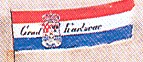
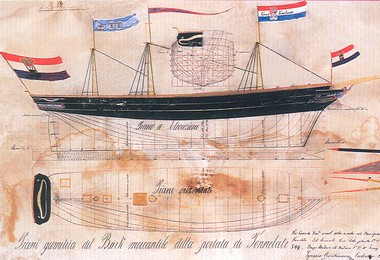
Plan of the barg Grad Karlovac (The City of Karlovac, in Croatia), built in Kraljevica in 1868 (photo from [Barbalic, Marendic, p. 117])

Unknown
boat with Croatian coat of arms in the
middle of the mast
(photo from [Barbalic,
Marendic, p. 123])

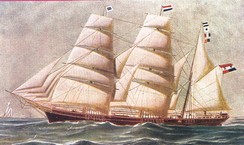
Barg Tri sina (Three Sons - of Vjenceslav Turkovic, a Croatian patriot and Maecenas), with Croatian threecolor flag (photo from [Barbalic, Marendic, p. 124])
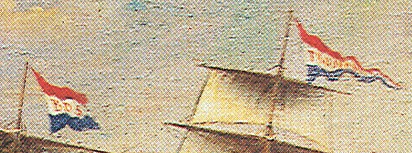
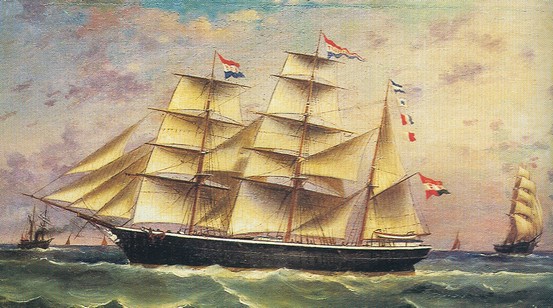
Barg Trojednica (Threeune, i.e. United Kingdom of Croatia, Dalmatia and Slavonia) , BDS (Brodarsko drutvo Senj - Shipping Society Senj). On the main mast there is the Croatian threecolor flag with the name of the barg - Trojednica. Painted by Ivancovich (photo from [Barbalic, Marendic, p. 126]).
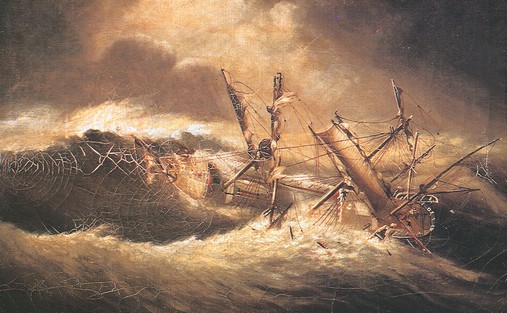
Barg
Hervatska
(Croatia), built in
Senj in 1874.
(photo from [Barbalic,
Marendic, p. 132])
A Croatian bark named
HERVATSKA, that is,
CROATIA, sailing on February 2, 1882 from Philadelphia to Dalmatian
ports, saved a crew of the English vessel, the CHEROKEE OF GREENOCK,
during a desastrous storm in the Atlantic. It obtained a recognition of
the English Queen. The bark was a property of the Senj
Navigation
Corporation. Senj is an important Croatian port in the
Adriatic
Sea.
This information has been provided by The
American Croatian
HISTORICAL REVIEW in July 1946.
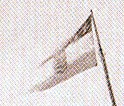
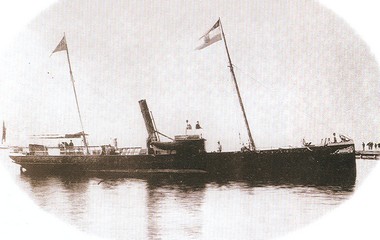
Steamer Hrvat (Croat) built in Recice near Rijeka in 1872, with Croatian flag on the main mast (photo from [Barbalic, Marendic, p. 143])
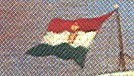
Brigantin
Ida P(ersic),
built in
Rijeka in 1869 (the name was initally Secunda),
(photo from [Barbalic,
Marendic, p. 164])
Benedikt Kotruljevic (Benedictus de Cotrullis from Dubrovnik) is the author of "De Navigatione", 1464. It is the first known manual on navigation in the history of Europe. Note that it appeared almost 30 years before the discovery of America.

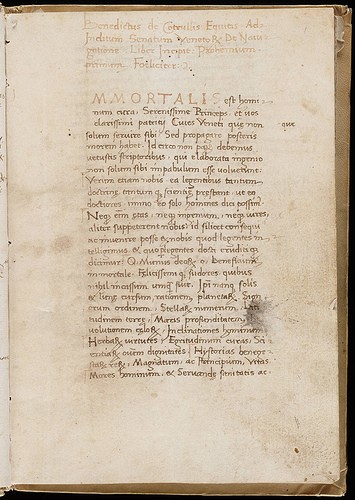
Benedictus de Cotrullis: De
Navigatione, 1464;
photo from Beinecke Rare Book & Manuscript Library
The original manuscript is kept at the University of Yale, USA, in the Beinecke Rare Book and Manuscript Library.
The church of St Nikola in Stari Grad on the island of Hvar is a votive church for fishermen and mariners. It keeps various paintings ordered by mariners which survived whipwrecks. The church was a seat of confreternaty of fisherman and mariners in Stari Grad. The town of Stari Grad has been founded by Greek settlers in 384 B.C., as witnessed by a stone monument with inscription carved in Greek language.
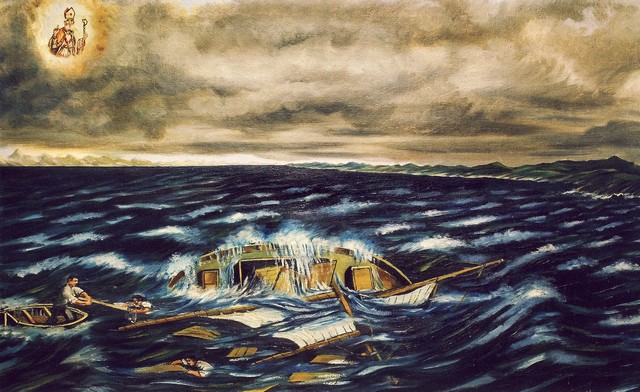
Koter "Marija" pod zapovjedni¹tvom Luke Kovacevica i mornara mu sina Mate kao i mornara Mije Kovacevica Nikole nastradao krcat pijeska uslijed jakog vjetra izmedju Braca i Staroga grada 11. Aprila 1907. (Pijesak je bio namijenjen za izgradnju Osnovne skole u Starom Gradu, D.Z.)
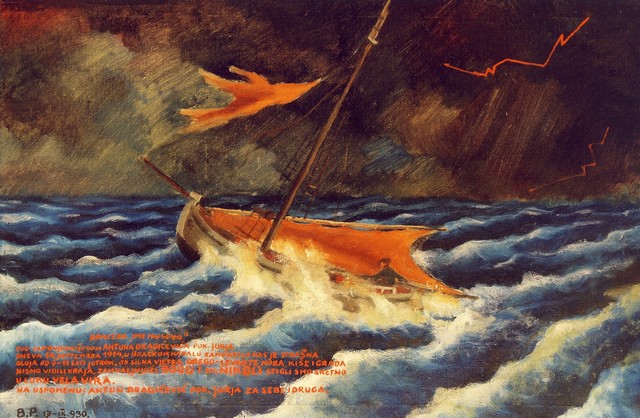
Bracera
"Ime Isusovo" pod
zapovjedni¹tvom Antuna Dragicevica pok. Jurja
dneva 14. septembra 1914. u Brackom kanalu zahvatila nas je strasna
oluja od 9-11 sati jutrom. Od silna vjetra grego-levante, mora, kise i
grada nismo vidili kraja. Zahvaljujuci Bogu i sv. Nikoli stigli smo
sretno u luku Vela Vira. Na uspomenu: Antun Dragicevic pok. Jurja za
sebe i druga.
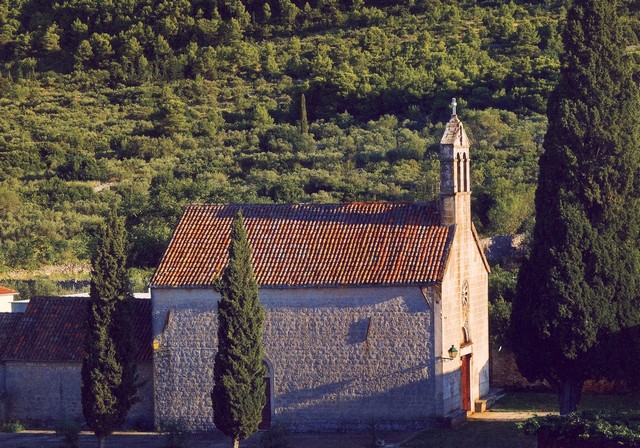
The church of St. Nikola in Stari Grad, Hvar (14/15th centuries). Photographs by Pawel Jarszewski, from a 2008 Calendar issued by Damir Cavic, Stari Grad. Many thanks to Matislav i Marija Kovacevic, Stari Grad, for the calendar.
Nikola Primorac Croatian captain of City of Ragusa craft sailing from Liverpool to New York and back in 1870 (also here)
Ivan Dellitti (19/20th ct) from the city of Senj in Croatia discovered the method of production of acetylene gas. He also constructed the first acetylne gas lamp (carbide lamp).
Jakov Kuljiš from the island of Vis (in the fishing town of Komiža) patented his first acetyene lamp for the needs of night fishing in 1898 (lov ribe "na sviću"). Due to this patent, in 1903, he obtained a recognition in the USA by becoming a honorary citizen of this state. His patent soon started to be used in coal mines as well, as miner's lamp.
Petar Dragić, born in 1873 in the town of Crikvenica on Croatian coast, introduced the purse seine net (in Croatian: mreža plivarica), the precursor of today’s monster nets. He died in 1831 in San Pedro in the USA. His method, introduced in California (and called Californian method), enabled tuna fishig since 1917 in the open sea, and not just along the coast. This method revolutionized fishing throughout the world.
More information:
- Šime Županović: Hrvati i more, Prva knjiga Ribarstvo (1995), Druga knjiga Ribarstvo (1995), Treća knjiga Ribarska terminologija (1998), Četvrta knjiga Ribarska terminologija (1998), AGM Zagreb
- Joško Božanić: Terra nauta / Doprinos hrvatskih ribara svjetskom ribarstvu, Sušačka revija, 17(2009) 65, str. 23–37.
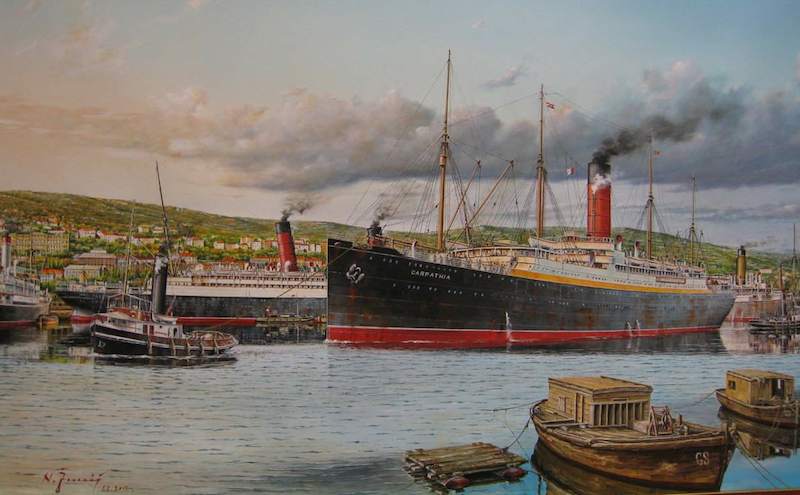
Carpathia ship saving 705 people from Titanic (while about 1500 people perished)
The basic and most important monograph about this operation was written by Slobodan Novković (Zagreb):
(translation of the Croatian title: Carpathia, Hero-Ship in the Shadow of Titanic, published in the city of Rijeka in 2019)
The crew of the ship Carpathia, operating between Rijeka (then Fiume) and New York, which came to rescue of Titanic in 1912, had a personnel of abotu 300 people. Nearly one quarter of them were Croatians, more precisely, 84 of them. Slobodan Novković is the author of the first monograph about Carpathia, published in the city of Rijeka in 1919.
Out of 84 Croatian members of the crew, 33 were from the city of Rijeka, 17 from Labin, 3 from the city of Senj, 2 from Pula, 2 from Kostrena, etc.
Elizabeth Peratrovich a native Tlingit woman and civil rights pioneer bearing Croatian second name
The Savannah nuclear ship, the first nuclear-powered merchant ship, was built to the plans of Erazmo Tićac 1904-1968, born in Croatia in Žurkovo near the city of Rijeka. After the president Dwight Eisenhower announced his decision to build a nuclear-powered merchant ship in 1955, the planning was entrusted to the firm The Sharp Brothers Inc., and Tićac became the leading planner. On a plaque above the entrance to the ship's lounge was written in golden letters: "Ben Tićac, naval architect".
- Adam
S. Eterovich:
- First Croatians in the Americas
- Croatia in the New World; Columbus, the Republic of Ragusa (Dubrovnik) and Saint Vlaho (Saint Blaise) - Patron Saint of Dubrovnik, Ragusan Press, 1992, ISBN 0-918660-81-5 (fax 415-592-1190)
- Croatian Coats of Arms
- CROATIA and CROATIANS and the LOST COLONY 1585-1590
- James F. Adomanis
- Thegetthoff Class Dreadnoughts - The Sinking of Viribus Unitis, by Ante Sucur (...The last great victim of the World War I in the Adriatic sea was the admiral ship of the former Austro-Hungarian monarchy, battleship Viribus Unitis (lat. "With united forces" - motto of the emperor Franz Joseph I). She sank without battle, in the middle of Pula Hrbour, with Croatian flag on her mast, not Austro-Hungarian! Her tragic story certainly deserves attention...)
- Barbalic, Marendic, Onput kad smo partili, zapisi o posljednjim kvarnerskim jedrenjacima, MH Rijeka, 2004.
- Radojica Barbarić: Brodarstvo u Senju i Podgorju kroz prošlost, Senjski Zbornik IV., Senj 1970.
- Mate Milicic-Cripotov and collaborators: Libar o Brusju, Zavicajna udruga "Bruska zora", Zagreb 2007., ISBN 978-953-95856-0-8
- Falkusa regatta from 1593, the earlist known regatta in Europe
- Nada Fiskovic: The Maritime Hertiage in Croatia; Paintings of old ships in Croatia, Gallery Klovicevi dvori, Zagreb 2000, ISBN 953-6776-24-3
- Anica Kicic: Zavjetne slike hrvatskih pomoraca, Matica hrvatska, Zagreb 2001., ISBN 953-150-598-5
- Croatians in America - photo collection by Vladimir Novak
- Croatian Ships series of stamps by issued by Croatian Post
- Dragutin Ivancic: Hrvatski rijecni vukovi opet plove, 2010.
- Ivan Marjanovic De Tonya (Croatian American poet and author): CROATOAN – The "Lost Colony" of Roanoke
- Božidar Rucevic: Croatan Indijanci / Od legende do istine, Split 2014., ISBN 978-953-336-127-7
- Joško Božanić: Terra Nauta, Doprinos hrvatskih ribara svjetskom ribarstvu, Sušačka revijar br. 65
- Mithad Kozličić: Kartografskis spomenici hrvatskoga Jadrana, AGM Zagreb 1995
- Šime Županović: Hrvati i more, Prva knjiga Ribarstvo (1995), Druga knjiga Ribarstvo (1995), Treća knjiga Ribarska terminologija (1998), Četvrta knjiga Ribarska terminologija (1998), AGM Zagreb
- Joško Božanić: Terra nauta / Doprinos hrvatskih ribara svjetskom ribarstvu, Sušačka revija, 17(2009) 65, str. 23–37.
- Petar Vloga: Nećete vjerovati da su nam Talijani ovo ukrali s otoka Visa!
Riječ je o golemom spomeniku na otoku Visu, pet metara visokom lavu
podignutom u čast palim Hrvatima i Austrijancima koji su poginuli od
strane Talijana 1866. godine. Kasnije, nakon prvog svjetskog rata,
Talijani su lava ukrali s Visa i odnijeli ga u Livorno, gdje danas
stoji u predvorju jednog fakulteta.
JELACIC, by Michel Iellatchitch, France
Croatian History, Culture, and Science