Croatian Classical Music, 10th-19th centuries
Darko Zubrinic, Zagreb (1995) An
age is known by its music
Croatian proverb (see [Kuhac])
The first known Croatian neum manuscripts for church music date from the 10th century. We know of a fragment of a pontifical from the 10th century containg neums, kept in the Convent of Minor Brothers in Dubrovnik. See [Demovic, Dubrovački neumatski rukopisi od X. do XII. st., p. 589] and [Demovic, Neumatski fragment beneventanskog pontifikala].
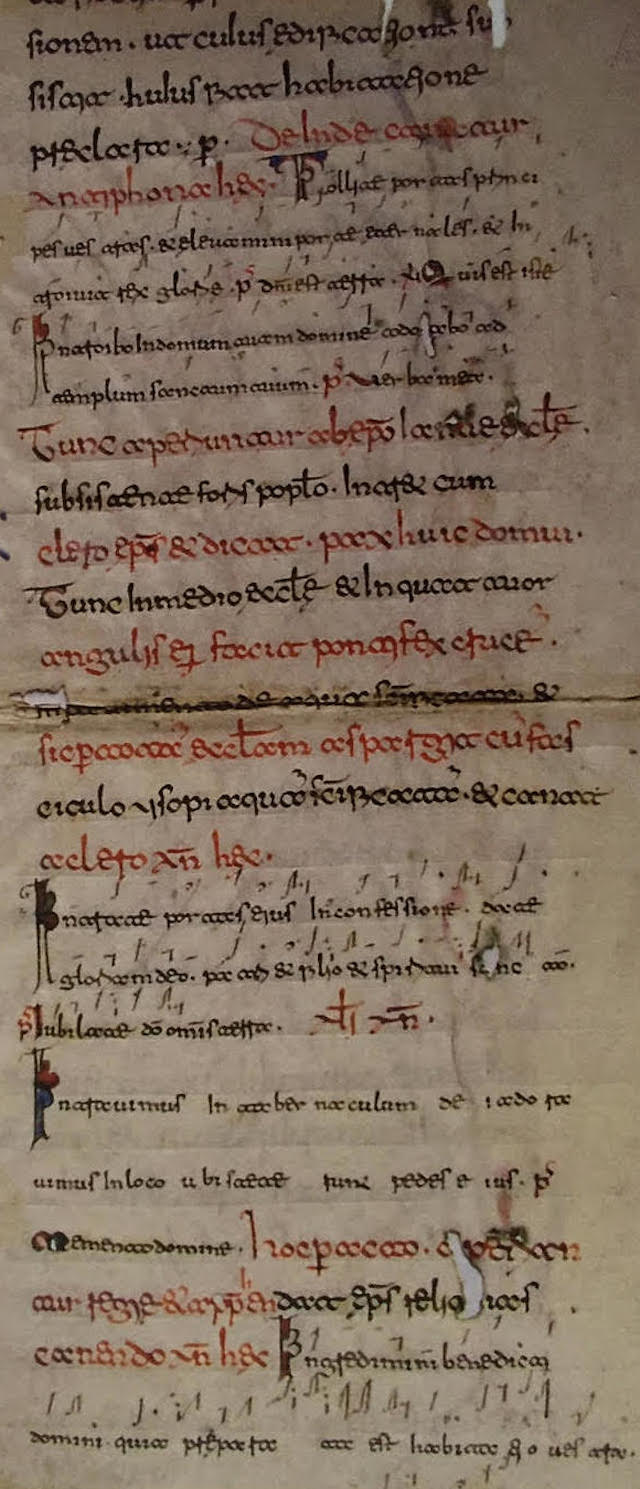
Right column of a Dubrovnik liturgical book from the 10th century,
containing neums of coral music.
Photo from [Demovic, Velika povijest dubrovacke glazbe,
knj. I.], by kind permission of the author.
According to dr don Miho Demovic, Croatians have coral sheet music
earlier than Germans.
The Lokrum Missal from 1070 is the oldest known book from Dubrovnik. Lokrum is the name of the island in front of the medieval walls of the city of Dubrovnik, and the book was written in the Abbey of St. Mary (Sv. Marija) on that island. The book contains as many as 440 music pieces written in neums (in the benevent notation "in canpo aperto").
Source Miho Demović: Dubrovačko
kotorski misal iz 1070. godine,
950 godina najstarije dubrovačke
knjige, Dubrovnik 1070. - 2020. (monograph, 224 pp.). According to
research of Dr. Demović, this missal was written in 1070 in the Abbey
of St Mary on the island of Lokrum near Dubrovnik. It is known to have
been since 1332 until unknown year in the city of Kotor.
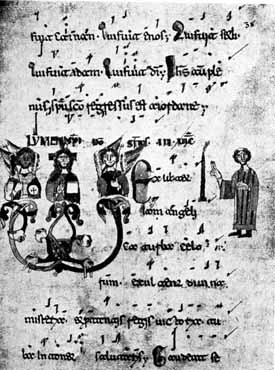 The
Osor Evangelistary
(1080-1082) from the convent of st. Nikola in Osor (island of Cres),
containing neum notation, is
written in beneventana, ornamented by Monte Cassino initials, and
accompanied with old neums. This evangelistary contains among others a
prayer for the Pope, for Byzantine emperor, and for the King which at
that time was factual ruler of Osor (regis nostri) - Croatian King
Zvonimir. The evangelistry is held in the Vatican Archives. Some of the
Christmas folk songs from the 12th century are still very popular.
It
is interesting that the Croats have more than 500 (five hundred)
Christmas carols. There are Christmas verses that can have a dozen of
different melodies, varying considerably from region to region. The
number of Croatian
Christmas carols is surprisingly
large even in world's proportions.
The
Osor Evangelistary
(1080-1082) from the convent of st. Nikola in Osor (island of Cres),
containing neum notation, is
written in beneventana, ornamented by Monte Cassino initials, and
accompanied with old neums. This evangelistary contains among others a
prayer for the Pope, for Byzantine emperor, and for the King which at
that time was factual ruler of Osor (regis nostri) - Croatian King
Zvonimir. The evangelistry is held in the Vatican Archives. Some of the
Christmas folk songs from the 12th century are still very popular.
It
is interesting that the Croats have more than 500 (five hundred)
Christmas carols. There are Christmas verses that can have a dozen of
different melodies, varying considerably from region to region. The
number of Croatian
Christmas carols is surprisingly
large even in world's proportions.
According to Dr. Miho Demovic, a well known and very popular Croatian Christmas carol Narodi nam se kralj nebeski is from 13th century, and U se vrime godisca might be from 12th century, see Glas koncila, 25. 12. 2007, p 15.
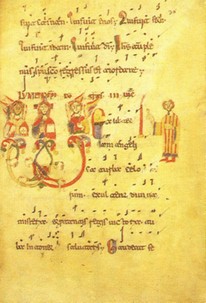
Miho Demovic, a Croatian musicologist, discovered some old scores in the Vatican archives originatin from the territory of Croatia. Together with Hortus Musicus (Tallin Estonia), two concerts were organized within The Osor Musical Evenings, entitled Music in Croatia from 8th to 10th centuries, and Music in Croatia from 10th to 12th centuries. See here, and also Miho Demović: Liturgijski recitativi iz starih hrvatskih kodeksa od X. do XII. stoljeća, Zagreb, Kor Prvostolne Crkve Zagrebačke, 2000, ISBN 9005208-5-2, 400526039
The Cika Breviary from 11th century is important monument of Croatian culture written in the Benedictine Monastery of St. Krsevan in Zadar. It also contains musical notation, and is kept in Budapest in the Library of the Hungarian Academy of Sciences.
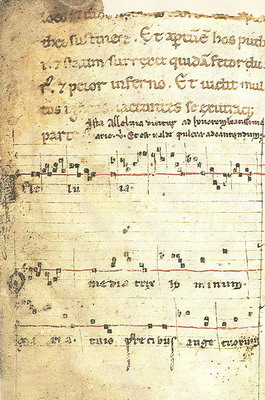
Vekenega Evangelistary, a top monument of Croatian culture, is a richly illuminated Latin text from the 11th century. It has been written in the famous Benedictine monastery of St Krsevan, and is kept today in the Bodleian Library in Oxford. Below you can see the neums accompaning the text.
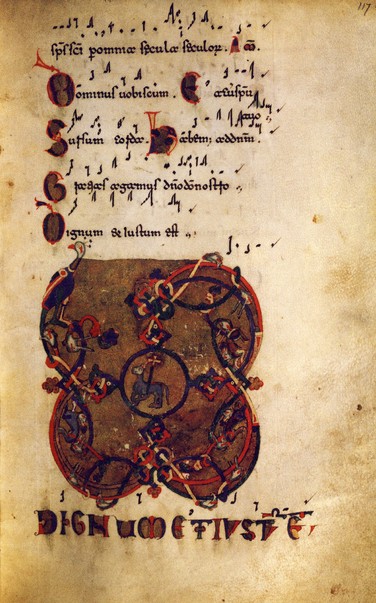 |
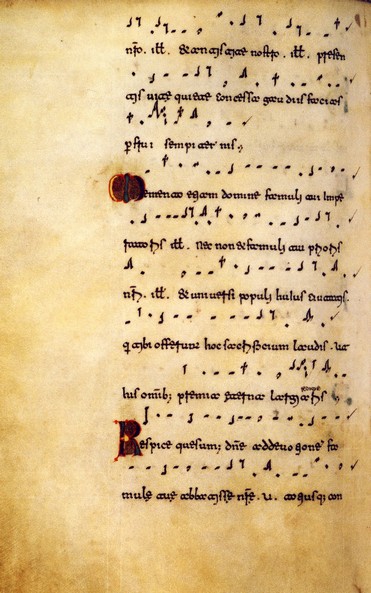 |
Very old and valuable for the history of Croatian music is the Dubrovnik Missal from 12th century, now kept in the Bodleian Library in Oxford (Canon Ligurg 342). Written in Latin, in Beneventan script, it contains prayers and some chants unique in Europe. See [Menalo, pp. 34-35], and also Dubrovnik. The Missal, written for the Dubrovnik Cathedral, is full of old Gregorian chants, containing more than 200 monodic meodies. For a long time it was believed to have been written in North Italy, until E.A. Lowe discovered that it was written in Dubrovnik. Miho Demović proved that the Missal was written for the Dubrovnik Cathedral, [Demović, Rasprave i prilozi, p 171-183]. It is interesting that as many as 430 monodic melodies are preserved in the Dubrovnik region from that time: 220 are kept in Dubrovnik missals, out of 720 known monodic melodies preserved in the whole of Croatia. Out of these 220 monodic melodies, 50 of them represent the Dubrovnik music particularities. In this way Dubrovnik became important European center for monodic music. Some of them according to Demović represent the highest achievements of world heritage with respect to melodic beaty [Demović, Rasprave i prilozi, p 177].
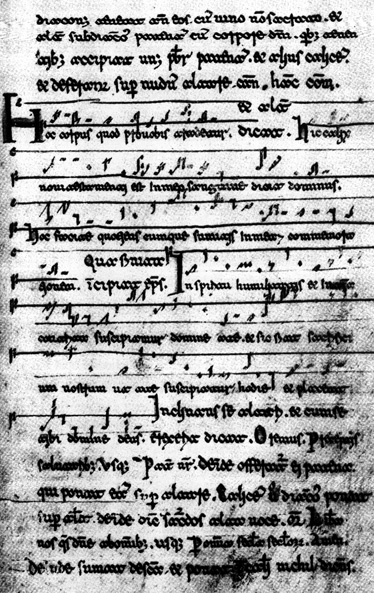 |
We can see musical notation also in the famous Trogir Evangelistary (Evangeliarium Traguriense), written in 1230-40, kept in the treasury of the cathedral in Trogir:

According to Dr. Miho Demovic, an important collection of Croatian Middle Age monodic music can be found in about fifty samples, preserved mostly in the Dubrovnik beneventan missal from the 12th century, and in the Dubrovnik beneventan liturgical manual of legend and rite of St Nicholas from 11th century with additional thirty seven songs, achieving high artistic level. It is a part of common musical heritage created in Western Europe. The analysis of preserved scores testifies that the Early Middle Age Croatia had one of the most developed and most beautiful music traditions in Europe. See [Demovic, Glazba u staroj hrvatskoj drzavi, pp 145-146]. The following set of photos is from this reference. Many thanks to Dr. Miho Demovic for kind permission.
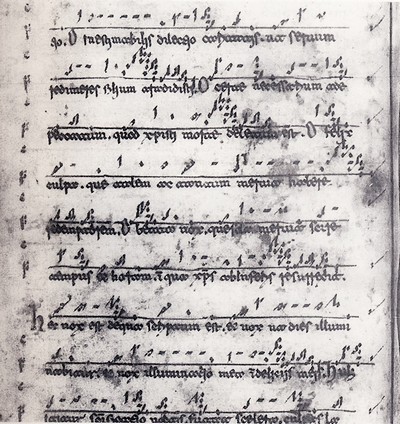
Music score of the exultet from the Dubrovnik missal, 12th century.
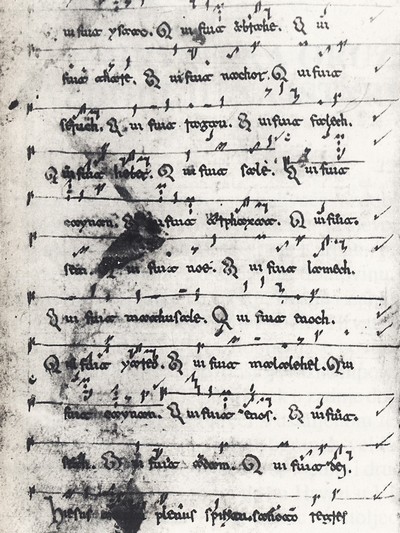
Geneaology according to Luka in the Dubrovnik missal, 12th century.
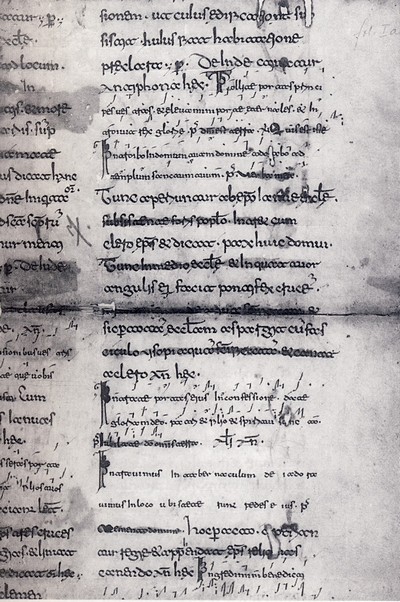
Fragment from the Dubrovnik pontifical, 10th century.
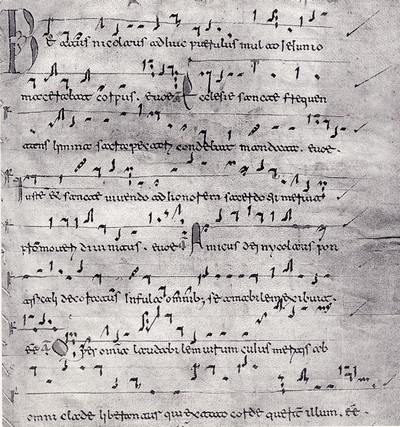
Antiphons in ligurgical manual from Dubrovnik, 11th century.
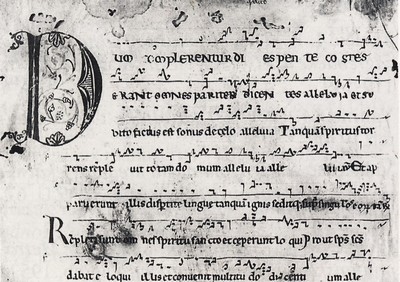
Antiphon from the Korcula antiphonal, 11th century, from the island of Korcula.
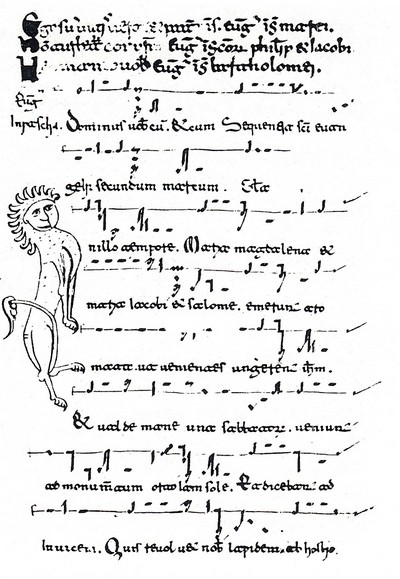
Music score of Easter Evangel from the Kotor pontifical, 11th century.
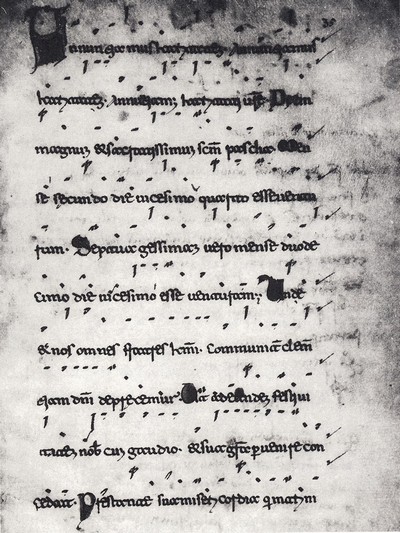
Music scores in the Osor Evangel from 1070.
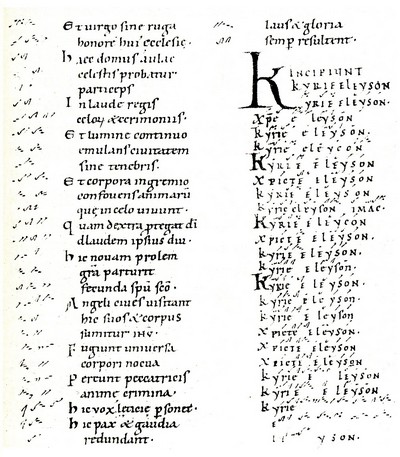
Music scores from the Sibenik Liber sequentiarum, 11th century.
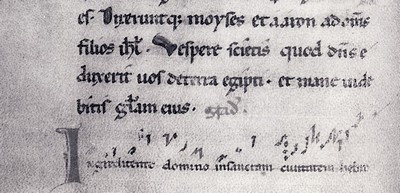
Responsory from the Split Sacramentory, 12th century.
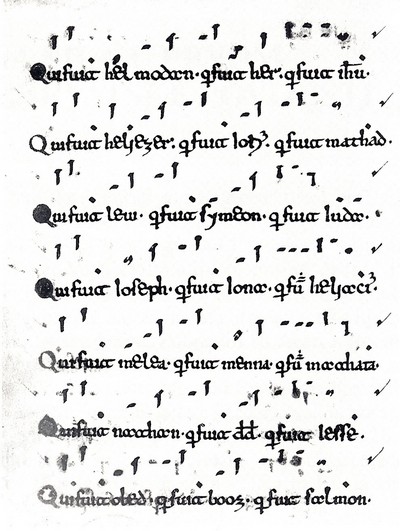
Geneaology according to Luka from the Dubrovnik missal, 12th century.
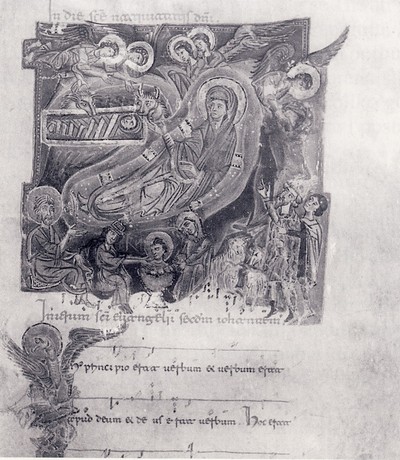
Music score of Easter Evangel from the Trogir Evangelistary, 12th century.
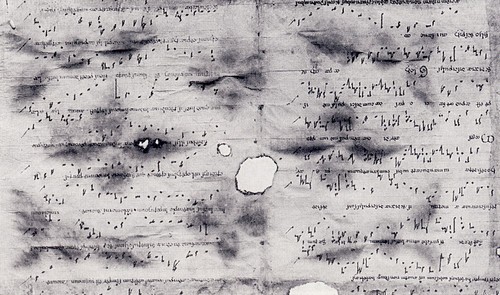
Antiphons from the antiphonal of the chruch of St. Stosija in Zadar, 12th century.
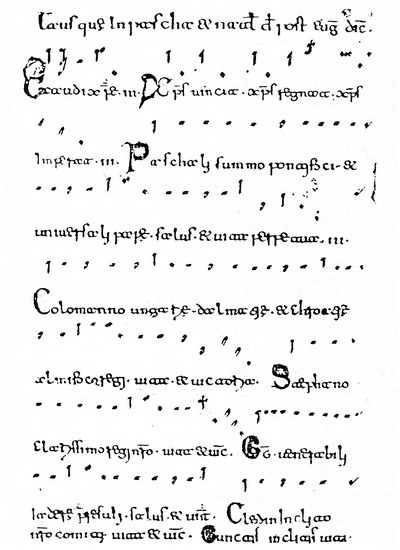
Lauds in the evangelistary from the church of St. Simun in Zadar, 11th century.
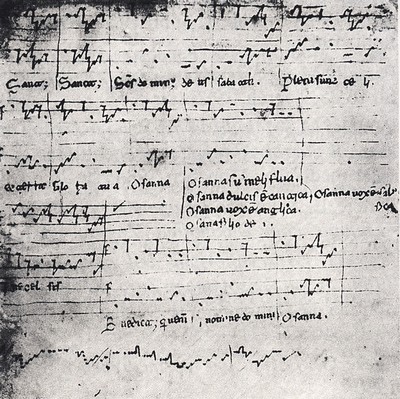
Musical score from the cartular of the convent of St. Marija in Zadar, 11th centry.
The earliest known French-Flemish musician living in Dubrovnik was Gallus Piffarus. He was in the City since 1425. See [Demović, Rasprave i prilozi, p 314].
It seems that the Roman Rite in the Middle Age Croatia was preceded by a separate rite which emerged in Dalmatia in Early Christian period, simulataneously with other Eastern and Western Rites. It was the so called Illyric Rite, named so by Matija Vlacic, i.e. Flacius Illyricus, 1520-1575. It seems that the remains of liturgical books belonging to this rite are: the Evangelistary from Srijemska Mitrovica, Kiev folia and Miroslav evangel, which cannot be fully included neither to Roman nor to Eastern Rite. See [Demovic, Glazba u ranoj hrvatskoj drzavi, p. 111 and the references therein].
A special place in the history of Croatian music has the Glagolitic church singing. The earliest mention of glagolitic singing in Croatia is already from the year 1177, when Pope Alexandre III visited the town of Zadar, known for its very old and fruitful glagolitic tradition in Croatia . In the 1368 Missal of Prince Novak (kept in the National Library in Vienna) there are symbols above the Glagolitic text which seem to denote the way of singing. The same holds for the Hrvoje Missal, written in ~1404 by scribe Butko probably in Zadar, kept in the Library of Turkish sultans (Topkapi Sarayi) in Constantinople in Turkey.
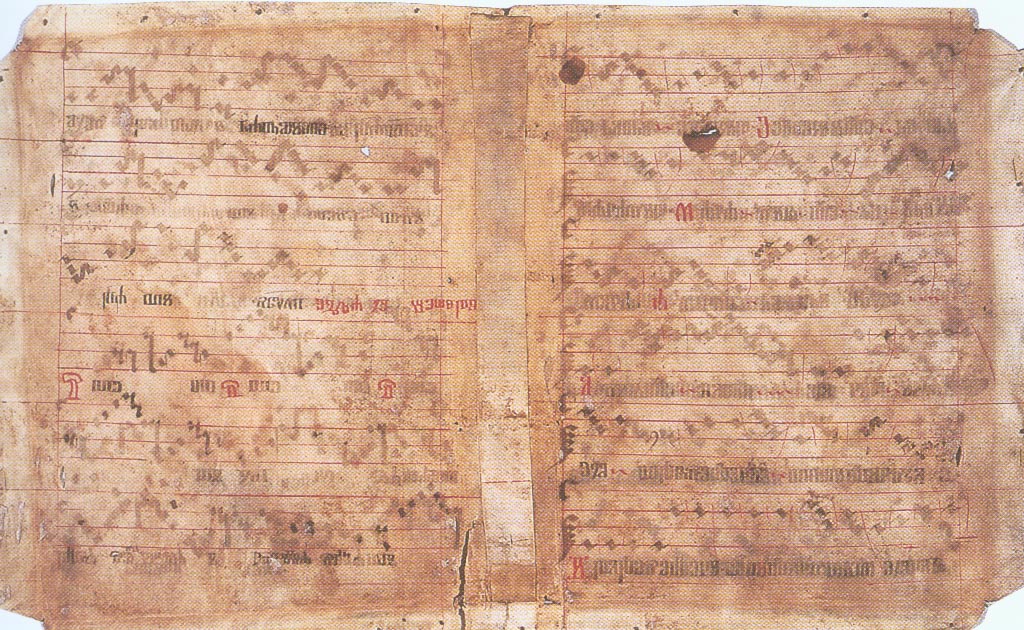
- Stanislav Tuksar, Kratka povijest hrvatske glazbe, Matica hrvatska, Zagreb, 2000, p. 12,
- [Croatia - Europe, Volume I, Glagolitic singing by Jerko Bezic, pp 729-737],
- Katarina Livljanic, Music, in [The Croats - Christianity, Culture, Art], pp 183-192; the above Croatian glagolitic fragment with musical notation, found in Strahov in the Prague, is held at the University Library of Ljubljana, Slovenia, obviously a part of larger unknown Croatian manuscript from 15th century. According to Josef Vajs the fragment is the proof that also in church singing the Croatian glagolites were not behind the Latin clergy, see his book, p. VIII
- A small Croatian glagolitic fragment from 15th century with musical notation (neums) is held also in the library of Franciscan convent of Sv. Franjo Ksaverski in Zagreb (information by dr. fra Izak Spralja).
- [Vinko Zganec]
- Croatian glagolitic singing (in Croatian, extensive presentation)
Ocara-Radio France and Harmonia Mundi, two renowned French publishers, issued a CD entitled Croatie. Musique d'autrefois, Croatia. Music of Long Ago (C 600006/HM79). It represents an anthology of Croatian traditional music. See also Katarina Livljanic.
The Passion procession on Croatian islands (like on Hvar for instance) has centuries old tradition with its roots in the Middle Ages. Passion processions are not organized by the Church or priests, but by laity, i.e. by confraternities of villagers. Musicologists consider passion songs in Croatia among the oldest in Europe. Each spring a festival of Croatian passion heritage (Pasionska bastina) is held in Zagreb. Its symbol is glagolitic letter A. In 1985 Maestro Ljubo Stipisic issued 8 cassettes representing Old Church (Glagolitic) folk songs from 15 places on the island of Hvar. These are records of very old tradition.

Les
chantres de Pharos: Chants
glagolitiques pour la Semaine
Sainte
Ile de Hvar, Croatie
ZA KRIZEM: Glagolitic chant for Holy
Week from Hvar, Croatia
The Pharos Cantors, recorded in June 1999 in Stari Grad, Hvar, Croatia
produced by Nenad Bach
These Croatian glagolitic Lenten chants retrace a venerable and direct link to our ancestors, our roots, and our religious belief. Born out of Middle Ages, they continue to extend an unbroken tradition of Croatian history. They still resonate as part of our being, so let them be our pride, our support, and our hope.Dr. Vedran Deletis, New York
The Pharos Cantors (Hvarski kantaduri) sang their very old Lenten chants in Czechia, Great Britain, Bosnia and Herzegovina, Hungary, Germany, Spain, the USA, the Netherlands, Austria, etc.
Examples:
- Gospin plac - Madonna's weeping (Stabat mater dolorosa) [mp3]. According to dr. Miho Demović, this way of singing has some parallels with Coptic singing.
- Tebe Boga hvalimo (Te Deum) [wma]
See Pasionska bastina page (in Croatian), and listen to Madonna's weeping (Stabat mater dolorosa), a glagolitic chant from the island of Hvar (village of Vrbanja). Truly amazing way of singing (be patient while listening).
Mel Gibson's web page The Passion of the Christ also in Croatian.
Leos Janacek, Czechia, composed his famous Glagolitic Mass. According to The Penguin Guide to Bargain Records, 1966, GB, the text is taken from native Croatian variations of the Latin text (see p. 191).
The oldest known music preserved in Croatian language is considered to be Kantual "Blagoslovimo Gospodina" (Let us Bless Lord), written in Latin Script, dating from the end of 14th till the beginning of 16th centuries.
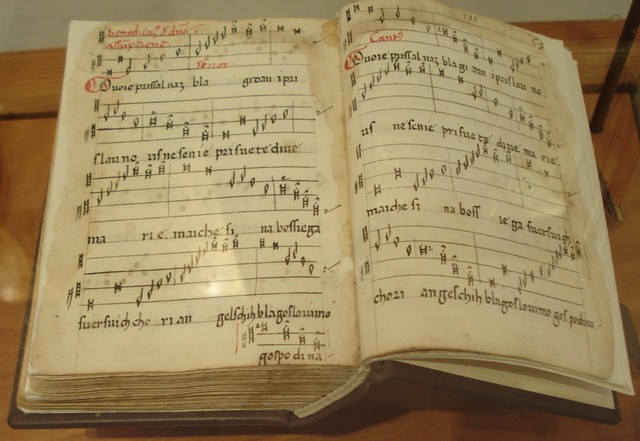
It is kept in the Dominican Convent in Starigrad on the island of Hvar.
The earliest known Croatian composers are Andrija Motovunjanin (Andrea Antico da Montona, born in the Istrian town of Motovun around 1480, died after 1539) and Franjo Bosanac (a Croat born in Bosnia around 1490).
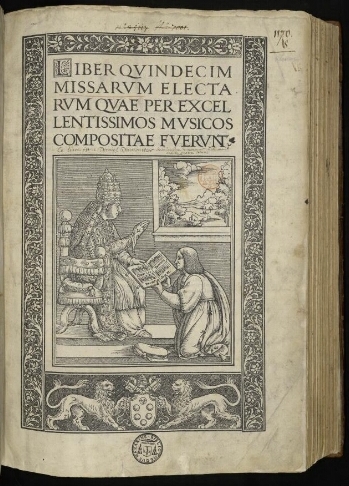
Andrea Antico (Andrija Motovunjanin): Liber
Qvindecim Missarum, Rome 1516
In 1516, Andrija Motovunjanin (Andrea Antico da Montona)
published his book Liber Quindecim
Missarum
(The Book of 15 Masses) in Rome, containing masses of Josquin des Prés,
Antoine
Brumel, Jean Mouton, Antoine de Févin, and Matthaeus Pipelare. This
was the first printed book containing polyphonic sacral music. Andrija
Motovunjanin obtained an exclusive right for publishing sheet
music from Pope Leon X. He was the first one to who a Pope granted such
permission (in 1516). In 1517, Andrija Motovunjanin printed his Frottole
Intabulate da Sonar Organi, and this was the first printed
collection of vocal frottolas, adapted for organ.
Information by the courtesy of Franjo Bilić and Eva
Kirchmayer-Bilić, Zagreb (2022).
In 1521, Andrija Motovunjanin collaborated with Venitian printing house
of Andrea Torresani, who became well known
for printing Croatian Glagolitic
Books (the first Croatian Primer for
children in 1527, and the Missal of Pavao Modrušanin in 1528).
- Croatian Middle Age Music, by Hana Breko (in Croatian)
- Glagolitic singing, by Gorana Doliner (in Croatian)
Petar Hektorovic, a well known Croatian poet, nobleman, connoisseur of Latin language and classical literature, wrote his Ribanje i ribarsko prigovaranje in 1568, which is the first realistic epic poem of Croatian Renaissance literature. It provides four folk tunes accompanied with musical notation. The book has been translated from Croatian into English in 1979 by Edward Dennis Goy under the title Fishing and fisherman's' conversation.
Bartol Gyurgieuvits (1506-1566), born in Turopolje near Zagreb, had spent 14 years enslaved in Turkish Empire. After his escape to Europe he published numerous works about the Turks. Among them is De Turcarum ritu et caeremoniis (where he is called Bartholomeus Georgievits), published in Amsterdam in 1544, in which he described among others the characteristics of music in Islamic society. It was among the first in Europe treating Islamic music, and was translated into seven languages. It was indeed very popular throughout Europe: the work had as many as 77 editions.
Juraj Hus, a Croatian captive in Turkey, became a military trumpeter for the Turkish army. Once he played his trumpet on the top of a pyramid near Cairo, 16th century!
The Croats can boast of having two excellent Renaissance composers. The first one is Julije Skjavetic (Schiavetti) from the 16th century. Between 1557 and 1573 he lived in Sibenik, and was conducting a choir in the famous Sibenik Cathedral. He wrote a collection of madrigals for 4-5 voices and a collection of motets for 5-6 voices (both published in Venice in 1563 and 1564 respectively). An important collection of his motets that was held in Dresden, disappeared after the destruction of the city in 1945. Luckily, it was discovered in Krakow in 1993.
According to [Miho Demovic, Andjelko Klobucar,
p. v], the first organs arrived to Europe from the East (sic!) in the
8th century, while their earliest known written trace is from Vienna
from 1334. The earliest known documents testifying to existence of
organs in Croatia are from Zagreb 1363 and Dubrovnik 1389.
Ivan Lukacic (1584-1648), a Renaissance composer born in Sibenik, was conductor and organist in the Split Cathedral. In 1620 he published a collection Sacrae cantiones, containing 27 motets for 1-5 voices accompanied by organs. Lukacic's collection was lost in the course of WW2, and rediscovered in the 1980's at the Jagiellon Library in Krakow, Poland. This is the only known copy.
Gabriello Puliti (1580-1643), an Italian priest, was an important composer for lute and organ in various Croatian towns of Istria. Another interesting Italian composer was Tomaso Cechini (1580-1644), an organist in the cathedral in Split and Hvar (on the island of Hvar). Both of them influenced the Croatian cultural circle in this region.
Besides Lukacic, Vinko Jelic (1596-1636) was the most important representative of Croatian church music of the time. He was born in Rijeka, and died in Alsace in France (Zabern). This Early Baroque composer is noted for introducing new techniques like chromatics and sequences into his music, which have just begun to appear in Europe. In 1622 he published a collection consisting of 24 motets (plus 4 other pieces) Parnassia militia in Strassbourg.
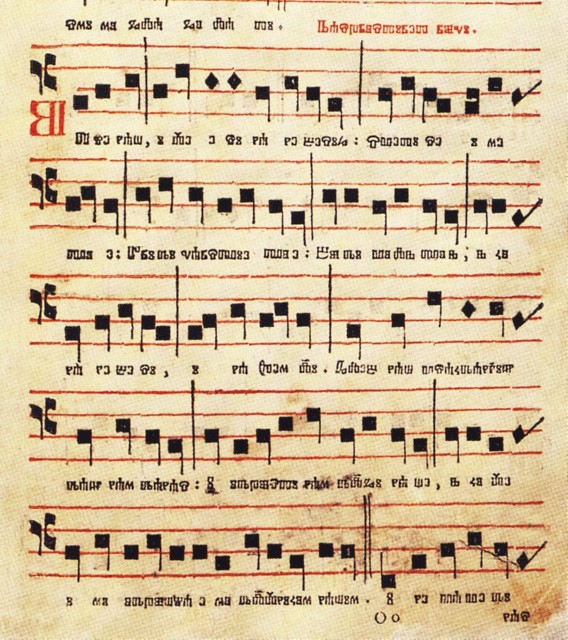
Otce
nas
(Our Father) in the Glagolitic,
Levakovic's Glagolitic
Missal, Rome 1631
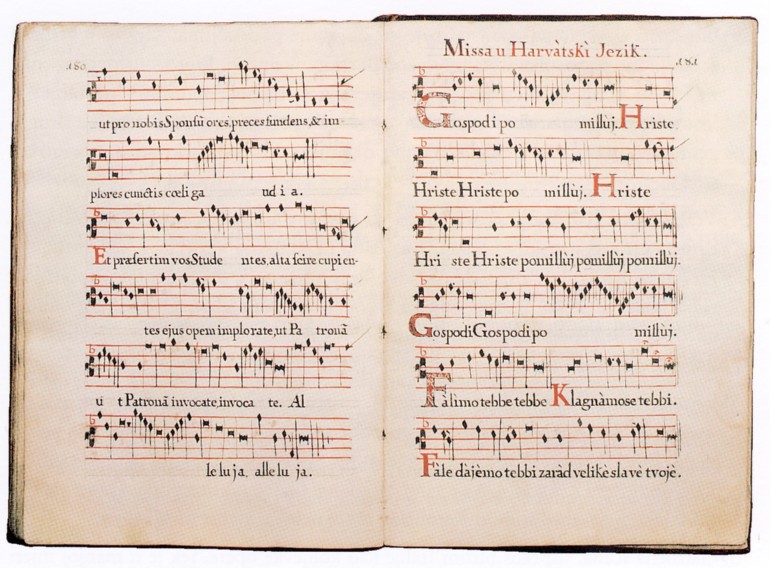
Misa u Harvatski Jezik (= Mass in Croatian Language) ,
kept in the Franciscan convent in Sinj, 1644
A true jewel of Croatian culture is Pavlinski zbornik (Paulist collection) from 1644, a collection of church chants. It is important in its language, text and sheet music. Paulists left important traces in Croatian culture during five centuries of their presence in Croatian lands from 13th to 18th centuries, see [Sekulic].
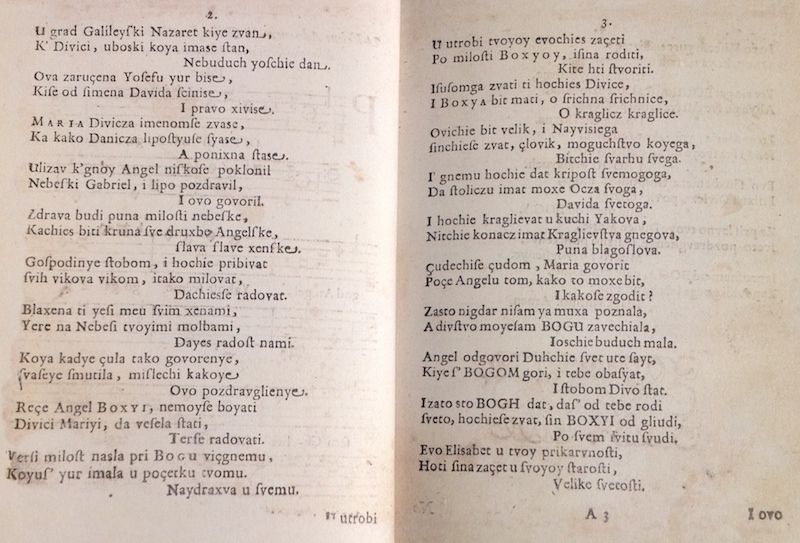
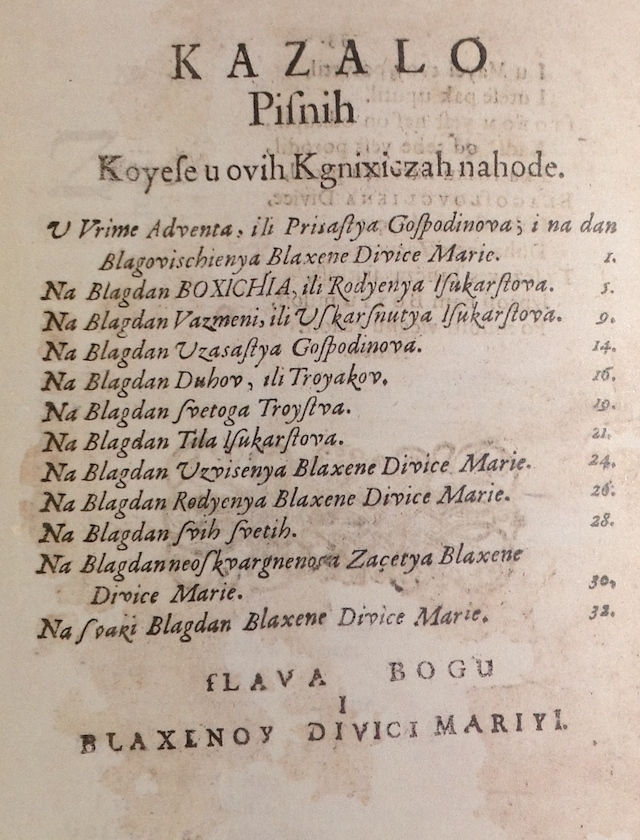
Atanazije Jurjević
(Athanas Georgiceo alias Jurjevich-Dalmata, 1590- arround 1640) is the
author of the first known printed church songbook in Croatian language:
Pisni za najpoglaviteje
(Songs for the Most Important). It was published in Vienna in 1635. The book has been
reprinted in 2012 (Miho Demović: Prva tiskana hrvatska
crkvena pjesmarica Pisni Atanazija Jurjevića iz 1635.,
by "Udruga hrvatskih himnologa Pavao Štoos", with the
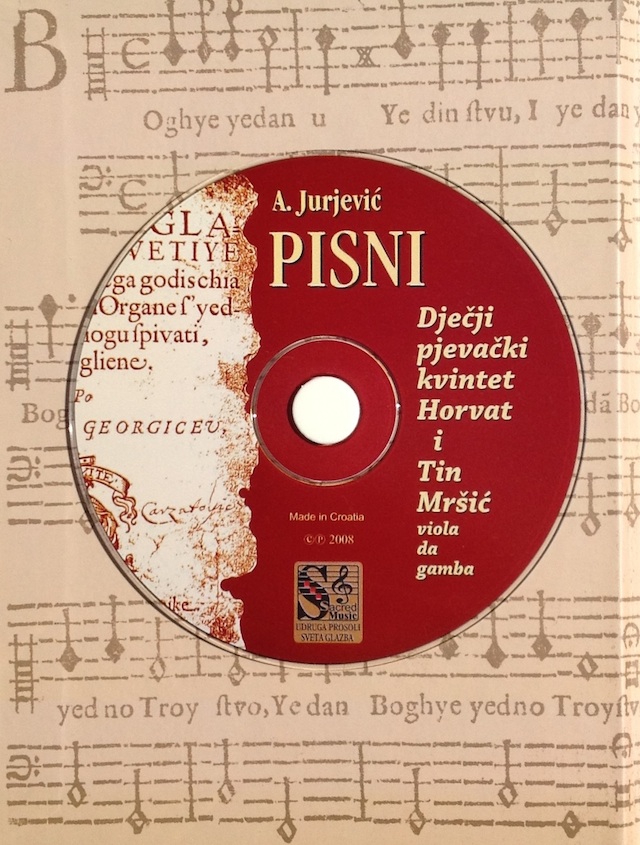
accompaning CD (A. Jurjević: Pisni,
u izvedbi Dječjeg
pjevačkog kvinteta Horvat i
Tina Mršića; Udruga
Prosoli - Sveta glazba).
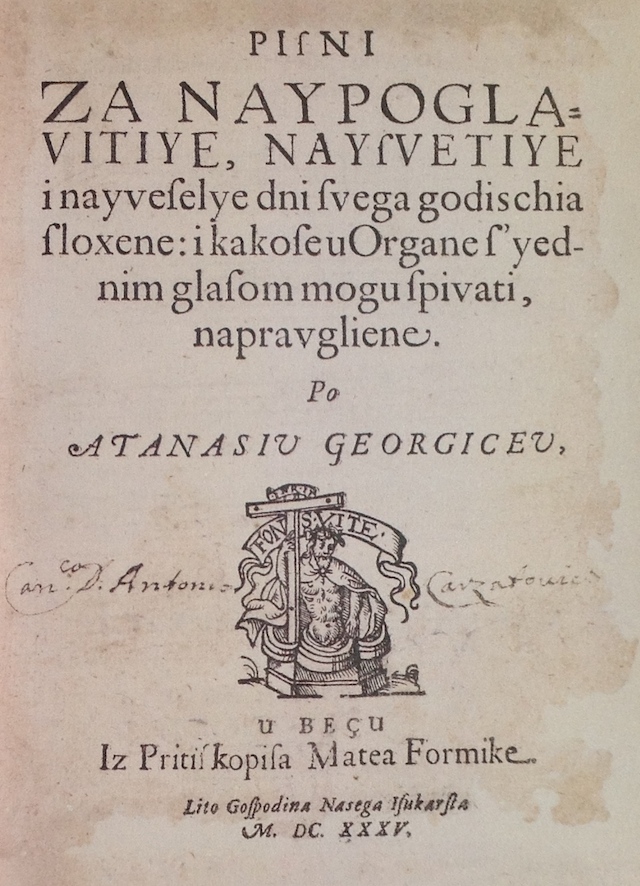
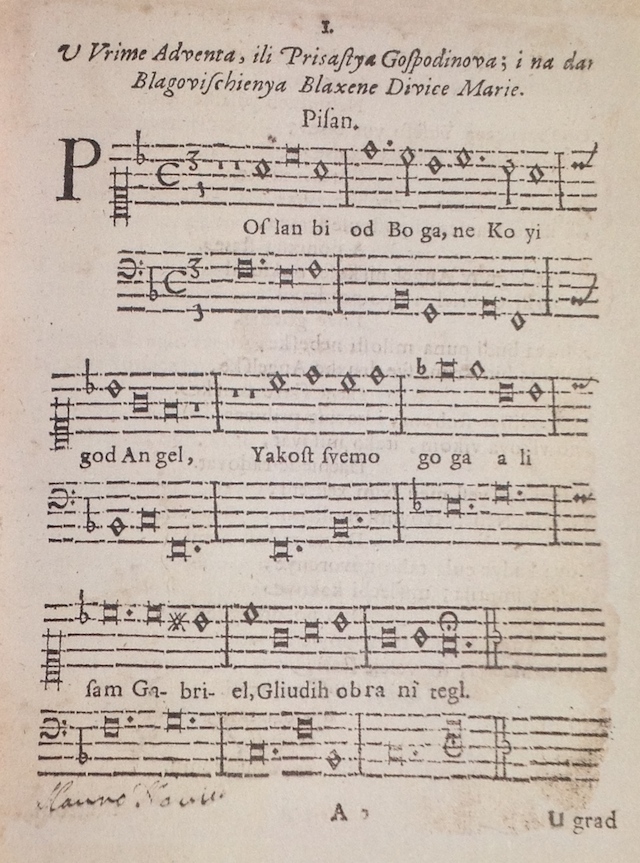
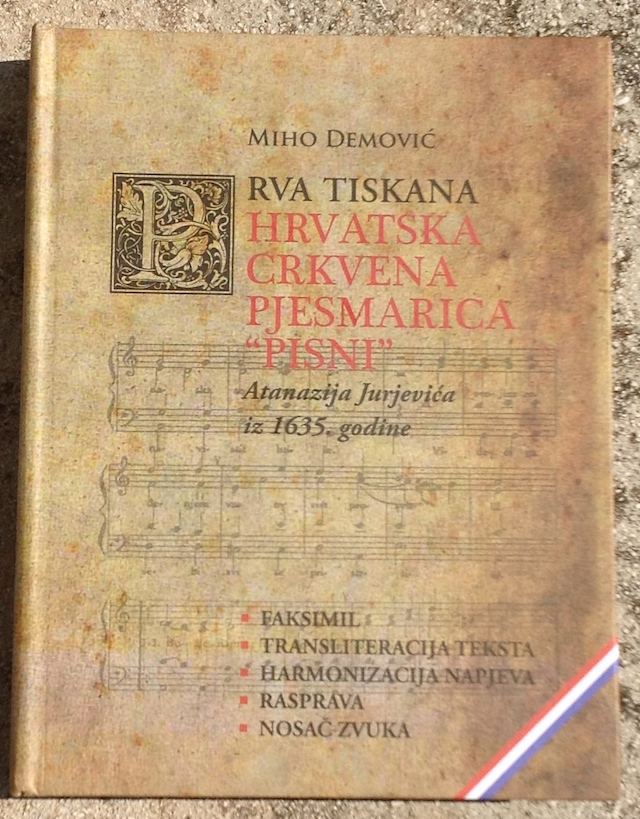
Miho Demović: Prva hrvatska crkvena pjesmarica "Pisni", Atanazija Jurjevića iz 1635. g.,
Udruga hrvatskih himnologa - "Pavao Štoos", Zagreb, 2011. g., ISBN 978-953-56866-0-6.
Many thanks to dr. Miho Demović and to the editor of the edition rev. Zlatko Pavetić
for permission to take the photos.
According to outstanding Croatian ecumenist, theologist and musicologist Juraj Krizanic (1618-1683), music should be regarded as a part of mathematics. In Rome he supervised a publication of musical works of the Portuguese king D. João IV.
Kristofor Ivanovic, a Canon of the town of Budva in Boka kotorska, published his Memorie teatrali in Venice in 1681. It was the first history of Venetian opera, covering the period of 1637 - 1681. Its 2nd edition appeared in 1687.
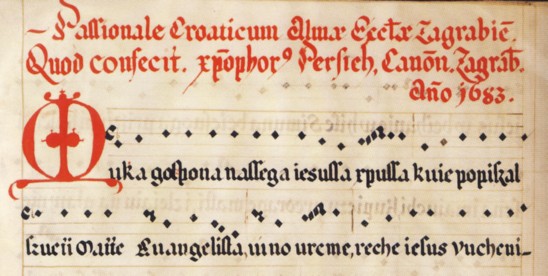
Passionale
Croaticum Almae Ecclesiae Zagrabiensis,
1683
(kept in the National and University Library, Zagreb)
For more information see Vjera Katalinic: Glazbena kultura u hrvatskim zemljama (Music Culture in Croatian Lands), [Baroque and Enlightenment, 17th-18th centuries, III, pp. 705-716]
Petar Nakic (1694-~1769), born near the town of Sibenik, and better known under his italianized name Pietro Nacchini, is one of the most important representatives of Croatian late Baroque and early Classicism. In various cities in northern Italy and in smaller number in Dalmatian part of Croatia (Nerezisce and Supetar on the island of Brac, the Cathedral of Rab on the island of Rab, church of St. Frane in Sibenik, Visovac covent on the Krka river) his workshop built more than 300 top quality organs (according to some data - more than 500!). He built sophisticated organs for the grand basilica in Padova (with 30 registers and 2 manuals), but it disappeared in the fire in 1926. In Croatia his organs are for example in Visovac, Sibenik, Makarska and Zaostrog. He also introduced some innovations in the construction of organs (tiratutti) that are in use even today, found new tonal ratios (mensura's), and founded a unique school for organ building in Venice.
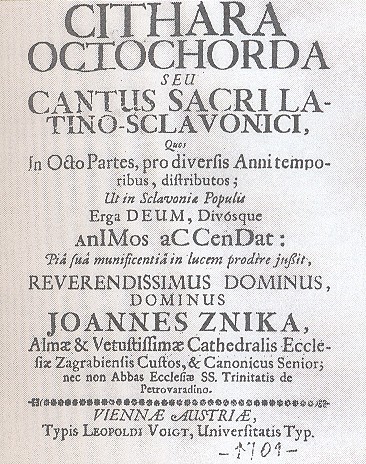
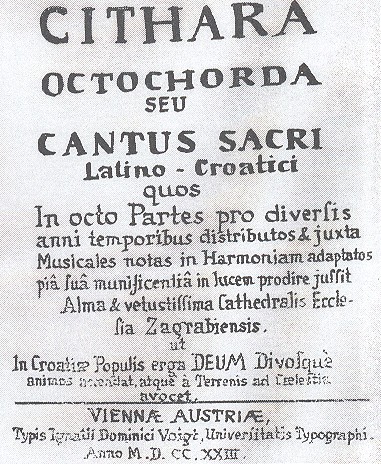
Cithara Octochorda is the most significant old collection of Latin - Croatian Church songs, published in 1701 in Vienna, reprinted in 1723 again in Vienna, and in 1757 in Zagreb. This impressive, monumental book contains 235 Croatian songs in the Kajkavian dialect. The songs were a part of the so called Old Zagreb Rite (the official Croatian name was Stari Zagrebacki obred, founded in the course of 11th and 12th centuries), that was cancelled in 1788 and replaced by Roman Rite. A short description of Cithara Octochorda is provided by the British Library, London.
 |
 |
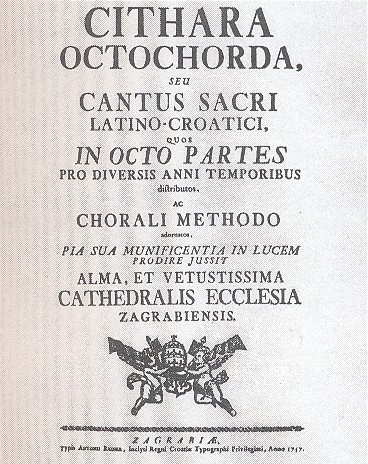 |
According to [Korner and Demovic] the 1757 edition of Cithara Octochorda was the first printed book in Croatia containing sheet music of Croatian songs.
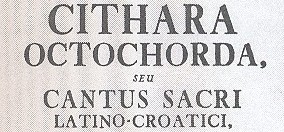
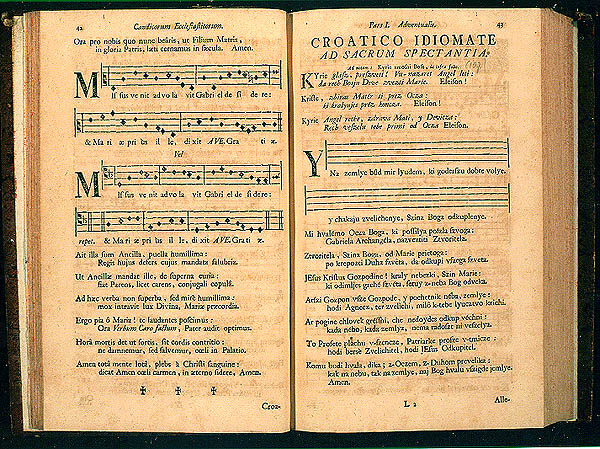
Cithara Octhocorda (each of its 378 pp can be viewed) at the National and University Library in Zagreb.
The Old Zagreb Rite mentioned above had been used in the Zagreb Bishopric, which at that time was much larger than today. It was probably also used in Istria and in the Senj Bishopric. The cancellation of the Old Zagreb Rite in 1788 (after approximately seven centuries of existence) certainly included the Zagreb Cathedral, but numerous churches still continued to use the Rite. In some Croatian churches its traces could be found even until the IInd Vatican Council 1962-1965. The first printed Missal (and the only one) according to the Old Zagreb Rite had been published already in 1511. Personal information by dr. Miho Demovic in 2009. See also the articles by [Hana Breko] and [Josip degl'Ivellio].
Amanado Ivancic (1727-c. 1790) entered the Pauline Order in 1744 taking the name Amandus/Amando, and that he spent some years in a monastic house in Graz. He later spent some considerable time teaching in the town of Trnava in modern Slovakia. He composed church music, symphonies and divertimenti and chamber sonatas - particularly works for flute. His works are preserved in archives in Croatia, Hungary, Slovenia, Austria, Germany, Slovakia and Poland. His roots are Croatian on his father's side.
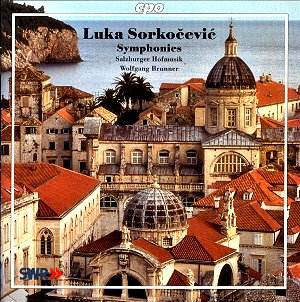
Luka Sorkocevic (1734-1789), whose beautiful symphonies are performed throughout the world, lived in Dubrovnik. The opening melody to this web page is his Allegro. Sorkocevic was born 22 years before Mozart.
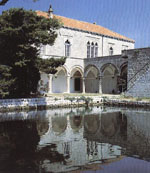
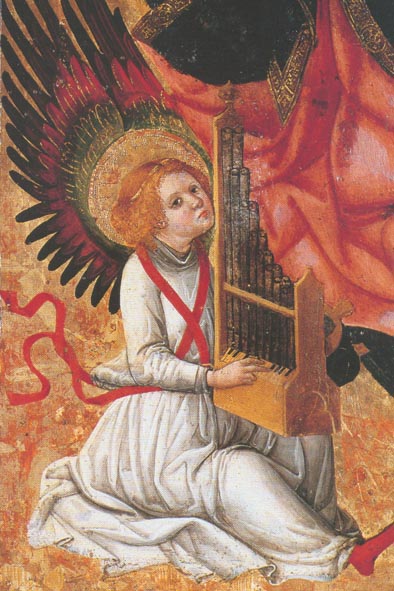
You can see a detail from the Dubrovnik polyptich by Lovro Dobricevic from 1466, representing an angel playing portative, a small portable organ:
Ivan Mane Jarnovic (Italianized name Giornovichi, 1740-1804) was an outstanding Croatian violinist and composer of the 18th century, probably from Dubrovnik. He had a true European career - playing, composing and conducting in France (Paris), Austria, Germany, Switzerland, Poland, Scandinavian countries, England. Also played the first violin in the orchestra of the Russian empress Katarina II. Jarnovic composed about 50 chamber instrumental pieces, 22 violin concerts (17 preserved), and is known for having introduced the romanza as a slow movement into the structure of the violin concert. Many inspired fans of Jarnovic's beautiful concerts enlisted in lessons for beginners in the hopes of one day being able to emulate the man.
His life is described in a novel Jarnowick by G. Desnoisterres - Le Brisoys, Paris 1844, and in a collection Scènes de la vie d'artiste by P. Smith (Une leçon de Jarnovic, Paris, 1844).The earliest known symphonic orchestra in Croatia has been founded in Dubrovnik 1755. The first organ with two manuals for the Korčula Cathedral has been built by Vicenzo Klišević in 1790s, who was organ builder in Dubrovnik. Information by the courtesy of Miho Demović (March 2017).
Mihall Sillobod (Mihajlo Silobod-Bolsic) wrote his Gregorian plainsong Fundmanetum cantus gregorian seu choralis in Zagreb 1760. It is a testimony of the Croatian musical Gregorian-plainsong tradition. It consists of six dialogues discussing
- the emergence of music and singing
- staff, notes and keys
- on solmisation
- on intervals
- on authentic and plagal tones
- on intonations.
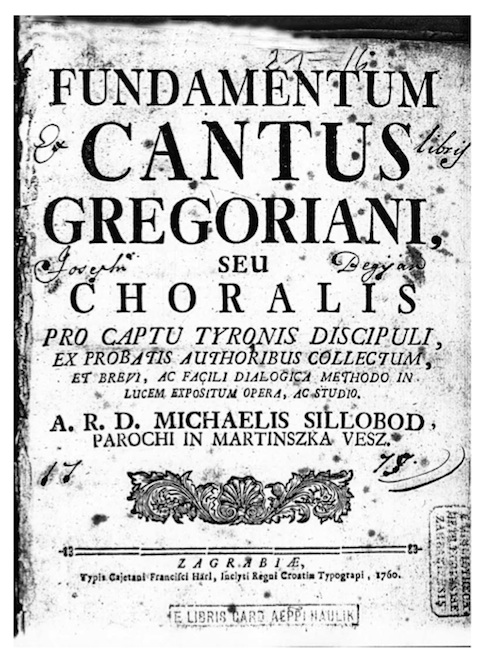
Lit. Katarina Koprek: Gregorijanski manual Fundamentum cantus gregoriani seu choralis (1760.) Mihajla Šiloboda Bolšića [PDF] (The Gregorian plainsong manual Fundamentum cantus gregoriani seu choralis (1760) by Mihajlo Šilobod-Bolšić), Povijesni prilozi (Historical Contributions) 33, 311-330.
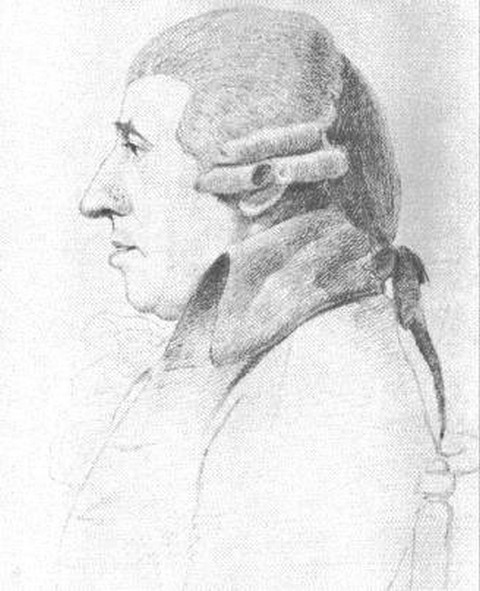
Joseph Haydn (1738-1809),
Austrian and
Croatian composer.
Pencil sketch by George Dance, 1794. Source of the photo Classical Music Pages.
 Our folk music is of great beauty and
variety. Some of its themes were used by famous European composers,
like Bedrich Smetana and Joseph Haydn, who spoke Croatian. Joseph Haydn
(1738-1809) was born in a Croatian ethnic enclave in Burgenland (Gradisce)
in Austria. For example the main theme of his London symphony no 104 in
D major (movement IV) is based on the well known Croatian traditional
song "Oj, Jelena, Jelena, jabuka zelena" (Oj, Jelena, Jelena, my green
apple). Also the final of his Es major symphony is based on the
Croatian folk song "Divojcica potok gazi" (A little girl treads on a
brook). And even the following song that is widely known in Croatia -
"Nikaj na svetu lepsega ni, nego gorica kad nam rodi..." (There is
nothing more beautiful in the world than a fruitful hill) was exploited
by Haydn (I
learned this on a wonderful 11th birthday party of my dear friend Ema
Tolic).
Our folk music is of great beauty and
variety. Some of its themes were used by famous European composers,
like Bedrich Smetana and Joseph Haydn, who spoke Croatian. Joseph Haydn
(1738-1809) was born in a Croatian ethnic enclave in Burgenland (Gradisce)
in Austria. For example the main theme of his London symphony no 104 in
D major (movement IV) is based on the well known Croatian traditional
song "Oj, Jelena, Jelena, jabuka zelena" (Oj, Jelena, Jelena, my green
apple). Also the final of his Es major symphony is based on the
Croatian folk song "Divojcica potok gazi" (A little girl treads on a
brook). And even the following song that is widely known in Croatia -
"Nikaj na svetu lepsega ni, nego gorica kad nam rodi..." (There is
nothing more beautiful in the world than a fruitful hill) was exploited
by Haydn (I
learned this on a wonderful 11th birthday party of my dear friend Ema
Tolic).
A famous compser Ludwig van Beethowen used a theme from Croatian folk song "Kisa pada, trava raste, bor se zeleni" for his Pastoral Symphony. A well known Czech composer Berdrich Smetana in his symphonic melody Vltava has the main theme (in minor) which is almost indentical with Croatian folk song (in major) "Mis mi je polje popasel". Information provided by Josip Zavrski, Skolske novine, 16. travnja 1991., p. 5.
Sir William Henry Hadow, renowned English scholar and musicologist (1859-1937), lecturer in Oxford, editor in chief of the Oxford Encyclopedia of Music (1901-1905), and a leading influence in English education at all levels in the 1920s and 1930s, wrote a booklet entitled
in 1897 in London
(published by Seely and co. limited; reprinted in 1972 by Freeport, New
York). This and other references related to Joseph Haydn can be found
at The Library of Congress Citations:
Author: Hadow, William Henry, Sir, 1859-1937.
Title: A Croatian composer; notes toward the study of Joseph Haydn.
Published: Freeport, N.Y., Books for Libraries Press [1972]
Description: 98 p. illus. 22 cm.
LC Call No.: ML410.H4 H3 1972
Dewey No.: 780/.92/4 B
ISBN: 0836968816
Notes: Reprint of the 1897 ed.
Subjects: Haydn, Joseph, 1732-1809.
Names, Personal -- Croatia.
Control No.: 72004147 /MN/r972
Here we reproduce the concluding paragraph of Haydn's short biography presented by MusicaClassica:
A distinguishing trait of Haydn's works was his frequent use of Croatian folk music for his melodic material. Wrote W. H. Hadow: "The Croatian melodies are bright, sensitive, piquant, but they seldom rise to any high level of dignity or earnestness. They belong to a temper which is marked rather by feeling and imagination than by any sustained breadth of thought, and hence, while they enrich their own field of art with great beauty, there are certain frontiers which they rarely cross, and from which, if crossed, they soon return." Even many of Haydn's original melodies are characterized by typical rhythmic and melodic qualities to be found in the Croatian folk songs. However, as Franze Bellinger has added, "Haydn's speech, like that of every genius, was not only that of his race, but of the world." To these Croatian characteristics, Haydn added his high inspiration and sensitivity, and produced a type of melody which, for the most part, is unmistakably his.
Haydn is a common Croatian family name. In the Croatian telephone book you can see the names of Hajdin, Hajdina, Hajdinjak, Hajdinac, Hajdinovic: 63 families in the Zagreb county, 91 families in Medimurje and Varazdin counties, 65 families in Primorsko-Goranska county; and altogether 320 families in the whole Croatia (1999). There is a village of Hajdine near Vrbovsko in Croatia, on the main road to Rijeka, and the village of Hajdin near Vojnic. The name Hajdin (= hajda's) is derived from hajda = buckwheat.
Parents of Franz Joseph Haydn are Mathias Haiden and Anna Maria Haidin, as can be seen on their grave in the Rohrau cemetery even today. This is stated by outstanding Croatian musicologist academician Lovro Zupanovic in his afterword to the book of [Kuhac, pp 305-306]. Academician Zupanovic stated also the following:
"It is a pity that in his time Kuhac did not know for team work, or could not (was not allowed to?) accomplish. Otherwise - the redactor [ie. Zupanovic] is firmly convinced on the basis of own experience - ... that for half of names listed [by Kuhac] in his Hystorical introduction he would have no problems in proving their Croatian descent. This especially holds for Franz Joseph Haydn..." (see [Kuhac, p. 305]).
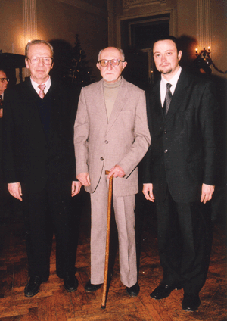
For those who can read Croatian, here is what academician Zupanovic wrote (see [Kuhac, pp 305-306]):
"Šteta je što Kuhač u svoje vrijeme nije znao za timski (grupni) rad, ili ga - ako mu je i bila poznata tehnika - nije umio/moga (smio?) ostvariti. Da mu je to uspjelo, on bi - priređivač je na osnovi vlastitog iskustva u to čvrsto uvjeren - zajedno s po jednim lingvistom, povjesničarom, arheologom, teologom i još pokojim (strukovno srodnim) znanstvenikom za polovicu imena što ih je naveo u Historijskom uvodu argumentirano dokazao njihovo hrvatsko podrijetlo. To osobito vrijedi za Franza Josepha Haydna, sina Mathiasa Haden-a i Ane Marije Haidin kako piše na nadgrobnom spomeniku koji danas stoji na groblju u Rohrauu. U svoje vrijeme - uz iznimku engleskoga muzikologa W. H. Hadowa (1859.-1937.) - posebice u njemačkim zemljama dočekana "na nož" a danas posvema odbačena, Kuhačeva pretpostavka ostaje ako ništa drugo a ono curiosum sui generis.
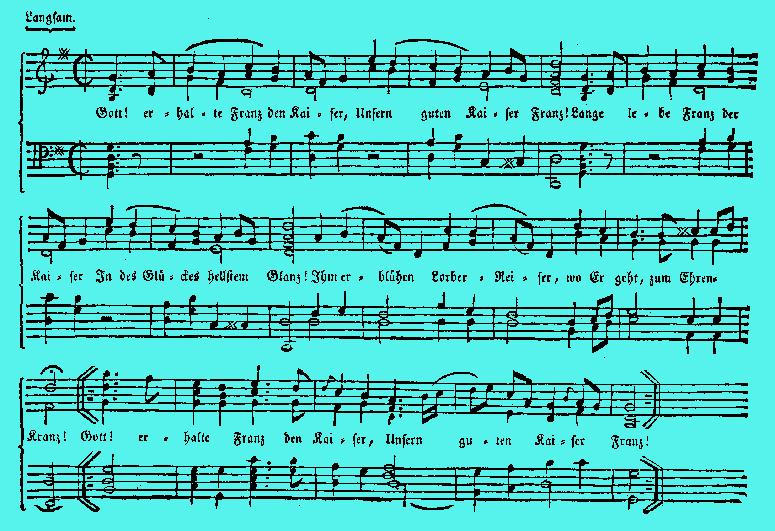
Let us add that the melody for the Austrian national anthem (and later the German anthem), composed by Joseph Haydn, is based on a very old Croatian folk song ("V jutro rano se ja stanem, rano pred zorom...", see the Oxford Music Dictionary). It is also significant that Haydn himself named the song Volkslied, before it became the anthem ("Gott erhalte Franz den Kaiser" - God Save the Emperor Franz). Compare the Croatian folk song

with the German national anthem:

See also sheet music taken from Austrian - American Magazine, March 2002. For more details see Hadow's analysis from his monograph A Croatian Composer; notes towards biography of Joseph Haydn (London 1897).
The poet J. W. Goethe translated some of our most beautiful folk ballades into German (from their Italian translation, done by Alberto Fortis; see his Viaggio in Dalmazia, Venice 1774). In this way Asanaginica obtained a European fame (translated also by P. Méerimée, W. Scott, A. Puskin, A. Mickiewicz and others). Only in Scotland it had three translations in the 18th and 19th century (including that of Walter Scott). This poem appeared most probably in Dalmatia in the 16th or 17th century and represents a jewel of Muslim-Slav oral tradition. After its Italian translation many other translations ensued: about ten translations into German, about the same number into French as well as English, and also translations into Swedish, Russian, Spanish, Romanian, Hungarian, Czech, Polish, Latin, Esperanto, Hebrew, Dutch, Albanian, Macedonian, Turkish, Persian, Danish, Ukrainian.
Jelena Pucić-Sorkočević (1786-1865), who was born and died in Dubrovnik, was the first known Croatian women composer. Her compositions belong to early and middle Romantic era. Many thanks to Dr Miho Demovic for this information.
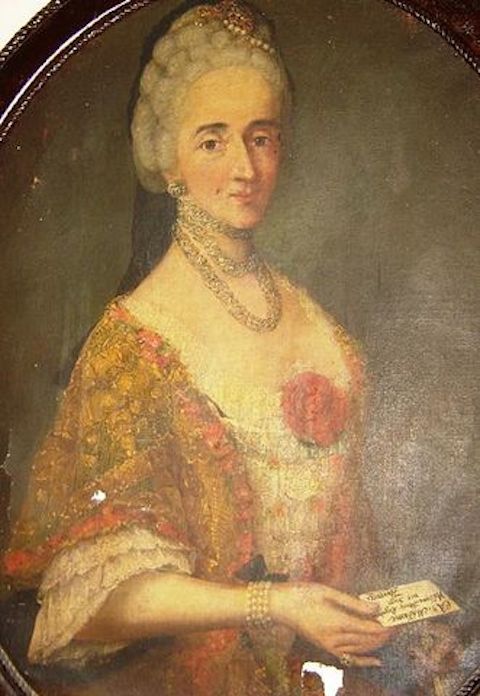
Jelena Pucić Sorkočević (1786-1865), the first Croatian woman composer.
Photo from www.geni.com.
More details about Jelena Pucić Sorkočević can be found in
his monograph Miho Demović: Glazba i
glazbenici na području bivše Dubrovačke Republike za vrijeme austrijske
uprave 1814.-1918., Zagreb-Dubrovnik 2016.
The Croatian Musikverein (Hrvatski Glazbeni zavod) in Zagreb was established in 1827. Related to this are the beginnings of the Music Academy in Zagreb from 1829.
The verses for the Austrian national anthem "Land der Berge, Land am Strome", were written by Paula von Preradovic (1887-1951), Austrian writer and poetess, grand-daughter of the Croatian poet Petar Preradovic (1818-1872), with the music of W.A. Mozart.

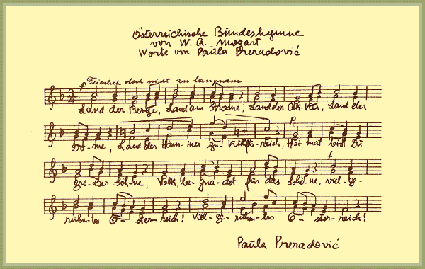
| Land
der Berge, Land am Strome, Land der Äcker, Land der Döme, Land der Hämmer, zukunftsreich. Heimat bist du grosser Söhne, Volk begnadet für das Schöne, Vielgerühmtes Österreich, Vielgerühmtes Österreich! Heiss umfehdet, wild umstritten, Mutig in die neuen Zeiten, |
Land
of mountains, land on the river, Land of fields, land of cathedrals, Land of hammers, rich in outlook. You are the native home of great sons, A people uniquely gifted for the beautiful, Much applauded Austria. Fiercely embattled, ferociously
contested, Courageously we stride |
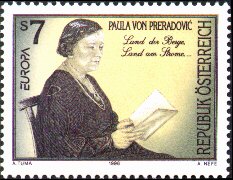
Paula von Preradovic on Austrian postage stamp, issued in 1996
She wrote a lot about Croatia, its people, history and nature, for example "Königslegende" in 1950, "Pave und Pero" in 1940, and "Dalmatinische Sonette" in 1933.
According to Franjo Kuhac (19th century), both Austrian and German anthem have been composed by Joseph Haydn in the 18th century, based on a slightly abridged Croatian folk melody "V jutro rano ja se stanem."
A lovely parade march called the Jelacic March (Op. 244), composed by Johann Strauss the Elder, was played by the composer and his orchestra in Vienna in 1849, one day after Josip Jelacic was proclaimed an honorary citizen of the city. A total of eight marches and one waltz were dedicated to J. Jelacic by various Austrian composers.
Very beautiful traditional song of Bosnian Croats is S onu stranu Plive (On the other side of the Pliva river). Since the creation of Bosnia and Herzegovina as an independent state in 1992, the song has been chosen as the national anthem of this state.
The first national operas among the Slavs were composed by Russians (M. I. Glinka, 1836, 1842), then the Croats follow immediately. Vatroslav Lisinski composed the first Croatian national opera "Ljubav i zloba" ("Love and malice") in 1846. Then follow the Czechs (B. Smetana in 1862), and these three nations are the only ones among the Slavs who have national operas.
Let us mention that Franz Liszt gave piano concerts in Zagreb (see here, in Croatian) and in Samobor, a lovely nearby town, in 1846. Operas composed by Ivan Zajc (1832-1914) and Jakov Gotovac (1895-1982) are performed in concert halls throughout the world. The most famous opera of Jakov Gotovac is Ero s onoga svijeta, which has been translated into 9 languages and performed in about 80 countries.
It seems that a well known tune "U boj, u boj!" from the opera Nikola Subic Zrinski by Ivan Zajc is taught in Japanese schools. Information by Mr. Nenad Bach, New York. Professor Vladimir Devidé, outstanding japanologist from Zagreb, considers this very probable: he remembered a very young boy walking on a Tokyo street Komaba, wearing a huge rucksack filled with books, and whistling the familiar melody - "U boj, u boj"! (this occurred in 1961, during his first visit to Japan; personal information, 2004).
"U boj, u boj!" for Japanese readers, with historical account, where you can listen to the tune performed by Japanese choir singing in Croatian! (Provided by Kwansei Gakuin Glee Club).
U boj, u boj! is a web web page where You can find additional information, including libretto in Croatian. Listen to Japanese student choirs singing in Croatian:
The first known opera in Croatia was performed in Dubrovnik in 1629, composed by Lambert Courtoys junior. His grandfather was a naturalized citizen of Dubrovnik, Lambert Courtoys senior from France. The opera was composed according to the text of Junije Palmotić's (1606-1657) Atalanta, written in Croatian, which bore the subtitle Musica. Unfortunately, the scores are not preserved, but a document preserved in the Dubrovnik archives from that time proves that it was indeed an opera performed by 17 musicians. See [Demović, Rasprave i prilozi, p 387].
Julije Bajamonti (1744-1800) was the most versatile and fertile Croatian composer of the time (230 compositions, some of them fragmentary). He wrote an article "Il medico e la musica" ("The physician and music"), an essay on musical therapy already in 1796 , one of the first in history, in which he showed that music has therapeutic strength.
Bajamonti composed sacred music for verses in Latin, Italian, and Croatian: for example La passione de Gesu Cristo (cantata to words of Pietro Metastasio), Requiem (composed on the occasion of death of Rugjer Boskovic, commissioned by the Dubrovnik Senat in 1787), Spiritual songs to Croatian verses. In 1767 he composed an oratorio which according to Lovro Zupanovic, represents the most beautiful work of its time in Croatia. He also wrote the first Croatian oratory (La translation di San Diomo), one of the highest achievements of Croatian 18th century music.
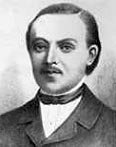
The verses for the Croatian national anthem Our Beautiful Homeland (Lijepa nasa domovino) were written by a Croatian poet and diplomat Antun Mihanovic (1796-1861).
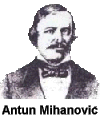
|
Lijepa
naša domovino
|
Our
Beautiful Homeland
|
| Lijepa naša domovino, Oj junačka zemljo mila, Stare slave djedovino, Da bi vazda česna bila! |
Beautiful
is our homeland,
|
| Mila, kano si nam slavna, Mila si nam ti jedina, Mila, kuda si nam ravna, Mila, kuda si planina! |
You
are our only glory,
|
| Teci, Sava hitra, teci Nit ti Dunaj silu gubi, Kud li šumiš, svijetu reci: Da svog doma Hrvat ljubi. |
Sava,
Drava, keep on flowing,
|
| Dok mu njive sunce grije, Dok mu hrastje bura vije, Dok mu mrtve grob sakrije, Dok mu živo srce bije! |
When
his fields are kissed by
sunshine,
|
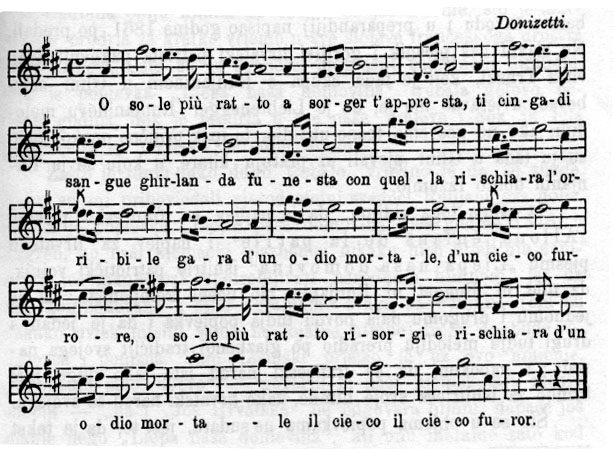
It is sometimes claimed that the music for "Lijepa nasa" (Our Beautiful) was written according to Donizetti's "O sole piu ratto" from the opera "Lucia di Lammermoor". However, as I was informed by Emil Cic (musicologist and musical critic, Zagreb), this is not true. Indeed, see the score. Josip Runjanin, who composed the melody for Lijepa Nasa, is sometimes claimed to be a Serb born in Croatia, which also is not true. See a monograph written by Andrija Tomasek, "Lijepa nasa - povijest jedne zablude", Muzicki informativni centar Koncertne direkcije Zagreb, 1990. Hearing a remark about alleged Serbian origin of her father, Runjanin's daughter exclaimed: "But, my father was a Croat!" Runjan was born in Vinkovci, of pravoslav (Orthodox Christian) parents, and a great Croatian patriot (see [Kuhac, pp 231-244]). It is little known that Lijepa Nasa was proclaimed Croatian national anthem in 1891 after suggestion of Dalmatian Croats (ibid., p. 237). Many people have already remarked exceptional poetic value Our Beautiful (Lijepa Nasa). For instance, compare its content with the bloody message of the French national anthem.
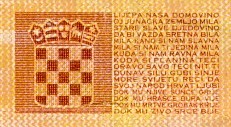
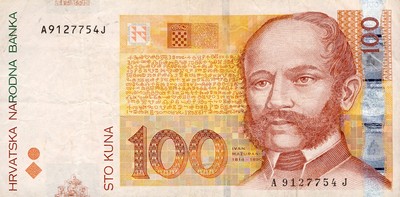
Croatian National Anthem Lijepa Nasa on the 100 HRK (Hrvatska kuna - Croatian kuna) banknote, with the Baska Tablet and portrait of Ivan Mažuranić (1814-1890).
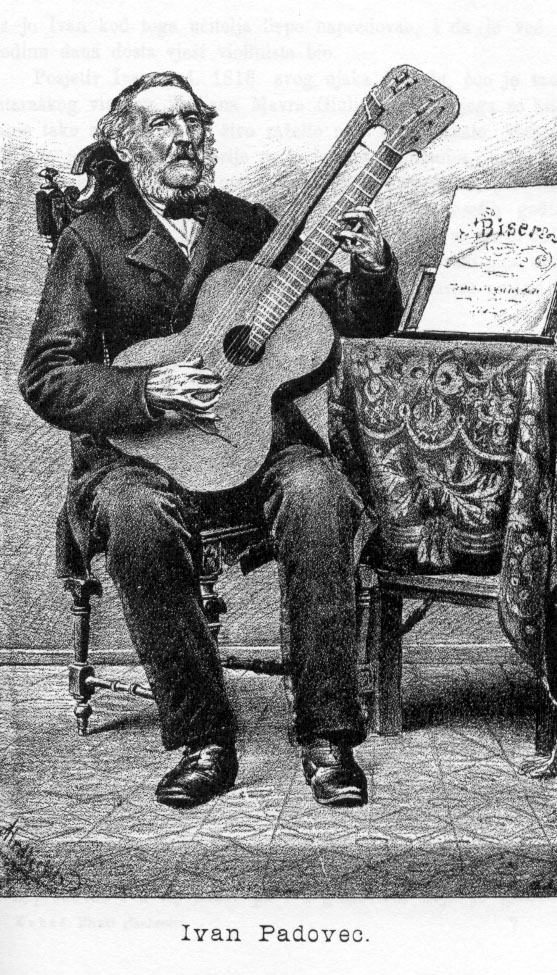
Ivan Padovec (1800-1873), born in the beautiful baroque town of Varazdin (known for its festivals of baroque music) was a guitar virtuoso, who gave concerts in Zagreb, Vienna, Prague, Budapest, Hamburg, London, in Poland, Russia etc. He constructed a ten string guitar. Also, he published his Teoretish - praktische Guitar - Schule in Vienna in 1842.
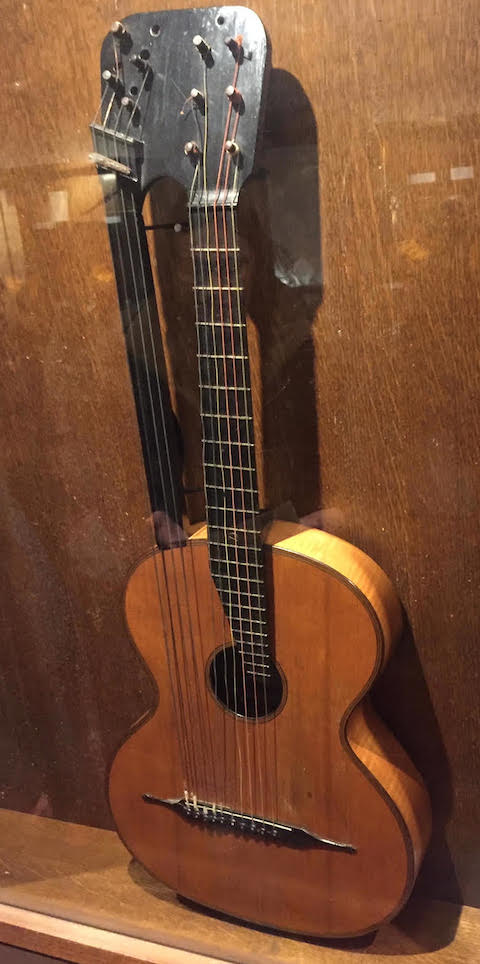
Padovec double neck guitar (10 strings), kept in the Museum of Arts and Crafts in Zagreb.
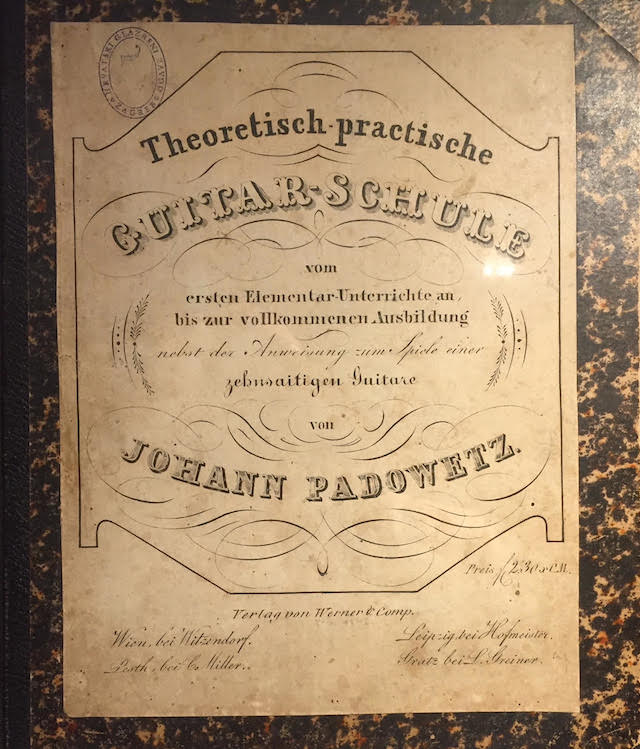
Johann Padowetz: Theoretisch-practische Guitar-Schule, Wien 1842.
Mirko Orlic: Ivan Padovec, Croatian guitarist of european renown, Gitara 2, 2000., in Croatian [PDF]
Ivan Padovec: Popijevke uz pratnju gitare / Songs with Guitar Accompaniment, 2000. Edited by Darko Petrinjak, renowned Croatian classical guitarist. The collection contains and firstly presents all 30 known songs with guitar accompaniment by the Croatian Romantic composer and guitar virtuoso Ivan Padovec (Padowetz, 1800-1873), composed on Croatian and German texts between 1837 and 1867, and mostly published in Vienna, Varaždin and Zagreb during the 19th century. Source: Croatian Musicological Society.
Franz von
Suppè (Split
1819 - Vienna 1895; the
accent in Suppé is incorrect -
information by Sandra Wigh
Hrašćanec) lived in Dalmatia in the then Austro-Hungarian Empire (a
coastal part
of present Croatia) until the age of 16. He spent his youth in the city
of Zadar, and began to compose at an early age. He entered into the
history of both Austrian and Croatian music. His Missa dalmatica (Dalmatian
Mass) was composed in 1832, when he was at the age of 13, and performed
in Zadar in the Church of Sv. Frane in 1837 (renewed in 1870 and sent
to Zadar, and then performed in Zadar in 1891).
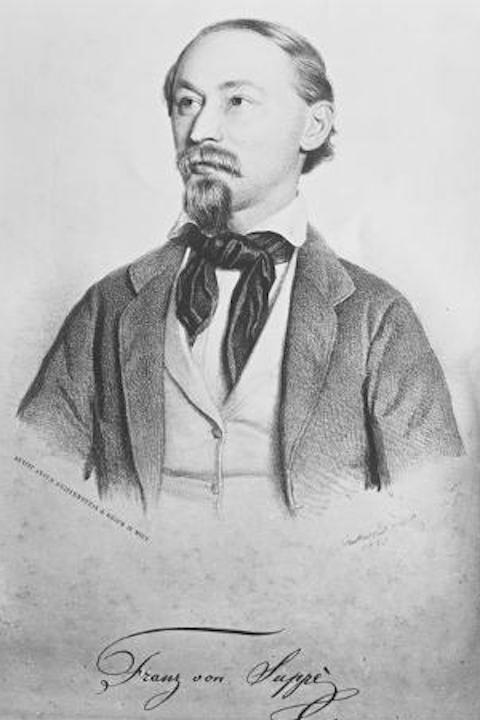
Franz von Suppè (please note that his signature ends with è, and not
é).
His family roots are Belgian. He wrote for himself "sono Dalmata" (I am
Dalmatian).
He wrote a collection of Dalmatian culinary recipes (in manuscript,
unpublished).
His operetta Des Matrosen Heimkehr (Ritorno del Marianio - Return of the Mariner) takes place on the island of Hvar in Croatia. In this sense (according to Sandra Wigh Hrašćanec, Vienna), it can be considered as a Croatian national opera. He also composed an Ouverture on Dalmatian folk themes in f-minor. He composed about 30 operettas and 180 farces, ballets and other stage works. Franz von Suppè was supporting distinguished Croatian composer Ivan Zajc.
- More information about Franz von Suppè at the State Archives of Zadar, Croatia.
- Some sources claim that von Suppè is a relative of Italian composer Gaetano Donizetti, which is not true.
- Sandra Wigh Hrašćanec, Vienna: Franz von Suppè (in German)
Illma de Murska (born as Ema Puksec in the town of Ogulin, 1834 - 1889) was an opera diva of international fame, nicknamed Croatian canary and Croatian nightingale. She sang in Italy, Spain, Hungary, and her most fruitful period was in Vienna, Austria. She also sang in Berlin, Hamburg, Paris and London, and had tours in Australia, Russia, USA and New Zealand. In St. Petersburg she was singing at the Court and the Russian Czarina crowned her with a brilliant diadem (see here for more details). In Melbourne, Australia, there is a street called De Murska Street in her honour.
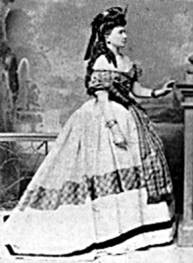
The prima donna Ilma di Murska on the London stage
Joseph
Angster (1834-1918) was born in
Jagodnjak (Kacsfalu) in eastern Croatia (near Danube river), famous
church organ constructor. His organs can be found in many churches in
Austria, Hungary, Croatia, Czech Republic, Slovakia, Slovenia, Serbia,
Montenegro, Poland, in Rome -Italy, Romania and
Ukraine. He
participated in organ construction for Cologne-castle, Notre-Dame
church in Paris and for St. Trinity church organ.
Many
thanks to Mr. Darko Varga (from Bilje, Baranja) for having contributed
Angster's biography to this web.
Darko Varga: Josef Angster - poznati graditelj orgulja iz Baranje
Josip Kašman (1850-1925, Joseph Kaschmann, Gisueppe Kashmann) was distinguished Croatian bariton singer, born in the town of Mali Lošinj on the island of Lošinj. His father was of Austrian descent and his mother Croatian. As a member of the Zagreb Opera, in 1870 he sang at the premiere of Croatian opera "Mislav" by Ivan pl. Zajc. He was singing in 7 languages, and he considered Croatia as his homeland. He was singing at the opening of the Metropolitan Opera in New York in 1883. Alberto Franchetti, Italian composer, entrusted him the leading role in the opera Cristofor Columbo, which he sang in 1892 at the premiere organized on the occasion of 400 years since the discovery of America (in 1492). In that period he was considered to be the best bariton in Italy. He was singing in Chicago, Warszaw, Madrid, Barcelona, in Portugal, Monte Carlo, Kairo, Alexandria, Bayeurth, Argentina, Uruguay, S. Petersburg and Moscow. In the town of Mali Lošnji where he was born, he organized regular concerts since 1907. In this town on the pcituresque island of Lošinj, a music manifestation Dani Josipa Kašmana (the Days of Josip Kašman) are organized since 2006. When in 1909. he returned to Zagreb, he said: „Živila moja mila domovina Hrvatska!“ (Long live my homeland Croatia!). More detailed information is provided by Croatian Biographical Lexicon and by Marija Barbieri.Countess Louise Erdödy (born in Vienna as Drasche Wartinberg, 1853-1924), nicknamed Lios, was a pianist and composer. At the age of 28 she became widow (she was married in Croatia, in the palace of Maruševec near the city of Varaždin). She then married for count Rudofl Erdödy in 1881, who lived in Croatia in a clastle in the town of Novi Marof, north of Zagreb. She composed 23 songs for solo voice and piano, based on the verses of Heine and others, published in Vienna. Also, her work for cello and piano composed in C major is preserved. Upon her initiative, a hospital was opened near the town of Novi Marof in 1885, which she directed for 20 years, and which still exists. Her humanitarian work was recognized by Pope Pius X. In Croatian, her name is often written just as Lujza Erdedi. She is rememberd also today for her selfless caritative work in this part of Croatia. Her compositions can be heared in a CD Čarolija toplog daha (Ein Magischer Widerhall; Magic Echo) issued by Sandra Wigh Hrašćanec (contralto dramatico) in 2018.
Lit. Agneza Szabo: Istaknute žene iz jastrebarske i zagorske grane grofova Erdödy [PDF], see pp. 166 and 167.
Franjo
Krezma (born in Osijek
in 1862) had a reputation of an authentic violin virtuoso, and was a
concert master in the Royal orchestra in Berlin (today's Berliner
Philharmonie) at the age of 17. Already at the age of 16 he was admired
in many European cities: Rome, Prague, Genova, Paris, Vienna, Venice.
Once he played also with Franz Liszt. Having inscribed the Conservatory
of Vienna at the age of 9 as the youngest student ever, he completed
his studies at the age of 13, after which started his spectacular
European career. Such musicians like Giuseppe Verdi, Franz Liszt, Henry
Vieuxtemps considered him a successor of Paganini. Unfortunately, he
died very young at the age of 19.
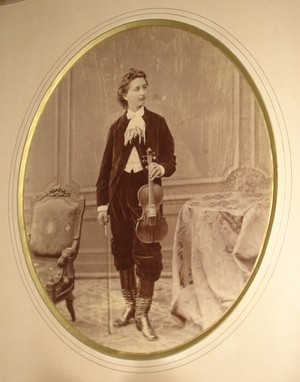
About
100 of his pieces have been discovered by Kresimir Marmilic in Zagreb
in 1996!
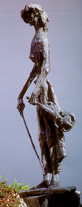
Jednoč, kada se
je Krežma sa svojim sinčićem šetao prema Savi, te
došao k livadi na kraju savske ulice, kaže Franjo: "Otče,
deder da malo stanemo, ja bih slušao, kako žabe krekeću." A
tada će: "Slušaj samo, otče, ona žaba tamo na desno pjeva
tenor, ona tamo s lieva bas, a ovi tu malo bliže srednje glasove,
sbilja cieli kvartet; ali ove tu kraj jarka kvare harmoniju, jer dočim
sbor pjeva u dur-priemetu, ove tamo krekeću u molu." Otac se nasmije,
te mu odvrati: "Nemoj ludovati", ali Franjo mu reče: "O, mene moj sluh
ne vara."
Ivana Marija Vidovic translated into Croatian the verses written in 1876 in honor of Franjo Krezma in Verona
Croatian violinist and violist Louis Svecenski (1862-1926) was born in Osijek and studied at the Vienna Conservatory. He was a member of the Kreisler Quartet in the period of 1885-1917, and director of the New York Institute of Music. Also, he was one of the founders of Curtis Institute of Music in Philadelphia.
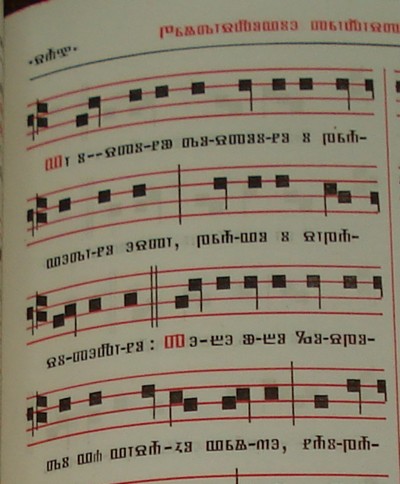
Liturgical singing from the Parcic Glagolitic Missal printed in Rome in 1893. Note that the text is printed in Croatian Glagolitic characters.
References related to Croatian music:
- F. Kuhač: Ilirski glazbenici, HSN, 1994 (reprinted from 1893 edition), with afterword of academician Lovro Zupanovic; on p. 5 Kuhač cites the following Croatian proverb: Po zveku (glazbi) se vrieme pozna, that we took as the motto of this web page.
- Miho
Demović:
- Velika povijest
dubrovačke glazbe, knjige
- I. (od konca X. stoljeća do velikog potresa 1667. godine),
- II. (od 1667. do 1808.),
- III. (od 1908. do 1918.)
- IV. (od 1918. do 1944.),
- svezak V. u pripremi,
- Lokrumski misal iz 1072.: najstarija dubrovačka knjiga (uz objavljivanje faksimila "Kotorskog misala od Lođe"), Glas koncila br. 46, 17. studenoga 2019., str. 17.
- Dubrovački neumatski rukopisi od X. do XII. st., str.
583-668, u Tisuću godina uspostave
Dubrovačke (nad)biskupije, Biskupski ordinarijat
Dubrovik, Crkva
u svijetu Split, Dubrovnik 2001., ISBN 953-6151-51-0
- Neumatski fragment beneventanskog pontifikala, Rad
JAZU 409, Zagreb, 1988, str. 225-253
- Povijest crkvene glazbe dubrovačke katedrale kroz vjekove, Udruga "Stara dubrovačka glazba", Dubrovnik, 2013. ISBN 978-953-57889-0-4
- Glazba u staroj hrvatskoj državi, pp 103-155, in [Prvi hrvatski kralj Tomislav]
- Glazba i glazbenici u Dubrovačkoj republici od početka XI. do doplovine XVII. stoljeća, Zagreb, 1981. German edition: Musik Und Musiker in Der Republik Dubrovnik (Ragusa) Vom Anfang Des XI. Jahrhunderts Bis Zur Mitte Des XVII. Jahrhunderts, Hardcover, G. Bosse, ISBN 376492229X (3-7649-2229-X)
- Dubrovacki beneventanski liturgijski priručnik legende i obreda blagdana Svetog Nikole iz XI. stoljeca, Zagreb, 1998.
- Prva hrvatska crkvena
pjesmarica "Pisni", Atanazija Jurjevića iz 1635. g., Udruga
hrvatskih himnologa - "Pavao Štoos", Zagreb, 2011. g., ISBN
978-953-56866-0-6
- Liturgijski recitativi iz starih hrvatskih kodeksa od X. do XII. stoljeća, Zagreb, Kor Prvostolne Crkve Zagrebačke, 2000, ISBN 9005208-5-2, 400526039
- Najznačajniji zagrebački srednjovjekovni kodeks MR 165 nije napisan u Mađarskoj već u Zadru, Glas koncila, 1982., Zagreb, str. 8.
- Rasprave i prilozi iz stare hrvatske glazbene prošlosti, Glas koncila, Zagreb 2007., ISBN 978-953-241-075-4
- Hrvatske crkvene pučke i tiskane pjesmarice s napjevom, Zagreb 2001., ISBN 953-98675-0-9
- Glazba i glazbenici na području bivše Dubrovačke Republike za vrijeme austrijske uprave (1814.-1918.), Udruga "Stara dubrovačka glazba", Zagreb-Dubrovnik 2015., ISBN 978-953-57889-1-1
- Anđelko Klobučar /
Skladbe za orgulje, Kor prvostolne crkve zagrebačke, Zagreb 2001.
- Velika povijest
dubrovačke glazbe, knjige
- Jeronim Korner and Miho Demović: Kajkavske popijevka Cithare Octochorde, Zagreb 1998.
- Stanislav Tuksar: Kratka povijest hrvatske glazbe, Matica hrvatska, Zagreb 2000.
- Stanislav Tuksar: The presence of of Italian Music in the Croatian Lands in the 1600 -1800 Period - A General Survey [PDF]
- Lovro Županović: Glazbena kultura, in [Croatia - Europe, volume II],
- Croatian glagolitic singing
- Jerko Bezić: Glagoljaško pjevanje, in [Croatia - Europe, volumes I and II]
- mo. Josip degl' Ivellio: Crkvena pučka popijevka
- Hana Breko: Croatian Mediaeval Music
- Stefan Kocsis: Die sakrale Musik der
burgenländischen Kroaten
in Geschichte und Gegenwart - Maestro degl'Ivellio nam predstavlja, at www.croatia.ch
- Muzicka akademija, Zagreb
- Hrvatsko Muzikolosko drustvo - Croatian Musicological Society, Zagreb
- Sveta Cecilija, journal for liturgical music in Croatia
- Izak Špralja (ed.): Leksikon hrvatske crkvene glazbe, Meridijan, Zagreb 2011.
- Tomislav Krobot: Orgulje u Hrvatskoj (Organs in Croatia)
- Nada Bezić: Glazbene šetnje Zagrebom, Zagreb 2016.
- Hana Breko Kustura: Glazba povijesnih hrvatskih zemalja u srednjemu vijeku, Zagreb 2022.
Croatian Classical Music, 20th-21st centuries
Croatian Folk and Pop Music
Bunjevci Croats in Backa
Croatia - overview of its History, Culture and Science