Cardinal Alojzije Stepinac and
saving the Jews in Croatia during the WW2
©
by Darko Zubrinic, Zagreb (1997)
I
will live a pure life
in my house
and will never tolerate evil
(The Bible, Psalm 101)
Whoever
saves one life
is as though he had saved the entire world
(The Old Testament; motto of Yad Vashem)
The Holocaust Martyrs' and Heroes' Remembrance Authority, Jerusalem, or in Hebrew - Yad Vashem, was founded by the Israeli Knesset in 1953. Its main objective is not only to keep memory on the Jewish victims of the atrocities of the WW2, but also to keep memory on those brave people (non Jews) who risked their lives to save the Jews throughout Europe. Yad Vashem therefore established a special honour for The Righteous among the Nations.
There are about hundred persons in Croatia who obtained "The Certificate of Honour" and "The Medal of the Righteous" from Yad Vashem in Jerusalem till now. Their names can be seen in "The Honour Wall in the Garden of the Righteous" in Jerusalem.
We would like to mention only a few of these Croatian Righteous:
- rev. Dragutin Jesih, from Scitarjevo near Zagreb, killed during the WW2. The Jews he saved were sent to him by Croatian Archbishop Alojzije Stepinac. Also the local peasants helped to save their lives.
- prof.dr Zarko Dolinar, a well known Croatian intellectual (biologist) working in Switzerland, saved (together with his brother) about 300 Jews.
- dr Mate Ujevic, Croatian lexicographer and writer, editor in chief of the Croatian encyclopedia (1938-1945), who saved his close collaborator and friend Manko Berman from the infamous Jasenovac concentration camp, together with sisters Stefa and Hermina Müller, and took care about their property.
- sisters (nuns) Cecilija and Karitas Jurin.
- Ljubica Stefan, a well known historian (she also risked her life while staying in Belgrade until 1992, when Croatia was already in flames after the aggression of Serbia and the Yugoslav Army; there she managed to prepare in secret her richly documented books about the history of Fascism and anti-Semitism in Serbia during the WW2).
See the list of Croatian Righteous.
There is no doubt that one day the Croatian Archbishop (later the Cardinal) Alojzije Stepinac (1898-1960) will be included into this list. An official request to the Israeli Yad Vashem for the posthumous inclusion of dr Alojzije Stepinac to the list of Righteous has been sent by dr Amiel Shomrony and dr Igor Primorac, now both citizens of Israel. The request has been sent twice, for the first time in 1970, and then in 1994, and both times refused. Bear in mind that only saved Jews and their descendants have the right to nominate candidates to Yad Vashem. Official Jewish organization in Croatia did not send such a request yet.
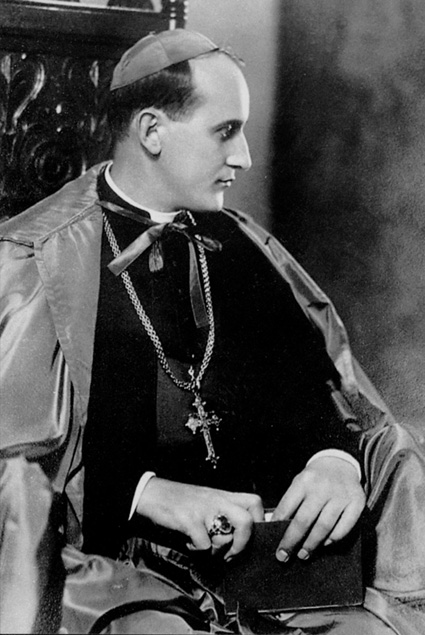
According to solidly based data he saved several hundred Jews during the WW2: either by direct action, or by secret rescripts to the clergymen, including mixed marriages, conversion to Catholicism, as did some Righteous in other European countries (in Greece for instance).
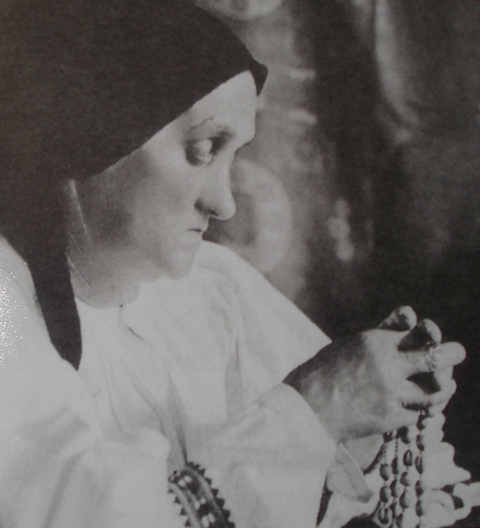
Mother
of Alojzije Stepinac in prayer
Already in 1936 Stepinac began to support materially and by other means Jewish refugees from Germany and Austria in Croatia. In 1937, while only 39 years old, he became Archbishop. In 1938 he founded "Action for help to refugees." Archbishop Stepinac also founded Croatian Caritas. In January 11, 1939 he sent a request to 298 addresses of eminent Croats asking for help:
Dear Sir,Due to violent and inhuman persecutions, a large number of people had to leave their homeland. They are left without means for normal life, and wander throughout the world...
Every day a large number of emigrants contact us asking for intervention, for help in money and goods. It is our Christian duty to help them... I am free to address to You, as a member of our Church, to ask for support for our fund in favour of emigrants. I ask You to write Your free monthly allotment on the enclosed leaflet.
Signature: Alojzije Stepinac, the Zagreb Archbishop
The "Action for help to refugees" worked until the arrival of Nazists to Zagreb in 1941. Archbishop ordered to destroy all the archival material, that is, the list of several dozens of thousands of Jews who asked for help (and obtained help) in order to be saved from Nazists. The materials have been burned down by Dr. Franjo Šeper, the then secreatary of archbishop. The responsable for the help to Jews in the "Action" founded by Stepinac was Mrs. Terezija Škringer, who was imprisoned in 15 March 1941. by the Nazis in Graz and Vienna, and condemned to the death penalty. Upon various interventions of the archbishop Stepinac she was released in 1. Septemeber 1941. For more information see [Vladimir Horvat SJ].
In a confidential rescript sent to Croatian clergy in 1941, Archbishop Stepinac wrote: "The role and task of Christians is on the first place to save people. When this time of madness and wildness is over, only those will remain in our Church who converted out of their own conviction, while others, when the danger is over, will return to their faith." Archbishop Stepinac also gave another instruction to his clergy to issue the certificate of baptism to endangered Jews and Serbs whenever they asked for. This was done with all procedures maximally simplified, often with false names. To our knowledge, these efforts are unique in the occupied part of Europe.
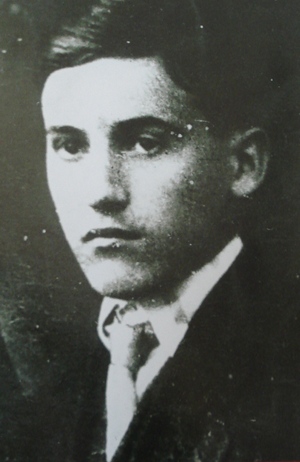
See also about amazing involvement of Croatian secondary school pupils in saving the Jews and Serbs in Croatia, which is without precedent in the history of WW2.
At the same time the metropolitan bishop of the Serbian Orthodox Church Josif Cvijic sent to all of his clergy a public rescript ordering the prohibition of conversion of Jews to Pravoslav (i.e. Orthodox Christian) faith. In this way the destiny of all Jews in Serbia has been sealed up, and after May 1942 there are no more Jews. Also an "Appeal to Serbian people" to support Nazi occupying forces in Serbia has been signed by 545 leading intellectuals in Belgrade in August 1941.
Stepinac most resolutely defended mixed marriages contracted in the Catholic Church. Already in March 1941 he sent a letter to Ante Pavelic where he wrote the following:
...As a representative of Catholic Church, and following my holiest duty, I raise my voice against interference of the state into questions of lawful marriages, that are insolvable, regardless to racial affiliation. There is no state authority having the right to solve these marriages. If it uses physical power, then the state is perpetrating ordinary violence.On the other hand, it is known that also in the highest circles of our state administration there are similar marriages that are insolvable.
He alluded on Pavelic himself, whose wife seems to have been a Jew (Pavelic's mather-in law was Jewish - Ivana Herzfeld), as well as 12 other highest state officials, whose wives were either Jewish or Serbian, see [Kristo], p. 141, or [Stefan], p. 15 (the Jewish community in Zagreb has no available data).
Kristian Krekovic, a famous Croatian painter, made several portraits of Pavelic. Krekovic's wife was a Jew (Sina Pevsner, 1910-2004), educated as pianist and polyglot, born in Paris, daughter of outstanding surgeon in Paris. She lived with Kristian Krekovic in Zagreb during the whole period of WWII (information by mr. Anto Cigeljevic). They both left Zagreb and Croatia in 1946 immediately after the humiliating mock trial (that is, soon after the Yugoslav communist rule started), with the status of displaced persons in their passports.
And here is another letter of protest sent by Archbishop Stepinac to Pavelic in July 1941:
As an Archbishop and representative of the Catholic Church I am free to call your attention to some events that touch me painfully. I am sure there will be hardly anyone having the courage to point to them, so it is my duty to do it. I hear from various sides about inhuman and cruel treatment of non-Arians...
Among the Jews that Stepinac managed to save there were also 60 inmates of the Jewish Old People's Home in Zagreb, that the German authorities in Zagreb ordered in December 6, 1943 to leave within 10 days, otherwise they would be sent to a German concentration camp. Upon the request of the members of the Jewish community in Zagreb, Alojzije Stepinac organized their stay in archbishopric's building in Brezovica near Zagreb, of course with the knowledge of the ustasha officials. Archbishop Stepinac often visited them. It is interesting that the inmates stayed there until 1947, while the Archbishop was already in the communist prison since 1946. Five of the inmates died a natural death during this period. It is regrettable that the total number of saved persons is often unjustly reduced to 55, even by the official Jewish sources in Croatia (as was the case in the ``Voice of the Jewish Community in Zagreb'', in an article written by dr Ivo Goldstein).
In the beginning of 1943 the Zagreb Chief Rabbi dr Miroslav Shalom Freiberger accepted an offer of Archbishop dr Alojzije Stepinac and entrusted him his very valuable private library. The Chief Rabbi had been killed in Auschwitz in 1943. He was arrested in 1943, when Himmler himself arrived to Zagreb, dissatisfied with the way the ustasha regime is "solving the Jewish problem" in Croatia. Stepinac immediately sent a request for his liberation to state officials, but without success. It should be noted that Chief Rabbi Freiberger did not accept an offer by Archbishop Stepinac to take refuge on his court until the end of war, since he wanted to share the destiny of his people. The library was returned to the Jewish community in Zagreb after the end of WW2.
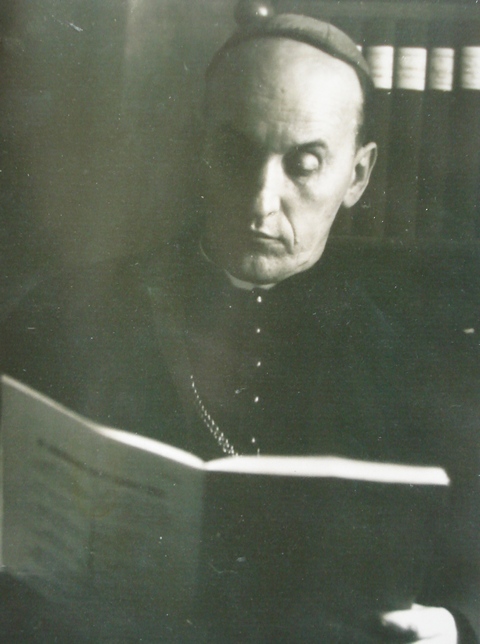
Already in the beginning of NDH in 1941, a group 83 outstanding Croatian physicians of Jewish nationality, mostly with their families, were moved to Bosnia, at that time a part of NDH, to be away from the eyes of German Nazists (see [Jasa Romano, pp. 95-99]). Otherwise they would be liquidated. This has been organized by the NDH minister of health, dr Ivan Petric, with the knowledge and approval of highest NDH officials, including Ante Pavelic (see Ha-Kol, 5960/1999, bulletin of the Jewish community in Zagreb, p. 11; the number of 71 saved Jewish families mentioned in Ha-Kol is wrong: there were 83 families, see the aforementioned monograph of Jasa Romano). An important role in saving these Jewish families had prof.dr Ante Vuletic, 1999 Croatian Righteous (awarded posthumously). The role of these physicians in Bosnia was to struggle against infectious diseases, and against endemic syphilis on the first place.
One of the greatest German speaking actresses of the 20th century was a Jew - Tilla Durieux (1880-1971). In 1933 she escaped in front of the Nazis from Germany to Switzerland, and then to the town of Opatija. In 1941 she happened in Serbia, where chetniks killed her husband. She managed to escape to Crotian capital Zagreb, where (during the NDH period) her life had been saved. It is interesting that she collaborated in Kazaliste lutaka (Theatre of Dolls) in Zagreb. She lived in Zagreb until 1955, that is, for about 20 years, and then returned to West Berlin. Tilla Durieux wrote an interesting autobiographic book, and a little known theatre play "Zagreb 1945", which was performed in Luzern in Switzerland. There is a memorial room devoted to her in the Museum of the City of Zagreb. (Glas Koncila, 2. travnja 2000, p. 21).
Dissatisfied with "solving the Jewish problem" in NDH during WW2, Himmler himself arrived to Zagreb in 1943. In an extensive raid that ensued many Jews were transported to Auschwitz. This has been witnessed by dr Amiel Shomrony, now Israeli citizen, personal secretary of rabbi Miroslav Shalom Freiberger. Even Eugen Dido Kvaternik, chief of the ustasha police (his grandfather was Josip Frank - a Jew), sent a secret message to dr Amiel Shomrony (his name in Zagreb was Emil Schwartz) to save himself as he can.
Dr Juraj Vranesic, a well known Zagreb physician, was hiding two Jews - Milan Sachs (conductor of the Zagreb Opera) and his wife in his sanatorium from 1941 until the end of WW2 (personal information by Ljubica Stefan). Vranesic, who also saved Miroslav Krleza from ustashis, was sentenced to death by YU communists in 1947. There were no Jews to initiate his nomination at Yad Vashem, though he deserved it (and still deserves), like many other anonymous Croatian Righteous. It is also known that there were plenty of Jews in Zagreb wishing to witness in favour of Archbishop Stepinac in the process raised against him in 1946, but were not allowed to (see [Stefan], p 92). Moreover, Dr Amiel Shomrony was adviced not to arrive to Zagreb to witness in favour of Stepinac, under the cynical pretext that nobody could guarantee his return to Israel.
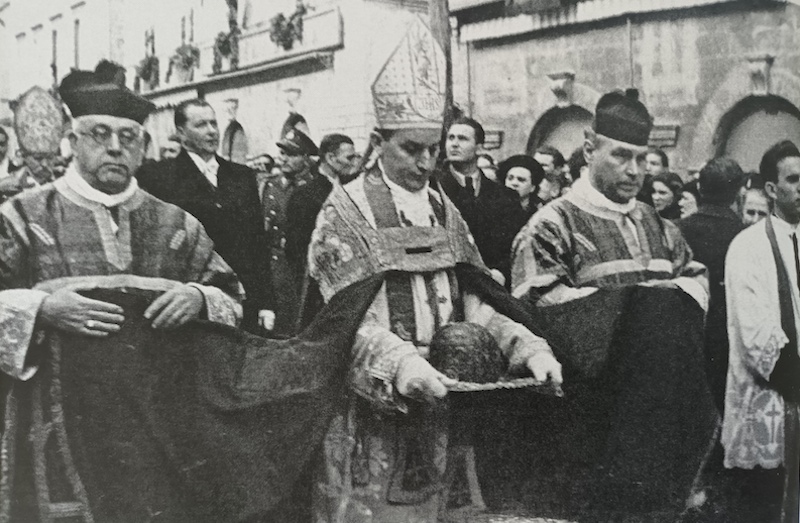 Cardinal Alojzije Stepinac in Dubrovnik in 1941, during the St. Blaise Festivity (Fešta sv. Vlaha).The Festivity of St. Blaise was inscribed in 2009 on the UNESCO Representative list
of Nontangible Cultural Heritage of Humanity. The Festivity is being
organized continuously since the 10th century (more precisely, since
972 AD).
Cardinal Alojzije Stepinac in Dubrovnik in 1941, during the St. Blaise Festivity (Fešta sv. Vlaha).The Festivity of St. Blaise was inscribed in 2009 on the UNESCO Representative list
of Nontangible Cultural Heritage of Humanity. The Festivity is being
organized continuously since the 10th century (more precisely, since
972 AD).
Though it can in no way efface the shame of the ustasha regime, it should be said that the Jewish community in Zagreb was the only one in Europe that acted legally in NDH during the whole WW2 in the period 1941-45, at Tomislavov trg 4.
 |
 |
 |
|
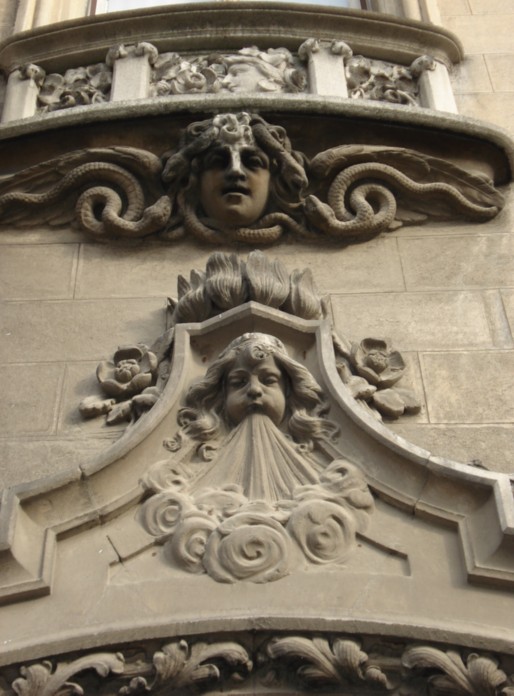
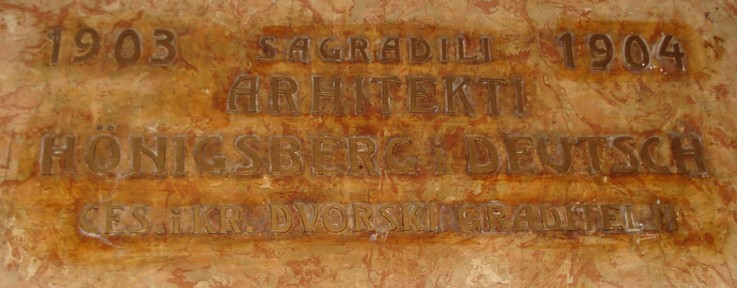
The house of Feller's
at Tomislavov trg 4, Zagreb, built in 1904,
(photo by D.Z., 2006)
According to a report of the British Naval Intelligence Division from 1944, the Croatian "Roman Catholic clergy, following the example of monsignor Stepinac, the Zagreb Archbishop, energetically protested against ustasha persecutions of Serbs and Jews, as well as against government's attempts for forced conversion to Roman Catholicism" (written by experts from Oxford and Cambridge in 1944, with note `only for official use'). See Stefan, pp. 127-131.
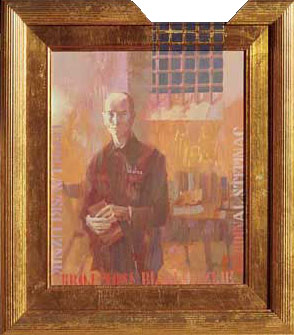
Cardinal
Stepinac in prison
Charles
Billich, see source
Only two days after the arrest of Stepinac in 1946 a protest conference was organized by Louis Breier in New York (Bronx), at that time the president of the Jewish community in the USA. He declared:
This great man was tried as a collaborator of Nazism. We protest against this slander. He has always been a sincere friend of Jews, and was not hiding this even in times of cruel persecutions under the regime of Hitler and his followers. Alongside with Pope Pius XII, Archbishop Stepinac was the greatest protector of persecuted Jews in Europe. (my translation from a Croatian source).
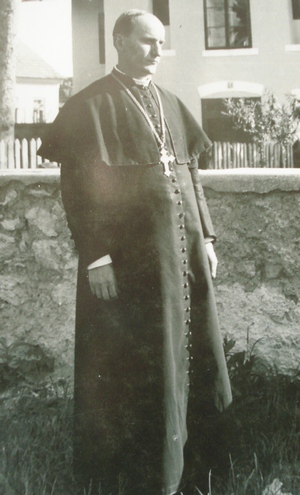
His sermons were not allowed to be printed publicly during the NDH period (1941-1945), so that people multiplied and spread them in secret. Glaise von Herstenau, a German Nazi general in Zagreb, declared: "If any bishop in Germany were speaking this way, he would not descend alive from his pulpit!" And when Stepinac visited the Holy See in 1943, he was warned that his life is in danger from the Nazis. There he met Ivan Mestrovic, a famous Croatian sculptor, to whom he said: "With God (=farewell), we are about not to see each other any more. Either Nazists will kill me now, or Communists will kill me later." Here are some characteristic extracts from his public sermons held in Croatian churches during the NDH period (1941-1945):
- All people of all colors are God's children. All of them, without any discrimination whatsoever, be they Gypsies, black people, civilized Europeans, Jews or proud Aryans are equally entitled to say" `Our Father who art in heaven...' That is why the Catholic Church has always condemned and it still condemns any injustice committed in the name of class, racial or nationalistic theories. Gypsies and Jews must not be exterminated in the name of a theory which claim that they belong to an inferior race. (A part of the sermon delivered in the Zagreb Cathedral on October 24, 1942.)
- There is a diversity of peoples and nations on the Earth. Mankind represents a unique whole. All of them have their roots in God. And all of them, be they of Aryan or non-Aryan race, have the same human nature.
- We were always accentuating in our public life the principles of eternal life of God, regardless to whether Croats, Serbs, Jews, Gypses, Catholics, Pravoslavs were in question, or anybody else. Catholic Church knows for races and peoples as creations of God, and its respect goes more to those with noble heart, than to those having powerful fist.
Archbishop Stepinac publicly condemned ruining of the Zagreb Synagogue in Praska ulica in 1941 with the following words: "The House of God of any faith is a sacred place..." (witnessed in written by Dr. Amiel Shomrony, citizen of Israel). This sermon, as other, could not have been published in press. But it was copied in secret among ordinary people, and one copy had been sent by Archbishop Stepinac himself to Chief Rabbi Freiberger (see [Stefan], p. 54).
Franjo pl. Lučić (1889-1972), Croatian composer, was playing organs not only in the Zagreb Cathedral, but also in the Zagreb Synagoge. Listen to his Angus Dei composed in 1940, or Fantasy in C-minor.

The
statue of cardinal Alojzije Stepinac near the Trsat Franciscan Monastery,
the city of Rijeka
In an unpublished letter sent to editor in chief of the Jerusalem Post in July 29, 1995, reacting on the statement of Reuven Dafni, vicepresident of Yad Vashem, that "Stepinac did not do anything to save the Zagreb Synagogue" (Jerusalem Post, July 26, 1995), Dr Amiel Shomrony wrote the following ([Stefan], p. 55-56):
Sirplease allow me through your column to inform your readers truthfully about "Croatia's past stalks relations with Jews", written by Mr. Jan Immanuel. In doing so I hope there is no need to stress that I have no personal interest whatsoever above stating what really happened during W.W.II in Croatia.
As former secretary of the Chief Rabbi of Zagreb Dr. Shalom Freiberger and his personal contact with Cardinal Stepinac I am in the position to point out various misinterpretations if not untruths in the above mentioned article of July 26th.
...The allegation that Archbishop Stepinac welcomed the Nazis is absolutely false; on the contrary, he publicly condemned the Nazis' racial theories as antireligious even before the state of Croatia became "independent" in 1941.
...There are in Israel and the U.S. people who were hidden in 1941 by Stepinac in monasteries during the war. More than 50 elderly Jews were allowed to hide and live until the end of the war on his estate when they were brutally evicted from the old people's home Lavoslav Schwarz. Also the Jewish community received money as well as sacs of flour on a monthly basis from the Archbishop for the inmates of the concentration camp Jasenovac.
...it is a fact that he condemned all laws against Jews, Pravoslavs, Moslems and Gypsis in his Sunday sermons in the cathedral house, "all of them are children of God". Also in his sermons he specifically denounced the destruction of our Synagogue as "being a house of God"; "the perpetrators will be dully punished by almighty God"...
As to the danger to his life - we submitted relevant proofs to Yad Vashem, but the matters being sub judice, I shall refrain from mentioning them here...
Allow me only one more pertinent point: I am today one of the very few survivors from the Jewish community of Zagreb of W.W.II and being honorary member of "The cultural society Dr. Shalom Freiberger" I surely am a more reliable witness than people who base their opinions and "facts" one hearsay.
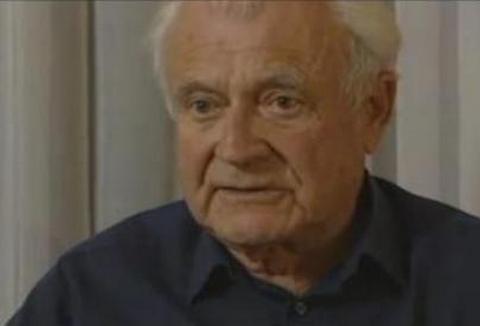
Dr
Amiel Shomrony
(1917-2009),
born in Croatia in the town of Zupanja as Emil
Schwarz, personal
secretary of rabbi Miroslav Shalom Freiberger in Zagreb, died in
Israel.
See his interview registered in a film by
Jakov Sedlar.
As for the Jasenovac camp, Stepinac declared in his sermon to be disgrace and shame for the entire Croatian people. He never payed a visit to the Jasenovac camp. There are documents proving that German Gestapo planned assassination of Stepinac, as a result of his brave sermons.
Hans Helm, the public ataché at the German embassy in Zagreb, wrote in March 25, 1943 that Stepinac was a great friend of Jews (see Kristo, p 141).
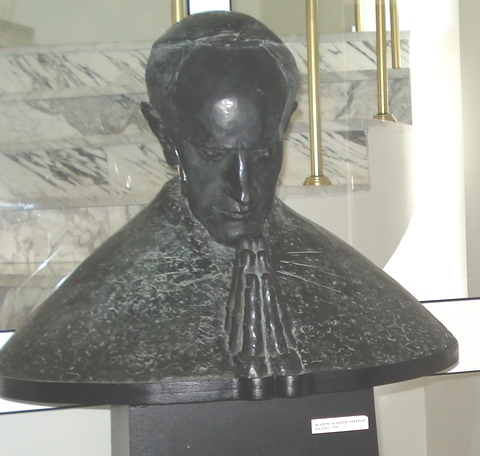
Bust of Alojzije
Stepinac in the Franciscan Convent in Livno, Bosnia
and Herzegovina
In his monograph [Les forces armées croates 1941-1945, p. 18] Cristophe Dolbeau mentions organizing and protecting the escape of three boats in the Black Sea to Turkey in 1944, overcrowded with Roumanian Jews:
Peu expérimenté (au débout tout au moins) et plutot mal équipé, la Légion Maritime Croate s'est parfaitement bien comportée tout au long de ses trois ans de présence en Mer Noire où l'amirauté allemande n'a eu qu'à se féliciter de son action. Bon soldats, les marins croates ont combattu dans l'honneur et sans haine : ainsi, le 24 mars et le 21 avril 1944, ont-ils organisé et protégé la fuite en Turquie de trois navires (le Milka, le Marcia et le Bella Citta) remplis de Juifs roumains... De retour à Zagreb le 21 mai 1944, ces matelots auront droit à un bref repos avant de reprendre la mer, dans l'Adriatique cette fois, et pour défendre les rivages de leur patrie.
And here is an example of brave behaviour of ordinary Croatian citizens. When professor Petar Grgec, at that time director of the Archbishopric's classical gymnasium in Zagreb, met a humiliated group of Jews on a street, with yellow armbonds on the sleeves, he took of his hat - expressing thus his deep respect, and silent protest against their suffering. This brave example, given by the old professor, must have left a deep imprint on souls of his pupils. Equally well, antifascist (and later anticommunist) example of Archbishop Stepinac left a deep imprint on the entire Croatian nation.
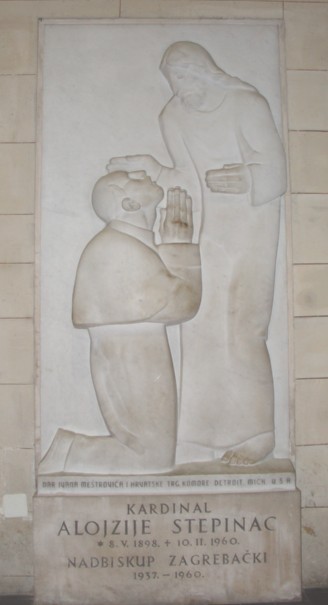
Gift
of Ivan
Mestrovic and the Croatian
bussiness chamber from Detroit,
Michigan (USA), to the Zagreb Cathedral
In 1944, January 1, the
first Croatian full-length film made
by Oktavijan Miletic was shown with great success in Zagreb, entitled
"Lisinski", about the distinguished Croatian composer Vatroslav Lisinski.
However, the premiere
was not attended by Gestapo officials. Namely, the origin of Vatroslav
Lisinski (1819-1854, born and died in Zagreb) was Jewish: his original
name was Ignaz Fuchs, or Ignatius Fux, or Ignacije Fuchs. The music for
the film was recorded by Boris Papandopulo,
and participating was Srebrenka Sena Jurinac,
one of the greatest opera
singers of the 20th century. In the then circumstances in Zagreb, it is
surprising that it was possible to show the film.
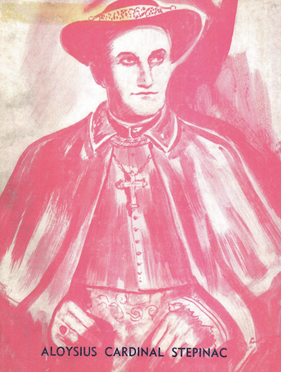
Potrait made by Gustav Likan (1912-1998) distinguished Croatian painter
Esther Gitman:
... my thoughts drifted to
Archbishop Stepinac who, in 1942 prevented a major catastrophe when he
heard that the governor of the Italian zones of occupation, Giuseppe
Bastianini wished to send all the Jews, around 6000, back to the NDH
(WWII Independent State of Croatia). Stepinac, jointly with Abbot
Marcone obtained a permit, with the help of the Vatican, for all Jews
to remain under the protection of the Italian Second Armata. My mother
and I were among thousands of other Jews who survived. I owe gratitude
and acknowledgment to Archbishop Stepinac and the Vatican! ... (source in English; translation into Croatian)
Esther Gitman, in her monograph Alojzije Stepinac - Pillar of Human Rights,
Zagreb 2019, wrote the following:
In the same book by Esther Gitman, on pp. 157-158, footnote 105 on p. 157, we find the following two sentences:
Olga Rajšek Neumann became a rescuer of a Jewish child Danko
Shtockhammer from the town of Pakrac. Danko needed a special care at
the tender age of eight. The help of Aloysius Stepinac was crucial.
Stepinac helped, among other things, in placing Danko in a Catholic
orphanage until the end of the war. (See p. 157.) On p. 158 of her
aforementioned monograph, Esther Gitman stated again the following:
"However, it seems peculier about
Archbishop Stepinac, the person responsible for Danko's rescue, was not
even mentioned at the ceremony."
According to an information obtained in 2012 from Mr. Antun Abramovic, Zagreb (a former member of Croatian Parliament - Hrvatski Sabor), the inventory of the former Jewish Synagogue in Zagreb (demolished by Germans in 1941 and 42) has been completely saved prior to demolishing. It is kept in the Museum of Arts and Crafts (Muzej za umjetnost i obrt, MUO) in Zagreb. The inventory was publicly exhibited in MUO in 1983 at the exhibition called "Judaica". Why this exhibition was not shown again since 1983 until today (2012)? It was a great wish of former president Franjo Tudjman to build a new Synagogue in Zagreb, at the same place (Praska ulica), and a special committee has been founded with this purpose.
Cardinal Alojzije Stepinac was beatified in 1998 by Pope John Paul II in Marija Bistrica near Zagreb.
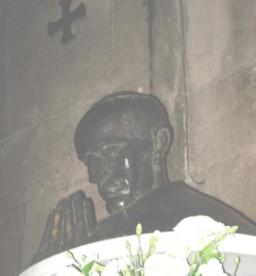
Bust
of Cardinal Alojzije Stepinac in the Trogir Cathedral
- Archbishop Stepinac's Reply at the Communist Trial (1946)
- Ivan Mestrovic: ON RELIGIOUS ART (1954), excerpt: "...The head of that suffering Church is Cardinal Stepinac, my compatriot, my dear friend, of whom I and all Croats are proud. I am sure that our feelings are shared not only by all the Catholics throughout the world but also by all men of goodwill everywhere who cherish freedom of spirit..."
- Saving the famous Sarajevo Haggadah (Jewish Bible) in 1941
- Esther Gitman: Alojzije Stepinac Pillar of Human Rights, Zagreb 2019 (Summary of the book in English: ... In the Croatian State Archives (in Zagreb, DŽ), Dr. Gitman discovered 420 petitions written on behalf of Jews, signed by thousands of people...)
- Esther Gitman, New York: Hrvati su spasili tisuće Židova, a Stepinac je svetac
- Esther Gitman's interview 2016 about Archbishop Alojzije Stepinac and his role in saving the Jews in Croatia
- Jakov Sedlar: MONSIGNOR - Priča o Josipu Devčiću
- Akademik Fučić o blaženom Alojziju Stepincu: Dostojno i pravedno, Govor Branka Fučića na nedjeljnoj misi u crkvi sv. Jeronima u Rijeci, 27. rujna 1998
- Juraj Batelja: Uloga blaženoga Alojzija Stepinca u zbrinjavanju ratne siročadi / i njihovo liječenje u zagrebačkim bolnicama od 1. lipnja 1942. do 1. kolovoza 1943. godine, Zagreb 2023. (predstavljanje knjige)
- Tomislav Galović: Branko Fučić, okvir djela - trenuci života,
Malinska: Općina Malinska-Dubašnica; Glosa, 2025. (osobito str. 48-52:
Zagrebački nadbiskup Alojzije Stepinac i student Branko Fučić: tri
intervencije za tri životne sudbine)
- Ina Vukić: Croatian History And Deconstruction Of Lies
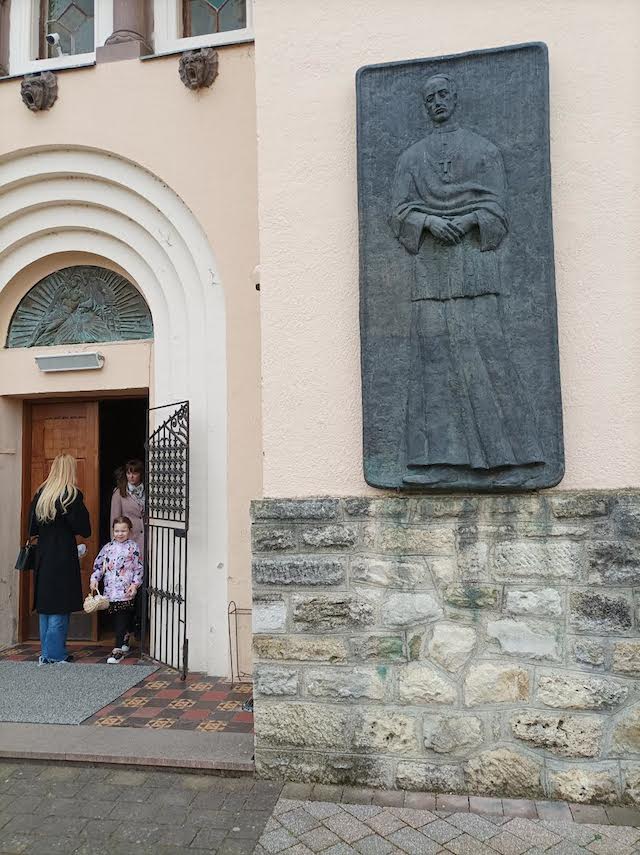
Bronze relief by Ante Starčević appearing near the main entrance to the Krašić parish church,
representing Alojzije Stepinac.
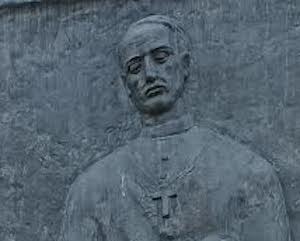
Portrait of Alojzije Stepinac from the above relief

Monument
of Alojzije Stepinac in Zagreb (Utrine)
I dare ask You taking the trouble (especially if You are a Jew) to read the following:
- Let
me repeat again, the ustasha regime in Croatia and the
Jasenovac camp are the greatest shame in the history of
Croatia. According to Vladimir
Zerjavic, an upper bound of
the number of victims is
- 85,000
killed in Jasenovac, out of
which
- 48-52 thousand Serbian victims,
- 13,000 Jews killed in Jasenovac (also 6,000 killed Jews in other camps and ditches in Croatia, and 7,000 outside of Croatia),
- 12,000 Croatians,
- 10,000 Romanys (Gypses).
There are views among Croatian scholars that Zerjavic's number of 85,000 killed in Jasenovac is exaggerated, see for example books of Jurcevic and Ivezic. It should be taken into account that altogether 62 Yugoslav concentration camps are known to have existed in the period from 1945-1951 (including the Jasenovac camp from 1945-1947), with unknown number of victims of communist terror, see here.
The Serbian propaganda claims 700,000 victims in Jasenovac (and even 1.5 million, claimed by Serbian politician Vuk Draskovic in Paris in the 1990s), i.e. almost 10 to 20 times more than estimated by Zerjavic. It would be important to revisit uncritical statements and numbers written by Menachem Shelach in The Encyclopedia of Holocaust, IV, pp 1716-1722, New York (see Yugoslavia). Who was professor Menachem Shelach? Born in Zagreb (as Raul Spicer), he died as a university professor in Haifa in 1995. He said in an interview published in an Israeli weekly Hotam (December 30, 1994), that he "deathly hates the Croats" (in Hebrew: sin 'at mavet)!! Croats as such, the entire nation. We all know what is anti-Semitism, but what is this and how to name it? Due to Shelach's inventions and lies, even the University of Haifa published a letter (signed by a secretary of the University) stating that the rules of professional ethics cannot be applied to everything that Shelach published as a history lecturer at this University. Dr Milan Bulajic, Belgrade, was his close collaborator. And the article in The encyclopedia of Holocaust, written by Shelach, has been read and is still read by millions of Jews and others throughout the world. The last days of his life, dying of cancer, Shelach was able to speak only - in Croatian.
- 85,000
killed in Jasenovac, out of
which
- The brilliant figure of Cardinal Alojzije Stepinac is shining on, despite double refusal of Yad Vashem to acknowledge his courage and perseverance in saving the Jews in Croatia. Explaining the refusal, the spokesperson of Yad Vashem (Iris Rosenberg) wrote in an official letter to a Croatian weekly that "persons who assisted Jews but simultaneously collaborated or were closely linked with a Fascist regime which took part in the Nazi orchestrated persecution of Jews [compare with Shomrony's letter], may be disqualified for the Righteous title." We know of plenty of examples showing that this is not true. See some of them in the book "Stepinac i Zidovi" by Ljubica Stefan, p. 133-137: Giorgio Perlesca (Italy), Oskar Schindler (Poland), patriarch Papandreu Damaskinos (Greece), Georg Duckwitz (Denmark), Max Schmeling (well known boxer, Germany, member of Wermacht during the whole WW2). It is impossible to efface the truth about Cardinal Stepinac.
- We know that Belgrade was the only European capital with two concentration camps - Sajmiste (exclusively for Jews) and Banjica, and with the number of victims comparable to those in Jasenovac. But there are no memorial tablets as in the similar places elsewhere in Europe. No mention of Belgrade concentration camps is made in the Encyclopedia of Holocaust. To our knowledge, also the existing Museums of Holocaust in Israel and in the USA do not have Belgrade on their maps of concentration camps in Europe. Thus it turns out as if the ustasha regime in Croatia was the only one responsible for holocaust on the territory of former Yugoslavia.
- Probably the most
outstanding falsfier of the history of
the Jewish
Old People's Home in Zagreb,
that Archbishop
Stepinac saved from German Nazis in 1943, was Dr Lavoslav
Kadelburg, Croatian Jew born in
Vinkovci (1910-1994).
He was the president of the Union of Jewish Communities of
Yugoslavia during many years, from 1965 to 1994,
representative in many Jewish organizations in the world,
vicepresident of the European Jewish Congress until his
death. Also the
judge of the Supreme law-court of the Socialist Republic of
Serbia.
- Kadelburg himself sent a signed statement against Archbishop Stepinac to Yad Vashem.
- An unknown number of documents containing signed Jewish statements in favour of Stepinac during the process raised against him in 1946 was in the possession of the Jewish community in Zagreb and then sent to Belgrade. When Dr Amiel Shomrony asked Kadelburg (president of the Union of Jewish Communities in YU, Belgrade) to send him copies, he answered: "These documents have no importance, and I destroyed them." See [Stefan].
- I kindly ask Jewish authorities to contact Igor Primoratz, Amiel Shomrony (both citizens of Israel), Ljubica Stefan, and Frano Glavina (Zagreb), who are without any doubt among the greatest connoisseurs of the subject covered by this web page.
- Memorial book of the Old People's Home in Zagreb published by the Jewsih community in Zagreb in 1960, does not even mention Alojzije Stepinac and his decisive role in saving the Jewish inmates during WW2, see [Kristo].
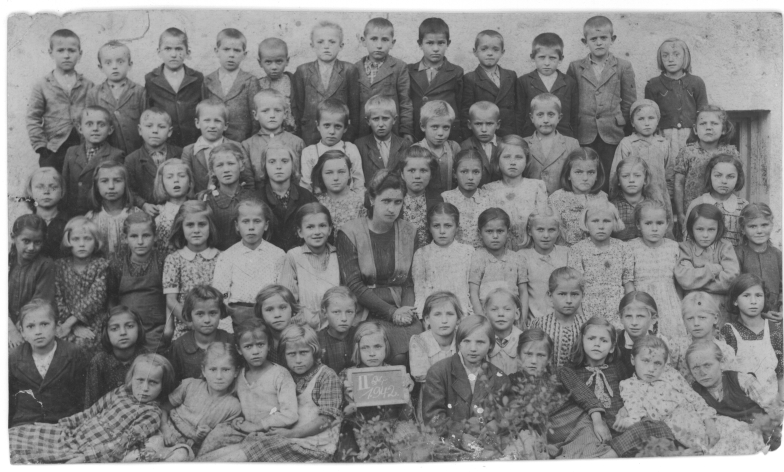
- An appeal of my mother, related to a Jewish school-teacher that taught her to read, write, calculate, and draw in a small town of Sveti Kriz - Zacretje (near Zagreb) from 1941 to 1943. It was a very young person - Stefica Rubin, that all pupils adored (photo, 370 K). She was teaching there despite the existing ustasha regime. When she was killed by a partisan bomb in a train, all her classes were crying. Any information about her and her family would be most welcome. Another Jew of which all citizens of Sveti Kriz - Zacretje keep best memories was Mr Lemberger, a physician. And a nearby village bears the name Zidovinjak (roughly - Jewish village!), situated in Hrvatsko Zagorje, less than 40 km north of Zagreb. The name of the village, which bears witness about presence of Jews in this region so explicitly, was left unchanged also during the NDH period in Croatia (1941-1945).
I express my gratitude to Ljubica Stefan for valuable information that enabled the creation of this web-page. For more details see:
Back to Croatia - an overview of its History, Culture and Science