Croatian Music
© by Darko Zubrinic, Zagreb (1995)
An age is known by its
music
Croatian proverb
Local index of names:
The first Croatian neum manuscripts for church music date from the 11th century. Some of the Christmas folk songs from the 12th century are still very popular. It is interesting that the Croats have more than 500 (five hundred) Christmas carols. There are Christmas verses that can have a dozen of different melodies, varying considerably from region to region. The number of Christmas carols is surprisingly large even in world's proportions.
The earliest known Croatian composers are Andrija Motovunjanin (born in the Istrian town of Motovun around 1470) and Franjo Bosanac (born in Bosnia around 1490).
The Croats can boast of having two excellent Renaissance composers. The first one is Julije Skjavetic (Schiavetti) from the 16th century. Between 1557 and 1573 he lived in Sibenik, and was conducting a choir in the famous Sibenik Cathedral. He wrote a collection of madrigals for 4-5 voices and a collection of motets for 5-6 voices (both published in Venice in 1563 and 1564 respectively). An important collection of his motets that was held in Dresden, disappeared after the destruction of the city in 1945. Luckily, it was discovered in Krakow in 1993.
Ivan Lukacic (1584-1648), a Renaissance composer born in Sibenik, was conductor and organist in the Split Cathedral. In 1620 he published a collection Sacrae cantiones, containing 27 motets for 1-5 voices accompanied by organs. Lukacic's collection was lost in the course of WW2, and rediscovered in the 1980's at the Jagiellon Library in Krakow, Poland. This is the only known copy.
Gabriello Puliti (1580-1643), an Italian priest, was an important composer for lute and organ in various Croatian towns of Istria. Another intersting Italian composer was Tomaso Cechini (1580-1644), an organist in the cathedral in Split and Hvar (on the island of Hvar). Both of them influenced the Croatian cultural circle in this region.
Besides Lukacic, Vinko Jelic (1596-1636) was the most important representative of Croatian church music of the time. He was born in Rijeka, and died in Alsace in France (Zabern). This Early Baroque composer is noted for introducing new techniques like chromatics and sequences into his music, which have just begun to appear in Europe. In 1622 he published a collection consisting of 24 motets (plus 4 other pieces) Parnassia militia in Strassbourg.
Cithara Octocorda is the most significant old collection of Latin - Croatian Church songs, published in 1701 in Vienna, reprinted in 1723 again in Vienna, and in 1757 in Zagreb. This impressive, monumental book contains 235 Croatian songs in the Kajkavian dialect. The songs were a part of the so called Zagreb church service, that was cancelled in 1878.
Luka Sorkocevic (1734-1789), whose beautiful symphonies are performed throughout the world, lived in Dubrovnik. His two sisters were the first women-composers in Croatia.
Ivan Mane Jarnovic (1740-1804) was an outstanding Croatian
violinist and composer of the 18th century, probably from
Dubrovnik.
He had a true European career -
playing, composing and conducting in France (Paris),
Austria, Germany, Switzerland, Poland,
Scandinavian countries, England. Also played the first violin
in the orchestra of the Russian empress Katarina II.
His life is described in a novel ``Jarnowick'' by G.
Desnoisterres - Le Brisoys, Paris 1844, and in a collection
``Scènes de la vie d'artiste'' by P.Smith (Une leçon de
Jarnovic, Paris, 1844).
Sir William Henry Hadow, renowned English scholar and
musicologist (1859-1937), lecturer in Oxford, editor in
chief of the Oxford Encyclopedia of Music (1901-1905), and a leading
influence in English education at all levels in the 1920s
and 1930s, wrote a booklet
entitled
in 1897 in London (published by Seely and co. limited;
reprinted in 1972 by Freeport, New York). This and other references related to Joseph Haydn can be
found at The Library
of Congress Citations:
Author: Hadow, William Henry, Sir, 1859-1937.
Here we reproduce the concluding paragraph of Haydn's short
biography presented by MusicaClassica:
Haydn is a common Croatian family
name. In the
Croatian
telephone book you can see the names of
Hajdin, Hajdina, Hajdinjak, Hajdinac, Hajdinovic:
63 families in the Zagreb county, 91 families in
Medimurje and Varazdin counties, 65 families in
Primorsko-Goranska county; and altogether 320 families in
the whole Croatia (1999). There is a village of
Hajdine near Vrbovsko in Croatia,
on the main road to Rijeka. The name Hajdin (= hajda's) is derived from
hajda = buckwheat.
Let us add that the melody for the German national
anthem, composed by Joseph Haydn, is based on a very old Croatian
folk song (``V jutro rano se ja stanem rano pred zorom...'',
see the Oxford Music Dictionary). Compare the Croatian folk song
with the German national anthem:
For more details see Hadow's analysis from his monograph
A Croatian Composer; notes towards
biography of Joseph Haydn (London 1897).
The poet J. W. Goethe
translated some of our most beautiful folk ballades
into German (from their Italian translation, done by
Alberto Fortis; see his ``Viaggio in Dalmazia'', Venice
1774). In this way ``Asanaginica''
obtained a European fame
(translated also by P. Méerimée, W. Scott, A. Puskin, A.
Mickiewicz and others). Only in Scotland it had three
translations in the 18th and 19th century (including that
of Walter Scott).
This poem appeared most probably in Dalmatia in the
16th or 17th century and represents a jewel of Muslim-Slav
oral tradition.
After its Italian translation many other translations
ensued: about ten translations into German, about the same
number into French as well as English, and also
translations into Swedish, Russian, Spanish, Roumanian, Hungarian,
Czech, Polish, Latin, Esperanto, Hebrew, Dutch, Albanian,
Macedonaian, Turkish, Persian, Danish, Ukrainian.
The verses for the Austrian national anthem "Land der Berge,
Land am Storme", were written
by Paula von Preradovic (1887-1951), Austrian
writer and poetess, grand-daughter of the Croatian poet
Petar Preradovic (1818-1872). She wrote a lot about
Croatia, its people, history and nature, for example
"Kroatishe Königs legende".
According to Franjo Kuhac, both Austrian and
German anthem have been composed by Joseph
Haydn in the 18th century, based on a
slightly abriged Croatian folk melody "V jutro rano ja se
stanem."
A lovely parade march called the Jelacic March (Op.
244), composed
by Johann Strauss the Elder, was played by the composer and
his orchestra in Viena in 1849, one day after Josip Jelacic
was proclaimed an honorary citizen of the city. A total of
eight marches and one waltz were dedicated to J. Jelacic by
various Austrian composers.
Very beautiful traditional
song of Bosnian Croats is S onu stranu
Plive (On the other
side of the Pliva river).
Since the creation of Bosnia and Herzegovina as an
independent state in 1992, the song has been chosen as the
national anthem of this state.
The first national operas among the Slavs were
composed by Russians
(M. I. Glinka, 1836, 1842), then the Croats follow
immediately.
Vatroslav Lisinski composed the first Croatian
national opera "Ljubav i zloba" ("Love and malice") in 1846. Then follow
the Czechs (B. Smetana in 1862), and these three nations are
the only ones among the Slavs who have national operas.
Let us mention that Franz Liszt gave piano concerts in
Zagreb (see here, in Croatian)
and in
Samobor,a
lovely
nearby town, in 1846.
Operas composed by Ivan
Zajc (1832-1914)
and Jakov Gotovac (1895-1982) are performed in
concert halls throughout the world. The most famous opera
of Jakov Gotovac is Ero s onoga svijeta, which has been
translated into 9 languages and performed in about 80
countries.
We cannot avoid the fact that some outstanding historians of Croatian music
(like Lovro Zupanovic, Ennio Stipcevic) prove that the first
Croatian opera was composed almost 80 years earlier than
"Ljubav i zloba" by Lisinski. The name of the composer is
Julije
Bajamonti (1744-1800).
In 1796 he wrote an article "Il medico e la musica" ("The
physician and music"), an
essay on musical therapy, one of the first in history, in
which he showed that music has therapeutic strength.
He was the most versatile and fertile Croatian composer of
the time (230 compositions, some of them fragmentary).
Bajamonti composed sacred music for verses in Latin,
Italian, and Croatian: for example La passione de Gesu Cristo
(cantata to words of Pietro Metastasio), Requiem (composed
on the occasion of death of Rugjer Boskovic, commissioned by
the Dubrovnik Senat in 1787), Spiritual songs to Croatian
verses. In 1767 he composed an oratorio which represents the
first Croatian opera, and according to Lovro Zupanovic, the
most beautiful work of its time in this country. He also
wrote the first Croatian oratory (La translation di San
Diomo), one of the highest achievements of Croatian 18th century
music.
The verses for the Croatian national anthem
Our Beautiful
Homeland (Lijepa nasa domovino) were written by
a Croatian poet and diplomat Antun Mihanovic (1796-1861).
The music was composed by Josip Runjanin (1821-1878).
It is interesting that many Croats who sang it
during the former Yugoslav regime (for example on country
weddings),
risked to be imprisoned.
There was a jail not far from
Zagreb, nicknamed as ``Jail for Singers'' (see [Macan, Sentija]).
Ivan Padovec (1800-1873) was a guitar virtuoso, who
gave concerts in Zagreb, Vienna, Prague, Budapest, Hamburg, London,
in Poland, Russia etc. He constructed a ten string
guitar.
Illma
de Murska (born as Ema Puksec in the town of Ogulin, 1834 - 1889)
was an opera diva of international fame. She sang in Italy, Spain, Hungary, and her most fruitful period was in Wiena,
Austria. She also sang in Berlin,
Hamburg, Paris and London, and had tours
in Australia, Russia,
USA and New Zealand. During a short period she was lecturing at
the Conservatory in New York.
Franjo Krezma (born in Osijek in 1862) had a
reputation of an
authentic violin virtuoso, and was a concert master in
the Royal orchestra in Berlin (today's Berliner
Philharmonie)
at the age of 17. Already at the age of 16 he was admired in
many European cities: Rome, Prague, Genova, Paris, Vienna,
Venice. Once he played also with Franz Liszt.
Having inscribed the Conservatory of Vienna at the age of
9 as the youngest student ever, he completed his studies at the age
of 13, after which started
his spectacular European career. Such musicians like
Giuseppe Verdi, Franz Liszt, Henry Vieuxtemps considered
him a successor of Paganini.
Unfortunately, he died
very young at the age of 19.
Any admirer of classical music certainly knows
the Zagreb
Soloists,
conducted by maestro Tonko Ninic (until 1997). Let us also add:
Artists of international reputation are:
In 1999 Croatian pop singer Tereza Kesovija received an
important French recognition Chevalier des Arts et
Lettres for contributions to culture.
On behalf of the French president Jacques Chirac it was
presented by Jean-Jacques Gaillarde, French Ambassador in
Croatia. She is known in
Croatia and France for her promotion of the French chanson.
At the Grand Prix Eurovision Contest held in 1985 she represented
Luxembourg.
Tereza will be remembered also for her numerous humanitarian
concerts during the 1991-1995 aggression on Croatia, held
not only in her homeland, but also in central Bosnia (Nova
Bila). Her house in native Konavle near the City
of Durbovnik was ravaged by Serbian and Montenegrin troops.
Very rich personal archives and valuable concert piano were burnt
down.
The Dubrovnik Summer Festival, which puts on
dramatic, music and balletic art, was founded in 1950. A
special attention is devoted to the plays of Marin Drzic
and William Shakespeare. Especially famous is the
Hamlet
performance on the old tower of Lovrijenac. Due to its
exceptional ambience, offerning enormously powerful
aesthetic experiences, it is regarded to be the best stage
for Hamlet in Europe.
Musical Evenings in Donat, a summer festival in Zadar which
began in 1961, include performances of medieval,
renaissance and baroque music. A large number of
outstanding European ensembles participated with
masterpieces not only from their own country, but also with
Croatian musical heritage (Skjavetic, Lukacic, Bosanac and
others).
The well known musical ``The Cantenbury Tales'', which played
in London for quite a long time, was directed by Vlado Habunek,
an outstanding name in theatrical life of Croatia.
An important cultural manifestation held in Zagreb is the
Music
Biennale, devoted to contemporary, experimental and
avant-garde
music. It has already a long tradition: in 1995 we had the 18th Biennale.
Let us mention only
two names:
An outstanding Croatian composer is Frano Parac. I
can recommend you to enjoy his music.
In 1989 the Croatian pop music group Riva from the city of
Zadar has won the European song contest held in Lausanne. Thanks
to this great international success of Croatian pop music,
the city of Zagreb, hosted the Eurovision song
contest in 1990.
Croatian cultural society Napredak (Progress) from
Sarajevo, capital of Bosnia - Herzegovina, has a nice mixed choir
called Trebevic. During the 1992-95 ferocious bombing of
the city of Sarajevo, they gave numerous concert in the
ruined city (in conditions that are difficult to describe), as well as 30
concerts in France, including Notre Dame in Paris. Napredak
also organized very successful postwar international
concerts in Sarajevo, starting from 1998.
Let us mention a young Bosnian Croat
Dejan Ivanovic from the town of Tuzla
(born in 1976), who took part in
the prestigeous International competition for classical guitar in Madrid
in 1998 as a representative of Croatia, and won the first
prize and the special prize.
In music probably the most original contribution is the
tamburitza, the Croatian national string instrument and one
of the hallmarks of Croatia.
The orchestral tamburitza play started in Osijek
in 1847. Our folk music is very popular among the Croatian
diaspora. There exist hundreds of tamburitza ensembles
among Croatian emigrants throughout the world.
Visit my web-pages devoted to
Tamburica links in Austria:
For those wishing to know more, we can recommend
to read The Tamburitza and the
preservation of Croatian folk music written by Michael
B. Savor (Canada).
An outstanding member of the Croatian Fraternal Union (the USA)
was Rudy Perpich (1928-1995),
a late Governor of Minnesota.
It seems that the melody for the famous
Hawaiian song ALOHA OE
might be based on a Croatian folk song,
as indicated in HAWAII MAGAZINE, August 1996, p 41.
The folk song in question is Sidi Mara na kamen
studencu from Srijem, whose melody is very close to
ALOHA OE.
References related to national costumes and customs:
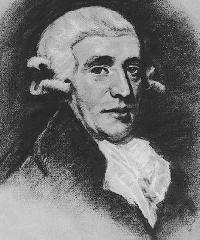 Our folk music is of great
beauty and variety.
Some of its themes were used by famous European composers, like
Bedrich Smetana and Joseph Haydn,
who spoke Croatian. Joseph
Haydn (1738-1803) was born in a Croatian ethnic
enclave
in Burgenland (Gradisce) in Austria. For example the main
theme of his London symphony
no 164 in D major (movement IV) is based on the well known
Croatian traditional song "Oj, Jelena, Jelena, jabuka
zelena" (Oj, Jelena, Jelena, my green apple). Also the final of his Es major symphony is based
on the Croatian folk song "Divojcica potok gazi" (A little
girl treads on a brook). And even
the following song that is widely known in Croatia -
"Nikaj na svetu lepsega ni, nego gorica
kad nam rodi..." (There is nothing more beautiful in the
world than a fruitful hill) was exploited by Haydn
(I learned this on a wonderful 11th birthday party
of my dear friend Ema Tolic).
Our folk music is of great
beauty and variety.
Some of its themes were used by famous European composers, like
Bedrich Smetana and Joseph Haydn,
who spoke Croatian. Joseph
Haydn (1738-1803) was born in a Croatian ethnic
enclave
in Burgenland (Gradisce) in Austria. For example the main
theme of his London symphony
no 164 in D major (movement IV) is based on the well known
Croatian traditional song "Oj, Jelena, Jelena, jabuka
zelena" (Oj, Jelena, Jelena, my green apple). Also the final of his Es major symphony is based
on the Croatian folk song "Divojcica potok gazi" (A little
girl treads on a brook). And even
the following song that is widely known in Croatia -
"Nikaj na svetu lepsega ni, nego gorica
kad nam rodi..." (There is nothing more beautiful in the
world than a fruitful hill) was exploited by Haydn
(I learned this on a wonderful 11th birthday party
of my dear friend Ema Tolic).
Title:
A Croatian composer; notes toward the study of Joseph
Haydn.
Published: Freeport, N.Y., Books for Libraries Press [1972]
Description: 98 p. illus. 22 cm.
LC Call No.: ML410.H4 H3 1972
Dewey No.: 780/.92/4 B
ISBN: 0836968816
Notes: Reprint of the 1897 ed.
Subjects: Haydn, Joseph, 1732-1809.
Names, Personal -- Croatia.
Control No.: 72004147 /MN/r972
A distinguishing trait of Haydn's works was his frequent use of Croatian
folk music for his melodic material. Wrote W. H.
Hadow: "The Croatian melodies are bright, sensitive, piquant, but they
seldom rise to any high level of dignity or
earnestness. They belong to a temper which is marked rather by feeling
and imagination than by any sustained breadth of
thought, and hence, while they enrich their own field of art with great
beauty, there are certain frontiers which they rarely
cross, and from which, if crossed, they soon return." Even many of
Haydn's original melodies are characterized by typical
rhythmic and melodic qualities to be found in the Croatian folk songs.
However, as Franze Bellinger has added, "Haydn's
speech, like that of every genius, was not only that of his race, but
of the world." To these Croatian characteristics, Haydn
added his high inspiration and sensitivity, and produced a type of
melody which, for the most part, is unmistakably his.


It is sometimes claimed that the music for "Lijepa nasa"
(Our Beautiful) was written according
to Donizetti's ``O sole piu ratto'' from the opera ``Lucia
di Lammermoor''. However, as I was informed by Emil Cic
(musicologist and musical critic, Zagreb), this
is not true. Also, Runjanin is sometimes claimed to be a Serb born in
Croatia, which also is not true. See a monograph written by
Andrija Tomasek, "Lijepa nasa - povijest jedne zablude", Muzicki informativni
centar Koncertne direkcije Zagreb, 1990.
Hearing a remark about alleged Serbian origin of her father, Runjanin's
daughter exclaimed: "But, my father was a Croat!"
Many people have already remarked exceptional poetic value
Our Beautiful (Lijepa Nasa).
Compare for instance its content with the bloody message of
the French national anthem.
About 100 of his pieces have been discovered
by Kresimir Marmilic in Zagreb in 1996!
Mr Cosetto is also known to have rearranged a
beautiful
Croatian song Fala (Thank you)
as a funeral song on the
occasion of Tito's death in 1980,
thus distorting its original message.
from The Oxford
Dictionary of Music (two editions - 1987, 1998) we learn
that Pogorelic is - a Serbian pianist!
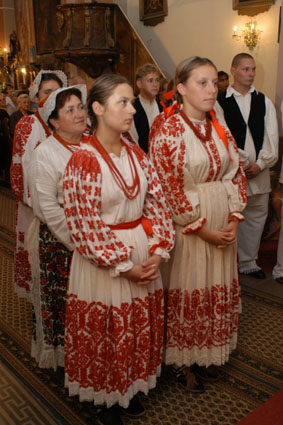 The first
tamburitza concert in the USA was held as early as in 1900
in the Carnegie Hall in New York. That same year the American
Croats were invited to the White House to play for the
president Roosvelt. In 1902 the first Croatian choir
``Zora'' (Dawn) in the
USA was founded
In 1960 the Croats in Pittsburg founded the ``Tamburitza
Philharmonic Orchestra'', which had 75 players.
Over the past several decades only in
the USA several hundred tamburitza orchestras were active, with more than
5,000 players. At this moment ``The Youth Federation of
Tamburitza Players'' in the USA comprises 44 orchestras. Its
rich activity is mainly due to the fruitful efforts of the
Croatian Fraternal Union
(CFU)
(Hrvatska bratska zajednica) and its president Bernard
Luketich in Pittsburg. Except in Croatia and the USA,
numerous tamburitza orchestras exist among
Croatian diaspora in Austria, Switzerland, Germany,
Hungary, Scandinavia, South African Republic, Australia, New Zealand,
Canada and elsewhere.
The first
tamburitza concert in the USA was held as early as in 1900
in the Carnegie Hall in New York. That same year the American
Croats were invited to the White House to play for the
president Roosvelt. In 1902 the first Croatian choir
``Zora'' (Dawn) in the
USA was founded
In 1960 the Croats in Pittsburg founded the ``Tamburitza
Philharmonic Orchestra'', which had 75 players.
Over the past several decades only in
the USA several hundred tamburitza orchestras were active, with more than
5,000 players. At this moment ``The Youth Federation of
Tamburitza Players'' in the USA comprises 44 orchestras. Its
rich activity is mainly due to the fruitful efforts of the
Croatian Fraternal Union
(CFU)
(Hrvatska bratska zajednica) and its president Bernard
Luketich in Pittsburg. Except in Croatia and the USA,
numerous tamburitza orchestras exist among
Croatian diaspora in Austria, Switzerland, Germany,
Hungary, Scandinavia, South African Republic, Australia, New Zealand,
Canada and elsewhere.
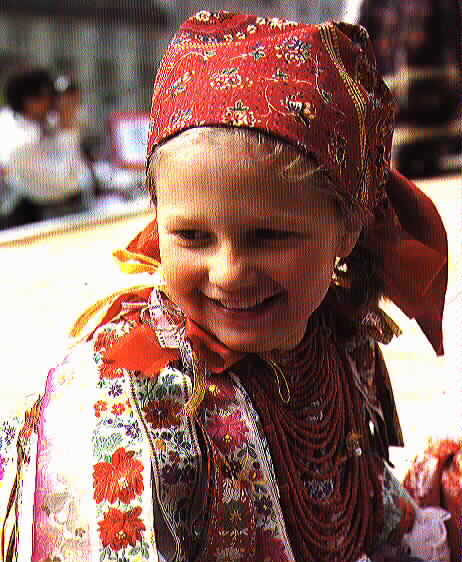
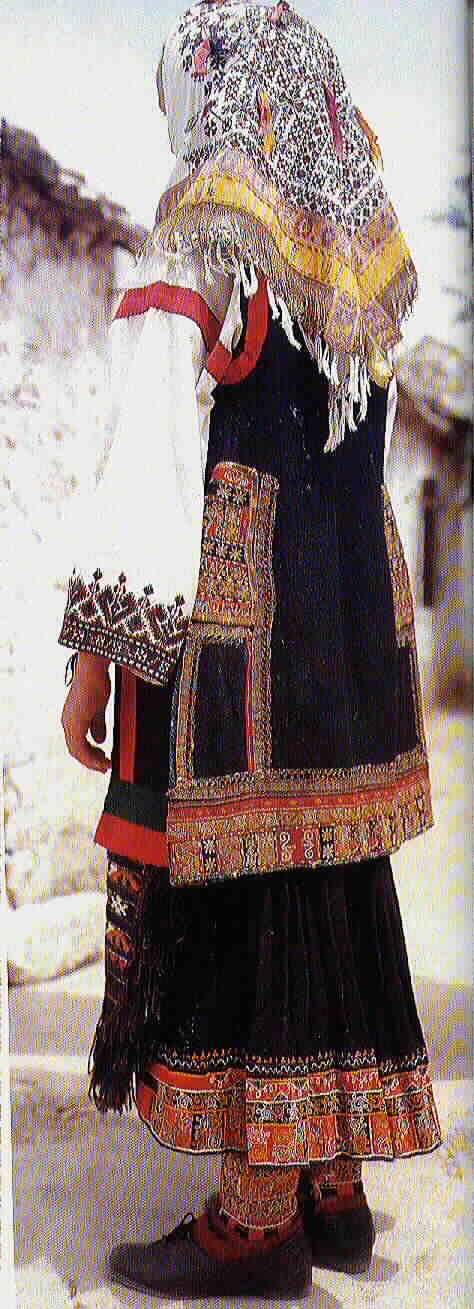 Hand in hand with folk music go the national
costumes and dances
in which one can see
such a rich source of creativeness and imagination that are
simply impossible to describe in a short essay like this.
See
Hand in hand with folk music go the national
costumes and dances
in which one can see
such a rich source of creativeness and imagination that are
simply impossible to describe in a short essay like this.
See
The King of Dolls! - Since 1991 an
invaluable collection of more
than 350 dolls owned by Mr Ljeposlav Perinic,
Argentina, is in Zagreb, Croatian capital.
Dressed in picturesque national costumes from over 100
countries, these dolls represent gifts of
many dignitaries, Kings, Queens, Emperors, Empresses,
Presidents, First Ladies, Prime Ministers, Governors, etc.
to Mr Perinic. He collected them for more
than 30 years.
Bunjevci Croats in Backa
Pere Tumbas - Hajo (1891-1967), conductor, composer,
and the famous
tamburitza player, was very active among Backa Croats
in Subotica, which was his birthplace.
His greatest success was the sensational triumph at the "International
folklore festival" in Langolen in England in 1952, where his
4 member orchestra and 8 dancers won the first prize, among 16
best folklor groups of the world (including the Russian
balalayka group and Spanish flamenco players).
The administrative authorities in the Yugoslav capital
Belgrade never gave him
opportunity again to show his brilliant tamburitza play
outside of former Yugoslavia.
Despite this, the Croatian
"Tamburitza" society from Pittsburg performed throughout the
USA many songs arranged or composed by Hajo. In the
journal "The Tamburitzan" Hajo has been
represented as the most famous tamburitzan.
Josip Andric (1894-1967) is a figure with a wide range of interests. In music he created about 700 songs, an opera for tamburitza (devoted to Bunjevci, Croatian ethnic branch in Vojvodina), collected almost 2000 folk songs, he was conducting already at the age of 15. In literature, among the plenty of his books and brochures let us mention his history of Slovak music, the first ever written: "Povijest Slovacke glazbe", HKD Sv. Jeronima Zagreb, 1944. And also the first grammar of the Slovak language: "Slovnica Slovacckog jezika", HKD Sv. Jeronima Zagreb, 1942. We owe him our first information about the glory of the Irish early Christian civilization, the fact that not only the British, but also the Francs received the Christian religion from them. He belonged to the Croatian minority in the north of present day New Yugoslavia (Vojvodina), called Bunjevci and Sokci. During many years, and especially since 1991, they have been going through the process of almost complete ethnic and cultural extinction, with a rate and violence unknown in Europe after 1945. Only in the period between 1971 and 1991 (before the Serbian aggression!) the number of the Croats in Vojvodina dropped from 140,000 to 74,000. The Croats in Vojvodina have no any national minority rights in the new Yugoslavia.
In his weekly "Obitelj" (Family) he wrote articles against Hitler already in the thirties of the 20th century. During WW2 he was arrested by Gestapo, but after three months of prison, upon intervention of the Slovak government, he had been released.
Albe Vidakovic (1914 - 1964), born in the town of Subotica in today's new Yugoslavia, was an important composer of Croatian church music. He also collected Croatian musical folklore. The Insitute for Church Music in Zagreb is called after him. He belonged to Croatian subethnic group of Bunjevci around the city of Subotica. Bunjevci Croats are recognizable by their beautiful ikavian dialect and folklore which is very close to that of Croatian north-east. When he was born, Subotica was the city with the second largest number of Croats after Zagreb, our capital. Even more interesting is the fact that in the period 1900-1904 Subotica was the largest Croatian city (larger than Zagreb)!
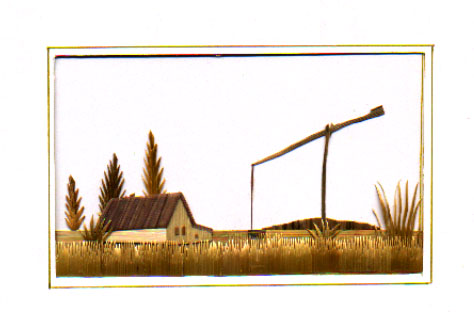
I adore the art of the slamarke among the Bunjevci Croats in the north of today's Yugoslavia.
In 1928 Ivan Mestrovic sent four recommendation letters to his influential friends in Croatia in which he asked to help the Croatian Youth Society BUNJEVAC from the city of Subotica to visit the land of their grandparents - Dalmatia and Herzegovina. As he stated, Bunjevci Croats in Baccka (on the north today's Yugoslavia) have preserved the character of their grandparents in their ikavian speech and customs. See "Marulic", 5/1998, 908-911.
Ivan Mestrovic carved the bust of Ante Evetovic Miroljub, poet and priest in Subotica. It was placed in front of the Subotica cathedral in 1936, removed during the hungarian occupation in 1940, and placed there again in 1996.
We would like to illustrate the position of Croats in the present new Yugoslavia. An important poet Jakov Jaso Kopilovic (1918 - 1997), born as a Bunjevac Croat in the city of Subotica, refused to change his nationality for membership in the Serbian Academy of Sciences (SANU, Belgrade), as it has been offered to him. Information by his closest relatives, and by prof. Joja Ricov, his personal friend (Joja Ricov is a poet, laureate of international prize "Golden Partenopa" and "Knight of Art for 1997", conferred by The Universal Academy "Neapolis" for fine arts, sciences and literature in Naples, Italy; member of Sindicato Libero Scrittori Italiani di Roma; a close friend of Italian Nobel prize winner Salvatore Quasimodo).
 |
LIPA NASSA
Lipa nassa
Lipa nassa
Lipa nassa
Lipa nassa J. Kopilovich
|
Those wishing to learn more about the history of Backa Croats (Bunjevci and Sokci) in today's Yugoslavia may consult the following references (especially books written by dr. Ante Sekulic, leading expert for the history and culture of Croats in Backa):
- Academician Ante Sekulich (born in Tavankut in Backa):
- Baccki Hrvati - Narodni zzivot i obiccaji, Zbornik za narodni zzivot i obiccaje Juzznih Slavena 52, JAZU (now HAZU), Zagreb, 1991 (519 pages)
- Rasprave o jeziku bacckih Hrvata, Matica hrvatska, Zagreb, 1997 (291 pages)
- Umjetnost i graditeljstvo bacckih Hrvata, Matica hrvatska, Zagreb, 1998 (171 pages) Serbianism in Podunavlje (the Danube region) 1918-1995
- The Croatian
Bunjevci, by Evetovic-Pekic-Sokcic,
Croatian Almanac, 1986
Back to Croatia - overview of its History, Culture and Science