Haiku poetry in Croatia
Darko Žubrinić, Zagreb 2008.
There are about fifty countries in the world where haiku poetry is cherished. One of them is Croatia. Surprisingly, Croatia is among the best ones, counting the number of published haiku in various anthologies throughout the world.
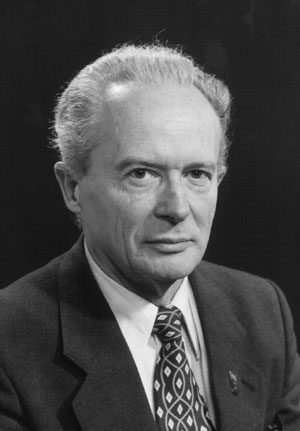
Vladimir Devidé (1925-2010)
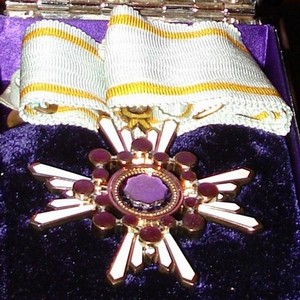
The beginnings of the history of haiku poetry in Croatia are indelibly tied to the name of outstanding Croatian Japanologist and mathematician Vladimir Devidé, a member of the Croatian Academy of Sciences and Arts in Zagreb, born 1925 and living in Zagreb. For his contributions in popularization of Japanese culture he was awarded the prestigious Japanese Order of the Sacred Treasure - Konsantõ Zuihôshõ.
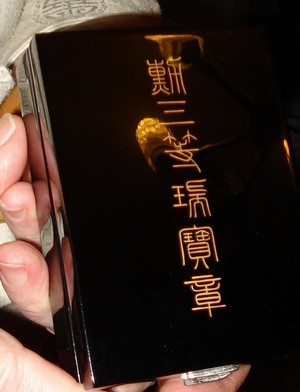
Order of the Sacred Treasure - Konsantõ Zuihôshõ, which Vladimir Devidé received from the Japanese Government in 1983
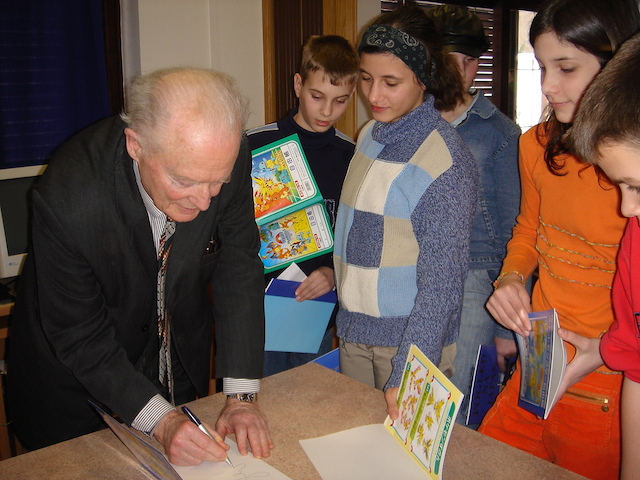
Professor Devidé's tireless enthusiasm over the past fourty years, including numerous published monographs and hundreds of public lectures, resulted in surprising popularity of haiku poetry throughout Croatia and other parts of Eastern Europe. It is especially nice to see him surrounded with youngest haiku poets in Croatia, at the primary school age.
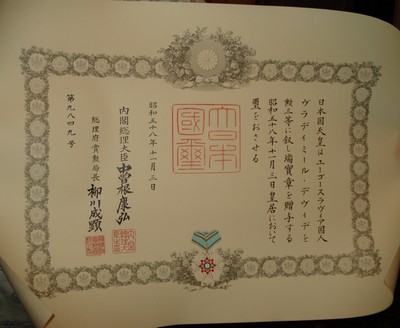
The Order of the Sacred Treasure - Konsantõ Zuihôshõ, is accompanied with the above diploma. In the middle there is the red seal of Japanese Emperor Hirohito, and on the left below is a smaller red seal of the Prime Minister Nakasone Yasuhiro, and still smaller is by the Chief of the Protocol.
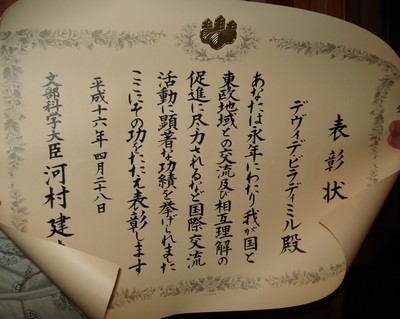
Diploma of the Ministry of Culture of Japan which professor Vladimir Devidé received in 2004.
According to Professor Devidé, counting the number of prizes won at various international competitions, and in particular Japanese, Croatia can be ranked among three "haiku world superpowers", immediately after Japan and the USA!
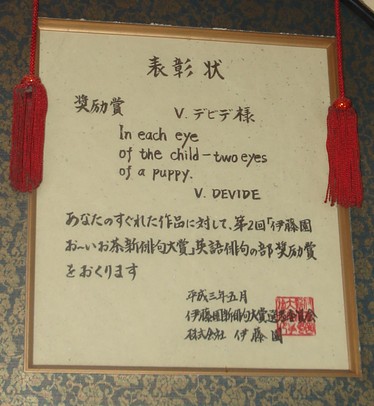
Vladimir Devidé received 18 prizes on various Japanese international haiku competitions. Above is his earliest Japanese prize.
|
U svakom oku |
In each eye |
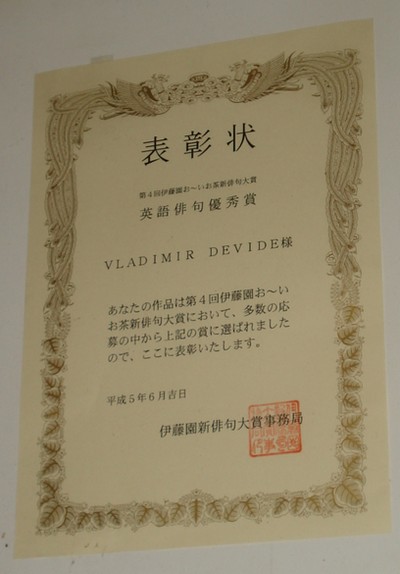
Another diploma which Vladimir Devidé obtained at the ITOEN haiku competition in Japan.
Professor Devidé is the author of the monograph Japanska haiku poezija i njen kulturno-povijesni okvir (Japanese Haiku Poetry and its Cultural and Historical Framework), issued in Zagreb in 1970, which had five editions, printed in altogether 15000 copies. His another important book is the one dealing with haiku in Croatia, entitled Antologija hrvatskoga haiku pjesništva (Anthology of Croatian Haiku Poetry), Zagreb 1995. His monograph Haibun, published in Zagreb in 1997, had a huge international success: besides in Croatian, it was published in English, German and Japanese. This book contains about one hundred haiku. His other related books are Japan - tradicija i suvremenost (Japan, Tradition and Modernity), Zagreb 1978, Japan - poezija i zbilja (Japan - Poetry and Reality), Zagreb 1987, Zen - ideje, umjetnost, tekstovi (Zen - Ideas, Art, Texts), Zagreb 1989, Japan, Zagreb 2006.
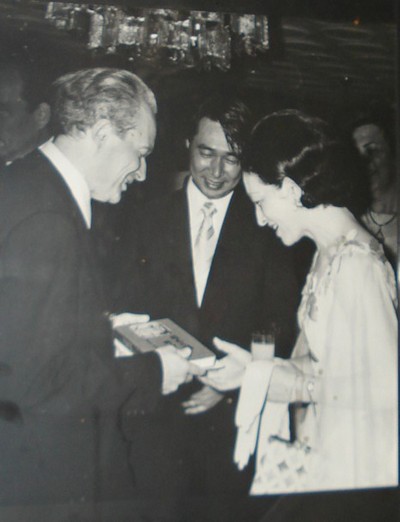
Japanese Princess Michiko, wife of Crown Prince Akihito (in 1989 they became Empress and Emperor of Japan), receiving a gift from professor Vladimir Devidé in Cavtat near Dubrovnik, June 12th, 1976. The gift was his book Japanska haiku poezija i njen kulturno-povijesni okvir (Japanese Haiku Poetry and its Cultural and Historical Framework), issued in Zagreb in 1976, published in Croatian.
He is a honorary member of the German Haiku Society. Professor Devidé has a large collection of haiku books in his appartment in Zagreb. This is probably one of the largest personal haiku libraries in the world. His knowledge of English, German, French, Russian, Japanese, and Croatian, enabled him very interesting linguistic comparisons of haiku written in these languages.
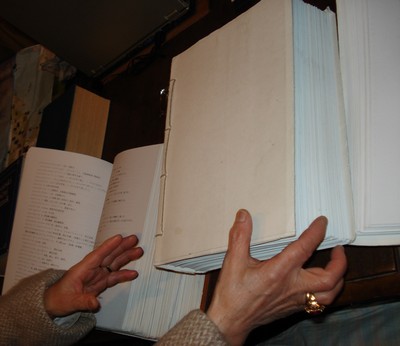
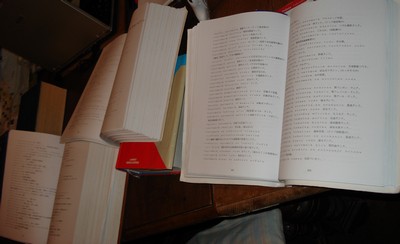
Vladimir Devidé's wife Yasuyo Hondõ is preparing a voluminous multi-volume Croatian - Japanese Dictionary.
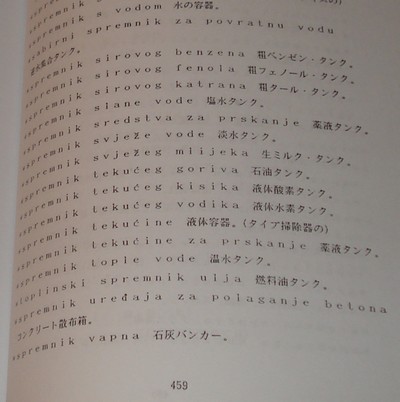
Professor Devidé's wife Yasuyo Hondõ is preparing a voluminous Croatian - Japanese Dictionary. She started with her painstaking work already in 1988, and the books in preparation are indeed amazing.
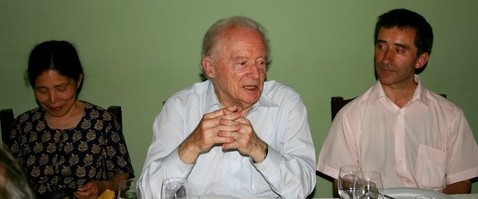
Vladimir Devidé with his wife Yasuyo Hondõ, and with Željko Hanjš in 2006.
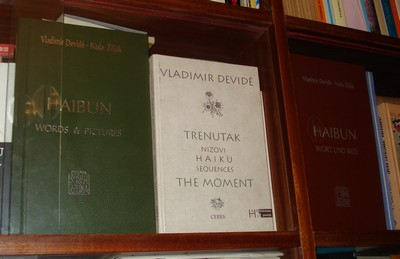
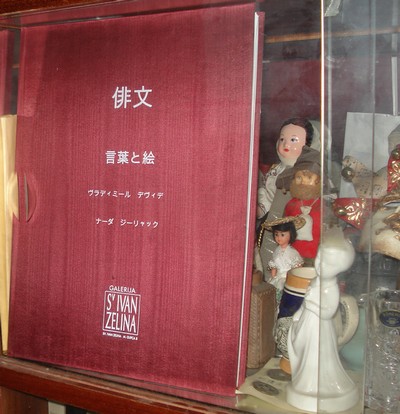
HAIBUN - Words and Pictures by Vladimir Devidé and Nada Žiljak, has been translated into Japanese by Yasuyo Hondõ, wife of professor Devidé. The book has been published in Croatia.
|
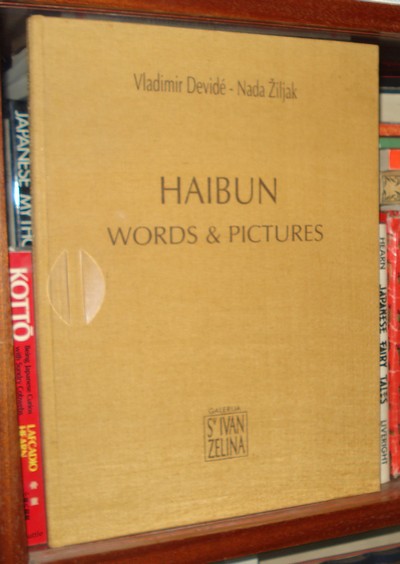
HAIBUN - Words and Pictures by Vladimir Devidé and Nada Žiljak. Galerija Sv. Ivan Zelina:1997. Hard cover, 6.5 x 10.5 inches. Contact Vilko Žiljak, Vukovarska 35 A / VII, Zagreb, Croatia, for ordering information and price. Jane Reichhold 1997 (source): This is a very special book. Hard cover bound in green with silver embossed lettering, full color illustrations on every other page, of Nada Ziljak's artwork which is stunning, but the most special of all are Vladimir Devidé's haibun. Many authors think haibun are simply haiku with prose wedging them apart. Not so. It takes a very specific way of seeing to find the material for haibun and then the author must learn a new way of writing the prose so that it is prose and not poetry but poetry that dances just above prose. There is a very fine line and Devidé has found it. By learning first to write excellent haiku, he has applied these techniques to his prose which is not prose but really haibun. In the same way that haibun gives only the "terminals" from which the reader's thoughts connect, Nada Ziljak's artwork functions in a similar manner. Full of light and air, the reader can recognize elements that definitely relate to the haibun, but it requires just the right amount of imagination to complete the pictures as the haibun do. HAIBUN: Wort und Bild von Vladimir Devidé und Nada Ziljak. Galerija S'IVAN ZELINA., 1999, Hardcover 6" x 11", 80 Seiten., farbige Illustrationen. Contactpersonen: Vladimir Devidé, Vinogradska 10, 10000 Zagreb, Croatia. Source. Vladimir Devidé ist ein wohlbekannter Dichter in Europa. Er überraschte uns 1997 mit einem in Leinen gebundenen Band seiner Haibun, sehr künstlerisch farbig illustriert von Nada Žiljak. Nun hat er, kaum zu glauben, eine Übersetzung ins deutsche, wiederum als hardcover, herausbringen lassen. Professor Devidé schreibt eine vorzügliche Prosa und überblendet die Texte mit seinen besten Haiku und anderen Gedichtformen. Immer entsteht dabei ein in sich poetisch vollkommen neues, selbständiges Gebilde. Es sollte niemanden wundern zu sehen, daß Devidé's poetische Ideen nicht nur in Europa Schule machen werden. Seine Arbeiten bieten Anregungen in Hülle und Fülle. Man ist gespannt, ob auch in Europa sich Schriftsteller finden werden, die Prosa und Gedicht, ähnlich wie wir es in den USA erlebten, mit mehreren Personen gemeinsam schreiben werden mit dem Ziel, symbiotische Dichtung weiter zu entwickeln. |
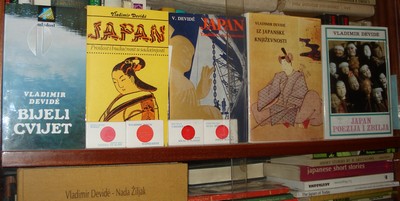
One of numerous shelves in appartment of professor Devidé in Zagreb.
| POTOK
Vladimir Devidé Jednom sam, šećući se uz pokošeno sijeno pokraj ceste, izdaleka vidio djevojku s glatkom lanenom kosom; sa spuštenom glatkom kosom poput vode sto se preljeva preko obloga bijelog kamena u gorskom potoku kada god padne jača kiša ili u proljeće kad se topi snijeg u brdima. Ne znam je li bila lijepa; samo sam joj na trenutak vidio velike modre oči. Poslije je više nisam vidio i dugo sam, danju i noću, gledao tu djevojku s lanenom kosom. Niz
obli kamen: Htio bih ubrati modrih cvjetova na livadi da ih upletem u lanene kose; cvjetove vodopije i modrih zvončića. Gdje li je sad ta djevojka s lanenom kosom? U Mliječnoj stazi još je uvijek samo odbljesak njezine kose. Samo je poneka vlat u zlatnim slamkama dozrelog žita. Samo se jedan pramen i sada slijeva preko obloga kamena u gorskom potoku, kada ga god probode mlaz zalazećeg sunca, što se probio meðu stablima omorika. Izvor: HAIBUNI Riječ i slika
|
A
BROOK
Vladimir Devidé Once, while walking by the road, past cut hay, I saw in the distance a girl with lank flaxen hair; with loose lank hair like water overflowing a round white stone in the mountain brook whenever there is heavy rain or in spring when snow is melting on the surrounding hills. I do not know whether she was beautiful; I just saw her big blue eyes for a moment. I never saw her again, but in my thoughts I looked for a long, long time, day and night, at the girl with lank flaxen hair. Over
a round stone I would like to pick some blue flowers from the meadow to weave them into the flaxen hair, flowers of forget me-not and blue bell-flowers. Where is she now, that girl with flaxen hair? In the Milky Way there is still only a reflection of her hair. But there are some blades of it in the golden straw of ripe corn. Just one lock is still overflowing that round stone in the mountain brook, whenever it is pierced by a ray of the setting Sun bursting through the pine-trees. Source: HAIBUN
|
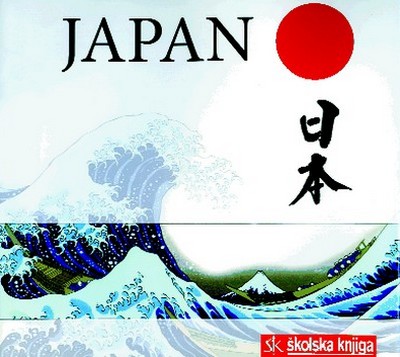
Vladimir Devidé: Japan, ©kolska knjiga, Zagreb, 2007.
Here we mention an anthology of haiku poetry prepared by Bart Mesotten, entitled Duizend Kolibries (A Thousand Hummingbirds), published in Belgium in 1993 in the Flemish language, where 33 countries have participated. Each country was represented by one chapter, except Croatia, which was represented by two chapters. One chapter was standard, entitled Haiku Poetry in Croatia, while an another one was nonstandard, entitled War in Croatia. It contained haiku poetry related to tragic events in 1990s. As an example we provide two of them related to the aggression on Croatia, written in 1991 by professor Vladimir Devidé:
|
Spaljeno selo. |
In the burned-out village |
|
Lokvica krvi - |
A small pool of blood - |
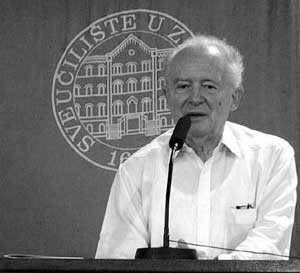
Professor Vladimir Devidé, behind him is the seal of the University of Zagreb founded in 1669
|
VLADIMIR DEVIDÉ roðen je u Zagrebu 3. svibnja 1925. Dipl. Ing. graðevinarstva (1951) i Dr. Sc. matematičkih znanosti (1956). Redoviti sveučilišni profesor u miru i redoviti član Hrvatske akademije zanosti i umjetnosti. Na postdoktorskim studijima u Izraelu (1960) i u Japanu (1961-1963). Gostujući profesor na Monash sveuč. u Melbourneu, Australija (1968) i na Ohio State Univ. u SAD (1971). Sudjelovao na brojnim našim i meðunarodnim matematičkim kongresima i simpozijima. Republičku nagradu "Ruðer Bošković" primio 1965, Nagradu grada Zagreba 1982, meðunarodnu nagradu "Le Prix CIDALC" 1977 te Odličje japanske vlade "Red Svetoga Blaga" 1983. Državna nagrada Republike Hrvatske za životno djelo na području prirodnih znanosti godine 2003. Posebno priznanje japanskog ministarstva kulture za istaknuti doprinos meðunarodnom promicanju razumijevanja izmeðu Japana i Istočen Europe 2004. Dvadesetak nagrada na japanskim meðunarodnim natjecanjima u haiku pjesništvu. Iz područja matematike objavio 40 znanstvenih i oko 200 stručnih i popularnih radova i članaka te održao oko 60 javnih predavanja o rezultatima svojega znanstvenog rada i objavio 15 knjiga. Iz područja japanologije i književnosti objavio više od 200 eseja, članaka i tekstova u našim, američkim, japanskim, njemačkim itd. časopisima i održao sličan broj javnih predavanja te objavio 16 knjiga. |
VLADIMIR DEVIDÉ was born in Zagreb on May 3rd, 1925. B.Sc. (Civil Engineering), 1951 and Sc.D. (Mathematics),1956. Retired Full Professor of the University of Zagreb and Full Member of the Croatian Academy of Sciences and Arts. Post-doctoral studies in Israel (1960) and in Japan (1961 - 1963). Visiting Professor at Monash University, Australia (1968) and Ohio State University in Columbus, USA (1971). Participated in numerous international mathematical congresses and symposia. Croatian "Ruðer Bošković" Prize for Scientific Achievement (1965), Prize of the City of Zagreb (1982), "Le Prix CIDALC" (1977), and the Japanese Order of the Sacred Treasure (1983). State prize of the Republic of Croatia for life work in the field of natural sciences (2003). Special recognition of the Japanese Ministry of Culture for outstanding contribution to international understanding between Japan and Eastern Europe (2004). Some twenty prizes on Japanese international haiku competitions. In the field of mathematics he has published 40 scientific papers and about 200 essays and articles, and held some 60 public lectures about results of his scientific work. He has published 15 books on mathematics. In the field of Japanology and literature he has published more than 200 essays and articles in Croatian, American, Japanese, German, etc., literary journals and magazines, as well as 16 books. |
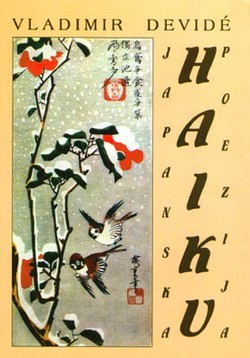
Concerning the beginnings of haiku poetry in Croatia, professor Devidé had a few predecessors that we should not forget. Already in 1961 Tonči Petrasov Marović (1934-1991) published his haiku poetry in the journal Mogućnosti (Possibilities), 1961. no 6, in the city of Split. Next to him is Dubravko Ivančan (1931-1982), born in Krapina near Zagreb, who published his first book of haiku poetry under the title Leptirova krila (Butterfly Wings) in Zagreb in 1964. Let us mention the monograph HAIKU RIJEČ I SLIKA Dubravko Ivančan - Nada Žiljak, issued in honour of Dubravko Ivančan, edited by Vladimir Devidé, with texts written by Vladimir Devidé and Ðuro Vanðura.
Some of the best Croatian haiku poets are:
- Tonči Petrasov Marović
- Dubravko Ivančan
- Vladimir Devidé
- Tomislav Maretić
- Nikola Đuretić
- Drago Štambuk
- Robert Bebek
- Darko Plažanin
- Dubravko Marijanović
- Marijan Čekolj
- Milan Žegarac Peharnik
- Višnja McMaster
- Boris Nazansky
- Anto Gardaš (also here)
- Luko Paljetak
- Enes Kišević
- Pajo Kanižaj
- Zvonko Petrović
etc.
|
tigrova sjena |
a tiger's shadow on the wall... a kitten in front of the lamp |
In Croatia there are now about ten different centers throughout the country where haiku poetry is promoted via formal organizations, publications, journals etc. Some of them are: Zagreb, Varaždin, Samobor, Krapina, Kloštar Ivanić, Ivanić Grad, Rijeka.
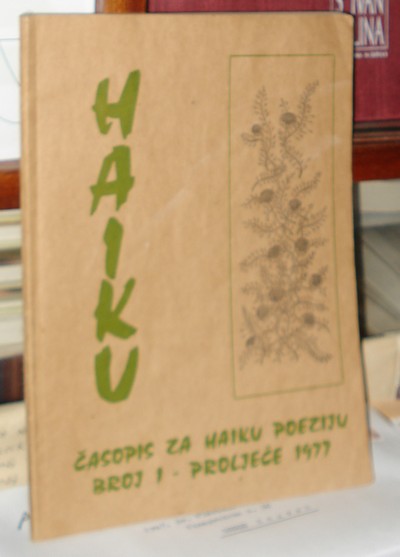
Haiku - issued in Croatia since 1977, was probably the earliest european journal specialized in haiku.
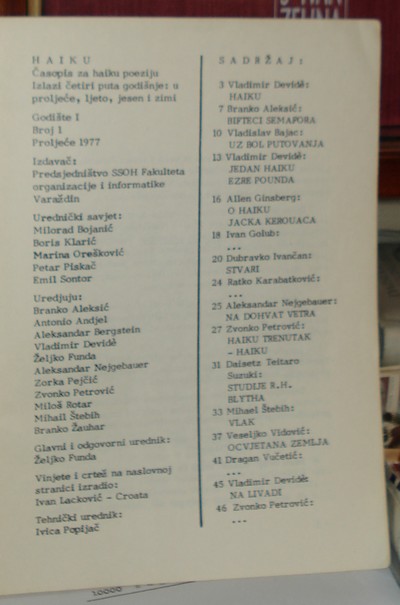
The journal Haiku issued in the town of Varaždin since 1977 was probably the earliest european journal specialized for haiku. It has been conceived by Zvonko Petrović, one of the haiku "veterans" in Croatia.
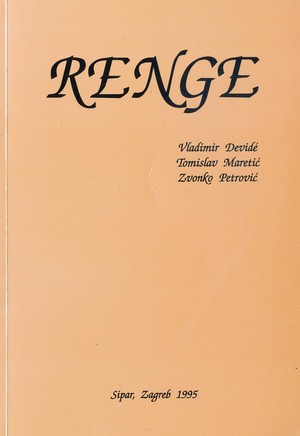
One of the haiku societies in Croatia is Društvo hrvatskih haiku pjesnika (The Association of Croatian Haiku Poets) in Zagreb. Its president is Višnja McMaster, while professor Vladimir Devidé is Honorary President of the society.
Croatian haiku poetry atWorld
Haiku Association
|
The first competition in Croatia in haiku poetry among primary school children was organized in 1986, on the occasion of the grand exhibition Kyoto - cvijet kulture (Kyoto - Flower of Culture) in Zagreb. About 500 children throughout Croatia participated. Kyoto and Zagreb are sister cities since 1972.
|
Josefina Gerlach, a 5th grade elementary school pupil, was born in 1990 in Zagreb, Croatia. She has been writing haiku since 1998, and has, so far, won three first prizes in Croatian children's haiku festivals. "Ever since my teacher introduced me to haiku," she says, "I understood that there is big life hiding in small moments." Josefina's haiku appeared from time to time on the Internet Shiki Haiku Salon, where some poets became rather fond of her poetry. She felt specially close to John Crook, who wrote to her letters of encouragement and was the first to make web pages for her. Her haiku and Smiljana's photographs [Smiljana is Josfina's mother, D.Ž.] are a part of John Crook's web pages, "Grains of Rice" at http://www.haiku.org.uk Josefina's mother Smiljana Gerlach, a photographer and a haiku poet, started illustrating her daughter's haiku in 1999. On Feb. 4th 2002, their first joint photo-haiga exhibition was opening in Zagreb. A Special Photo-Haiku Tribute to John
Crook Josefina, born in 1990, is writing her haiku from the age of 8. Haiku Josefina Gerlach
Source: WHC Haikujunior
|
|
Rene Matoušek (1958-1991)
|
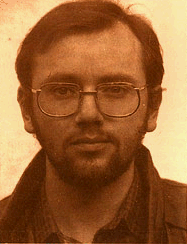
|
Ljetni pljusak. Cijedi se Dunav Čamac u zoru. U vrtu dvorca plavog leptira pastrmka iskočila drhti vrana svježi osmjeh
djevojke Prsten od Vuke. Borovski dimnjak Stranac se čudi! Prolom oblaka. Platana zimi. djeca
još spavaju - Sred Vukovara |
heavy autumn rain - Danube dripping boating at dawn - chestnuts cannonade blue butterfly - leap of a trout - a crow shivers the fresh smile of a girl the ring of Vuka - Borovo chimney a foreigner in awe a cloudburst - Plane-tree in Winter. children still asleep - in the middle of Vukovar |
|
Notes to the above haiku of Rene Matoušek:
Source: World Haiku Review
|
|
Rene Matoušek at Temps Libres:
Source: Temps Libres
|
|
Višnja MacMaster (Croatia), Haiku In Education: A Case Study in Croatia - Haiku as therapy for war trauma, and as a means of encouraging free thinking in a new democracy Source: World Haiku Review (WHR) At the festival, Professor Zrinka ©imunović shared a report of her work using haiku toward language rehabilitation of children and youth with specific speech difficulties. She has been kind enough to allow World Haiku Review to publish her paper, as read at WHR2005, and the case report, along with a gallery of wonderful haiga by her students. HAIKU POETRY AS ONE OF THE MODES OF SPEECH AND LANGUAGE REHABILITATION IN A POPULATION OF CHILDREN WITH SPECIFIC LANGUAGE DIFFICULTIES Zrinka ©imunović
I am a teacher in school for children that have speech and language problems. They come from regular schools and stay in ours until their language problems are solved after complex rehabilitation (through a special method invented and developed by Petar Guberina). After spending some time in our school, most of them go back to their regular schools. They still need the help of a speech pathologist and are treated individually twice a week. In this way, they are continuously in the process of rehabilitation. Some children with speech and language disorders finish their education in our own primary school, and are integrated after that in regular grammar schools. The curriculum in our school is the same as in regular public schools, but adjusted to children's' abilities, and to a rhythm that is appropriate to a group of children with similar problems. The classes typically contain 7-10 children so that the teacher/speech pathologist can pay attention to each one individually. Their problems are:
If these problems are not recognized in time - by the first or second grade - and treated properly, they lead to other learning problems and difficulties in communication. These children are not mentally handicapped; IQ scores in non-verbal tests are in the normal range, sometimes very high! Two years ago, two girls from the elementary school at the SUVAG Polyclinic won first prizes for their haiku. This happened again this year in March at the 8th Festival of Children's Haiku Poetry 2005 in Zagreb. Their specific language difficulties obviously and in no way interfered with their ability to write haiku that were evaluated by the judges (Devidé, McMaster and Žiljak) as very good ones and worthy of winning first place. Children are introduced to haiku in the 5th grade (aged10) in the subject "Croatian language and literature". Even at first sight, the short haiku form is attractive to them. They are able to read and understand this poetic form without problems. For their homework, they then try to write haiku of their own. In our school, this leads to the creation of several interesting observations in verses; I wholeheartedly supported and encouraged their efforts to express themselves poetically. It has been noticed that in children with language difficulties, the short and simple haiku form of expression is very close to their own language expression, which is sometimes terser in everyday communication, but, when oriented to a particular motif/motivation, can have the effect of a poetic image. During 3 school years, our children created numerous haiku inspired by the seasons of the year, certain changes and phenomena in nature, and by some specific situations in life which stimulated them to express their observations and emotions. At the "literary group", we read haiku poems and talk about the sensations that arise. Mrs. Višnja McMaster introduced us to "haiku cards," which are excellent didactic material and a good way to introduce children to an understanding of poetry, in general. Encouraging children to imagine the "poets' words" (images) by the senses of hearing, smell, taste, touch and even movement in space produces a polysensory experience of the "poetic image". In this way, the children "easily live in the poem" and have the poetic experience. This way of "living in the poem" is very close to them; they are young and still live a great part in the world of the imagination. It is the first big step on the way to showing children how poetry is close to them, and how easily they can become direct participants in a poem. They like this method of "getting into the poem" very much, and enjoy talking about experiences they have had. Usually, these children don't talk very much because of expressive language problems, but want to speak about haiku experience, because they are quite certain about what they have felt. Some of the children with language difficulties have problems in understanding longer sentences (especially, longer sentences with abstract nouns, prepositions and adverbs which modify the meaning of the words). In the very beginning of rehabilitation, it is very important to take care of the length and syntactic complexity in communication. That is why the short, simple haiku form is an ideal form for these children to express themselves; they memorize it easily and can use simple grammatical structures (subject, verb, object) as a pattern to express themselves in everyday communication. A haiku is a very good ground on which the language structure can be built gradually. This school year, we began to write haiku motivated by the drawings of the "art group", of children that are hearing-impaired (in one department of our school there are classes for such a population of children, who learn to speak oral language, without gestures). These haiku inspired by drawings are excellent and are a new experience for us; at the same time children look at the same drawing and create different observations, through different perceptions and sensations. Reading and writing haiku has become an integral part of the process in which effective attention is paid to insufficiently developed language expression in this group of children. However, this does not involve bald and monotonous special-purposes language material, but evokes creativity that confirms the children's own abilities, which is a crucial prerequisite. At the same time, the children develop their attitudes towards the environment and their awareness of the world and the phenomena of life and its manifestations. Hence it seems incontrovertible that writing haiku is one of the most creative ways of helping children with language difficulties to find their own means of expression.
|
A few Croatian haiku poets at HAIKU sans frontières - une anthologie mondiale, in Croatian and French
The following Croatian haiku, written by Darko Plažanin, Samobor, earned the prestigeous Ehime Prefecture first prize 1990, National Cultural Festival, Japan:
|
nakon oluje |
after the storm |
The town of Samobor near Zagreb is an important haiku center. Besides Darko Plažanin we mention the names of Marijan Čekolj, Milan Peharnik Žegarac, Marinko ©panović, Nediljko Boban and others.
Darko Plažanin - his haiku translated into Hungarian
Haiku in Catalonian language, written by Llorenç Vidal, dedicated to Croatian painter Kristian Kreković:
TITANICA
Homenatge
a K. Krekovic
Força titanica
de pau i llum energica
brolla dels olis.
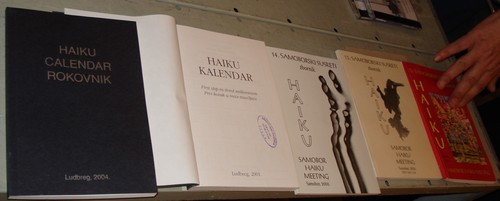
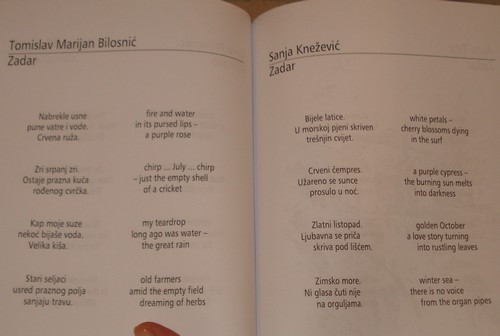
A
part of Croatian haiku literature in the
Scientific Library in the city of Zadar. Many thanks to professor
Milenka Bukvic, director of the Library.
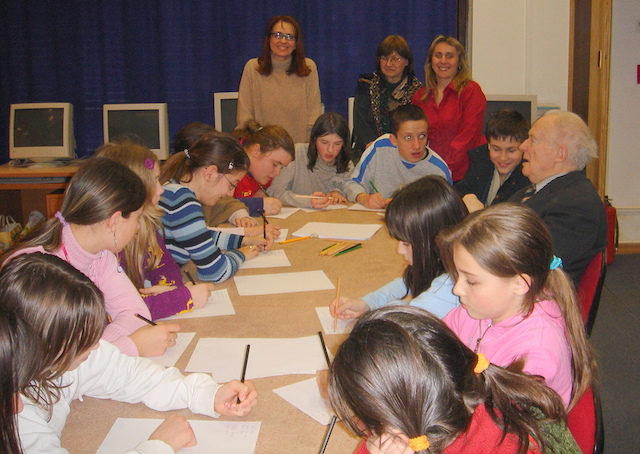
Professor Vladimir Devidé with children interested in haiku.
Photos by the courtesy of Mrs. Višnja McMaster, Zagreb.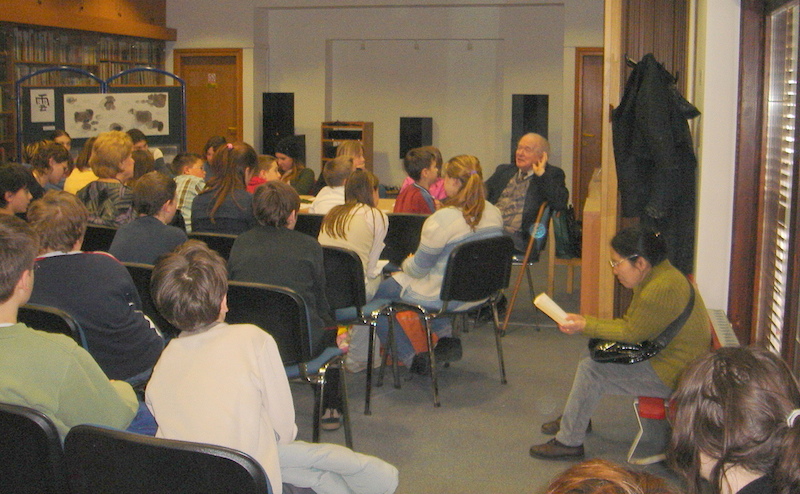
Razgovor s profesorom Devidéom
O jednom dogaðaju vjerojatnosti nula, koji je prof. Devidé ipak doživio
www.croatia.org - Croatian World Network
I express my sincere gratitude to professor Vladimir Devidé for providing me with some basic information about the phenomenon of haiku poetry in Croatia.
Croatia - its History, Culture and
Science