
Hrvatsko glagoljsko pismo
© Darko Zubrinic, Zagreb (2001.)U povijesti hrvatskog narod rabila su se tri pisma:
- hrvatsko glagoljsko pismo,
- hrvatska ćirilica (bosančica),
- latinica.
Danas se rabi jedino latinično pismo.
I pismo zvano Arabica bilo je u uporabi među muslimanima u Bosni i Hercegovini. To je u stvari arapsko pismo korišteno za hrvatski jezik, i čini temelj tzv. Adjami ili Aljamiado književnosti, slično kao i u Španjolskoj. Njeni prvi izvori u Hrvatskoj datiraju iz 15. st. Jedan od najstarijih tekstova je ljubavna pjesma pod nazivom ``Chirvat-türkisi'' (hrvatska pjesma) iz 1588., koju je napisao neki Mehmed. Rukopis se čuva u Austrijskoj nacionalnoj knjižnici u Beču. Osim u književnosti arabica se rabila u religioznim školama i za administrativne potrebe. Razumije se, ona je bila u uporabi mnogo manje nego ostala pisma. Posljednja knjiga otisnuta arabicom objavljena je 1941. g.
 Hrvatsko glagoljsko pismo ima dugu i bogatu povijest od preko tisuću
godina. Hrvati koji su rabili glagoljsko pismo bili su jedini narod u
Europi s posebnom povlasticom Pape Inocenta IV. iz godine 1248.,
kojom je odobrena uporaba njihova jezika i pisma u bogoslužju. Točnije,
ovo je dopuštenje Papa dao biskupu Filipu u Senju. Ipak, činjenica
da je Vatikan s pridavao posebnu pažnju glagoljskoj liturgiji u sljedećim
stoljećima, čak i tiskanjem glagoljskih misala i brevijara u Rimu, pokazuje
da se ta povlastica odnosila na sve hrvatske zemlje gdje je bila u uporabi
glagoljsko bogoslužje, većinom duž obale. Kao što je dobro poznato, latinski
jezik i pismo bili su povlašteni u bogoslužju Katoličke crkve sve do II.
Vatikansko sabora, kada su u katoličko bogoslužje uvedeninarodni jezici
umjesto latinskog. Zanimljivo je da se i danas u nekim hrvatskim crkvama
povremeno rabi glagoljsko bogoslužju.
Hrvatsko glagoljsko pismo ima dugu i bogatu povijest od preko tisuću
godina. Hrvati koji su rabili glagoljsko pismo bili su jedini narod u
Europi s posebnom povlasticom Pape Inocenta IV. iz godine 1248.,
kojom je odobrena uporaba njihova jezika i pisma u bogoslužju. Točnije,
ovo je dopuštenje Papa dao biskupu Filipu u Senju. Ipak, činjenica
da je Vatikan s pridavao posebnu pažnju glagoljskoj liturgiji u sljedećim
stoljećima, čak i tiskanjem glagoljskih misala i brevijara u Rimu, pokazuje
da se ta povlastica odnosila na sve hrvatske zemlje gdje je bila u uporabi
glagoljsko bogoslužje, većinom duž obale. Kao što je dobro poznato, latinski
jezik i pismo bili su povlašteni u bogoslužju Katoličke crkve sve do II.
Vatikansko sabora, kada su u katoličko bogoslužje uvedeninarodni jezici
umjesto latinskog. Zanimljivo je da se i danas u nekim hrvatskim crkvama
povremeno rabi glagoljsko bogoslužju.
Godine 1252. isti Papa Innocent IV. dopustio je i glagoljaškim benediktincima jednog samostana kod grada Omišlja na otoku Krku da rabe glagoljaško bogoslužje umjesto latinskog.
Poznato je da su hrvatski glagoljaši benediktinci postojali i u
gradu Krku na istoimenom otoku, kao i na otoku Pašmanu pored Zadra. Još
je neobičnije postojanje benediktinaca glagoljaša na otoku Braču pored Splita,
u gradiću Povlja,
koji su rabili hrvatsko crkvenoslavensko bogoslužje, ali hrvatsko
ćilisko pismo! Treba istaknuti da su benediktinci bili strogi sljedbenici
latinskog bogoslužja i latinskog jezika i pisma svuda u Europi osim na dijelovima
hrvatske obale.
Prema Ivanu Ostojići, benediktincu i istaknutom stručnjaku za povijest
tog reda u Hrvatskoj, tijekom 13. i 14. st. u Hrvatskoj je postojalo čak
70 muških benediktinskih samostana i 20 ženskih. Oni su predstavljali
veliku intelektualnu snagu u Hrvatskoj. Podsjetimo se poznatog benediktinskog
pravila - Ora et labora. (Moli i radi). Vidi [Gregory Peroche], str. 40.
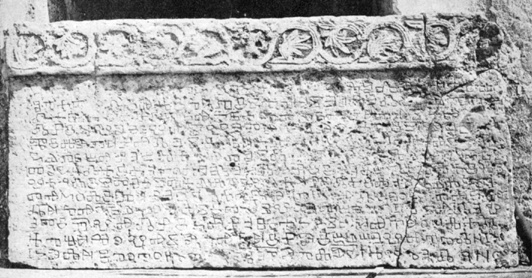
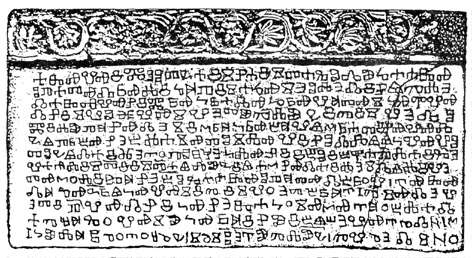
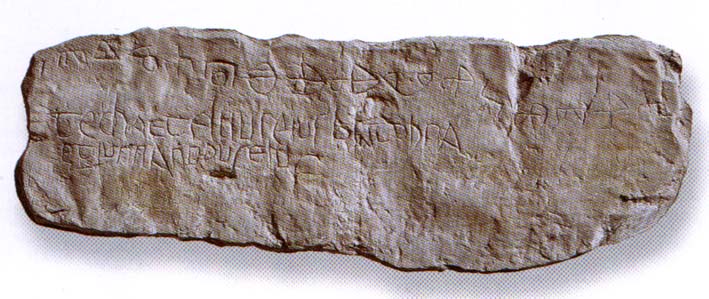
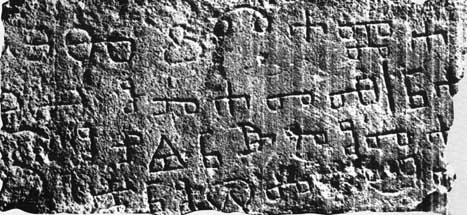
 rlo važan spomenik pisan hrvatskom glagoljicom je znamenita Bašćanska ploča s konca 11. st., nađena u Crkvici sv. Lucije
u Jurandvoru kod Baške na otoku Krk. Ploča sadži oko
400 egzotičnih glagoljskih slova. Dimenzije ploče su 2x1 m., i težina joj
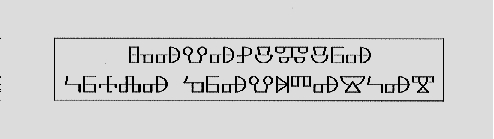
je 800 kg. Njena osobita važnost je u sljedeće tri riječi:
rlo važan spomenik pisan hrvatskom glagoljicom je znamenita Bašćanska ploča s konca 11. st., nađena u Crkvici sv. Lucije
u Jurandvoru kod Baške na otoku Krk. Ploča sadži oko
400 egzotičnih glagoljskih slova. Dimenzije ploče su 2x1 m., i težina joj
je 800 kg. Njena osobita važnost je u sljedeće tri riječi:
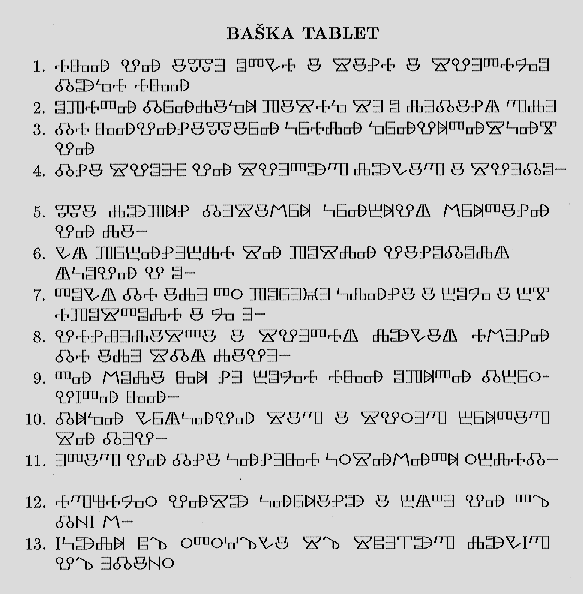
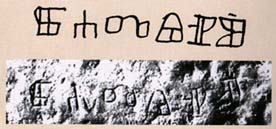
Može se vidjeti u trećem retku - Z'v'nimir', kral' hr'vat'sk'y, na najsvečanijem mjestu na ploči. Malo je naroda u Europi koji se mogu pohvaliti s tako opsežnim pisanim spomenikom, i to na narodnom hrvatskom jeziku s elementima crkvenoslavenskog (po akademiku Branku Fučiću), i to već u 11. st.
Više podataka o Bašćanskoj ploči naći ćete na:
- Bašćanska ploča
- rekonstruirani sadržaj bašćanske ploče, s razmacima među riječima. Na slici desno je rekonstrukcija Bašćanske ploče prema akademiku Branku Fučiću. S lijeva je njen sadašnji izgled.
- Wen: Baska tablet, Appleby,
Drenova.
- episode with the British Prince Philip, related to the Baska tablet.
Treba spomenuti sljedeću važnu činjenicu: glagoljski natpisi klesani u
kamenu (stotine njih, najraniji iz 11. st., po Marici Čunčić iz 10. st.)
postoje jedino na hrvatskom etničkom prostoru, i nigdje drugdje.
Postoje indikacije da je i znameniti povijesni izvorSclavorum Regnum, poznat kao Ljetopis popa Dukljanina i Hrvatska kronika, bio napisan glagoljicom. Ovaj vrlo stari tekst predstavlja najstarije poznato povijesno djelo o Hrvatima i najstariji poznati književni tekst na hrvatskom jeziku.

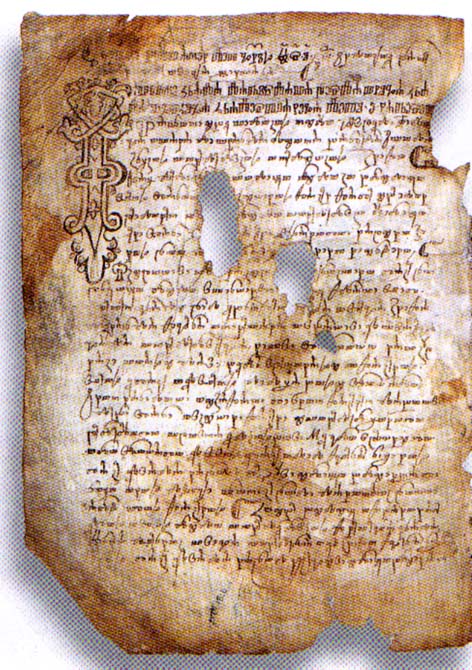 Jedan
od najstarijih i najvažnijih hrvatskihpravnih spomenika je Vinodolski
zakon (vrlo različit od Rimskog zakona), pisan kurzivnom glagoljicom
1288. g. Zakon je također uveo i instituciju svjedoka. Jedinstven je u
Europi tog vremena po uvođenju moralne žaštite žene. Vinodolski zakon
ne dopušta torture u pravnom postpuku, i smatra se jednim od najvažnijih
dokumenata te vrste u Europi. Među slavenskim zakonicima jedino je Ruski zakon "Pravda" nešto
stariji (1282). Prvo hrvatsko izdanje Vindolskog zakona objavljeno je
u Zagrebu 1846. Uskoro su objavljena dva ruska prijevoda s komentarima:
jedan u Moskvi 1846. i drugi u Petrogradu 1878. Prijevod na poljski jezki
pojavio se 1856., a na francuski 1896. Zakon je objavljen u mnogim europskim
zemljama: preveden je na najmanje devet jezika.
Jedan
od najstarijih i najvažnijih hrvatskihpravnih spomenika je Vinodolski
zakon (vrlo različit od Rimskog zakona), pisan kurzivnom glagoljicom
1288. g. Zakon je također uveo i instituciju svjedoka. Jedinstven je u
Europi tog vremena po uvođenju moralne žaštite žene. Vinodolski zakon
ne dopušta torture u pravnom postpuku, i smatra se jednim od najvažnijih
dokumenata te vrste u Europi. Među slavenskim zakonicima jedino je Ruski zakon "Pravda" nešto
stariji (1282). Prvo hrvatsko izdanje Vindolskog zakona objavljeno je
u Zagrebu 1846. Uskoro su objavljena dva ruska prijevoda s komentarima:
jedan u Moskvi 1846. i drugi u Petrogradu 1878. Prijevod na poljski jezki
pojavio se 1856., a na francuski 1896. Zakon je objavljen u mnogim europskim
zemljama: preveden je na najmanje devet jezika.
There are many other important legal documents regarding medieval Croatia, of which mention should be made
- the Korcula codex (from the island of Korcula, 1214, statute
of the city and island written in Latin),
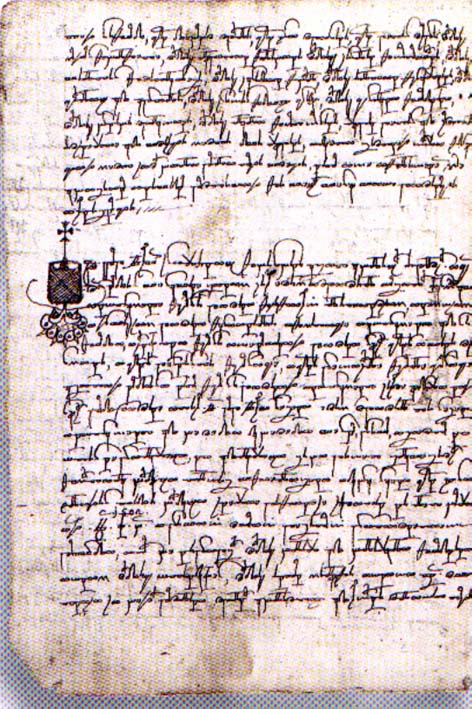 Istarski
razvod from the Istrian peninsula, 1275, written originally in three languages:
Croatian in the Glagolitic alphabet, Latin and German. It defined the
border between different rulers in Istria.
Only the Croatian Glagolitic version has been preserved. There are Italian
and Latin translations from Croatian dating from the 16th century, which
kept the original Croatian names for many places, proof that the population
in the Istrian hinterland was dominantly Croatian. By its juridical
and literary value it can be ranked among the most interesting documents
of that time in Europe. It is also the oldest international diplomatic
document written in Croatian. Earlier written documents bear witness
to the presence of the Croats in Istria from the seventh century.
Istarski
razvod from the Istrian peninsula, 1275, written originally in three languages:
Croatian in the Glagolitic alphabet, Latin and German. It defined the
border between different rulers in Istria.
Only the Croatian Glagolitic version has been preserved. There are Italian
and Latin translations from Croatian dating from the 16th century, which
kept the original Croatian names for many places, proof that the population
in the Istrian hinterland was dominantly Croatian. By its juridical
and literary value it can be ranked among the most interesting documents
of that time in Europe. It is also the oldest international diplomatic
document written in Croatian. Earlier written documents bear witness
to the presence of the Croats in Istria from the seventh century.
- the Statute of the Poljica
Principality (1444, near Split),
written in the Croatian Cyrillic Script. The
Poljica Principality (Poljicka knezija) was a unique phenomenon in Europe.
It existed continuously for almost seven centuries, with its own very
original legal system. Russian scientist P. Alexeev believes that Thomas
More wrote his ``Utopia (The Perfect State)'' (Louvain, 1516) inspired
by the Poljica Principality. Thomas More calls Poljica man - Poly(it)eritu,
i.e. those who use more scripts (3 scripts: Glagolitic, Cyrillic, and
Latin). Legend has it that the Principality was founded by three sons
of dethroned Croatian king Miroslav in the mid 10th century. It was
abolished during the French rule in 1807. As remarked by scientists
already in the 19th century, the "Poljica Statute" is very closely related
to the above mentioned Ruskaya Pravda, though they appeared in very
distant areas (Kiev and Dalmatia). See [Pascenko],
p. 272.
One of the items of Poljica statute is that "everybody has the right to live," contrary to many medieval European laws replete with punishments involving torture. Thomas More added to the 1516 edition of his Utopia a frontispiece showing 4 lines in the Utopian language and Utopian alphabet. According to Alexeev, those who know glagolitic script, at a first glance cannot resist the idea that ``some letters in these four lines are in fact written in the glagolitic script'' (see [Mardesic], p. 147).
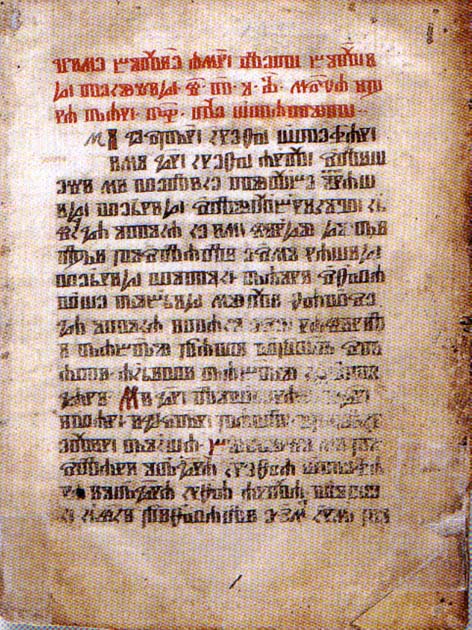 We
know of several Croatian city statutes written in the Glagolitic Script:
We
know of several Croatian city statutes written in the Glagolitic Script:
- the Vrbnik Statute (on the island of Krk), written in 1388,
- the Kastav Statute (1490, near Rijeka), preserved in Latin, translated from the Glagolitic Script,
- Moscenica Statute (~1501, Istria), preserved in Latin, translated from the Glagolitic Script,
- the Veprinac Statute (1507, Istria), preserved in the Glagolitic.
Except for the very rich sacral literature, there are thousands of other documents proving that the Glagolitic alphabet was also used in the administration and in private communication.
The oldest known Croatian nonliturgical verses (10 poems) are from 1380, written in cakavian dialect in the glagolitic collection Code Slave 11, which is now held in Bibliothéque Nationale, Paris.
 The
famous Czech king Charles IV of Luxemburg built a Glagolitic convent
in Prague in 1347, where Croatian Benedictines from the island of
Pasman were invited as teachers. It is remarkable that the convent was
just a few hundred meters from the famous Charles University, built the
next year, in 1348 (Charles IV also founded the University of Vienna in
1365). One of the Glagolitic books from this convent (Emaus) in Prague
came to Reims in 1574, where for centuries the French kings (Charles IX,
Henri II, Louis XIII, Louis XIV) were sworn in by putting their hands
on this holy book, known under the name Texte du Sacre or Évangéliaire
de Reims. This Glagolitic book was written in 1395, and represents
a copy of an older Croatian book, written probably in Omisalj. In fact,
the Glagolitic book was bound together with a Cyrillic book which is of
the Ukrainian (Ruthenic) provenance, written in Kiev, and dates from the
12th century. The book is ornamented with gold, precious stones and relics,
and according to [Dolbeau], p 26-27, probably calligraphed on the island
of Krk or in a Czech monastery. These Dolbeau's pages are available here.
The
famous Czech king Charles IV of Luxemburg built a Glagolitic convent
in Prague in 1347, where Croatian Benedictines from the island of
Pasman were invited as teachers. It is remarkable that the convent was
just a few hundred meters from the famous Charles University, built the
next year, in 1348 (Charles IV also founded the University of Vienna in
1365). One of the Glagolitic books from this convent (Emaus) in Prague
came to Reims in 1574, where for centuries the French kings (Charles IX,
Henri II, Louis XIII, Louis XIV) were sworn in by putting their hands
on this holy book, known under the name Texte du Sacre or Évangéliaire
de Reims. This Glagolitic book was written in 1395, and represents
a copy of an older Croatian book, written probably in Omisalj. In fact,
the Glagolitic book was bound together with a Cyrillic book which is of
the Ukrainian (Ruthenic) provenance, written in Kiev, and dates from the
12th century. The book is ornamented with gold, precious stones and relics,
and according to [Dolbeau], p 26-27, probably calligraphed on the island
of Krk or in a Czech monastery. These Dolbeau's pages are available here.
The French kings were sworn in on the
Glagolitic book with the following words:
Precious stones, relics, and a part of the true Cross disappeared from the cover of the book during the French revolution. See [Gregory Peroche], p. 62.
In 1485/46 a French pilgrim Gheorge Langherand wrote that in Zadar he heard a "Sclavonic" sermon, that is, a Croatian Glagolitic mass. In 1549 a French Franciscan and cosmograph Andre Thevet noted the prayer "Oce nas" (Our Father) in Croatian language. See [Raukar], p. 360.
According to the renowned Czech linguist Nemec, the influence that the Croatian glagolites in Prague had on the formation of orthography of the Czech language was "neither big nor negligible". The Polish king Vladislaw II Jagiello also opened a Glagolitic convent in Krakow (Kleparz) in 1390, where the glagolitic priests were active for almost 100 years. His wife Jadviga was the Croat.
As a young man Charles IV visited for several days the Croatian coastal town of Senj in 1337, when he was only 21. In this important glagolitic center, with the unique Roman Catholic cathedral where only the Glagolitic liturgy had been served (instead of Latin rite), he made friends with the nobleman Bartolomej Frankapan. Frankapan supplied him with military escort on his journey to Tirol, where he was to meet his brother.
There exist even earlier important traces of cultural contacts between Czechs and Croats, going back to 10th and 11th centuries. If you visit Prague, we recommend you to see the famous monastery in Sazava, just 30 km from Prague. There you can find the "Croatian room", describing in detail the presence of the Croatian glagolites in Czechia.
It is worth noting that the famous Czech
lexicographer Bartolomej z'Hlouce, better known as Kloret
(14/15th centuries), wrote his Latin - Czech dictionary where
Latin words are translated into Czech, while words of the
Greek or Hebrew origin are translated - into Croatian! For
example: sanctus -> svat, hagios -> svet.
The 14th century
Czech philosopher Jan z'Holesova wrote in his tractate
about the religious song "Hospodine, pomiluj ny" (sung even today), that it contains
many Croatian words (like hospodine = gospodine). Moreover,
he even states that the Czech language and nation stem from
the Croats: ...nos Bohemi et genere et lingua originaliter
processimus a Charvatis, ut nostrae chronicae dicunt seu
testantur, et ideo nostrum boemicale ydioma de genere suo est
charvaticum ydioma..., see [Hercigonja,
Povijest hrv. knjiz. II, p. 63]
A Croatian glagolitic Dominican priest
Beniamin de Croatia, born probably in Split, participated in the preparation of Genadij's
Bible, the oldest Russian Bible (1491). He was the chief
collaborator of the Novgorod Archbishop Genadij, where he
spent about 20 years (~1490-1510), at that time the capital
of Russia. Beniamin
translated large portions from the Latin text of Vulgata
into Russian (e.g. the Book of Macabians, the Ezra
sermons and some other). It is therefore not surprising that some
elements of the Croatian language can be
traced in this oldest Russian Bible. Beniamin translated
also other western books into Russian. Until his arrival
Russia was in contact almost exclusively with Byznatine culture.
See [Gregory Peroche], p. 69.
I would like to thank academician Eduard
Hercigonja for bringing my attention to Beniamin.
See [Horvat], p. 17.
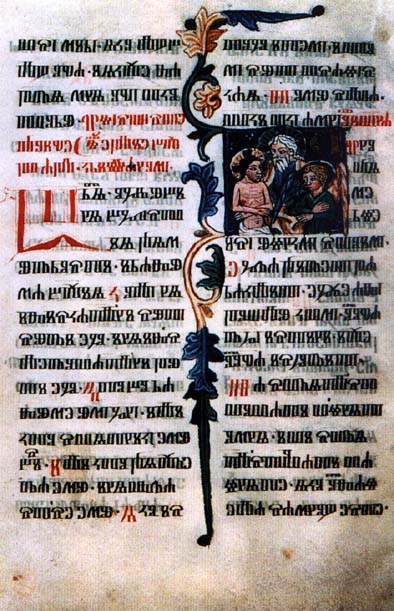
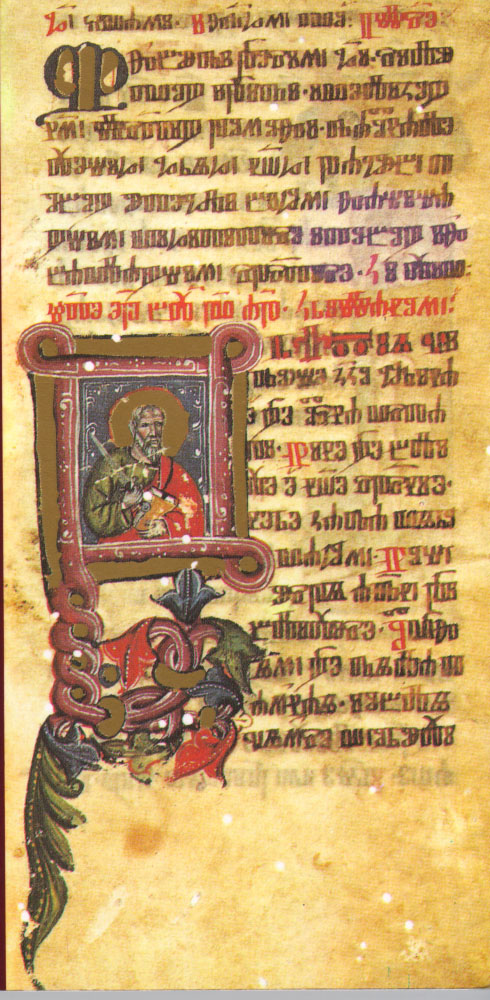 Probably the most interesting Glagolitic book is a
liturgical book called Missal of Hrvoje, written in 1404 by a glagolitic
scribe Butko. It has 94 beautiful illuminations, 380 colourful initials
(some of them in gold), and has been kept in the Library of the Turkish
sultans (Topkapi Saray) in Constantinople since the 16th century. It is
written in two columns on 488 pp (22.5x31 cm), and contains also some
music notation.
Probably the most interesting Glagolitic book is a
liturgical book called Missal of Hrvoje, written in 1404 by a glagolitic
scribe Butko. It has 94 beautiful illuminations, 380 colourful initials
(some of them in gold), and has been kept in the Library of the Turkish
sultans (Topkapi Saray) in Constantinople since the 16th century. It is
written in two columns on 488 pp (22.5x31 cm), and contains also some
music notation.
Hrvoje Vukcic Hrvatinic was the duke of Bosnia, a Croat who belonged to Krstyans (members of the Bosnian Church), a Christian religious sect about which we still know very little. Hrvoje also left us another very interesting book, Missal for Krstyans, written in the Croatian Cyrillic Script (ikavian dialect) by Hval in 1404, which is now kept in the University Library in Bologna. This beautiful book is a translation from the glagolitic original. Moreover, glagolitic letters can be found on two places.
According to Croatian researcher Josip Hamm, members of the Bosnian Church (Krstyans) particularly appreciated the Glagolitic Script: all the important Bosnian Church books (Nikoljsko evandjelje, Sreckovicevo evandelje, the Manuscript of Hval, the Manuscript of Krstyanin Radosav, etc.) are based on Croatian Glagolitic Church books.
Due to testimonies of Ivan Zovko written in 1899 we also know that Croatian women in Bosnia - Herzegovina had an old custom to embroider Crotian glagolitic letters.
Here are some of very interesting Croatian glagolitic monuments from Bosnia and Herzegovina that I scanned:
- two inscriptions carved in stone
tablet found in the vicinity of Banja-Luka (Slatina) from
1471:
- se pisa t(?) i l, ... ("this was written by...", a typical Croatian expression)
- se pi(s)a a? i (reference for both monuments is: [Poviest]).
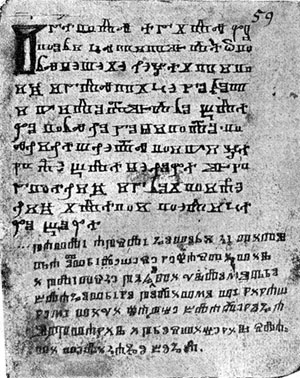
- from the Manuscript of Krstyanin Radosav, 15th century (a glagolitic page from the book written in Croatian cyrillic; the book contains also Glagolitic azbuka).


 t is important to note that the Krstyans had a humble
church that strove for
independence from the Vatican. The pataren
heresy was an excuse for several Crusades,
whose primary goal was the occupation of Bosnia. It is
therefore not surprising that with the arrival of the Turks
most of the Krstyans converted to Islam.
t is important to note that the Krstyans had a humble
church that strove for
independence from the Vatican. The pataren
heresy was an excuse for several Crusades,
whose primary goal was the occupation of Bosnia. It is
therefore not surprising that with the arrival of the Turks
most of the Krstyans converted to Islam.
It is worth mentioning that some Russian monks had been using the Glagolitic as a secret Script (latest known case dates back to the 17th century). Even today some children in Croatia use it for the same purpose.
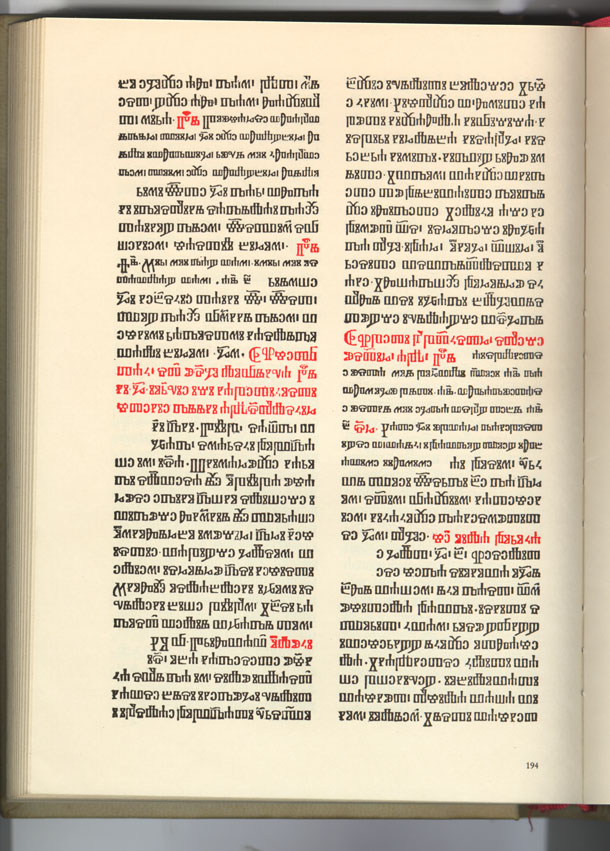 The first
Croatian printed book in Glagolitic letters appeared as early as 1483,
only 28 years after Gutenberg's Bible, 6 years after the first printed
book in Paris and Venice, one year before Stockholm, 58 years before Berlin
and 70 years before Moscow. It was a Missal (440 pp, 19x26 cm),
unfortunately it is not known where it was printed. The Croatian Glagolitic
Script was the fifth to appear in the history of European printing, very
soon after the Latin, Gothic, Greek and Hebrew scripts.
The first
Croatian printed book in Glagolitic letters appeared as early as 1483,
only 28 years after Gutenberg's Bible, 6 years after the first printed
book in Paris and Venice, one year before Stockholm, 58 years before Berlin
and 70 years before Moscow. It was a Missal (440 pp, 19x26 cm),
unfortunately it is not known where it was printed. The Croatian Glagolitic
Script was the fifth to appear in the history of European printing, very
soon after the Latin, Gothic, Greek and Hebrew scripts.
The first incunabulum printed in the Croatian language and in the Latin
Script was the Lectionary of Bernardin of Split, published
in Venice in 1495. There is no doubt that it was created on
the basis of earlier glagolitic lectionaries.
Glagolitic books were printed not only in Croatia (Kosinj, Senj, Rijeka), but also in Venice, which had two Glagolitic churches at that time, and in Rome. Early Croatian printing becomes even more fascinating if we consider that at that time (by the end of the 15th century) invasions of the Ottoman Empire began. We know that the Croats participated in preparation of as many as 150 incunabula in Croatia and western Europe in the period between 1474 and 1500 (i.e. books printed during the earliest period of printing, 1455 - 1500).
Let us mention the name of Dobric
Dobricevic (Boninus de Boninis), Ragusan born on the
island of Lastovo, 1454-1528,
who worked as a typographer in Venice, Verona, Brescia.
His last years he spent as the dean of the Cathedral
church in Treviso. His bilingual (Latin - Italian) editions
of "Aesopus moralisatus, Dante's "Cantica" and
"Commedia del Divino" were printed first in Brescia in 1487,
and then also in Lyon, France.
We know of about 50 of his editions, the greatest number
belonging to the period of 1483-1491 that he spent in Brescia - about 40.
Croatia is in possession of 19 of his editions in 30
copies. The greatest number of his editions is in possession
of the
British Museum, London (22).
Another Croat, known as
Jacques Moderne, born in Buzet (15th century), Istria, printed about
50 music booklets in Lyon, France.
 ccording
to the views of most Slavic scholars, the
Glagolitic Script was
created by St. Cyrill in the second half of the 9th century.
Not all scholars agree on this point. Some of them believe
that it must have existed earlier, and that it had a natural development
over a much longer period. In any case, some of its letters are
quite close to the corresponding ones from very old
oriental scripts: South-Semitic, Samaritan (an old
Hebrew Script), the Cretan linear A and B, Armenian and others.
Some are of the opinion that the appearance of this Script
in this part of Europe was due to extensive migrations from the
East.
The question of the origins of the Glagolitic Script seems to
be still a difficult open problem. In the earliest period it also existed
in Ukraine, Bulgaria and Macedonia, but only until
the 12th century, when the Cyrillic Script (which is
essentially a Greek Script) became predominant.
ccording
to the views of most Slavic scholars, the
Glagolitic Script was
created by St. Cyrill in the second half of the 9th century.
Not all scholars agree on this point. Some of them believe
that it must have existed earlier, and that it had a natural development
over a much longer period. In any case, some of its letters are
quite close to the corresponding ones from very old
oriental scripts: South-Semitic, Samaritan (an old
Hebrew Script), the Cretan linear A and B, Armenian and others.
Some are of the opinion that the appearance of this Script
in this part of Europe was due to extensive migrations from the
East.
The question of the origins of the Glagolitic Script seems to
be still a difficult open problem. In the earliest period it also existed
in Ukraine, Bulgaria and Macedonia, but only until
the 12th century, when the Cyrillic Script (which is
essentially a Greek Script) became predominant.
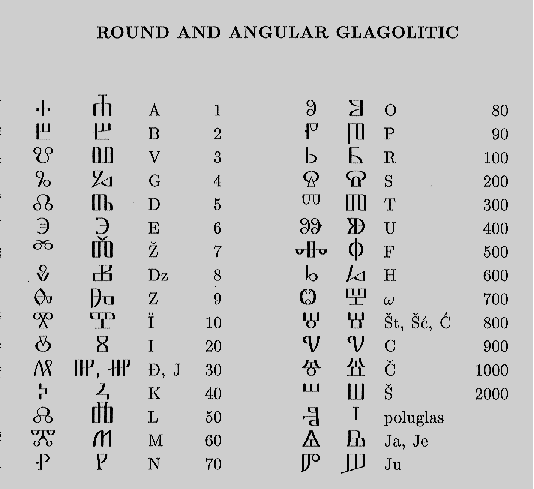
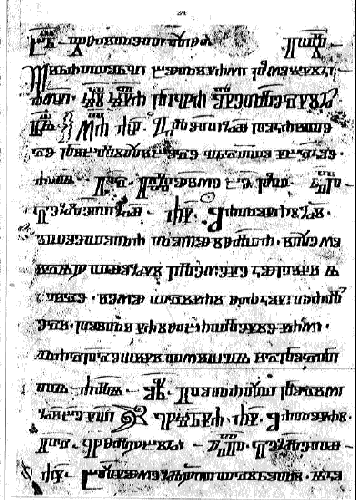 The Glagolitic Script began
to acquire a new, angular form in the 12th century, usually referred
to as the Croatian Script. The round
form was also present on earliest Croatian glagolitic monuments. Let
us list more than 20 of the most important Croatian glagolitic documents
written in the round glagolitic or round/angular glagolitic in the earliest
period (11th and 12th centuries). First those written on parchment:
The Glagolitic Script began
to acquire a new, angular form in the 12th century, usually referred
to as the Croatian Script. The round
form was also present on earliest Croatian glagolitic monuments. Let
us list more than 20 of the most important Croatian glagolitic documents
written in the round glagolitic or round/angular glagolitic in the earliest
period (11th and 12th centuries). First those written on parchment:
- the first of the Kiev Folia - which has been written in the Dubrovnik region (11th century), as proved by dr. Agnezija Pantelic;
- the Vienna Folia (11th century), (see the photo on the right),
- the Glagolita Clozianus (11th century),
- the Budapest fragments (11/12th centuries),
- the Grskovic fragment of Apostle (12th century),
- the Mihanovic fragment of Apostle (12th century),
- the Baska ribbons (12th century),
- the Split fragment (12/13th centuries),
- the muniment of the `famous Dragoslav', (parchment or paper, preserved in later transcript) January 1, 1100, the earliest mention of Vrbnik and Dobrinj on the island of Krk,
- the Vrbnik fragments of a church book, 12th
century
(see Ivan Bercic's "Citanka staroslavenskog jezika", 1864, Prague, or Vjekoslav Spincic's "Crtice iz hrvatske knjizevne kulture Istre", 1926, reprinted by KS, Zagreb 1984), - the Vrbnik fragment of a breviary, 12th century (ibid.)
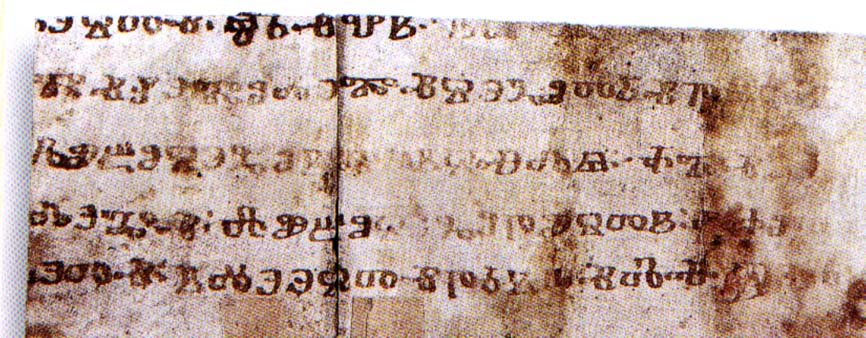
The rest are 17 inscriptions from the 11-12th centuries, carved in stone in the round or the round/angular glagolitic. It is of interest to stress that glagolitic monuments carved in stone exist only among the Croats (in today's Croatia and parts of BiH), nowhere else.
- the Valun tablet (11th century; according to dr. Marica Cuncic from 10th century, personal info.),
- the Plomin tablet (11th century; according to dr. Marica Cuncic from 10th century),
- the Krk tablet (11th century; according to dr. Marica Cuncic from 10th century),
- the Baska tablet (end of 11th century),
- the Baska fragments (end of 11th century), remains of the second Baska tablet,
- the Senj tablet (end of 11th century),
- the Kijevci fragment (11/12th centuries), north - western Bosnia,
- the Kukuljevich tablet (1095), lost, but its content is known (western Slavonia, between Lipovljani and Novska);
- the Brodski Drenovac stone inscriptions, western Slavonia, according to my estimate the oldest parts belong to 12th century; proof: trapesoidal yat appearing on several places, vaulted glagolitic D with two eyes, the famous triangular A as on the Baska tablet (on a stone tablet in the church of Sv. Dimitrije, obivously transferred from an older church);
- the Grdoselo fragment (11/12th centuries),
- the Supetar fragment (St. Peter in the Wood, Istria, 12th century),
- the Knin fragments (11/12th centuries),
- the Plastovo fragment (11/12th centuries),
- the Konavle fragment (12th century or earlier), discovered in the region south of Dubrovnik in 1997,
- the Hum graffitto (12th century),
- the Roc abecedarium (approx. 1200),
- the Humac tablet (12th century), Herzegovina.
It is possible that the following monuments should be added to the above list:
- the Marian Evangel (end of 10th century; its provenance is still not clear - Bulgarian specialists think it is of the Bulgarian origin),
- the Paris glagolitic abecedarium (sometimes called "Bulgarian" in the literature),
- the München abecedarium,
- the Rudina inscription (12th century, western Slavonia).
The above list shows that the name ``Bulgarian glagolitic'' or ``Macedonian glagolitic'' for the oldest form of the Glagolitic Script is not fully justified.
Investigations of the oldest forms of the Glagolitic Script performed by Dr. Marica Cuncic in her Ph.D. thesis (1985) have led to the discovery of triangular form of the Glagolitic (with triangular shapes occurring in most of the letters), dating from the 9th and 10th century. Its remnants can be found in the Croatian Glagolitic inscriptions - for example on the Valun tablet, Krk tablet, and Plomin tablet (from the islands of Cres, Krk and Istrian peninsula respectively, all from 10th century according to dr. Cuncic), and also on some other oldest Croatian glagolitic monuments. By transforming the triangles into circles the round type has developed. All three forms can be seen on the Baska Tablet (Bascanska ploca), also in handwritten books as well as in printed books. Hence, the glagolitic script evolved from the triangular form:
- Triangular glagolitic (9-10th centuries),
- Round glagolitic (11-12th centuries),
- Angular glagolitic (13-19th centuries).
It is interesting that a table of the Glagolitic Script was included as early as in 1644 in a book prepared by Richard Daniell and published in London. It represents a catalogue of various Scripts in use in the Christian world. The Glagolitic Script presented there is called expressly the Croatian hand or Alphabetum Charvaticum. Still earlier, in 1545, an Italian encyclopaedist Giovanni Batista Palatino presented in one of his books the Glagolitic Script, which he claims to be "different from all other existing Scripts". Also a renowned French polyhistorian and encyclopaedist Gyon Costel included a table of this script in one of his books in 1538. In 1591 an Italian scholar Angelo Rocca wrote a book where Glagolitic Script is included.
The Croats possess an extensive collection of about 700-800 legal documents, statutes etc., written in the vernacular between the 12th and the 16th centuries - more than any other Slav nation. This extremely important collection of muniments called Acta Croatica represents a rich source for the study of the Medieval Croatian language. Most of the documents are written in Glagolitic, some also in Croatian Cyrillic. "Acta Croatica" is to be published by the Croatian Academy of Sciences and Arts.
The Croatian Glagolitic Script has hundreds of extraordinary ligatures, resembling real buildings, connecting two, three and sometimes even four or five letters. They had been in extensive use in both handwritten and printed books, and especially in the glagolitic quick-script. The Brozich breviary alone, which is a printed book (1561), contains as many as 250 different ligatures. The Croatian Glagolitic Script has very probably more ligatures than any other script in the world.
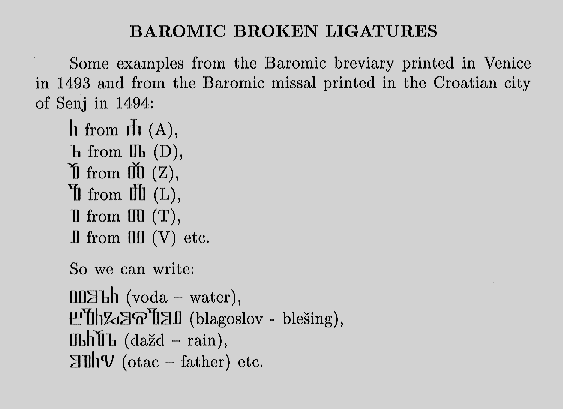
The broken ligatures created by Blaz Baromic (14/15th centuries) represent a unique phenomenon in the history of European printing. The idea was to add one half of a letter to another. This possibility arose from the architecture of glagolitic letters. Broken ligatures appear in two incunabula: the Baromic breviary printed in Venice in 1493, and the Baromic missal printed in the Croatian city of Senj in 1494. When looking at their pages, one has the impression as if they are handwritten. It is fascinating that the Senj printing house had been active despite the onslaughts of the Turkish Ottoman Empire.
We know of altogether five Croatian glagolitic incunabula, whose samples are held in Zagreb, Washington, the Vatican, St Petersburg, Schwarzau, München, Budapest, Venice, Sibiu (Roumania), plus one lost incunabulum (from 1492, written by Matej Zadranin). In the period between 1483 and 1561 altogether 21 titles of printed glagolitic books were issued.
 esides of city of Senj, Zadar was also an important
glagolitic center during centuries. It is interesting
that in numerous Zadar churches - St Marija,
St Donat, St Stjepan, St Mihovil and other - also
the Glagolitic mass was served besides Latin. The same
is true even for the Zadar cathedral of St Stosija. See [Runje].
esides of city of Senj, Zadar was also an important
glagolitic center during centuries. It is interesting
that in numerous Zadar churches - St Marija,
St Donat, St Stjepan, St Mihovil and other - also
the Glagolitic mass was served besides Latin. The same
is true even for the Zadar cathedral of St Stosija. See [Runje].
Thousands of books were printed in the Croatian Glagolitic and some in the Croatian Cyrillic Script during the past centuries, many of them with the generous help of Croatian Protestants who were active in Wittenberg and Urach in Germany in the 16th century. About thirty books were printed in 25,000 copies between 1561 and 1565, 300 of which have been preserved. On the front page of the glagolitic Cathecismus prepared by the Croatian glagolitic priest Stipan Konzul from Istria and printed in the German city of Tübingen in 1561, it is explicitly stated to be written in the Crobatischen Sprach (Croatian language). It is interesting that several editions were printed for Italians living in Istria (of course, in Italian and in the Latin script).
The last Croatian glagolitic book (Missal) was printed in Rome in 1905.
It is little known that a rescript of Austrian-Hungarian King Ferdinand I (1515-1564) granted the Burgenland Croats in Austria, who had to escape before the Turks, the right to choose their own priests who practiced God's service in Croatian vernacular language, and with holly books written in the Glagolitic. This privileges had been cancelled after his death, and since 1569 the Glagolitic was officially forbidden in Croatian parishes in Burgenland in Austria (Gradisce). See Miroslav Vuk-Croata: Hrvatske Bozicnice, HKD Sv. Jernoma, Zagreb 1995, p. 167.
The Glagolitic alphabet represents maybe the most interesting cultural monument of Croatia. Our glagolitic books (written and printed) and other glagolitic monuments are scattered in many national libraries and museums of the World, in as many as 21 countries, in about 50 cities outside Croatia:
- Russia: Moscow, St.Petersburg
- Ukraine: Kiev, Odessa
- Austria: Vienna, Innsbruck, Schwarzau, Linz, Trier, Güssing
- Germany: Berlin, Kassel, Weimar, Wertheim
- Sweden: Uppsala
- Denmark: Kopenhagen
- United Kingdom: London, Cambridge, Oxford
- Turkey: Constantinople
- France: Paris, Tours
- USA: New York, Washington, Princeton
- Czech Republic: Praha
- Slovakia: Martin
- Poland: Krakow, Wroclaw
- Portugal: Porto
- Spain: Madrid, Salamanca
- Hungary: Budapest
- the Vatican,
- Italy: Rome, Trento, Padova, Firenza, Sienna, Trieste, Cividale, Goriza
- Roumania: Sibiu
- Slovenia: Ljubljana, Mojstrana, Hrastovlje, Kopar, Novo Mesto,
- Bosnia-Hercegovina: Sarajevo (Zemaljski muzej), Fojnica (Muzej franjevacckog samostana), Humac (Franjevaccki muzej), Banja Luka (Muzej Bosanske krajine), neighbourhood of Jajce (discovered in 1996).
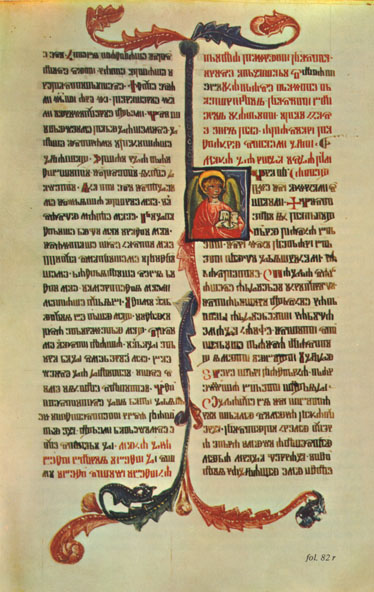 The
New York Missal, 1400-1410 written in the region of Zadar or Lika-Krbava,
now in the possession of the Pierpont Morgan Library in New York. Reprinted
by Verlag Otto Sagner Verlag (Munich) in 1977 with an introduction by
Henrik Birnbaum (USA).
The
New York Missal, 1400-1410 written in the region of Zadar or Lika-Krbava,
now in the possession of the Pierpont Morgan Library in New York. Reprinted
by Verlag Otto Sagner Verlag (Munich) in 1977 with an introduction by
Henrik Birnbaum (USA).
PROVENANCE: Zadar or Lika-Krbava region.
Frederick North, fifth Earl of
Guilford (1766-1827), with his bookplate; his sale, Evans,
1830, bought by Thorpe for Sir Thomas Phillips. The
underbidder was probably Sir Frederic Madden, for the
British Museum. Phillips paid the colossal price for this
manuscript at the Guilford sale, and considered it one of
his chief treasures. It was often produced at his "desserts
of manuscripts" for the admiration of visitors. This codex
was considered by Sir Thomas Phillips to be one of his chief
treasures. In 1966 it was bought by the Pierpont Morgan Library, New
York. For more information see [Birnbaum], and a
monograph written by
Andrew Corin: The New York Missal: A
Palaeographic and Phonetic Analysis, 272 pp, 1991, UCLA,
Los Angeles, USA.
 edieval religious plays were performed in Croatian
cities and towns
on the squares in front of churches, like in Western Europe.
The first secular dramas were presented in Zagreb and Vukovar as
early as the 14th century (in the Croatian
language, written in the Latin Script). Some of the earliest preserved stage
instructions written in the Glagolitic Script come from the island of Pasman near
Zadar.
edieval religious plays were performed in Croatian
cities and towns
on the squares in front of churches, like in Western Europe.
The first secular dramas were presented in Zagreb and Vukovar as
early as the 14th century (in the Croatian
language, written in the Latin Script). Some of the earliest preserved stage
instructions written in the Glagolitic Script come from the island of Pasman near
Zadar.
You can see more about some outstanding Croats in the Middle ages who used the Glagolitic Script:
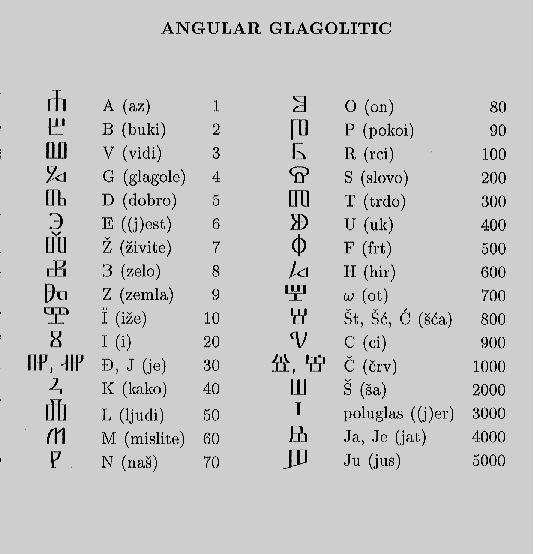
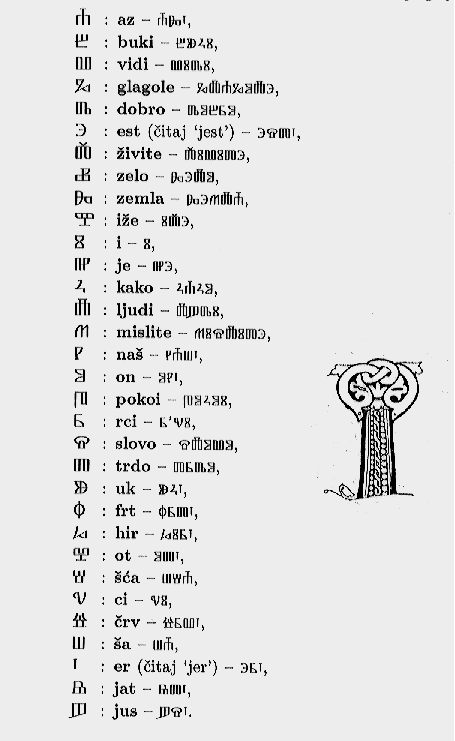
 pelling of Glagolitic Letters, with the
corresponding numerical values, according to George de
Slavonie (Juraj iz Slavonije, ~1355-1416),
Glagolitic priest and university
professor on Sorbonne in Paris (his manuscripts are held in
the Municipal library in Tours, France;
in his accompaning text he wrote:
Istud alphabetum est Charwaticum -
this is a Croatian Script):
pelling of Glagolitic Letters, with the
corresponding numerical values, according to George de
Slavonie (Juraj iz Slavonije, ~1355-1416),
Glagolitic priest and university
professor on Sorbonne in Paris (his manuscripts are held in
the Municipal library in Tours, France;
in his accompaning text he wrote:
Istud alphabetum est Charwaticum -
this is a Croatian Script):
|
|
One of his manuscripts held in Tours, France, contains prayers like:
in beutiful glagolitic handwriting, and with his translation into Latin. My deepest gratitude goes to academician Franjo Sanjek for his studies about George (Juraj), and for the facsimile.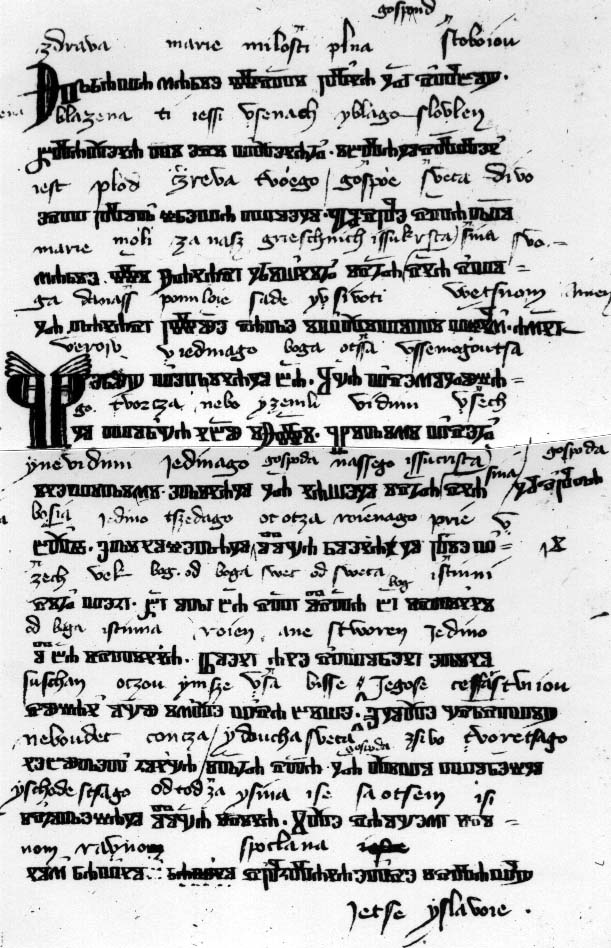

You can see a fragmentary, yet impressive list of the most important glagolitic monuments over the centuries (in Croatian).
It is generally beleived, even by specialists, that the last letter of Croatian Glagolitic is Jus. However, this is not true. There is one more letter, coming after Jus, which is Jest - je (as spelled by George de Sorbonne). Seven important Croatian Glagolitic abecedariums (they contain 33 - 34 letters) confirm this:
- The Roc abecedarium (about 1200),
- two Lovran abecedariums (Lovran is a town on the Istrian peninsula), see [Fucic, pp 238 and 240],
- Glagolitic abecedarium of Juraj from Slavonia (George de Sorbonne), held in France, around 1400,
- Glagolitic abecedarium of Bosnian Krstyanin Radosav from 1443,
- Pasman abecedarium,
- Psalter of Simun Kozicic Benja, printed in 1531 in Rijeka,
- Glagolitic primer from 1527, printed in Venice.
An importnat personality in the history of glagolitic script is Dragutin Antun Parcic, a 19th century lexicographer, linguist and glagolitic priest.
Places to visit in Croatia, possessing glagolitic monuments:
- permanent Exhibition of the Glagolitic Script (Izlozba glagoljice) in Rijeka, which we strongly recommend to you (prepared by academician Branko Fucic and prof Vanda Ekl; address: Dolac 1, near Korzo in the center, 10-13, 18-20, every day except Sunday and Monday).
- the Alley of Glagolites (Aleja glagoljasa) joining the cities of Roc and Hum in northern Istria (7 km). We recommend that you stop in the village Bernobici near Hum, where there is a glagolitic lapidarium. Don't miss seeing Roc and Hum - the smallest city in the world!
- permanent Exhibition of the Glagolitic Script in a Franciscan convent of St. Paul on the beautiful island of Galevac (also called Skoljic), near the town of Preko on the (much larger) island of Ugljan (close to Zadar). Contact address: dr. fra Bozo Sucic, Samostan sv. Pavla, 23273 Preko, Croatia. Also an interesting annual International art workshop "Jadertina" is held on Skoljic.
- Glagolitic lapidarium in Valun on the island of Cres,
- The exotic city of Vrbnik on the island of Krk.
- the Baska tablet (Bascanska ploca, replica) in the church of St. Lucy in Baska on the island Krk.
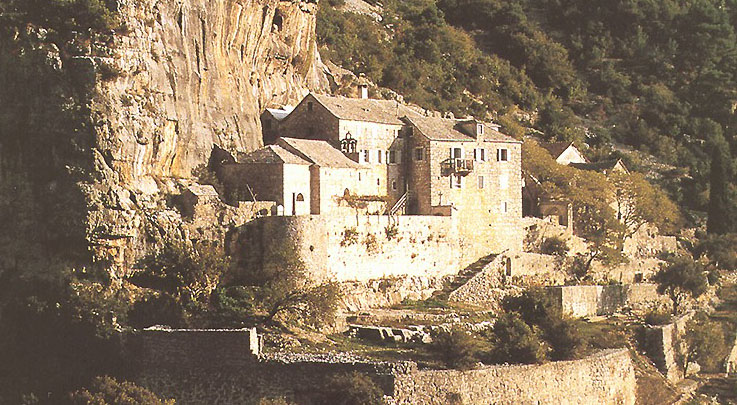
- Blaca, a lonely convent built on cliffs on the island of Brac, is indeed a fascinating place. It was founded by Croatian glagolitic hermits, who fled here from the Turks in the 16th century. The last glagolitic hermit was Don Niko Milicevic, who was also an astronomer of international reputation, with his published works in such prestigeous journal as "Astornomische Nachrichten" in Vienna, and with rich international correspondence. After his death in 1963 the place was transformed into museum.
- In the village of Gata (which belongs to very old Poljica principality) near Omis, not far from Split, there is a monument to unknown glagolitic priest, carved by Kruno Bosnjak in 1989.
- Glagolitic alley in the village of Gabonjin near Dobrinj on the island of Krk (conceived and realised by Mr Svetko Usalj in 2001).
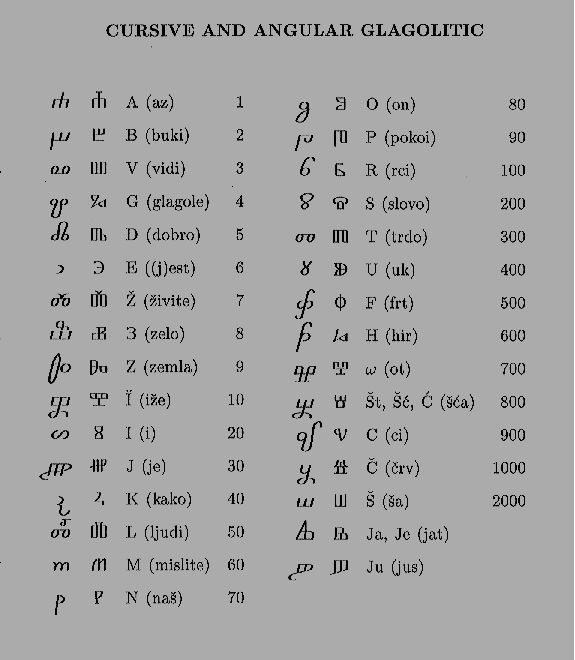
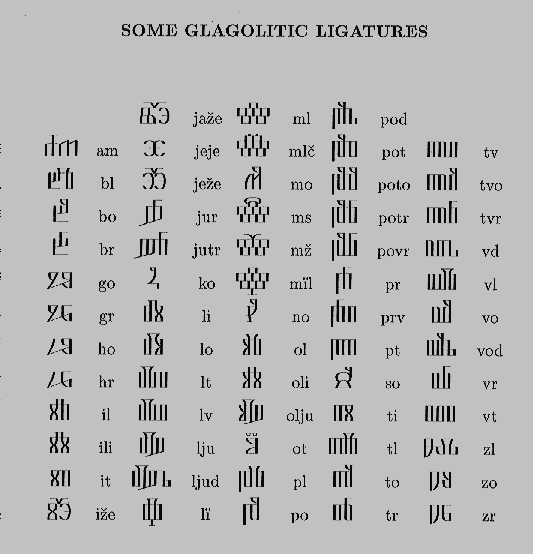
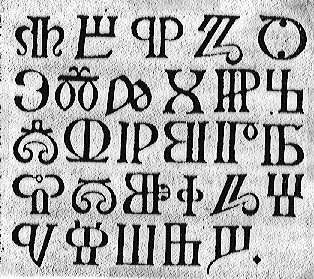
We provide several tables of various types of glagolitic characters:
- round and angular glagolitic,
- cursive and angular glagolitic,
- some glagolitic ligatures,
- spelling of glagolitic letters according to George of Slavonie (Juraj iz Slavonije), 14/15th centuries,
- caligraphic letters.
It is very probable that some glagolitic documents are held in private collections. I would deeply appreciate any such information.
Events:
- Glagolitic Breviary of Vitus of Omisalj (1396), written by academician Branko Fucic on the occasion of its 600th anniversary.
- Discovering the Glagolitic Script of Croatia,
Long Room of the Dublin University Trinity College Library, Ireland,
from 20th November 2000 till 20th February 2000. The representative
catalogue with very nice photos and detailed
comments exists. We know of three glagolitic documents containing texts
of Irish provenance:
- A Croatian glagolitic miscellany from the first half of 15th century, held in Oxford (Bodleian Library), contains St. Patrick's Purgatory. The Oxford Miscellany also contains Philbert's Vision which originated probably in Latin in England in the 13th century.
- Tundal's vision (Visio Tugdali), an Irish legend from 12th century, is kept in the Petris Miscellany from 1468, the most important glagolitic collection.
- De Morte Prologus (an imaginary discussion between Man and Death), contained in a Croatian glagolitic miscellany from 15th century (National and University Library of Ljubljana, Slovenia), and in the Petris Miscellany from 1468.
Glagolitic monuments on the web:
- Relief with the figure of St. Martin, Senj, 1330
- Lintel with Glagolitic inscription, Baska, 1626
- Reliquiary with glagolitic inscription, Novi, 16th century
Important projects for the future:
- Glagolitic palaeogrpahy (and also Croatian cyrillic);
- Acta Croatica; in Surmin's last 1898 edition
of Acta Croatica which is rather incomplete, we read a 1288 muniment
about Stipan from old Dubrovnik, the glagolitic bishop of Modrus
in Lika, p. 74); see also [Modrus,
p. 112];
As pointed out to me by Mihaela Sokic from Dubrovnik, the Old Dubrovnik (Stari grad Dubrovnik) refers to a Bosnian town north of Sarajevo that disappeared after the fall of Bosnia under the Turks in 1463. This town in Middle Bosnia was founded by merchants from the famous Dubrovnik. See an article "Zla kob starobosanskog grada Dubrovnika," Stecak, Sarajevo, No 66, 1999, p. 33. - detailed catalogue of the Croatian glagolitic (nobody knows by how many units the preserved Croatian glagolitic heritage is represented, not even in thosands: 4000, 5000,...?).
Remark. Some of the most outstanding Encyclopedias in the world contain errors in the presentation of the Croatian Glagolitic Script. As an illustration, we consider the Encyclopedia Britannica only. There it is stated that our national script has no ligatures. However, there are hundreds of them in handwritten books (and their remainings) preserved from the 13th to 16th centuries. Another mistake is that the golden period of the Croatian glagolism falls in the 16th and 17th centuries, which should be corrected to 12-16th centuries. The 16th century represents already the beginning of the fall of this script, which is closely related to the Ottoman occupation of large parts of Croatia, and consequently, the enormous material impoverishment of the Croats. It is also claimed that "The oldest extant secular materials in Glagolitic date from 1309." Such materials have existed only in Croatia, nowhere else. I do not know what secular materials from 1309 Encyclopedia Britannica has in mind. If "secular" means "nonliturgical", than the oldest known such material is the muniment of "famous Dragoslav" from January 1, 1100 (yes, eleven hundred) where the towns of Vrbnik and Dobrinj on the island of Krk are mentioned for the first time. It is also claimed that Glagolitic script "is still used, however, in the Slavonic liturgy in some Dalmatian and Montenegrin communities." For Montenegrin communities this is not true. Some of the above mentioned errors have obviously been taken from monographs of a British palaeographer David Diringer, and are still uncritically spread by other scholars. Finally, no mention of the Croatian Cyrillic Script was made in any of the encyclopedias I consulted so far.
Aleksandar Belich, a linguist from Belgrade, has been probably the only one who tried to attach the Serbian name to the Croatian glagolitic ("serbo-croatian" glagolitic, in 1915 and 1926).
Additional information:
- Obshtezhitie, the webpage for the study of cyrillic and glagolitic manuscripts and early printed books, maintained by the University of Portsmouth (UK),
- facsimiles of Croatian glagolitic books (handwritten and printed),
- recent references related to the Croatian glagolitic and Croatian cyrillic (bosancica). List of the most important glagolitic monuments over the centuries (in Croatian).
- Baska tablet
- Croatian glagolitic manuscripts abroad
- Glagolitic heritage related to Lika, Krbava and Senj
- Glagoljica u Slavoniji (in Croatian)
- What Was the Name of the Glagolitic Seminary in Priko? by Benedikta Zelic Bucan
- The Croatian Language in Liturgy, author Anonymous (signed with initial V.)
- El idioma croata en la liturgia, an article published in Studia Croatica, 1996 3(132) (Buenos Aires),
- Krunidbena glagoljska knjiga u Francuskoj, Darko Zubrinic; available also in Spanish: El libro glagolitico de la coronacion en Francia (translated from Croatian by Joza Vrljicak, Studia Croatica, Buenos Aires)
- Drustvo prijatelja glagoljice (Scripturae Glagoliticae Amicorum Societas), Zagreb
Back to Croatia - an overview of its History, Culture and Science