Stjepan Tomislav Poglajen or Tomislav Kolakovic (1906-1990)
Darko Žubrinić,
Zagreb, 2008
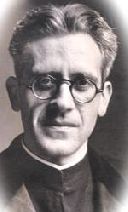
Stjepan Tomislav Poglajen;
source [Komorkovsky]
Stjepan Tomislav Poglajen was born in Croatia, in the village of Podgorače near the town of Našice on the north of Croatia. After finishing his primary school in Čepin, and six years of the Real Gymnasium in Osijek, at the age of sixteen he decided to become a Jesuit.
Finishing the Jesuit noviciate in Ljubljana he then continued his schooling at the Clasiscal Gymnasium in Travnik in Bosnia and Herzegovina, directed also by Croatian Jesuits. Completing his maturation exam in 1926 at the age of 20, he proceded with the two-year study of philosophy in Valse près de Puy in France.
Upon his return to Travnik in Bosnia, Poglajen was teaching Latin at the Classical Gymansium. In 1929 he finished a summer course of French language at Sorbonne in Paris, earning a certificate. After three years of pedagogical work in Travnik, directed by outstanding Jesuit Fr. Stjepan Jambrekovic, rector of the Jesuit Collegium and director of the Gymnasium in Travnik, he was sent to Zagreb in order to help issuing a Jesuit review Život (Life).
Poglajen completed his theological studies in Louvian, Belgium, in the period from 1932 to 1936.
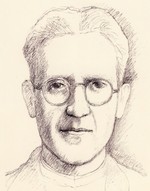
Stjepan Tomislav Poglajen;
source [Šestak]
Poglajen's best known book is God's Underground, New York, 1949, published under the name of "Father George", his pseudonym. It was prepared by a well known American writer Gretta Palmer to who Poglajen described his activities and experiences in Croatia, Slovakia, Czechia, Hungary and Russia. The idea of writing the book came from a famous American bishop Fulton Sheen, who also wrote its Foreword.
However,
this book covers only a relatively small
segment of his life.
Very little is known about his life and work in China, India, Vietnam,
and in some other countries, where he was active in the post WWII era,
until the end of the "Cold War" in 1990, the year in which he died in
Paris. The date of his death is unknown, as well as the precise place
of his burrial.
Poglajen was very much
influenced with the movement of Jeunesse
Ouvriere Chretienne
(JOC, Young Christian
Workers),
founded by a Belgian chaplain Joseph
Cardijn in 1925. The aim of JOC
was to work in small communities
among young people originating from working class, later also among
academic circles. Poglajen collaborated with Cardijn already in time
when he was a young Jesuit studing in Louvian.
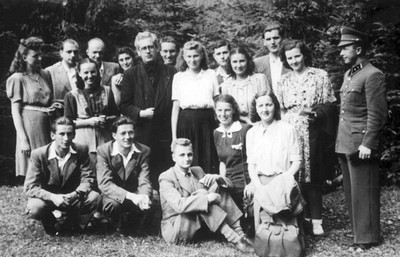
Stjepan Tomislav Poglajen or
Tomislav Kolakovič in Slovakia; source [Komorkovsky]
Poglajen's range of activities is indeed amazing in its global aspect: from Croatia, across Hungary, Slovakia and Czechia, to Russia, USA, China, Vietnam, India and Phillipines.
During his short 2.5 year's stay in Slovakia, since his arrival to this country in 1943, he succeeded in creating laying foundations of Rodina (Family) movement in Slovakia and Czechia, which was a laicist church organized as a network of small groups. It was the "underground church" founded in time when the Red Army and communist rule came to power by the end of WWII, active until the fall of communism in Europe. Very interesting program for Rodina, written in May 1945 before Poglajen's travel to Moscow in case he does not return, can be seen in Krpotić's study in [Šestak, pp. 307-318]. According to Poglajen's own words, his main mission in Slovakia and Czechia was to prepare contacts between Soviet Union and the Catholic Church, see Krmpotić in [Šestak, p. 352].
He was active as a preacher and minister, and his solid education in the field of medicine was quite important during the tragic days of the WWII. A Slovak politician declared in 2006 that collaborators of professor Kolaković had to pay with five hundred years of prison (see Cviić in [Šestak, p. 31]). "Professor Kolaković" was Poglajen's conspirative name in Slovakia, coined according to his mother's second name. Poglajen and members of Rodina were actively participating in anti-fascist movement in Slovakia.
Poglajen was persecuted by various secret police organizations, equally Fascist, Nazist and Communist. He was a violent critic of all three mentioned totalitarisms already in 1937, when he became editor in chief of the important and influential journal Život (Life) in Zagreb, issued by Croatian Jesuits. Upon the arrival of Nazists to Croatia he had to escape from Zagreb to Split in 1941, and then to Slovakia in 1943.
He nearly fell into hands of communist secret police in China in 1949. A Belgian missionary in China, collaborator of father Poglajen, was interrogated and tortured in attempts to find out more details about this mysterious Croat in China. Various secret intelligence services were following him, including ex-Yugoslav infamous OZNA, later called UDBA (see Cviić in [Šestak, p.29]).
Several attempts of his physical liquidation by the Russian secret service (see Milan Simčić in [Šestak, p. 34]) persuaded him to be extremely cautious, even in European West. Until the end of his life he lived under various pseudonyms. One of his pseudonyms in France was professeur Georges, abée Georges, or simply professeur in Belgium, profesor Kolakovič or Vlado or simply profesor in Slovakia, Father George in the USA and India, Houyang or professor Yoris in China, etc.
After the WWII, since the end of 1945 till 1980, he was active in China and Vietnam (before communist rule came to these countries), in parts of India (since in 1950s there was a danger for this country to succumb under the communist rule), and in Phillipines. His method of work was to try to organize the Catholic Worker's Movement there and the institutions aiming to dismantle the communist propaganda. It is interesting that in India he contacted Mother Teresa and Father Anto Gabric.
He was very critical
towards the American policy in Vietnam,
since in their naivity the Americans believed that just by military
action they would be able to defeat systematic communist indoctrination
and the proud Vietnamese conscionce, while drugs and prostitution were
spreading at the same time (see Milan Simčić in [Šestak,
p. 37]).
Father Poglajen was exceptionally influential, and many doors were open to him on highest levels. His deep insight and direct experiences on global matters, and the ability for thorough analysis, enabled him personal contacts with presidents Truman and Eisenhower in the USA, as well as with the leading peronalities of the State Department (see Milan Simčić, p. 35).
He also had direct contacts with Pope Pius XII, important church persons in the Vatican, as well as with bishops throughout the world. For example, he was very close to a famous american bishop Fulton Sheen, who wrote foreword to his 1949 book "God's Underground", written under the pseudonyme Father George, dismantling the communist regime behind the Iron Curtain. The fact that he wrote it under a pseudonyme means that even in the USA he felt insecure. This book can be perhaps compared with an earliear equally important book by another Croat - Ante Ciliga, a direct witness of difficult life in Soviet Union in 1930s, and also as prisoner of Soviet concentration camps from 1930 to 1936.
It is indeed amazing that Poglajen was planning his direct contact with Stalin, and even travelled to Moscow with that goal. Having encountered Soviet soldiers arriving in 1944 to Slovakia during the final operations against Nazists, he realized that many of them are deeply attached to the spirituality of Eastern Christianity. During his 6 month's travel through the USSR immediately after the WWII he learned about Catacomb Churches among Eastern Christians, both Pravoslav and Catholic (Milan Simcic in [Šestak, p. 35]), about which he reported in the book "God's Underground" prepared by Gretta Palmer in 1949.
As an excellent
connoisseur of Russian langaugage, he had no
problems in getting close to Soviets, and he did not hesitate to
distribute thousands of small picture of Mother
of God of
Iverskaya (Iverskaya
Bogorodica) among Soviet soldiers, very much
adored among Eastern Christians. The pictures were accompanied with a
short one-page text of spiritual nature, see Krmpotić in [Šestak,
pp. 283-284]. Such steps undertaken
by Poglajen were extremely dangerous. Many have lost their lives for
much lesser "offences" of the communist rule than spreading holy
pictures.
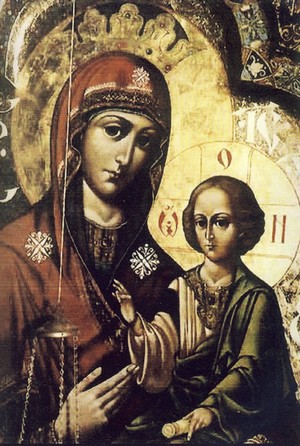
The icon of Mother of God
Iverskaja (or Iverskaya), very much revered among Russian people,
printed upon Tomislav Kolakovič's initiative in about 100,000 copies
and distributed in secret to Soviet soldiers; source [Šestak];
the accompaning text is: Presveta
Bogorodice, isprosi mi od svog
Sina mir u duši i svijetu i milost na času smrti... (Dear
Mother of God, ask your Son to pray for peace in my soul and in the
world, and for mercy at the moment of my death...), see [Sečkar,
p. 250].
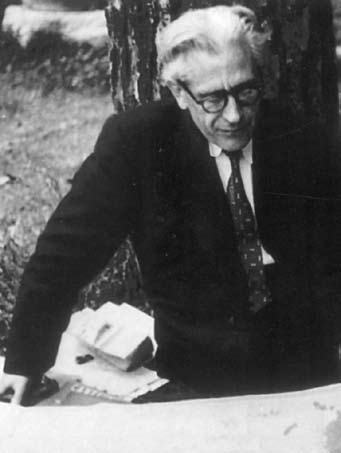
Stjepan Tomislav Poglajen or
Tomislav Kolakovič in Slovakia; source [Komorkovsky]
Father George: God's Underground, New York, 1949...The big, smiling young Russian opened the door and said, "Good day." The man in the partisan officer's uniform entered and went straight to the rickety table in the center of the room. Carefully following the agreed formula, he laid out the things he had brought - five potatoes here, a quarter-pound of tea in the center, a handful of raisins to the left. Then the visitor nervously repeated the words of the code: "Your friend Sasha asked me to pay you my respects and to thank you for your kindness to his mother." The Russian quickly gave the set reply of recognition and the two shook hands. Thus a Roman Catholic priest made contact with a station of the underground within Russia. For six months after World War II, "Father George" traveled through the U.S.S.R. with Red army credentials, studying resistance to the Communist regime and especially the secret confederacy of Christians. What he found makes an exciting book, written in collaboration with magazine-writer Gretta Palmer and published this week as God's Underground (Appleton-Century-Crofts; $3). When the Nazis invaded Yugoslavia, Father George was a Croatian organizer of Catholic youth groups. He promptly took off his clerical garb, went underground, and with many other young Christians, eventually joined Slovak partisans. Fighting side by side with Russians, they kept their religion under cover - celebrating Mass, and even holding retreats, in forests with lookouts posted. The Way It Spreads. According to Father George, Russians are cynical about the sincerity of their government's war-inspired toleration of the Russian Orthodox Church. He reports that even some of the Orthodox priests stay underground just in case the state once again begins to close the churches. Even registered Orthodox priests cannot hold classes in religion for children under 18. A nine-year-old boy showed Father George how children learned their catechism. "He held up his left hand, fingers outspread. T have five friends. I know my catechism from my comrade, who learned it from his grandmother. I have to teach it to my five friends ... I give them an examination. Then if they pass, they become teachers. Each of them has to pass it on to five other friends. That's the way it spreads.' " In one town Father George found a group who called themselves "postoffice Christians." Members send their wedding rings to be blessed by a Catholic priest and mailed back; in the same way they obtain consecrated earth to be sprinkled over graves, and holy water for baptisms. The Russian resistance movement, says Father George, is made up of all sorts of men, among whom the Christians are highly respected. Said one of the leaders: "They are the bravest. They are the most cheerful. I wish I could share their secret." Metaphysical Revolution. No one knows just how many secret priests are in Russia today. Lying ill last week in a monastery near Cologne was black-bearded bespectacled Father Kurt Szekalla, who, like Father George, successfully penetrated the Iron Curtain and got out again. But many are not so lucky. German-born Father Szekalla says he knows of seven fellow priests who entered Russia between 1939 and 1946, disguised as artisans or peasants. None has returned. At least one, a Czech priest named Father Romza, Szekalla knows to have been executed. Father Szekalla reports that he found clandestine congregations of the Roman Catholic "catacomb church" almost, everywhere he went - even at high bureaucratic levels. In Leningrad, he says, one group customarily celebrated Mass within the Naval Academy while unsuspecting guards stood sentry duty outside. Father Szekalla is optimistic about Russia's eventual conversion: "I think that the revolution in Russia which began in the social order will end in the metaphysical order. The new resistance of the Russian people as evidenced in their catacomb church will one day reassert itself . . . Religion will come back to Russia - but by evolution instead of revolution." Source: Catacomb Church, TIME, Jan. 17, 1949
|
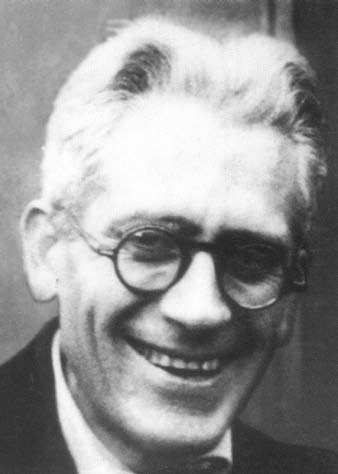
Stjepan Tomislav Poglajen or
Tomislav Kolakovič in Slovakia; source [Komorkovsky]
|
Lorne Trainor: Father George: God's Underground, Father George as told by Gretta Palmer (296 pages), St. Dunstan's Red and White, Vol. XL, Winter 1949, No. 2, pp. 74-76, [PDF] (book review): GODS UNDERGROUND Father George as
fold by Gretta Palmer In 1941 the Nazis occupied Jugo-Slavia. Father George, a Catholic Croat priest, was on their black list. Immediately he went underground with the Christian youth organizations of his country. In spite of constant dangers of death and the influence of the atheistic doctrines of Fascism, Nazism, and Communism, Father George, in various disguises and with the help of underground friends, for three years kept the light of faith burning brightly in the minds and hearts of the youthful zealots of his overrun and harassed country. Late in 1944, Father George's work as spiritual adviser to his young friends became too dangerous. He joined a group of partisan militia as a medical doctor. (He had been a doctor previous to his study of theology). Early the next year the partisan group, of which he was a member, was attached to the Red Army of the Ukraine and became subject to Russian orders and discipline. Through the instrumentality of a Red Army Officer, who was a secret believer in Christianity, Father George obtained a military pass which took him into the Soviet Union. For six months, Father George, still wearing the partisan uniform, and still posing as a doctor, travelled about western Russia with the purpose of learning about the hopes and beliefs of the Russian people. At the end of this time he decided to return to his native land, but on his way home he was arrested and jailed in Prague. Here he underwent a trial on trumped-up charges. He won his case in this dramatic trial and finally escaped to freedom. God's Underground is the amazing and intensely interesting story of the experiences of Father George as a priest and doctor under the circumstances mentioned above. The most astounding fact revealed by Father George in relating his experiences is, that, in spite of a ruthless thirty years attempt on the part of the Communist minority in Russia to crush the Christian religion, it is still secretely believed, practised and cherished by probably one-third of the Russian people. Father George tells us that he found in Russia secret seminaries training young men for the priesthood, priests secretely ministering the sacraments to the faithful, young and old from all ranks of life, even among the Red Army and M.V.D. officers, still clinging to their ancient faith or, seeing the emptiness of Atheistic Communism, arriving at a knowledge of truth and a desire to worship God. All this is an
amazing revelation to us of the Western
world, which hears very little of religious activity behind "The Iron
Curtain". However, high church authorities vouch for the authenticity
of Father George's story. Monsignor Fulton J. Sheen, who God's Underground is an authentic story of the strong Christian Fifth Column which exists in Russia. It clearly distinguishes between the Communistic minority and the majority of the Russian people. It arouses our love for this fine suppressed majority and suggests that a faith is springing up in Russia which, warmed by Divine Charity and supplemented by our prayers, will in some future day roll back the Iron Curtain as the stone was once rolled back from the tomb. -LORNE TRAINOR '49
|
Various
editions of Father
George's (this is pseudonym of Poglajen) God's
Underground:
According
to Valcav
Vaško
the book prepared by Gretta Palmer is not reliable, since it has a lots
imprecisions and mistakes. For example, Gretta Palmer does not
distinguish Croatia from Slovakia and Bielorussia. Hence, the book
should be read with care. Vaško concludes that it is a pity
that
the book contains her inventions and additions to make it more
interesting for American readers.
- God's Underground (by Father George as Told to Gretta Palmer), Hardcover, Publisher: Appleton-Century-Crofts, Inc., New York, 1949. A story of the fight for Christianity in Soviet Russia. Forward by Bishop Fulton J. Sheen.
- THROUGH
GOD'S UNDERGROUND - THE
ADVENTURES OF
''FATHER GEORGE'' AMONG PEOPLE UNDER SOVIET RULE AS TOLD TO GRETTA
PALMER (Hardcover) by Gretta Palmer (Author),
Hardcover, Publisher: Hollis & Carter (1950) - Through God's Underground - The Adventures Of Father George Among People Under Soviet Rule As Told To Gretta Palmer (Hardcover), by Anonymous (Author), Hardcover, Publisher: Hollis & Carter (1951)
- Father George, God's Underground, Bethany Press, St. Louis, MO (1970).
- Dans les maquis de Dieu, Ed. du Rocher, Monaco 1951
- THROUGH GOD'S UNDERGROUND (Hardcover), by Gretta Palmer (Author), Hardcover, Publisher: Hollis & Carter (1953)
- Kolakovič T.: Božie podzemie, Sekulárny inštitút Fatima v Nitre, Slovakia, 1994.
- God's Underground (Paperback), by Father George (Author), Gretta Palmer (Editor), Paperback: 316 pages, Publisher: Kessinger Publishing (May 28, 2005)
- Father George (zoals hij het vertelde aan Gratta Palmer) - God's ondergrondse, oorspr. titel 'God's Underground' vert. uit het Engels H. Bronkhorst, Amsterdam, Van Kampen & Zoon, 2e dr., z.j. - 293pp ingenaaid, linnen met stofomslag, goede staat - s.o. zwaar beschadigd, verder goed, Tweedehands; Christendom; Geloofsvervolging; Sovjet Unie
- Stjepan Tomislav Poglajen: Božje podzemlje, Verbum, Split, 2006., commentaries about the book in Croatian by Rev. Vladimir Horvat; MV info
- There is information about possible existence of German, Spanish and Chinese (Taiwna) editions of the book, see [Sečkar, p. 253].
POGLAJEN, Stjepan
Tomislav: Temeljni obrisi
ljudskog
poretka /
Dora Krupićeva d.o.o., Zagreb 2006. - 101 str.; 18 cm. - (Biblioteka
Zvekir)
Articles, books and links related to Poglajen:
- TIME: Catacomb Church, Monday, Jan. 17, 1949
- MIKLOŠKO František: Nebudete ich môcť rozvrátiť. Z osudov katolíckej cirkvi na Slovensku v rokoch 1943 - 1989. Bratislava 1991.
- VARINSKÝ, Vladimír: Odbojové ambície prof. T. Kolakoviča a Rodiny. In: Zborník 2005. Múzeum Slovenského národného povstania. Banská Bystrica. Zjednocovanie antifašistických síl na Slovensku v roku 1943. Vznik a činnosť ilegálnej SNR. Zostavovatelia Ján Stanislav a Dezider Tóth, s. 49 - 67.
- Vaclav Vaško: Dobrodruh v Ježíšových službách legendární profesor Kolakovič, published online by www.pastorace.cz
- Vaclav Vaško: Profesor Kolakovič - mýty a skutočnosť, Impulz, Slovakia, 2006.
- Profesor Kolakovič a Anton Neuwirth, Conference (300 participants) held at the University Pastoral Center in Bratislava in honour of Poglajen and his student Neuwirth in 2006
- JÁN KOMOROVSKÝ: Usporiadanie spoločnosti podľa Stjepana Tomislava Poglajena Kolakoviča (K 100. výročiu narodenia) [PDF], Viera a život, Slovakia, 2006, č. 4, 18-28.
- KRČMÉRY, S. - JUKL, V.: V šľapajach Kolakoviča. Bratislava 1995.
- BULÁNYI, György: Spomienka na pôsobenie pátra Kolakoviča v Maďarsku. In: KRČMÉRY S. - JUKL V.: V šľapajách Kolakoviča, s. 99 - 101.
- JABLONICKÝ, J.: Tomislav Poglajen Kolakovič na Slovensku 1943 -1946. In: Slovenské rozhľady, 8/1996, s. 90 - 106.
- JOZEF JABLONICKÝ, Podobi nasilia, Bratislava, Kaligram, 2000.
- Norbert Kmeť: Katolícka cirkev v strednej Európe po druhej svetovej vojne [PDF], Pamat naroda, 2007.
- Spomienky Štefana Šmálika na profesora Kolakoviča, written by Štefan Šmálik, 1991.
- Janka Poradová: Diplomová práca o Šmálikovi,
- IVAN. A. PETRANSKÝ: KATOLÍCKA CIRKEV NA SLOVENSKU A POVSTANIE ROKU 1944 [PDF], in SLOVENSKÁ REPUBLIKA 1939 - 1945 OČAMI MLADÝCH HISTORIKOV III. (POVSTANIE ROKU 1944) , Zborník príspevkov z tretieho sympózia Katedry histórie Filozofickej fakulty UCM Trnava Lúka 21. - 22. mája 2004, Poglajen ie Kolakovič on pp 55-57
- Vladimir Horvat:
- Stjepan Tomislav Poglajen - alias profesor Kolakovič (in Croatian, [PDF]) Renewed Life (Obnovljeni život), Release: Vol. 61 No. 4, 15.12.2006.
- Apostol u najtežim vremenima XX. stoljeća , Fokus, 8. veljače 2008.
- Držao predavanja studentima i srednjoškolcima , Fokus, 20. listopada 2006.
- Razgovor s prof. dr. Vladimirom Horvatom o Stjepanu Tomislavu Poglajenu, Katolički tjednik
- Matija Maša Vekić: Lucidni evangelizator XX. stoljeća, razgovor s prof.dr. Vladimirom Horvatom o Stjepanu Tomislavu Poglajenu, Katolički tjednik, 2006.
- Stjepan Tomislav Poglajen, a short biography in Croatian, Verbum, Split
- Stjepan Tomislav Poglajen, 2007., Križ života
- Ivo Sečkar: Veliki i zagonetni S.T. Poglajen [PDF], Obnov. život (51) 3 (1996) 237-260.
- Cviic, Christopher: The mysterious missions of Fr Poglajen: a personal memoir, Frontier Magazine, Keston Institute, UK, No 11, 2006, 19-24.
- Stjepan Tomislav Poglajen, Wikipedia
- Ivan Šestak: Stjepan Tomislav Poglajen as editor of the journal Život (in Croatian), [PDF], Renewed Life, Release: Vol. 62 No. 1, 19.02.2007.
- Ivan
Šestak (ed.): Stjepan
Tomislav Poglajen alias profesor Kolaković (1906.-1990.), Zbornik
radova međunarodnog znanstvenog simpozija održanog u Zagrebu 28. rujna
2006. povodom 100. obljetnice rođenja S.T. Poglajena, Zagreb, 2007.,
372 str., ISBN 978-953-231-058-0
- Krsto Cviić (London): Poglajen u svjetskom kontekstu
- Milan Simčić (Rim): Čovjek koji je stvarao povijest
- Ivan Šestak (Zagreb): Poglajen kao suradnik i urednik časopisa Život
- Miroslav Klobučnik (Bratislava): Kolaković i konfontacija s komunističkom vladom
- Frano Glavina (Zagreb): Tomislav Poglajen u svjetlu izvora nastalih radom OZNA-e, UDBA-e i SDB-a
- Vladimir Horvat (Zagreb): Poglajen kao vizionar i realizator
- Lazar Ivan Krmpotić: Stjepan Poglajen alias Tomislav Kolaković - evangelizator Slovačke, oko 130 str.
- etc.
- Stjepan Tomislav Poglajen: Krsšćanski personalizam, niz Hrvatska katolička baština, nakladnik Glas Koncila, Zagreb 2001., ISBN 978-953-841-8-283
- Rod Dreher: Live Not by Lies - A Manual for Christian Dissidents, 2020 (translated into Croatian in 2022: Oduprite se laži - Priručnik za kršćanske disidente, Verbum), Review
Croatia - its History, Culture and Science