May 6, 1931
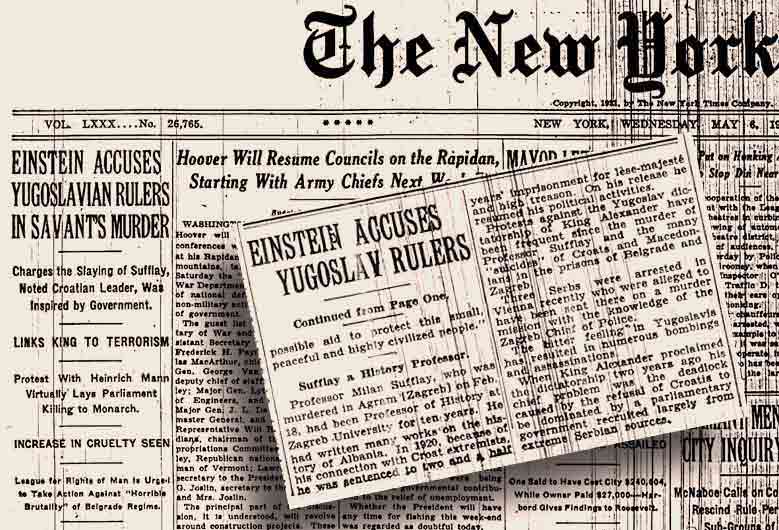
Einstein Accuses
Yugoslavian Rulers in Savant's Murder
 Charges
the Slaying of Sufflay, Noted Croatian Leader, Was Inspired by
Government.
Charges
the Slaying of Sufflay, Noted Croatian Leader, Was Inspired by
Government.
Increase In Cruelty Seen.
League
for Rights of Man is Urged to Take Action
Against "Horrible
Brutality" of Belgrade Regime.
Special cable to The New York Times.
Berlin, May 5. Accusing the Yugoslav Government of the murder of a Croatian Professor Milan Sufflay, who was struck down in the streets of Agram [Zagreb] on Feb 18, Professor Albert Einstein and the novelist Heinrich Mann, brother of Thomas Mann, have sent a joint letter to the international headquarters of the League for the Rights of Man in Paris urging a protest against the "horrible brutality which is being practiced upon the Croatian people." The letter also was signed by the German headquarters of the league. The Paris headquarters, upon receipt of the communication, immediately undertook steps toward an effective protest in Belgrade.
"As the professor was walking home on the fatal day he was attacked from behind with an iron rod, according to our information and felled." the letter of protest reads "On the next day he died and he was buried on the twenty-second beside other Croatians."
Noted for Scientific Works.
Professor Sufflay was noted for a long list of scientific books, the letter continues."Yet Agram [-> Zagreb] newspapers were not allowed to report his activities and the news of his death was suppressed." the protest reads on. Condolence telegrams were not delivered. The time of the funeral was not allowed to be made public and the raising of a mourning flag on the university was forbidden. The authorities went so far as to expel those school children who took part in the funeral and to remove wreaths which were bound with the Croatian national colors fom the grave.
"The name of the murderer was known. It was Nikola Jukitsch [-> in fact, Branko Zwerger, see below]. His organization (Young Yugoslavia) likewise is known. It was even known that arrangements for the murder had been worked out on the night of the eleventh in the home of the military commandant of the city, General Beli Markowitsch, at a session in which members of the Young Yugoslavia organization, Brkitsch, Godler, Marischetz and the murderer Jukitsch [-> in fact the real name is Branko Zwerger] took part. Yet the Agram [-> Zagreb] police officially stated the next day that the name of the murderer was not known.
Charges Threats to the Croats.
Turning to the events leading to the murder, Professor Einstein and the other signers charged that when the King visited the Croatian capital in January, numerous leading Croats received letters signed "For King and Country." in which their lives and those of their families were threatened if they uttered any protest while the King was there. Professor Sufflay received one of the letters, it is charged."The name of this terrorist organization was Young Yugoslavia," the protest continued. "The King, in an address to the organization, told how the Croatian representatives to parliament had been put out of the way at his request. An example of this was the shooting of a Croatian leader [-> Stjepan Radic] on the floor of the house on June 20, 1928."
Following the King's visit, the murder of political and intellectual leaders of the Croatians was openly demanded in the government press, says the letter.
"The official organ Nascha Sloga in Suschak, on Feb. 18 wrote, `Skulls will be split.' The same evening Professor Sufflay was struck down," the letter says.
In January the delegates to the Croatian National Assembly sent a memorandum to Geneva calling attention to the situation in Croatia.
"The facts show that the cruelty and brutality practiced upon the Croatians only increase," Professor Einstein's letter says. "In view of this frightful situation, we urge the International League for the Rights of Man to do everything possible to press this unrestrained rule of might which prevails in Croatia."
"Murder as a political weapon must not be tolerated and political murderers must not be made national heroes. The League should muster all possible aid to protect this small, peaceful and highly civilized people."
Sufflay a Histoy Professor.
Professor Milan Sufflay, who was murdered in Agram [Zagreb] on Feb. 18, had been professor of History at Zagreb University for ten years. He had written many books on the history of Albania. In 1920 because of his connection with Croat extremists, he was sentenced to two and a half years' imprisonment for lese-majeste and high treason. On his release he resumed his political activities.Protests against the Yugoslav dictatorship of King Alexander have been frequent since the murder of Professor Sufflay and the many "suicides" of Croats and Macedonians in the prisons of Belgrade and Zagreb.
Three Serbs were arrested in Vienna recently who were alleged to have been sent there on a murder mission with the knowledge of the Zagreb Chief of Police.
The bitter feeling in Yugoslavia has resulted in numerous bombings and assassinations.
When King Alexander proclaimed the dicatorship two years ago his chief problem was the deadlock caused by the refusal of Croatia to be dominated by a parliamentary government recruited largely from extreme Serbian sources.
A similar article appeared in the San Francisco Examiner on Sunday May 31, 1931 saying pretty much the same thing. Many thanks to BACHNenad's tribune, in particular to Marko.
Remark: From archival material held in Zagreb we know that the name of assassin was not Nikola Jukich (Jukitsch), but BRANKO ZWERGER (hanged in 1943 in Jasenovac). It seems that Einstein and Mann have changed the name to Jukitsch since they lived in Germany, in Berlin, from where they wrote their appeal to Paris. The name of Zwerger sounds German or Jewish, which they may have found unpleasant (and unimportant) for the purpose of this appeal. We are not in possession of the original text, which is written most probably in German. It seems that the original text is in Moscow archives. Namely, during the WW2 the Russians came in possession of all archives of the Ligue de Droits de l'Homme (League of Human Rights in Paris), concerning documents dating before 1945.
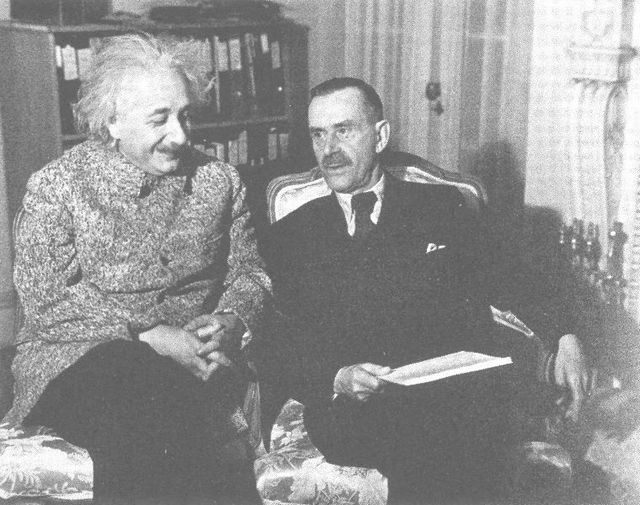
Thomas Mann with Albert Einstein in Princeton, 1938 (source Wikipedia)
Related links: