Dubrovnik
© by Darko Zubrinic, Zagreb (1995)  The territory of the famous Republic
of Dubrovnik (Ragusa), though somehow disconnected from the
main part of Croatia, was able to keep balance with great forces, which
always had respect for its economic wellbeing and culture, and it remained
free due to its numerous diplomatic and economic relations. This earliest
Croatian city-state had as many as 85 consulates in various seaports throughout
the Mediterranean, and diplomatic representatives in Madrid and Rome.
Dubrovnik was especially flourishing from the 15th to the 18th century,
and was the chief rival to Venice. In the 16th century Dubrovnik had a
fleet of 200 larger ships, which grew to 300 in the 18th century. Around
1780 the ships from Dubrovnik were sailed to New York, Baltimore etc.
The territory of the famous Republic
of Dubrovnik (Ragusa), though somehow disconnected from the
main part of Croatia, was able to keep balance with great forces, which
always had respect for its economic wellbeing and culture, and it remained
free due to its numerous diplomatic and economic relations. This earliest
Croatian city-state had as many as 85 consulates in various seaports throughout
the Mediterranean, and diplomatic representatives in Madrid and Rome.
Dubrovnik was especially flourishing from the 15th to the 18th century,
and was the chief rival to Venice. In the 16th century Dubrovnik had a
fleet of 200 larger ships, which grew to 300 in the 18th century. Around
1780 the ships from Dubrovnik were sailed to New York, Baltimore etc.
The English word ARGOSY (= Ragusin ship; Ragusa = Dubrovnik)
soon after the first Dubrovnik ships arrived in England in
1510, became synonymous with a large, rich cargo ship.
It is strange that "The World Book Dictionary", an
important American dictionary of the English language, claims
for "argosy" to be an "Italian (!) Ragusea (ship) of Ragusa, an
Italian port (!) which traded extensively with England in the
1500's". See its 1995 edition, Vol. I, p. 110.
An Italian naval historian Bartolomeo Crescentio, author of "La Nautica Mediterranea", 1602, Rome, states that the Ragusans were the best builders of galleons in the Mediterranean and that the Argosy was a galleon of Ragusa. On the front sail of a drawing of a Ragusan galleon appearing in that book is the coat of arms of Dubrovnik, and the back sail has the Croatian checkered arms. The Dubrovnik galleon Argosy is mentioned in two Shakespeare's plays: "Merchant of Venice" and "Taming the Shrew".
The white flag of Dubrovnik contains a figure of Sv. Vlaho (St. Blais), patron of the City. Also other flags were in use on Dubrovnik ships, like the one with significant inscription LIBERTAS, or
|
The Dubrovnik coat of arms as we know it since 1358 has the form of a shield with red and silver squares, which is a well known Croatian coat of arms.
The famous Columbus crew in 1492 had at least two Ragusan mariners: Martin de Araguis, Pedro de Arague. The Ragusan name can be found in numerous places of the New World. Why? See Croatian mariners in the New World.
Literature written in Croatian flourished in Dubrovnik. In the first place we should mention Marin Drzic (1508-1567), who is one of the most outstanding names of the European Renaissance literature, a predecessor to Moliére's comedy and Shakespeare's drama (Moliére 1622-1673, Shakespeare 1564-1616). It was observed long ago that Marin Drzic handled themes and motifs that appeared 50 years later in the works of Shakespeare.
Also Shakespeare's The Tempest has its source in the old Croatian chronicle from the 12th century, known as the Chronicle of Father Dukljanin. Its Italian translation was published in 1601, a decade before The Tempest was composed (see [Mardesic], p. 151).
One of the greatest Croatian poets was Ivan Gundulic (1589-1638), who wrote the well known and endeared patriotic verses in Croatian language:
| Oh beautiful,
oh dear, oh sweet liberty, the gift that Allmighty God gave us, the cause of truth and all our glory, the only adornment of Dubrava; Neither all the silver and gold, nor the human lives can match your pure beauty! |
|
The word LIBERTAS is written on the flag of the famous city of Dubrovnik and its freedom loving people.
- In 1272 Dubrovnik had its first statute (in eight books) and
urban planning.
- The seventh book of the Statute contains exclusively regulations concerning Maritime Law, which is the oldest such document in the world. Among other things, the statute sais If a slave is embarked on a Dubrovnik ship - he must be considered as a free man.
- In 1296 Dubrovnik had a sewerage.
- In 1377 Dubrovnik the first quarantene in Europe.
- The first European pharmacy that has been working continuously till these days was opened there in 1317. Among the oldest ones (from 1355) is also the pharmacy of Zagreb, in which a grandson of Dante was a pharmacist. According to some documents the pharmacy in the city of Trogir goes back as early as 1271.
- Dubrovnik's 1395 Inusrance Law is the oldest in Europe. It had all aspects of contemporary maritime insurance. This law is three centuries older than Lloyd's insurance, London, which dates from the end of 17th century.
- An organized production of soap started in 1417.
- The first hospital (Domus Christi) in Dubrovnik was opened in 1347. The Dubrovnik Senat recognized it as the hospital in 1540. It was shelled and seriously damaged during the Serbian aggression in 1991-1995.
- Slave trade in the Republic of Dubrovnik was forbidden in 1418 (in the British Empire in 1833).
- The first orphanage was founded in 1432.
- Dubrovnik had the oldest arboretum in Europe - Trsteno, founded in 1498, with many rare plants. It was completely destroyed during the Serbian aggression in 1991-1995.
In 1497, a German pilgrim Arnold von Harff wrote in his travel book a short list of 56 Croatian words, as he heard them when talking to citizens of Dubrovnik, withe explanation in German. In the 16th century a German pilgrim Konrad von Grünemberg wrote that Dubrovnik is "the most important city in Croatian Kingdom" (die kunglich hobstat in Croattien). In 1506 an English Sir Richard Guylforde wrote that "Dubrovnik is in Sclavonia or Dalmatia, which is a province in Kingdom of Croatia." See [Raukar], pp. 360-362.
Didak Izaija Cohen, known under pseudonyms Dydacus Pyrrhus Lusitanus and Iacobus Flavius Eborensis, was a renowned Portugese physician and poet of the Jewish origin. He lived in Dubrovnik from 1558 until his death in 1599, i.e. for more than 40 years. He devoted some of his verses to the beauty of Dubrovnik. Another famous Jew exiled from Portugal who found refuge in Dubrovnik (1556-1558) was Amatus Lusitanus (Juan Rodriguez), a leading European physician of the 16th century.
When Dominko Zlataric, a 16th century Croatian writer in Dubrovnik, translated Electra from the Greek original to Croatian (not via the Italian translation), he approximated the Hellenic spirit by Christianizing it, according to the measure and spirit of his own time. As he wrote himself, he made his Electra Croatian. He dedicated some of his translations into Croatian ("u hrvatski izlozene") to Juraj Zrinski, son of the Sziget hero Nikola Subic Zrinski. Zlataric's teacher and later a close friend was the above mentioned Dydacus Pyrrhus.
André Vaillant, a famous French specialist for Slavic languages, defended his thesis entitled ``La langue de Dominko Zlataric, poéte ragusain de la fin du XVIe siècle'' in 1926. That same year he published ``Les Piesni razlike de Zlataric''.
The first cofee-house in England was opened in
London in the 17th century by a native of Dubrovnik, a
certain Pasque Rosee (probably distorted form of
Raguseo).
In 1983 at North Stoneham, England (a few
kilometers
from Southampton), a stone slab was uncovered under a boarded floor
near the choir stall in the Church of North Stoneham
(6 feet 8 inches by 3 feet 8 inches). It contains emblems
of St Mathew, St Luke, St Mark and St John. Carved around
the edge of the stone is the inscription: "The Guild of the
Slavonians (Croats) in the year 1491." It is very probable
that the stone was initially in Southampton in a chapel that
belonged to the Guild of Croatian mariners there.
One of the earliest Croatian mariners
in Southampton is Blasius de Jar' from Zadar, mentioned
already in
1396, while in the 15th century there are many other
Croatians in Venetian galleys: from Dubrovnik, Zadar, Split,
Zagreb, Kotor,
Budva, Bar. Moreover, according to collected data from that
period we know that a great part of the staff in Venetian
galleys was
composed of the Croats.
See [Eterovich], p. 21, and Lovorka
Coralic: Hrvatska bratovstina u juznoj Engleskoj
(XV.-XVI.st.), Marulic, 1998, No1, p.53-59.
It is little known that thre existed Old Dubrovnik (Stari grad Dubrovnik), which refers to a Bosnian town north of Sarajevo that disappeared after the fall of Bosnia under the Turks in 1463. This town in Middle Bosnia was founded by merchants from the famous Dubrovnik. A 1288 muniment written in the Glagolitic Script mentions Stipan from old Dubrovnik, the glagolitic bishop of Modrus in Lika, see [Modrus, p. 112]. It was found by Franjo Glavinic near Trsat in Rijeka.
It is little known that there was the Society of Dalmatians in
England already in 1590.
Personal information by dr Adam S.
Eterovich.
It is interesting that the Dubrovnik merchants had their settlement in the city of Gvendolin in India in the 16th century, where they built the Church of St. Blase in 1653, which exists even today.
 The greatest and most famous
Croatian philosopher and scientist Rudjer
Boskovic (1711-1787), was born in Dubrovnik, where he was educated
in the Jesuit Collegium. He was a member of the Royal Society of London,
a member of St.Petersbug Academy, "membre correspondant" of the French
Academie Royale des Sciences, a professor at many European universities.
Very delicate work on repairing the cupola of St. Peter's church in the
Vatican (diameter: 42m) was entrusted to R. Boskovic, a proof that he
was a leading European authority for static computations and civil engineering
of that time.
The greatest and most famous
Croatian philosopher and scientist Rudjer
Boskovic (1711-1787), was born in Dubrovnik, where he was educated
in the Jesuit Collegium. He was a member of the Royal Society of London,
a member of St.Petersbug Academy, "membre correspondant" of the French
Academie Royale des Sciences, a professor at many European universities.
Very delicate work on repairing the cupola of St. Peter's church in the
Vatican (diameter: 42m) was entrusted to R. Boskovic, a proof that he
was a leading European authority for static computations and civil engineering
of that time.
Portrait of Boskovic by the English painter
Edge Pine (1760).
He was also the founder of the astronomical observatory in Brera near Milan. In 1773 a charter granted by Louis XV made him a French subject. Soon he was appointed by Louis XV to a very prestigeous position and became the Director of Naval Optics of the French Navy in Paris (Optique Militaire de la Marine Royale de France). He left to his adoptive country an achromatic telescope and micrometre. Boskovic spent nine years in France, and became a good friend to many outstanding scientist, like the mathematician Clairaut, Laland, Buffon. When D'Alembert took him for Italian, he hastened to correct him.
Boskovic stayed 7 months in England and met many famous scientists there: James Bradley (famous astronomer), George Parker (president of the Royal Academy), Samuel Johnson (Lexicographer), Edmund Burke (philosopher and political writer), Joshua Reynolds (the first president of the Royal Academy of Arts), and others.
When Charles Burney, a well known English musicologist, met Boskovic in Milan, he wrote: ...if all Jesuits were like this father, who uses the higher science and the work of mind to advance science for the happiness of mankind, then it were to be wished that this society were as durable as is this world.
William Thompson-Kelvin, the English physicist, once expressed his opinion that his atomic theory is a pure "Boskovicianism."
With his theory of forces R. Boskovic was a forerunner of modern physics for almost two centuries. It was described in his most important book Theoria Philosophiae naturalis (Vienna 1758, Venice 1763, London 1922, American edition in 1966).
Werner Heisenberg (Nobel prize for physics in 1932) wrote the following: Among scientists from the 18th century Boskovic occupies outstanding place as a theologian, philosopher, mathematician, and astronomer. His "Theoria philosophiae naturalis" announced hypotheses which were confirmed only in the course of last fifty years.
He was also very active in astronomy and diplomacy. A great many letters sent to his sister and two brothers written in Croatian witness that he did not neglect his mother tongue. He also wrote poetry. Most of his manuscripts are kept in Berkeley, USA. Some of his books, articles and letters, together with other documents, are kept in the famous Franciscan monastery (Samostan Male Brace) in Dubrovnik. Its library possesses 30,000 volumes, 22 incunabulas, 1,500 valuable handwritten documents. It was severely damaged in the aggression in 1991/92 (shelled by the Serbian army - 37 direct hits).
The names of Rudjer Boskovic and Marin Getaldic (Ghetaldus) appear on an extensive list of the Chronology of Mathematics, where you can find additional biographical sources related to Bosskovic held in the USA and UK.
One of the greatest English 20th century novlists Aldous Huxley, in Antic Hay (1923) mentions Boskovic, Leonardo, Michelangelo, Händel.
Rudjer Boskovic, Gelehrter und Diplomat, by Kresimir Veselic, Hagen, Germany
Cornelia Wright (1757-1837), an English writer, in her "Authobiography'' left us important information about Raymund Kunic (Croatian latinist and grecist), whom she met in Rome. She also met Rugjer Boskovic in Paris, whom she admired as a ``matehmatician and astronomer and as a good Latin poet who like many of his countrymen had the gift of composing Latin verse with facility''.
It is very likely due to her acquaintance with Kunic that the first translation of a Croatian poem into English arose (a poem by Ignjat Gjurgjevic, translated from its Latin translation).
During the French occupation in 1808 the Republic of
Dubrovnik was abolished, although the Senat refused such a
decision with indignation. On the other hand, it is
interesting to mention René Bruère Desrivaux
(1736-1817), a French
consul in Dubrovnik about 30 years earlier, who declared:
j'aime les Ragusins comme les Francais. His son, born
probably in Tours or Lyon, has been
completely "ragusinated," and became a ragusin poet -
Marko Bruerovic (~1765-1823). In 1793 he was engaged for 4
years in diplomatic work in Bosnia (Travnik) as commercial
attaché. He also helped Jewish merchants in Sarajevo.
His wife was Katarina Hodic, a Bosnian Croat who gave him
two children. See [Dolbeau], p 38.
The name of Katarina
is very frequent among the Croats in central Bosnia.
This is related to the
last Bosnian Queen Katarina.
Antun Sorkocevic (Compte de Sorgo, 1775-1841), a good friend of Marko Bruerovic, was the last ambassador of his native Republic of Ragusa in France, where he spent 35 years. Author of numerous publications, he became member of Académie Celtique (1806), Société des Antiquaries (1828). Among other books he published "Mémoire sur la langue et les moeurs des peuples slaves", "Fragments sur l'histoire et la littérature de la République de Raguse et sur la langue slave", translated Ivan Gundulic'es Osman (Osman, poéme illyrien en vingt chants) in 1838.
Antonia Gertruda Pusic (1805-1883), outstanding Portugese poetess and writer, is the daughter of Antun Pusic (Pushich) (1760-1838), the Croat from Dubrovnik, doctor of literature and science, officer of the Dubrovnik navy.
The city of Dubrovnik endured a great many attacks in its history. Only during the Serbian Nemanjic dynasty (1168-1371) the Serbs performed 15 unsuccessful attempts to occupy Dubrovnik: in 1172, 1196, 1215, 1228, 1252, 1253, 1254, 1265-1268, 1275, 1301, 1302, 1317, 1318, 1325, 1328. The greatest tragedies in the history of Dubrovnik were the earthquake and the fire in 1667, and the well known Serbian aggression in 1991/92. The population of the Dubrovnik region was 82.4% Croatian before the aggression, with only 6.7% Serbs.
The philosophical and medical works of Ibn-Sina (Avicenna, 980-1037) are a part of the rich collection of our oldest libraries. The Dominican Library, founded in 13th century in Dubrovnik, possesses one of the oldest Latin translations of Avicenna's works on metaphysics and logic and a tractate of St. Thomas Aquinus - Concordantie super Physiceu (14th century). It was one of the biggest European libraries in the period between the 15th and the 17th century. Now it possesses 16,000 volumes, 240 incunabulas and important archives (shelled by the Serbian army in 1991/92 - 25 direct hits).
It is not widely known that Dubrovnik has the second oldest Jewish synagogue in Europe (shelled by the Serbian army in 1991/92). Here we would like to stress that only half a dozen of the 2000 Jews in Croatia have chosen to emigrate to Isreal since the Serbain aggression began.
To be more precise, the Dubrovnik synagogue represents
The oldest Jewish cemetery on the territory of former Yugoslavia was in the town of Cernik, near Nova Gradiska in Slavonia. The cemetery has been totally destroyed by the Serbs in 1991.
When German Gestapo entered Dubrovnik in 1941, the annals ("Pinkes") of the Jewish Sephardic community were confiscated. This represents irreparable loss for the Jewish and Croatian culture. The annals described the history of the community and the city itself over a very long period, starting with 1600.
Saving the famous Sarajevo Haggadah (Jewish Bible) from German Nazis in 1941.
To the east of Dubrovnik is the region of Konavle. Its eastmost part is the cape of Ostra (rt Ostra, also imprecisely called "Prevlaka"), which is an interesting stretching about 2,5 km long and several hundred meters wide. This area was in possession of the Dubrovnik Republic since the first half of 15th century, when it was bought from Bosnian dignitaries in 1419 and 1426. As such it is a part of Croatia (also during the ex-Yugoslav communist period). The region of Konavle, occupied by the Yugoslav (Serbian and Montenegrin) army in 1991/92, served as a basis for ferocious attacks on the city of Dubrovnik. By aggressive and primitive intrigues (claiming that borders of states in ex-Yugoslav federation were only administrative) and pseudohistory, the Yugoslav and Montenegrin official institutions and diplomacy are trying in vain to question Croatian jurisdiction over this territory. For more details see [Macan].
- Forgery on the Origins of the Population of Konavle - Historical Pseudo-Science on Dubrovnik, Niko Kapetanic and Nenad Vekaric, Dubrovnik, 1997
- Niko Kapetanic, Nenad Vekaric: Stanovnistvo Konavala 1, 2, Dubrovnik 1991, ISBN 953-154-311-9, ISBN 953-154-313-5
Boka kotorska
The region of Boka kotorska is situated on the south-east of Dubrovnik and Konavle, along the Adriatic coast from Herceg Novi to very near the town of Bar. It was named after the town of Kotor, which is placed in a fascinating fjord.Boka kotorska was annexed to Montenegro in 1945. At that time it was populated mostly by Croatian Catholics (Bokelji). Now the ethnic situation in this region is entirely different, especially after 1991.
The Bokelj's had a very strong fleet, which counted as many as 300 ships in the 18th century. Boka was a rival to Dubrovnik and Venice. It is worth mentioning that one of the Bokeljs - Matej Zmajevic - was the admiral of Baltic navy and the ship-builder of the famous Russian tsar Peter I the Great, and for whom he built a fleet in Voronez.
Boka kotorska region is under protection of UNESCO, due to its very rich Croatian cultural heritage. The region around the town of Kotor is situated in probably the most beautiful fjord in Europe. In 1979 there was an earthquake that destroyed or seriously damaged numerous cultural monuments.
Very important historical source for early Croatian history is Libellus Gothorum, a chronicle from 12th century known in Croatia as Ljetopis popa Dukljanina. It was written by Archbishop Grgur of Bar, born in Zadar, and Bar is a coastal town in Boka kotorska. The chronicle represents the oldest historiographic work of Croatian Middle Ages.
It is interesting that Tripun Kotoran, a Kotor goldsmith, worked on the court of Ivan Grozny in Moscow in 1476. One of the earliest Croatian typographers was Andrija Paltasic (~1450-1500), born in the town of Kotor. He was one of the best Venetian typographers around 1480, who printed more than 40 incunabula, among them the Bible in Italian language. We also mention by the way that a very old missal from 12th century - the Kotor missal, is held in St. Petersburg, Russia.
Nikola Modruski, born in Boka kotorska, was bishop of Modrus in Lika, Pope's representative at the court of Stjepan Tomasevic in Bosnia, and on the court of the Hungarian king Matijas Corvin in Budim, his huge library is in the Vatican. He wrote a treatise in defense of the Glagolitic Script in Modrus bishopric. It is regarded to be the first polemic treatise in the history of Croatian literature.
Captain Petar Zelalic (Zhelalich), 18th century, born in Boka kotorska, was a member of Order of Maltese Knights. He became famous after his ship defeated a huge Turkish ship called "The Ottoman Crown."
In 1782 Krsto Mazarevic from the city of Kotor (in today's Montenegro) performed a flight in two balloons.
Another outstanding Croat is captain Ivan Visin born in Prcanj in Boka. His travel around the world started in Antwerpen in 1852 (his ship "Splendido" was 30m long, 311 metric tons of cargo) and ended successfully in Trieste in 1859. He was only the sixth after Magellan to do a similar exploit. For his brave undertaking, which was of the historical importance, he had been decorated by a flag of honour Merito navali by the Austrian Emperor (in fact, Visin was the only one who ever obtained such a honour). The trophy is held in Prcanj. Visin also became the honorary citizen of Trieste.
Antun Lukovic, descendant of an old Croatian family from Boka kotorska, was the chief engineer in the project of building the Suez Canal (1859-1869).
The Bokelj Marine 809 (Bokeljska mornarica 809) is a confraternity whose aim is to preserve more than a thousand year's Croatian maritime tradition. In 809 the remains of St Tripun were brought by Croatian mariners from Asia Minor to Kotor. The Cathedral of St Tripun in Kotor is the oldest Croatian cathedral, built in 1166.
It is worth mentioning that New Yugoslavia participated at the international maritime exhibition EXPO'98 in Lisabon, Portugal, with Croatian cultural and maritime heritage of Boka kotorska. This very old and rich heritage was presented as Yugoslav without even mentioning that it belongs to the Croats in Boka kotorska. One can say that the Croats had in fact two pavilions in Lisabon: one belonging to Republic of Croatia (generally considered as one of the most original pavillions on the exhibition), and the other hidden under the name of Yugoslavia.
Yugoslav press (and even some Croatian!) used to add an innocent number 1 to 809, to obtain 1809, thus reducing the rich history of Croatian mariners in Boka kotorska for no less than 1000 years!
A delegation of the Bokelj mariners from Boka kotorska participated with their traditional uniforms at the funeral of Stjepan Radic in Zagreb, after his assassination in the Yugoslav Parliament in Belgrade in 1929.
Boka kotorska is also known as the Bay of Croatian saints. Out of six Croatian saints and blessed, three of them are from Boka kotorska:
- St Leopold Bogdan Mandic,
- blessed Ozana Kotorka,
- blessed Gracija from Mul.
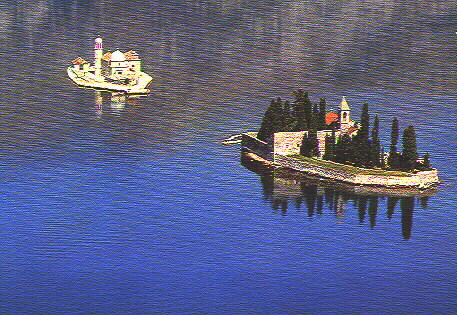 Out of 38 churches existing
in the Kotor region (annexed to Montenegro in 1945) 36 are Catholic and
only 2 are Orthodox (one of them was a gift of the Croats in Boka kotorska).
On the photo you can see two beautiful churches on islets in the Boka
bay, belonging to the Croatian Catholic community in Montenegro, built
in the first half of the 17th century (Sveti Juraj and Gospa od Skrpjela).
It is interesting that the Church of Gospa od Skrpjela (on the photo)
is built on an artificial island! Each year a procession of Croatian Catholics
encircles in numerous fishing boats the island of Gospa od Skrpjela and
pilgrims throw pebbles around it. An important monument, showing uninterrupted
presence of the Croats in Montenegro during many centuries, is the cathedral
of St Tripun in the town of Kotor, built as early as 1166. As we have
said, it represents the oldest known Croatian cathedral. Its ciborium
is decorated with a beutiful wattle pattern which is even older than the
church itself, and of the same type as numerous exotic wattle patterns
found in many pre-Romanesque churches along the
Croatian littoral. The town of Kotor has a surrounding wall which is about
5km long.
Out of 38 churches existing
in the Kotor region (annexed to Montenegro in 1945) 36 are Catholic and
only 2 are Orthodox (one of them was a gift of the Croats in Boka kotorska).
On the photo you can see two beautiful churches on islets in the Boka
bay, belonging to the Croatian Catholic community in Montenegro, built
in the first half of the 17th century (Sveti Juraj and Gospa od Skrpjela).
It is interesting that the Church of Gospa od Skrpjela (on the photo)
is built on an artificial island! Each year a procession of Croatian Catholics
encircles in numerous fishing boats the island of Gospa od Skrpjela and
pilgrims throw pebbles around it. An important monument, showing uninterrupted
presence of the Croats in Montenegro during many centuries, is the cathedral
of St Tripun in the town of Kotor, built as early as 1166. As we have
said, it represents the oldest known Croatian cathedral. Its ciborium
is decorated with a beutiful wattle pattern which is even older than the
church itself, and of the same type as numerous exotic wattle patterns
found in many pre-Romanesque churches along the
Croatian littoral. The town of Kotor has a surrounding wall which is about
5km long.
The benedictine order is present in the region of Boka kotorska since the 9th century. Today this region has about a hundred of Catholic churches and chapels.
One of Croatian churches, given as a gift to Serbian Pravoslav Church in Kotor already in 1657 (during Venetian rule), was the church of St Luka in Kotor. The church itself is much older, and dates from 1195. Above the main entrance to the Church we can now read the following inscription "Serbian Pravoslav Church - 1195." This falsification that appeared in 1990's aims to "prove" that the Serbs built this church already in 1195. In 1995 the Serbs in Montenegro even "celebrated" 800th anniversary of this church which was Catholic until 1657, when it was given as a gift to Serbian Pravoslavs.
One of the greatest Croatian Baroque painters is Tripo Kokolja (1661-1713), born in the town of Perast in Boka kotorska, whose works of art are held in the Church of Gospa od Skrpjela, and also in the Dominican church in Bol on the island of Brac, in Hvar on the island of Hvar, in Korcula on the island of Korcula (where he died), and in Dubrovnik.
When a Russian travel-writer P.A. Tolstoy visited Boka in 1698, he noted that the local hills are also inhabited by the Croats.
In the Boka kotorska churches there are important works of art of many outstanding Croatian artists, like Ivan Mestrovic, Antun Augustincic, Celestin Medovic, and other.
According to official Montenegrin sources, 40% of real monumental property and 66% of movable monumental property of this republic is in the Boka kotorska region. This means that at least 50% of the entire monumental cultural heritage of Montenegro belongs to the Catholic church in Boka, i.e. to the Croats. And now Montenegro has less than 1% of Catholics.
A result of the assimilation and systematic persecutions from the Serbs and Montenegrins in the Boka kotorska region was that the population of the Croats began to diminish rapidly since Yugoslavia was created in 1918, and especially after the aggression against Croatia in 1991. Let us illustrate only the "silent" ethnical cleansing in the ex-Yugoslav period (1918-1991). Namely, while in the period from 1910 (when the last Austro-Hungarian recension was held) to 1991 (the last ex-YU recension) the overall population in Boka kotorska doubled, on the other hand the number of Croats dropped in the same area three times.
The towns of Kotor, Perast, Tivat, Dobrota, Prcanj, Herceg Novi and Budva had a Croatian majority in 1910. A large Catholic majority in 1910 had peninsula Vrmac and southern part of Spich (from Sutomore to the border between Boka kotorska and Montenegro near the town of Bar). For example,
- The number of Croats in Kotor dropped from 69% in 1910 to 7% in 1991;
- in Herceg Novi from 70% to 2%;
- in Tivat from 95% to 23%.
In 1991 there were only 8% of Croats in Boka kotorska region, and today (after 1991-1995 Serbian and Montenegrin agression on Croatia and Bosnia-Herzegovina) even less. For example, 350 Croatian families had to leave their native Tivat in the period of 1991-1998.
In June 1996 msgr. Ivo Gugic, bishop of Kotor, was cruelly killed (strangled by a wire).
The name of the town of Dobrota in Kotor bay has interesting meaning: Goodness. In fact, the French bonté is even closer to the meaning of Croatian dobrota. And there is a family name - Dobrota, that can be found also among the Croats in Konvle region south of Dubrovnik.
Vjenceslav Cizek (Gjenovici, Boka kotorska, 1928-2000) has passed away in Dortmund. He was born in a peasant-working class family, educated in Kumbor and Herceg-Novi, and studied philosophy in Sarajevo. For his political beliefs he was sentenced twice to a total of 17 years imprisonment, and due to savage prison tortures he became blind. After his release he lived in Germany. He became internationally known as the "captive of conscience." Vjenceslav Cizek was an exceptional lyricist and satirist of dictatorship. Unfortunately, his literary activity was interrupted by prison. Due to his blindness, he memorised poems while he was in prison using a special mnemonic technique. In his poems he writes about places of his youth - Boka and Konavle.
In 1998 a new mosaic was exhibited in a Catholic chapel in the town of Budva in Boka kotorska, on the initiative of the Pravoslav Church in the city. This was done without knowledge of the Catholic Church. On the other hand, it is known that the Votive Icon of Our Lady existed on the same place from 1333 to 1949, when local yugoslav communists threw it out into the sea. Fortunately, the old Catholic icon was saved (though damaged), but it was not allowed to be placed where it had been for centuries.
It is little known that until 1949 Bosnia - Herzegovina had another entrance to the Adriatic sea in the region of Sutorine (between Prevlaka peninsula nad Herceg Novi), which is today in Montenegro. Today quite unjustly the New Yugoslav state claims the right to Croatian Prevlaka. See [Macan]
As confirmed by all partisan documents related to Boka kotorska and Montenegro during WW2, both regions are mentioned with clear distinction: Boka kotorska (which is defined as a coastal region from Herceg Novi to very near the town of Bar) and Montenegro. Since 1945 the name of Boka kotorska was simply erased. The name of Montenegrins (or Yugoslavs) was imposed to the Croats. Even today many Croats in Boka kotorska are hidden under the name of Yugoslavs (of Catholic faith).
An outstanding Croatian intellectual born in 1919 in Boka kotorska was Luka Brajnovic, professor of Ethics of the University of Navarra, a former director of the Institute of Artes Liberales, a well known Spanish intellectual. Premio Brajnovic a la communication is a prestigeous Spanish award (500,000 pesets) established in his honor during his lifetime upon the initiative of newspapermen and lecturers from the University of Pamplon.
For the reader who thinks that these claims are not sufficiently well grounded, I can offer a personal experience from the city of Zagreb, Croatia's capital. In 1971 a recension was held in the whole ex-Yugoslavia. At that time I was a 15 years old secondary school pupil. My math teacher "suggested" to everybody, in front of the whole class, to fill in the form as follows: "If I were on your place, I would fill in Yugoslav in the nationality section, and underline it three times." She was a daughter of a Serbian colonel in Zagreb. It was only many years later that I realized the meaning of this "suggestion."
- Trpimir Macan: Rt Ostra u povijesti i politici, Matica hrvatska, Zagreb 1998, ISBN 953-150-168-8
- Dominik Mandic: Crvena Hrvatska, ZIRAL (Zajednica Izdanja Ranjeni Labud), Chicago-Rim, 1973 (see other Mandic's references related to history of Bosnia and Herzegovina)
- The history of Boka kotorska from Antiquity until 1918, Based on the text "Boka kotorska od najstarijih vremena do 1918" by Ankica and Josip Pecaric. Summarized and translated by Ivica Kresic, University of Chicago.
- Josip Pecaric: Kako su komunisti prodali Boku kotorsku
- Josip Pecaric: Borba za Boku kotorsku (basic reference)
- Agneza Szabo: Hrvati Boke kotorske u doba preporoda i bana Jelacica
The city of Dubrovnik, the Plitvice Lakes, and the old part of Split have been under the protection of UNESCO since 1979.
Back to Croatia - an overview of its History, Culture and Science